Time for the energy sector to self-correct. EE, August 15th, 2017, by Prof. Hartmut Winkler, University of Johannesburg,May and June 2017 will go down as two of the most dreadful months in the history of the South African power utility Eskom. Its credibility in the eyes of the public has reached rock bottom after a series of well-publicised scandals.
Following the suspension of the then acting Eskom CEO, Matshela Koko, over a large contract allegedly benefitting his step-daughter, the nation was stunned by the reinstatement of the former CEO, Brian Molefe, who had previously left the utility under a cloud. The saga also forced the power utility to face the wrath of the parliamentary portfolio committee on Public Enterprises.
Highly damaging revelations followed from leaked emails, corroborating the findings of the Public Protector that Eskom’s leadership had allegedly irregularly assisted the Gupta family’s Oakbay Investments in securing the Optimum mine and the associated coal supply contract. The emails apparently also highlighted indefensibly close links between the Guptas and specific Eskom board members and executives. To top it off, the R4-billion Duvha boiler replacement was inexplicably awarded to a Chinese company, at a much higher cost than proposed by its competitors.
The scale of these alleged transgressions and the initial unwillingness or inability of government to deal with these matters has generated the impression that there are other agendas at play. It suggests that, like many other state-linked entities, Eskom has been taken over by persons furthering individual interests at the expense of the national good, a phenomenon now referred to as state capture.
This further raises the suspicion that the brazen taking of sides in the rollout of new generating capacity is also driven by other motives. Koko and Molefe have been outspokenly pro-nuclear and have blocked the long outstanding conclusion of power purchase agreements with successful bidders under the Renewable Energy Independent Power Producers Procurement Programme (REIPPPP). The power utility appears to have also promoted the distorted narrative that renewables are chiefly responsible for job losses at Mpumalanga coal mines.
The latest REIPPPP projects offer vastly reduced power purchase tariffs compared to the early rounds. Most renewables are now clearly cheaper than the cost of new coal and nuclear. Therefore Eskom’s opposition to REIPPPP on affordability grounds sounds decidedly hollow. The perception has therefore been created that Eskom is part of an effort to sabotage the renewable energy sector, which is the nuclear industry’s chief competitor in South Africa’s future energy landscape……..
While at this stage not directly compromised in the manner of Eskom, the nuclear industry too is in need of deep introspection. The sector has failed to condemn the irregularities and presidential interference in the nuclear procurement process to date, which saw Russian developer Rosatom allegedly placed in a dominant position over its competitors.
The Western Cape High Court ruling that the Russian nuclear agreement is invalid is viewed in some quarters as merely a speed hump rather than a call to return to the drawing board. NECSA board chair Kelvin Kemm’s defiant pronouncement in Moscow that the nuclear deal will be finalised before year end, probably to Rosatom’s advantage, is the worst thing the nuclear sector could do right now. Whatever the intention, such sabre rattling will merely harden the opposition from a public seemingly skeptical of all things nuclear.
There are respected people working in the nuclear field who genuinely believe that nuclear technology has a role in the future South African energy mix. These nuclear advocates have to now recognise that rehabilitating their sector requires the rebuilding of public trust, and honest attempts to allay concerns about costs, safety and potential corruption associated with new builds.
The renewable energy sector has been riding high on the back of positive international sentiment and the successful implementation of projects from the first three REIPPPP phases. That ride is however about to get much bumpier as the sector runs into opposition from unions and government.
While this opposition is to some degree based on misinformation, possibly planted deliberately, the renewable industry also needs to re-evaluate its tactics. Green hype and crude PR are no longer going to cut it, and current and past mistakes are about to be exploited ruthlessly. As with nuclear, sober engagement and diplomacy are now crucial to take the renewable energy sector forward to its rightful place in South Africa’s energy landscape. Send your comments to energize@ee.co.zahttp://www.ee.co.za/article/time-energy-sector-self-correct.html
Secretive report on South Carolina nuclear reactor construction never given to state utility regulators, Post and Courier, By Andrew Brown abrown@postandcourier.com, Aug 31, 2017 COLUMBIA — SCANA Corp. may have misled state utility regulators about the existence of a secretive report that detailed construction failures at two troubled nuclear reactors at the V.C. Summer station in Fairfield County, months before the $9 billion energy project was abandoned.
The director of the state Office of Regulatory Staff told The Post and Courier on Thursday that SCANA officials repeatedly told state agency employees they didn’t have a copy of a report that was produced by Bechtel Corp., an engineering and project management company that observed the nuclear construction near Jenkinsville in past years.
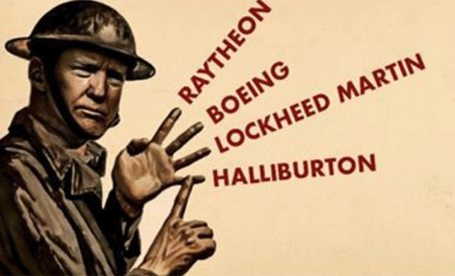
Fill the Swamp: Trump to Put Military Industrial Complex Lobbyist in Charge of the Army, Last Wednesday, it was reported that Donald Trump was moving to nominate Raytheon lobbyist Mark Esper for secretary of the Army. Raytheon is one of the “big five” defense contractors, and the president’s decision comes at a time when concerns are being raised over the idea of defense industry executives being placed in senior positions at the Pentagon.Daily Liberator, By: James Holbrooks, 29 Aug 17
The Washington Examiner, which broke the news in an exclusive after speaking with unnamed D.C. sources, reported that Pentagon officials “privately expressed confidence that Esper, with his military, Pentagon and Capitol Hill experience, will win quick Senate confirmation.”
That would be a change of pace. Esper’s nomination is Trump’s third attempt to fill the position of Army secretary.
A ROCKY ROAD
Trump’s first choice, New York billionaire and owner of the Florida Panthers hockey team, Vincent Viola, withdrew back in February over concerns about financial conflicts of interest……..
Assuming Mark Esper hangs in there and keeps his name in the running for Army secretary, he’ll need to pass vetting by the Senate Armed Services Committee (SASC). That hearing isn’t expected to take place until September. But it was within that committee, back in June, that SASC chairman John McCain first voiced concern over members of the defense industry taking key positions at the Pentagon.
THE CHAIRMAN MAKES NOISE
In a hearing Defense News called“surprisingly contentious,” McCain threatened to block the SASC confirmation of Patrick Shanahan for deputy defense secretary, the number two spot at the Pentagon below defense secretary James Mattis. One of the reasons, the Arizona senator made clear, was Shanahan’s ties to industry contractors.
Shanahan had been with Boeing since 1986 before accepting Trump’s nomination. He was a member of the Boeing Executive Council and had even earned the nickname “Mr. Fix-it” within the corporation for his ability to turn around troubled projects.
At the hearing, McCain cited Shanahan’s industry past, saying he was “not overjoyed” that the would-be deputy secretary spent so much time at one of the big five defense contractors. He also said Shanahan’s ilk serving at the Pentagon was “not what our Founding Fathers had in mind.”
McCain, a Republican, went further weeks later, bluntly stating in a hallway interview in Congress that he “did not want people from the top five corporations” to fill positions at the Pentagon. Party politics aside, at least some lawmakers across the aisle appear to share his concern.
Senator Jack Reed, a Democrat who sits on the SASC, toldDefense News in early July that “real concern about the concentration of these people” exists because decision-making processes may be “influenced by [their]prior employment.”
Similarly, Senator Richard Durbin, another Democrat, said the Trump administration has “turned a blind eye to the whole question of conflicts of interest from start to finish.”
Despite such criticisms, the SASC gave Shanahan the green light, and the Senate officially confirmed him last Tuesday. This means that right now, the two most powerful men at the Pentagon have significant past connections to the defense industry.
For those unaware, for years Secretary of Defense James Mattis was a board member of one of the big five contractors, General Dynamics, and up until the point of his nomination had nearly $600,000 in vested stock options with the corporation, according to Securities and Exchange Commission (SEC) filings.
LUCKY BREAK
In a convenient bit of timing, John McCain was absent at Shanahan’s full Senate confirmation on July 18, as he was recovering from surgery to remove a blood clot, which ultimately revealed a brain tumor. The same could be said for Ellen Lord, who went through SASC vetting relatively unscathed on the very same day and now awaits the committee’s nod to move on to a full Senate vote.
Lord has been CEO of Textron Systems, a global aerospace and defense conglomerate, since 2012. As with what happened to Shanahan, Lord likely would have faced a harsh grilling from McCain. Commenting on Lord’s smooth sail through her SASC hearing, Defense News wrote:
“That may have been due to the absence of Sen. John McCain, the Arizona Republican who chairs SASC. McCain, recuperating at home from a recent surgery, previously told Defense News he is concerned about the number of defense industry figures entering key Pentagon roles.”
The same good fortune was bestowed upon a former Lockheed Martin vice president on Thursday. Ryan McCarthy passed his SASC vetting for undersecretary of the Army, and if the Senate eventually confirms both him and Mark Esper, it would mean the top two Army positions at the Pentagon would be filled by defense industry executives.
It was speculated that former Lockheed Martin attorney David Ehrhart would come under heavy scrutiny at his SASC hearing for Air Force General Counsel, the department’s chief legal officer. The same would have surely gone for John Rood, Trump’s expected pick for undersecretary of defense for policy and current head of international sales at Lockheed.
But with the SASC confirming defense industry figures in McCain’s absence, it now appears the Arizona senator’s leeriness was the only substantive thing holding up the show.
DOWN A DARK PATH
Like Senator Richard Durbin and others in Congress who don’t like the emerging trend under Donald Trump, most in the mainstream media will only go so far as to highlight the myriad conflicts of interest between the Trump administration and the corporate world.
Indonesian militants planned ‘dirty bomb’ attack – sources, Yahoo 7 By Tom Allard and Agustinus Beo Da Costa, 24 Aug 17, JAKARTA (Reuters) – Indonesian militants planned to detonate a radioactive dirty bomb, security sources said, highlighting the rising ambitions of extremists to wreak destruction in the world’s largest Muslim-majority nation.
But experts cast doubt on their expertise, equipment and chances of success.
The plot was foiled when police raided homes and arrested five suspects in Bandung, West Java, last week, the sources with direct knowledge of the plot said. After the raids, police spoke of a plan to explode a “chemical” bomb but provided no other details……
The three counter-terrorism sources, speaking on condition of anonymity, said the militants had hoped to transform low-grade radioactive Thorium 232 (Th-232) into deadly Uranium 233 (U-233).
The highly radioactive uranium would be combined with the powerful home-made explosive triacetone triperoxide (TATP) to create a “nuclear bomb”, according to an instruction manual used by the militants and reviewed by Reuters.
In fact, the device would be, at best, a radiological dispersal device or dirty bomb that could spray radioactive material when the conventional bomb exploded.
A spokesman for Indonesia’s national police, Inspector General Setyo Wasisto, declined to confirm or deny the plot to construct the device, but said it would have been more potent than the two bombs made from TATP that killed three police in Indonesia’s capital Jakarta in May.
“If this bomb was finished, it would have had a more destructive impact than the bomb made from ‘Mother of Satan’,” he said, using the nickname for TATP.
“It could burn anything and make it hard for people to breathe.”
Thorium-232 can be transformed into Uranium-233 but requires the Thorium to absorb a neutron, a process that needs powerful irradiation, generally from a nuclear reactor, according to three analysts contacted by Reuters and the website of the World Nuclear Association, which represents reactor vendors and nuclear engineers, among other industry stakeholders….
One senior Indonesian counter-terrorism source said the Bandung-based cell had bought a large amount of a household item and had begun to extract the Thorium. Reuters has chosen not to name the item.
“They needed three weeks. It was still only one week (into the process when police raided),” the source said…..
According to police, the suspected Bandung plotters were members of JAD and were considering targets like the presidential palace in Jakarta and police headquarters in Bandung and the capital….. (Reporting by Tom Allard and Agustinus Beo Da Costa Additional reporting by Stefanno Reinard; Editing by Ed Davies and Nick Macfie) https://au.news.yahoo.com/a/36844136/exclusive-indonesian-militants-planned-dirty-bomb-attack-sources/
Free speech for me but not for thee” seems to be a core principle of the Trump administration.
The president defended a group of white supremacists, neo-Nazis, Ku Klux Klan members, and the “very fine people” who march with them earlier this month, partly on the grounds that they had secured a permit and thus had a First Amendment right to assemble. But when it comes to scientists publishing their findings on issues that Republicans and the fossil fuel interests that pay their campaign bills find inconvenient, this administration suddenly takes a very dim view of free expression. The latest example comes via a scientist at Northeastern University, who received an intriguing email from a federal bureaucrat Thursday afternoon:[on original]
As another scientist who shared Bowen’s post on Twitter put it, this is a textbook case of censorship. Political operatives in the administration are attempting to police the work of nonpartisan academics to remove any references to “climate change” or “global warming.” Because if you never say the words, the things they describe will never appear. Like Beetlejuice.
These aren’t exactly uncharted waters for the Trump administration. Earlier this month, it emerged that staffers at the U.S. Department of Agriculture were instructed to censor the terms “climate change,” “reduce greenhouse gasses,” “sequester carbon,” and “climate change adaptation” in their work. In March, Politicoreported the Department of Energy’s international climate office had instructed staff not to use “climate change,” “emissions reduction,” or “Paris Agreement” in “memos, briefings, or other written communication.”
And of course, the contemptible Scott Pruitt—the man tasked with destroying the Environmental Protection Agency from the inside—has enacted a policy of secrecy at that agency that wouldn’t be out of place at the CIA. The problem is so bad that scientists from 13 federal agencies preemptively leaked a terrifying report on the realities of man-made climate change, explicitly stating that they were concerned it would be censored by the administration.
This all fits the mold for Republicans in general. After all, Vice President Dick Cheney and his operatives did plenty of meddling in climate research during the Bush administration. And the administration of Governor Rick Scott in Florida—a state in which the biggest city is already flooding at high tide—has long banned the use of certain terms, including “climate change.” Because again, if you don’t say the words, the problem doesn’t exist. It’s like playing hide and seek with a toddler. Just put your palms over your eyes and stand there while the water rises around your ankles.
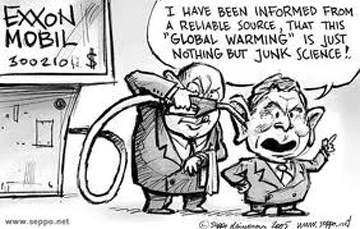
Exxon accused by Harvard researchers of misleading public on climate change, ABC News 24 Aug 17 Two Harvard University researchers say they have collected data proving Exxon Mobil Corp made “explicit factual misrepresentations” in newspaper ads it purchased to convey its views on the oil industry and climate science.
In an article in the journal Environmental Research Letters, researchers Geoffrey Supran and Naomi Oreskes said they examined 187 documents, including internal memos, peer-reviewed papers by Exxon scientists and “advertorials” that ran in The New York Times — paid advertisements in the style of opinion pieces.
The researchers said they used a social science analysis method to turn statements in the documents into data points that could be counted and compared to each other.
Exxon ‘consistently asserted doubt’ on climate change
Mr Supran and Ms Oreskes said as early as 1979, Exxon scientists acknowledged burning fossil fuels was adding more carbon dioxide to the atmosphere and causing global temperatures to rise, but they said the company’s position in newspaper ads remained significantly different by consistently asserting doubt about climate science.
The study was funded by the Rockefeller family philanthropies, which previously supported a campaign to prove Exxon knew more than it publicly admitted about climate change.
That campaign used the slogan #ExxonKnew…..
Ms Oreskes said the Rockefeller family funding did not affect the study’s outcome.
As the name suggests, the NIEHS’ site links to research summariesdetailing how the environment affects personal health. Since it began tracking changes to the site in April, the EDGI report found that the NIEHS has deleted dozens of references to climate change or edited them to simply say “climate.”
Obviously, “climate” is not the same as human-driven climate change. But eliding that difference casts climate change as something abstract or distant. It’s not. It’s real, it’s tangible and its effects have an enormous impact on people’s health. Unfortunately, the NIEHS is failing in its mission to inform people of this. Among the removals is a fact sheet, “Climate Change and Human Health” that lists the immediate health impacts of climate change. Though still hosted on the site, the links have been removed and its no longer listed on the NIEHS’ Brochures and Fact Sheet page.
The fact sheet regionalizes weather effects like extreme heat, flooding and poor air quality and connects them to climate change, summarizing how climate change has an outsized impact on specific vulnerable populations—the elderly, pregnant women, low income and indigenous groups. These groups are both the most vulnerable to the effects of climate and are the clear targets of campaigns meant to mislead on the dangers of climate change.
The latests revisions in the NIEHS only compound with similar deletions on the Department of Energy and Environmental Protection Agency websites. They’re falling in line with the Trump administration’s stance on climate change: deflection (senior officials admitting they “haven’t asked” if the President believes in climate change,) and casting the consensus as a “both sides” debate. Further, it works against the newer, soft rebranding of climate denial employed by EPA head Scott Pruitt—this pernicious idea that the science of climate change is unsettled and no cause for alarm.
But if climate change doesn’t pose a threat, then why are they so afraid of it?
JOHANNESBURG – Energy expert Chris Yelland says the latest documents linked to the nuclear industry are deepening public suspicion about dubious dealings in the procurement process.
The Auditor-General (AG) apparently found key nuclear-related contracts entered into by the Department of Energy are irregular and unauthorised, according to the Democratic Alliance.
Radio 702’s Bongani Bingwa speaks to Yelland about an alleged report yet to be finalised by the AG, this is according to the DA energy spokesperson Gordan McKay.
Anti-Bure website 18th Aug 2017, In Bure on the 15 August 2017, around 800 people set off on a demo (numbers
like this had never been seen before for a non-declared demo in Bure). The
prefecture deliberately chose a strategy of aggression and asphyxiation
that led to a number of injured people.
The police deployed were twice the number deployed for the demo of the 18 February 2017, 15 riot cop vans and
a water cannon were counted. The route of the demo headed towards Saudron
and not the “laboratory”, chosen to avoid the fortified red zone and
all the blue team.
The objective was to arrive in a big field between the
village of Saudron the “Espace Technologique” (an Andra Building) to
highlight a very important Neolithic site discovered by archaeologists and
ignored by Andra http://en.vmc.camp/2017/08/18/bure-prefecture-chose-strategy-agression-led-number-injured-people-lets-keep-supporting-struggle/
Police in northeast France used water cannons and fired tear gas and stun grenades Tuesday against demonstrators protesting plans to store nuclear waste at an underground site.
The issue has been raging for years as the waste is the dangerous long-term by-product of France’s extensive nuclear energy program.
Around 300 protesters took part in the demonstration in Bure, a commune in the Meuse department, against plans to store highly radioactive waste 500 meters underground.
Protest organizers said 36 people were injured, with six gravely hurt in the clashes, while the local prefecture said at least three demonstrators had been injured, according to calls to emergency services.
The protest was one in a series to try to block the waste site. France’s Environment Minister Nicolas Hulot has said he needs more information before he gave his position on the project.
Earlier this month, the Nuclear Safety Authority said it had “reservations” about the project, known as Cigeo, citing uncertainty about the potential danger from highly inflammable material in the case of rising temperatures.
In July, the National Agency for the Management of Radioactive Waste said construction of the storage site would start in 2022 at the earliest.
Environmentalists have long objected to calling a coal-fired carbon capture and sequestration project “clean coal,” arguing that the label is misleading because it focuses on carbon dioxide pollution while ignoring other problems like acid rain and airborne contaminants. And carbon capture projects rely on continuing fossil fuel production, because the CO2 that’s captured is sold to oil companies who pump it into aging wells to coax more oil from the ground.
Politicians nevertheless continue to use the term. “My administration is putting an end to the war on coal,” President Donald Trumpsaid this spring. “We’re going to have clean coal, really clean coal.”
New Fraud Allegations Emerge at Troubled ‘Clean Coal’ Project As Southern Co. Records Multi-Billion Loss, Desmog By Sharon Kelly • Tuesday, August 8, 2017 Southern Co. is accused of fraudulently misrepresenting the prospects for its troubled “clean coal” project in Kemper County, Mississippi in several legal filings this summer.
Southern announced in late July that it was shuttering the troubled “clean coal” part of Kemper after construction ran years behind schedule and the company spent $7.5 billion on the 582 megawatt power plant — over $5 billion more than it first projected.In a lawsuit filed today, Brett Wingo, a former Southern Company engineer, alleges he warned the company’s top executives that it would not be possible to meet key construction deadlines. Management responded by retaliating against him, the complaint asserts, and Southern continued to assure investors and the public that Kemper’s schedule and budget targets would be met, then blamed unpredictable factors like the weather when those goals were missed.
Wingo’s claim that Southern misled investors by concealing construction-related problems drew national attention in a front page New York Times investigation last year. In January, the U.S. Occupational Safety and Health Administration (OSHA) concluded that Wingo had suffered a “continuing pattern of retaliatory treatment” and ordered Southern to reinstate Wingo, but the company has refused, according to a statement accompanying the lawsuit. (The case is “Brett Wingo v. The Southern Company, et al.,” Case No. 2:17-cv-01328-MHH in the U.S. District Court for the Northern District of Alabama, Southern Division.)
A second less-noticed legal filing with Mississippi state regulators accuses Southern of misrepresenting Kemper’s prospects right from the outset, before construction even began. Those claims center on Southern’s projections for what it would cost to operate and maintain the plant once it was up and running, which the filing asserts were so low they were “indefensible”.
In an email to DeSmog, Wingo seconds those claims, saying that he believes management knew back in 2012 that its “operation and maintenance” (O&M) projections were off — but kept the accurate numbers under wraps for years.
“By hiding the true O& M costs for so long, apparently since 2012 and likely longer, Fanning basically ensured shareholders would be forced to absorb $6 billion in losses,” Wingo told DeSmog.
“In 2012, sunk costs on Kemper were only around $1 billion and the natural gas part of the plant substantially complete. It would have been a perfect time to stop a runaway train from running off the end of the tracks,” he added. “But history shows, that’s not what Fanning and Southern Company chose to do.”…….
Spending Money to Make Money
Why would a company want to build a power plant that’s too expensive to run? Part of the answer, critics say, is the way that utilities like power companies are regulated.
Because they are essentially regulated monopolies, the laws governing how utilities like power companies make money are different than most industries, as explained in a 2015 Wall Street Journal article titled “Utilities’ Profit Recipe: Spend More.”
“[U]tilities have another incentive for heavy spending; It actually boosts their bottom lines — the result of a regulatory system that turns corporate accounting on its head,” The Journal reported, explaining that as long as state-level regulators sign off on a project, regulated utilities get a fixed percentage of what they spend as a profit……..
Clean Coal?
Kemper was supposed to be an engineering feat, able to turn the world’s least efficient but most abundant form of coal, lignite coal, into a climate-friendly fuel. That’s “climate friendly” as compared to the kind of coal-burning power plants upon which the U.S. has historically relied for the bulk of its electricity……..
Environmentalists have long objected to calling a coal-fired carbon capture and sequestration project “clean coal,” arguing that the label is misleading because it focuses on carbon dioxide pollution while ignoring other problems like acid rain and airborne contaminants. And carbon capture projects rely on continuing fossil fuel production, because the CO2 that’s captured is sold to oil companies who pump it into aging wells to coax more oil from the ground.
Politicians nevertheless continue to use the term. “My administration is putting an end to the war on coal,” President Donald Trumpsaid this spring. “We’re going to have clean coal, really clean coal.”
Asked about the prospects for new “clean coal” projects in general after Kemper’s shuttering, a top Department of Energy official was dubious. EIA chief Howard Gruenspecht noted the role of natural gas prices, as well as the lower price of oil, which hurts the price of carbon sold to enhance oil recovery.
If true, one effect of the alleged scheme would have been to move vast sums of money from the Adani Group’s domestic accounts into offshore bank accounts where it could no longer be taxed or accounted for.
Adani mining giant faces financial fraud claims as it bids for Australian coal loan, Exclusive: Allegations by Indian customs of huge sums being siphoned off to tax havens from projects are contained in legal documents but denied by company, Guardian, Michael Safi in Delhi, 16 Aug 17, A global mining giant seeking public funds to develop one of the world’s largest coal mines in Australia has been accused of fraudulently siphoning hundreds of millions of dollars of borrowed money into overseas tax havens.
Indian conglomerate the Adani Group is expecting a legal decision in the “near future” in connection with allegations it inflated invoices for an electricity project in India to shift huge sums of money into offshore bank accounts.
The directorate of revenue intelligence (DRI) file, compiled in 2014, maps out a complex money trail from India through South Korea and Dubai, and eventually to an offshore company in Mauritius allegedly controlled by Vinod Shantilal Adani, the older brother of the billionaire Adani Group chief executive, Gautam Adani.
Vinod Adani is the director of four companies proposing to build a railway line and expand a coal port attached to Queensland’s vast Carmichael mine project.
The proposed mine, which would be Australia’s largest, has been the source of years of intense controversy, legal challenges and protests over its possible environmental impact.
Expanding the coal port to accommodate the mine will require dredging an estimated 1.1m cubic metres of spoil near the Great Barrier Reef marine park. Coal from the mine will also produce annual emissions equivalent to those of Malaysia or Austria according to one study.
One of the few remaining hurdles for the Adani Group is to raise finance to build the mine as well as a railway line to transport coal from the site to a port at Abbot Point on the Queensland coast.
To finance the railway Adani hopes to persuade the Northern Australia Infrastructure Facility (Naif), an Australian government-backed investment fund, to loan the Adani Group or a related entity about US$700m (A$900m) in public money.
While it awaits the decision on the loan, in Delhi the company is also expecting the judgment of a legal authority appointed under Indian financial crime laws in connection to allegations it siphoned borrowed money overseas.
The Adani Group fully denies the accusations, which it has challenged in submissions to the authority.
The investigation
News of the investigation was first reported in India three years ago, but the full customs intelligence document reveals forensic details of the workings of the alleged fraud which have not been publicly revealed.
The 97-page file accuses the Adani Group of ordering hundreds of millions of dollars’ worth of equipment for an electricity project in western India’s Maharashtra state using a front company in Dubai.
The Dubai company allegedly sold the exact same equipment back to Adani Group-controlled businesses in India at massively inflated prices, in some instances said to be eight times the sale price.
According to the allegations in the file, the effect of these transactions was that the Adani Group spent an average 400% more for the materials. That money was allegedly paid to a company Indian authorities allege was owned through a series of shell companies leading to a Mauritius trust controlled by Vinod Adani.
If true, one effect of the alleged scheme would have been to move vast sums of money from the Adani Group’s domestic accounts into offshore bank accounts where it could no longer be taxed or accounted for.
Because tariffs for using electricity transmission networks are determined partly by what they cost to build, if the DRI’s accusations are correct, the overvaluation of capital goods would have been likely to have led to higher power prices for Indian consumers……
The Australian loan
The Adani Group, or a linked entity, has reportedly been granted “conditional approval” for the US$700m (AU$900m) concessional loan from Naif, the Australian government investment fund.
But due to secrecy around the operation of the investment fund, it is not clear whether the loan application discloses the existence of the DRI notice or the ongoing legal proceedings, or whether the applicant is required to do so under the Naif’s anti-money laundering provisions……
The Guardian is publishing excerpts from the DRI file in the interests of ensuring Naif, as well as the public, have access to as much relevant information as possible in assessing whether Adani or linked companies would be suitable recipients of public money.
In a separate case last year, six Adani subsidiaries were listed among 40 other companies being investigated for allegedly running a similar price-inflation scheme. The companies are accused of inflating the price of coal imports from Indonesia to hide profits in overseas tax havens.
The DRI and the ED did not respond to a request to clarify the status of the investigations.
Paul Langley,https://www.facebook.com/paul.langley.9822/posts/10213752429593121CAL-2, 14 Aug 17, 5 yr-old Simon Shaw and his mum. Simon was flown from Australia to the US on the pretext of medical treatment for his bone cancer. Instead, he was secretly injected with plutonium to see what would happen. His urine was measured, and he was flown back to Australia.
Though his bodily fluids remained radioactive, Australian medical staff were not informed. No benefit was imparted to Simon by this alleged “medical treatment” and he died of his disease after suffering a trip across the world and back at the behest of the USA despite his painful condition. The USA merely wanted a plutonium test subject. They called him CAL-2. And did their deed under the cover of phony medicine.
“Congress of the United States, House of Representatives, Washington, DC 20515-2107, Edward J. Markey, 7th District, Massachusetts Committees, [word deleted] and Commerce, Chairman Subcommittee on Telecommunications and Finance, Natural Resources, Commission on Security and Cooperation in Europe] MEMORANDUM To: Congressman Edward J. Markey From: Staff Subject: The Plutonium Papers Date: 4/20/94
Staff Memo on Plutonium Papers
The medical file for Cal-2 also contains correspondence seeking follow-up from Argonne National Laboratory in the 1980s. Cal-2 was an Australian boy, not quite five years old, who was flown to the U.S. in 1946 for treatment of bone cancer. During his hospitalization in San Francisco, he was chosen as a subject for plutonium injection. He returned to Australia, where he died less than one year later.
Document 700474 is a letter from Dr. Stebbings to an official at the Institute of Public Health in Sydney, Australia, in an attempt to reach the family of Cal-2. This letter reports that the child was “injected with a long-lived alpha-emitting radionuclide.” Document 700471 is a letter from Dr. Stebbings to New South Wales, Australia (names and town deleted), inquiring about recollections of the boy’s hospitalization in 1946. The letter notes that, “those events have become rather important in some official circles here,” but provides few details to the family.
A hand-written note on the letter reports no response through October 8, 1987. Considering the history on the lack of informed consent with these experiments, it is surprising that the letters to Australia failed to mention the word “plutonium.”
The Australian news media has since identified Cal-2 as Simeon Shaw, the son of a wool buyer in New South Wales, and information on the injection created an international incident. The information in the medical file does indicate that at a time when Secretary Herrington told you that no follow-up would be conducted on living subjects, the Department of Energy was desperately interested in conducting follow-up on a deceased Australian patient.
In an effort to determine the full extent of follow-up by the Department after 1986, your staff has requested, through the Department’s office of congressional affairs, the opportunity to speak with Dr. Stebbings, Dr. Robertson, and any other officials who may have been involved in the follow-up. So far, that request has been unsuccessful. It remains an open question as to what was the full extent of follow-up performed in the 1980s, and whether the efforts then would facilitate any further follow-up on subjects now. It seems appropriate for the Interagency Working Group to address these questions as its efforts continue.”
NO MORE DUAL USE ABUSE OF AUSTRALIANS MR PRESIDENT. STOP FUNDING SYKES AND FLINDERS UNIVERSITY IN THE DOE QUEST FOR CHEAP CLEANUP OF URANIUM CONTAMINATED SITES.
Mr. President, you are wrong if you think you can do the same again re hormesis funding in Australia as the USA did with CAL-2. We have not forgotten and do not trust you or your paid agents in Australian universities such as Flinders.
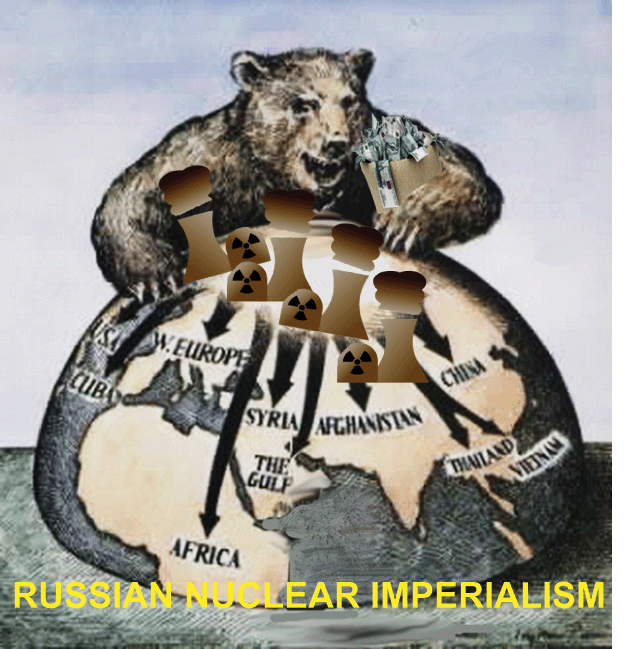
Poland speaks out harshly against Belarusian nuclear plantPoland has lent its voice to a growing chorus of countries that won’t buy power from the Belarusian Nuclear Power Plant that Moscow is building in Ostrovets because it considers the project to be unsafe, RIA Novosti reported, Bellona, August 9, 2017 by Charles Digges, “………Since the early 2000s, many in the West see Russia’s ambitions to built nuclear plants abroad as attempt to cast Moscow’s apron strings into the European Union.
By fully financing reactor builds, they say, the Kremlin is offering a Faustian bargain: energy independence in exchange for long-term debt and Moscow friendly politics.
The Moscow-leaning government of Viktor Orban in Hungary is a good example. Budapest relies on a Soviet-built nuclear power plant for 50 percent of its electricity, and recently signed a €12 billion deal for a second Russia-built plant. Budapest is now also less likely to pester Moscow over sensitive issues like Russia’s covert war in Ukraine.
That’s because Moscow has a habit of settling political disputes by shutting off the power and heat in places where it has built infrastructure. Disputes between Russia and Ukraine, which remain bitter, led to cuts in Europe’s gas supply from Russia during the winter in 2006 and 2009.
Lithuania’s law against the Ostrovet’s plant is Vilnius’s attempt to opt out of being a hostage to Moscow’s new zero-sum nuclear energy policy, and Poland seems to agree.
These boycotts against buying nuclear power have been enormously effective in shutting down other unpopular nuclear builds in the region.
A Russian nuclear plant in the Kaliningrad enclave was quietly shelved in 2011 when Poland declared it wouldn’t help out with financing.
Lithuania’s own plans for a nuclear power plant took a more tortured route. Since 2009, the country has been trying, unsuccessfully, to kindle investment interest in its own Visaginas nuclear power plant to replace the Soviet-built Ignalina station.
“Throughout the history of the church, people have always found ways to use God and scripture to justify empire, to justify oppression and exploitation,” Kyle Meyaard-Schaap, an organizer with a pro-environmental Christian group called Young Evangelicals for Climate Action (YECA), told me. “It’s a convenient theology to hold, especially when we are called to drastic, difficult action.”
How Fossil Fuel Money Made Climate Change Denial the Word of God Brendan O’Connor, Splinter , 8 Aug 17 In 2005,at its annual meeting in Washington, D.C., the National Association of Evangelicals was on the verge of doing something novel: affirming science. Specifically, the 30-million-member group, which represents 51 Christian denominations, was debating how to advance a new platform called “For the Health of a Nation.” The position paper—written the year before An Inconvenient Truth kick-started sense of public urgency around climate change—included a call for evangelicals to protect God’s creation, and to embrace the government’s help in doing so. The NAE’s board had already adopted it unanimously before presenting it to the membership for debate.
At the time, many in the evangelical movement were uncomfortable with its close ties to the Republican anti-environmental regulation agenda. That year, a group called the Evangelical Alliance of Scientists and Ethicists protested the GOP-led effort to rewrite the Endangered Species Act, and the NAE’s vice president of governmental affairs Richard Cizik pushed for the organization to endorse John McCain and Joe Lieberman’s cap-and-trade bill. “For the Health of a Nation,” which Cizik also pushed, was an opportunity to draw a bright line between their support of right-wing social positions on abortion and civil rights and a growing sentiment that God’s creation needed protection from industry……..
At the behest of a group called the Interfaith Stewardship Alliance, the board buckled, releasing a statement in February 2006 “recognizing the ongoing debate” on global warming and “the lack of consensus among the evangelical community on the issue.” Just days later, an outside group of 86 evangelical leaders, under the aegis of the Evangelical Climate Initiative, issued a “Call to Action” declaring that climate change was real and that “millions of people could die from it in this century.”
For his trouble, Cizik was targeted by a collection of hard right Christians, who petitioned the NAE board to muzzle him or force him to resign. “Cizik and others are using the global warming controversy to shift the emphasis away from the great moral issues of our time, notably the sanctity of human life, the integrity of marriage, and the teaching of sexual abstinence and morality to our children,” their letter read. It also implied that Cizik, who had worked for the NAE for nearly three decades, supported abortion, giving condoms to children, and infanticide…….
The NAE did eventually endorse climate action in 2015. But it was too late. By that time, a corps of right-wing Christians, funded by fossil-fuel interests, had hijacked the public and political machinery of the evangelical movement. They are now in the White House, where the anti-environmental agenda is dominated by Christian fundamentalists like EPA Commissioner Scott Pruitt while the more moderate views offormer ExxonMobil CEO Rex Tillerson are ignored. This is the story of how they did it.
At a town hall in Michigan last May, Republican Rep. Tim Walberg assured his constituents that, while the climate may be changing, they don’t need to be concerned. “As a Christian, I believe that there is a creator in God who is much bigger than us,” he told them. “And I’m confident that, if there’s a real problem, He can take care of it.”
This idea—that whatever happens in God’s creation happens with His blessing—has deep roots in the American evangelical community, especially among the elite fundamentalists who walk the halls of power in Washington, D.C. For years, an evangelical minister named Ralph Drollinger has held weekly Bible studies for members of Congress, preaching that social welfare programs are un-Christian and agitating for military action against Iran. (In December 2015, he expressed his desire to shape Donald Trump into a benevolent, Christian dictator.) Drollinger also teaches that climate change caused by humans is impossible in light of God’s covenant with Noah after the Flood: “To think that man can alter the earth’s ecosystem—when God remains omniscient, omnipresent and omnipotent in the current affairs of mankind—is to more than subtly espouse an ultra-hubristic, secular worldview relative to the supremacy and importance of man,” he wrote recently.
Conservative groups, funded by fossil fuel magnates, spend approximately one billion dollars every year interfering with public understanding of what is actually happening to our world. Most of that money—most of the fraction of it that can be tracked, anyway—goes to think tanks that produce policy papers and legislative proposals favorable to donors’ interests, super PACs that support politicians friendly to industry or oppose those who are not, or mercenary lobbyists and consultants, in some instances employing the same people who fought to suppress the science on smoking. In terms of impact, however, few investments can rival the return that the conservative donor class has gotten from the small cohort of evangelical theologians and scholars whose work has provided scriptural justifications for apocalyptic geopoliticsand economic rapaciousness.
“Throughout the history of the church, people have always found ways to use God and scripture to justify empire, to justify oppression and exploitation,” Kyle Meyaard-Schaap, an organizer with a pro-environmental Christian group called Young Evangelicals for Climate Action (YECA), told me. “It’s a convenient theology to hold, especially when we are called to drastic, difficult action.”
Many of these soothsayers are gathered together in an organization called the Cornwall Alliance—formerly known as the Interfaith Stewardship Alliance, the same group that mobilized against Cizik’s environmental proposal—a network with ties to politicians and secular think tanks across the conservative landscape. In 2013, Cornwall published an anti-environmentalist manifesto called Resisting the Green Dragon. “False prophets promise salvation if only we will destroy the means of maintaining our civilization. No more carbon, they say, or the world will end and blessings will cease,”it warns. “Pagans of all stripes now offer their rival views of salvation, all of which lead to death.” Members of the Cornwall Alliance and their ilk are not simply theoreticians but enforcers, stifling dissent in the wider American evangelical community, smothering environmentalist tendencies before they gain a following………
For almost 20 years, Beisner and members of the Cornwall Alliance have worked with establishment conservatives to bolster opposition to climate change: The Heartland Institute identifies him as a policy advisor on its web site, and he speaks regularly at the institute’s annual conference on climate change (though in an interview he curiously denied ever actually giving any policy advice to Heartland). The Heritage Foundation hosted the 2015 premierof Where the Grass is Greener, a documentary produced by the Cornwall Alliance. In May, Beisner and senior executives from Heartland, Heritage, and a slew of other billionaire-funded political entities like Americans for Prosperity and the Competitive Enterprise Institute sent a letter to Donald Trump urging him to withdraw from the Paris climate agreement and asking him to stop funding United Nations global warming programs.
Together, Cornwall, Heartland, and Heritage have been able to set the terms of the conservative conversation—evangelical or otherwise—about the climate. They determine what science is acceptable, which proposed solutions can be considered, and what the consequences of inaction might look like. “There’s a very strong connection between those institutions and the evangelical Right,” Rev. Hescox told me. “Their denial of the science—and really portraying this as a big government issue—is why there was so much pushback among evangelicals.”
The Cornwall Alliance, joined by scientists associated with organizations partly funded by ExxonMobil, continued hammering away at Christian groups that supported action on climate change. In 2008, it launched the bizarrely named “We Get It!” campaign, which targeted the Evangelical Climate Initiative and was endorsed by a slew of conservative organizations, including the Family Research Council and David Barton’s WallBuilders…..
Given that it is a relatively small operation with relatively low overhead, the money that the Cornwall Alliance receives is a vanishingly small fraction of the hundreds of millions spent by the Koch, the Mercer, or the DeVos families. (The Kochs are oil, coal, and gas scions; Robert Mercer is a hedge fund manager who, with his daughter Rebekah, fueled Trump’s rise; Education Secretary Betsy DeVos and her husband Dick are long-time Republican donors).
Their money flows through a multitude of nonprofits, front groups, and donor-advised funds. (A donor-advised fund is a kind of money-laundering service for philanthropists who don’t want anyone to know where their money is going: They make a contribution to the fund, and then tell the fund where to send the money; as a nonprofit, the fund has to disclose all of the grants that it makes, but it does not need to disclose its own donors, nor what direction those donors attached to their money.) Donors Trust, the “dark money ATM” of the conservative movement, contributed $1,001,500 to the James Partnership between 2009 and 2015; in most years, this constituted around half of the Partnership’s total revenue………
…….billions are paying off. Not only have the people who funded Cornwall successfully stopped the government from pursuing policies that might make the lives of people who are living with the consequences of climate change a little bit better, but under the Trump administration their lackeys are actively working to dismantle what little progress has been made. When Drollinger teaches that God’s covenant with Noah means that the consequences of climate change not only will not but in fact cannot be as devastating as scientists believe, he echoes a lengthy essay published by the Cornwall Alliance in 2009 that lays out the same argument. Typical of the organization’s style, it appears to the casual observer like any policy paper drawn up at one of D.C.’s many think tanks and nonprofits; in reality, the document blends quotations from scripture with pseudo-scientific data—citing, for example, the Mercer-funded Oregon Institute of Science and Medicine. During Pruitt’s confirmation hearing, Republican Sen. John Barrasso favorably cited Beisner and the Cornwall Alliance’s support for the Oklahoma attorney general……http://splinternews.com/how-fossil-fuel-money-made-climate-denial-the-word-of-g-1797466298