Addressing a room full of federal and circuit judges at the Ninth Circuit’s annual judicial conference, David McCraw, the deputy general counsel for The New York Times, explained that regardless of how one feels about Assange and traditional news outlets receiving the same kind of deference over publishing leaked materials, his prosecution would be a gut punch to free speech.
“I think the prosecution of him would be a very, very bad precedent for publishers,” McCraw said. “From that incident, from everything I know, he’s sort of in a classic publisher’s position and I think the law would have a very hard time drawing a distinction between The New York Times and WikiLeaks.”
McCraw went on to clarify that while Assange employs certain methods that he finds discomfiting and irresponsible, such as dumping unredacted documents revealing the personal information of ordinary people, Assange should be afforded the same protections as a traditional journalist.
“Do I wish journalism was practiced in a certain way, like it is with The New York Times, The Washington Post, or The Wall Street Journal? Of course. But I also think new ways of publishing have their value. Our colleagues who are not only challenging us financially but journalistically have raised an awareness that there are different ways to report,” McCraw said.
“But if someone is in the business of publishing information, I think that whatever privilege happens to apply – whatever extension of the law that would apply – should be there. Because the question isn’t whether he’s a journalist. It’s in that instance was he committing an act of journalism.”
Assange has long considered himself a journalist operating no differently than other news outlets. This has complicated matters, because if Assange can be prosecuted for publishing leaked information, why not prosecute news organizations like The New York Times?
Earlier this month, a grand jury returned an indictment against twelve Russian military spies for hacking into the servers and emails of the Democratic National Committee and state election officials, stealing documents and staging the release of those documents to interfere with the 2016 presidential election. While the indictment did not name Assange and WikiLeaks specifically, it has been widely suggested that WikiLeaks received the materials and could very well be the group referred to in the indictment as “Organization Number 1.”
Barry Pollack, who represents Assange in an ongoing criminal investigation in the Eastern District of Virginia, weighed in on the indictment Tuesday.
“If you read the indictment that just came out on Russians and you look at what Organization Number 1, which is clearly WikiLeaks, is alleged to have done in that indictment, it is doing exactly what The New York Times and The Washington Post do every day of the week,” Pollack said. “He [Assange] is communicating with a source, the source provides him with information, he publishes that information.
“There are no questions about the truthfulness or accuracy or authenticity of that information. And then he encourages the source to give him more information. He says ‘don’t give it to my competitors, give it to me. This story will have more impact if I publish it.’”
Pollack and McCraw spoke as part of a panel titled “The Law of Leaks,” a session on how the United States has ramped up efforts to prosecute people who have leaked state secrets. Thirteen people have been prosecuted under the first law against leaking state secrets, the Espionage Act of 1917, most under the Obama administration.
President Donald Trump has waged an unprecedented war against the media, taking to Twitter last year to call the media “the enemy of the American people.” Yet no publisher has ever been indicted over leaks, and both McCraw and Pollack expressed doubts about whether it will happen any time soon.
“Unlike firing off a tweet, bringing a prosecution requires a career professional prosecutor to sign off on the prosecution, so there also is a tremendous check there that doesn’t exist in some of the rhetoric we hear,” Pollack said.
“Prosecutions of journalists would be difficult,” McCraw said. “I think they’d be unpopular, I think they’d be wrong, and I think they’d be unsuccessful. I see this PR campaign against the press as almost an alternative to legal measures.”
Ken Raskin, 16 July 18 People forget about the Green run From Hanford. The Green Run occurred, when the government purposely let loose one of the largest plumes, of radionuclide poison in history, into South East Washington, using everyone there as test rats. A whole graveyard of miscarried and hopelessly deformed babies, from the aftermath of the radionuclide genocide, can be found in Walla Walla, Washington.
Since then, tons and tons more of radioactive waste have accumulated at Hanford, to be stored, or await the bogus vitiriolization-gaslighting lie. A lie that has gone on for 50 years, that will mever happen. Untold amounts of the the most toxic crud known to man, lethal at billionths of a gram, have leaked into the surrounding areas and the Columbia River.
More of the worst radionuclide waste known :cesium 137, plutonium, uranium poisons, and many more radionuclide wastes have accumutalted at hanford from the HOKEY PROMISE OF vitrification.
If one considers atrocities, like the green run, at Hanford, Hanford is far worse than Mayak.
Our ethnocentric , evil monkey nucleoapes, will not admit it. It is always Russia or chernobyl etc . That is the worst nuclear abomination on the planet. That is in spite of the fact, that the US military and govt detonated more than a thousand nuclear bombs in mureica, on its own citizens.
There is so much old highly radioactive waste, from the cold war and nuclear waste, from the reactors by Hanford, as well as the new shit constantly pouring in. There is a major radiation incident at Hanford, every few months now.
From Wikipedea The “Green Run” was a secret U.S. Government release of radioactive fission products on December 2–3, 1949, at the Hanford Site plutonium production facility, located in Eastern Washington. Radioisotopes released at that time were supposed to be detected by U.S. Air Force reconnaissance. Freedom of Information Act (FOIA) requests to the U.S. Government have revealed some of the details of the experiment.[1] Sources cite 5,500 to 12,000 curies (200 to 440 TBq) of iodine-131 released,[1][2][3] and an even greater amount of xenon-133. The radiation was distributed over populated areas, and caused the cessation of intentional radioactive releases at Hanford until 1962 when more experiments commenced.[3]
There are some indications contained in the documents released by the FOIA requests that many other tests were conducted in the 1940s prior to the Green Run, although the Green Run was a particularly large test. Evidence suggests that filters to remove the iodine were disabled during the Green Run.[3][4]
The project gets its name from the processing of uranium at Hanford, WA in an open loop/water cooled nuclear reactor for the sole purpose of irradiating the Uranium-238 producing the fissile Plutonium-239. Due to other unwanted highly radioactive decay products being formed, normal batch processing would take place 83 to 101 days after reactor extraction to allow the radioactive isotopes to decay before extracting the fissile Plutonium-239 in a safe manner for the 30,000 nuclear weapons amassed and now MOX fuel during the cold war by the United States. For the Green Run test, a batch was fresh from the reactor with only a scheduled 16-day decay period and then was vented into the atmosphere prematurely. The unfiltered exhaust from the production facility was therefore much more radioactive than during a normal batch.
Oral history
Leland Fox says that his father was in the military and was bivouacked on the banks of the Wenatchee River during the Green Run:
…and people with radiation suits walked around and moved the little colored flags as the radiation was detected. The cooking was done outdoors and they slept near the beach. The Officers did not stay long except to give orders and drive away. Almost everyone that my father knew was there has died of cancer. My father had chronic lymphocytic leukemia and died from the complications of lung cancer. The Feds said that the leukemia can not be caused by iodine-131 but his doctor, Dr. Bonnie Takasugi of Burien WA, said that it most probably was.[citation needed]
Health Physicist Carl C. Gamertsfelder, Ph.D. described his recollections as to the reasons for the Green Run by attributing it to the intentions of the Air Force to be able to track Soviet releases.
Herb Parker called me to request that I, and the groups that I supervised, cooperate with the Air Force in the conduct of an experiment which became known as the Green Run… And we didn’t recommend, we wouldn’t have recommended, that they operate it. We told them that. They wanted to run anyway, and they did run.”
In a recently published fact sheet, OSHA reminds contractors, subcontractors, and licensees of the Nuclear Regulatory Commission (NRC) and contractors and subcontractors of the Department of Energy (DOE) that their employees are protected from retaliation for reporting potential violations of the Energy Reorganization Act (ERA) or the Atomic Energy Act (AEA) to their employers or to the government.
According to OSHA, retaliation comprises a wide range of actions, including firing or laying off, blacklisting, demoting, denying overtime or promotion, disciplining, denying benefits, failing to hire or rehire, intimidation, reassignment affecting promotion prospects, reducing pay or hours, and making threats.
Affected employers
Under the ERA, employees of the following employers are protected from retaliation for engaging in protected activity:
NRC licensees and applicants for licenses, including the Tennessee Valley Authority;
NRC contractors and subcontractors;
Contractors and subcontractors of NRC licensees and applicants for licenses;
Agreement state licensees and applicants for licenses from agreement states, including their contractors and subcontractors; and
Certain DOE contractors and subcontractors.
Protected actions
Employees of the above entities may not be discharged or otherwise retaliated against because the employee:
Notified the employer of an alleged violation of the ERA or the AEA;
Refused to engage in any practice that is unlawful under the ERA or the AEA if the employee has identified the alleged illegality to the employer;
Testified before Congress or at any federal or state proceeding regarding any provision (or proposed provision) of the ERA or the AEA;
Commenced a proceeding, caused a proceeding to be commenced, or is about to commence or cause to be commenced a proceeding under the ERA or the AEA;
Testified, assisted, or participated in or is about to testify, assist, or participate in a proceeding under the ERA or AEA; or
Assisted, participated in, or is about to assist or participate in any other action to carry out the purposes of the ERA or the AEA.
Filing requirements
The major burden for an employee seeking redress for alleged illegal retaliation is that the complaint must be filed with OSHA within 180 days after the employee was notified of the action taken against her or him. Otherwise the process is relatively simple. The employee or his or her representative can file an ERA complaint with OSHA by visiting or calling his or her local OSHA office, sending a written complaint to the closest OSHA office, or filing a complaint online. No particular form is required, and complaints may be submitted in any language. Also:
Written complaints may be filed by fax, electronic communication, hand delivery during business hours, U.S. mail (confirmation services recommended), or other third-party commercial carrier.
The date of the postmark, fax, electronic communication, telephone call, hand delivery, delivery to a third-party commercial carrier, or in-person filing at an OSHA office is considered the date filed.
What OSHA will do
If the complaint is filed on time, OSHA will investigate it according to procedures at 29 CFR Part 24.
“If the evidence supports an employee’s complaint of retaliation, OSHA will issue an order requiring the employer to, as appropriate, put the employee back to work, pay lost wages, restore benefits, and provide other possible relief,” states OSHA. “The exact requirements will depend on the facts of the case. If the evidence does not support the employee’s complaint, OSHA will dismiss the complaint.”
After OSHA issues a decision, the employer and/or the employee may request a full hearing before an administrative law judge of the Department of Labor (DOL). The judge’s decision may be appealed to DOL’s Administrative Review Board. The employee may also file a complaint in federal court if the Department does not issue a final decision within 365 days.
DOE’s program
Also, the DOE has established regulations at 10 CFR Part 708 to protect employees of DOE contractors against reprisal by the employer for specific employee actions that largely mirror OSHA’s protected actions listed above.
Procedures for filing a complaint under Part 708 differ from OSHA’s procedures and are generally considered more difficult to navigate. For example, the complaint must be filed within 90 days of the alleged retaliation; the complaint must be filed in writing; and the complaint may not be filed if it is based on the same facts for which the employee already requested a remedy from OSHA, under Federal Acquisition whistleblower protection regulations for contract employees, or from a state government.
In July 2016, the Government Accountability Office reported on DOE’s Part 708 program and recommended improvements.
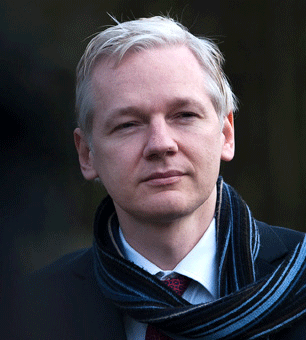
June 19 marks six years since the founder of WikiLeaks entered the building of the Ecuadorian Embassy in London. He hasn’t stepped foot outside it since.
Julian Assange has been residing at the Ecuadorian Embassy in London since 2012, where he sought refuge while facing sexual assault allegations in Sweden.
981 days have passed since the Metropolitan police removed dedicated 24/7 guards from outside the Ecuadorian Embassy on October 12, 2015.
“Like all public services, MPS resources are finite. With so many different criminal, and other, threats to the city it protects, the current deployment of officers is no longer believed proportionate,” a statement by the Met police said.
865 days since the UN Working Group on Arbitrary Detention (WGAD) ruled in a majority decision that Assange was being detained inside the Ecuadorian Embassy in London arbitrarily and was allowed to leave.
396 days since the allegations were dropped by Swedish prosecutors, but the Wikileaks founder would still get arrested if he left the embassy’s premises — by the UK police — for failing to surrender to the court in 2012.
158 days since Assange was granted Ecuadorian citizenship and subsequently the UK was asked to recognize the whistleblower as a diplomatic agent. Had the British agreed — it would have given Assange immunity to finally leave the embassy.
83 days since the whistleblower’s access to the Internet was cut off “in order to prevent any potential harm.”
“The government of Ecuador has suspended the systems that allows Julian Assange to communicate with the world outside of the Ecuadorian Embassy in London… The measure was adopted due to Assange not complying with a written promise which he made with the government in late 2017, whereby he was obliged not to send messages which entailed interference in relation to other states,” the government of Ecuador said in a statement.
Julian Assange fears extradition to the United States to be prosecuted for espionage after his website leaked classified US data.
London: Australian government officials have paid a mysterious visit to Julian Assange in his Ecuadorian embassy refuge in London, in a sign there may be a breakthrough in the stalemate that has lasted almost six years.
Two officials from Australia’s High Commission were spotted leaving the embassy in Knightsbridge in west London on Thursday.
It is the first time Australian consular officials have visited Assange at the embassy.
They were accompanied by Assange’s lawyer Jennifer Robinson.
Robinson confirmed the meeting to Fairfax but said she could not say what the meeting was about “given the delicate diplomatic situation”. “Julian Assange is in a very serious situation” she said. “He remains in the embassy because of the risk of extradition to the US. That risk is undeniable after numerous statements by Trump administration officials including the director of the CIA and the US attorney-general.”
Assange entered the embassy on June 19, 2012, after he had exhausted his appeals against an extradition order to go to Sweden to face rape and sexual assault allegations.
Swedish authorities have since closed their investigation, saying it couldn’t continue without Assange’s presence in their country.
However Assange still faces arrest if he steps out of the Ecuadorian embassy for breach of his bail conditions, after failing in a legal bid earlier this year to have the warrant cancelled by an English court.
His condition has recently become much worse, with his hosts repeatedly suggesting in public comments that they want the situation resolved and him out of the building. The court proceedings also revealed his worsening health, including serious tooth problems, respiratory infections, depression and a frozen shoulder.
His internet and phone connections were cut off by the Ecuadorian government six weeks ago and he was denied any visitors apart from lawyers, after Ecuador complained he had breached “a written commitment made to the government at the end of 2017 not to issue messages [on social media] that might interfere with other states”.
A spokeswoman from the High Commission said she would have to refer any questions about the meeting to the Department of Foreign Affairs and Trade in Canberra.
The Department of Foreign Affairs and Trade in Canberra confirmed it is providing consular assistance to Assange through the Australian High Commission in London.
Citing privacy obligations, however, DFAT refused to offer further comment.
Assange has complained for years that the Australian government has not offered him consular assistance, despite his being an Australian citizen.
In May last year Assange’s mother Christine Assange called on the Australian Government to give her son a new passport so that he can leave Britain.
“His passport’s been confiscated, the Australian Government should immediately issue him another one and demand safe passage for him to take up legal asylum in Ecuador,” she told the ABC.
Nuclear power plant legislation signed into law, June 8th, 2018, by Fulton Sun JEFFERSON CITY — Last week, 77 bills were signed into law including one regarding nuclear power plant security.
Rep. Travis Fitzwater’s bill strengthens security measures at nuclear power plants in Missouri and defines specifically what armed nuclear security guards can do to provide protection at those facilities.
House Bill 1797 specifies the level of physical force nuclear security guards can use while guarding a nuclear power plant; protects certain nuclear power plant employers from civil liability in carrying out their duties; and increases the penalties associated with trespassing at a nuclear power plant………
Commonly known as the Nuclear Power Plant Security Guard Act, the legislation faced little opposition in the state House and Senate. …….. To read the bill in its entirety, visit house.mo.gov/bill.aspx?bill=HB1797&year=2018&code=R.
Kevin Zeese, a prominent US activist and lawyer, issued the following statement this week endorsing action in defense of Julian Assange, including the June 17 rally in Sydney and vigils in London and around the world on June 19.
Zeese has spoken out against the escalating censorship of the Internet and the broader erosion of democratic rights. He is a co-director of the Popular Resistance organisation and is on the advisory board of the Courage Foundation which raises funds for the defence of persecuted journalists and whistleblowers.
Statement of Kevin Zeese endorsing protests and vigils in defense of Julian Assange
Julian Assange through his work as editor of WikiLeaks has made major strides toward democratizing the media by creating a vehicle for whistleblowers to share the truth and correct the misinformation of the mass corporate media. Assange and WikiLeaks have given people a precious tool—access to the undeniable truth about what governments and big business are doing. This is a tool we can all use to educate each other about what is really going on around us.
Assange is being persecuted because a democratized media threatens the monopoly over media control of the elites. A democratized media makes it more difficult for them to misinform, mislead and propagandize.
Through WikiLeaks, Assange with whistleblowers like Edward Snowden and Chelsea Manning have exposed war crimes, the truth about the Guantanamo Bay prison, the corporate domination of US policy and the actions of governments around the world and more. This has led to popular revolts around the world that have challenged those who abuse their power.
Freedom of speech and freedom of the press is being defined by the treatment of Julian Assange. Everyone who cares about these freedoms should speak out and take action on his behalf by joining the demonstration in Sydney, Australia on June 17 and the vigils being held in London and around the world on June 19—the anniversary of when Julian sought asylum in the Ecuadorian embassy six years ago. On June 19 at 11:00 a.m. we will be holding a protest in support of Julian Assange at the White House. Please join us to call for an end to his persecution.
Kevin Zeese, co-director of Popular Resistance, member of the advisory board of the Courage Foundation
THE Ministry of Defence (MoD) used British nuclear test pilots like “guinea pigs” during the Cold War, deliberately exposing them to radiation, it has been claimed By ALICE SCARSI, May 31, 2018
The shocking allegation was made by the widow of a pilot who obtained secret documents suggesting her husband took part in a life-threatening experiment.
Shirley Denson, 83, said the documentation shows her husband, Flight Lieutenant Eric Denson, was ordered to fly through the cloud of a thermonuclear explosion at Christmas Island in the Pacific.
The test exposed him to so much radiation he was left with unbearable headaches which eventually brought him to kill himself to make the pain stop, she added.
And the experiment may have affected two of the couple’s four daughters, as Mrs Denson claimed they were born with abnormalities.
The widow, who was handed the papers by the MoD while conducting research about her husband’s service, described the situation “wicked” and “evil”.
“It makes me furious to think it was done on purpose, that my Eric mattered so little to them.”
The documents revealed Fl Lt Denson had flown his Canberra B6 bomber into the mushroom cloud of a 2.8 megaton nuclear explosion on April 28 1958, with X-ray badges on the seat to measure radiation, the Mirror reported.
During the flight, the pilot would have been exposed to 65 years’ worth of normal background radiation during the six-minute flight.
British Nuclear Test Veterans’ Association chairman Alan Owen said: “This is the first time in all our years of campaigning we have ever found evidence this strong.
“Our members always believed they were guinea pigs and this appears to prove some of them were, at best, collateral damage in horrifying experiments.
“We need to know everything – now.”
The MoD denied Fl Lt Denson was purposely exposed to radiation.
The allegations caused outrage among politicians, who urged the MoD to answer the claim.
Deputy Labour leader Tom Watson described the documents as “shocking”, and said the Defence Secretary should issue an unqualified apology to Mrs Denson in the Commons.
He said: “This is a shocking document the MoD cannot wriggle out of.
“We need answers about what experiments were conducted, and how many of the 22,000 nuke vets were involved in them.”
Shadow defence secretary Nia Griffiths said the papers brought to light “deeply worrying revelations” and called for them to be investigated by the MoD.
And Shadow Health Secretary Jonathan Ashworth added: “This is an absolute scandal.”
A spokesman for the MoD rejected the claims saying: “It is not true to say these men were subject to an experiment to look at the effects of radiation.
“The British nuclear testing programme contributed towards keeping our country secure during the Cold War and regular health checks were conducted throughout.
“The National Radiological Protection Board has carried out three studies of nuclear test veterans and found no valid evidence to link this programme to ill health.”
And he exclusively revealed to Express.co.uk: “According to the information available in the Operational Record Books for the squadron, Fl Lt Denson did not fly the same aircraft in the week after his sampling sortie.
“The ‘experiments’ referred to were to determine the best possible arrangement on the body of dosemeters (devices that measure radiation) so that these mens’ exposure could be measured as accurately as possible.”
Saudi Arabia: Thousands Held Arbitrarily, Dramatic Increase in Detention Without Trial Human Rights Watch , 6 May 18, (Beirut) – Saudi Arabia is detaining thousands of people for more than six months, in some cases for over a decade, without referring them to courts for criminal proceedings. Saudi Arabia’s attorney general should promptly charge or release all criminal defendants and stop holding people arbitrarily.
Human Rights Watch analyzed data from a public online Interior Ministry database, which revealed that authorities have detained 2,305 people who are under investigation for more than six months without referring them to a judge. The number held for excessively long periods has apparently increased dramatically in recent years. A similar Human Rights Watch analysis in May 2014 revealed that only 293 people had been held under investigation for that period.
“If Saudi authorities can hold a detainee for months on end with no charges, it’s clear that the Saudi criminal justice system remains broken and unjust, and it only seems to be getting worse,” said Sarah Leah Whitson, Middle East director at Human Rights Watch.
“It seems that MBS’s ‘Vision2030’ plan better describes the length of detentions without charge than an aspirational time horizon for reforms.”
Saudi Arabia’s use of arbitrary detention has faced increasing scrutiny since the November 4, 2017 mass arrest of 381 people on corruption allegations. The arrests raised human rights concerns and appeared to take place outside of any recognizable legal framework, with detainees forced to trade financial and business assets for their freedom.
…….Human Rights Watch analyzed the data on April 2, which was updated through March 31. Of the 5,314 people in the database, 3,380 had been held for over six months without a conviction or their “case file under judicial review,” including 2,949 for more than a year and 770 for over three years. The database indicated Saudi authorities were holding 2,305 people “under investigation” for more than six months, 1,875 for more than a year, and 251 for over three years.
Saudi authorities have held one Saudi citizen without a conviction since September 2003 and another “under investigation” since December 2006. Of the 251 held “under investigation” for over three years, 233 are Saudis.
“We’ve reverted to a Saudi version of Kafka when authorities detain citizens for over a decade without charge because they are ‘under investigation’,” Whitson said. “This effectively means that Saudi authorities can detain and jail anyone they want by claiming they are investigating them, however endless the investigation.”………..
Extended detention without charge or trial or without an appearance before a judge is arbitrary, and violates both Saudi law and international human rights standards.
Loujain is a well-known campaigner for women’s right to drive in the ultra-conservative kingdom. Late last week, we learned that she had been arrested from her home. She was one of at least six prominent women’s rights activists detained by the Saudi Arabian authorities.
Loujain has been arrested several times in recent years for campaigning for women’s right to drive and the abolition of the male guardianship system. Now, she is the victim of a state-orchestrated smear campaign, designed to undermine the important campaigning that she and other human rights activists have been undertaking.
Along with the other human rights activists, Loujain has been detained and accused of crimes including “suspicious contact with foreign entities” and undermining the “security and stability” of the country. She was branded a ‘traitor’ to the country by state-aligned media. These arrests come one month before Saudi Arabian authorities will lift the ban on women driving in the kingdom. It is a cruel irony that the very women who championed the right to drive campaign may not be able to benefit from their activism – instead, they may be behind bars instead of behind the wheel.
These accusations are nothing more than ludicrous lies, intended to silence strong feminist voices speaking up for women’s rights.
The following morning, it only got worse. A vile and unprecedented smear campaign took over the front pages of Saudi newspapers and spread across social media platforms. Local newspapers like Okaz and Al-Jazirah were filled with aggressive front-page headlines, photos and countless opinion articles, calling the activists spies. On Twitter, one graphic was widely shared, revealing the faces and names of these activists with the word “traitor” stamped across their photos.
We fear that they, like many other peaceful activists and human rights defenders, will be tried and sentenced to lengthy prison terms for their activism. This continued criminalization of peaceful activism and human rights work is repulsive. It’s been a week since their arrests, and we still don’t know where the activists are, if they have been presented with clear legal charges, or have had access to a lawyer of their choosing.
In recent weeks, Saudi Arabia’s Crown Prince Mohammad bin Salman has travelled the world on a PR blitz, shaking hands with fellow leaders while promising positive change in the kingdom. MbS (as he’s known) claims women’s rights will be respected as part of his reforms. These arrests show those promises to be a lie.
How can the Crown Prince tell the world that he is an advocate for women’s rights while locking up activists who have called for the reforms he claims credit for? How can he claim to support women’s empowerment when the brave activists who have sacrificed their freedom for the rights and freedoms of Saudi Arabian women in the country won’t be able to drive next month?
For government leaders around the world who have been taken in by MbS’ talk of reform, we have a simple message: as long as human rights activists are deemed a threat to state security, and as long as the rights to freedom of expression, association, and assembly are equated with terrorism, Saudi reform is not meaningful.
It is clear that underneath all the PR hype and spin, Crown Prince Mohammad bin Salman doesn’t care about women’s rights and real human rights reforms. Saudi Arabian authorities cannot continue to publicly state they are dedicated to reform, while treating women’s rights campaigners in this cruel way. It’s time to end the systematic discrimination against women and the repression of the human rights community in Saudi Arabia.
Samah Hadid is Amnesty International’s Middle East Director of Campaigns
Saudi Arabia has widened its crackdown on women’s rights activists, bringing the number of arrests up to 11 people, according to human rights groups.
Since the sweep began on May 15, the detained activists, most of whom are women, have been branded “traitors” by pro-government news outlets and social media accounts, according to Human Rights Watch. Over the weekend, several state-linked newspapers published the names and photographs of those detained in what rights groups dubbed a “smear campaign“.
Those arrested reportedly include prominent women’s rights defenders who have long advocated for ending the ban on women driving, among them, Loujain al-Hathloul, Aziza al-Yousef and Eman al-Nafjan, along with Mohammed al-Rabea, an activist, and Ibrahim al-Modaimeegh, a human rights lawyer. They may face charges for “suspicious contact with foreign parties” and undermining “stability,” according to the Presidency for State Security, an office which reports to the king.
Since the kingdom is expected to soon lift its prohibition on women driving, rights groups said the motivation behind the escalating arrests remains unclear.
King Salman bin Abdulaziz Al Saud and his son, Crown Prince Mohammed bin Salman, drew international plaudits last year when they announced the ban on female drivers would end on June 24.
But now international outrage over the arrests threatens to derail the crown prince’s image as liberalizer.
“The crown prince, who has styled himself as a reformer with Western allies and investors, should be thanking the activists for their contributions to the Saudi women’s rights movement,” Sarah Leah Whitson, HRW’s Middle East director said in a statement. “Instead, the Saudi authorities appear to be punishing these women’s rights champions for promoting a goal bin Salman alleges to support — ending discrimination against women.”
Today is the day that net neutrality’s “slow and insidious” death at the hands of the Republican-controlled FCC officially begins, and Congress is facing urgent pressure to save the open internet before it’s too late.
With Monday marking 60 days after the FCC’s net neutrality repeal entered the Federal Register, parts of the GOP-crafted plan — spearheaded by agency chair and former Verizon lawyer Ajit Pai — will now slowly begin taking effect, while some still need to be approved by the Office of Management and Budget.
Net neutrality backers in Congress, meanwhile, are still struggling to compile enough votes to repeal Pai’s new rules, despite the fact that they are deeply unpopular among the American public.
The Senate needs just one more vote to pass a Congressional Review Act (CRA) resolution to restore net neutrality protections before it can move to the House, where it would face an uphill battle. An official vote in the Senate has yet to be scheduled, but could come in the next few weeks.
In a recent Twitter thread, the advocacy group Fight for the Future warned against sensationalistic headlines proclaiming that net neutrality will immediately be gone on Monday, noting that large telecom companies will ensure that the open internet’s death is as quiet and subtle as possible in order to minimize public backlash.
“The ISPs aren’t going to immediately start blocking content or rolling out paid prioritization scams. They know Congress and the public are watching them,” the group noted. “And that’s the worst part. What will happen is over time ISP scams and abuses will become more commonplace and more accepted. They’ll roll out new schemes that appear good on their face but undermine the free market of ideas by allowing ISPs to pick winners and losers.”
Seeks contractor that can monitor 290,000 global news sources
• ‘Media influencer’ database to note `sentiment’ of coverage
The U.S. Department of Homeland Security wants to monitor hundreds of thousands of news sources around the world and compile a database of journalists, editors, foreign correspondents, and bloggers to identify top “media influencers.”
It’s seeking a contractor that can help it monitor traditional news sources as well as social media and identify “any and all” coverage related to the agency or a particular event, according to a request for information released April 3.
The data to be collected includes a publication’s “sentiment” as well as geographical spread, top posters, languages, momentum, and circulation. No value for the contract was disclosed.
“Services shall provide media comparison tools, design and rebranding tools, communication tools, and the ability to identify top media influencers,” according to the statement. DHS agencies have “a critical need to incorporate these functions into their programs in order to better reach federal, state, local, tribal, and private partners,” it said.
The DHS wants to track more than 290,000 global news sources, including online, print, broadcast, cable, and radio, as well as trade and industry publications, local, national and international outlets, and social media, according to the documents. It also wants the ability to track media coverage in more than 100 languages including Arabic, Chinese, and Russian, with instant translation of articles into English.
The request comes amid heightened concern about accuracy in media and the potential for foreigners to influence U.S. elections and policy through “fake news.” Nineteen lawmakers including Reps. Josh Gottheimer (D-N.J.), Lee Zeldin (R-N.Y.), Ron DeSantis (R-Fla.), and Sen. Ted Cruz (R-Texas), sent a letter to Attorney General Jeff Sessions last month, asking whether Qatar-based Al Jazeera should register as a foreign agent because it “often directly undermines” U.S. interests with favorable coverage of Hamas, Hezbollah and al-Qaeda’s branch in Syria.
The DHS request says the selected vendor will set up an online “media influence database” giving users the ability to browse based on location, beat, and type of influence. For each influencer found, “present contact details and any other information that could be relevant, including publications this influencer writes for, and an overview of the previous coverage published by the media influencer.”
A department spokesman didn’t immediately return a phone call and email seeking comment.
Responses are due April 13. Seven companies, mainly minority- or women-owned small businesses, have already expressed interest in becoming a vendor for the contract, according to the FedBizOpps web site.
— With assistance from Daniel Snyder
To contact the reporter on this story: Cary O’Reilly in Washington atcoreilly@bgov.com
Hokkaido METI bureau requested changes to nuclear energy part of high school lecture https://mainichi.jp/english/articles/20180407/p2a/00m/0na/017000c (Mainichi Japan) SAPPORO –– High-ranking officials from the local bureau of the Ministry of Economy, Trade and Industry (METI) requested that an assistant professor change an October 2017 lecture to high school students pointing out the dangers of nuclear power, it has been learned.
“We will review our operations so as not to cause misunderstandings,” stated industry minister Hiroshige Seko regarding the request by the Hokkaido Bureau of Economy, Trade and Industry.
The lecture at Hokkaido Niseko High School in the prefectural town of Niseko was on energy issues. The school had been chosen by the Agency for Natural Resources and Energy, an industry ministry-affiliated body, as a model for energy education last academic year, and the lecture by Hokkaido University assistant professor Sadamu Yamagata was supported by a government grant.
According to multiple sources close to the matter, Yamagata sent his lecture materials to the school beforehand to be printed, and the school handed the documents over to METI’s Hokkaido bureau at the latter’s request. Two high-ranking officials from the bureau then visited Yamagata and requested that he make changes to a section of the materials explaining the dangers and costs of nuclear power, illustrated with a photo of the aftermath of a hydrogen explosion at the Fukushima No. 1 Nuclear Power Plant. The officials told Yamagata that this was “only one perspective” and that called it “impression manipulation.”
Yamagata added the statement, “natural energy is not necessarily 100 percent safe” along with a photo of a collapsed windmill, but did not comply with the request to change the section about nuclear energy.
“I found it uncomfortable that (the request for changes) was focused on nuclear power,” Yamagata told the Mainichi Shimbun. Hokkaido Niseko High School principal Noboru Baba said, “The lecture content was good. I don’t know if there was intrusion (by the ministry) into education.” However, residents who were aware of what had happened view the flow of events as meddling by the government in education, and the Niseko Municipal Government has held three meetings to explain the situation to locals.
Industry minister Seko told a post-Cabinet meeting news conference on April 6, “It’s common sense that the government takes responsibility for the content of an agency-commissioned program, but with the focus (by the bureau officials) only on nuclear energy, misunderstandings can arise easily.”
The incident comes on the heels of criticism of the Ministry of Education, Culture, Sports, Science and Technology for pressuring the Nagoya Municipal Board of Education by requesting a report about a lecture given by former vice minister of education Kihei Maekawa.
But how should the Hokkaido case be understood? The class taught by Maekawa was set up by the school and the Nagoya education board, completely independently of the central government. On the other hand, the Hokkaido case was funded by a central government grant, and Japan’s stance has so far been that funding gives related government bodies a say in how the monies are used.
The Hokkaido bureau’s Natural Resources, Energy and Environment Department denied intervening, telling the Mainichi, “The purpose was to show both the merits and demerits of all types of energy sources, and if the lecture had hypothetically been extremely critical of natural energy resources, the same request for alternations would have been made. If only the shortcomings of nuclear energy are presented while ignoring the benefits, that is a problem.”
However, experts are critical. Hokkaido University emeritus professor Yoichi Anezaki said, “The case of the education ministry requesting a report of Maekawa’s class was also problematic, but in this case with the industry ministry, which plays a key role in nuclear power policies, requesting that a section pointing out the issues with nuclear energy be changed, it’s an intrusion into education by authority and is much worse. It’s tantamount to censorship.”
“The belief that just because the government provided the grant, it means that it can have its say on the content of education doesn’t make sense,” said Kyoto University of Art and Design professor and former education ministry bureaucrat Ken Terawaki. “If we allow for this, then it means that it’s fine for the Ministry of Foreign Affairs to promote the Trans-Pacific Partnership and the Ministry of Defense the necessity of military affairs in the classroom. Intrusion into education is a serious matter.”
(Japanese original by Ryuko Tadokoro, Hokkaido News Department)
Daniel Ellsberg’s decision to release the Pentagon Papers was an act of valor—his actions saved countless lives. He was a whistleblower who changed the course of history and curtailed an ongoing genocide which ended up preventing the needless dissolution of American soldiers and Vietnamese civilians alike. The publishing of the Pentagon Papers is a prime example of the critical part a free press plays in keeping governments in check and exposing the corrosive nature of consolidated power. This is why the First Amendment of the Bill of Rights enshrines the rights to free speech and of a free press in the United States Constitution.
Tyrants throughout history have targeted journalists and reporters for a reason.
On Wednesday afternoon, Julian Assange, who has been forced into self-imprisonment at the Ecuadorian embassy since 2012 to ward off prosecution from the United Kingdom and the United States, had his internet access cut off. Assange is our generation’s Daniel Ellsberg; WikiLeaks—the online publication he started—has been invaluable in letting the public know about the malfeasance of their elected officials and highlighting the duplicity of governments throughout the world. In an era where mainstream journalists have been turned into a corporate-state propagandists, WikiLeaks stands out in their dogged pursuit of truth and exposing deep-seated corruption and graft.
On October 12, 1969, Daniel Ellsberg copied a secret dossier with the intention of disclosing the truth about the Vietnam War. The Pentagon Papers were a chronicle of events that recorded the scope of operations in Vietnam and beyond—details which were being withheld from the American public. The Vietnam War was built on the foundation of lies; we were rushed into the war using the Gulf of Tonkin as a false flag and defending freedom as a pretext to further the interests of the defense-financial complex. The truth eventually caught up to the lies of politicians and bureaucrats; Defense Secretary Robert McNamara later admitted the Gulf of Tonkin attack never took place.
The Gulf of Tonkin set the stage for a decade of continuous half-truths and outright lies as the US government suppressed information from the citizenry and kept falsifying records. This coordinated campaign of governmental disinformation prolonged a war that led to the deaths of 58,200 Americans and snuffed the lives of over 2 million Vietnamese people. It was this pernicious operation of deceit—intent on keeping the public in the dark—that prodded Ellsberg to act. After presenting the findings of the Pentagon Papers to authorities in government only to be met with a wall of silence, he decided to inform the press. The firestorm of controversy that was created after The New York Times published the Pentagon Papers and the ensuing outcry from the public played a large part in bringing an end to the Vietnam War.
Daniel Ellsberg’s decision to release the Pentagon Papers was an act of valor—his actions saved countless lives. He was a whistleblower who changed the course of history and curtailed an ongoing genocide which ended up preventing the needless dissolution of American soldiers and Vietnamese civilians alike. The publishing of the Pentagon Papers is a prime example of the critical part a free press plays in keeping governments in check and exposing the corrosive nature of consolidated power. This is why the First Amendment of the Bill of Rights enshrines the rights to free speech and of a free press in the United States Constitution.
Tyrants throughout history have targeted journalists and reporters for a reason. Napoleon Bonaparte, a savage dictator, once noted that four hostile newspapers are more to be feared than a thousand bayonets. He said this because he knew that journalists can awaken a slumbering public from sleep and rally them against repressive regimes. A free press is the last line of defense between liberty and despotism. The founders of our republic, in the hopes of preventing America from traveling down the path of authoritarianism, made the rights of a free press sacrosanct for this exact reason. Sadly, our nation is living proof that all revolutions eventually devolve to the very tyranny that gave birth to them.
Bureaucrats and elected officials in government learned the wrong lessons from the Pentagon Papers. Instead of being transparent and reducing corruption in governance, authorities decided to cloak themselves in darkness, methodically target whistleblowers for prosecution and intimidate journalists in order to prevent them from doing their jobs. All this is taking place in a backdrop where corporations have initiated a hostile takeover of government; by weaponizing their wealth, globalist oligarchs have effectively turned public servants and technocrats into their enforcers and security guards.
In an environment where billionaires like Jeff Bezos and Rupert Murdoch own more than 90 percent of the media content and the way it is disseminated to the public, reporters and journalists in corporate media have to be mindful of keeping their checks as much as they are fearful of getting a knock on the door from subpoena bearers. This systematic war against free press metastasized after the heinous attacks of 9/11; the US government—yet again using national security as a pretext—made it a priority to silence dissent within government and neutralize aggressive reporting against its excesses. As western powers piously preach about freedom and democracy throughout the globe, they are steadily dismantling both domestically.
On Wednesday afternoon, Julian Assange, who has been forced into self-imprisonment at the Ecuadorian embassy since 2012 to ward off prosecution from the United Kingdom and the United States, had his internet access cut off. Assange is our generation’s Daniel Ellsberg; WikiLeaks—the online publication he started—has been invaluable in letting the public know about the malfeasance of their elected officials and highlighting the duplicity of governments throughout the world. In an era where mainstream journalists have been turned into a corporate-state propagandists, WikiLeaks stands out in their dogged pursuit of truth and exposing deep-seated corruption and graft.
It is this defiance in seeking truth and bringing light to criminality that has earned WikiLeaks in general, and Julian Assange specifically, scorn and contempt from autocrats in D.C. and throughout European capitals. It is at once amusing and vexing to hear public officials take to the podium to lecture tinpot dictators about good governance and respecting a free press while they target whistleblowers like Chelsea Manning, Edward Snowden and harass reporters like Julian Assange and Glenn Greenwald who dare give voice to them. This quest to silence free speech and neuter a free press is a bipartisan campaign and a bilateral initiative. Both sides of the aisle in D.C. and a multitude of supposedly “democratic” governments throughout the world are stepping up efforts to eradicate the rights of journalists and truth-tellers alike.













 nuclear-news