There are also meetings in eight areas of England as the government hunts for a single location to bury the lethal waste.
The waste, which has been accumulating from nuclear power stations over the last 60 years, is to be transferred from specially-engineered containers where it is currently building up to a subterranean Geological Disposal Facility (GDF) where it can be left forever.
The government’s official line is that no location has been chosen and that any site will only be picked if a community is willing.
Experts at the RWM (a subsidiary of the Nuclear Decommissioning Authority) have been scouring Wales for suitable regions and this is what they have to say about the area in which you live:
1. North Wales offshore including the Vale of Clwyd……….
2. North Wales Coalfield, comprising Wrexham and north to Prestatyn…….
3. From St Brides Bay to the Severn Estuary, extending north to Welshpool……
4. 20 km offshore strip along the Bristol Channel – from Carmarthen Bay to Cardiff…..
5. Most of North Wales and West Wales – from St Davids to Bangor……
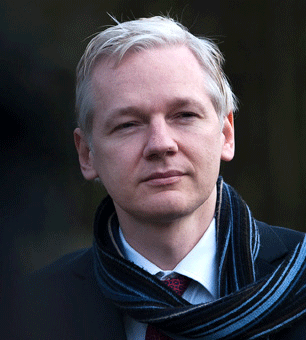
Ecuador has begun a “Special Examination” of Julian Assange’s asylum and citizenship as it looks to the IMF for a bailout, the whistleblowing site reports, with conditions including handing over the WikiLeaks founder.
Former Ecuadorian President Rafael Correa tweeted an image of the letter he received from the State Comptroller General on December 19, which outlines the upcoming examination by the Direction National de Auditoria.
The audit will “determine whether the procedures for granting asylum and naturalization to Julian Assange were carried out in accordance with national and international law,” and will cover the period between January 1, 2012 and September 20, 2018.
Assange has been in the Ecuadorian Embassy in London since he sought asylum there in 2012. He was granted Ecuadorian citizenship last December in a bid to protect him from being extradited to the US where he fears he faces secret charges for publishing US government cables and documents.
WikiLeaks tweeted the news on Wednesday, joining the dots between the audit and Ecuador’s consideration of an International Monetary Fund bailout. The country owes China more than $6.5 billion in debt and falling oil prices have affected its repayment abilities.
According to WikiLeaks, Ecuador is considering a $10 billion bailout which would allegedly come with conditions such as “the US government demanded handing over Assange and dropping environmental claims against Chevron,” for its role in polluting the Amazon rainforest.
Assange’s position has increasingly been under threat under Correa’s successor, President Lenin Moreno, with Ecuadorian authorities restricting his internet access and visitors.“I believe they are going to turn over Assange to the US government,
More than 65 years since the UK began conducting secret nuclear weapons testing in the Australian Outback, scores of files about the program have been withdrawn from the country’s National Archives without explanation.
The unannounced move came as a shock to many researchers and historians who rely on the files and have been campaigning to unseal the small number which remain classified.
“Many relevant UK documents have remained secret since the time of the tests, well past the conventional 30 years that government documents are normally withheld,” said expert Elizabeth Tynan, author of “Atomic Thunder: The Maralinga Story”.
“To now withdraw previously available documents is extremely unfortunate and hints at an attempted cover-up.”
Dark legacy The UK conducted 12 nuclear weapons tests in Australia in the 1950s and 1960s, mostly in the sparsely populated Outback of South Australia.
Information about the tests remained a tightly held secret for decades. It wasn’t until a Royal Commission was formed in 1984 — in the wake of several damning press reports — that the damage done to indigenous people and the Australian servicemen and women who worked on the testing grounds became widely known.
Indigenous people living nearby had long complained of the effects they suffered, including after a “black mist” settled over one camp near Maralinga in the wake of the Totem I test in October 1953. The mist caused stinging eyes and skin rashes. Others vomited and suffered from diarrhea.
These claims were dismissed and ridiculed by officials for decades — until, in the wake of the Royal Commission report, the UK agreed to pay the Australian government and the traditional owners of the Maralinga lands about AU$46 million ($30 million). The Australian authorities also paid indigenous Maralinga communities a settlement of AU$13.5 million ($9 million).
While the damage done to indigenous communities was acknowledged, much about the Totem I test — and other tests at Maralinga and later at Emu Field — remained secret, even before the recent withdrawal of archive documents.
“The British atomic tests in Australia did considerable harm to indigenous populations, to military and other personnel and to large parts of the country’s territory. This country has every right to know exactly what the tests entailed,” Tynan said. “Mysteries remain about the British nuclear tests in Australia, and these mysteries have become harder to bring to light with the closure of files by the British government.”
Alan Owen, chairman of the British Nuclear Test Veterans Association, which campaigns on behalf of former servicemen, said “the removal of these documents affects not only our campaign, but affects the many academic organizations that rely on this material.”
“We are very concerned that the documents will not be republished and the (Ministry of Defense) will again deny any responsibility for the effects the tests have had on our membership,” Owen told CNN.
Unclear motives Responding to a request for comment from CNN, a spokeswoman for the National Archives said the withdrawal of the Australian nuclear test files was done at the request of the Nuclear Decommissioning Authority (NDA), which has ultimate responsibility over them.
The NDA said that “a collection of records has been temporarily withdrawn from general access via The National Archive at Kew as part of a review process.”
“It is unclear, at this time, how long the review will take, however NDA anticipates that many of the documents will be restored to the public archive in due course,” a spokeswoman said.
Jon Agar, a professor of science and technology at University College London, said the withdrawal “is not just several records but two whole classes of files, many of which had previously been open to researchers at the National Archives.”
“These files are essential to any historian of the UK nuclear projects — which of course included tests in Australia. They have been closed without proper communication or consultation,” he added.
Agar shared correspondence he had with the NDA in which a spokeswoman said some files would be moved to a new archive — Nucleus — in the far north of Scotland. However the Nucleus archivesfocus on the British civil nuclear industry, and it is unclear why files on military testing would be moved there, or why those files would need to be withdrawn to do so.
Nucleus also does not offer the type of online access to its records as the National Archives does.
“Why not just copy the files if the nuclear industry needs them at Nucleus for administrative reasons? Why take them all out of public view?” Agar wrote on Twitter.
Information freedom In correspondence with both CNN and Agar, the NDA suggested those interested in the files could file freedom of information (FOI) requests for them.
Under the 2000 Freedom of Information Act, British citizens and concerned parties are granted the “right to access recorded information held by public sector organizations.”
FOI requests can be turned down if the government deems the information too sensitive or the request too expensive to process. Under a separate rule, the UK government should also declassify documents between 20 and 30 years after they were created.
According to the BBC, multiple UK government departments — including the Home Office and Cabinet Office — have been repeatedly condemned by auditors for their “poor,” “disappointing” and “unacceptable” treatment of FOI applications.
Commenting on the nuclear documents, Maurice Frankel, director of the Campaign for Freedom of Information, a UK-based NGO, said it was “worrying that properly released records can suddenly be removed from public access without notice or explanation.”
“It suggests that the historical record is fragile and transient and liable to be snatched away at any time, with or without good reason,” he added.
Sputnik News, 18 Nov 18The former NSA contractor, who faces capital punishment in the US for leaking classified information on numerous US secret surveillance programmes, voiced his support for the WikiLeaks founder after it came to light that US authorities are apparently poised to indict Julian Assange.
Edward Snowden, who has been granted political asylum in Russia, has voiced his concern about the dangerous precedent for stifling press freedom which could emerge from the US Justice Department’s alleged plans to prosecute WikiLeaks founder Julian Assange.
The Freedom of the Press Foundation, where Snowden is a board member, also issued a statement condemning the possible indictment of Julian Assange, whose website published a classified Iraqi dossier revealing that the US killed civilians during the country’s 2003 invasion and subsequent occupation. Trevor Timm, executive director of Freedom of the Press Foundation, cited a profound threat to press freedom if any charges are brought against WikiLeaks for their publishing activities.
“Whether you like Assange or hate him, the theories used in a potential Espionage Act prosecution would threaten countless reporters at the New York Times, Washington Post, and the many other news outlets that report on government secrets all the time. While everyone will have to wait and see what the charges detail, it’s quite possible core First Amendment principles will be at stake in this case,” his statement reads.
Earlier this week, it came to light through what is believed to be an accident that there’s a sealed complaint against Assange, as the US Department of Justice is gearing up to prosecute the whistleblower. It is now “optimistic” about the prospect of securing his release to US authorities, a new report suggests. According to the Wall Street Journal, prosecutors have weighed several types of charges against the journalist, who has resided in self-imposed exile at the Ecuadorian Embassy in London since 2012……….https://sputniknews.com/us/201811171069890725-snowden-assange-whistleblower-prosecution/
America deserves to know how much money Trump is getting from the Saudi government,His corruption is a national security issue. VOX, By Matthew Yglesias@mattyglesiasmatt@vox.com Oct 12, 2018A foreign government — an American ally, no less — can’t just murder a US resident with impunity while he’s on the soil of a NATO member state because they didn’t like his newspaper columns.
And yet that seems to be exactly what President Donald Trump wants to let Saudi officials do, explaining to reporters on Thursday that he does not want to respond to the murder of Washington Post columnist Jamal Khashoggi because “I don’t like stopping massive amounts of money coming into our country” and “I don’t like stopping an investment of $110 billion in the United States.”……….
Why is Trump so willing to let the Saudis slide? Is Trump getting paid by Saudi Crown Prince Mohammed bin Salman, a.k.a. MBS, and the Saudis? Is his son-in-law, Jared Kushner? Normally, these would be absurd questions to raise about a president. But they are serious. Trump has commented before on his business ties to Saudi Arabia, bragging at a campaign rally in Alabama about how much business he did with Saudi interests. And he’s never fully aired the extent of his vast business and financial ties.
MEPs defy warnings from internet pioneers, civil liberties groups and commercial interests, Guardian, Rankinin Brussels, Wed 20 Jun 2018 A European parliament committee has voted for legislation that internet pioneers fear will turn the web into “a tool for surveillance and control”.
In a key vote on a draft law to overhaul EU copyright rules, the parliament’s legal affairs committee on Wednesday voted for measures that would require the likes of Google and Microsoft to install filters to prevent users from uploading copyrighted materials.
The MEPs voted narrowly for the provision, despite warnings from some of the biggest names in the internet, and civil liberties campaigners, that the law would damage freedom of expression, while entrenching the power of the biggest companies and loading costs on to European startups.
The plans still have to be agreed with representatives from the EU’s 28 governments before becoming law, but the vote reduces the chances of serious changes.
Guardian 17th Sept 2018 Britain’s energy regulator has been fighting to keep secret the claims of
two whistleblowers who independently raised concerns about potentially
serious irregularities in projects worth billions of pounds, the Guardian
can reveal. The two men say Ofgem threatened them with an obscure but
sweeping gagging clause that can lead to criminal prosecutions and possible
jail terms for those who defy it. https://www.theguardian.com/law/2018/sep/17/ofgem-made-my-life-hell-whistleblowers-say-they-were-threatened-by-regulator
Bideford radiation expert held over home chemicals, BBC News, 13 September 2018A radiation scientist has spoken of his anger at being arrested on suspicion of making a bomb.Two police officers “felt unwell” during a visit to Dr Chris Busby’s home in Bideford, Devon, which boasts its own laboratory.
The 73-year-old said he was held for 19 hours under the Explosives Act before being released with no further action………..
A cordon was set up around his home on Wednesday morning when the two officers complained of feeling unwell – which Dr Busby attributed to “psychological problems associated with their knowledge of the Skripal poisoning”.
The scientist said he was handcuffed and interviewed all night by police who suspected he was making a bomb, but the only substances found at his home were “innocuous chemicals for research into radiation”.
He returned home that night to find officers had searched his home laboratory and sealed off his home in Bridge Street.
“They destroyed my experiment. It was most irritating,” he said.
Dr Busby said he felt he was being targeted because of his criticism of the government’s current assessment of radiation risks.
WikiLeaks Whistleblower Awaits Fate, American Free Press , September 7, 2018 The fate of gutsy WikiLeaks founder and whistleblower Julian Assange rests in the hands of the government of Ecuador, first reported here in AFP’s Issue 33&34. Assange has lived at the Ecuadorian embassy in London since 2012 and will be instantly arrested by the UK if he leaves the building. Just-released news that his health is deteriorating rapidly makes even more urgent Ecuadorian action’s even more urgent.
By S.T. PatrickAs the future of WikiLeaks founder Julian Assange twists in the political winds, the United States, Great Britain, and Ecuador continue to negotiate over the life of the Australian computer programmer and hacker.
Assange has been housed at the Ecuadorian embassy in London since 2012. According to one of his lawyers, Assange’s health is suffering and, for the past four months, he has been held in a situation that can be more accurately described as “solitary confinement.” The end of WikiLeaks, as well as Assange’s own version of freedom, may soon be near.
The white-haired Australian, Assange, 47, founded WikiLeaks in 2006, but his presence in the global spotlight dates back to 2010 when he published a series of leaks given to him by U.S. Army soldier Bradley (Chelsea) Manning. The leaks, factual yet damaging to the U.S. military’s public image, prompted a federal criminal investigation into WikiLeaks and its founder. Allied nations were encouraged to do the same………
Technically, Assange is not a prisoner of any government. That is the inevitability that he is trying to avoid. He may leave the embassy, but doing so would trigger the execution of an active warrant that still exists in the UK for jumping bail. If arrested, extradition to the United States seems likely.
Time may be at hand for Assange. On July 27, Ecuadorian President Lenin Moreno admitted that he has been in talks with the British government to revoke the asylum. Moreno had been a detractor of Assange since taking office in May 2017……..
Because there is a clause in the UK-Ecuadorian extradition treaty that bars one country turning citizens over to the other, Assange’s Ecuadorian citizenship may have to be rescinded for extradition to occur.
…..In April, Attorney General Jeff Sessions hinted to the media that he would consider bringing criminal charges against Assange.
“We are going to step up our efforts and already are stepping up our efforts on all leaks,” Sessions said. “We will seek to put some people in jail.”…….
Former U.S. litigator Glenn Greenwald, founder of “The Intercept” website, believes that extradition to the United States would not be as automatic as is being reported by many news outlets. He calls the British government “subservient” to the United States, yet he points out that the British judges lean more independent. He also points out that the specifics of the U.S.-UK treaty may not allow extradition.
“Political crimes, like publishing documents and engaging in journalism—that really isn’t what extradition is for,” Greenwald said. “And in fact . . . is excluded from most extradition treaties, including the one between the U.S. and the UK.”……
Big Brother is keeping ‘Five Eyes’ on you,Darius Shahtahmasebi is a New Zealand-based legal and political analyst, currently specialising in immigration, refugee and humanitarian law. Rt.com 7 Sep, 2018 Just last week, the world’s leading snooping powers quietly and without notice issued a disturbing warning to tech giants, telling them to surrender unprecedented backdoor access to their citizens’ data.
Not many people know this, but the United Kingdom has some of the most extreme spying powers in the developed world. At the end of 2016, passing what some people called the “Snooper’s Charter,” the UK put into law some of the most draconian anti-privacy laws that we have ever known, allowing its government to compel companies to break their own encryption.
The UK plays a pivotal part in the so-called Five Eyes alliance, which also includes the US, Canada, Australia and New Zealand. Nobody knew it at the time, but the American military base which my family and I grew up next to has played a crucial role in delivering US drone strikes across the Middle East and beyond. America’s drone-strike regime, largely considered illegal for numerous reasons, is not something that countries should willingly participate in lightly and without public scrutiny.
Why am I mentioning this? Because it goes to the very heart of my point: the extent to which we know or do not know what our governments are doing behind closed doors is quite literally a matter of life and death.
Now, it has been revealed that the Five Eyes alliance, dedicated to a global “collect-it-all”surveillance task, has issued a memo calling on their governments to demand that tech companies build backdoor access for states to access users’ encrypted data or face measures that will force companies to comply.
The memo was released quietly with little media coverage last week by the Australian Department of Home Affairs, and essentially demanded that providers “create customized solutions, tailored to their individual system architectures that are capable of meeting lawful access requirements.” The memo was reportedly released after ministers for the intelligence agencies of the Five Eyes nations met on Australia’s Gold Coast last week……
Will those tech companies cave in to these government’s demands? You can bet your bottom dollar that eventually, yes, they very well might. ……
It is worth noting that there has been next to no criticism of these Five Eyes powers for delivering such a blatant attack on our right to privacy. Remember that, of course, Russian President Vladimir Putin is attempting to “wrest control of the internet,” as the Guardian wrote approximately three years ago. But these same Western media companies are awkwardly silent about what their own governments are proposing to do, something which other nations could only dream about achieving on such a global scale. …….https://www.rt.com/op-ed/437895-privacy-five-eyes-encryption/
The Fukushima Prefectural Government and the Reconstruction Agency are looking to take legal action over the video over concerns it will stoke “unreasonable” fears of radiation in the Fukushima Prefecture, the Japan Times reports.
A senior official from the prefecture said they were “examining the video content”.
In the episode, Farrier is filmed taking a tour of areas affected by the 2011 meltdown of a nuclear plant in Fukushima where he suspects a meal served from a restaurant in Namie, a town in Fukushima Prefecture, has been contaminated by radiation.
It also shows the journalist enter a no-go zone around the Fukushima Daiichi nuclear power plant without permission from authorities, reporting from an abandoned game arcade, and tourists on a bus becoming distressed over rising radiation levels without information about the vehicle’s location.
The show has the journalist travel to different locations around the world associated with grim historical events, including the footsteps of serial killer Jeffrey Dahmer in Milwaukee, and voodoo rituals in Benin, West Africa.
The Nuclear Resister, August 13, 2018 UPDATE: August 17 – the jailed activist was released from custody today.
Among the many commemorative events all around the Peace Park in Hiroshima, Japan on August 6 was an evening memorial service for victims of both the Bomb and nuclear power by Go West, Come West. It is a civic association of evacuees from the March, 2011 Fukushima disaster and their supporters who are challenging the Japanese government’s response to the ongoing catastrophe affecting all of eastern Japan as inadequate and cruel.
This is their story about how police then arrested one of their members on trumped-up charges. [The headline of this post was corrected 8/15/18 to reflect that the jailed activist is a friend of Fukushima evacuees, and not herself an evacuee. The gender of the arrested person was also corrected from the error in the machine translation of this story.]
Emergency Statement on the Oppression at the Hands of the Local Police against the Fukushima Nuclear Evacuees’ August 6 Hiroshima Action.
Hiroshima Police Unlawfully Arrested a Citizen to Silence Evacuees Appealing about Ongoing Fukushima Disaster.
A Serious Threat to Human Right and Free Speech.
We demand that the Hiroshima police immediately release the arrested friend of the nuclear evacuees who participated in August 6 Hiroshima actions!
We, an organization of evacuees from the Fukushima nuclear disaster and their supporters, attended various peace rallies and events held in Hiroshima on August 6th 2018, commemorating the 73rd anniversary of 1945 nuclear atomic bomb dropped on Hiroshima, killing hundreds of thousands of innocent civilians. Survivors of Hiroshima atomic bombing and Fukushima nuclear evacuees are both victims of nuclear disaster and radiation.
Our goal was to unite with Hiroshima and act together to end these ongoing disasters in the world.
There on the night of the 6th, in front of the great number of people coming for these peace events from all over the world, we gave speeches in both Japanese and English. Our speech was for remembrance of those killed by the nuclear atomic bombing and the endless damage caused by the Fukushima nuclear disaster in 2011.
A lot of Japanese and foreign tourists who visited Hiroshima for this anniversary stopped and listened to our speeches earnestly, taking our handouts explaining what the Fukushima nuclear disaster has caused: the real health damage of residents now spreading all over the eastern Japan; and the predicaments that evacuees are faced with even today.
We were deeply moved by the amount of attentions and feedback we received from them. When one of the 2nd generation of atomic bomb victims gave a speech on how Hiroshima and Fukushima are connected with one straight line, radiation exposure, there was a round of applause from people including locals of Hiroshima. It became a great place of solidarity for sharing experiences and thoughts among those who were there with us.
However all things were changed when a suspicious passerby wearing military fashion, pointing his camera, started shouting complaints at us, and took photos of us, apparently aiming to disturb our speeches. We ignored him but when we were finishing it up and packing our stuff, he screamed saying, “Someone just broke my camera” and called the local police even though we did not go near him or made any physical contact with him or whatsoever.
The local police officers rushed to us and blocked us from going anywhere. The officers started to question us and we explained many times that we did nothing to him, it was totally a false accusation and we needed to go back home because some of us were getting very sick from the summer heat. However, the police officers still refused to let any of us leave.
The officers were talking with their supervisor by cell phone all the time. Then suddenly they said, “The police have had an eyewitness who saw your member break that man’s camera. So now we will take this person to the police station.”
We told them that none of us did such a thing, however the officers put handcuffs on one of our members, saying, “You are under suspicion of escape!! You are under arrest!! We’ll let you know the reason of arrest when you are brought to the police station.” The police officers lifted that her body violently and then threw her into their police car and took her to the main police station in Hiroshima. This is clearly illegal abduction and confinement by the police using a false accusation.
The police officers physically held us away, telling us not to approach to the suspicious camera man or “eyewitness”. Witnessing a whole situation, some citizens there shouted to the police officers, “How dare you doing such a thing on the memorial day for war dead!” and “How come? They have done nothing wrong!”
The officers withdrew to the police station right after they made the arrest as if they themselves were fugitives.
The reason for this arrest was, we suspect, that the upper-level of the police department judged our speeches and handouts politically, and they ordered those police officers at the site to arrest our member.
This fact shows how the current Japanese administration is terrified of their biggest skeleton in the closet, the actual health damage due to the Fukushima nuclear disaster, coming to light. They are also making desperate efforts to hamper the voices of Fukushima nuclear victims and the concerns and resentment against atomic bombings from spreading among people in Japan and around the world. So they use whatever means to stop those real pictures being known to the public, domestically and internationally.
Prosecutors have since asked that she be held in detention at the Hiroshima prefectural police headquarters until at least August 18, or even August 28.
Individual international and organizational statements of support for Mr. A. and Go West Come West should be sent via email to danatsu8.6@gmail.com. ………
How come the Australia government, which gives help to convicted murderers overseas – does nothing to help whistleblower Julian Assange? It’s a national disgrace!
Assange may finally leave Ecuadorian embassy in London as health worsens – report Julian Assange, who has spent more than 2,230 days in the Ecuadorian embassy in London, is expected to leave the building soon with his health deteriorating, sources say.
This latest information about the WikiLeaks founder, who was already expected to leave the embassy “in the coming weeks,” was Wednesday by Bloomberg which cited “two people with knowledge of the matter.” The news agency reported that the whistleblower’s health “has declined recently.”
The news comes days after Ecuadorian President Lenin Moreno announced that Assange must “eventually” leave the embassy. “Yes, indeed yes, but his departure should come about through dialogue,” the Ecuadorian president said in answer to a reporter’s question on whether he will eventually have to leave.
“For a person to stay confined like that for so long is tantamount to a human rights violation,” Moreno said, stressing that Ecuador wants to make sure that nothing “poses a danger” to the whistleblower‘s life.
The whistleblower’s health is deteriorating, according to the Courage Foundation, a group that fundraises for the legal defense of whistleblowers. Assange is in “a small space” and has “no access to sunlight,” the group , adding that this has a serious impact “on his physical and mental health.”
Rape allegations, stemming from Assange’s visit to Sweden in August 2010, were the main reason that he sought refuge in London’s Ecuadorian embassy in 2012 when a warrant was issued for his arrest. Assange maintained that he could be extradited from Sweden to the US, where he would be prosecuted for his whistleblowing and would not receive a fair trial. Swedish prosecutors dropped the investigation in 2017, but a British warrant for violating bail conditions still stands.
Washington simply “wants revenge” for the “embarrassment” WikiLeaks caused it, and wants it to serve “as a deterrent to others,” human rights activist Peter Tatchell told RT earlier in July. “Someone who’s published that information in the same way that the New York Times or the Guardian publish information, I don’t think they should face risk 30 or 40 years in jail in the United States,” Tatchell added.
Launched in 2006, the WikiLeaks project is aimed at exposing government and corporate secrets. It garnered global attention back in 2010 with its massive release of classified US military documents, which included those detailing how American military equipment was deployed in Afghanistan and Iraq. Assange won thousands of admirers, with many applauding his willingness to speak the truth.
Is BBC Spying on WikiLeaks Founder Assange in Ecuadorian Embassy? https://sputniknews.com/europe/201808091067081598-bbc-spy-assange/ 09.08.2018 Ecuadorian President Lenin Moreno recently raised the issue of WikiLeaks’ founder leaving the country’s embassy in the UK, where he has been holed up since 2012, fearing the UK police will arrest and extradite him to the US.
On Thursday WikiLeaks Twitter account posted a screenshot of a letter received by some of the residents of no. 18 Hans Cres, London — an apartment building across from the Ecuadorian Embassy that serves as an asylum for Julian Assange. The letter, which has a BBC News logo in its top right corner, asks permission to install permanent cameras outside residents’ apartments so that they overlook the embassy.
The letter was motivated by a desire to better cover Julian Assange’s story and promised to compensate for any disturbances caused. The letter also contains Jonathan Whitney’s email as a contact for those interested in the offer. According to Whitney’s profile, he is a BBC News Deployment Editor.
WikiLeaks chief editor Julian Assange has been living in Ecuador’s UK Embassy since 2012 fearing the UK may extradite him to the US, where he could face prosecution over WikiLeaks’ publication of leaked US military and diplomatic documents. Recently Ecuadorian President Lenin Moreno touched upon the issue of expelling Assange from the embassy, but noted that the UK must first guarantee the activist’s safety.
His statements followed conflicting media reports that Ecuador might revoke Assange’s asylum and that the whistleblower might leave voluntarily to due increasing health issues.