Tokai nuclear plant ordered to halt for lack of evacuation plans
|
Tokai nuclear plant ordered to halt for lack of evacuation plans https://english.kyodonews.net/news/2021/03/a1683cef5f2a-breaking-news-japan-court-orders-suspension-of-tokai-nuclear-plant.html KYODO NEWS A Japanese court ordered Thursday the suspension of the Tokai No. 2 nuclear power plant, located northeast of Tokyo, citing a lack of evacuation plans despite persisting safety concerns over nuclear power generation 10 years after the Fukushima Daiichi accident.he Mito District Court’s ruling became the second case to order the suspension of a nuclear reactor in Japan after the Fukushima crisis, following a 2014 Fukui District Court decision to halt operations of the Nos. 3 to 4 units of the Oi nuclear plant.
The Tokai No. 2 plant in Ibaraki Prefecture, which started commercial operation in 1978, has remained idle as its operator Japan Atomic Power Co. is working to meet stricter regulations set after the 2011 disaster. The electricity wholesaler is seeking to restart the Tokai plant, after gaining approval for the extension of its operations beyond the preliminary 40-year limit in November 2018. Nuclear reactors are allowed to run for 40 years in Japan but can extend their operations for an additional 20-year period with approval from the nuclear watchdog. In handing down the landmark ruling, Presiding Judge Eiko Maeda said the situation is such one cannot say that “attainable evacuation plans and a disaster risk reduction system are in place.” Plaintiffs who live in Ibaraki and surrounding prefectures have expressed concerns about that point, as around 940,000 people are living within a 30-kilometer radius of the plant, the most among nuclear facilities nationwide. Maeda pointed out only five of the 14 municipalities within the radius have formulated regional evacuation plans in the event of a disaster, and such plans lack safety and need improvement. The current situation “poses a concrete danger that could infringe on personal rights” of local residents, the judge said. At the same time, however, the court did not find problems in the plant’s temblor and tsunami estimates as well as quake resistance of its building. |
|
Hinkley Point nuclear reactors with cracks are allowed to resume limited operations
Reuters 17th March 2021, Britain will allow two nuclear reactors at Hinkley Point where cracks were
found to resume limited operations ahead of their scheduled closure in 2022, the sector’s regulator said on Wednesday.
Flamanville nuclear reactor: 3 new welds do not meet safety requirements
Actu Environnement 17th March 2021, Flamanville EPR: three new welds are a problem. Three new welds do not meet
all of the requirements that significantly reduce the risk of breakage. However, if they broke, the breach would be greater than envisaged in the .safety studies.
https://www.actu-environnement.com/ae/news/non-conformites-soudure-piquages-EPR-37225.php4
Japanese regulator decides against restarting Kashiwazaki-Kariwa No. 7 nuclear reactor
Daily Mail 17th March 2021, Japanese nuclear regulators said Wednesday that the world’s largest nuclear
power plant, owned by the utility behind the Fukushima nuclear crisis, will
not restart anytime soon due to serious holes in the anti-terrorism
measures found at the facility.
The Nuclear Regulation Authority at its
weekly meeting decided to suspend further safety inspection and other
processes for a restart of the No. 7 reactor at the Kashiwazaki-Kariwa
nuclear power plant on the northern Japanese coast in Niigata prefecture.
The plant is owned by the Tokyo Electric Power Co.
Duane Arnold nuclear reactor, same type as Fukushima Daiichi, vulnerable to extreme weather
|
Fukushima 10 years later: It still could happen here https://thebulletin.org/2021/03/fukushima-10-years-later-it-still-could-happen-here/ By Edwin Lyman | March 11, 2021 On March 11, 2011, 10 years ago this week, a massive earthquake and tsunami flooding triggered a power blackout at the Fukushima Daiichi nuclear plant in Japan, causing three reactors to melt down and release massive amounts of radioactive material. Last summer, an aging nuclear reactor several miles outside of Cedar Rapids, Iowa came uncomfortably close to experiencing a similar fate. On August 10, a powerful storm called a derecho swept through the Midwest with wind gusts of up to 130 miles per hour, cutting off the external power supply to the Duane Arnold Energy Center, a General Electric reactor of the same type and vintage as the doomed Fukushima Daiichi units. A pandemic-weary nation didn’t pay much attention, but it should have. According to a preliminary Nuclear Regulatory Commission (NRC) analysis, this was the most serious US nuclear power plant incident in at least 18 years. Duane Arnold, which its owner, NextEra, had been planning to shut down at the end of October 2020 for economic reasons, was already in a vulnerable state. It was operating at only 80 percent of capacity because the primary containment had been overheating due to a cooling system leak, and there was a ruptured nuclear fuel element in the core. In addition, major pieces of safety equipment were out of service for maintenance. At 12:49 p.m. local time, Duane Arnold automatically shut down after the derecho took down all six power lines supplying the plant. The reactor’s two emergency diesel generators started up as expected. However, the nuclear fuel remained hot, and it took plant operators 14 hours of deft maneuvering to stabilize and cool down the reactor—a process that was not trouble-free. Operators violated technical restrictions several times, one of the two spent fuel pool cooling pumps blew a fuse, and a strainer that filtered potentially damaging debris from the cooling water supply to one of the diesel generators became clogged and had to be bypassed. Off-site power to the plant was not restored until nearly 24 hours after it was lost. Meanwhile, the destructive derecho had blown down the cooling towers that normally provide shutdown heat removal, punched a hole in the reactor’s secondary containment, and ripped large sections of siding from the turbine building. The storm also damaged one of two storage buildings containing emergency backup equipment that the NRC required all nuclear plants to acquire after Fukushima, rendering that equipment inoperable. Given all this damage, NextEra decided to scrap the plant then and there, rather than repair it for only another couple of months of operation. Although operators were able to compensate for all the problems and shut down Duane Arnold safely, the NRC estimates that there was at least a one-in-1,000 chance, on average, that the reactor could have experienced a meltdown. The NRC considers such high-risk events “significant” precursors to a severe accident. For example, if the reactor’s emergency diesel generators had failed, a station blackout similar to the Fukushima accident would have occurred. (The NRC risk estimate optimistically assumes a nearly 90 percent chance that personnel would have been able to save the plant even after a blackout, which workers had failed to accomplish three times over at Fukushima.) The NRC initially decided not to conduct a more intensive inquiry of Duane Arnold’s near-miss and its potential implications for other US reactors. John Hanna, an NRC analyst who dissented from this decision, wrote: “Some population of our commercial reactor fleet may have unacceptably high risk due to (weather-related) losses of off-site power coincident with a challenge to the ultimate heat sink. I am of the opinion that the Duane Arnold event is ‘telling us something,’ and I think we, as an agency, should listen.” In response to Hanna’s concerns, the agency did agree to undertake a review, which should be completed this month. Unfortunately, it is highly unlikely that the NRC will take action even if it finds other plants with similar risks, as the agency continues to maintain an “it can’t happen here” attitude. After Fukushima, the NRC ordered all nuclear plant owners to reassess their facilities’ vulnerability to natural disasters such as floods and earthquakes, and most found that their sites faced more severe hazards than they were required to withstand. Regardless, the NRC decided that it was unnecessary for owners to harden their plants’ defenses against these updated threats. Under the leadership of newly appointed chairman Christopher Hanson, the NRC should reverse course and require nuclear plants to thoroughly prepare not only for the known hazards they face today, but also for the potentially greater disasters that climate change will likely bring in the future. Otherwise, a US Fukushima-like disaster may be all but inevitable. |
|
Conclusions and recommendations of safety assessment of advanced nuclear reactors – non-light-water ones
Assessing the Safety, Security, and Environmental Impacts of Non-Light-Water Nuclear Reactors,Union of Concerned Scientists, Edwin Lyman Mar 18, 2021 “Advanced” Isn’t Always Better ”
”……….Conclusions of the Assessment
The non-light-water nuclear reactor landscape is vast and complex, and it is beyond the scope of this report to survey the entire field in depth. Nevertheless, enough is clear even at this stage to draw some general conclusions regarding the safety and security of NLWRs and their prospects for rapid deployment.
Based on the available evidence, the NLWR designs currently under consideration (except possibly once-through, breed-and-burn reactors) do not offer obvious improvements over LWRs significant enough to justify their many risks. Regulators and other policymakers would be wise to look more closely at the nuclear power programs under way to make sure they prioritize safety and security. Future appropriations for NLWR technology research, development, and deployment should be guided by realistic assessments of the likely societal benefits that would result from the investment of billions of taxpayer dollars.
Little evidence supports claims that NLWRs will be significantly safer than today’s LWRs. While some NLWR designs offer some safety advantages, all have novel characteristics that could render them less safe.
All NLWR designs introduce new safety issues that will require substantial analysis and testing to fully understand and address—and it may not be possible to resolve them fully. To determine whether any NLWR concept will be significantly safer than LWRs, the reactor must achieve an advanced stage of technical maturity, undergo complete comprehensive safety testing and analysis, and acquire significant operating experience under realistic conditions.
The claim that any nuclear reactor system can “burn” or “consume” nuclear waste is a misleading oversimplification. Reactors can actually use only a fraction of spent nuclear fuel as new fuel, and separating that fraction increases the risks of nuclear proliferation and terrorism.
No nuclear reactor can use spent nuclear fuel directly as fresh fuel. Instead, spent fuel has to be “reprocessed”—chemically treated to extract plutonium and other TRU elements, which must then be refabricated into new fuel. This introduces a grave danger: plutonium and other TRU elements can be used in nuclear weapons. Reprocessing and recycling render these materials vulnerable to diversion or theft and increases the risks of nuclear proliferation and terrorism—risks that are costly to address and that technical and institutional measures cannot fully mitigate. Any fuel cycle that requires reprocessing poses inherently greater proliferation and terrorism risks than the “once-through” cycle with direct disposal of spent fuel in a geologic repository.
Some NLWRs have the potential for greater sustainability than LWRs, but the improvements appear to be too small to justify their proliferation and safety risks.
Although some NLWR systems could use uranium more efficiently and generate smaller quantities of long-lived TRU isotopes in nuclear waste, for most designs these benefits could be achieved only by repeatedly reprocessing spent fuel to separate out these isotopes and recycle them in new fuel—and that presents unacceptable proliferation and security risks. In addition, reprocessing plants and other associated fuel cycle facilities are costly to build and operate, and they increase the environmental and safety impacts compared with the LWR once-through cycle. Moreover, the sustainability increases in practice would not be significant in a reasonably foreseeable time frame.
Once-through, breed-and-burn reactors have the potential to use uranium more efficiently without reprocessing, but many technical challenges remain.
One type of NLWR system that could in principle be more sustainable than the LWR without increasing proliferation and terrorism risks is the once-through, breed-and-burn reactor. Concepts such as TerraPower’s traveling-wave reactor could enable the use of depleted uranium waste stockpiles as fuel, which would increase the efficiency of uranium use. Although there is no economic motivation to develop more uranium-efficient reactors at a time when uranium is cheap and abundant, reducing uranium mining may be beneficial for other reasons, and such reactors may be useful for the future. However, many technical challenges would have to be overcome to achieve breed-and-burn operation, including the development of very-high-burnup fuels. The fact that TerraPower suspended its project after more than a decade of development to pursue a more conventional and far less uranium-efficient SFR, the Natrium, suggests that these challenges have proven too great.
High-assay low enriched uranium (HALEU) fuel, which is needed for many NLWR designs, poses higher nuclear proliferation and nuclear terrorism risks than the lower-assay LEU used by the operating LWR fleet.
Many NLWR designs require uranium enriched to higher levels than the 5 percent U-235 typical of LWR fuel. Although uranium enriched to between 10 and 20 percent U-235 (defined here as HALEU) is considered impractical for direct use in nuclear weapons, it is more attractive for weapons use—and requires more stringent security—than the lower-assay enriched uranium in current LWRs.
The significant time and resources needed to safely commercialize any NLWR design should not be underestimated.
It will likely take decades and many billions of dollars to develop and commercially deploy any NLWR design, together with its associated fuel cycle facilities and other support activities. Such development programs would come with a significant risk of delay or failure and require long-term stewardship and funding commitments. And even if a commercially workable design were demonstrated, it would take many more years after that to deploy a large number of units and operate them safely and reliably.
Vendors that claim their NLWRs could be commercialized much more quickly typically assume that their designs will not require full-scale performance demonstrations and extensive safety testing, which could add well over a decade to the development timeline. However, current designs for sodium-cooled fast reactors and high-temperature gas-cooled reactors differ enough from past reactor demonstrations that they cannot afford to bypass additional full-scale prototype testing before licensing and commercial deployment. Molten salt–fueled reactors have only had small-scale demonstrations and thus are even less mature. NLWRs deployed commercially at premature stages of development run a high risk of poor performance and unexpected safety problems.
Recommendations
The DOE should suspend the advanced reactor demonstration program pending a finding by the NRC whether it will require full-scale prototype testing before licensing the two chosen designs as commercial power reactors.
The DOE has selected two NLWR designs, the Natrium SFR and the Xe-100 pebble-bed HTGR, for demonstration of full-scale commercial operation by 2027. However, the NRC has yet to evaluate whether these designs are mature enough that it can license them without first obtaining data from full-scale prototype plants to demonstrate novel safety features, validate computer codes, and qualify new types of fuel in representative environments. Without such an evaluation, the NRC will likely lack the information necessary to ensure safe, secure operation of these reactors. The DOE should suspend the Advanced Reactor Demonstration Program until the NRC—in consultation with the agency’s Advisory Committee on Reactor Safeguards and external experts—has determined whether prototypes will be needed first.
Congress should require that an independent, transparent, peer-review panel direct all DOE R&D on new nuclear concepts, including the construction of additional test or demonstration reactors.
Given the long time and high cost required to commercialize NLWR designs, the DOE should provide funding for NLWR R&D judiciously and only for reactor concepts that offer a strong possibility of significantly increasing safety and security—and do not increase proliferation risks. Moreover, unlike the process for selecting the two reactor designs for the Advanced Reactor Demonstration Program, decision-making should be transparent.6 Congress should require that the DOE convene an independent, public commission to thoroughly review the technical merits of all NLWR designs proposed for development and demonstration, including those already selected for the ARDP. The commission, whose members should represent a broad range of expertise and perspectives, would recommend funding only for designs that are highly likely to be commercialized successfully while achieving clearly greater safety and security than current-generation LWRs.
The DOE and other agencies should thoroughly assess the implications for proliferation and nuclear terrorism of the greatly expanded production, processing, and transport of the high-assay low-enriched uranium (HALEU) required to support the widespread deployment of NLWRs.
Large-scale deployment of NLWRs that use HALEU fuel will require establishing a new industrial infrastructure for producing and transporting the material. The DOE is actively promoting the development of HALEU-fueled reactor designs for export. Given that HALEU is a material of higher security concern than lower-assay LEU, Congress should require that the DOE immediately assess the proliferation and nuclear terrorism implications of transitioning to the widespread use of HALEU worldwide. This assessment should also address the resource requirements for the security and safeguards measures needed to ensure that such a transition can occur without an unacceptable increase in risk.
The United States should make all new reactors and associated fuel facilities eligible for IAEA safeguards and provide that agency with the necessary resources for carrying out verification activities.
The IAEA, which is responsible for verifying that civilian nuclear facilities around the world are not being misused to produce materials for nuclear weapons, has limited or no experience in safeguarding many types of NLWRs and their associated fuel cycle facilities. NLWR projects being considered for deployment in the United States, such as the Natrium SFR and the Xe-100 pebble-bed HTGR, would provide ideal test beds for the IAEA to develop safeguards approaches. However, as a nuclear-weapon state, the United States is not obligated to give the IAEA access to its nuclear facilities. To set a good example and advance the cause of nonproliferation, the United States should immediately provide the IAEA with permission and funding to apply safeguards on all new US nuclear facilities, beginning at the design phase. This would help to identify safeguard challenges early and give the IAEA experience in verifying similar facilities if they are deployed in other countries.
The DOE and Congress should consider focusing nuclear energy R&D on improving the safety and security of LWRs, rather than on commercializing immature NLWR designs.
LWR technology benefits from a vast trove of information resulting from many decades of acquiring experimental data, analysis, and operating experience—far more than that available for any NLWR. This gives the LWR a significant advantage over other nuclear technologies. The DOE and Congress should do a more thorough evaluation of the benefits of focusing R&D funding on addressing the outstanding safety, security, and cost issues of LWRs rather than attempting to commercialize less mature reactor concepts. If the objective is to expand nuclear power to help deal with the climate crisis over the next few decades, improving LWRs could be a less risky bet.
Endnotes………
This is a condensed, online version of the executive summary. For all figures, references, and the full text, please download the PDF. https://ucsusa.org/resources/advanced-isnt-always-better#read-online-content
Nuclear reactors – “Advanced” Isn’t Always Better” – Non-Light-Water Nuclear Reactors
|
Assessing the Safety, Security, and Environmental Impacts of Non-Light-Water Nuclear Reactors,Union of Concerned Scientists, Edwin Lyman Mar 18, 2021 “Advanced” Isn’t Always Better ”……………………….Key Questions for Assessing NLWR Technologies It is critical that policymakers, regulators, and private investors fully vet the claims that the developers of NLWRs are making and accurately assess the prospects for both successful development_ and_ safe, secure, and cost-effective deployment. Given the urgency of the climate crisis, rigorous evaluation of these technologies will help our nation and others avoid wasting time or resources in the pursuit of high-risk concepts that would be only slightly better— or perhaps worse—than LWRs. Key questions to consider are the following:
To help inform policy decisions on these questions, the Union of Concerned Scientists (UCS) has evaluated certain claims about the principal types of NLWRs. In particular, this report compares several classes of NLWRs to LWRs with regard to safety and security, the risks of nuclear proliferation and nuclear terrorism, and “sustainability”—a term that in this context includes the often-claimed ability of some NLWRs to “recycle” nuclear waste and use mined uranium more efficiently. The report also considers the potential for certain NLWRs to operate in a once-through, “breed-and-burn” mode that would, in theory, make them more uranium-efficient without the need to recycle nuclear waste—a dangerous process that has significant nuclear proliferation and terrorism risks.
Non-Light-Water Reactor TechnologiesUCS considered these principal classes of NLWRs: Sodium-cooled fast reactors (SFRs): These reactors are known as “fast reactors” because, unlike LWRs or other reactors that use lower-energy (or “thermal”) neutrons, the liquid sodium coolant does not moderate (slow down) the high-energy (or “fast”) neutrons produced when nuclear fuel undergoes fission. The characteristics and design features of these reactors differ significantly from those of LWRs, stemming from the properties of fast neutrons and the chemical nature of liquid sodium. High-temperature gas–cooled reactors (HTGRs): These reactors are cooled by a pressurized gas such as helium and operate at temperatures up to 800ºC, compared with around 300ºC for LWRs. HTGR designers developed a special fuel called TRISO (tristructural isotropic) to withstand this high operating temperature. HTGRs typically contain graphite as a moderator to slow down neutrons. There are two main variants of HTGR. A prismatic-block HTGR uses conventional nuclear fuel elements that are stationary; in a pebble-bed HTGR, moving fuel elements circulate continuously through the reactor core. Molten salt–fueled reactors (MSRs): In contrast to conventional reactors that use fuel in a solid form, these use liquid fuel dissolved in a molten salt at a temperature of at least 650ºC. The fuel, which is pumped through the reactor, also serves as the coolant. MSRs can be either thermal reactors that use a moderator such as graphite or fast reactors without a moderator. All MSRs chemically treat the fuel to varying extents while the reactor operates to remove radio-active isotopes that affect reactor performance. Therefore, unlike other reactors, MSRs generally require on-site chemical plants to process their fuel. MSRs also need elaborate systems to capture and treat large volumes of highly radioactive gaseous byproducts. The Fuels for Non-Light-Water ReactorsToday’s LWRs use uranium-based nuclear fuel containing less than 5 percent of the isotope uranium-235. This fuel is produced from natural (mined) uranium, which has a uranium-235 content of less than 1 percent, in a complex industrial process called uranium enrichment. Fuel enriched to less than 20 percent U-235 is called “low-enriched uranium” (LEU). Experts consider it a far less attractive material for nuclear weapons development than “highly enriched uranium” (HEU), with a U-235 content of at least 20 percent. The fuel for most NLWRs differs from that of LWRs. . Some proposed NLWRs would use LEU enriched to between 10 and 20 percent uranium-235; this is known as “high-assay low enriched uranium” (HALEU).2 While HALEU is considered impractical for direct use in a nuclear weapon, it is more attractive for nuclear weapons development than the LEU used in LWRs. Other types of NLWRs would use plutonium separated from spent nuclear fuel through a chemical process called reprocessing. Still others would utilize the isotope uranium-233 obtained by irradiating the element thorium. Both plutonium and uranium-233 are highly attractive for use in nuclear weapons. Typically, the chemical forms of NLWR fuels also differ from those of conventional LWR fuel, which is a ceramic material composed of uranium oxide. Fast reactors can use oxides, but they can also use fuels made of metal alloys or chemical compounds such as nitrides. The TRISO fuel in HTGRs consists of tiny kernels of uranium oxide (or other uranium compounds) surrounded by several layers of carbon-based materials. MSR fuels are complex mixtures of fluoride or chloride salt compounds. The deployment of NLWRs also would require new industrial facilities and other infrastructure to produce and transport their different types of fuel, as well as to manage spent fuel and other nuclear wastes. These facilities may use new technologies that themselves would require significant R&D. They also may present different risks related to safety, security, and nuclear proliferation than do LWR fuel cycle facilities—important considerations for evaluating the whole system. Non-Light-Water Reactors: Past and PresentIn the mid-20th century, the Atomic Energy Commission (AEC)—the predecessor of today’s Department of Energy (DOE) and the NRC—devoted considerable time and resources to developing a variety of NLWR technologies, supporting demonstration plants at various scales at sites around the United States. Owners of several of these reactors abandoned them after the reactors experienced operational problems (for example, the Fort St. Vrain HTGR in Colorado) or even serious accidents (the Fermi-1 SFR in Michigan). Despite these negative experiences, the DOE continued R&D on various types of NLWR and their fuel cycles. In the 1990s, the DOE initiated the Generation IV program, with the goal of “developing and demonstrating advanced nuclear energy systems that meet future needs for safe, sustainable, environmentally responsible, economical, proliferation-resistant, and physically secure energy.” Although Generation IV identified six families of advanced reactor technology, the DOE has given most of its subsequent support to SFRs and HTGRs. Today, a number of NLWR projects at various stages of development are under way, funded by both public and private sources (Table 1). With support from Congress, the DOE is pursuing several new NLWR test and demonstration reactors. It is proceeding with the design and construction of the Versatile Test Reactor (VTR), an SFR that it hopes to begin operating in the 2026–2031 timeframe. The VTR would not generate electricity but would be used to test fuels and materials for developing other reactors. In October 2020, the DOE selected two NLWR designs for demonstrating commercial power generation by 2027: the Xe-100, a small pebble-bed HTGR that would generate about 76 megawatts of electricity (MWe), and the 345 MWe Natrium, an SFR that is essentially a larger version of the VTR with a power production unit. The DOE is also providing funding for two smaller-scale projects to demonstrate molten salt technologies. In addition, the DOE, the Department of Defense (DOD), and a private company, Oklo, Inc., are pursuing demonstrations of so-called micro-reactors—very small NLWRs with capacities from 1 MWe to 20 MWe—and project that these will begin operating in the next few years. A number of universities also have expressed interest in building small NLWRs for research. Congress would need to provide sufficient and sustained funding for any of these projects to come to fruition. This is far from assured—for example, funding for the VTR to date has fallen far short of what the DOE has requested, all but guaranteeing the project will be delayed. The Goals of New Reactor DevelopmentIf nuclear power is to play an expanded global role to help mitigate climate change, new reactor designs should be demonstrably safer and more secure—and more economical—than the existing reactor fleet. Today’s LWRs remain far too vulnerable to Fukushima-like accidents, and the uranium enrichment plants that provide their LEU fuel can be misused to produce HEU for nuclear weapons. However, developing new designs that are clearly superior to LWRs overall is a formidable challenge, as improvements in one respect can create or exacerbate problems in others. For example, increasing the physical size of a reactor core while keeping its power generation rate constant could make the reactor easier to cool in an accident, but it could also increase cost.
Moreover, the problems of nuclear power cannot be fixed through better reactor design alone. Also critical is the regulatory framework governing the licensing, construction, and operation of nuclear plants and their associated fuel cycle infrastructure. Inadequate licensing standards and oversight activities can compromise the safety of improved designs. A key consideration is the extent to which regulators require extra levels of safety—known as “defense-in-depth”—to compensate for uncertainties in new reactor designs for which there is little or no operating experience………
This is a condensed, online version of the executive summary. For all figures, references, and the full text, please download the PDF. https://ucsusa.org/resources/advanced-isnt-always-better#read-online-content |
|
Serious security lapse at a Japanese nuclear plant
|
Serious security lapse at nuclear plant in Niigata https://www3.nhk.or.jp/nhkworld/en/news/20210316_26/
Japanese nuclear regulators have assessed a security lapse at the Kashiwazaki-Kariwa nuclear plant in Niigata Prefecture as being at the most serious level in terms of anti-terror measures. The Nuclear Regulation Authority was notified by the plant’s operator, Tokyo Electric Power Company, in January that a worker accidentally damaged sensor equipment for detecting intruders. On Tuesday, the result of an investigation of the plant was reported at an NRA closed-door meeting. The probe found that other sensor equipment may have remained broken since March of last year, making the plant vulnerable to intruders for months. The NRA revealed that TEPCO employees in charge of security did nothing despite knowing that alternative measures taken were ineffective. The NRA’s provisional assessment of the security lapse was that it was the most serious on a four-level scale of risks in safeguarding nuclear material. The authority members plan to consider punishment for the utility as soon as the assessment is finalized. Last September, another problem took place at the plant. An employee entered the plant’s central control room illegally, using another employee’s ID card. |
|
Turkey’s nuclear power plant could prove irresistible to terrorists

Turkey’s nuclear power plant could prove irresistible to terrorists
A tempting target — Beyond Nuclear International
A Tempting target https://wordpress.com/read/feeds/72759838/posts/3231822640 Beyond Nuclear International
Accurate missiles and drones could knock down critical electrical supply lines to Turkey’s nuclear reactor and destroy its emergency generators, nuclear control rooms, reactor containment buildings, and spent reactor fuel buildings.By Henry Sokolski and John Spacapan
Although it got little attention from the U.S. media, an explosion late last month at a Turkish nuclear power plant construction site raised eyebrows in Turkey. It should raise eyebrows in America, too. Donald Trump pushed nuclear exports to the region when he was president. His replacement, Joe Biden, should not. The recent Turkish explosion clarifies why: nuclear plants in unstable regions are tempting targets that could explode, and not by accident.
The blast injured at least two people and caused serious damage to homes in the area. The Russian-Turkish nuclear construction firm, Akkuyu Nuclear Inc., claims the explosion took place when a subcontractor carried out “planned drilling and blasting.” So far, Ankara has kept mum on the story.
Angry local officials and opposition party leaders, though, aren’t buying the construction firm’s account. A member of the leading political opposition, the Republican People’s Party, said locals are losing sleep “thinking about the possibility of more blasts that might happen in the future when the nuclear power plant starts to function.” Meanwhile, the local governor has ordered a special police team to investigate the incident and to “hold those responsible to account.”
Whether or not the explosion was planned, the Republican People’s Party leaders, Turkish citizens, and local Akkuyu politicians worry about reactor accidents. The Akkuyu plant sits on a major plate tectonic fault line. Besides natural accidents, they should worry about another threat—terrorist and proxy missile and drone attacks. Certainly, if government officials ignore local opposition to the nuclear project, then they will have to worry that the PKK (a Kurdish terrorist group that seeks an autonomous state in southeastern Turkey) might hold the Turkish government hostage by threatening to strike the plant.
Nearby, last July, the Azerbaijani defense ministry’s spokesman did precisely that, publicly threatening to use precise Azeri missiles to strike Armenia’s Metsamor nuclear power plant. It was shortly after this threat was made that Russian president Vladimir Putin called Turkish president Recep Erdogan to restrain Azerbaijan’s military. The Iranians and their proxies also have toyed with attacking reactors. Hezbollah, armed with Iranian-made rockets, has threatened to strike Israel’s Dimona nuclear reactor.
Another Iranian proxy, the al-Houthi group in Yemen, claimed that they fired a missileat the UAE’s Barakah nuclear power plant, which it failed to hit. They claim they intend to try again.
Finally, if Iran chose to give similar missiles to militias such as the Syrian National Defense Forces, who are supportive of the Assad regime in Syria (a bitter enemy of Turkey), similar threats might be made against Akkuyu.
Then, there is the PKK, which has attacked Turkish soldiers and military bases with sophisticated explosive drones. In one attack, the PKK blew up a Turkish ammunition dump, killing seven Turkish soldiers and wounding dozens more. Security analysts contend the PKK’s newer drones can travel sixty miles at fast enough speeds to outwit Turkish military jamming technology. They are now reportedly designing a new generation. Such drones have to be considered a future threat against Turkey’s nuclear plant.
They already are in the United States. The Federal Aviation Administration is now studying how drones might harm power plants including nuclear reactors. Why? Between 2015 and 2019, at least fifty-seven drones flew illegally over United States nuclear power plants, including swarms that flew over plants in Arizona and Pennsylvania.
The Turks should pay attention. Accurate missiles and drones could knock down critical electrical supply lines to a reactor and could destroy its emergency generators, nuclear control rooms, reactor containment buildings, and spent reactor fuel buildings. The effect of such strikes range (in the case of calculated near misses) from inducing public panic (and the consequential shutdown of reactors throughout the country) to inducing spent fuel fires that could release massive amounts of radiation, mimicking Chernobyl or worse.
All of this suggests Akkuyu is a nuclear target in the making. Turkish critics of the Akkuyu project, including the Republican People’s Party, argue it would be far cheaper and safer to kill the reactor and invest instead in renewables and natural gas. The Biden administration should be on their side and quietly encourage Turkey to drop the project. Helping it with nonnuclear alternatives would make sense.
Henry Sokolski is the executive director of the Nonproliferation Policy Education Center and the author of Underestimated: Our Not So Peaceful Nuclear Future. He served as deputy for nonproliferation policy in the office of the U.S. secretary of defense from 1989 to 1993.
John Spacapan is the Wohlstetter Public Affairs Fellow at the Nonproliferation Policy Education Center and is researching the future of security arrangements in the Middle East.
Safety breaches at Sellafield have raised fears of a Chernobyl-style disaster.
Fears of Chernobyl-style disaster after 25 safety breaches at Sellafield nuclear plant There have been burst pipes, unstable chemicals, radiation leaks, a cooling tower failure and two plant evacuations in less two years at the site in Cumbria. Mirror John Siddle, 13 MAR 2021
Safety breaches at Sellafield have raised fears of a Chernobyl-style disaster.
Campaigners worry that incidents at Europe’s largest nuclear plant in Cumbria could lead to a blast bigger than the 1986 Ukraine horror.
An official report logs 25 breaches in less than two years, including burst pipes, unstable chemicals, radiation leaks, a cooling tower failure and two plant evacuations.
The bomb squad was called in last August after chemicals “changed state”.
Janine Allis-Smith, of a local anti-nuke group, says campaigners “fear an explosion that would make Chernobyl look like a tea party”.
Sellafield – which now splits spent nuclear fuel into plutonium, uranium and waste – said incident reports were published to reassure the public….
https://www.mirror.co.uk/news/uk-news/fears-chernobyl-style-disaster-after-23709599
Slovenia’s hazardous old nuclear reactor in an earthquake zone
|
A nuclear reactor in an earthquake zone NEW EUROPE
By Otmar Lahodynsky, President of the Association of European Journalists (AEJ) and former European Editor of the Profil news magazine in Austria , 12 Mar 21, Ten years after the Fukushima nuclear disaster, an old power plant in Slovenia is about to be allowed to run till 2043. Austrian politicians and environmental organizations want to prevent that.The Slovenian nuclear power plant in Krsko actually should be decommissioned in two years. The reactor, built 40 years ago in the old Communist-era Yugoslavia with technology from the American company Westinghouse – has reached the end of its life. Nevertheless, the Slovenian-Croatian operating company, GEN Energija d. o. o., wants to keep the reactor running for 22 more years – until 2043. This week, an environmental impact study has started, a procedure that is being run under international scrutiny.
The nuclear power plant is located on the Croatian-Slovenian border, but what is truly alarming is that it is located in an area that is particularly at risk from earthquakes. Krsko is 85 kilometres from the epicentre of an earthquake that shook Croatia on December 29, 2020. The previous March, the Croatian capital Zagreb was hit hardest by an earthquake; with an epicentre that was only 40 km away from Krsko. Earthquake safety has always been one of the most discussed concerns regarding the Krsko plant. …….. https://www.neweurope.eu/article/a-nuclear-reactor-in-an-earthquake-zone/ |
|
Turkey’s nuclear ambitions bring fears of a ”new Chernobyl” in the region
|
Are Turkey’s nuclear power ambitions a threat to regional safety? Ekathimerini.com, 12 Mar, 21,Foreign Minister Nikos Dendias expresses fears of a new ‘Chernobyl’ in the Eastern Mediterranean in call with his US counterpart, Vassilis Nedos , Yiannis Souliotis, Approximately three weeks ago, during a 45-minute call with his American counterpart, Greek Foreign Minister Nikos Dendias broached a subject that often flies under the radar of international diplomacy. Dendias brought up the many problematic issues of constructing a nuclear power station in Akkuyu, southern Turkey, with Tony Blinken. These range from the fact that it constitutes a security threat to other states in close proximity to Turkey, to that it is the largest foreign investment by Russia, and Ankara’s unwillingness to share information on the plant. According to the same source, Dendias also highlighted the danger that Akkuyu could become a new “Chernobyl” in the Eastern Mediterranean.
For many years, Athens has attentively observed Turkey’s suspicious endeavor. Reports circulating within the responsible Greek services, which Kathimerini has been made aware of, make it clear that there is another danger regarding Turkey’s nuclear program. Through its creation of nuclear reactors for energy production, Turkey is acquiring both the necessary technological know-how and access to materials that could be used for the development of nuclear arms. Greek officials, speaking on the condition of anonymity, reported that Turkey is implementing a plan for the construction of three nuclear power plants. At the same time, it is training nuclear engineers and seeking access to dual-purpose resources – fissile material and equipment intended for both civilian and military use. Out of the three planned nuclear power stations, the one furthest along is that in Akkuyu, on Turkey’s southeastern coast near the city of Mersin. Two other plants are being constructed or planned, in Sinop on the Black Sea and Igneada in Eastern Thrace, also on Black Sea, near the border with Bulgaria. Turkish President Recep Tayyip Erdogan has publicly voiced his ambition to establish Turkey as a nuclear-weapon state. “Some states possess missiles armed with nuclear warheads and they tell us that we cannot also acquire such weapons. This is something I cannot accept,” he said to members of his Justice and Development Party (AKP) in September 2019. The deal to construct the Akkuyu plant was signed by the Turkish state and Rosatom, Russia’s state corporation for nuclear energy, in 2010. The cost of the project is approximately 22 billion dollars and the deal stipulates the construction of four 1,200 MW nuclear reactors. Two of these are already under construction and the first is scheduled to come online in 2023, the Turkish Republic’s centenary. However, the power plant is not expected to be fully operational before 2025. It is estimated that the Akkuyu nuclear power station will cover 8%-10% of Turkey’s energy needs and have an expected lifespan of at least 60 years. Rosatom is funding the project through its Turkey-based subsidiary company Akkuyu Nukleer JSC (Rosatom has held 99% of the company’s shares since 2010). It is the largest private investment in nuclear energy in the last 17 years. As for the Akkuyu site, it must be noted that it has not yet undergone the required stress tests, the evaluation of various technical issues including any dangers posed by the region’s seismic activity. ………….. Finally, it should be noted that Turkey is not a party to the International Atomic Energy Agency’s Joint Convention on the Safety of Spent Fuel Management and on the Safety of Radioactive Waste Management. https://www.ekathimerini.com/in-depth/analysis/1156931/are-turkey-s-nuclear-power-ambitions-a-threat-to-regional-safety/
|
|
|
A dangerous and toxic culture of bullying at Britain’s Sellafield nuclear site
BBC 10th March 2021, A “toxic culture” of bullying and harassment at Sellafield could let
serious safety concerns go unreported, whistleblowers have told the BBC. In
a leaked letter, the nuclear site’s group for ethnic minority staff
described “shocking stories” of racial abuse.
Other workers said sexist and homophobic bullying had become routine. Sellafield said it was committed to eradicating unacceptable behaviour from the workplace.
A BBC investigation found: Multiple claims of serious bullying and sexual harassment among its
10,000-strong workforce. Allegations of racial abuse outlined in a leaked
letter to senior management. Concerns about the working culture at the site
and how it could impact nuclear safety.
“When I started working there, it quickly became apparent there was rampant bullying in the organisation,” said Alison McDermott, a senior consultant hired in 2017 to work on
Sellafield’s equality strategy. She said staff interviews and focus groups
revealed serious allegations of sexual harassment at the sprawling site on
the Cumbrian coast.
10 years after Fukushima – still nuclear regulatory capture, and poor safety culture
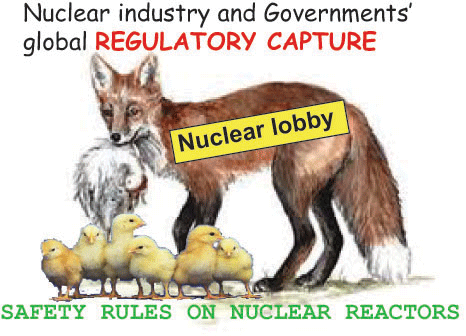 10 years after Fukushima, safety is still nuclear power’s greatest challenge The Conversation, March 6, 2021 Kiyoshi Kurokawa, Professor Emeritus, University of Tokyo, Najmedin Meshkati, Professor of Engineering and International Relations, University of Southern California ” …………A decade later, the nuclear industry has yet to fully to address safety concerns that Fukushima exposed.We are scholars specializing in engineering and medicine and public policy, and have advised our respective governments on nuclear power safety. Kiyoshi Kurokawa chaired an independent national commission, known as the NAIIC, created by the Diet of Japan to investigate the root causes of the Fukushima Daiichi accident. Najmedin Meshkati served as a member and technical adviser to a committee appointed by the U.S. National Academy of Sciences to identify lessons from this event for making U.S. nuclear plants safer and more secure. 10 years after Fukushima, safety is still nuclear power’s greatest challenge The Conversation, March 6, 2021 Kiyoshi Kurokawa, Professor Emeritus, University of Tokyo, Najmedin Meshkati, Professor of Engineering and International Relations, University of Southern California ” …………A decade later, the nuclear industry has yet to fully to address safety concerns that Fukushima exposed.We are scholars specializing in engineering and medicine and public policy, and have advised our respective governments on nuclear power safety. Kiyoshi Kurokawa chaired an independent national commission, known as the NAIIC, created by the Diet of Japan to investigate the root causes of the Fukushima Daiichi accident. Najmedin Meshkati served as a member and technical adviser to a committee appointed by the U.S. National Academy of Sciences to identify lessons from this event for making U.S. nuclear plants safer and more secure.
Those reviews and many others concluded that Fukushima was a man-made accident, triggered by natural hazards, that could and should have been avoided. Experts widely agreed that the root causes were lax regulatory oversight in Japan and an ineffective safety culture at the utility that operated the plant. These problems are far from unique to Japan. As long as commercial nuclear power plants operate anywhere in the world, we believe it is critical for all nations to learn from what happened at Fukushima and continue doubling down on nuclear safety. |
|
A new setback for France’s Flamanville nuclear reactor
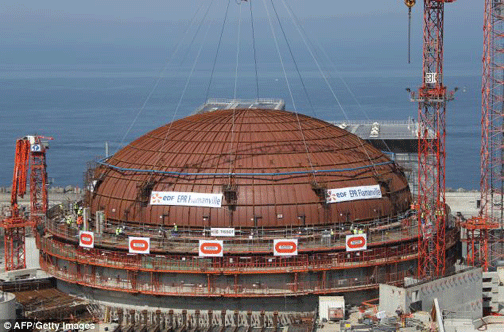 La Presse de la Manche 5th March 2021, Nuclear: a new setback for the Flamanville EPR. A “significant event” was declared on March 2, 2021 to the Nuclear Safety Authority, concerning taps on the main primary circuit of the EPR reactor. While the file of the welds to be resumed on the main secondary circuit , the steam circuit in fact, is still being examined by the Nuclear Safety Authority , EDF declared on March 2 to ASN a new “event”. significant “. It concerns deviations from the study reference system on three taps of the main primary circuit of the La Presse de la Manche 5th March 2021, Nuclear: a new setback for the Flamanville EPR. A “significant event” was declared on March 2, 2021 to the Nuclear Safety Authority, concerning taps on the main primary circuit of the EPR reactor. While the file of the welds to be resumed on the main secondary circuit , the steam circuit in fact, is still being examined by the Nuclear Safety Authority , EDF declared on March 2 to ASN a new “event”. significant “. It concerns deviations from the study reference system on three taps of the main primary circuit of theFlamanville EPR reactor. |
1 This Month



26 September – International Day for the Total Elimination of Nuclear Weapons


PLEASE OPPOSE HR 8255 AND S.3639 – bills would accelerate satellite deployment, with no environmental review or safeguards – https://ncstd5li.quorum.us/campaign/169331/
To see nuclear-related stories in greater depth and intensity – go to https://nuclearinformation.wordpress.com
-
Archives
- September 2026 (245)
- August 2026 (330)
- July 2026 (355)
- June 2026 (287)
- May 2026 (306)
- April 2026 (356)
- March 2026 (251)
- February 2026 (267)
- January 2026 (308)
- December 2025 (358)
- November 2025 (359)
- October 2025 (375)
-
Categories
- 1
- 1 NUCLEAR ISSUES
- business and costs
- climate change
- culture and arts
- ENERGY
- environment
- health
- history
- indigenous issues
- Legal
- marketing of nuclear
- media
- opposition to nuclear
- PERSONAL STORIES
- politics
- politics international
- Religion and ethics
- safety
- secrets,lies and civil liberties
- spinbuster
- technology
- Uranium
- wastes
- weapons and war
- Women
- 2 WORLD
- ACTION
- AFRICA
- Atrocities
- AUSTRALIA
- Christina's notes
- Christina's themes
- culture and arts
- Events
- Fuk 2022
- Fuk 2023
- Fukushima 2017
- Fukushima 2018
- fukushima 2019
- Fukushima 2020
- Fukushima 2021
- general
- global warming
- Humour (God we need it)
- Nuclear
- RARE EARTHS
- Reference
- resources – print
- Resources -audiovicual
- Weekly Newsletter
- World
- World Nuclear
- YouTube
-
RSS
Entries RSS
Comments RSS
 nuclear-news