Are California’s 2 active nuclear plants safe from earthquakes?
Both studies should help decide if California’s two active nuclear plants are safe enough to operate into the 2040s
 San Onofre’s Seismic Study to Play Role in Nuclear Plant’s Future The nuclear generating station has been offline since January. Southern California Edison is considering whether to re-license or shut down San Onofre after 2022. Poway Patch, April 27, 2012 Operators of the San Onofre Nuclear Generating Station are about to embark on a costly study on earthquake risk that could determine the future of the plant, it was reported Friday. Continue reading
Incompetence of nuclear safety executives – a world-wide problem
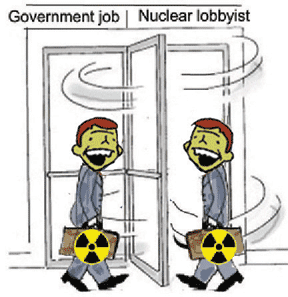 Fukushma the Japanese Chernobyl’…a year later and politics still ‘trump’ safety…UK Progressive, JEANINE MOLLOF | APRIL 29, 2012“……Fukushima—revolving door … The problems of Fukushima are endemic to the nuclear industry at large, where executives are frequently selected from government or business ranks rather than the scientific community. Fukushima was no exception.
In a WikiLeaks revelation—cables sent from the US Embassy in Vienna to Washington DC cited Tomihiro Tanguchi’s weak leadership as head of Safety and Security for the International Atomic Energy Agency ( IAEA). Complaints mounted concerning Taniguchi’s
incompetence and negligence especially with regards to the Japanese nuclear industry—eighteen months before the Fukushima disaster.
“For the past 10 years, the Department has suffered tremendously because of (deputy director general) Taniguchi’s weak management and leadership skills,” said one despatch on Dec 1, 2009.
“Taniguchi has been a weak manager and advocate, particularly with respect to confronting Japan’s own safety practices, and he is a particular disappointment to the United States for his unloved-step-child treatment of the Office of Nuclear Security,” said another, which was sent on July 7, 2009…..
http://www.ukprogressive.co.uk/fukushima%E2%80%A6-the-%E2%80%98japanese-chernobyl%E2%80%99%E2%80%A6a-year-later-and-politics-still-%E2%80%98trump%E2%80%99-safety%E2%80%A6/article18462.html
The General Electric Corporations’s connection with Fukushima
5 of the 6 reactors at Fukushima-Daiichi are GE manufactured Mark 1 systems. To add further insult to injury—the GE Mark 1 reactors at Fukushima—have “23 sisters in the US.” According to Nuclear Regulatory Commission (NRC) data, 23 of the 104 existing nuclear plants in the US are GE boiling-water reactors with GE’s Mark 1 radiation containment systems.
nuclear reactors such as those at Fukushima are little more than a radioactive time-bomb …”looking for a place to happen.’

 Fukushma the Japanese Chernobyl’…a year later and politics still ‘trump’ safety…UK Progressive, JEANINE MOLLOF | APRIL 29, 2012 “…….. The GE Connection to Fukushima… Tanaka has not been the only engineer involved in the building and operation of ‘boiling-water’ reactors who became a whistle-blower against corporate practices deemed scientifically negligent in the nuclear industry. Dale G. Bridenbaugh, Gregory C. Minor and Richard B. Hubbard, all former engineers with GE resigned in protest over major design flaws in the Mark 1 nuclear reactor designs they were reviewing.
Dubbed the “GE Three”—these engineers switched sides and joined the anti-nuclear movement in 1975. The GE Three were reviewing the Mark 1 system which is among the oldest reactors in use. Arguing that the Mark 1 system was a disaster in the making to deaf corporate ears—the three engineers quit in disgust. Continue reading
Earthquake fault underneath spells the end for Tsuruga nuclear plant
 Restart of Tsuruga nuclear reactors ‘almost impossible’: safety commission chief http://www.japantimes.co.jp/text/nn20120427b3.html Kyodo The chances of Japan Atomic Power Co. resuming operations at its Tsuruga nuclear plant in Fukui Prefecture are virtually nil now that an active fault is suspected to run directly beneath one of its reactors, the head of the Nuclear Safety Commission said Thursday. Continue reading
European Union chief wants greater nuclear plant safety tests
Oettinger said he had agreed with the European Nuclear Safety Regulators Group (ENSREG) to have more plants visited and to add more concrete information on the potential impact of airplane crashes.
“EU citizens have the right to know and understand how safe the nuclear power plants are they live close to.”
 Brussels unhappy with Europe nuclear stress tests http://www.google.com/hostednews/afp/article/ALeqM5jol2rLXOwQ-7rqnPnOJ29q7nDZCQ?docId=CNG.5f4e1c774335c730ee31b56d4e3bfe91.161 (AFP) –27 April 12, BRUSSELS — The EU’s energy chief Thursday deemed an almost year-long study on nuclear plant safety in Europe as short on detail and numbers and demanded further work before publication of the critical report.
“Going deep is more important than being fast,” Commissioner Guenther Oettinger told journalists, saying that a final report would be available to the public in the autumn rather than in the summer, as scheduled.
Ordered in the aftermath of the Fukushima catastrophe, the European Commission and national atomic regulators launched stress tests in June on 147 nuclear plants in 15 EU countries — including Lithuania which has closed down plants — plus 15 reactors in Ukraine and five in Switzerland. Continue reading
Salp invasion cuts nuclear power output
 Jellyfish-like creatures force California nuclear power plant to curtail operations By Steve Chawkins / Los Angeles Times, April 26, 2012 LOS ANGELES — Strange, jellyfish-like creatures swarming a coastal nuclear power plant: It might sound like the premise of a cult horror flick, but the invasion has prompted officials at the Diablo Canyon facility in San Luis Obispo, Calif., to curtail operations for at least a few days.
The plant’s operator, Pacific Gas & Electric, cut power generation from one of the plant’s two reactors to 25 percent of its capacity, spokesman Tom Cuddy said Wednesday. The other reactor was shut down this week for what PG&E described as routine refueling and
maintenance, a procedure that could take about a month.
Workers on Monday discovered an influx of the creatures, called salp, clogging screens that are used to keep marine life out of the sea water used as a coolant, Cuddy said. Often thronging many square miles of ocean in huge, gelatinous masses, salp are tubular, transparent organisms that can be roughly the size of a human thumb. No one knows how many are at the Avila Beach plant or how long they will remain…
.. Jellyfish swarmed Diablo Canyon in 2008, triggering a steep, sudden decrease in power generation. Over the years, they have been a problem at nuclear plants in the U.S., Japan, Israel andScotland. …. http://news.bostonherald.com/news/national/west/view/20120426jellyfish-like_creatures_force_california_nuclear_power_plant_to_curtail_operations/srvc=home&position=recent
Nuclear Risk Reduction Center expanding its role to security in cyberspace
In U.S.-Russia deal, nuclear communication system may be used for cybersecurity Washington Post, By Ellen Nakashima, April 26 A secure communications channel set up to prevent misunderstandings that might lead to nuclear war is likely to expand to handling new kinds of conflict — in cyberspace.
The Nuclear Risk Reduction Center, established in 1988 under President Ronald Reagan so that Washington and Moscow could alert each other to missile tests and space launches that could be mistaken as acts of aggression, would take a central role in an agreement nearing
completion between U.S. and Russian negotiators..
…The secure channel would be a milestone in the effort to ensure that misperceptions in
cyberspace — where it is difficult to know who is behind a digital attack or even whether a computer disruption is the result of deliberate action — do not escalate to full hostilities, say U.S.officials and experts from both countries…….. http://www.washingtonpost.com/world/national-security/in-us-russia-deal-nuclear-communication-system-may-be-used-for-cybersecurity/2012/04/26/gIQAT521iT_story.html?tid=pm_wo
Fukushima nuclear disaster remains critical
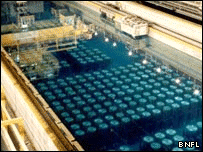 The Fukushima Nuclear Disaster Is Far From Over HUFFINGTON POST, Robert Alvarez, Senior Scholar, Institute for Policy Studies, 22 April 12, Spent reactor fuel, containing roughly 85 times more long-lived radioactivity than released at Chernobyl, still sits in pools vulnerable to earthquakes.
More than a year after the Fukushima nuclear power disaster began, the news media is just beginning to grasp that the dangers to Japan and the rest of the world are far from over. After repeated warnings by former senior Japanese officials, nuclear experts, and now a U.S. Senator, it’s sinking in that the irradiated nuclear fuel stored in spent fuel pools amidst the reactor ruins pose far greater dangers than the molten cores. This is why:
• Nearly all of the 10,893 spent fuel assemblies sit in pools vulnerable to future earthquakes, with roughly 85 times more long-lived radioactivity than released at Chernobyl
• Several pools are 100 feet above the ground and are completely open to the atmosphere because the reactor buildings were demolished by explosions. The pools could possibly topple or collapse from structural damage coupled with another powerful earthquake.
• The loss of water exposing the spent fuel will result in overheating and can cause melting and ignite its zirconium metal cladding resulting in a fire that could deposit large amounts of radioactive materials over hundreds, if not thousands of miles……
The urgency of the situation is underscored by the ongoing seismic activity where 13 earthquakesof magnitude 4.0-5.7 have occurred off the northeast coast of Japan between April 14 and 17. This has been the norm since the first quake and tsunami hit the Dai-Ichi site on March 11 of last year. Larger quakes are expected closer to the power plant.
Spent nuclear fuel is extraordinarily radioactive and must be handled with great care. In a matter of seconds, an unprotected person one foot away from a single freshly removed spent fuel assembly would receive a lethal dose of radiation within seconds. As one of the most dangerous materials on the planet, spent reactor fuel requires permanent geological isolation to protect humans for thousands of years…… http://www.huffingtonpost.com/robert-alvarez/the-fukushima-nuclear-dis_b_1444146.html
USA government reports calculate and confirm that nuclear power is highly dangerous
Nuclear power plants and the process of atomic fission in them are inherently dangerous—at a scale of technological disaster that is unparalleled.
now there are numerous and truly safe, clean energy technologies available that render nuclear power totally unnecessary. Thus, we can avoid sinking with the atomic Titanics which the nuclear power promoters insist we board.
Nuclear Titanics – The Perils of Technological Hubris, Counter Punch, by KARL GROSSMAN 16 April 12, On the 100th anniversary of the sinking of the Titanic, The Japan Times yesterday ran an editorial titled “The Titanic and the Nuclear Fiasco” which stated: “Presenting technology as completely safe, trustworthy or miraculous may seem to be a thingof the past, but the parallels between the Titanic and Japan’s nuclear power industry could not be clearer.”
“Japan’s nuclear power plants were, like the Titanic, advertised as marvels of modern science that were completely safe. Certain technologies, whether they promise to float a luxury liner or provide clean energy, can never be made entirely safe,” it said…
the same kind of baloney behind the claim that the Titanic was unsinkable is behind the puffery that nuclear power plants are safe. The nuclear power promoters are still saying that despite the sinking of atomic Titanics: Three Mile Island, Chernobyl and now the Fukushima Daiichi nuclear plants.
In fact, underneath the PR offensive are government documents admitting that nuclear power plants are deadly dangerous. The first analysis of the consequences of a nuclear plant accident was done in 1957 by Brookhaven National Laboratory, Continue reading
Fukushima Daiichi’s Unit 4 reactor a radioactive time bomb
if the [spent fuel rods] pool should spring a leak, or another earthquake bring the pool crashing down, all that fuel would be exposed to the outside air, letting them heat up and release massive amounts of radiation.
Fukushima Daiichi’s Achilles Heel: Unit 4′s Spent Fuel? WSJ, By Phred Dvorak, April 17, 2012, Just how dangerous is the situation at Japan’s crippled Fukushima Daiichi nuclear plant? Very, according to U.S. Senator Ron Wyden, a senior member of the Senate’s energy committee who toured the plant earlier this month.
Another big earthquake or tsunami could send Fukushima Daiichi’s fragile reactor buildings tumbling down, resulting in “an even greater release of radiation than the initial accident,”
Mr. Wyden warned in a Monday letter to Japanese Ambassador to the U.S. Ichiro Fujisaki. Continue reading
Don’t drink and Drive a Nuclear reactor
 Nuclear regulator proposes drug, alcohol policy for workers, The Star, 18 April 12 If you can’t drink and drive, maybe you shouldn’t drink and run a nuclear power plant.
Canada’s nuclear regulator has proposed new “fitness for duty” rules that would require anyone with unescorted access to sensitive areas of a nuclear plant to be subject to random drug and alcohol testing. The policy would be a departure for the Canadian Nuclear Safety Commission. “Presently, the CNSC does not have explicit alcohol or drug testing
requirements,” a spokesman said.
The commission does require nuclear operators to have a “fitness for
duty” program, but doesn’t spell out the requirements for drug and
alcohol use. Now, the commission has released a discussion paper proposing to change that.
“The CNSC believes in being proactive, in order to reduce the risk of impairment-related safety events at Canada’s nuclear power plants,” says the paper……
http://www.thestar.com/business/article/1163170–nuclear-regulator-proposes-drug-alcohol-policy-for-workers
Fire at Idaho nuclear research laboratory
Fire prompts evacuation at nuclear research lab in Idaho SALMON, Idaho, April 16 (Reuters) – A welder’s torch ignited a small fire on the roof of a building at a nuclear research laboratory in Idaho on Monday, prompting an evacuation, but no one was hurt and no radioactive material was involved, lab officials said.
Nearly 100 employees were cleared from the building, part of a complex that includes facilities housing spent nuclear fuel and radioactive waste at the Idaho National Laboratory, the U.S. Energy Department’s leading facility for nuclear reactor technology. Continue reading
30 years later, today’s road workers affected by radioactive spill
Workers sick amid highway radiation scare http://www.abc.net.au/news/2012-04-18/radioactive-discovery-halts-pacific-hwy-upgrade/3957168 April 18, 2012 Road workers were sent for medical treatment after vomiting when suspected nuclear material was unearthed during work on an upgrade to the Pacific Highway on the mid-north coast of New South Wales The materials, which include caesium, were buried north of Port Macquarie after a truck carrying radioactive isotopes from Sydney’s Lucas Heights nuclear reactor crashed in the area in 1980.
The isotopes were being taken to Brisbane, before being shipped to the United States. The upgrade’s project manager, Bob Higgins, says road workers fell ill after unearthing a strange clay-like material.
“As we’ve taken down the cutting there we exposed the face of the existing material (and) came across a clay material that when it’s exposed to air it gets an orange streak through it,” he said. ”There were a number of workers that felt a little bit of nausea and there was a bit of vomiting when they were in close proximity. ”[They went] off to the doctor, but obviously we need to be extremely careful here.”
The Environmental Impact Statement for the highway upgrade had noted some uncertainty about where exactly the containers were buried. Specialists are in the area assessing what to do with the radioactive materials, and if they pose any risk.
Let the Facts Speak: 1980, December 4 PORT MACQUARIE, AUSTRALIA Continue reading
Radiation safety fears in Sri Lanka, due to proximity to India’s nuclear projects
The recent developments in the Kudankulam nuclear power plant in Tamil Nadu’s Tirunelveli district is making Sri Lanka nervous as the power plant is only 250 kilo meters from Sri Lanka’s northwestern coastal town of Mannar.
 Sri Lanka sets up radiation warning system, Apr 14, 2012, ColomboPage News Desk, Sri Lanka. Apr 14, Colombo: Sri Lanka has taken measures to establish a warning system to alert to the danger of radiation in an event of a leak from the nuclear plants in neighboring India. Continue reading
Thousands of gallons of radioactive water into the river
NRC reveals radioactive water spill at Limerick nuke plant, The Mercury, By Evan Brandt 04/12/12 LIMERICK — “Several thousand gallons” of water containing as much as five-times the government’s “safe” level of radioactive tritium was accidentally released at Exelon Nuclear’s Limerick Generating Station last month and then flushed into the Schuylkill River, The Mercury learned Thursday….. http://www.pottsmerc.com/article/20120412/NEWS01/120419797/nrc-reveals-radioactive-water-spill-at-limerick-nuke-plant&pager=full_story
1 This Month




PLEASE OPPOSE HR 8255 AND S.3639 – bills would accelerate satellite deployment, with no environmental review or safeguards – https://ncstd5li.quorum.us/campaign/169331/
To see nuclear-related stories in greater depth and intensity – go to https://nuclearinformation.wordpress.com
-
Archives
- September 2026 (339)
- August 2026 (330)
- July 2026 (355)
- June 2026 (287)
- May 2026 (306)
- April 2026 (356)
- March 2026 (251)
- February 2026 (267)
- January 2026 (308)
- December 2025 (358)
- November 2025 (359)
- October 2025 (375)
-
Categories
- 1
- 1 NUCLEAR ISSUES
- business and costs
- climate change
- culture and arts
- ENERGY
- environment
- health
- history
- indigenous issues
- Legal
- marketing of nuclear
- media
- opposition to nuclear
- PERSONAL STORIES
- politics
- politics international
- Religion and ethics
- safety
- secrets,lies and civil liberties
- spinbuster
- technology
- Uranium
- wastes
- weapons and war
- Women
- 2 WORLD
- ACTION
- AFRICA
- Atrocities
- AUSTRALIA
- Christina's notes
- Christina's themes
- culture and arts
- Events
- Fuk 2022
- Fuk 2023
- Fukushima 2017
- Fukushima 2018
- fukushima 2019
- Fukushima 2020
- Fukushima 2021
- general
- global warming
- Humour (God we need it)
- Nuclear
- RARE EARTHS
- Reference
- resources – print
- Resources -audiovicual
- Weekly Newsletter
- World
- World Nuclear
- YouTube
-
RSS
Entries RSS
Comments RSS

