The danger of nuclear powered drones, and plutonium for spacecraft
 The Deadly Folly of Nuclear Power Overhead HUFFINGTON POST, Karl Grossman: 04/12/2012 The crash last week of a U.S. drone on the Seychelles Islands– the second crash of a U.S. drone on Seychelles in four months — underlines the deadly folly of a plan of U.S. national laboratory scientists and the Northrop Grumman Corp. for nuclear-powered drones. Continue reading
More unusual wear found in San Onofre nuclear plant
Additional tube wear found at troubled San Onofre nuclear plant on California coast Washington Post, By Associated Press, April 12 LOS ANGELES — The operator of an idled nuclear plant on the California coast announced Thursday that more unusual wear has been found on tubing that carries radioactive water, the latest disclosure in an ongoing mystery involving the plant’s steam generators.
Southern California Edison said in a statement that investigators at the San Onofre Nuclear Generating Station found additional wear in its Unit 2 generators that is similar to degradation in its sister reactor, Unit 3, though at a lower level…….
The new findings show “all of the generators are exhibiting the same kind of wear, though the wear in unit 3 is more excessive than in Unit 2,” Nuclear Regulatory Commission spokesman Victor Dricks said.
The twin-reactor plant has been shut down for more than two months while federal regulators and company officials try to find out why tubing designed to withstand many years of use under high pressure has been quickly wearing away……..
http://www.washingtonpost.com/national/additional-tube-wear-found-at-troubled-san-onofre-nuclear-plant-on-california-coast/2012/04/12/gIQAWEx8CT_story.html
In 3 days, Japanese government runs up sloppy safety standards, to keep the nuclear industry going
It even appears that the government intentionally worked out looser standards so that utilities can meet them in order to hasten the reactivation of Oi nuclear plant’s idled reactors.
Economy, Trade and Industry Minister Yukio Edano says there is no need for reactivation of nuclear reactors stopped for regular inspections if the overall supply of electric power is sufficient.

 New standards for reactivating nuke reactors are too hasty and sloppy , 11 April 12, http://mainichi.jp/english/english/perspectives/news/20120409p2a00m0na018000c.html The government should be criticized for having moved too hastily and in a sloppy manner when it set new standards for deciding whether to reactivate nuclear reactors, even though the criteria are crucial in ensuring the safety of the public.
Prime Minister Yoshihiko Noda and three Cabinet ministers concerned approved the standards on April 6 with an eye to approving resumption of operations at the No. 3 and 4 reactors at the Oi Nuclear Power Plant in Fukui Prefecture, which are currently suspended for regular inspections. Continue reading
The danger of nuclear powered drones to foreign countries, and to USA citizens
drones have become a nightmare for local residents. Civilian deaths inflicted by drone strikes have repeatedly strained relations between America and Pakistan….. ten times as many civilians as suspected terrorists died in U.S. drone attacks.
the document gives the “green light” for drone-based domestic spying.
Pentagon considers nuclear-powered drones. Space Daily Moscow Apr 09, 2012 American scientists are working on new-generation nuclear-powered unmanned aircraft capable of staying in the air for up to several months. While being able to tackle a wider range of more complicated tasks compared to their existing analogues, the new drones will not require a costly air base network for refueling and technical maintenance.
What’s more, on February 14 President Barack Obama signed the Federal Aviation Administration Reauthorization Act that allows the use drones in U.S. airspace by both state-owned and private companies….. Continue reading
Sri Lanka will raise safety objections to India’s Koodankulam and other nuclear reactors


 Sri Lanka concerned over radiation from India’s nuclear plants, Economic Times, 9 APR, 2012, COLOMBO: Sri Lanka today expressed concern over possible impact of radiation from India’s nuclear power plants located in the southern region, as it prepares to raise the issue with global atomic watchdog IAEA.
The official raising of concern with the International Atomic Energy is to be made in September, the power and energy minister Champika Ranawaka said. “We respect the right of India to have nuclear power stations. But our concerns are on the possible radiation affects they could have on Sri Lanka. We have already written a letter”, Ranawaka said…… Sri Lankan energy officials say at least three nuclear plants are located on the southern coast of Tamil Nadu which is separated from the island by a narrow strip of sea…… Koodankulam nuclear plant in India’s Southern coast is just 250 km from Sri Lanka’s northwest coastal town of Mannar.
Sri Lanka Atomic Energy Authority does not possess adequate facilities to face a threat of nuclear accident. http://economictimes.indiatimes.com/news/politics/nation/sri-lanka-concerned-over-radiation-from-indias-nuclear-plants/articleshow/12594324.cms
Palisades Nuclear Power Plant shut down after safety violations
Troubled Michigan nuclear plant shut down for maintenance,By Todd Sperry, CNN Senior Producer April 9, 2012 – Washington — A troubled Michigan nuclear power plant cited for safety violations has been taken off line for maintenance and refueling, the plant’s owner said Monday.
Palisades Power Plant, a 39-year-old facility located near Kalamazoo, has been under increased scrutiny from inspectors after the Nuclear Regulatory Commission cited the plant for three safety violations. The plant is currently owned and operated by Entergy Corporation…….
Violations at the plant included a September 25, 2011, incident in which half of the control room indicators were lost because of an electrical fault “caused by personnel at the site,” according to the NRC. A special inspection “determined the plant failed to have adequate work procedures for the electrical panel maintenance work to ensure the job was done successfully,” the NRC report said. Additionally, the NRC cited Palisades and Entergy for an October 2010 incident in which an operator left his post unattended in the nuclear
reactor’s control room without permission.
The Palisades spokesman declined to provide a timetable for when the work will be completed….. The news of a shutdown at Palisades came just days after Friday’s report that California’s San Onofre nuclear plant would remain shut down indefinitely until the source of problems with two of its generators can be determined. http://edition.cnn.com/2012/04/09/us/michigan-nuclear-plant/
Fire at Fort Calhoun nuclear plant was a major danger
Feds confirm Neb. nuke plant fire was major threat OMAHA, Tulsa’s Channel 8, Neb. (AP) – Federal regulators on Tuesday confirmed their preliminary finding that a fire at an idled Nebraska nuclear plant last June presented a serious safety threat.
The Nuclear Regulatory Commission said in its final determination that the small fire at the Fort Calhoun plant 19 miles north of Omaha was of “high safety significance.” The finding mirrored the commission’s preliminary conclusion announced March 12.
“This finding has high safety significance because it affected multiple safety systems and consequently warrants actions to prevent recurrence,” said the NRC’s regional administrator, Elmo Collins…… http://www.ktul.com/story/17375718/feds-confirm-neb-nuke-plant-fire-was-major-threat
Far from being over, Japan’s government fears worse to come from Fukushima
Such an event would cause widespread nuclear fallout throughout the region and force the government to evacuate the nearly 10 million residents of Tokyo and surrounding areas, a scenario which government emergency planners are now taking into serious consideration.
 It’s Not Over: Government Plans for the Worst: Forced Evacuation of Tokyo. Mac Slavo SHTF Plan.com, April 3rd, 2012 While it has for the most part disappeared from mainstream view, the Fukushima nuclear disaster is anything but over. In fact, the situation in Japan has gone from bad to worse.
Bottom line: There is no way to contain the radiation.
Even more alarming is that the U.S. Nuclear Regulatory Commission (NRC) and other agencies have warned that the nuclear storage pools (the containment units that are being used to cool the nuclear fuel) have been damaged and may collapse under their own weight. Continue reading
Fukushima nuclear plant not ‘under control’ as radioactive water spills
 Tons of radioactive water spill from Fukushima nuclear plant http://rt.com/news/fukushima-nuclear-water-leak-378/ 05 April, 2012, Officials at the Tokyo Electric Power Company (TEPCO), which acts as the operator of the crippled nuclear
facility, say there is reason to believe some of the 12 tons of radioactive water has flowed into the Pacific Ocean.
A leak was found in a pipe attached to a temporary decontamination system. The water, once it has been used to cool the reactors, contains massive amounts of radioactive substances and is put into the water-processing facility so it can be recycled for use as a coolant.
“Our officials confirmed that cooling water leaked at a joint in the pipes,” a TEPCO spokesman told reporters, adding that “it is possible that some of the water may have flowed outside the facility and pouredinto the ocean.”
This accident is the latest of several leaks of radioactive water at the plant, undermining the government’s claim that the shuttered reactors were now under control.
Just last month, about 120 tons of radioactive water leaked at the plant’s water decontamination system and about 80 liters (21 gallons) seeped into the ocean, according to TEPCO. The plant, which is just north-east of Tokyo, was crippled by
meltdowns and explosions caused by Japan’s massive earthquake and tsunami
Safety worries continue at Fort Calhoun Nuclear Power Plant
“It’s unsettling to live just a few miles from the plant,” ….. Regulators also found flaws in the utility’s analysis of how the plant would withstand different accident conditions such as earthquakes, tornadoes or loss of coolant.
Fort Calhoun Nuclear Power Plant Unlikely To Restart Before Fall (includes video) HUFFINGTON POST 04/ 4/2012 BLAIR, Neb. (AP) — Federal regulators said Wednesday it’s unlikely the Fort Calhoun nuclear power plant will restart before fall because of the extensive inspections and repairs needed. Continue reading
France’s nuclear plant leaks after 2 small fires
Leak Found in French Nuclear Plant http://online.wsj.com/article/SB10001424052702304072004577326322716346232.html?mod=googlenews_wsj By NADYA MASIDLOVER WSJ, 6 April 12, PARIS—French state-controlled utility Electricité de France SA said late Thursday that a leak was detected at one of its nuclear reactors in northwestern France, after two small fires were extinguished at the site earlier in the day.
France’s nuclear regulator said it had provisionally ranked the leak as a low-level incident and had returned to normal management of the situation after shifting to crisis mode earlier in the day. In a statement, EDF said that a faulty joint on a pump used to cool the reactor had caused a leak inside the reactor building of its nuclear power station in Penly, Normandy. The water from the leak is currently collected in circuits which exist for this use, the company said.
The reactor, which automatically halted after the fire, continues to be cooled normally and the plant teams are working to reduce the pressure and the temperature of the water in the circuit, according to EDF.
Even after a reactor is halted, the nuclear fuel continues to generate heat and must be cooled continuously.
French nuclear safety body, Autorité de Sureté Nucléaire, said it continues to analyze the situation and follow its evolution. The regulator said the incidents had no consequence on the environment.
Earlier in the evening, a spokeswoman for EDF said that lubricant from one of the reactor’s cooling pumps had leaked on the floor, generating smoke and small flames inside the reactor building. The two small fires were extinguished Thursday afternoon.
Japan postponing decision on restarting nuclear reactors
Japan holds off on decision to restart reactors
* PM wants Fukushima accident taken into account on safety standard
* Safety concerns run deep, local govts want new measures
By Risa Maeda, TOKYO, April 3 (Reuters) – Japan needs more time to decide whether to restart two offline nuclear reactors, the trade minister said on Tuesday, as concerns about a summer power crunch vie with safety worries in the wake of last year’s Fukushima crisis.
Prime Minister Yoshihiko Noda will not make any immediate decision on a restart date, Continue reading
USA military has had to stall plans for nuclear powered drones
Several drones are lost both in testing and in combat areas every year after the radio connection between controller and drone was broken. Most famously, a CIA-operated version of America’s most-advancedproduction UAV, the RQ-170 Sentinel crashed 140 miles inside Iran after the operators reportedly lost the radio signal that allowed them to control it….
U.S. decides against making crash-prone drones run on nukes Look, up in the sky, it’s a bird, it’s a plane, it’s 1,000 pounds of fissionable nuclear material falling this way! IT World, By Kevin Fogarty April 02, 2012, — The U.S. military has apparently shelved the idea of developing a nuclear-powered drone aircraft that would be capable of staying in the air for months, but would pose so great a risk of those it might crash on that it was canceled due to “political conditions.” Continue reading
Japan struggling with the idea of nuclear regulation independent of nuclear promotion
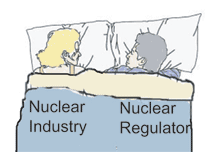 ‘Obviously, having promoters and regulators under the same roof is not desirable’
Previous investigations into the Fukushima accident have found evidence of lax supervision by NISA, cozy relations with utilities and delays in upgrading safety measures.
Japan’s new nuclear regulatory agency delayed Bloomberg, By MARI YAMAGUCHI 2 April 12, Japan’s government has failed to create a revamped nuclear regulatory agency by the promised date, April 1, amid political infighting, raising questions about its commitment to bolstering oversight in the wake of last year’s nuclear crisis. Continue reading
Seoul: agreements on non-nuclear medical isotopes the only bright spot
waste and spent fuel which are stored on an interim basis in pools of water or in casks are of the greatest concern
agreement between the U.S., France, Belgium, and the Netherlands was made to produce medical isotopes without the use of HEU by 2015.
Korea’s Nuclear Summit a Damp Squib, Asia Sentinel by Lee Byong-chul, 30 MARCH 2012 Little of significance despite the presence of the world’s most powerful leaders The Nuclear Security Summit held on March 26-27 in Seoul, has turned out to be a half-baked extravaganza that produced little of significance except for proclaiming the lofty goal of a nuclear-free world vision – while one of the world’s nuclear outlaws lurked just 65 km to the north, rattling rockets in the face of the world’s most powerful leaders. Continue reading
1 This Month





PLEASE OPPOSE HR 8255 AND S.3639 – bills would accelerate satellite deployment, with no environmental review or safeguards – https://ncstd5li.quorum.us/campaign/169331/
To see nuclear-related stories in greater depth and intensity – go to https://nuclearinformation.wordpress.com
-
Archives
- September 2026 (339)
- August 2026 (330)
- July 2026 (355)
- June 2026 (287)
- May 2026 (306)
- April 2026 (356)
- March 2026 (251)
- February 2026 (267)
- January 2026 (308)
- December 2025 (358)
- November 2025 (359)
- October 2025 (375)
-
Categories
- 1
- 1 NUCLEAR ISSUES
- business and costs
- climate change
- culture and arts
- ENERGY
- environment
- health
- history
- indigenous issues
- Legal
- marketing of nuclear
- media
- opposition to nuclear
- PERSONAL STORIES
- politics
- politics international
- Religion and ethics
- safety
- secrets,lies and civil liberties
- spinbuster
- technology
- Uranium
- wastes
- weapons and war
- Women
- 2 WORLD
- ACTION
- AFRICA
- Atrocities
- AUSTRALIA
- Christina's notes
- Christina's themes
- culture and arts
- Events
- Fuk 2022
- Fuk 2023
- Fukushima 2017
- Fukushima 2018
- fukushima 2019
- Fukushima 2020
- Fukushima 2021
- general
- global warming
- Humour (God we need it)
- Nuclear
- RARE EARTHS
- Reference
- resources – print
- Resources -audiovicual
- Weekly Newsletter
- World
- World Nuclear
- YouTube
-
RSS
Entries RSS
Comments RSS

