The risk of weakening safety standards at USA nuclear weapons facilities
Don’t let foxes guard our nuclear henhouse THE HILL, By Katherine M. Fuchs, program director, Alliance for Nuclear Accountability – 05/09/12 Today the House Armed Services Committee will debate the National Defense Authorization Act (NDAA), possibly overturning 25 years of safety standards at our nation’s weapons facilities. During this debate members of this committee will have a choice – they can protect communities around nuclear sites and the employees who work there or they can go on record as turning their back on those safety standards.
There are several sections of the NDAA that relate directly to nuclear safety and pose a threat to security. Perhaps the most troubling aspect of this bill is the fact that it would overturn the “adequate protection standard” that has guided nuclear safety oversight for over two decades. Continue reading
Japan’s idle nuclear reactors still need huge electricity to keep them safe
The end of nuclear, CLIMATE SPECTATOR, Matthew Wright , 8 May 2012 “………When they get too old to operate safely or get shut early due to disaster they still need to be propped up on life support, to manage the site cleanup, to manage their waste and to cool that waste.
In fact right now, Japan’s 54 idled reactors are using the electricity equivalent to the output of three entire reactors, just to provide cooling and other critical services. These will need to go on being delivered to the sites for years even if the reactors are to be completely decommissioned.
That means that nuclear reactors are competing with hospitals, schools and factories for scarce electricity supplies. Due to inherent safety risks, the reactors get power ahead of everyone else in the country. It doesn’t matter if you’re in an emergency ward needing urgent medical attention to save your life, the reactors’ safety comes first……
http://www.businessspectator.com.au/bs.nsf/Article/nuclear-power-and-Japan-end-of-nuclear-Fukushima-d-pd20120508-U3UUW?opendocument&src=rss
New Vogtle nuclear reactor – delays and unexpected costs
Utility: Building schedule slips on Ga. nuke plant The Telegraph, Middle Georgia, By RAY HENRY — Associated Press May 9, 2012 The timeline for building a first-of-its-kind nuclear plant in Georgia has slipped seven months, while the Southern Co. faces a dispute over who should pay for $400 million in unanticipated costs, utility executives said Wednesday. Continue reading
Japan is no further on in getting new nuclear regulator
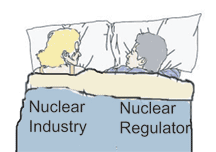 it would lead to problems in the future if the government rushes to restart Japan’s nuclear reactors without changing the current framework, in which the nuclear regulator is under the auspices of its promoter, the industry ministry.
New nuclear regulatory agency still up in air, Mainichi, 7 May 12 TOKYO (Kyodo) — Japan entered a rare period on Sunday of having no nuclear power supply following last year’s
Fukushima No. 1 Nuclear Power Plant disaster, without seeing much progress on shaping a new nuclear regulatory agency that could play a key role in addressing public concerns over the safety of atomic power.
The government plans to establish a new agency under the Environment Ministry amid criticism that the existing Nuclear and Industrial Safety Agency lacks teeth because it is under the umbrella of the Economy, Trade and Industry Ministry, a promoter of nuclear power.
But parliamentary deliberations on a bill submitted by the government to launch the new agency on April 1 have not yet started and the main opposition Liberal Democratic Party has complained that the organization’s independence would not be sufficiently secure under the government plan. Continue reading
Nuclear physicist plotted terrorist attack

 Nuclear researcher sentenced in France for plotting attack (Reuters) 4 May 12, – A Paris court sentenced a Franco-Algerian nuclear physicist to five years in prison on Friday on charges of helping to plot an attack in France in 2009 with an al Qaeda militant in Algeria.
Adlene Hicheur, 35, a former researcher at the prestigious CERN physics lab in Geneva, was found guilty of providing logistical advice to Mustapha Debchi, a militant for al Qaeda in the Islamic Maghreb (AQIM), using encrypted messages sent via the Internet.
Hicheur said he had been charged over his opinions rather than his acts, but prosecutors called him a “technical attack adviser” and said he had provided Debchi with a terrorist manual….. http://www.reuters.com/article/2012/05/04/us-france-crime-idUSBRE8431CK20120504
Apprehension in Kansas about radioactive waste shipments
 Kansas regulates radioactive-waste shipments far more loosely than nearby Missouri, Iowa and other Midwestern states through which such waste travels
No one who ships nuclear waste through Kansas is required to tell state authorities of their plans
More nuclear waste headed to Kansas, By Gene Meyer | Kansas Reporter, 4 May 12, FAIRWAY — Missouri lawmakers may relax their state’s monitoring of radioactive-waste haulers, a move that worries some Kansans. Continue reading
Savannah River Nuclear Site – inadequate radiation protection
NRC: SRS Saltstone facility’s radiation exposure may exceed limit in 10K years Aiken Standard 5/4/2012 By ANNA DOLIANITIS – Staff writer – email:adolianitis@aikenstandard.com A recent report released by the Nuclear Regulatory Commission expressed concern that the Saltstone Disposal Facility at the Savannah River Site may not meet the standards to prevent radiation exposure to the Site’s surrounding population in the long term….. Continue reading
At critical time, San Diego radiation monitor was not working
San Diego Radiation Monitor Not Working During Fukushima Crisis, Audit Reveals San Diego Reader, Matt Potter, May 3, 2012 An April 19 audit by the Inspector General of the United States Environmental Protection Agency has revealed that major components of the government’s radiation monitoring and reporting system, including an air sampling device in San Diego, were not functioning during last year’s Fukushima nuclear plant meltdown in Japan.
“On March 11, 2011, at the time of the Japan nuclear incident, 25 of the 124 installed RadNet monitors, or 20 percent, were out of service for an average of 130 days,” auditors said.
San Diego’s monitoring device was one of 11 said to be out of service for more than 140 days, according to the findings….. http://www.sandiegoreader.com/weblogs/news-ticker/2012/may/03/san-diego-radiation-monitor-not-working-during-fuk/
Paragliding into a French nuclear power plant!
 http://www.reuters.com/article/2012/05/02/france-nuclear-greenpeace-idUSL5E8G2F0C20120502
* Greenpeace enters nuclear site, drops smoke flare
* Intrusion just days before presidential runoff
* France’s high use of nuclear is issue in campaign
* Man entered Civaux plant’s security zone (Adds separate intrusion, details)
 PARIS, May 2 (Reuters) – A Greenpeace activist dropped a smoke flare as he flew over a French nuclear reactor on a paraglider on Wednesday, seeking to draw attention to what green activists call gaps in nuclear security four days before a presidential election runoff. The plant’s owner, EDF, confirmed an engine-powered paraglider had landed within its Bugey nuclear site in southeastern France. [ note – there’s a brief video of this flight at: http://usnews.msnbc.msn.com/_news/2012/05/02/11504375-greenpeace-bombs-french-nuclear-reactor-could-it-happen-in-us?lite ]
The pilot flew over the plant and threw a red-smoke flare on the roof of a building before landing, television images showed. Continue reading
Costs and safety problems in Japan’s older nuclear reactors
Six reactors in Japan, including Tsuruga’s unit No. 1, have the same design as those that failed at Fukushima—a General Electric Co. model called Mark I originally designed based on tests from the late 1950s and early 1960s.
In 2009, Chubu Electric Power Co. based in central Japan, decommissioned the No. 1 and 2 reactors at its Hamaoka nuclear-power plant because they were too expensive to keep up to safety standards.
 Japan Assesses Older Nuclear Plants WSJ, By MARI IWATA and ELEANOR WARNOCK, May 2, 2012, TOKYO—Japan is grappling with the question of whether older nuclear reactors are more prone to spinning out of control when a disaster hits, as the nation pushes to restart units for the first time since last year’s accident in Fukushima. Continue reading
Indonesia – earthquake zone – not good for nuclear reactors
 Indonesia should consider the fact that it is located on the “Pacific Ring of Fire”, making it prone to disaster.
Indonesians ‘should think twice’ before going nuclear http://www thejakartapost.com/news/2012/05/03/indonesians-should-think-twice-going-nuclear.html The Jakarta Post, Jakarta, 05/03/2012 Japanese experts have warned the Indonesian government to be very careful when deciding whether to generate power from nuclear energy, arguing that the archipelago is prone to natural disasters. Continue reading
USA’s Nuclear Regulatory Commission’s pro nuclear enthusiasts, in turmoil
The NRC review, published last July, made about a dozen safety recommendations.
But the nuclear regulators chose not to enforce those same safeguards before granting a licence to two new reactors at an existing plant in Georgia.
 Jaczko – the sole commissioner to object to the licence – argued the new project should have been built to the higher standard.
Republicans in Congress have been gunning for Jaczko since then.
The infighting that threatens to undermine US nuclear safety The Nuclear Regulatory Commission became more powerful post-Fukushima, but it has been beset by division and dissent, Guardian UK, 30 April 12,, Suzanne Goldenberg, US environment correspondent “……….the real drama, going largely unseen amid the infighting at the regulator, is over the future of America’s nuclear industry after the Fukushima disaster in Japan last year, nuclear experts say.USA’s nuclear regulators put costs above safety
“If filtered vents are good enough for Sweden, if they are good enough for Germany, if they are good enough for France and for Switzerland,” “they should be good enough for us.”
 Nuclear Safety Advocates Accuse Industry And Regulators Of Foot-Dragging On Basic Safety Measure HUFFINGTON POST, Tom Zeller Jr.04/30/2012 “…… one seemingly straightforward emergency feature: Requiring a filtered vent in the concrete containment buildings surrounding nuclear reactors like the one at Pilgrim.
Such a vent would come into play in only the worst sort of emergency, when the usual means for keeping the reactor core cool are lost and things inside are heating up to the point of becoming explosive. Operators can then open the vent and exhale the pressure directly into the air. The filter would capture dangerous radioactivity, to prevent contamination of the surrounding area.
Until now, vents have been an optional feature for American plant operators, but in March, the Nuclear Regulatory Commission issued its first orders since undertaking a review of safety systems and procedures at American plants in the aftermath of the disaster in Japan. Among the orders was a requirement that reactors of similar pedigree to those used at Fukushima should have containment vents installed. For reactors that already have them, steps should be taken to ensure they operate in an emergency, officials declared.
To the dismay of Lampert and others, however, regulators have not required filters, Continue reading
Revelations of the un-safety of Japan’s nuclear reactors
”All the samples would be considered nuclear waste if found here in the US.” – Arnie  Gundersen on soil samples taken recently from parks, playgrounds and rooftop gardens throughout Tokyo.
 Fukushma the Japanese Chernobyl’…a year later and politics still ‘trump’ safety…UK Progressive, JEANINE MOLLOF | APRIL 29, 2012 The Japanese Prime Minister Declares Nuclear Plant Safe… Last week, Japanese Prime Minister Yoshihiko Noda declared that nuclear units 3 & 4 at the Ohi Nuclear Plant were safe for operation.
Prime Minister Noda based this declaration on ‘stress tests’ which were nothing more than computer simulations. The computer simulations merely estimate any given reactor’s ability to withstand large earthquakes and/or tsunamis, allegedly like last year’s Fukushima disaster. No other studies, expert testimony or other considerations were mentioned. Unfortunately, for Japan—and the world—Noda couldn’t be more wrong. Continue reading
Safety flaws in San Onofre nuclear power plant
“Here’s a tip: when your nuclear reactor is springing leaks and radioactive pipes are deteriorating 20 times faster than they should, it’s a big deal, and no amount of nuclear spin by Edison or the NRC can hide that fact,”
 Study Claims Flaws Caused Nuclear Leak Laguna Beach Independent, Rita Robinson | April 29, 2012 Changes at the San Onofre nuclear power plant that “crammed” 400 additional tubes into one generator required drilling that allegedly weakened the generator’s foundation, according to a study by the nuclear watchdog group Friends of the Earth.
The weakened foundation along with removing a support piece called the “stay cylinder,” designed to prevent vibration, caused the tubes to rub against other apparatus and resulted in radiation leaks, said the report, issued earlier this month. Continue reading
1 This Month




PLEASE OPPOSE HR 8255 AND S.3639 – bills would accelerate satellite deployment, with no environmental review or safeguards – https://ncstd5li.quorum.us/campaign/169331/
To see nuclear-related stories in greater depth and intensity – go to https://nuclearinformation.wordpress.com
-
Archives
- September 2026 (339)
- August 2026 (330)
- July 2026 (355)
- June 2026 (287)
- May 2026 (306)
- April 2026 (356)
- March 2026 (251)
- February 2026 (267)
- January 2026 (308)
- December 2025 (358)
- November 2025 (359)
- October 2025 (375)
-
Categories
- 1
- 1 NUCLEAR ISSUES
- business and costs
- climate change
- culture and arts
- ENERGY
- environment
- health
- history
- indigenous issues
- Legal
- marketing of nuclear
- media
- opposition to nuclear
- PERSONAL STORIES
- politics
- politics international
- Religion and ethics
- safety
- secrets,lies and civil liberties
- spinbuster
- technology
- Uranium
- wastes
- weapons and war
- Women
- 2 WORLD
- ACTION
- AFRICA
- Atrocities
- AUSTRALIA
- Christina's notes
- Christina's themes
- culture and arts
- Events
- Fuk 2022
- Fuk 2023
- Fukushima 2017
- Fukushima 2018
- fukushima 2019
- Fukushima 2020
- Fukushima 2021
- general
- global warming
- Humour (God we need it)
- Nuclear
- RARE EARTHS
- Reference
- resources – print
- Resources -audiovicual
- Weekly Newsletter
- World
- World Nuclear
- YouTube
-
RSS
Entries RSS
Comments RSS

