Indian Point nuclear plant has three times the radioactivity of Fukushima’s spent fuel pools.
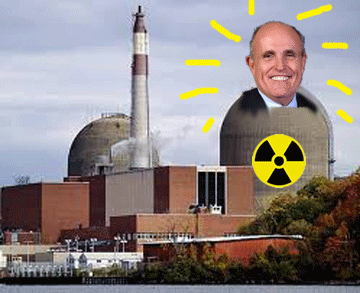 Wake Up and Smell the Radioactive Waste, OpEd News, 20 June 12, By Abby Luby“……Currently at Indian Point, 1,500 tons of high-level irradiated waste is stored in heavy steel and concrete casks on a tarmac a few hundred feet from the Hudson River. The Westchester-based plant produces about 30 tons of radioactive waste every 18 months, which is then crammed into two overcrowded, 40-foot deep spent fuel pools. Each pool holds about 1,000 tons of radioactive waste and has been leaking into the ground and river for years. However, the NRC has maintained that whatever leaches into the river is negligible, reiterating their catch phrase: “Dilution is the solution to pollution.”….
In a study by the Institute for Policy Studies, “Spent Nuclear Fuel Pools in the U.S.: Reducing the Deadly Risks of Storage,” Robert Alvarez, author and senior scholar for nuclear policy, said that Indian Point has three times the radioactivity of Fukushima’s spent fuel pools.
Indian Point is about 30 miles from Manhattan. A 1997 analysis, the Brookhaven National Laboratory [ http://pbadupws.nrc.gov/docs/ML0230/ML023040470.pdf – page 4] estimated a severe fire in a spent-fuel pool would release enough radioactive material to cause as many as 28,000 cancer deaths in a densely populated area and render 188 square miles uninhabitable.
In light of the Fukushima disaster and the potential for future leakage and catastrophic fires, the court ruled that the NRC’s analysis of the impacts of spent fuel storage was insufficient and is now requiring the agency to reassess the environmental impacts of the waste storage. Now it’s up to the NRC to heed the court and truly “protect the health and safety of the public.” http://www.opednews.com/articles/Wake-Up–Smell-the-Radioa-by-Abby-Luby-120614-180.html
No relicensing of nuclear reactors until a permanent waste solution is found
Anti-nuclear activist Ben Davis Jr. is also pushing to get a proposition placed on the statewide ballot that would force both California facilities to go offline and remain shuttered until such time as a feasible plan for nuclear waste storage was actually developed.
 Nuclear Waste Must be Considered in Plant Relicensing, San Diego Reader, Dave Rice, June 19, 2012 A June 8 decision from the U.S. Court of Appeals in Washington, D.C. could impact the Nuclear Regulatory Commission’s decision on re-licensing California’s two nuclear plants, as well as dozens of others across the nation.
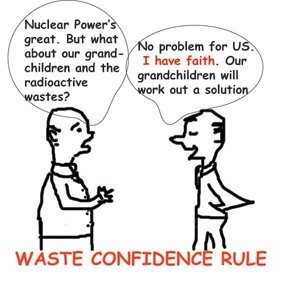
In a 2010 Waste Confidence Decision, the Commission ruled that permanent storage for highly radioactive spent fuel used in the reactors would be available “when necessary,” and said that it would be safe to store the spent fuel on the site of various power plants until a long-term repository became available…. Continue reading
Design flaws cause safety problems in San Onofre nuclear reactors
An environmental group, Friends of the Earth, has claimed Edison misled the NRC about the changes that it has identified as the likely culprit in excessive tube wear. The federal agency previously disputed that charge, but Collins said that’s under review as part of the
investigation. The group on Monday filed a petition asking the NRC to keep the plant offline until the company amends its license to reflect the design changes……
The NRC has said there is no timetable to restart the reactors.
Feds: Design led to nuke plant woes, Fuel Fix June 18, 2012 by Associated Press CAPISTRANO BEACH, Calif. — After months of investigation, federal regulators have determined that design flaws appear to be the cause of excessive wear in tubing that carries radioactive water through California’s troubled San Onofre nuclear power plant, a top federal regulator said. Continue reading
Russia can’t afford new nuclear plants, and can’t afford to shut down old ones
The decommissioning of nuclear plants after exhausting their resources will put an enormous strain on Russian state budget. Largely for this reason, Rosatom is making every effort to prolong their operational life, knowing quite well that there will be economic shockwaves in the industry should nuclear units be closed.
Russia’s Dangerous Nuclear Legacy – Analysis Eurasia Review, By: Richard Rousseau June 18, 2012“…….The safety of nuclear reactors is primarily provided through the increased number of sophisticated security systems and physical barriers that limit or contain potential radiation leaks. These systems consist of a combination of natural and artificial barriers that work in tandem and complement each other in assuring the required
long-term isolation of the waste by preventing or limiting the movement of radioactive substances from the infrastructure of the repository to the biosphere.
However, in essence this has made nuclear plants increasingly more complex systems, which in turn drives up their construction and operation costs, while it is still impossible to achieve a 100 percent safety level. Continue reading
Potential disaster at Hanford reservation’s nuclear power plant
Sadly, we have a similarly designed GE Boiling Water Reactor (BWR) with the same potentially disastrous arrangement of spent fuel storage at the Columbia Generating Station (CGS) — formerly known as the WPPSS 2 nuclear power plant — on the Hanford reservation on the Columbia River.
In view of the lessons learned from Fukushima Dai-ichi, it is unfortunate that the Nuclear Regulatory Commission has approved an extension of the CGS license for another 20 years. … A serious accident at the CGS nuclear power plant could provoke a double disaster because it would probably compromise cleanup of nuclear and toxic wastes at the site.
Shut down the Northwest’s only nuclear power plant, Oregon Live, , June 17, 2012 By John Howieson The Fukushima nuclear power accidents, resulting from the earthquake and tsunami that struck the northeast coast of Japan on March 11, 2011, have brought home to people around the world the perilous nature of nuclear energy. If a country as advanced as Japan cannot adequately regulate its nuclear industry to run its reactors safely, then we cannot assume anyone else is capable of it. ……
Recently, a wall of the spent fuel pool located over the Fukushima Dai-ichi number 4 reactor has revealed a bulge increasing the concern about its stability. Failure of this structure or of the precarious water supply cooling the spent fuel threatens a disastrous further release of radioactivity — an even greater amount than was released last year. Continue reading
Concern about “complex” nuclear waste at a former western Pennsylvania nuclear waste dump
 Security upped at former Pa. nuclear waste dump, TimesOnline, Jun 17, 2012. Guards from the federal Department of Homeland Security are patrolling a former western Pennsylvania nuclear waste dump as officials rethink their cleanup plans after finding what they called more “complex” nuclear material than expected.
The Pittsburgh Tribune-Review ( http://bit.ly/LwlpaH) says neither the Army Corps of Engineers, which is managing the cleanup, nor the Nuclear Regulatory Commission would say exactly what material was found at the Armstrong County site….
The dump along Route 66 was used to store nuclear and chemical waste from the former Nuclear Materials and Equipment Corp. in Apollo and Parks townships from about
1960 to the early 1970s. http://www.timesonline.com/news/state/security-upped-at-former-pa-nuclear-waste-dump/article_1e038332-6fd1-5569-aad2-2c9f4d5d1e8e.html
Nuclear regulators found security problems at San Onofre, but details not revealed
Feds find security issues at Edison nuclear plant, Bloomberg, June 15, 2012 SAN ONOFRE, Calif. (AP) — Federal regulators have uncovered security problems at Edison International’s troubled San Onofre nuclear plant on the California coast that could result in violations.
San Onofre has been closed for more than four months because of excessive wear on some equipment. It is operated by owner Southern California Edison, which is a unit of Edison International.
A Nuclear Regulatory Commission statement Thursday said inspectors reviewed records, observed activities and interviewed personnel during an inspection in May. The inspection found apparent violations, but many details were withheld because of security concerns.
The problems cited include failure to develop procedures to monitor security of certain electronic devices at the plant…. http://www.businessweek.com/ap/2012-06-15/feds-find-security-issues-at-edison-nuclear-plant
Fire at Spanish nuclear power plant
Fire Shuts Nuclear Plant in Spain , WSJ, By ILAN BRAT, 15 June 12, An electrical fire forced a shutdown of Spain’s Almaraz I nuclear plant, the country’s nuclear safety authority said Friday. One worker was injured in the fire in electrical equipment outside the building housing the reactor in western Spain.
The Nuclear Safety Council said the fire posed no threat for the general public or the environment…. http://online.wsj.com/article/SB10001424052702303822204577468610332293428.html
San Onofre nuclear plant, do we need its danger?
 Pasadena is about 70 miles from San Onofre, but 8.5 million people in Orange and San Diego Counties live within 50 miles of the plant and would be in the greatest danger if a serious accident were to occur at San Onofre.
To a great extent, [Japan will implement] a drastic conservation program that will include minimal use of air conditioning and the turning off of all unnecessary lights. Japan has become a living laboratory that will test the feasibility of such a program.
If Japan is successful in eliminating nuclear power, perhaps we can eventually do the same.
Nuclear deals with the devil?, US could learn from Japanese example in reducing nuclear energy dependency, Fourth in a series on the performance of California utilities, Pasadena Weekly, By John Grula 06/14/2012, Continue reading
Fukushima Daiichi – a global disaster still only in its infancy
There is every reason to suspect that the vital information about the full extent of the nuclear disaster in Japan is still being kept from the public; that the life-threatening damage to Japan’s nuclear infrastructure does not end with Fukushima #1.
The Fukushima Debacle is Only in Its Infancy The growing realization that the worst of the Fukushima debacle lies in the future rather than in the past puts in sharp relief the pertinence of Einstein’s observation.
 Fukushima Daiichi: From Nuclear Power Plant to Nuclear Weapon Global Research, by Prof. Anthony Hall , 13 June 12, “Our world is faced with a crisis that has never before been envisaged in its whole existence… The unleashed power of the atom has changed everything save our modes of thinking, and thus we drift towards unparalleled catastrophe.” Albert Einstein, Bulletin of the Atomic Scientists, May, 1946
Albert Einstein’s Warning and the Ominous Fate of Fukushima Daiichi
As the bad news gradually spreads that the debacle at Fukushima nuclear power plant #1 is becoming more perilous rather than less so, the words of Albert Einstein come to mind. Recall that the legendary physicist, Einstein, helped to set in motion the Manhattan Project whose personnel designed and built the first atomic bombs dropped on Hiroshima and Nagasaki in 1945…..
Albert Einstein worried that human ways of thinking could not be made to adapt to the changes brought to the world by the tapping the enormous energy sources emanating from the molecular constitution of inner space.
Japan as Laboratory Continue reading
Proposed nuclear reactor restarts in Japan – ‘woefully unprepared for accidents’
critics say the offsite center in Oi is woefully unprepared for a severe accident on the scale of Fukushima.
Fukushima Watch: Japan Gets ‘Feudal’ on Reactor Restarts By Chester Dawson and Mitsuru Obe, WSJ, June 12, 2012 As the Japanese government moves full steam ahead with plans to bring back online the first nuclear reactors since last year’s crisis in Fukushima, the town of Oi is preparing to roll out the futons for a pair of long-term visiting V.I.P.s from Tokyo. The two high-ranking government officials are being sent to the rural seaside town as part of a promise made last month by nuclear disaster minister Goshi Hosono, in order to pave the way for restarts of Oi’s No. 3 and No. 4 reactors—a controversial decision amid widespread public anxiety about nuclear safety. Continue reading
Comparing USA nuclear reactors with Fukushima reactors
nuclear reactors in the United States were built during the same time period as the Fukushima reactor, before 1980. These reactors were all built using the same 80-year-old technology, which is to say they’re all just as outdated as Fukushima and the materials and equipment used are all beginning to show the same signs of wear and tear.
 What makes this scenario even more alarming is that Gundersen says the reactors in the United States hold 4-5 times more nuclear waste than the Fukushima reactor.
Fukushima forum: Arnie Gundersen compares U.S. and Japanese nuclear reactors http://www.examiner.com/article/fukushima-forum-arnie-gundersen-compares-u-s-and-japanese-nuclear-reactors by Donna Anderson, 10 June 12 John B. Wells was at the helm for the Fukushima forum on the Saturday, June 9, 2012 edition of Coast to  Coast AM . The first guest was Arnie Gundersen who appeared on the show to share his expertise in the area of nuclear engineering and to make the American public more aware of the potential danger hiding in their own backyard.
Gundersen, who holds a master’s degree in nuclear engineering, has manged and coordinated design efforts for 70 nuclear reactors in the United States and has more than 40 years experience in nuclear power engineering. He’s currently working on the AP1000 nuclear power generator being built in South Carolina.
According to Gundersen the nuclear reactors in the United States were built during the same time period as the Fukushima reactor, before 1980. These reactors were all built using the same 80-year-old technology, which is to say they’re all just as outdated as Fukushima and the materials and equipment used are all beginning to show the same signs of wear and tear. Continue reading
Japan’s re-opened nuclear plants will not be safe until after 2015
Filtered vents that could substantially reduce radiation leaks in case of an accident ; a radiation-free crisis management building; and fences to block debris washed up by a tsunami won’t be ready until 2015. This means the plant, as well as plant workers and residents, won’t be fully protected from radiation leaks in case of a Fukushima-class crisis…
Japan readies for reopening of nuclear reactors amid safety concerns, guardian.co.uk, 8 June 2012 Prime minister Yoshihiko Noda assures citizens’ safety and says reactors must be restarted to boost economy… Prime minister Yoshihiko Noda said the government has taken ample safety measures to ensure the two reactors in western Japan would not leak radiation ifan earthquake or tsunami as severe as last year’s should strike them. Continue reading
Fukushima nuclear disaster remains a problem for the whole world
324 Civic organizations from all over the world have submitted a petition called “An Urgent Request for UN Intervention to Stabilize the Fukushima Unit 4 Spent Nuclear Fuel”, Mr. Murata said noting that those organizations are also demanding a moratorium on Japan’s nuclear reactors.
”the nuclear village and nuclear dictatorship is exposed, and public opinion and their movements are strong.”Nuclear village is a term for the Japanese distorted social structure in which the pronuclear politicians, scholars and companies have more power than those who are skeptical of nuclear energy. Anti-nuclear protests have been ignored for more than 40 years.
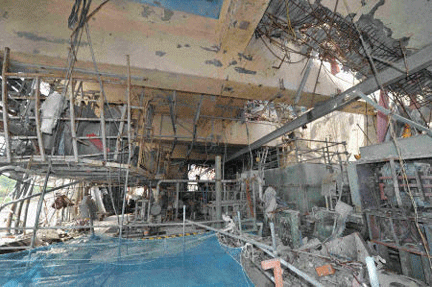 Fukushima Reactor Global Security Issue: Japanese Former Diplomat http://www.panorientnews.com/en/news.php?k=1784, June 7, 2012 Tokyo- (PanOrient News)The Fukushima Daiichi Nuclear Plant Number 4 reactor presents a security problem for the entire world, Mitsuhei Murata, Japan’s former ambassador to Switzerland said.
Fukushima Daiichi plants are “not under control at all… and the situation with nuclear reactors in Japan is like vehicles being driven without a license,” Mr. Murata told a news conference at the foreign correspondents’ club of Japan on June 5. Continue reading
Increasing global danger from nuclear weapons and nuclear power
the calculations used to assess risks posed by nuclear weapons and nuclear power are “fallible.”…. the risks posed by nuclear accidents, regional war, and nuclear terrorism are increasing…. “no nation is immune from risks involving nuclear weapons and nuclear power.”
 Risks from nuclear power and weapons are on the rise, Even established power faces a riskier nuclear environment. ArsTechnica, by James Holloway – June 7 2012, The risks posed by both nuclear weapons and nuclear energy are increasing. Nowhere is immune from these risks, and the methods used to assess them are imperfect. Continue reading
1 This Month




PLEASE OPPOSE HR 8255 AND S.3639 – bills would accelerate satellite deployment, with no environmental review or safeguards – https://ncstd5li.quorum.us/campaign/169331/
To see nuclear-related stories in greater depth and intensity – go to https://nuclearinformation.wordpress.com
-
Archives
- September 2026 (339)
- August 2026 (330)
- July 2026 (355)
- June 2026 (287)
- May 2026 (306)
- April 2026 (356)
- March 2026 (251)
- February 2026 (267)
- January 2026 (308)
- December 2025 (358)
- November 2025 (359)
- October 2025 (375)
-
Categories
- 1
- 1 NUCLEAR ISSUES
- business and costs
- climate change
- culture and arts
- ENERGY
- environment
- health
- history
- indigenous issues
- Legal
- marketing of nuclear
- media
- opposition to nuclear
- PERSONAL STORIES
- politics
- politics international
- Religion and ethics
- safety
- secrets,lies and civil liberties
- spinbuster
- technology
- Uranium
- wastes
- weapons and war
- Women
- 2 WORLD
- ACTION
- AFRICA
- Atrocities
- AUSTRALIA
- Christina's notes
- Christina's themes
- culture and arts
- Events
- Fuk 2022
- Fuk 2023
- Fukushima 2017
- Fukushima 2018
- fukushima 2019
- Fukushima 2020
- Fukushima 2021
- general
- global warming
- Humour (God we need it)
- Nuclear
- RARE EARTHS
- Reference
- resources – print
- Resources -audiovicual
- Weekly Newsletter
- World
- World Nuclear
- YouTube
-
RSS
Entries RSS
Comments RSS

