Anti nuclear Pilgrim Watch in hearing by Atomic Safety and Licensing Board
Anti-nuclear activists in Mass. seek hearing, Boston Herald, By Associated Press, June 7, 2012 – Activists who say federal regulators haven’t done enough to fix nuclear power plant flaws exposed by last year’s accident in Japan are arguing a nuclear safety board should hear their case.
The Atomic Safety and Licensing Board met in Boston today to hear from attorneys for Pilgrim Watch, which opposes the Pilgrim Nuclear Power Station in Plymouth. The board was trying to determine if it should hold a broader evidentiary hearing about Pilgrim Watch’s claims….. A Pilgrim Watch attorney said even if the fixes make plants marginally
safer, they still don’t adequately protect the public, and that gives Pilgrim Watch standing to try to overturn them. ww.bostonherald.com/business/general/view/20120607anti-nuclear_activists_in_mass_seek_hearing/
80 year plan for old nuclear reactors – invites catastrophe
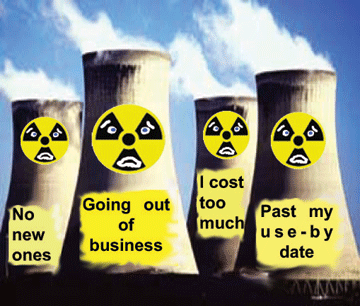 Nuclear regulators know that embrittlement of the reactor vessels limits nuclear plant life but are willing to expose the public to greater risks from decrepit, old and leaking reactors. As we learned from Fukushima, the nuclear industry is willing to expose the public to catastrophic risks
Getting operating license extensions “is a lucrative deal for operators,”
a concern by the nuclear industry that “they’re not going to build any new reactors anytime soon”–thus the push to keep existing plants running.
Inviting Atomic Catastrophe OPEd News 4 June 12By Karl Grossman The U.S. Nuclear Regulatory Commission will be holding a meeting this week to consider having nuclear power plants run 80 years–although they were never seen as running for more than 40 years because of radioactivity embrittling metal parts and otherwise causing safety problems. Continue reading
Need for probe on Nuclear Regulatory Commission’s dubious safety culture
U.S. Nuclear Agency Needs Independent Probe, Markey Says Bloomberg News, By Katarzyna Klimasinska June 04, 2012 An independent investigation is needed of alleged lapses in the safety culture at the U.S. Nuclear Regulatory Commission, Representative Edward Markey said, citing worker concerns about a lack of management support. Continue reading
Seabrook nuclear power plant fails safety test
NRC reports Seabrook nuclear plant failures in emergency test, SeaCoast online, By Shir Haberman, June 05, 2012 SEABROOK — The operators of the Seabrook Station nuclear power plant failed to properly detect a simulated radiological release and also failed to advise state emergency planning officials during a test of the emergency preparedness process held in April.
Plant staff also failed to detect the lapse until Nuclear Regulatory Commission inspectors pointed it out, an NRC report dated May 29 indicated.
“The finding (by NRC inspectors) is more than minor because it … affected the … objective to ensure that the licensee is capable of implementing adequate measures to protect the health and safety of the public in the event of a radiological emergency,” the report reads.
Multiple errors occurred during the full-scale, biennial emergency planning exercise conducted April 16-17 at the Seabrook plant, according to the NRC report. The test assigned to the plant’s emergency staff was a large-break loss of reactor coolant…..
http://www.seacoastonline.com/articles/20120605-NEWS-120609849
Indian Point still USA’s most dangerous nuclear plant
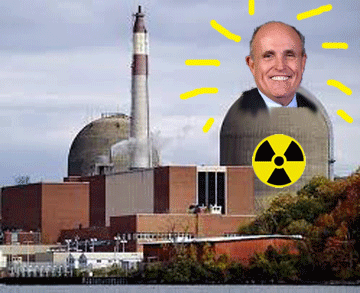 There is no protection for those fuel pools…You couldn’t see the fuel rods in fuel pool 2 because the water was so murky… it is so densely crowded with fuel rods, you can’t even get equipment in to fully inspect it …”
“There’s enough surplus power in this region to turn off Indian Point tomorrow and we won’t have any kind of shortage if we don’t do another thing until 2020,” “In the meantime, you can build two Indian Point’s worth of replacement power. You can save 30 percent of our power needs just by energy efficiency… We do not need the power —
they want to fool you into believing we do.”
Why the “Shut It Down” Crowd Won’t be Silenced Indian Point: Still America’s Most Dangerous Nuclear Plant? Counter Punch, by JOHN RAYMOND, 31 May 12 “Shut it down! Shut it down! Shut it down!” rang through the cavernous grand ballroom of the Doubletree Hotel in Tarrytown, NY, last week when the Nuclear Regulatory Commission staged an Orwellian charade promoted as an “open house” held to reassure the public that the Indian Point nuclear power plant was, as the New York Post headlined the following day, “Still Safe!”
The NRC’s annual “safety assessment” of the plant, which sits on the Hudson River 30 miles north of New York City, was based on 11,000 hours of ”inspection activities.” It found that Indian Point performed “within expected regulatory bounds” and the 25 matters that do require attention but “no additional NRC oversight,” are ‘low risk’, or have “very low safety significance.”
“So,” the Post mused, “will this finally silence the ‘shut it down’
crowd? …Don’t hold your breath.”
But do keep your fingers crossed…if you’re one of the 17.5 million
people living within 50 miles of the plant… Continue reading
USA’s Nuclear Regulatory Commission’s real role is to PROMOTE nuclear power
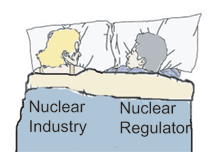
 Nuclear Rubberstamp Commission HUFFINGTON POST, Karl Grossman, 05/30/2012“… The resignation last week of the chairman of the U.S. Nuclear Regulatory Commission is another demonstration of the bankrupt basis of the NRC. Gregory Jaczko repeatedly called for the NRC to apply “lessons learned” from the Fukushima Daiichi nuclear plant disaster in Japan. And, for that, the nuclear industry — quite successfully — went after him fiercely.
The New York Times, in an editorial over the weekend , said that President Obama’s choice to replace Jaczko, Allison Macfarlane, “will need to be as independent and aggressive as Dr. Jaczko.”
That misses the institutional point.
The NRC was created in 1974 when Congress abolished the U.S. Atomic Energy Commission after deciding that the AEC’s dual missions of promoting and at the same time regulating nuclear power were deemed a conflict of interest. The AEC was replaced by the NRC, which was to regulate nuclear power, and a Department of Energy was later formed to advocate for it.
However, the same extreme pro-nuclear culture of the AEC continued on at the NRC. It has partnered with the DOE in promoting nuclear power.
Indeed, neither the AEC, in its more than 25 years, nor the NRC, in its nearly 30 years, ever denied an application for a construction or operating license for a nuclear power plant anywhere, anytime in the United States.
The NRC is a rubberstamp for the nuclear industry. “NRC stands for Nuclear Rubberstamp Commission,” says Kevin Kamps of the organization Beyond Nuclear. And it isn’t that Jaczko opposed nuclear power. “Greg is not anti-nuclear, but he’s pro-nuclear in a smart and considered way,” says Christopher Paine , director of the nuclear program at the Natural Resources Defense Council. Continue reading
New NRC chair Allison Macfarlane likely to be ‘crucified’ if she pursues nuclear safety
Nuclear Rubberstamp Commission HUFFINGTON POST, Karl Grossman, 05/30/2012“… “……..A “Petition for Rulemaking to Improve Emergency Planning Regulations ” was brought to the NRC in February by the Nuclear Information and Resource Service and 37 safe-energy and environmental groups. It declared that “the real-world experience of the Chernobyl and Fukushima disasters … were more severe and affected a much larger geographical area than provided for in NRC regulations” and asked, among other things, for the NRC to expand its current 10-mile evacuation planning zone around nuclear plants. “Waiting to see how bad an emergency gets before expanding evacuation … is not a plan of action, it is a recipe for disaster and an abdication of responsibility.” The likely NRC response? No.
On that issue, the nuclear industry was extremely upset that Jaczko, after the Fukushima accident began, advised U.S. citizens within 50 miles of the exploding nuclear complex to evacuate. It sought to continue the myth that 10 miles were fine.
As for the proposed new chair of the NRC, Allison Macfarlane, if she seeks to push safety, as theNew York Times thinks she can, she would be crucified — just like Jaczko.
The solution? Abolish the Nuclear Rubberstamp Commission — and shut down every nuclear power plant in the U.S. They provide just 20 percent of our electricity and this could be substituted for with electricity generated by safe, clean, renewable energy sources such as solar and wind — without the loss of lives. http://www.huffingtonpost.com/karl-grossman/nuclear-regulatory-commission-chairman_b_1549012.html
USA’s Nuclear Regulatory Commission weakening the rules on nuclear safety
“successful implementation of existing mitigation measures can prevent reactor core damage or delay or reduce offsite releases of radioactive material.” Tell that to the people impacted by Chernobyl and Fukushima.
the NRC is holding a meeting with DOE and the industry’s Electric Power Research Institute on extending licenses to 80 years. Consider the reliability of an 80-year-old car….
 Nuclear Rubberstamp Commission HUFFINGTON POST, Karl Grossman, 05/30/2012“……..At the NRC in recent months a move has begun to negate what has been its benchmark analysis on the impacts of nuclear plant accidents. “Calculation Reactor Accident Consequences 2,” referred to as the CRAC-2 report. Issued in 1982, it projects the impacts from a meltdown with a breach of containment at every nuclear plant in the U.S. Continue reading
USA’s Nuclear Regulatory Commission in crisis
 Exit Jackzo: The Nuclear Regulatory Commission in Free Fall
http://www.huffingtonpost.com/richard-brodsky/nuclear-regulatory-commission_b_1539797.html by Richard Brodsky, 25 May 12, The resignation of NRC Chairman Gregory Jackzo puts the issue of nuclear safety smack on the middle of Obama’s desk, and then into the presidential race.
That’s a good thing. The NRC is not doing the job that the law and common sense require it to do. It is a captive of the nuclear industry, operates in secret and without due regard for the public health and safety. The NRC’s relationship to the nuclear industry today is just what the SEC’s relationship was to Wall Street four years ago. We are skating on very thin ice. Continue reading
Without waiting for safety solutions, NRC approves relicense for Pilgrim nuclear plant
“When the regulator does not follow its own rules, don’t expect that
it will require the nuclear industry to do so either. Fukushima showed
what happen,”
Nuclear Regulatory Commission OKs new 20-year license for Pilgrim nuke plant, Boston Herald, By Associated Press, May 25, 2012 The Nuclear Regulatory Commission approved the renewal of the Pilgrim Nuclear Power Station’s operating license for another 20 years, the agency announced Friday, despite objections from Gov. Deval Patrick and other Massachusetts officials. The commission voted 3-1 to
authorize staff to renew the license before June 8, when the original
40-year license of the Plymouth, Mass., facility was set to expire.
Patrick called the NRC’s decision “extremely troubling.” He and other
officials, including Attorney General Martha Coakley and U.S. Reps.
Edward Markey and William Keating, had called on the NRC hold off on
renewal until all safety and environmental contentions had been
resolved. Continue reading
Radiation released right after Fukushima accident was much more than first estimated
Fukushima radiation higher than first estimated, By Kevin Krolicki TOKYO May 24 (Reuters) – The radiation released in the first days of the Fukushima nuclear disaster was almost 2-1/2 times the amount first estimated by Japanese safety regulators, the operator of the crippled plant said in a report released on Thursday. Continue reading
USA losing a strong advocate for nuclear safety, Gregory Jaczcko
Nuclear Power After Fukushima, May 25, 2012 The resignation of Gregory Jaczko, the embattled chairman of the Nuclear Regulatory Commission, means the country is losing a strong advocate for public safety who was always willing to challenge the nuclear industry and its political backers in Congress.
The White House’s choice to replace him, Allison Macfarlane, has strong credentials as an expert on nuclear waste and weapons. She will need to be as independent and aggressive as Dr. Jaczko. Both industry and her fellow commissioners will have to be pushed to implement necessary improvements highlighted by the disaster at the Fukushima Daiichi nuclear power plant in Japan…..
Another radioactive spill at Point Lepreau nuclear power plant
N.B. nuclear plant reports second spill in 6 months The Canadian Press 24, 2012 LEPREAU, N.B. — About 300 litres of radioactive heavy water spilled during a test at a New Brunswick nuclear power plant, making it the second spill at the site in less than six months.
NB Power said in a statement that the water spilled Monday at the Point Lepreau nuclear power plant, Atlantic Canada’s only nuclear facility…… In December, four to six lit res of radioactive heavy water spilled because of a leak at the plant, which prompted an evacuation. ….
….Point Lepreau has been out of service since March 2008 for a major refurbishment that’s meant to extend the life of the reactor by 25 years.
The project is about three years behind schedule and $1 billion over
the original $1.4-billion budget.
http://www.ctv.ca/CTVNews/SciTech/20120524/nuclear-power-plant-spill-120524/#ixzz1vsdrt7z3
Theft of uranium 235
Moldova: 3 Sentenced in Nuclear Case http://www.nytimes.com/2012/05/25/world/europe/moldova-3-sentenced-in-nuclear-case.html By REUTERS May 24, 2012 A Moldovan court sentenced three people on Thursday for their part in illegal trafficking of uranium-235, which can be used in making nuclear weapons. The three were part of a five-member group seized by the police in June during what was said to be an exchange of a cylinder containing the radioactive material for cash. Intelligence services from several other countries, principally the United States, Germany and Ukraine, were involved in the case, the justice authorities in Moldova said. According to the general prosecutor’s office, a Russian woman was sentenced to three years in prison, and her accomplice got five years. A third person was fined $1,200. The group had been trying to sell about two pounds of uranium-235 for $38 million, the prosecution said. It was not clear to what degree the uranium was enriched.
Nuclear fuel rods at Fukushima’s reactor no. 4 – highly dangerous
The workers are like Samurai warriors, they’re like suicide workers. They know they are getting huge amounts of radiation going to the site. They can only go in, seconds to minutes, at a time doing work and then the next batch has to come in.
Chernobyl had a half a million workers who worked minutes at a time. Here we have a situation much worse than Chernobyl simply because we have basically five reactors that could go up. One reactor setting off the next reactor, that’s a huge amount of radiation, over ten times the radiation inventory found in Chernobyl.
“People don’t realize that the Fukushima reactor (Number 4) is on a knife’s edge; it’s near the tipping point.
 includes videos and audio http://deathby1000papercuts.com/2012/05/large-crack-on-south-wall-of-fukushima-nuclear-reactor-number-four-photo/ Large
  Crack on South Wall of Fukushima Nuclear Reactor Number Four? DBKP. May 20, 2012 By LBG1 We could have adisaster much worse, many times worse than Chernobyl.” Dr. Michio Kaku on the precarious state of the spent fuel rods in the severely damaged Fukushima nuclear reactor Unit Number Four building Continue reading
1 This Month




PLEASE OPPOSE HR 8255 AND S.3639 – bills would accelerate satellite deployment, with no environmental review or safeguards – https://ncstd5li.quorum.us/campaign/169331/
To see nuclear-related stories in greater depth and intensity – go to https://nuclearinformation.wordpress.com
-
Archives
- September 2026 (339)
- August 2026 (330)
- July 2026 (355)
- June 2026 (287)
- May 2026 (306)
- April 2026 (356)
- March 2026 (251)
- February 2026 (267)
- January 2026 (308)
- December 2025 (358)
- November 2025 (359)
- October 2025 (375)
-
Categories
- 1
- 1 NUCLEAR ISSUES
- business and costs
- climate change
- culture and arts
- ENERGY
- environment
- health
- history
- indigenous issues
- Legal
- marketing of nuclear
- media
- opposition to nuclear
- PERSONAL STORIES
- politics
- politics international
- Religion and ethics
- safety
- secrets,lies and civil liberties
- spinbuster
- technology
- Uranium
- wastes
- weapons and war
- Women
- 2 WORLD
- ACTION
- AFRICA
- Atrocities
- AUSTRALIA
- Christina's notes
- Christina's themes
- culture and arts
- Events
- Fuk 2022
- Fuk 2023
- Fukushima 2017
- Fukushima 2018
- fukushima 2019
- Fukushima 2020
- Fukushima 2021
- general
- global warming
- Humour (God we need it)
- Nuclear
- RARE EARTHS
- Reference
- resources – print
- Resources -audiovicual
- Weekly Newsletter
- World
- World Nuclear
- YouTube
-
RSS
Entries RSS
Comments RSS

