Indian Point Nuclear Plant emergency procedures won’t be good enough

 Former NRC Chair: Emergency Plans Won’t Protect Residents from Radiation Huff Post , Roger Witherspoon, 8 Oct 13 The former head of the Nuclear Regulatory Commission said yesterday that emergency plans for a catastrophic event at the
  Indian Point nuclear power plant are not designed to ensure that residents will escape unhealthy doses of radiation and it would be best if the plant closes down.
Gregory Jaczko, who led the five-member commission during the triple meltdown of Japan’s Fukushima Daiichi nuclear station and resigned last year after intense clashes with the industry and the other four commissioners, said in a wide-ranging interview that:
- Emergency plans for Indian Point only teach officials how to make the best decisions in a bad situation and minimize the extent of contamination for those within 10 miles of the Hudson River site. The plans will do nothing to protect the 21 million people living within 50 miles, including New York City, northern New Jersey, eastern Pennsylvania, and western Connecticut.
- With the exception of Allison M. Macfarlane, his replacement as NRC Chair, the four commissioners “were brought onto the commission because they were more interested in looking at the impact of regulations on the industry rather than on the possible impact on the safety of the public.”
- The agency’s risk assessment, which undergirds its regulatory structure and determines what practices are safe, is seriously flawed because of a basic assumption that worst case scenarios cannot happen. As a result, there is little thought given to the consequences of accidents — even though it is certain that some will occur.
- Because the consequences of a meltdown at Indian Point are incalculably catastrophic, it would be best if the plant were closed. Continue reading
Radiation exposure to 6 Fukushima workers following pipe incident
6 Fukushima workers exposed to radiation after pipe incident Rt.com October 09, 2013 Six people working at the site of crippled Fukushima power plant have been exposed to radiation after one of them mistakenly removed a pipe connected to a contaminated water treatment system. It’s the second incident at Fukushima in three days.
The accidental pipe detachment on Wednesday resulted in the leak of several tons of water, which Fukushima operator TEPCO uses to cool the reactors. ……http://rt.com/news/fukushima-leak-radiation-workers-919/
Safety worries about China’s new nuclear plant
 China nuclear plant delay raises safety concern South China Morning Post, 07 October, 2013, Eric Ngeric.mpng@scmp.com The world’s first AP1000 third-generation nuclear power plant being built in Sanmen, Zhejiang province, has fallen behind schedule, and questions are being raised over its safety standards.
Industry veteran Li Yulun said the plant’s developer, China National Nuclear Corp (CNNC), and its United States technology partner Westinghouse should be more transparent about how mainland reactors would be built according to the most advanced safety standards.
“Our state leaders have put a high priority on [nuclear safety] but companies executing projects do not seem to have the same level of understanding,” Li, a former vice-president of CNNC, said on the sidelines of a recent clean energy conference in Macau.
The State Council in October last year decided to resume “normal” construction of nuclear power plants, ending a 19-month suspension of new project approvals amid a thorough safety review of all operating projects and those under construction or being planned following the earthquake-nuclear disaster in Japan in March 2011.
Beijing also scaled back expansion of new plants before the end of 2015 and allowed only a small number of “well-proven” projects in coastal regions……..http://www.scmp.com/business/china-business/article/1325973/china-nuclear-plant-delay-raises-safety-concern
Iran prevents latest nuclear sabotage plan
 Iran foils nuclear plant sabotage plot http://www.skynews.com.au/world/article.aspx?id=912635 Sunday October 6, 2013 Iran has arrested four people suspected of attempting to sabotage one of its nuclear plants, Atomic Energy Organisation chief Ali Akbar Salehi says. ‘Some time ago, we uncovered sabotage activities by several people at a nuclear plant,’ Salehi said in comments carried by the Mehr news agency on Sunday.
‘We let them continue their activities so that we could gather more intelligence. ‘We arrested them at the appropriate moment and their interrogation is ongoing.’ Salehi did not specify which of Iran’s nuclear plants was targeted.
In August last year, saboteurs blew up power lines supplying Iran’s underground uranium enrichment plant at Fardo outside the central city of Qom.
In 2010, a US cyber-attack, reportedly carried out in collaboration with Israel, hit Iran’s nuclear facilities. The Stuxnet virus was tailored specifically to target uranium enrichment facilities. ‘There are still viruses out there but we have taken the necessary measures,’ Salehi said.
‘Since we uncovered the Stuxnet virus, we have reinforced our protection systems and a special unit has been set up.’ In recent years, Iran has detained a number of alleged US or Israeli agents accused of spying on, or attempting to sabotage, its nuclear program. Several Iranian nuclear engineers have also been killed in what Tehran says were assassinations by foreign intelligence services.
Acute danger of huge radiation release in TEPCO’s work on Fukushima Nuclear reactor no 4
 A Mistake Now Could Release 14,000 Times More Radiation than Hiroshima http://oilprice.com/Latest-Energy-News/World-News/A-Mistake-Now-Could-Release-14000-Times-More-Radiation-than-Hiroshima.html By James Burgess | Sat, 28 September 2013 Lately the bad news emanating from Japan is that the reactors at the Fukushima nuclear power plant have been leaking thousands of gallons of water ever since the earthquake that struck it in 2011. There is a high chance that the radioactive water could hit Korea, China, and the West Coast of North America, and it is only likely to get worse with time as Tepco, the Japanese utility and operator of the power plant, is unsure how to stop the leaks.
Now however there is worse news that could prove dangerous to much of the world, and again Tepco could be responsible.
At Fukushima, used nuclear fuel rods are stored in pools and, especially at reactor 4, some of these pools are damaged and at risk of completely breaking open in the event of another earthquake. If one of the pools were to collapse or catch fire, then the impacts would affect the world. Arnie Gunderson, a nuclear expert, and Helen Caldicott, a physician, have even suggested that if this occurs then people should evacuate the Northern Hemisphere. And Akio Matsumura, a former advisor for the UN, has called the situation “an issue of human survival.”
Tepco could be responsible for unleashing this devastation on the world as starting in November they have decided to begin an operation to remove 400 tonnes of fuel rod assemblies, on their own. Aworkforce of thousands is preparing to work on the fuel rod pools at the instable reactor 4 in order to relocate them to a safer location.
The spent fuel, which contains plutonium, one of the most deadly substances in the universe, will prove to be a very delicate procedure. If a fuel rod is broken, cracked, or dropped whilst being removed, then it could cause an explosion, a meltdown, or a fire; all of which would release radionuclides into the atmosphere, and result in the evacuation of Tokyo and much of Japan.
The more than 1,300 fuel rod assemblies tightly packed into the building at reactor 4 contain enough radiation equivalent to 14,000 times the radiation released during the atomic bomb dropped on Hiroshima in 1945.
Each fuel rod assembly weighs close to 300kg and measure 4.5 metres long. The reactor 4 building contains 1,331 of spent assemblies and 202 unused assemblies.
Working completely underwater, the fuel assemblies will be pulled off their racks where they are currently stored, and then inserted into a heavy steel chamber, which shields the radiation. Then they will be removed from the pool, lowered to ground level and transported across the plant to a storage pool in an undamaged building.
Toshio Kimura, a former technician at Tepco, said that “previously Previously it was a computer-controlled process that memorized the exact locations of the rods down to the millimeter and now they don’t have that. It has to be done manually so there is a high risk that they will drop and break one of the fuel rods.”
Whilst aware of the inherent dangers, Tepco is confident that it can carry out the operation safely.
Nuclear radiological attack will find USA cities unprepared
U.S. Cities Unprepared to Deal with Large-Scale Nuclear, Radiological Attack Washington Free Beacon 1 Oct 13 Watchdog group says federal government has offered little guidance to major cities Major U.S. cities lack the capabilities and know-how to effectively deal with the fallout from a large-scale nuclear and radiological attack by terrorists, according to the government’s top watchdog group.
The federal government has conducted “limited” planning and offered little guidance to major cities that are vulnerable to either a radiological or nuclear attack, according to a Monday report issued by the Government Accountability Office (GAO).
The disorganization and lack of preparedness could lead to a “disjointed” emergency response, increasing “the consequences,” fatalities, and economic toll of such a disaster, the report said.
These potentially catastrophic “gaps in early response abilities warrant federal attention,” the GAO said.
Most major cities admitted that while local emergency personnel could scramble to treat victims, they remain uncertain about how exactly to deal with such an attack and whether the federal government would come to their assistance.
There is currently “limited federal planning guidance related to the early response capabilities needed by cities for the large attack depicted in the national planning scenarios,” the GAO reported.
The GAO recommends that the Federal Emergency Management Agency (FEMA) “develop guidance to clarify the early response capabilities needed by cities for RDD [radiological dispersion device] and IND [improvised nuclear device] attacks.”……….
“10 of those cities were perceived as not being able to conduct any of the response activities for an [nuclear] attack without federal assistance.”
FEMA maintains that federal guidance would not be necessary despite the apparent lack of preparation and coordination with the federal government, according to the report………..
The GAO is warning congressional leaders that much more preparation and coordination is needed.
“A disjointed or untimely response could put many additional lives at risk, increase economic consequences, and undermine the public’s confidence in the federal, state, and local governments’ ability to respond to such a crisis,” the GAO wrote in a Monday letter to Sen. Tom Carper (D., Del.), chairman of the Senate Committee on Homeland Security and Governmental Affairs. http://freebeacon.com/u-s-cities-unprepared-to-deal-with-large-scale-nuclear-radiological-attack/
Nuclear catastrophe avoided in USA – so far
 We’re Incredibly Lucky There Hasn’t Been a U.S. Nuclear Catastrophe…Yet Atlantic Wire ERIC LEVENSON, 30 Sept 13 Know that popular Liberty Insurance Mutual commercial that jokingly shows people making small mistakes — dropping an air conditioning unit from an upper-story window or forgetting to put on the emergency brake — that destroy their cars? Funny, right? Now imagine that, but with nuclear weapons.
That’s the frightening picture that author Eric Schlosser paints in his new book Command and Control, a look at the many accidents involving nuclear weapons that almost led to massive destruction. His conclusion isn’t very comforting — it’s partly plain old luck that has kept an explosion from happening, one of several points he made in a phone interview with The Atlantic Wire………
The book is scarily full of stories like the Damascus Accident, which Schlosser worked to get declassified for the book. In another case, a B-52 plane exploded above North Carolina during a supposedly-routine flight, dropping two hydrogen bombs below. They failed to explode because of a single low-voltage switch, the last safety measure available for the explosives. Other gut-wrenching examples were reported in The New Yorker, Los Angeles Times, and The New York Times Book Review.
Just as we are lucky that none of these accidents ever resulted in an explosion, we’re equally lucky that no unhinged military members had a Dr. Strangelove-like desire to take nuclear action into their own hands, a possibility which, despite Air Force claims to the contrary, was very real. “The reality was until the early 1970s, there was nothing to prevent a bomber crew from just flying to the Soviet Union with their hydrogen bombs and dropping them,” Schlosser said. “There were no codes that they had to type in to unlock the bombs or unlock the missiles. So we’re glad that never happened but it’s a pretty risky way to manage a nuclear weapon.”
Even more disconcerting — two people in charge of safety protocols for nuclear weapons didn’t even know about all of these accidents until Schlosser told them. That’s because of the Air Force’s compartmentalized secrecy, which prevents the bomb users from interacting with its developers, Schlosser explained. “There were bomb handlers and pilots who didn’t realize some of the safety problems with the weapons, and there were weapons developers who didn’t realize how these weapons were being handled. And that’s a very bad combination,” he said.
And this isn’t just a historical problem; many of these same issues remain today. “I’m concerned about the arsenal right now, and the morale of the people who are running it, and some of the safety violations we’ve been having for the last two years,” Schlosser said. While his work highlights the potentially huge problems of human infallibility, the solutions he suggests don’t offer much. “But if we’re gonna have these weapons, we need to take care of them properly,” he said. Any other options? “Or just get rid of them.” http://www.theatlanticwire.com/national/2013/09/eric-schlosser-book-command-and-control-review-nuclear-explosion/69949/
Nuclear chief involved in illegal gambling?
American nuclear chief investigated over casino cheating Navy Vice Admiral Timothy Giardina is accused of using counterfeit poker chips at an Iowa casino The Independent TIM WALKER SUNDAY 29 SEPTEMBER 2013 Apparently, the US military would prefer the officers in charge of its nukes not be the gambling sort. Over the weekend it emerged that Navy Vice Admiral Timothy Giardina, the second-in-command of the US nuclear arsenal, is the subject of an illegal gambling investigation into the use of counterfeit poker chips at an Iowa casino. Admiral Giardina, who has not been arrested or charged, was suspended from his duties on 3 September, officials said on Saturday…….
Private nuclear companies pose a catastrophic threat, as TEPCO has shown
Latest Fukushima Crisis Shows Catastrophic Threat of Nuclear Power Companies http://truth-out.org/buzzflash/commentary/item/18219-fukushima-shows-catastrophic-potential-of-privatizing-nuclear-power MARK KARLIN, EDITOR OF BUZZFLASH AT TRUTHOUT 27 Sept 13, The possibility of a global nuclear catastrophe as a result of the ongoing crisis at Fukushima is not only a real threat to untold lives in Japan and around the world, it is a model example of why nuclear power of any sort should not be privatized — and should only have limited uses within governmental programs.
As reported on Monday on BuzzFlash at Truthout, the potential nuclear radiation release from “repairs” at Fukushima threaten the globe. “Nuclear Crisis at Fukushima Could Spew Out More Than 15,000 Times as Much Radiation as Hiroshima Bombing,”Harvey Wasserman, a longtime anti-nuclear advocate, wrote on BuzzFlash. Truthout posted a follow-up story today that states, “We’re in very apocalyptic territory, with a wide and unknown range of outcomes.”
It’s hard to analyze the nuclear industry rationally when the private company, TEPCO, in Japan has just thrown up its hands and admitted it does not have a full-proof plan to prevent a nuclear disaster of proportions not yet seen. You can bet the Japanese government which has been assuring the world that everything was under control had a role in inviting international assistance in keeping Fukushima from creating a nuclear nightmare.
What is a private power company, TEPCO, doing in charge of “repairing” Fukushima anyway? How did we turn over an energy source that can threaten the survival of life on earth to private companies? Continue reading
Libya’s 6,400 Barrels of Uranium controlled by militias
Libya Wondering What to do with 6,400 Barrels of Uranium Stored in City Controlled by Militias Front Page mag, September 26, 2013 By Daniel Greenfield At the UN, Obama asked whether it would have really been better to leave Gaddafi in charge of Libya. Can we get a final answer on that after we decide what to do about those 6,400 barrels of uranium?
The country was reportedly holding 6,400 barrels of the “yellowcake” uranium at a warehouse in Sabha.
Foreign Minister Muhammad Abdul Aziz said his country “is trying to determine if the concentrated uranium can be used for peaceful nuclear energy purposes or sold to countries which use the product for peaceful purposes.”
An independent think tank in Tripoli, though, has reportedly advised the government to use the material in its nascent nuclear-power program, as well as for “industrial and agricultural development.”
How secure is the city of Sabha? As secure as any place in Libya. Which is to say… not at all….http://frontpagemag.com/2013/dgreenfield/libya-wondering-what-to-do-with-6400-barrels-of-uranium-stored-in-city-controlled-by-militias/
Japan finally accepting foreign help in Fukushima crisis
 AUDIO Japan agrees to foreign help with Fukushima ww.abc.net.au/worldtoday/content/2013/s3855960.htm Mark Willacy reported this story on Wednesday, September 25, 2013
PETER LLOYD: To nuclear issues of another kind now, and Japan has finally accepted international help to sort out the mess at the Fukushima nuclear plant. It’s agreed to let the French help decommission and dismantle it. Our Tokyo correspondent Mark Willacy says it’s a climb-down that signals how little success Japan has had stopping the spread of contaminant since the earthquake two and a half years ago. Continue reading
Japan is on the verge of a collapse after Fukushima- Tokyo Professor

 Tokyo Professor: I want to stress that Japan is on verge of collapse after Fukushima — Osaka Professor: If you don’t recognize health risks and take action right now, you have no future (VIDEO) http://enenews.com/tokyo-professor-i-want-to-stress-japan-is-on-verge-of-collapse-after-fukushima-osaka-professor-if-you-dont-recognize-health-risks-and-take-action-right-now-you-have-no-future-video
September 24th, 2013
By ENENews
Title: 0.23μ㏜ – Fukushima: Is There a Way Out?
Source: Arirang TV
Date: Sept. 9, 2013
Fukushima: Is There a Way Out? […] What kind of tomorrow awaits Japan? […] The Japanese public spends every day in fear and anxiety, as the repercussions of the nuclear crisis can be felt everywhere, and there is no end in sight yet. […] Where is Fukushima headed? Will Japan be able to find a way out?
At 42:00 in
Professor Taisei Namura, Ph.D., National Institute of Biomedical Innovation (Under jurisdiction of Japan’s Ministry of Health, Labor and Welfare, located in Osaka): Cancer doesn’t happen immediately. If you don’t recognize it and take action right now, you have no future. We must raise public awareness. We can’t rest assured just because it’s a small amount. The symptoms will not appear until decades later.
At 46:00 in
Professor Eiji Makino, Hosei Universityy (“One of the most traditional private universities based in Tokyo”): This tragedy has revealed that Japan’s political, social, economic, and moral standards are falling apart. I think we’re facing a big crisis. I want to stress one more time that Japan is on the verge of a collapse.
Watch the 48 minute broadcast here
Fukushima’s nuclear reactor No 4 poses an apocalyptic danger
We’re in very apocalyptic territory, with a wide and unknown range of outcomes. Take that for what it’s worth — little could go wrong, or much
Risky repair of Fukushima could spill 15,000x radiation of Hiroshima, create 85 Chernobyls, America Blog 9/23/2013 by Gaius Publius Does the planned November 2013 removal of the spent fuel rods stored at Fukushima’s heavily damaged Reactor 4 need a global intervention, or should TEPCO (Tokyo Electric Power Co., a for-profit company) be allowed to go it alone?
So far, the Japanese government is allowing TEPCO to handle it. Why should you care? Read on………
Reactor No 4 today. Notice that it has no roof. The spent fuel rods (and about 200 “fully loaded” unspent rods — remember that “reactor 4 had been de-fueled” prior to the accident) are stored in a water-containing chamber high off the ground in a crumbling room and building without a roof. Below – Unit 4 today

How will “they” get the damaged fuel rods out of that crumbling room?
This is the problem today. There are about 1300 fuel rods stored in that room, packed together vertically in racks. Think of a pack of cigarettes standing upright with the top of the pack removed. Normally, the movement of fuel rods is done by a computer-driven machine that reaches into the room from above and removes or replaces a fuel rod by drawing it upward or lowering it downward.
The machine knows to the millimeter where each fuel rod is located. Also, the rods are undamaged — perfectly straight.
The problem is that this pack of cigarettes is crumpled, and the process must done manually. Therefore, the likelihood that some of the fuel rods will break is high. If that happens and fuel rods are exposed to the air — BOOM. What does “boom” look like?
Fukushima’s owner, Tokyo Electric (Tepco), says that within as few as 60 days it may begin trying to remove more than 1300 spent fuel rods from a badly damaged pool perched 100 feet in the air. The pool rests on a badly damaged building that is tilting, sinking and could easily come down in the next earthquake, if not on its own.
Some 400 tons of fuel in that pool could spew out more than 15,000 times as much radiation as was released at Hiroshima.
Meanwhile, at the rest of the site: Continue reading
5 drums of radioactive trash fell off a truck at Hanford
In brief: Hanford drums fall from flatbed truck Spokesman Review, 24 Sept 13 RICHLAND – A Department of Energy contractor said five drums holding low-level radioactive waste fell off a flatbed truck in the center of Hanford on Monday but no contaminated material was released.
The drums were among 74 on the truck that were being shipped from a treatment facility at Hanford to a nearby plant, the Tri-City Herald reported.CH2M Hill Plateau Remediation Co. said the truck was in an area where the public is not allowed. It stopped at a railroad crossing and the drums fell off. Radiological surveys showed that none of the drums broke.
The company was working Monday to determine what caused the drums to fall.
The treatment facility receives contaminated wastewater from Hanford activities, and the material in the drums was solid waste left from the water treatment. http://www.spokesman.com/stories/2013/sep/24/in-brief-hanford-drums-fall-from-flatbed-truck/
What if USA’s nuclear bombs dropped in North Carolina HAD detonated?
 The Potential Nuclear Fallout in North Carolina, Mapped Atlantic Wire CONNOR SIMPSON 21 Sept 13 You’ve probably heard by now that the U.S. military nearly committed the biggest “oopsie daisy!” in history when they accidentally dropped two nuclear bombs near Goldsboro, North Carolina. But what if they did? Thankfully they didn’t detonate, but let’s imagine, just for a split second, that they did. This isn’t you typical Saturday morning exercise. There’s a certain macabre aspect to it investigation that can be hard to get over. Thousands of people would be dead, but it’s hard not to be at least a little curious to know how much of the U.S. would have been affected had the bombs gone off………
it would have been bad.
How bad, you ask? Well, by using the handy NukeMap3D created by Alex Wellerstein, we can determine how much destruction would have followed at least one atomic bomb dropping in North Carolina. The blast could have reached, with the wind blowing in the right direction, as far up the coast as New York City. Philadelphia and Washington would likely have been affected. This map is calculated with a 15 mile an hour wind and 100 percent fission:
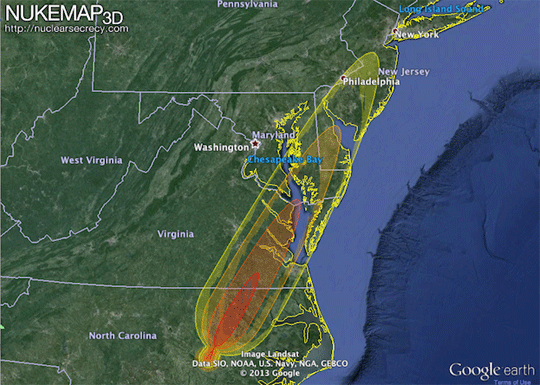
That’s a lot of the east coast. The fallout would likely not fall in such a straight line. And depending on the weather, could bend in many directions and possibly stretch even further. This is all speculative, of course. Most importantly, thankfully, the bombs never detonated in real life.
We know about this ultimate close call thanks to investigate journalist Eric Schlosser. He unearthed this declassified document that details the incident in question through a Freedom of Information Act request while researching his new book, Command and Control, about the nuclear arms race. http://www.theatlanticwire.com/national/2013/09/potential-nuclear-fallout-north-carolina-mapped/69701/
1 This Month




PLEASE OPPOSE HR 8255 AND S.3639 – bills would accelerate satellite deployment, with no environmental review or safeguards – https://ncstd5li.quorum.us/campaign/169331/
To see nuclear-related stories in greater depth and intensity – go to https://nuclearinformation.wordpress.com
-
Archives
- September 2026 (330)
- August 2026 (330)
- July 2026 (355)
- June 2026 (287)
- May 2026 (306)
- April 2026 (356)
- March 2026 (251)
- February 2026 (267)
- January 2026 (308)
- December 2025 (358)
- November 2025 (359)
- October 2025 (375)
-
Categories
- 1
- 1 NUCLEAR ISSUES
- business and costs
- climate change
- culture and arts
- ENERGY
- environment
- health
- history
- indigenous issues
- Legal
- marketing of nuclear
- media
- opposition to nuclear
- PERSONAL STORIES
- politics
- politics international
- Religion and ethics
- safety
- secrets,lies and civil liberties
- spinbuster
- technology
- Uranium
- wastes
- weapons and war
- Women
- 2 WORLD
- ACTION
- AFRICA
- Atrocities
- AUSTRALIA
- Christina's notes
- Christina's themes
- culture and arts
- Events
- Fuk 2022
- Fuk 2023
- Fukushima 2017
- Fukushima 2018
- fukushima 2019
- Fukushima 2020
- Fukushima 2021
- general
- global warming
- Humour (God we need it)
- Nuclear
- RARE EARTHS
- Reference
- resources – print
- Resources -audiovicual
- Weekly Newsletter
- World
- World Nuclear
- YouTube
-
RSS
Entries RSS
Comments RSS

