Fear of earthquakes may be prompting the speed up on clearing Fukushima Unit 4
Why are they ‘speeding up’ at Unit 4? — Expert in 2010: Megathrust quake to hit Fukushima ~Nov. 2013… Recurrence interval of 75 years with last rupture Nov. 1938 — Planet’s most powerful type of seismic event — WSJ: Top official concerned quake to destabilize fuel pool http://enenews.com/theyre-rushing-start-unit-4-expert-2010-megathrust-quake-hit-fukushima-nov-2013-recurrence-interval-75-years-last-rupture-nov-1938-planets-powerful-type-seismic-event-wsj-top-official-concern

Wall St. Journal,l, October 30, 2013 (Emphasis Added): Tepco will remove about 1,300 spent fuel rods and 200 new fuel rods […] the 4 meter-long rods will be pulled out of the pool at a time, is considered unprecedented in its scale. Shunichi Tanaka, chairman of the Nuclear Regulation Authority, has expressed concerns about the fragile state of the nuclear fuel left in three reactors and the spent fuel pool in the No.4 building. If improperly handled or destabilized by another major earthquake at the site, the fuel could discharge large amounts of radiation into the environment. […] Continue reading
Anxiety over poor screening of nuclear plant employees

 Arrests Call Into Question Nuclear Plant Employee Training, 5 NBC Chicago By Dick Johnson Wednesday, Oct 30, 2013 includes Video Two more Dresden Nuclear Power Plant employees have been arrested in the past month, further calling into question the security screening that all nuclear power plant employees must undergo on a regular basis.
NBC 5 Investigates has learned that Nery Fajardo, 40, and Black Speckman, 24, were in training to become licensed reactor operators at the Dresden plant, located in Morris, Ill., just southwest of Chicago.
But the two were arrested in September at an offsite party. Speckman is accused of tackling an officer, and Fajardo is charged with throwing a beer can at another officer and resisting arrest.
Nuclear safety experts say it’s further proof that there’s a breakdown in how employees are screened and trained at Dresden.
David Lochbaum, one of the nation’s leading independent experts on the subject, says “controls are not as tight as they should be.” The Dresden plant is one of six Illinois nuclear power plants operated by Exelon. The Nuclear Regulatory Commission has ordered Exelon to retrain all workers in those plants on proper security procedures, specifically on how to recognize and report suspicious behavior among employees.
It’s the direct result of the activities of Michael Buhrman and Landon Brittain, two former high-ranking Dresden employees who were senior nuclear operators at the plant.
Brittain is awaiting trial in DuPage County Jail, and Buhrman was just returned to the U.S. by federal marshals after being arrested in Venezuela.
Both men fled to the South American country after a wild diversion from their day jobs at Dresden. The NRC confirms Burhman recruited Brittain at the plant and tried to recruit others to help him in a carjacking and bank robbery based on his fascination with the movie “The Town.” Then, the men vanished………: http://www.nbcchicago.com/investigations/Arrests-Call-Into-Question-Nuclear-Plant-Employee-Training-229795161.html#ixzz2jKgRZ5b1
‘Bold and drastic’ action essential at Fukushima
Japan’s nuclear watchdog urges ‘bold and drastic’ action at Fukushima Raw Story, By Agence France-Presse Monday, October 28, 2013 Japan’s nuclear watchdog on Monday urged “bold and drastic” action to fix problems with radioactive water at Fukushima, as it warned of the growing risks over coming months.
Shunichi Tanaka, chairman of the Nuclear Regulation Authority, told the president of operator Tokyo Electric Power (TEPCO) that no expense should be spared in getting to grips with the water leaks that have beset the plant over the last half-a-year.
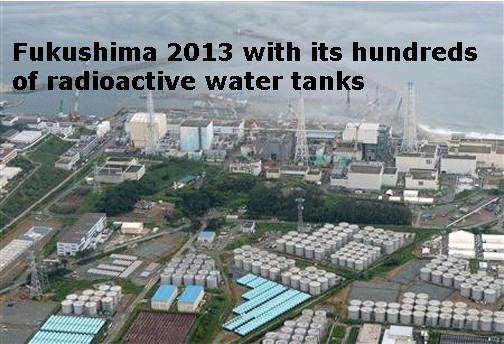
He also told Naomi Hirose that the removal of spent nuclear fuel rods from a cooling pool, which is due to begin next month, would be a difficult and complicated task……. Tanaka also urged TEPCO to exercise the utmost caution when it starts taking used nuclear fuel rods from a cooling pool at Reactor No.4.
In what is widely acknowledged to be the trickiest operation since the overheating reactor cores were stabilized in December 2011, TEPCO plans to take more than 1,000 fuel assemblies (bundles of rods) from the pool using a crane.
The assemblies must be moved one at a time and have to be kept in water to prevent them from spontaneously heating up. “Once a problem occurs, the risks will grow,” Tanaka told the TEPCO chief, according to Ikeda. “I would like you to do it very carefully.”
Hirose said he was fully aware of the possible dangers surrounding the operation, saying the firm would closely work with expert companies on site.
The full decommissioning of Fukushima is likely to take decades and include tasks that have never been attempted anywhere in the world, such as the removal of reactor cores that have probably melted beyond recognition.
Meanwhile, villages and towns nearby remain largely empty, their residents unable or unwilling to return to live in the shadow of the leaking plant because of the fear of radiation. http://www.rawstory.com/rs/2013/10/28/japans-nuclear-watchdog-urges-bold-and-drastic-action-at-fukushima/
Criminal behaviour by senior nuclear power plant operators
 Report: U.S. nuclear reactor operators captured — Several officers wounded — Terrorism charges for wanting to acquire C-4 explosives — Investigated for arms trading, trafficking of illegal substances — Planning kidnapping, murder http://enenews.com/report-u-s-nuclear-reactor-operators-captured-several-officers-wounded-terrorism-charges-for-wanting-to-acquire-c-4-explosives-investigated-for-arms-trading-trafficking-of-illegal-substance
NRC Press Release,, Oct. 28, 2013: NRC Issues Orders to Dresden Nuclear Plant and Former Plant Employees […] NRC investigated the incident in which senior reactor operator Michael J. Buhrman, planned to rob an armored car and recruited the assistance of another senior reactor operator, Landon E. Brittain […] Buhrman was apprehended for aggravated vehicular carjacking and fled the country after being released on bail […] NRC concluded that Buhrman’s and Brittain’s actions while offsite demonstrated they could not be relied upon to adhere to NRC requirements to protect plant and public safety. In addition, Dresden personnel who knew about Buhrman’s plan to commit an offsite crime failed to report the situation to plant management, which is an NRC requirement […] The company agreed to abide by the conditions of the order [including] developing a presentation of the facts and lessons learned from this incident to be presented at industry forums. […] The orders to Buhrman and Brittain prohibit them from participating in NRC-licensed activities due to the NRC’s lack of confidence that they can meet the agency’s safety requirements […]
Now for the rest of the story…
Enformable,, Oct. 25, 2013: […] SEBIN is an elite taskforce [in Venezuela] that only works special cases of organized crime, major fraud, etc […] SEBIN was already investigating [Buhrman and Brittain] for illegal arms trade and trafficking of illegal substances including steroids. After arriving in Venezuela, Buhrman and Brittain rented a luxury property, frequented a local gym, and were associated with a Venezuelan gang […] Once Buhrman began catching on to [a Venezuelan racketeer’s plan to tell police of Brittain and Buhrman], he began planning his murder. While attempting to capture Buhrman, several officers were wounded by the fugitive. One left with a fractured arm and another with a fractured foot. […] Landon Brittain was captured on May 23rd […] Buhrman’s last lover in Venezuela was the 19-year-old daughter of a prominent businessman […] the fugitive criminal was planning an offensive move involving kidnapping the businessman and holding him ransom. SEBIN arrested five other Venezuelans in relation to Buhrman and Brittain, who all face charges [that include] terrorism. The terrorism charge was added because Buhrman was interested in acquiring C-4 explosives and a Kalashnikov AK-47 for criminal purposes. Michael Buhrman was on a 5:00 pm flight today [Oct. 25, 2013] in the custody of U.S. Marshalls en route to the United States from Venezuela. […]
Depleted uranium and nuclear wastes – the perfect opportunity for “dirty bombs”
 Nuclear Power Dirty Bomb The Market Oracle, Oct 28, 2013 By: Andrew_McKillop “……RECYCLE, REUSE AND DEFEND THE ECONOMY Nuclear waste business, as we know, is not business friendly and leads to the very basic reflex of simply dumping a considerable and growing part of the world’s unmanageable nuclear wastes from the current world fleet of around 436 operating civil reactors (depending on how many Japanese reactors are brought
  back into service). Proliferation risks are deliberately restricted to only conventional explosive nuclear weapons and their radioactive materials – totally ignoring both Depleted Uranium weapons using “recycled” nuclear wastes, and the potential future Dirty Bomb targets of active and “partly decommissioned” reactors lurking on the horizon. These with almost no possible doubt will be prime targets in coming civil wars and international wars. These nuclear war options are above all cheap, and of course very dirty.
Since the 1991 Gulf War 1 against Iraq, the war against Afghanistan starting in 2001, and the second war against Iraq of 2003 at least 2500 tons of Depleted Uranium weapons have been used by the US, UK and France in these “delightfully far away” over the horizon wars against lesser races and nations. Depleted Uranium ordnance, to date has caused a conservatively estimated 10 000 cancer deaths, and as many as 50 000 still-living cancer victims in Iraq and Afghanistan.
This has easily calculated economic consequences. When this concerns free market white democrat middle class consumers, the same types of cancers are costed at roughly $ 40 000 for a cancer death and $ 25 000-per-year for surviving cancer sufferers.
The “cute idea” of recycling nuclear wastes as DU ordnance has a cosy market-friendly smell, to some, but the economic damage that these filthy weapons generate smells a lot worse. Those who profit from misery and death will finally pay. The same weapons can be turned around and used on them……… http://www.marketoracle.co.uk/Article42864.html
How long can China’s nuclear industry stay “safe”?
 Chinese nuclear disaster ‘highly probable’ by 2030 The Ecologist, He Zuoxiu 25th October 2013 “……But if China sticks to plans to build another 30 third-generation power stations between 2015 and 2020, the risks rocket. No AP1000 reactors – one of the key third-generation designs – have yet been built anywhere in the world, meaning there are no reactor-years of experience. Only the figures of 267 reactor-years from Three Mile Island’s 267 reactor years and Chernobyl’s 162 reactor-years can be used as reference.
Even if we take the larger of those numbers, that brings the “most probable” period for a nuclear accident in China forward to between 2020 and 2030.
Some may say that “theoretically” third-generation reactors are safer than their second-generation equivalents. In fact, these 30 nuclear power plants will use reactors that have not been operationally tested. They are all being built inland and all face problems with water supply. Several third-generation plants, including Pengze in Jiangxi and Taohuajiang in Hunan, each with six reactors, cheated during the environmental impact assessment process, with no action taken by the National Nuclear Safety Administration.
For safety’s sake, it would be better to stop at 41 reactors, a number due to be reached in 2015. The Great Leap Forward mentality
Why did the US and former Soviet Union see nuclear accidents so soon? Apart from a lack of experience and immature technology, another factor was the Cold War mentality – both were fighting to be the world’s number one nuclear power.
Similar attitudes exist in China today. Nuclear decision-makers aim to build up to 500 nuclear power stations by 2050, exceeding the current global total of 443, and allowing the country to claim the world’s number one spot.
This is nothing but Great Leap Forward thinking. If these attitudes continue, we will likely see “most probable” will become the “actual”.
This article was first published by China Dialogue under a Creative Commons “Some Rights Reserved” licence. http://www.theecologist.org/News/news_analysis/2133281/chinese_nuclear_disaster_highly_probable_by_2030.html
Japan’s nuclear regulator is in an unwinnable position
 Nuclear regulators can’t win, Japan Times , 27 Oct 13 THE NUCLEAR REGULATION AUTHORITY – , which observed the first anniversary of its creation on Sept. 19, faces two diametrically opposed criticisms. Proponents of nuclear power generation criticize the NRA as the root cause of the delay in the government’s policy to promote nuclear power, while “no-nuke” groups brand the body as a mouthpiece of the “nuclear power village” (the strong network of public organizations and power companies that work toward expansion of nuclear power).
These bitter criticisms coming from both ends of a spectrum seem to summarize the contradictions of Japan’s nuclear power policy. The NRA has become a skewed organization because the idea behind creating it was to satisfy both proponents and opponents of nuclear power. That has resulted in the lack of capabilities to execute its missions, thus making nuclear power plants in Japan even more dangerous than before. Continue reading
China’s nuclear safety prospects are not good
China is projected to have 71 nuclear power stations by 2020. If we use the figure of 4,922 reactor-years as explained above, then China will “most probably” suffer a major nuclear accident within the next 69 years.
Chinese nuclear technology can be regarded as approaching global levels, with similar design, safety and operational standards. But to reduce costs, Chinese designs often cut back on safety. In the past, earthquake-resilience was lower than in Japan, for example. China also has much less experience of this sector than Japan.
 Chinese nuclear disaster ‘highly probable’ by 2030 The Ecologist, He Zuoxiu 25th October 2013 As the UK prepares to build a fleet of new nuclear power stations with Chinese capital and expertise, a former state nuclear expert warns: China itself is heading for nuclear catastrophe. Some members of the nuclear power industry rely too much on theoretical calculations, when only experience can provide real accuracy.
The lifetime of nuclear reactors is calculated in “reactor-years”. One reactor year means one reactor operating for one year. The world’s 443 nuclear power plants have been running for a total of 14,767 reactor-years, during which time there have been 23 accidents involving a reactor core melting. That’s one major accident every 642 reactor years.
But according to the design requirements, an accident of that scale should only happen once every 20,000 reactor years. The actual incidence is 32 times higher than the theory allows. Continue reading
Potentially ‘Apocalyptic’ consequences in removing Fukushima nuclear reactor’s spent fuel rods
 Fuel Removal From Fukushima’s Reactor 4 Threatens ‘Apocalyptic’ Scenario. Radiation Fuel Rods Matches Fallout of 14,000 Hiroshima Bombs By Common Dreams Global Research, October 25, 2013 by Andrea Germanos
An operation with potentially “apocalyptic” consequences is expected to begin in a little over two weeks from now – “as early as November 8″ – at Fukushima’s damaged and sinking Reactor 4, when plant operator TEPCO will attempt to remove over 1300 spent fuel rods holding the radiation equivalent of 14,000 Hiroshima bombs from a spent fuel storage tank perched on the reactor’s upper floor……
The potential radiation releases in this situation can only be described as apocalyptic. Continue reading
Oconee Nuclear Station – one reactor shut down
1 reactor shut down at Oconee Nuclear Station The Tribune, : October 25, 2013 By JEFFREY COLLINS — Associated Press COLUMBIA, S.C. — The Oconee Nuclear Station near Seneca had to shut down one of its three reactors after a problem in the water system that helps generate electricity, federal regulators said.
Unit 3 at the plant was manually shut down by Duke Energy around 6 a.m. Thursday, about four minutes after the problem was detected, Nuclear Regulatory Commission spokesman Roger Hannah said.
A control valve in the plant’s water system started causing changes in the flow of water that generates steam to turn the turbines and create power. Engineers shut down the reactor before it was automatically turned off, and there was no danger to the public, Hannah said……. The shutdown did come in the same month the Government Accountability Office released a report about nuclear plant safety. Since 2000, the Oconee Nuclear Station reported the most safety violations of any nuclear plant in the Southeast.
The plant reported 163 lower-level violations and 14 higher-level violations. Lower-level violations pose very low risk, such as improper upkeep of a transformer, while higher-level violations range in significance, such as an electrical system that caused a fire…….. The Browns Ferry plant in Decatur, Ala., reported 135 lower-level violations and six higher-level violations, while the Palo Verde plant in Wintersburg, Ariz., reported 299 lower-level violations and five higher-level violations since 2000. http://www.sanluisobispo.com/2013/10/25/2749832/1-reactor-shut-down-at-oconee.html
Careless behaviour by USA nuclear Air Force officials
Nuclear officers left crucial blast doors open, according to AP report The Verge, By Russell Brandom on October 22, 2013 According to an exclusive report by the Associated Press, Air Force officers entrusted with nuclear launch codes have been caught leaving open the blast doors to their underground command post on two separate occasions. The doors are a crucial element of American nuclear security, ensuring that even if the outer facility is compromised, attackers will not be able to reach the codes required to launch a nuclear attack. The AP’s sources say similar violations are much more common than is publicly reported.
There’s no evidence that any facilities or launch codes were compromised, but the breach of protocol raises serious questions about the security of the US nuclear arsenal, especially after the arsenal’s commander, Maj. General Michael Carey, was abruptly firedlast week. In May, three officers from a North Dakota nuclear base were relieved for a lack of “proper attitude.” http://www.theverge.com/2013/10/22/4867234/nuclear-officers-left-crucial-blast-doors-open-according-to-ap-report
China General Nuclear Power Group – does it have the know how to safely run Britain’s nukes?
China’s need for nuclear power leads Britain to revive outdated technology Terry Macalister The Guardian, Sunday 20 October 2013 “…………But while EDF has now convinced government of the need to provide these different support mechanisms, the hard work begins for the French and its Chinese partner. The nuclear industry has a terrible reputation for completing new plants years late and over budget. Areva, the French nuclear engineering company providing the EPR design for Hinkley, is involved in similar plants at Flamanville in France and Olkiluoto in Finland. Both are proving more difficult than expected: the Finnish reactors are expected to be at least seven years late and at least £1.4bn over budget; Flamanville is two years late and believed to be as much as £2bn over budget.
And there is good reason to believe that British companies are going to miss out in Somerset. Centrica has already given up its opportunity to participate as an owner, while EDF has indicated the UK may not have the high-tech engineering skills to compete for supply contracts……
Western nuclear experts claim Beijing has a lot to prove that its own regulation is up to standard, and there will be intense pressure on the UK’s Office for Nuclear Regulation not to dilute standards to help Chinese firms operate their own plants here. There is already an inquiry going on into whether too many concessions have been made by George Osborne into a separate deal under which Chinese banks can operate more freely in London.
China General Nuclear Power Group is one of the biggest companies you have never heard of. In fact, it took a new name only six months ago. The change reflected its ambitions to establish itself on a world stage, outside its home base of Guangdong province. Involvement in Hinkley Point is a key part of the globalisation strategy…….http://www.theguardian.com/environment/2013/oct/21/china-nuclear-power-britain-outdated-technology
2 holes leaked radioactive water from bottom of Fukushima tank
[Photo] 2 holes found in the bottom of 300m3 leakage tank / Entirely deteriorated http://fukushima-diary.com/2013/10/photo-2-holes-found-in-the-bottom-of-300m3-leakage-tank-entirely-deteriorated/ by Mochizuki on October 8th, 2013
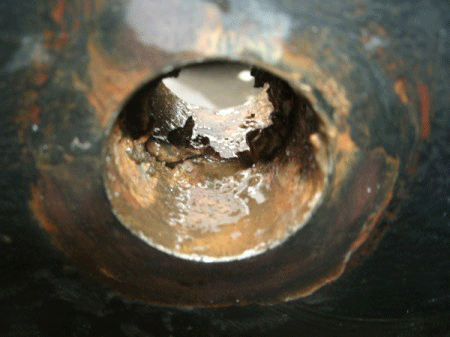
Tepco has been dismantling the tank since yesterday that experienced the 300m3 of leakage. The structural flaw may cause other tanks of the same type to leak commonly. Tepco is investigating the potential leaking points.
From their inspection, they found 2 holes around the bolt parts, which are 3mm × 11mm and 3mm × 22mm.
The flange parts were rusting inside and outside. The bottom parts of the tank were found severely deteriorated.
http://www.tepco.co.jp/nu/fukushima-np/handouts/2013/images/handouts_131008_03-j.pdf
http://photo.tepco.co.jp/date/2013/201310-j/131008-01j.html
News is not the truth. It’s a virtual reality that the sponsor wants us to live in.
Yuki Karakawa speaks on radiation emergency management
Japan Expert: Second explosion was “more like a bomb” at Fukushima — Spent nuclear fuel flew 30 kilometers away, pellets collected by military — Very strange materials like europium were found — Should have evacuated out to 300 kilometers (VIDEO) http://enenews.com/japan-expert-second-explosion-more-like-a-bomb-at-fukushima-nuclear-fuel-flew-30-kilometers-away-pellets-collected-by-japan-military-should-have-evacuated-300-kilometer-zone-150-years-t
October 7th, 2013
Title: Lessons from Fukushima
Source: Journal Tribune
Author: Tammy Wells
Date: Oct. 1, 2013
An ambassador to an international emergency management organization and a former minister of defense in Japan stopped by the York County Emergency Management Agency Monday […]
Yuki N. Karakawa, of the Karakawa Foundation and ambassador to the International Association of Emergency Managers, along with Kazuo Aichi, Japan’s defense minister in the 1990s, are both members of the Japan Resilience Initiative. […]
He said the disaster at Fukushima will be felt in Japan for a long time, and that there will be long-term medical effects – something he claims the country hadn’t put into their planning systems. […]
He estimated it will take 150 years for decontamination around Fukushima to be complete.
Yuki Karakawa – Lessons from Japan
Former York County Emergency Management Agency Director Bob Bohlmann said he’d known Karakawa for 15 years, and that he’s done a lot to spread the word about emergency management globally. […]
Yuki Karakawa’s presentation to InfraGard (“a partnership between U.S. businesses and the Federal Bureau of Investigation… dedicated to prevent hostile acts against the United States”), Published February 2013 (At 7:30 in): “300 kilometers should be evacuated, but we did not, Japan did not evacuate. […] In some areas, we can find very strange material like europium and so on. Now Self Defense Forces is collecting all materials. Also spent fuel flew because of a second explosion; it’s more like a bomb, exploded and flew like 30 kilometers. So government, or Self Defense, is now collecting all spent fuel pellets.” Watch Karakawa’s presentation here
See also: New Book: Nuclear explosion may have occurred at Fukushima Unit 3 after ‘supercritical condition’ — Sudden increase in plutonium, uranium recorded by U.S. at several EPA stations
PHOTOS: broken support braces on 400-foot tower near Fukushima reactors
New report shows support braces completely severed on 400-foot tower near Fukushima reactors (PHOTOS) http://enenews.com/new-report-shows-support-braces-completely-severed-on-400-foot-tower-near-fukushima-reactors-photos
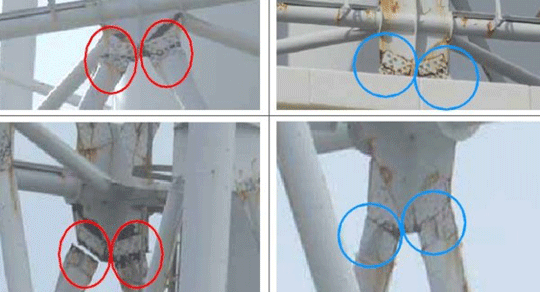
Title: (Systran Translation) Fukushima No. 1 nuclear power plant — Safety appraisal for the component damage of the machine chimney
Source: Tepco
Date: Oct. 7, 2013
h/t Fukushima Diary
1 This Month




PLEASE OPPOSE HR 8255 AND S.3639 – bills would accelerate satellite deployment, with no environmental review or safeguards – https://ncstd5li.quorum.us/campaign/169331/
To see nuclear-related stories in greater depth and intensity – go to https://nuclearinformation.wordpress.com
-
Archives
- September 2026 (330)
- August 2026 (330)
- July 2026 (355)
- June 2026 (287)
- May 2026 (306)
- April 2026 (356)
- March 2026 (251)
- February 2026 (267)
- January 2026 (308)
- December 2025 (358)
- November 2025 (359)
- October 2025 (375)
-
Categories
- 1
- 1 NUCLEAR ISSUES
- business and costs
- climate change
- culture and arts
- ENERGY
- environment
- health
- history
- indigenous issues
- Legal
- marketing of nuclear
- media
- opposition to nuclear
- PERSONAL STORIES
- politics
- politics international
- Religion and ethics
- safety
- secrets,lies and civil liberties
- spinbuster
- technology
- Uranium
- wastes
- weapons and war
- Women
- 2 WORLD
- ACTION
- AFRICA
- Atrocities
- AUSTRALIA
- Christina's notes
- Christina's themes
- culture and arts
- Events
- Fuk 2022
- Fuk 2023
- Fukushima 2017
- Fukushima 2018
- fukushima 2019
- Fukushima 2020
- Fukushima 2021
- general
- global warming
- Humour (God we need it)
- Nuclear
- RARE EARTHS
- Reference
- resources – print
- Resources -audiovicual
- Weekly Newsletter
- World
- World Nuclear
- YouTube
-
RSS
Entries RSS
Comments RSS

