Shut down Lynas! Call from Malaysians after 3rd death at rare earths plant
 Calls renew for Lynas shutdown after third death at plant Malaysian Insider, 14 Dec 13 Opponents of the Lynas Advance Materials Plant in Pahang have renewed calls for the closure of the controversial rare earth refinery following the death of an engineer who drowned in a pond at the facility yesterday. The Save Malaysia Stop Lynas (SMSL) movement said the fatal accident, the third in two years at the plant near Kuantan, Pahang, should be viewed seriously, and warranted a full investigation.
“This is very serious. We are demanding the government shut down the Lynas Advance Materials Plant immediately and cease all activities in the plant until a full and comprehensive independent investigation is completed by the relevant authorities like the Department of Occupational Safety and Health to establish the nature and cause/s of the fatal accident,” its chairman Tan Bun Teet said today…….
The plant in Gebeng has been mired in controversy after residents claimed it emits the hazardous thorium compound that can cause cancer among humans. It is known that the processing of rare earth materials would produce a thorium by-product.
The Australian-owned plant’s ability to obtain a temporary licence, despite not revealing a waste disposal facility, has enraged activists who have opposed the company’s practices and the government for allowing such a plant within a 30km radius of 700,000 residents.
Groups have called for the government and Lynas shareholders to remove the company’s operations from Malaysia amid the company’s poor performance in the Australian bourse due to weakened rare earth prices.
SMSL said although previously some of the firm’s shareholders had wanted to conduct best practices in its operations abroad, it has been business as usual for Lynas.
However, yesterday’s death has given the group more cause to question the plant’s operational procedures and safety hazards……http://www.themalaysianinsider.com/malaysia/article/calls-renew-for-lynas-shutdown-after-third-death-at-plant
Serious safety concerns about India’s nuclear industry
some nuclear projects in India have come close to “disaster.” ….The fact that there is no clear record on accidents or potential disasters at India’s nuclear power plants raises important questions about the transparency of information on the issue.
A nuclear disaster like Fukushima would have dire consequences in heavily populated India. Memories of the Bhopal tragedy, which killed an estimated 10,000 people in 1984, are still fresh, and so is the mismanagement of the fallout by the government of the day, including letting the senior management of U.S. firm Union Carbide escape scot free.
 Lessons from Japan for India on Nuclear Energy Fukushima has given energy-hungry India pause. Are its nuclear safety standards up to scratch? The Diplomat By Kabir Taneja December 13, 2013 The Kudankulam Nuclear Power Plant in the southern Indian state of Tamil Nadu has become the focal point of public debate in India over the pursuit of civil nuclear energy on a large scale. The run-up to the plant’s inauguration had been marred by protests from locals and the anti-nuclear lobby, who question the safety of the plant and have taken the issue all the way to the Supreme Court……
The outcome of Fukushima has also put the spotlight on the aggressive, globally active and well-funded nuclear energy lobby. For many in Tokyo, a disaster caused largely by a tsunami triggered by an earthquake in 2011 opened a can of worms over how the government regulated its nuclear backyard. This issue of regulation has gained momentum as more and more people question the conventional wisdom of nuclear energy being a safe bet. Continue reading
Slack security at UK’s nuclear bomb factory

Ministry of Defence security ‘asleep on the job’ guarding a nuclear bomb factory, By Vicky Smith Mirror, UK, 14 Dec 2013
Up to 50 MoD police are being probed for allegedly failing to carry out vital security patrols at the 225-acre complex which builds Trident warheads. Up to 50 Ministry of Defence police guarding a nuclear bomb factory are being probed for allegedly failing to carry out vital security patrols.
And last night it was claimed that some were sleeping on the job at the 225-acre complex which builds Trident warheads. Seven of the armed officers have resigned and others are facing disciplinary action amid claims they ignored key duties.
A source said: “At least some of the police were sleeping on the job when they missed the patrols.
“This is highly embarrassing at such a key facility.”
Peter Burt, of the Nuclear Information Service, which campaigns for nuclear safety, said: “The sheer scale of these claims are astonishing, especially given the highly sensitive nature of the complex.
“It handles radioactive materials, explosives and hazardous chemicals. ……..http://www.mirror.co.uk/news/uk-news/ministry-defence-security-asleep-job-2924587
Approval for Tokai nuclear reprocessing plant BEFORE safety screening!
NRA to approve restart of reprocessing facility http://www3.nhk.or.jp/nhkworld/english/news/20131211_29.html Japan’s nuclear regulator plans to approve a partial restart of a facility for reprocessing spent nuclear fuel before it clears safety screening under new regulations.
The Nuclear Regulation Authority says it’s allowing the restart to make plutonium and other highly radioactive waste in the facility solid and more stable.
The authority said on Wednesday that it plans to allow the government-backed Japan Atomic Energy Agency to operate part of the plant in Tokai Village, about 100 kilometers north of Tokyo.
The decision comes after the agency sought permission to restart the facility soon, saying that keeping the waste in liquid form involves high risks.
NRA commissioners said the facility’s stockpiles of plutonium solutions and other liquid waste will be made safer when reprocessed into solids.
They came up with a plan to allow part of the facility to run for 5 years before checking is done under the enhanced regulations.
The facility stores 3.5 cubic meters of solutions containing plutonium and more than 400 cubic meters of highly radioactive liquid waste. NRA secretariat officials say reprocessing the plutonium solutions into powder will take about 2 years, and turning other liquid waste into glass 21 years.
The new regulations are to take effect on December 18th. The NRA is to give formal approval after confirming that the agency can ensure stable reprocessing at the plant.
Trafficking of radiological materials
Dirty bombs, Glowing in the dark, The Economist 14 Dec 13 In the fight against trafficking in radiological materials, experts see some cause for cautious optimism
“………Nuclear and radiological materials slipped out of regulatory control 2,331 times between 1995 and the start of this year, according to the Incident and Trafficking Database compiled by the International Atomic Energy Agency (IAEA). The materials are widely used in industry, agriculture and medicine. They are kept in many poorly guarded X-ray and cancer-treatment clinics. Such places are often not overseen with terrorism in mind. They have even been bought by crooks as front operations, says Rajiv Nayan, of India’s Institute for Defence Studies and Analyses. Raids on abandoned uranium mines in the Democratic Republic of Congo are more frequent, according to that country’s General Atomic-Energy Commission. The problem is most acute in the former Soviet Union: in Ukraine alone, roughly 2,500 organisations use radiological materials……..
Libya’s uranium stockpile a cause of anxiety
Concerns Grow Over Libyan Uranium Stockpiles, VOA, Jamie Dettmar, 10 Dec 13, December 10, 2013 WASHINGTON — Inspectors from the United Nations nuclear agency will soon begin an assessment of the adequacy of security arrangements for thousands of barrels of yellowcake uranium stockpiled in Libya. The inspection comes amid rising anxiety among Western powers and Libya’s neighbors at the lawlessness disrupting the transition from dictatorship to democracy since the ouster two years ago of Moammar Gadhafi.
According to Mr. Mitri, 6,400 barrels of yellowcake uranium are stored in a facility near Sabha, a desert town in the south that has witnessed episodic clashes between Tubu and Abu Seif tribesmen. Libyan intelligence officials say Al Qaida-linked Tuareg fighters fleeing the French intervention in Mali have moved into Libya’s south to set up camps.
Rio Tinto’s ERA Australian uranium mine has radioactive spill
NT uranium mine suspended after radioactive leak SMH, 10 Dec 13,The federal government has suspended operations at the Ranger uranium mine in the Northern Territory, after a major leak of acid and radioactive slurry at the weekend.
The mine’s operator, Energy Resources of Australia, insists there has been no environmental impact from the million-litre spill, but this view is contested by local indigenous people and environment groups…….
On Friday, workers detected a hole in leach tank one within the mine’s processing area, which has a capacity of about 1.5 million litres. The next day, the tank split, pouring out a slurry of mud, water, ore and sulphuric acid…….
The NT Environment Centre said it did not believe ERA when the company said there had been no environmental impacts.
”It’s clear there’s contaminated water from the burst tank on soil,” director Stuart Blanch said.
There have been more than 200 safety breaches and incidents over the past 30 years at the site, according to the centre, which says the slurry spill overflowed levee banks designed to contain it and got into the mine’s stormwater drain system.
The regional organiser of the Australian Manufacturing Workers Union, Bryan Wilkins, said that during the construction and installation of the leaking tank, in 1993 or 1994, the welding was not properly tested. ”I know it wasn’t – I was there,” he said.
An investigation to determine what caused the tank to give way was being commissioned, ERA chief executive Andrea Sutton said……. http://www.smh.com.au/federal-politics/political-news/nt-uranium-mine-suspended-after-radioactive-leak-20131209-2z1un.html#ixzz2n5vZT1Pe
Hospital access blocked as 6 alleged thieves probably exposed to radiation
Federal police blocked access Friday to hospital where the six were held
Mexico Police Block Hospital Where 6 May Have Radiation Exposure In Wake Of Theft HUFFINGTON POST, By ADRIANA GOMEZ LICON and E. EDUARDO CASTILLO 12/06/13 06:MEXICO CITY (AP) — Six people being tested for possible radiation exposure in a hospital in central Mexico are suspects in the theft of highly radioactive cobalt-60, a government official said Friday.
The official said the six were arrested Thursday and taken to the general hospital in Pachuca for observation and testing for radiation exposure.Once they are cleared, they will be turned over to federal authorities in connection with the case of a cargo truck stolen Monday at gunpoint that was carrying the extremely dangerous material.
The official spoke on condition of anonymity because he was not authorized to speak to the press. He did not specify how the six were allegedly involved in the theft.
Hidalgo state Health Minister Pedro Luis Noble said Friday that the six suffered from skin irritations and dizziness, but that none are in grave condition and may be released soon. Only one was vomiting, a sign of radiation poisoning……..
The atomic energy agency said the cobalt has an activity of 3,000 curies, or Category 1, meaning “it would probably be fatal to be close to this amount of unshielded radioactive material for a period in the range of a few minutes to an hour.”
But Mexican officials said that the thieves seemed to have targeted the cargo truck with moveable platform and crane, and likely didn’t know about the dangerous cargo. The government official would not give details or location of Thursday’s arrest nor names or ages of the suspects…….
The material was from obsolete radiation therapy equipment at a hospital in the northern city of Tijuana and was being transported to nuclear waste facility in the state of Mexico, which borders Mexico City.
Authorities maintained a 500-meter (yard) cordon around the site where the cobalt-60 still remains in the state of Mexico and continued to work Friday to extract it safely, said Juan Eibenschutz, director general of Mexico’s National Commission of Nuclear Safety and Safeguards.
“It’s quite an operation and it is in the process of being planned,” he said. “It’s highly radioactive, so you cannot just go over and pick it up. It’s going to take a while to pick it up.”
Federal police blocked access Friday to hospital where the six were held. http://www.huffingtonpost.com/2013/12/06/mexico-hospital-blocked-radiation_n_4399922.html
Arkansas nuclear plant fire
Fire at Arkansas nuclear plant contained – report http://www.reuters.com/article/2013/12/09/energy-nuclear-fire-idUSL1N0JO0WK20131209 Dec 9 (Reuters) – A fire at a nuclear plant in Arkansas operated by Entergy Corp is contained, local media reported on Monday, citing a company spokeswoman.
The Courier News newspaper reported the fire broke out in a transformer at the plant, near the town of Russellville, and that Unit 2 was down, while Unit 1 was still operational. The newspaper also reported a possible explosion at the site.
Catastrophic radioactive spill at Rio Tinto’s Rossing uranium mine
Rössing shuts operations after ‘catastrophic leak’ Namibia Times, December 6, 2013 By Jade McClune & Marshallino Beukes All milling operations at Rössing Uranium Mine ground to an immediate halt after “a catastrophic structural failure” at one of twelve leach tanks in the processing plant on Tuesday.
The incident triggered a veritable crisis, reinforcing widespread fears of a radioactive leak.
Sources at the mine told the Namib Times on Tuesday that they had heard some “kind of explosion”.
The mine has since confirmed that a leak was detected near one of the leach tanks and said there was “a very serious incident”, but did not mention any explosion.
A Red Banner Health and Safety Alert was sent out to all employees of the mine on Wednesday, confirming that there had been a “leach tank failure” at around 18:30 on Tuesday, 3 December.
The actual outcome of the incident was described as “serious” and the “maximum reasonable outcome: critical”……..http://www.namibtimes.net/forum/topics/rossing-shuts-operations-after-catastrophic-leak
Highly dangerous and super expensive work to cover Chernobyl nuclear reactor
Workers can only spend a few hours at the reactor site before they reach the maximum radioactive exposure limit, and work is thus progressing at a snail’s pace
Despite the incredible lengths required to build the structure, it’s still only a band-aid

This Massive Steel Structure Will Entomb Chernobyl’s Reactor 4 (GREAT PHOTOS) http://www.gizmodo.com.au/2013/11/this-massive-steel-arch-will-entomb-chernobyls-reactor-4/ KELSEY CAMPBELL-DOLLAGHAN 30 NOVEMBER 2013 When an unexpected power surge sparked the world’s worst nuclear accident in Chernobyl, nearly a quarter of a million construction workers risked their lives to build an ad hoc “sarcophagus” of concrete around the stricken reactor. It was a stop-gap measure — and now, almost 30 years later, one of the biggest engineering projects in history is underway to protect it.
The BBC reports on the $US2 billion project to protect the decaying metal sarcophagus, using an even larger metal shield called the New Safe Confinement, or NSC. In simple terms, the NSC is a massive steel archway that is designed to protect the surrounding region if the 27-year-old sarcophagus eventually collapses. Continue reading
Leaking acid causes stop-work at Fukushima clean-up
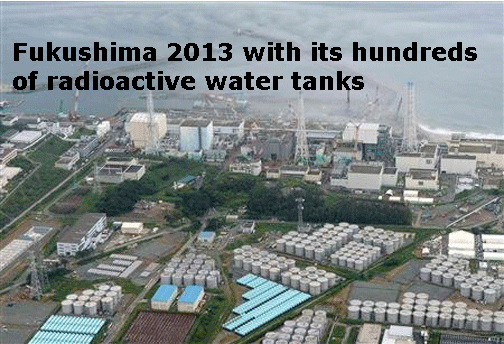 Fukushima nuclear reactor clean-up unit hit by acid leak http://www.theaustralian.com.au/news/world/fukushima-nuclear-reactor-cleanup-unit-hit-by-acid-leak/story-e6frg6so-1226772520045 STAFF WRITERS AFP DECEMBER 02, 2013 THE trouble-prone system used to decontaminate radioactive water at Japan’s crippled Fukushima nuclear power plant was switched off yesterday because of a chemical leak, the plant’s operator said.
Hydrochloric acid, used to neutralise the alkaline water being decontaminated, was found seeping from a pipe joint, the Tokyo Electric Power Co said.
The joint was wrapped in a vinyl bag to contain the leakage, TEPCO said, and the company was investigating the cause. About a litre of hydrochloric acid had been contained in the bag. The leak was found at one of three Advanced Liquid Processing System units designed to remove radioactivity from contaminated water at the plant, where a massive earthquake and tsunami in March 2011 sent the nuclear reactors into meltdown.
The systems are expected to play a crucial role in treating the huge amounts of toxic water accumulating at the plant. The troubled system was one of two units that had been in trial operation and were due to go into full operation yesterday.
In late September, plastic padding clogged up a drain in the same system, causing it to shut down. In October, it was halted due to a programming mistake.
Thousands of tonnes of water, used since the meltdown to cool reactors or polluted by other radioactive material, are being stored in huge tanks at the site on Japan’s northeast coast.
Looking for Internet pornography while at work – NRC employees
Nuclear Regulatory Commission employees surf porn while on the job, December 01, 2013 by: J. D. Heyes (NaturalNews) It’s something that Homer Simpson would most likely do, but he’s a cartoon character and isn’t even real. Still, it is an apt comparison given Simpson’s cartoon job status as an employee at a nuclear power plant.
As reported by The Washington Times, employees at the Nuclear Regulatory Commission, the federal agency that oversees the operations of the nation’s nuclear power plants, recently managed to bypass government firewalls and access porn online with their work computers.
From the paper:
It’s become tougher to surf porn on government computers after scandals, but some workers at the Nuclear Regulatory Commission managed to find ways to bypass detection software and firewalls to get the illicit content, records show.
One contract employee watched, in his words, two “porn type” Netflix movies during “downtime” on his 12-hour shift at the commission’s office of information services, according to case records reviewed by The Washington Times.
Problem has not gone away
Another employee, the paper said, had repeatedly used photo-sharing website Flickr to search for porn while in the office.
And for years, a resident inspector at the nuclear agency scanned eBay looking for images of porn.
http://www.naturalnews.com/043082_internet_surfing_government_employees_Nuclear_Regulatory_Commission.html#ixzz2mLPwliKZ
Bomb explosion near Kudankulam nuclear reactor – 6 killed
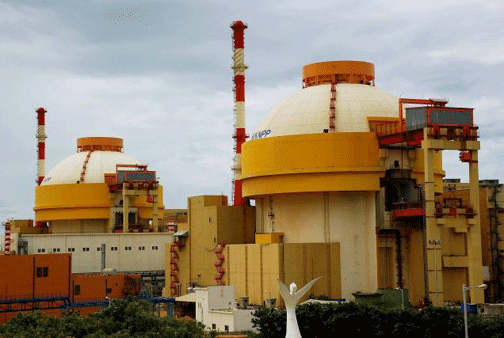 Bomb explodes near Indian nuclear reactor,THE AUSTRALIAN, ROBIN PAGNAMENTA THE TIMES NOVEMBER 29, 2013 A BOMB has exploded close to India’s biggest nuclear power station, killing six people and prompting a police investigation into whether it was linked with anti-nuclear protests in the area. The device exploded in a village close to Kudankulam in the southern state of Tamil Nadu, destroying at least two houses and seriously injuring three people. Among the six killed were a woman and three young children.
Vijayendra Bidari, a police spokesman, said the house in which it exploded was being used as a “bomb-making facility” in a village where anti-nuclear activists had been operating. He said the bomb apparently detonated accidentally as the suspected activists were building it. Two unexploded bombs were recovered from the site. The blast occurred about 1km from the Russian-built plant, which started operating last month – six years later than was planned – despite protests from locals who fear a nuclear accident.
Kudankulam lies in a seismically active area and the coastal zone was affected by the 2004 tsunami. Activists fear there could be a repeat of the 2011 Fukushima nuclear disaster in Japan.
SP Udayakumar, the founder of the People’s Movement Against Nuclear Energy, the main anti-nuclear group in the region, denied involvement in the bomb-making. “We made it clear immediately that we have nothing to do with the bomb blasts,” he said.
- Mr Udayakumar said he believed gangs associated with illegal mining were behind the blasts. – ………:
- –
6 Nuclear reactors now shut down in South Korea
 S.Korea nuclear reactor hit by automatic shutdown; six units now off First Post World, 29 Nov 13, SEOUL (Reuters) – A “safety-related action” automatically shut down one of its 23 nuclear reactors on Thursday, South Korea’s nuclear operator said, bringing the tally of those closed to six and hiking chances of possible power blackouts this winter……. “We are now looking into the cause of the shutdown and it is not yet clear when the reactor will restart,” said a spokesman at operator Korea Hydro & Nuclear Power. Operation of the 587-megawatt Kori No. 1 reactor, over 300 km southeast of Seoul, was suspended early on Thursday morning. The reactor, which started operation in 1978, had recently returned from nearly 180 days of scheduled maintenance through October 5, according to KHNP’s website. (www.khnp.co.kr). The unit’s license to operate was extended another 10 years in end-2007, another KHNP spokesman noted……
1 This Month




PLEASE OPPOSE HR 8255 AND S.3639 – bills would accelerate satellite deployment, with no environmental review or safeguards – https://ncstd5li.quorum.us/campaign/169331/
To see nuclear-related stories in greater depth and intensity – go to https://nuclearinformation.wordpress.com
-
Archives
- September 2026 (323)
- August 2026 (330)
- July 2026 (355)
- June 2026 (287)
- May 2026 (306)
- April 2026 (356)
- March 2026 (251)
- February 2026 (267)
- January 2026 (308)
- December 2025 (358)
- November 2025 (359)
- October 2025 (375)
-
Categories
- 1
- 1 NUCLEAR ISSUES
- business and costs
- climate change
- culture and arts
- ENERGY
- environment
- health
- history
- indigenous issues
- Legal
- marketing of nuclear
- media
- opposition to nuclear
- PERSONAL STORIES
- politics
- politics international
- Religion and ethics
- safety
- secrets,lies and civil liberties
- spinbuster
- technology
- Uranium
- wastes
- weapons and war
- Women
- 2 WORLD
- ACTION
- AFRICA
- Atrocities
- AUSTRALIA
- Christina's notes
- Christina's themes
- culture and arts
- Events
- Fuk 2022
- Fuk 2023
- Fukushima 2017
- Fukushima 2018
- fukushima 2019
- Fukushima 2020
- Fukushima 2021
- general
- global warming
- Humour (God we need it)
- Nuclear
- RARE EARTHS
- Reference
- resources – print
- Resources -audiovicual
- Weekly Newsletter
- World
- World Nuclear
- YouTube
-
RSS
Entries RSS
Comments RSS

