Radioactive water sprayed out on Fukushima workers, from tank leak

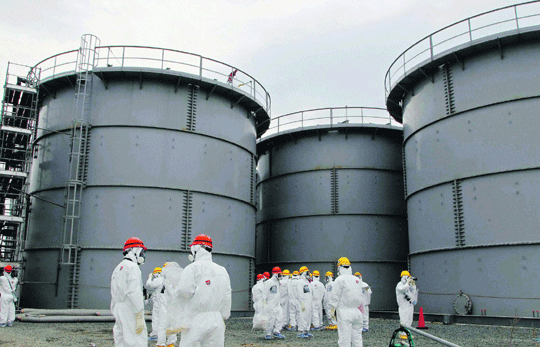 Fukushima Worker: People showered with highly radioactive water at plant — Leaking tanks spraying out contamination http://enenews.com/fukushima-worker-people-showered-highly-radioactive-water-plant-leaking-tanks-spraying-contamination
Title: People working at, living near Fukushima plant say Abe is in the dark
Source: Asahi Shimbun
Authors: Takuro Negishi and Shinichi Fujiwara
Date: September 20, 2013
[…] one man who has helped assemble the tanks from which contaminated water has leaked said, “I wonder if [Prime Minister Shinzo abe] is using words like ‘blocked’ and ‘control’ after really understanding what is going on at the site.”
The man recalls that one day he saw contaminated water spraying out of a tank. An employee of an affiliated company to TEPCO wore a raincoat over protective clothing to tighten a bolt on the tank, even as he was being showered with leaking water.
The man witnessed a similar scene on another day. However, TEPCO made no announcement about the two incidents.
“The affiliated company probably did not want to get on the bad side of TEPCO, so it stopped the leak and concealed the defect in the tank,” the man said. […]
Again, cracks found at Davis-Besse nuclear power plant
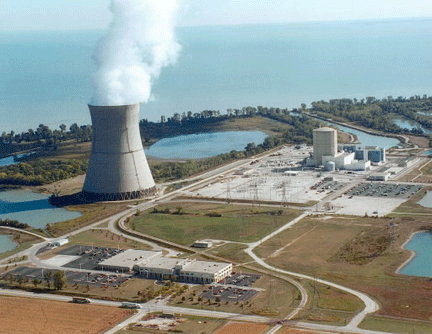 More cracks found at Davis-Besse nuclear plant NRC says they pose no threat Columbus Despatch September 22, 2013 TOLEDO (AP) — The operator of an Ohio nuclear plant along Lake Erie has found several more cracks in the concrete building housing the nuclear reactor and says some cracks found earlier have grown a bit…….http://www.dispatch.com/content/stories/local/2013/09/22/more-cracks-found-at-plant.html
Fukushima rocked by earthquake
Earthquake rocks Japan’s Fukushima http://www.skynews.com.au/world/article.aspx?id=907741 20 Sept 13, A magnitude 5.3 earthquake has rocked Japan’s Fukushima prefecture.
The epicentre of the earthquake was 22km below the ground, according to the US Geological Survey.
It struck 20km west of the city of Iwaki, bordering the Pacific Ocean, at 2.25am (3.25am AEST) on Friday.
The epicentre was about 50km southwest of the damaged Fukushima Daiichi Nuclear Power Station, which was crippled by the major quake and tsunami in March, 2011.
The Japan Meteorological Agency, which put the quake at magnitude 5.8, said no tsunami warning had been issued.
The tremor caused buildings to shake in the capital Tokyo, 175km away, an AFP reporter there said.
It came just hours after Japanese Prime Minister Shinzo Abe toured the Fukushima nuclear plant on Thursday, ordering its operator Tokyo Electric Power to fix radioactive water leaks there.
TEPCO said in a statement to Kyodo news agency that no abnormalities in radiation or equipment were observed at the plant after the quake.
Planned ice wall at Fukushima will make soggy ground worse, risking nuclear reactors collapsing
Asahi: Buildings at Fukushima plant can start floating from too much groundwater — Expert: Blocking groundwater with ice wall may weaken soil and cause buildings to topple (AUDIO) http://enenews.com/asahi-buildings-at-fukushima-plant-could-start-floating-from-continuous-flow-of-groundwater-expert-ice-wall-may-weaken-soil-and-cause-buildings-to-topple-audio
Asahi Shimbun,, Sept. 18, 2013: […] The site receives so much groundwater that special equipment–rendered useless by the 2011 earthquake and tsunami–was set up to prevent the plant’s buildings from floating on the continuous flow. […] The original site of the Fukushima No. 1 plant was a cliff more than 30 meters high. But 20 meters was lopped off […] putting the groundwater level only a few meters below the surface. The plant itself was constructed on land containing gravel layers through which water can easily pass through. In the past, a brook trickled by the No. 4 reactor. […] Without that pumping, the buildings faced the danger of being buoyed by rising groundwater. […] TEPCO officials have pinpointed only two locations, including the turbine building of the No. 1 reactor, where groundwater is entering the building basements. They believe there are many more breaches. […]
Atsunao Marui,, head of Groundwater Research Group at the National Institute of Advanced Industrial Science and Technology: “About 4 million tons of rain falls on the plant site over the course of a year. Of that figure, it is believed that between 1 million and 1.5 million tons seep into the ground.”
Gordon Edwards, nuclear expert (at 39:45 in): This underground river that we talked about flowing  thorough — the problem with this is they don’t really know how to stop it. […] They really don’t know how to stop this flow because it’s a major aquifer. One of the plans that they are talking about is… a wall of ice a mile long to act as a barrier to prevent the groundwater from going in to the cores of these damaged reactors, in order to try and solve the problem… And nobody knows if it’s actually going to work. In fact, some of the experts in Japan have said that by diverting the groundwater around the sides of the building, you may weaken the soil to the point where the buildings themselves topple — and that could be a far worse problem. So, they really don’t know what they’re going. They literally don’t know what they’re doing.
Typhoon making things worse at Fukushima nuclear plant

 Typhoon Man-yi complicates Fukushima nuclear cleanup (+video), Christian Science Monitor 16 Sept 13 Typhoon Man-yi brought heavy rain and wind to Japan Monday, raising concerns over the fragile cleanup at the Fukushima Daiichi Nuclear Power Plant. Workers already struggle to contain contaminated wastewater, and rain from Typhoon Man-yi adds to the complications at Fukushima.
By David J. Unger, Staff writer / September 16, 2013 The last thing cleanup workers at Fukushima need is a typhoon, but a typhoon is what they’re getting. Heavy rain and winds clocking in at 100 miles per hour slammed into Japan Monday. Typhoon Man-yi caused at least two fatalities and stirred fears at the crippledFukushima Daiichi Nuclear Power Plant. On a typical day, workers have struggled to contain the 400 tons of contaminated water they pump out of the plant. Added rain from Typhoon Man-yi makes matters more complicated.
“The typhoon has little chance of destabilizing the reactors, but it will certainly add more water to a site already crowded with hastily assembled steel storage tanks and relatively poor oversight,” Daniel Aldrich, a political scientist at Purdue University who has been following the Fukushima disaster, wrote in an e-mail.
As rain fell, workers pumped accumulating water from around those storage tanks into the Pacific Ocean in an effort to prevent flooding and radioactive contamination. That rainwater was untainted, according to Tokyo Electric Power Company (Tepco), the plant’s operator. But Japan’s Nuclear Regulation Authority said such a discharge could be subject to nuclear safety rules and was checking radiation levels.
The company also added new walls around the storage tanks to prevent future leaks in the run-up to the typhoon. Workers weighed down cranes and other materials to minimize wind damage. …… http://www.csmonitor.com/Environment/Energy-Voices/2013/0916/Typhoon-Man-yi-complicates-Fukushima-nuclear-cleanup-video
Monju MOX-fueled nuclear plant cut off by avalanche
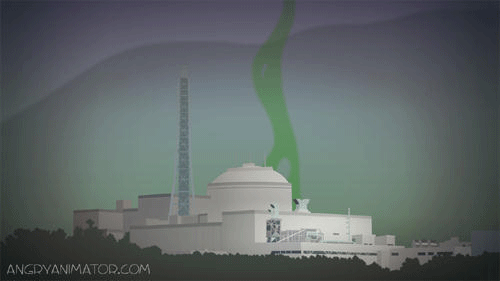 Landslide at MOX-fueled Japan Nuclear Plant — AP: Emergency data transmission from Monju stops as typhoon hits — Kyodo: Can’t access site due to mudslides, reactor temperatures unknown nenews.com/landslide-at-mox-fueled-japan-nuclear-plant-ap-emergency-data-transmission-from-monju-stops-as-typhoon-hits-kyodo-cant-access-site-due-to-mudslides-reactor-temperatures-unknown
Associated Press, Sept. 16, 2013: At Japan’s Monju test reactor site in Fukui, which is currently off-line, an emergency data transmission system went down, apparently due to storm damage, regulators said Monday, an indication of risk management issues at Japanese nuclear facilities even after the Fukushima crisis.
Kyodo News, Sept. 16, 2013: Data transmission from Monju reactor stopped […] There are no prospects for restoration of data transmission for now, with the reactor site in Tsuruga, Fukui Prefecture, inaccessible due to mudslides and fallen trees caused by the typhoon, it said. The Monju reactor has effectively been prohibited from operation because of lax safety management by the operator.
Kyodo News, Sept. 17, 2013: […] Heavy rain attributed to a typhoon caused a landslide near a tunnel entry point within the compound of the prototype fast-breeder reactor complex in Tsuruga city, according to the regulation agency’s secretariat. The cable damage is suspected near that area, it said. Restoration of the transmission of data such as reactor temperatures is expected to take some time […]
See also: Asahi: MOX reactor to restart this month in Japan — Nine fault lines run underneath
Nuclear train derailed in Cumbria, UK
INVESTIGATION INTO NUCLEAR TRAIN DERAILMENT IN CUMBRIA News and Star,, Monday, 16 September 2013 Emergency services have declared the incident closed after a nuclear train derailed in Barrow today. The incident happened at Salthouse Junction, near Barrow train station, shortly after 2pm.
A spokesman for International Nuclear Services Ltd (INS), a subsidiary of the Nuclear Decommissioning Authority responsible for the management and transport of nuclear material, said the train had been on its way to Sellafield carrying empty nuclear flasks.
He said: “The flasks were being transported from Barrow and had been shipped to the UK from Japan.”
A statement from operator Direct Rail Services said: “Work will now focus on recovering the derailed rolling stock. An investigation will be carried out into the cause of derailment in accordance with Rail and Nuclear Transport Regulations.”……http://www.newsandstar.co.uk/news/nuclear-train-derailed-emergency-services-at-scene-1.1084679
International Olympic Committee blind to the radioactive dangers facing Tokyo
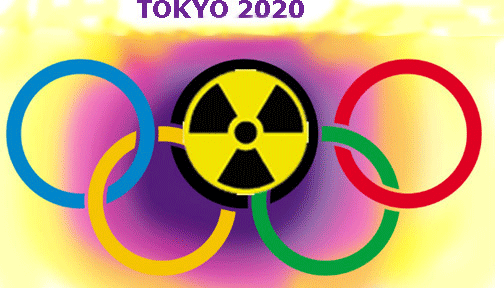 Tokyo Olympics Bid was Fixed by the International Olympic Committee’s Nuclear Lobby Prime Minister Shinzo Abe’s blatant lies about Fukushima radiation leaks being under control By Yoichi Shimatsu Global Research, September 16, 2013
“……….Ladies and Gentlemen, Put on Your Blinders As if wearing blinders, IOC delegates at Buenos Aires ignored media questions about the thousands of tons of radiation-contaminated water leaking from the Fukushima nuclear plant. Arguably worse is the ash from Tokyo’s incinerators that burned Fukushima combustible waste for two years. The highly radioactive cinders were dumped into landfills in Tokyo Bay, which will be the site of the Olympic Village and most of the sports venues.
The Arakawa River, which flows into Tokyo Bay, is also contaminated in its upper reaches by clouds drifting in from the Pacific. The forests around Tokyo’s watershed in Oku-Tama, which provides drinking water to the capital, are dangerously drenched by radioactive rainfall, and the national food supply is so irradiated that regulators have had to raise the food safety level.
The risk of more clouds of radioactive fallout sweeping toward Tokyo is not hypothetical but an inevitable consequence of uncontrollable meltdowns of hundreds of tons of nuclear fuel at Fukushima. The danger is amplified by recurrent earthquakes along Japan’s major fault lines and consequent volcanic eruptions, which pose a constant threat to the nearby nuclear plants at Hamaoka on the seaside below Mount Fuji, Tokai in neighboring Ibaraki, and the twin plants in Fukushima. Another explosion at any of these nuclear sites would force the evacuation of 50 million residents, or one-third of the population.
A major quake or volcanic eruption, long-overdue in the nearby Nankai Trough and Mount Fuji, and even under Tokyo itself, would close the capital’s airports, forcing thousands of Olympic athletes and spectators along with millions of residents to flee in the opposite direction, directly into Fukushima Prefecture. Tokyo is a killing field waiting to happen………..http://www.globalresearch.ca/tokyo-olympics-bid-was-fixed-by-the-international-olympic-committees-nuclear-lobby/5350045
Yoichi Shimatsu, a Hong Kong-based science writer, is former editor of the Japan Times Weekly in Tokyo. http://www.globalresearch.ca/tokyo-olympics-bid-was-fixed-by-the-international-olympic-committees-nuclear-lobby/5350045
Fire on Russian nuclear submarine
Russian nuclear submarine catches fire Sky News, September 16, 2013A Russian nuclear-powered submarine undergoing repairs at a shipyard has caught fire, but its reactor had long been shut off and poses no danger of radiation leaks, officials say.
The submarine Tomsk was being repaired at a shipyard near the city of Vladivostok when the fire broke out on Monday, the defence ministry said in a statement cited by Russian news agencies……
In late 2011 a massive fire broke out on another nuclear submarine in Murmansk while it was under repairs, injuring nine people. Reports later said that the vessel was armed with long-range missiles.http://www.skynews.com.au/world/article.aspx?id=906653
“Unusual event” at PPL’s Susquehanna nuclear plant
Leak found at PPL’s Susquehanna nuclear plant after reactor shut down “Unusual event” declared – an emergency classification established by the U.S. Nuclear Regulatory Commission. By Sam Kennedy, Of The Morning Call September 16, 2013 PPL Corp.’s Susquehanna nuclear power plant in Luzerne County declared an “unusual event” Sunday after radioactive water was discovered leaking inside a room in the plant’s Unit 2 reactor building.An unusual event is the first of the four emergency classifications established by the U.S. Nuclear Regulatory Commission for nuclear power plants……..http://www.mcall.com/news/breaking/mc-ppl-nuclear-plant-leak-0916-20130916,0,6535111.story#ixzz2fCcf1bAN
Fukushima’s radioactive trash pools are the REAL danger

Top scientists and government officials say that Tepco should be removed from all efforts to stabilize Fukushima. An international team of the smartest engineers and scientists should handle this difficult “surgery”.
The stakes are high
The REAL Fukushima Danger: Failure of Fuel Pools Could Trigger Worldwide Nuclear Radiation By Washington’s Blog Global Research, September 14, 2013
“…… the real problem is that the idiots who caused this mess are probably about to cause a much bigger problem.
Specifically, the greatest short-term threat to humanity is from the fuel pools at Fukushima.
If one of the pools collapsed or caught fire, it could have severe adverse impacts not only on Japan … but the rest of the world, including the United States. Indeed, a Senator called it a national security concern for the U.S.:
The radiation caused by the failure of the spent fuel pools in the event of another earthquake could reach the West Coast within days. That absolutely makes the safe containment and protection of this spent fuel a security issue for the United States.
Nuclear expert Arnie Gundersen and physician Helen Caldicott have both said that people should evacuate the Northern Hemisphere if one of the Fukushima fuel pools collapses. Gundersen said:
Move south of the equator if that ever happened, I think that’s probably the lesson there.
Former U.N. adviser Akio Matsumura calls removing the radioactive materials from the Fukushima fuel pools “an issue of human survival”.
So the stakes in decommissioning the fuel pools are high, indeed.
But in 2 months, Tepco – the knuckleheads who caused the accident – are going to start doing this very difficult operation on their own. Continue reading
The perilous state of Fukushima nuclear buildings Nos 1 to 4
Endless Fukushima catastrophe: 2020 Olympics under contamination threat Dr Helen Caldicott RT.com: September 15, 2013“…….The levels of radiation in buildings 1, 2 and 3 are now so high that no human can enter or get close to the molten cores. It will therefore be impossible to remove these cores for hundreds of years if ever
Buildings 1, 2 & 3
If one of these buildings collapses, the targeted flow of cooling water to the pools and cores would cease, the cores would become red hot and possibly ignite releasing massive amounts of radiation into the air and water and the fuel in the cooling pools could ignite. It is strange that neither the US government in particular nor the global community seem to be concerned about these imminent possibilities and exhibit no urge to avert catastrophe.
Similarly the global media is strangely disconnected with the ongoing crisis. Most importantly, the Japanese government until very recently has obstinately refused to invite and collaborate with foreign experts from nuclear engineering companies and/or governments.
Building 4
This structure was severely damaged during the initial quake, its walls are bulging, and it sank 31 inches (79cm) into the ground. On the roof sits a cooling pool containing about 250 tons of hot fuel rods, most of which had just been removed from the reactor core days before the earthquake struck. This particular core did not melt because TEPCO was able maintain a continuous flow of cooling water, so the rods and their holding racks are still intact, but geometrically deformed due to the force of the hydrogen explosion.
The cooling pool contains 8,800 pounds of plutonium plus over 100 other highly radioactive isotopes. Instead of this core melting into a larval mass like the other three cores, it sits exposed to the air atop the shaky building. A large earthquake could disrupt the integrity of the building, causing it to collapse and taking the hot fuel rods with it. The cooling water would evaporate and the intrinsic heat of the radioactive rods would ignite a fire as the zirconium cladding reacted with air, releasing the radioactive equivalent of 14,000 Hiroshima-sized bombs and 10 times more cesium than Chernobyl……..http://rt.com/op-edge/fukushima-catastrophe-nuclear-olympics-883/
Proof found that governments have let the nuclear industry make up the rules on liability
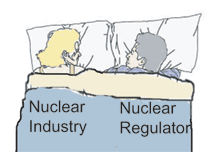 The nuclear industry has been allowed to write its own rules for more than 50 years, as the documents we’ve made public show. It’s time those rules were scrapped and the nuclear industry disqualified from the game it’s been playing with all our lives.
Proof that the nuclear industry has been dodging its responsibilities for over 50 years http://www.greenpeace.org/international/en/news/Blogs/nuclear-reaction/proof-that-the-nuclear-industry-has-been-dodg/blog/46544/ Justin McKeating – September 10, 2013 Information released today by Greenpeace Japan shows that the builders and suppliers of nuclear reactors were afraid of being held financially responsible for any accidents they might cause from the outset of the nuclear energy era in Japan.
A freedom of information request made by us has turned up documents from 1960 that show nuclear companies pressured the Japan Atomic Energy Commission to make sure they were exempted from all responsibility for a nuclear accident, except in the case of a deliberate act. The Commission was only too happy to agree.
But what if a nuclear company is grossly negligent? It needn’t worry. The Commission’s documents say:
“…we decided to delete ‘gross negligence’ to not make suppliers feel uneasy” Continue reading
Russia worried about he state of North Korea’s aged nuclear reactor
 Russia warns over North Korea work at ‘nightmarish’ nuclear reactor Russia has warned that North Korea is apparently conducting work on a nuclear reactor, saying the ageing facility is in such a “nightmarish state” it could cause a disaster. ABC News 13 Oct 13
 US analysts say satellite imagery suggests Pyongyang has restarted a research reactor capable of producing plutonium for weapons at its Yongbyon nuclear complex.
The Interfax news agency has quoted a diplomatic source as saying Russia does not have definite information the work has restarted, but warning of dire consequences should that happen.
“It is obvious that some works are being conducted, and for a long time at that. According to some signs, steps were indeed being taken to relaunch it,” the source said. “Our main concern is linked to a very likely man-made disaster as a consequence. The reactor is in a nightmarish state. It is a design dating back to the 1950s.
“For the Korean peninsula this could entail terrible consequences, if not a man-made catastrophe.”
The US-Korea Institute at the Johns Hopkins School of Advanced International Studies says a satellite image from August 31 shows white steam rising from a building near the hall that houses the plutonium production reactor’s steam turbines and electric generators.
“The white coloration and volume are consistent with steam being vented because the electrical generating system is about to come online, indicating that the reactor is in or nearing operation,” the Washington-based institute said. It says the reactor can produce six kilograms of plutonium a year.
The Russian source has cautioned the steam could “simply be testing of the generator”……. http://www.abc.net.au/news/2013-09-12/russia-warns-n-korea-over-work-at-nuclear-reactor/4954698
Is America’s Environmental Protection Agency (EPA) weakening standards for nuclear safety?
 EPA Documents Raise Doubts Over Intent of New Nuclear-Response Guide
National Journal By Douglas P. Guarino, Global Security Newswire September 11, 2013 WASHINGTON —Newly obtained government documents are prompting concern among critics that Environmental Protection Agency officials are seeking to use the organization’s new guide for nuclear-incident response to relax public health standards, but the agency is denying the claim.
The Freedom of Information Act release comes as the agency has yet to finish collecting public comments on the so-called protective-action guide, which it issued in April after years of internal infighting and public controversy. The document is meant to give federal, state and local officials advice on responding to a wide range of radiological incidents, such as “dirty bomb” attacks, nuclear power plant meltdowns and industrial accidents.
The documents obtained by Global Security Newswire show EPA officials have suggested at meetings around the world that the new guide could allow for the use of long-term cleanup standards dramatically less stringent than those the agency has enforced for decades at hundreds of sites throughout the United States, critics say.
In some cases, EPA officials have not only suggested that a drastic event akin to the Fukushima nuclear power plant meltdown in Japan would necessitate more flexible guidelines, but also have made statements that critics say challenge the very science behind the agency’s everyday radiation rules. Continue reading
1 This Month

22 June – Virtual Event –Climate Change: New Data, New Debate

Monday, June 22, 2026 2:30 p.m. – 3:15 p.m. CT
YouTube. Register here
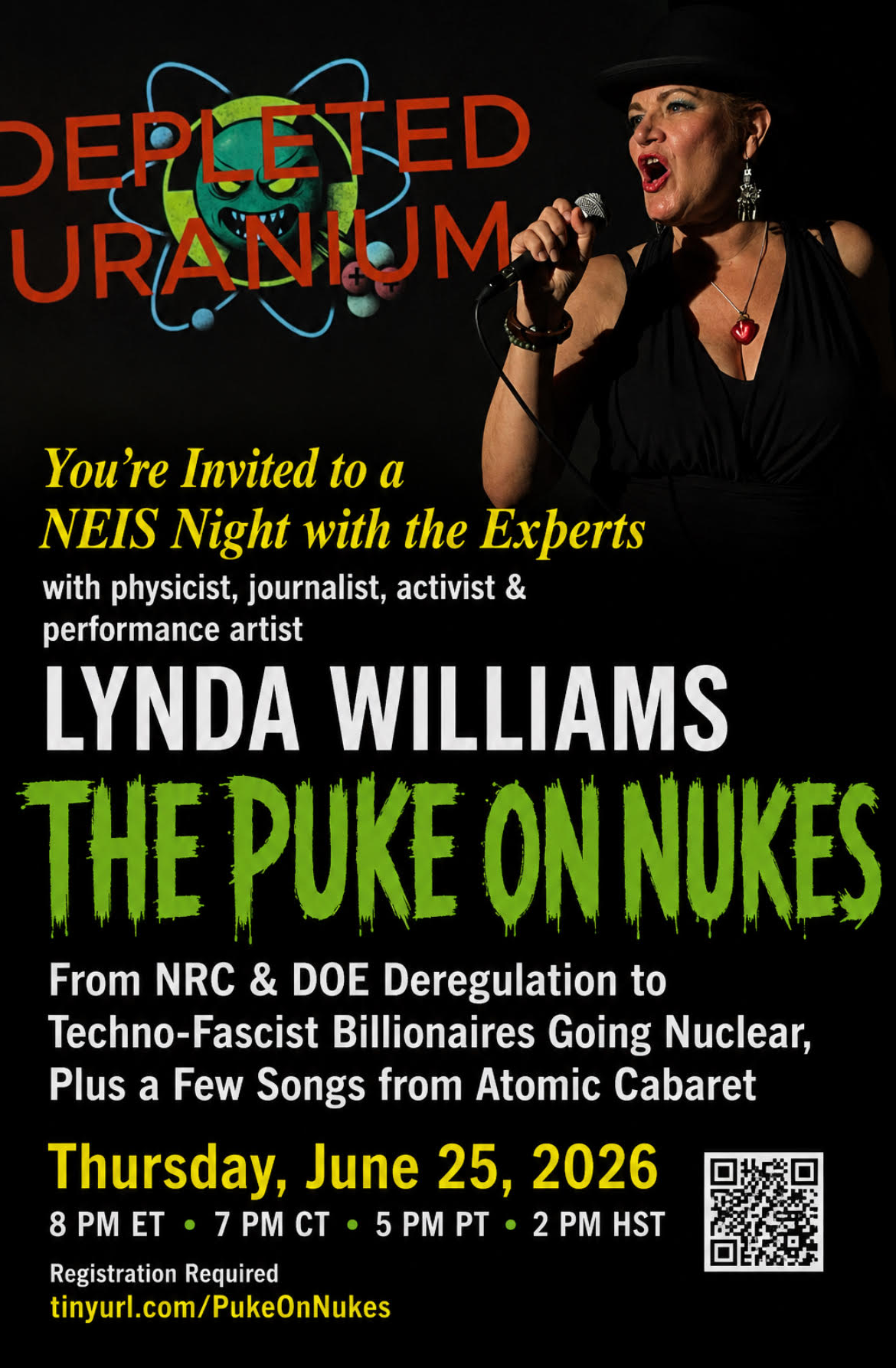
25 June- THE PUKE ON NUKES
Thursday, June 25, 2026
7pm Central Time (8pm ET, 6pm MT, 5pm PT) UTC – 5
From NRC & DOE Deregulation to Techno-Fascist Billionaires Going Nuclear, Plus a Few Songs from Atomic Cabaret REGISTER
26 June – Radiation Trainwreck at the NRC / Join the Protect Better Campaign – https://us02web.zoom.us/meeting/register/4ZlZ5_qLSHGiLSCg8FF6Bg#/registration
1st July – Webinar Waste of Space: The Environmental Harm of Military and Civil Space Activity st July, 7 pm

Report Launch Online: We are seeing an increasing exploitation of space for military and commercial purposes. This must change.

Protect Sazan Island from the Trump family! https://secure.avaaz.org/campaign/en/protect_sazan_island_from_the_trump_family_loc/?bqFCVab&v=174511&cl=22707147157&_checksum=5e9dde668860e8231c33699735e16a1fbf22ab2cb01da50c999fe8732b9775ef&utm_source=email&utm_medium=blast_email&utm_campaign=174511

Cuba Is Not a Failed State – It Is a Besieged State
PETITION: “Global Appeal to Endorse Palestinian Right of Return of Refugees”
To see nuclear-related stories in greater depth and intensity – go to https://nuclearinformation.wordpress.com
-
Archives
- June 2026 (227)
- May 2026 (306)
- April 2026 (356)
- March 2026 (251)
- February 2026 (268)
- January 2026 (308)
- December 2025 (358)
- November 2025 (359)
- October 2025 (376)
- September 2025 (257)
- August 2025 (319)
- July 2025 (230)
-
Categories
- 1
- 1 NUCLEAR ISSUES
- business and costs
- climate change
- culture and arts
- ENERGY
- environment
- health
- history
- indigenous issues
- Legal
- marketing of nuclear
- media
- opposition to nuclear
- PERSONAL STORIES
- politics
- politics international
- Religion and ethics
- safety
- secrets,lies and civil liberties
- spinbuster
- technology
- Uranium
- wastes
- weapons and war
- Women
- 2 WORLD
- ACTION
- AFRICA
- Atrocities
- AUSTRALIA
- Christina's notes
- Christina's themes
- culture and arts
- Events
- Fuk 2022
- Fuk 2023
- Fukushima 2017
- Fukushima 2018
- fukushima 2019
- Fukushima 2020
- Fukushima 2021
- general
- global warming
- Humour (God we need it)
- Nuclear
- RARE EARTHS
- Reference
- resources – print
- Resources -audiovicual
- Weekly Newsletter
- World
- World Nuclear
- YouTube
-
RSS
Entries RSS
Comments RSS
 nuclear-news