Nuclear submarine on fire – luckily it was unarmed

 Unarmed Russian nuclear submarine catches fire in shipyard, Stuff.co NZ, THOMAS GROVE , April 8 2015 Firefighters struggled to put out a blaze on a nuclear submarine as it underwent repairs at a shipyard in Russia’s northern province of Arkhangelsk on Tuesday (Wednesday NZT), Russian news agencies reported.
The agencies quoted sources as saying there were no weapons on board. Nobody was hurt, they said, although RIA news agency said the dry dock where the vessel was being repaired may have to be submerged under water to help extinguish the blaze.
The Emergencies Ministry declined comment on the reports of the fire at the Zvyozdochka shipyard, where the agencies said the 155-metre-long (just over 500 feet) 949 Antei submarine was being repaired.
“There is a fire on the submarine. We are fighting the fire now,” a shipyard source told Interfax news agency………http://www.stuff.co.nz/world/europe/67640388/unarmed-russian-nuclear-submarine-catches-fire-in-shipyard
Historical record indicates increased risk of a Nuclear Reactor Disaster
 The Risk of a Nuclear Reactor Disaster Cultural Psychology, Satyagraha, 2 April 15
Utility companies, to support their claims of nuclear reactor safety, present artificial risk estimates — such as no more than one core meltdown per 30,000 years of reactor operation — that are based on faulty assumptions, guessing, and unvalidated theoretical models. Our only solid source of information on reactor risk is the historical record. According to the International Atomic Energy Commission (2013), as of 2012 a total of 581 civilian reactors had logged 15,247 years in operation. There have also been three major reactor accidents: Fukushima, Chernobyl, and Three-Mile Island (counting the three reactor accidents at Fukushima as a single event). This produces a rate of 3/15247 or 0.000197 such accidents per reactor-year. That number may seem small, but, as we shall see, it actually indicates extreme danger.
The number calculated above is an empirical rate based on a limited sample. What we really seek is the long-run population risk rate. (Similarly, we might flip a coin twice and observe heads both times, making the empirical proportion 1.0, but the long-run population rate is 0.50.)…….Assuming that 100 reactors operate in the United States for an average of 25 years each, the conservatively estimated Total Risk of at least one meltdown accident ranges from about 60% to 72%. (Over 40 years, even the nonconservative estimate is above 50%.) These estimates are consistent with other recent analyses (e.g., Ghys 2011; Smythe 2011; Lelieveld et al. 2012; Ha-Duong & Journé 2014).
One can easily imagine a utility company looking at these results and countering: “You can’t go by past events. The industry learns from mistakes. Reactors today are better designed and safer than those at Chernobyl and Three-Mile Island.” However it is unlikely that today’s American reactors are better designed than those at Fukushima. Further, more complex designs supply new opportunities for malfunction. And human error is always a danger.
In short, if we base risk estimates on the historical record — our best, most objective, and perhaps only reliable source of data — it is more likely than not that a serious accident will occur at one or more US reactors within the next 25 years. The unacceptability of this risk becomes even more salient when we consider that we are all neighbors. An accident that happens anywhere in the country is not “the other guy’s problem.” We’re all in this together.
References……..https://satyagraha.wordpress.com/2015/04/01/the-risk-of-a-nuclear-reactor-disaster/
Shipping incident results in higher NRC oversight for Vogtle nuclear power plant
Nuclear Regulatory Commission increases oversight for Plant Vogtle following shipping incident, Augusta Chronicle By Meg Mirshak Staff Writer April 1 2015 The oversight includes an additional inspection at the commercial power plant near Waynesboro, Ga. about 26 miles southeast of Augusta, according to a NRC news release…….The violation had “low-to-moderate safety significance,” and it posed a risk to the public because of concerns the closure system on the type of cask used could fail if involved in an accident during shipping, according to the letter. …….http://chronicle.augusta.com/latest-news/2015-03-31/nuclear-regulatory-commission-increases-oversight-plant-vogtle-following
World’s largest moveable structure being built – the Chernobyl sarcophagus
 Chernobyl: Containing the world’s worst nuclear accident BBC News [excellent photographs] David Shukman Science editor 18 March 2015 Rising above the scene of the world’s worst nuclear accident is the spectacular sight of the largest moveable structure ever created on land.The complex of nuclear power plants at Chernobyl has dominated this corner of northwest Ukraine for decades but the new construction towers over it all.
The project is to build what is called a New Safe Confinement – in effect, a giant cover, a kind of dome, to fit over the building that houses the reactor that exploded on 26 April, 1986.
The radiation immediately above the reactor is still far too intense for the new enclosure to be built exactly where it is needed – anyone working there can only stay very briefly. So adjacent land has been cleared and then decontaminated – a massive task in itself – to allow the new structure to be assembled before being manoeuvred into position.
Sealed future Large enough to accommodate a couple of Boeing 747s or the Stade de France in Paris, and almost tall enough to hold St Paul’s Cathedral in London, the giant cover stands on a system of massive rails.
When complete, it will weigh an extraordinary 31,000 tonnes. Over several days, it will be rolled along its special track so as to just slide over the reactor building – a very tight fit – in order to seal it in.
There is still a 30km exclusion zone around the Chernobyl site
The task is “of a complexity and uniqueness we have never faced before”, according to Vince Novak, who runs the nuclear safety department of the European Bank for Reconstruction and Development. He has led the international drive to make Chernobyl less dangerous.
“Until this project is in place, we will not be safe,” he said during a media visit to the site.
“The ultimate objective is to protect the environment, contain the threat and deal with the radioactive material inside.”
Dangerous mix
This material is a nightmare mix of more than 100 tonnes of uranium, one tonne of plutonium, and other highly radioactive elements, formed into a previously-unseen lava-like mass.
Added to that are several thousand tonnes of sand and boron dropped on to the site by emergency workers at the time.
Vast quantities of radioactive liquids and dust are also present inside a reactor building that has itself long been in danger of collapse. In the months following the accident – when the reactor exploded and burned for 10 days – the authorities attempted to smother the building in an emergency “sarcophagus” of concrete and steel.
But this was only ever intended to be a temporary fix and has needed urgent repairs to try to keep it stable and intact………http://www.bbc.com/news/science-environment-31939778
Damage to concrete is a threat to nuclear reactors
Part II: Nuclear Power Stations Need Testing for Concrete Damage – Comment Deadline Monday, March 30th, 2015 by miningawareness Deadline is on Monday, March 30th, 11.59 Eastern Time (DC) – one minute to midnight- for whether the US NRC should use proper methods to detect concrete degradation at Nuclear Power Stations: “The petitioner requests that the NRC amend its regulations to improve identification techniques against ASR concrete degradation at U.S. nuclear power plants. The petitioner suggests that the reliance on a visual inspection does not ‘adequately identify Alkali-Silica Reaction (ASR), does not confirm ASR, or provide the current state of ASR damage (if present) without petrographic analysis under current existing code.”http://www.regulations.gov/#!docketDetail;D=NRC-2014-0257 (Comment at link; can be anonymous.) It is critically important to also ask for ultrasonic testing for damage to the nuclear reactor pressure vessel, even though it is not on the docket. See:https://miningawareness.wordpress.com/2015/03/03/nuclear-reactor-cracks-widespread-disease-scourge-warns-nobel-in-chemistry-nominee/
The average age of US commercial nuclear reactors is 34 years with the oldest being over 45 years old (EIA, 2015). Even in the best of circumstances, concrete suffers age related damage. But, nuclear power stations suffer from extreme conditions. According to William et. al., for the NRC (2013): Continue reading
New York endangered by High-Pressure Gas Pipeline Near a Nuclear Plant
Why on Earth Did the Feds Approve a High-Pressure Gas Pipeline Near a Nuke Plant? Nuclear safety expert: “We’re talking tens of millions of people who could be endangered.” By Alison Rose Levy / AlterNet March 27, 2015 A gas explosion leveled two buildings in New York’s East Village this past week, with two neighboring structures damaged, one still at risk for collapse, and 22 people injured, four of them severely. The fire raged from early afternoon into the next morning with more than 250 firefighters responding. Just over a year ago, a gas explosion leveled two buildings in Harlem, killing eight people. The National Transportation Safety Board has not yet released its conclusions as to what caused the Harlem fire.
While fires, explosions, plane crashes and others disasters are considered newsworthy, drawing people and the media to the scene, the quiet dramas of government policy, approval and planning that set the stage for—or can prevent—disastrous events are every bit as riveting……..
Since March 3, 2015, three high-risk conditions have begun converging north of the New York metro area: the aging Indian Point nuclear power plant; a high pressure, high-volume gas pipeline; and an authorization by the Federal Energy Regulatory Commission (FERC) to build a new segment of the pipeline in close proximity to the nuclear plant. In the few weeks since the authorization, apart from some felled trees in Yorktown Heights, there have been few visible signs that millions of New Yorkers may soon be living with the increased risk of a fiery, pipeline-triggered nuclear accident, 37 miles north of the City………http://www.alternet.org/environment/why-earth-did-feds-approve-high-pressure-gas-pipeline-near-nuke-plant
Torness nuclear power station has radiation leak
Radiation leak at Torness nuclear power station, Herald Scotland Rob Edwards Sunday 29 March 2015 An investigation is under way after a radiation leaked at the Torness nuclear power station in East Lothian, the Sunday Herald can reveal. According to the French state company that runs Torness, EDF Energy, radioactive tritium was discovered in water contained in part of the power station’s drainage system. The discovery was immediately reported to the Scottish Environment Protection Agency (Sepa) and the UK government’s Office for Nuclear Regulation (ONR)……
Dr Richard Dixon, director of Friends of the Earth Scotland, warned that Torness was “well into middle age and the cracks are literally beginning to show”.
He said: “This is the latest in a series of problems at Scotland’s two nuclear stations and shows that regulators need to be very vigilant if we are to avoid a serious release of radioactivity to the local environment while these plants continue to operate.”
The local liaison committee was told that reactors at Torness had to be unexpectedly shut down four times in 2014 because of a series of equipment faults. EDF Energy also operates a 39-year-old nuclear power station at Hunterston in North Ayrshire, where cracks and breakdowns were reported in October 2014.
Jason Rose, Scottish Green candidate for MP in East Lothian, thought that the number of leaks and shutdowns showed that Torness was well past its prime. “Those of us who have to live with a nuclear plant on our doorstep need assurances from EDF that more effort will be made to prevent these sorts of serious incidents,” he said.
“I remain extremely concerned that there will be no public scrutiny of plans to extend the operating life of the plant, and no effort by local or national government to prepare a smooth transition for workers and the economy. Local people should have a say in what happens next at Torness.”……http://www.heraldscotland.com/news/environment/investigation-under-way-into-radiation-leak-at-torness-nuclear-power-station.121878992
New Mexico Waste Isolation Pilot Plant (WIPP) accident caused by wrong type of kitty litter
 Nuclear leak caused by ‘wrong type of kitty litter,’ confirms government report Some — but not all — kitty litter can be used to stabilize nuclear waste The Verge, By James Vincent March 27, 2015 A yearlong investigation by the US Department of Energy has confirmed that a major accident at a nuclear waste storage facility was caused by the wrong type of kitty litter. Last year, a single 55-gallon drum of waste material was found to have burst its seams at the New Mexico Waste Isolation Pilot Plant (WIPP), dispersing radioactive material throughout the underground facility. The drum had been packed with organic rather than inorganic kitty litter, which led to “a series of ever-increasing heat releasing reactions” that breached the drum.
Although this scenario sounds far-fetched, kitty litter has been used to stabilize certain types of nuclear waste for decades. However, only inorganic litter contains the mineral silicates needed for the job. The substance itself is not used to “dry out” the waste, but actually stabilizes it before it dries out. As WIPP geologist Jim Conca explained last year: “‘Green’ cat litter [is] made with materials like wheat or corn. These organic litters do not have the silicate properties needed to chemically stabilize nitrate the correct way.”
Although this scenario sounds far-fetched, kitty litter has been used to stabilize certain types of nuclear waste for decades. However, only inorganic litter contains the mineral silicates needed for the job. The substance itself is not used to “dry out” the waste, but actually stabilizes it before it dries out. As WIPP geologist Jim Conca explained last year: “‘Green’ cat litter [is] made with materials like wheat or corn. These organic litters do not have the silicate properties needed to chemically stabilize nitrate the correct way.”
THE INCORRECT USE OF “SWHEAT SCOOP” KITTY LITTER HAS LED TO $243 MILLION IN DAMAGESAccording to the report, the “Swheat Scoop” brand of organic kitty litter was used to package drum 68660. As a result of the ensuing breach, 21 workers were contaminated with low-level doses of radiation and WIPP itself was completely shut down. The White House has requested $243 million in its 2016 budget to bring the plant back into operation, …….http://www.theverge.com/2015/3/27/8299325/kitty-litter-nuclear-waste-accident-wipp
International Atomic Energy Agency Slams India’s Nuclear Regulations
 Global Watchdog Slams India’s Nuclear Regulations NDTV All India | Written by Pallava Bagla | Updated: March 27, 2015 NEW DELHI: India’s atomic regulatory body is not independent and lacks internal emergency arrangements, a draft report by the global nuclear watchdog International Atomic Energy Agency, or IAEA, has said.
India, it also said, should allow more safety inspections of nuclear plants by independent bodies. These
facts have often been stated by anti-nuclear activists.
The experts of the Integrated Regulatory Review Service made their assessment after visiting various nuclear facilities during a 12-day trip to India at the invitation of the government.
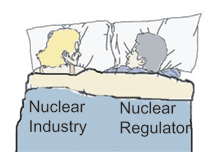 The global experts said India’s nuclear regulatory body – the Atomic Energy Regulatory Board or AERB — should be separated from bodies that can unduly influence its decision making. They also said India should have a system of radioactive waste management……http://www.ndtv.com/india-news/united-nations-nuclear-watchdog-review-slams-indias-nuclear-regulation-750131
Diablo Canyon—An American nuclear plant with troubling similarities to Fukushima
Doomsday Clock Moves Closer to Midnight As California’s Last Active Nuke Plant Puts Millions at Risk, Eco Watch Greg Schwartz | March 24, 2015 Humanity’s clock is ticking but few in power seem to recognize how late it’s getting. The Bulletin of the Atomic Scientists has been keeping time though with their “Doomsday Clock,” established in 1947 to convey threats to humanity and the planet in the new atomic age launched by the Manhattan Project two years before. Widely recognized as an indicator of the world’s vulnerability to catastrophe from nuclear weapons, global climate change and other emerging technologies, the Doomsday Clock was moved forward two minutes in January to 11:57 p.m. It’s the closest the clock has been to midnight since the height of the Cold War in 1984……..
Diablo Canyon—An American nuclear plant with troubling similarities to Fukushima Continue reading
Japan’s Monju fast breeder reactor still closed: over 10,000 cases of maintenance errors in 2013
 More errors with Monju nuclear reactor maintenance found, Mainichi, 27 Mar 15 Several more maintenance problems have been discovered at the Monju fast-breeder reactor facility in Tsuruga, Fukui Prefecture, which has been banned from operation following the discovery of over 10,000 cases of maintenance errors in 2013, it has been learned.
The Nuclear Regulation Authority (NRA) secretariat revealed on March 25 that the newly discovered maintenance errors — which involve the facility’s piping system — mean that Monju operator Japan Atomic Energy Agency (JAEA) may have violated safety regulations……..http://mainichi.jp/english/english/newsselect/news/20150326p2a00m0na007000c.html
Japan’s nuclear waste pools, the nuclear restart, and the terrorism risks in Northeast Asia
Japan’s choices have global significance for the threat of nuclear terrorism, and therefore demands serious consideration as part of a national and international risk-benefit assessment of the future evolution of nuclear power and spent fuel Nautilus Peace and Security NAPS Net Special Report by Peter Hayes 23 March 2015
 SUMMARY
In this report Peter Hayes examines the risk of nuclear terrorism in Northeast Asia with particular reference to Japan. He states that Japan is no more immune to nuclear terrorism than it was to a catastrophic reactor accident. In this context, the combination of safety and security concerns represented by spent fuel pools at reactors is a critical variable in the risk profile arising from the threat of nuclear terrorism. Japan’s choices have global significance for the threat of nuclear terrorism, and therefore demands serious consideration as part of a national and international risk-benefit assessment of the future evolution of nuclear power.
Peter Hayes is Co-founder and Executive Director of Nautilus Institute for Security and Sustainability; Honorary Professor at the Center for International Security Studies, Sydney University, Australia.
II. REPORT BY PETER HAYES
Introduction
In the post-Fukushima era, spent fuel management is recognized as a significant contributor to increased risk of nuclear terrorism. In the immediate weeks after the tsunami-earthquake, the situation at the spent fuel pools at Fukushima unit 1 was dire. The pools were damaged by debris from the hydrogen explosion, inaccessible due to intense local radiation from the melted reactor core, and losing coolant, underscored the argument that spent fuel pools are potential sources of radiological risk in themselves. The orthodox definition of nuclear terrorism based on the diversion of fissile material for use in a nuclear or radiological weapon, with similar potential scales of damage to entire cities as releases from a spent fuel pool, is only part of the nuclear risk story. The Fukushima incident conjoined the issue of nuclear terrorism conceived of as diversion and use of fissile material and nuclear weapons/nuclear energy dual-use technology with possible radiological attack via a dirty bomb or attack on nuclear facilities or on radiological materials in transport.
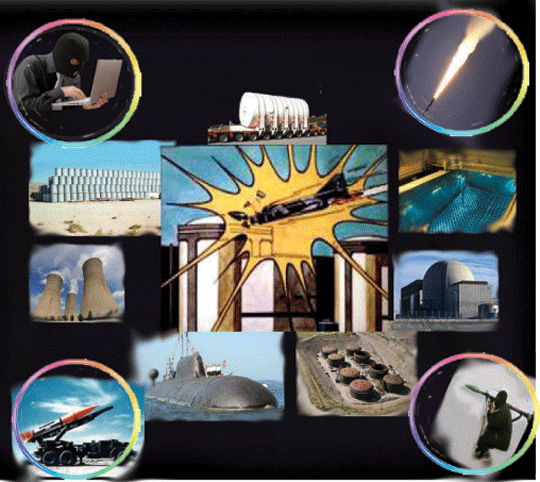
The Japanese authorities themselves recognized this linkage: “The accident revealed the possibility that terrorism at a nuclear facility may have the same serious effects on society [as a natural disaster].”[1] Indeed, Japanese nuclear security authorities now recognize not only that nuclear reactors and other nuclear facilities in which nuclear fuel or nuclear fuel materials are stored may be attacked, but that attacks also may target ancillary support systems such as power supply, and reactor core and spent fuel coolant supply, and that terrorists, including insiders, may attack at these points— with potentially the same devastating effect—or worse—than the earthquake and tsunami of March 11, 2011 had on the Fukushima plants.[2]
Post-Fukushima Response Continue reading
Perilous risks to Ukraine’s nuclear power plants in escalating war
Note that the Zaporizhia nuclear power plant is just to the west of the present combat zone in the eastern region of the Ukraine, and not far north of the Crimea, which is now part of the Russian Federation. It is the largest nuclear power plant in Europe and the fifth largest in the world. It is also right on the banks of the Dnieper River, which empties into the Black Sea, which in turn empties into the Mediterranean Sea. Failure of the Zaporizhia nuclear power plant will massively radioactively contaminate the Dnieper River, which will then flow into the Black Sea and radioactively contaminate the Black Sea, which then flows into the Mediterranean Sea, etc. You see the problem.

Just northeast of Odessa is another, the South Ukraine nuclear power plant.
Many armchair analysts, including commentators such as Paul Craig Roberts, have publicly advocated, or come very close to doing so, that Vladimir Putin send his military racing across the eastern and southern regions of Ukraine, in a blitzkrieg from the Russian border all the way toTransnistria, on the border between Moldova and the Ukraine, in order to incorporate that swath of territory into the Russian Federation, and present NATO and the regime in Kiev with a military fait accompli.
In my view, Putin has not done that because no military operation is ever as simple as it appears on paper; what can go wrong frequently does go wrong. And there are always unexpected complications.
Global nuclear power industry caught in a web of uncertainties
Nuclear terrorism risks in Northeast Asia: Japan’s reactor restart and spent fuel Nautilus Peace and Security NAPS Net Special Report by Peter Hayes 23 March 2015 “…….the nuclear power industry itself is snared in a web of interdependent uncertainties. These include:
- a) How many light water reactors will be restarted and when, and relatedly, will authorities allow reactor operating life to be extended beyond forty years, and will new reactor construction be allowed?
- b) Will reprocessing continue to separate plutonium?
- c) When will the Japanese Mixed Oxide (MOx) fuel fabrication plant be complete?
- d) What level of excess separated plutonium is acceptable domestically and internationally?
- e) Will the breeder reactor be reactivated and if so, for what purpose?
- f) Will uranium-235 recovered from spent fuel be recycled (affecting the already dismal economics of Japan’s enrichment program); and
- g) Will another massive unanticipated nuclear accident in Japan or elsewhere occur? Even ardent pro-nuclear advocates admit that such an event likely would end the use of nuclear power in Japan.[12]
With such massive uncertainty affecting each of these linked variables, any one of which can serve as a binding constraint on the others, the key actors in the Japanese nuclear power sector are unable to make strategic decisions and as a consequence are in a holding pattern until political waters clarify.
Consequently, to the outsider, the safety and security of spent fuel pools in Japan remains unsatisfactory. It is even unclear whether the leadership of the Japanese nuclear power sector recognizes that the risk of loss of coolant arising from malevolent attack exists for spent fuel pools.[13] However, the choices that Japan makes with regard to light water reactor (LWR) restart, reprocessing, the recycling of plutonium (Pu) through the production and use in LWRs of MOx fuel, the eventual use of fast reactors for actinide disposal, the future development of a plutonium-breeding fast reactor, and Japan’s enrichment activities, are all linked directly to the issue of nuclear terrorism and the risk of diversion of spent fuel and separated plutonium. In turn, choices made in each of these fuel cycle activities will determine how spent fuel is managed in Japan, starting with the management of spent fuel pools. Continue reading
Nuclear terrorism danger would be magnified, if Japan reactivated nuclear reprocessing
Nuclear terrorism risks in Northeast Asia: Japan’s reactor restart and spent fuel Nautilus Peace and Security NAPS Net Special Report by Peter Hayes 23 March 2015 “…..Japan’s Post-Fukushima Choice
Due to Fukushima, Japan now must choose to go in one of two directions that are largely exclusive: either towards a reactor restart choice that leads to a minimalist phase-out of separated plutonium over time; or towards a maximalist reliance on separated plutonium over time in a closed fuel cycle………
Should Japan opt to start enough reactors to justify reactivating the plutonium fuel cycle, then the implications for nuclear terrorism would be substantial. The train of logic for maximum spent fuel arising from a closed nuclear fuel cycle is radically different to that for the once-through fuel cycle. In this trajectory, the following would occur:
- Japan starts many more light water reactors, sooner rather than later, and extends reactor lifetimes beyond forty years, and constructs new reactors
- This choice enables far more MOx fuel fabrication and recycling of MOx fuel to these reactors than in the once-through fuel cycle usage; this choice would either slowly reduce or rapidly increase the stockpile of separated plutonium that would be supplemented (if the central state is willing to subsidize heavily the utilities for using MOx fuel) by reprocessing the spent fuel from the operation of the light water reactors
- Thereby generating a new stream of separated and un-separated plutonium in Japan to store and secure, and available for diversion or attack.
Although it does not follow automatically, this vision of the revived closed fuel cycle also implies that:
- The fast reactor is developed in order to burn actinides to reduce the waste disposal problem (whether it would do so is debatable)
- The fast reactor would be developed to breed plutonium based on the argument that doing so makes Japan more independent from external nuclear fuel supply.
All the steps in this second path which maximizes separated fuel involves more transport, more bulk processing and storage, and creates more opportunity for non-state actors to divert fissile material or to attack directly the spent fuel stocks in pools or other nuclear materials process sites in the envisioned “closed” fuel cycle. In short, this trajectory maximizes the nuclear terrorist threat, directly and indirectly, over the next thirty years, especially when the demonstration effect on other states to follow suit are taken into account. For exactly this reason, the United States has reaffirmed recently that it does not favor MOx use and breeder activity in Japan or elsewhere……..[19]http://nautilus.org/napsnet/napsnet-special-reports/nuclear-terrorism-risks-in-northeast-asia-japans-reactor-restart-and-spent-fuel/
1 This Month
26 September – International Day for the Total Elimination of Nuclear Weapons





PLEASE OPPOSE HR 8255 AND S.3639 – bills would accelerate satellite deployment, with no environmental review or safeguards – https://ncstd5li.quorum.us/campaign/169331/
To see nuclear-related stories in greater depth and intensity – go to https://nuclearinformation.wordpress.com
-
Archives
- September 2026 (313)
- August 2026 (330)
- July 2026 (355)
- June 2026 (287)
- May 2026 (306)
- April 2026 (356)
- March 2026 (251)
- February 2026 (267)
- January 2026 (308)
- December 2025 (358)
- November 2025 (359)
- October 2025 (375)
-
Categories
- 1
- 1 NUCLEAR ISSUES
- business and costs
- climate change
- culture and arts
- ENERGY
- environment
- health
- history
- indigenous issues
- Legal
- marketing of nuclear
- media
- opposition to nuclear
- PERSONAL STORIES
- politics
- politics international
- Religion and ethics
- safety
- secrets,lies and civil liberties
- spinbuster
- technology
- Uranium
- wastes
- weapons and war
- Women
- 2 WORLD
- ACTION
- AFRICA
- Atrocities
- AUSTRALIA
- Christina's notes
- Christina's themes
- culture and arts
- Events
- Fuk 2022
- Fuk 2023
- Fukushima 2017
- Fukushima 2018
- fukushima 2019
- Fukushima 2020
- Fukushima 2021
- general
- global warming
- Humour (God we need it)
- Nuclear
- RARE EARTHS
- Reference
- resources – print
- Resources -audiovicual
- Weekly Newsletter
- World
- World Nuclear
- YouTube
-
RSS
Entries RSS
Comments RSS

