USA alarmed at South Africa’s nuclear burglary – unsolved after 8 years

 A break-in at a South African nuclear complex alarms Washington and strains relations years later Two teams of raiders penetrated a site holding enough explosives to fuel six nuclear bombs, but no one was ever caught, Center for Public Integrity , 21 Mar 15 By Douglas Birch
 emailR. Jeffrey Smith
Key findings:
Washington remains spooked by a break-in at Pelindaba, the South African storage site for nuclear explosives, eight years ago.
No one was ever prosecuted for the Pelindaba break-in, even though a nonpublic South African report concluded in 2009 it posed a serious security threat.
South Africa’s government claims the break-in was a petty burglary, but U.S. officials and independent experts worry that the attackers were after nuclear explosives.
The nonpublic South African report described how at every step, the attackers displayed a detailed knowledge of Pelindaba’s layout and security systems, as well as the expertise needed to overcome the site’s defenses.
The incident led to unpublicized collaboration between a U.S. nuclear weapons laboratory and the nuclear site on stronger security measures, but White House officials are convinced more needs to be done at Pelindaba……….http://www.publicintegrity.org/2015/03/20/16917/break-south-african-nuclear-complex-alarms-washington-and-strains-relations-years
The many ways in which fracking is radioactively contaminated
Radioactive isotopes that contaminate fracking industry waste and its machinery include radon, radium-226, uranium-238, and thorium-232. According to the Health Department’s website, these long-lived radioactive pollutants come in six forms:
* “Produced water” which is injected underground but later brought to the surface as waste;
* “Sulfate scales,” which are hard, insoluble deposits that accumulate on frack sand and inside drilling and processing equipment;
* Contaminated soil and machinery;
* Filter socks, contaminated by filtering “produced water”;
* Synthetic “proppants” or sand; and
* Sludge and “filter cake” solids of mud, sand, scale and rust that precipitate or are filtered out of contaminated “produced water. They build up in “filter socks,” and in waste water pipes and storage tanks that can leak
Fracking Radiation- North Dakota Considers Weaker Landfill Rules, Less Oversight , CounterPunch, MARCH 19, 201 by JOHN LaFORGE Radioactive waste produced by hydraulic fracturing or “fracking” is making headlines all over gas land, particularly in North Dakota’s booming Bakken gas and oil field. Continue reading
South Africa’s stockpile of nuclear fuel – a target for terrorists
Technicians extracted the highly enriched uranium from the apartheid regime’s nuclear weapons in 1990, then melted the fuel down and cast it into ingots. Over the years, some of the cache has been used to make medical isotopes, but roughly 220kg remains, and South Africa is keeping a tight grip on it.
That gives this country – which has insisted that the US and other world powers destroy their nuclear arsenals – a theoretical ability to regain its former status as a nuclear-weapons state. But the US is worried that the nuclear explosives here could be stolen and used by militants to commit the worst terror attack in history.
Senior current and former US officials say they have reason to be concerned given that in November 2007, raiders breached the fences at the Pelindaba research centre and some fear they were after the bomb-grade uranium.
Washington has waged a discreet diplomatic campaign to persuade South Africa to get rid of its stock of nuclear-weapons fuel.
But President Jacob Zuma, like his predecessors, has resisted the White House……..http://www.iol.co.za/news/politics/terrorists-could-steal-sa-nuclear-fuel-us-1.1832093#.VQX8RNKUcnk
Web traffic for the UK’s nuclear weapons agency routed through Russian telecom by error
For the past week, something strange has been going on in the European internet. For five days, web traffic from Texas to certain addresses in the UK has been routed through Ukrainian and Russian telecoms, taking a detour thousands of miles out of the way. Network traffic often takes a circuitous route as a result of network congestion or interconnection difficulties, but neither one would be enough to account for these routes. Instead, this was the result of a bad route announced by Ukraine’s Vega telecom, inserting itself in between. “At this point, I have to believe this was an innocent mistake by Vega,” said Dyn’s Doug Madory, who first discovered the redirection, “but it’s concerning nonetheless.”
It’s still likely that the redirection was simply an innocent error, but it underscores the insecure nature of the global routing system. While much of the web has grown more wary of digital attack, routing is still based on trust, with networks freely announcing routes and friendly telecoms adopting them as a matter of habit. As a result, inefficient and potentially insecure routes like this one can linger for days without being corrected, without the parties involved ever being aware of them.
The full traceroute is below, with the Ukrainian telecom visible at line 11 and Russian interconnection at 12 and 13:…..http://www.theverge.com/2015/3/13/8208413/uk-nuclear-weapons-russia-traffic-redirect
Crash in Bosnia of van carrying radioactive materials
Van transporting radioactive material crashes in Bosnia Rt.com 13 Mar 15, A van carrying radioactive isotope Iridium-192 has crashed in north Bosnia, local media reported. The vehicle ran off the road after colliding with a car.
The police blocked the area around the crash site. Bosnia’s nuclear safety agency reported that no radiation leak had been detected.
The van was transporting “apparatus with radioactive material” from the Vinca Institute of Nuclear Sciences, the Banja Luka-based Nezavisne Novine newspaper reported.
After the collision, the van overturned. The radioactive material, however, which is in a solid state and poses no risk of large-scale contamination, remained contained, the authorities said……..
The driver of the car was killed in the crash, while the van driver and a passenger traveling with him survived.
Iridium-192 is a radioactive isotope with a half-life of 73.83 days. It is also a strong gamma ray emitter and is commonly used as a gamma ray source in radiography and radiotherapy as a radiation source.
According to the UN, Iridium-192 is the isotope that most frequently goes missing when radioactive materials are used to make a dirty bomb.http://rt.com/news/240425-bosnia-herzegovina-nuclear-crash/
Pakistan earthquake prone, non signatory to NPT -but China is building nuclear reactors there

 China Builds Nuclear Reactors in Earthquake-Prone Pakistan by Nick Cunningham Oil Price.com e, 10 March 2015
China has decided to defy international norms and build new nuclear reactors in Pakistan.
While the U.S. and Europe see stagnant growth for commercial nuclear power, the same is not true in Asia. China is not only building nuclear reactors at home, but it is exporting its technology abroad. Of particular concern is its construction of nuclear reactors in Pakistan. China helped build two reactors at Chashma, which came online in 2000 and 2011 respectively. More recently, it has decided to double the size of the Chashma power plant, with two additional reactors under construction. And it is also constructing a new nuclear power plant near Karachi, using China’s next generation ACP-1000 design.
But China’s plans in Pakistan are facing global criticism.
The problem is that Pakistan is not a signatory of the nuclear non-proliferation treaty (NPT), which should disqualify it for any international help in building nuclear power plants. The Nuclear Suppliers Group (NSG) is a coalition of nuclear technology exporting countries who have banded together to create guidelines and norms around the sale of nuclear technology in order to ensure its safe use while guarding against the spread of nuclear weapons capabilities. One of the core tenets of the NSG is to not trade nuclear technology to countries that have not signed up to the NPT. Pakistan is one of the world’s four remaining holdouts to the NPT (the other three are India, Israel, and South Sudan).
That is why China’s decision to build nuclear reactors in Pakistan has received criticism. As a member of the NSG, China is defying the guidelines on nuclear trade. China says that its promise to Pakistan predates its 2004 accession to the suppliers group……..http://oilprice.com/Alternative-Energy/Nuclear-Power/China-Builds-Nuclear-Reactors-in-Earthquake-Prone-Pakistan.html
Chinese physcst points out the danger of inland nuclear power plants
CPPCC eyes inland nuke power By Cao Siqi Source:Global Times 2015-3-11 :”………..He Zuoxiu, a theoretical physicist with the Chinese Academy of Sciences, argued against the proposal.
Compared with coastal plants, inland nuclear plants have more complicated requirements where location and geological conditions are concerned, and authorities must take population growth into careful account, as well as emergency evacuation and radioactive exhaust emissions, said the physicist.
He Zuoxiu added that such projects would carry with them tremendous potential danger, which in turn necessitates thorough consideration prior to any construction.
Increasing number of nuclear safety incidents at Britain’s top secret Trident nuclear submarine base,

 More than 450 nuclear safety incidents reported at Britain’s Royal Navy submarine base Mirror, 2 March 2015 By Chris Hughes The incidents took place between 2008/09 and 2013/14 at Her Majesty’s Naval Base Clyde, where the country’s nuclear armed Trident subs are housed
More than 450 “shocking” nuclear safety incidents have been reported at Britain’s top secret Trident nuclear submarine base, new figures show.
Up to 451 safety incidents happened between 2008/ 9 and 2013/14, which involved at least 71 fires and major equipment failures at the Faslane base.
In the last year alone the number of accidents has almost doubled from 68 in 2012/13 to 107 in the following year 2013/14.
The incidents happened at Her Majesty’s Naval Base Clyde, where Britain’s shadowy nuclear armed Trident submarines are based……. http://www.mirror.co.uk/news/uk-news/more-450-nuclear-safety-incidents-5261415
Every country’s nuclear weapons facilities are vulnerable to insider terrorism
Break-In at Y-12 How a handful of pacifists and nuns exposed the vulnerability of America’s nuclear-weapons sites .New Yorker, BY ERIC SCHLOSSER , 9 March 15 “…….The United States is far more open about its nuclear-weapons programs than any other nation. But that openness, and the many security problems it has revealed, should not imply that the greatest threat of nuclear terrorism comes from sites in the United States. On the contrary, America may have the best nuclear-security systems in the world. The management challenges that the United States has faced are now being encountered by every other country that possesses nuclear weapons.
Remarkably little is known about the security arrangements at India’s nuclear facilities. Its weapons aren’t as widely dispersed as Pakistan’s. But in both countries terrorists and extremists are more likely to seek plutonium and weapons-grade uranium. Fissile materials are easier to steal than nuclear weapons and much lighter to carry. An improvised explosive device can be made with just a hundred and twenty pounds of uranium or twenty pounds of plutonium. And those amounts don’t have to be stolen all at once.
The nuclear terror motivations of extremists of Salafi jihadists and of White Supremacists
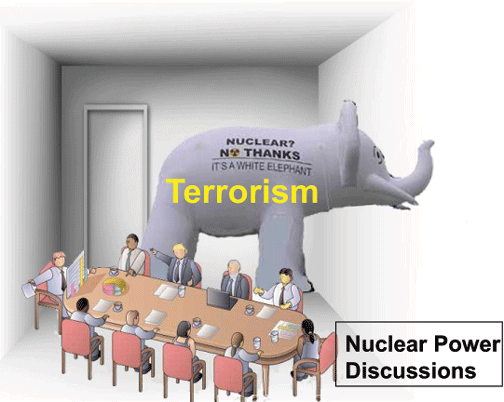 Break-In at Y-12 How a handful of pacifists and nuns exposed the vulnerability of America’s nuclear-weapons sites .New Yorker, BY ERIC SCHLOSSER , 9 March 15 “…….After considering the threat of nuclear terrorism for many years, William C. Potter, the director of the James Martin Center for Nonproliferation Studies, and Gary Ackerman, the director of the Unconventional Weapons and Technology Division, at the University of Maryland, outlined some of the motives that could drive a terrorist group to obtain a nuclear weapon. The group might hope to create mass anxiety or mass casualties. It might want to deter attacks by a state with nuclear weapons. It might want to destroy a large area belonging to an adversary. It might want the prestige that nuclear weapons seem to confer, the status of being a world power. And it might seek to fulfill a religious goal. Groups that have an apocalyptic outlook—that believe “an irremediably corrupt world must be purged to make way for a utopian future,” that celebrate violence as a means of achieving those aims—could be especially drawn to nuclear weapons, Potter and Ackerman found. Today, the number of those groups seems to be multiplying.
“The ruling to kill the Americans and their allies—civilians and military—is an individual duty for every Muslim who can do it in any country in which it is possible to do it,” Osama bin Laden declared in 1998. Al Qaeda’s current leader, Ayman al-Zawahiri, has said that his mood won’t improve until America vanishes. And he quoted, with approval, a radical imam’s view that using a nuclear weapon against the United States would be sanctified by God: “If a bomb were dropped on them, destroying ten million of them and burning as much of their land as they have burned of Muslim land, that would be permissible without any need to mention any other proof.”
The Salafi jihadist world view promoted by Al Qaeda stresses the religious duty to purify corrupt states through violence, drive out infidels, and create a new caliphate—a perfect state in which religious and political leadership will be merged. Seth G. Jones, the director of the International Security and Defense Policy Center at the RAND Corporation, estimates that there are about fifty Salafi jihadist groups worldwide. They focus primarily on local struggles, battling the “near enemy,” not the “far enemy”: the United States. The groups most likely to commit terrorist acts on American soil are Al Qaeda, its offshoot Al Qaeda in the Arabian Peninsula, and the Islamic State in Iraq and al-Sham (ISIS). None have thus far engaged in nuclear terrorism, preferring more conventional and reliable forms of violence.
Nuclear power nightmare unfolding in Karachi?
 Outcry and fear as Pakistan builds new nuclear reactors in dangerous Karachi WP, By Tim Craig March 5 KARACHI, Pakistan — World leaders have fretted for years that terrorists may try to steal one of Pakistan’s nuclear bombs and detonate it in a foreign country. But some Karachi residents say the real nuclear nightmare is unfolding here in Pakistan’s largest and most volatile city. Continue reading
European Union’s post-Fukushima Nuclear Safety Framework
 The Nuclear Safety Framework in the European Union after Fukushima, EU Bulletin
Written by European Values | Friday, February 27th, 2015 Franklin Dehousse and Didier Verhoeven (EGMONT – The Royal Institute for International Relations) “…….Even though the nuclear energy has already been in decline in many EU countries before 2011, it was the Fukushima accident that substantially contributed to Germany’s and Belgium’s decisions to abandon nuclear energy entirely, Italy’s decision to cancel the restart of its own nuclear energy program, and France’s decision to gradually decrease the share of nuclear energy in its overall electricity production. The trend to reduce the nuclear plants’ share of electricity supply will probably continue within the Union in the following years. This will happen not only because of the very fact that most of the nuclear reactors are 20 years and older and with only four new ones currently being built, but also because of the boom of renewable sources and the EU’s effort to reduce its energy dependency on Russia…..
Nevertheless, the EU directive of 2009, which enforced important restrictions, caused wide resentment and thus was replaced by a new directive in 2014, which dropped some of the substantial restrictions. The initial directive introduced common security standards and provided a legal framework for the foundation of a common security body which would associate inspectors with the right to control the implementation of these standards. The new directive, on the other hand, strengthens the security principles without implementing common standards, while seeking to ensure the increasing independence of national regulators and improve the control mechanisms.
(The study can be downloaded here) http://eubulletin.com/4144-the-nuclear-safety-framework-in-the-european-union-after-fukushima.html
Jellyfish and algae becoming a bigger hazard for nuclear reactors
Spineless attacks on nuclear power plants could increase, Bulletin of the Atomic Scientists Natalie Kopytko 19 Feb 15 Nuclear power plants increasingly face a new enemy: the humble jellyfish.
These aquatic animals—and algae and other plants—get caught in and block the cooling water intake pipes of nuclear power plants, preventing nuclear reactors from getting the huge amount of water they need every day to cool their reactor cores and associated equipment. Continue reading
Warning to France on drones- an easy way to destabilise nuclear reactors
 Most French Nuclear Plants ‘Should Be Shut Down’ Over Drone Threat,NewsWeek BY CATHERINE PHILLIPS AND CONOR GAFFEY / FEBRUARY 24, 2015 “You don’t need massive amounts of force to allow a nuclear plant to go into instability. The plant has enough energy to destroy itself. Drones can be used to tickle the plant into instability.”
With devastating simplicity, John Large explains how drones could be used to coordinate a terror attack on a nuclear power station. First, one drone hits the distribution grid serving the plant, depriving the facility of off-site power, making it dependent on its diesel generators to cool the reactor, which generates up to 1,000 megawatts of power – enough to light up half of Paris. Then the generators are easily taken out by an unmanned drone with a relatively small payload. Without power to cool the radioactive fuel, Large estimates it would take approximately 30 seconds before the fuel begins to melt, leading to potential leakages of nuclear waste.
It’s the same cause behind the meltdown at the Fukushima nuclear plant in Japan after it was hit by a tsunami in March 2011. But potential terrorists wouldn’t need to trigger an earthquake, just be able to accurately pilot a pair of readily-available commercial drones carrying small payloads of explosive. Last year, unmanned drones were spotted flying over at least 13 nuclear power stations in France. The last widely-reported sighting was on 3 January, when two aircraft were seen flying over a nuclear facility in Nogent-sur-Seine, in northern-central France.
Activists maintain that a government blackout has blocked information on any further sightings. Curiously, no pictures of drone sightings near power stations have surfaced, a fact that causes concern amongst experts.
“There’s not one single picture. That’s very troubling,” says Jean-Luc Fornier, whose company designs and operates drones for use in the media industry. “If we had some pictures, we could decide on who may be operating the machines.” Fornier suggests that the flyovers that have been noted have three possible explanations: innocent pranksters, anti-nuclear protestors, or trial runs by terrorists. French National Research Agency said the General Secretary for Defence is “providing €1m of funding for research projects into the detection, identification and neutralisation of small aerial drones”.
According to Large, of consulting engineers Large & Associates, based in London, who was commissioned by Greenpeace France to evaluate and report on the spate of flyovers, the “unacceptable” risk posed by a terrorist drone attack means that many of Europe’s nuclear power stations – including the majority of those in France – should be shut down……..
Rousselet says the government is downplaying the threat. He says Greenpeace became aware of a further flyover sighting on 28 January before a government blackout blocked further reports. For Large, the threat remains: “The problem is that these nuclear plants are very attractive targets as the public’s perception of all things nuclear is a fate worse than death. There’s a psychological attraction for these plants as targets as they can cause mass concern among the public.” http://www.newsweek.com/2015/03/06/most-french-nuclear-plants-should-be-shut-down-over-drone-threat-309019.html
Britain’s nuclear facilities are vulnerable to terrorist attacks via drone aircraft
UK nuclear sites warned over drone terror attack, By CAROLINE WHEELER Sunday Express 22 Feb 15
BRITAIN’S nuclear plants are at risk from a terrorist strike by unmanned drone aircraft, writes Caroline Wheeler.Such an attack could kill tens of thousands of people, a Government adviser has warned. But authorities are “burying their heads in the sand,” according to John Large.
His call for an urgent security overhaul comes as fi gures showed nuclear power plants suffered 37 security breaches last year – the highest numberalso been breached a dozen times since 2011, including by at least one drone.
Islamic State terrorists have already recruited chemical weapons specialists and counterterrorism experts say they are intent on building a “dirty bomb”.
Last night Mr Large, a nuclear engineer who has carried out work for Britain’s Atomic Energy Authority, demanded a major exercise to test the resilience of the nation’s power stations against acts of terrorism.
Mr Large, who has advised the French government after a growing number of mysterious unmanned flights over that country’s nuclear plants, said drones also pose a risk to the UK’s 16 operational reactors.“On application to UK nuclear power plants, I believe that much the same security and vulnerability issues apply,” he told the Sunday Express.
“The accessibility of the UK plants to small UAV’s [unmanned airborne vehicles] is relatively unimpeded.”
Asked whether a security review was needed in the wake of the terrorist attacks in Denmark and France, Mr Large said: “Absolutely yes.” Too much focus is placed on the risk assessment surrounding accidents at nuclear power stations, rather than terrorist threats, Mr Large said.
The consequences of the attack scenarios he examined would range from one casualty to tens of thousands of deaths, he added.
The last nuclear power plant built in the UK was completed in the 1990s but the Government is planning a new generation of reactors, starting with Hinkley Point C in Somerset. Last night Tory MP Mark Pritchard, a member of the Joint Committee on the National Security Strategy, said Mr Large’s recommendations would be taken “very seriously”…….http://www.express.co.uk/news/uk/559718/Nclear-plants-are-at-risk-from-a-terrorist-strike-by-unmanned-drones
1 This Month
26 September – International Day for the Total Elimination of Nuclear Weapons





PLEASE OPPOSE HR 8255 AND S.3639 – bills would accelerate satellite deployment, with no environmental review or safeguards – https://ncstd5li.quorum.us/campaign/169331/
To see nuclear-related stories in greater depth and intensity – go to https://nuclearinformation.wordpress.com
-
Archives
- September 2026 (323)
- August 2026 (330)
- July 2026 (355)
- June 2026 (287)
- May 2026 (306)
- April 2026 (356)
- March 2026 (251)
- February 2026 (267)
- January 2026 (308)
- December 2025 (358)
- November 2025 (359)
- October 2025 (375)
-
Categories
- 1
- 1 NUCLEAR ISSUES
- business and costs
- climate change
- culture and arts
- ENERGY
- environment
- health
- history
- indigenous issues
- Legal
- marketing of nuclear
- media
- opposition to nuclear
- PERSONAL STORIES
- politics
- politics international
- Religion and ethics
- safety
- secrets,lies and civil liberties
- spinbuster
- technology
- Uranium
- wastes
- weapons and war
- Women
- 2 WORLD
- ACTION
- AFRICA
- Atrocities
- AUSTRALIA
- Christina's notes
- Christina's themes
- culture and arts
- Events
- Fuk 2022
- Fuk 2023
- Fukushima 2017
- Fukushima 2018
- fukushima 2019
- Fukushima 2020
- Fukushima 2021
- general
- global warming
- Humour (God we need it)
- Nuclear
- RARE EARTHS
- Reference
- resources – print
- Resources -audiovicual
- Weekly Newsletter
- World
- World Nuclear
- YouTube
-
RSS
Entries RSS
Comments RSS

