No easy fix for France’s multi-billion dollar Evolutionary Power Reactor (EPR)

 France’s nuclear power giant beset by setbacks France 24 17 April 15 France, which has one of the most advanced nuclear energy systems in the world, is struggling to remain a major player in the nuclear field as its state-owned company Areva leaks cash and faces safety concerns.
France’s nuclear security authority ASN (Autorité de surete nucléaire) last week declared that a multi-billion dollar Evolutionary Power Reactor (EPR) being built by Areva in Flamanville, Normandy has “a serious anomaly”.
The anomaly comes at a difficult time for the French company as it faces a host of setbacks related to the construction of nuclear power plants around the world. ……..
“Either EDF abandons the project or it takes out the vessel and starts building a new one… this would be a very heavy operation in terms of cost and delay,” Pierre-Franck Chevet, head of the ASN, told the French daily ‘Le Parisien’.
So what next for the EPR?
Overall, there doesn’t seem to be an easy fix.
Yannick Rousselet, a nuclear specialist at Greenpeace in France, says that replacing the tank in Flamanville is more difficult than one might think.
“The tank is the only element that you cannot move easily,” Rousselet told FRANCE 24.
“Historically, tanks were not designed with the idea of dismantling them. In addition, the one at Flamanville is already welded in place, and fixed to the pipe of the reactor.”
Because EDF is state-owned, tax payers will ultimately pay the bill for the expensive project, says Rousselet.
“It’s the French who will pay for the mistakes. Officials collectively took us to a dead end.”…….http://www.france24.com/en/20150417-french-nuclear-company-faces-major-setbacks/
DOE, National Nuclear Security Administration and the Nuclear Waste Partnership, all to blame for WIPP radiation leak
Report: Nuke dump radiation leak could have been prevented, KRQE News 13
By SUSAN MONTOYA BRYAN Associated Press April 17, 2015, ALBUQUERQUE (AP) – A radiation leak that forced the indefinite closure of the federal government’s only underground nuclear waste repository could have been prevented, a team of investigators said Thursday.
A combination of poor management, lapses in safety and a lack of proper procedures were outlined in a final report released by the U.S. Department of Energy’s Accident Investigation Board. Officials reviewed the findings Thursday night during a community meeting in Carlsbad.
The investigators spent more than a year looking into the cause of the radiation release at the Waste Isolation Pilot Plant in southeastern New Mexico.
Like a separate team of technical experts, they too found that a chemical reaction inside a drum of waste that had been packaged at Los Alamos National Laboratory forced the lid open, allowing radiation to escape. The contents included nitrate salt residues and organic cat litter that was used to soak up moisture in the waste.
Aside from lab managers, the report places blame on Energy Department headquarters, the National Nuclear Security Administration and the Nuclear Waste Partnership, the contractor that manages the repository. It highlights numerous failures – from Los Alamos lab not having an adequate system for identifying and controlling hazards to federal nuclear officials not ensuring the existence of a “strong safety culture” at the lab.
Investigators found a failure by managers to resolve employee concerns that could have pointed out problems before the waste was shipped from Los Alamos to the repository.
Accident Investigation Board Chair Ted Wyka said during the town hall that some workers reported seeing foaming and yellowish smoke while repackaging waste. After short discussions with their supervisors, they went back to work on the assembly line.
That information did not make it up to lab managers, he said…….
The Energy Department and its contractors are facing $54 million in fines from the state of New Mexico for the failures that led to the mishap. Negotiations are ongoing, and the state has suggested more financial penalties are possible.
With the repository closed indefinitely, efforts to clean up decades of Cold War-era waste at federal facilities around the country are stalled. Federal officials say resuming full operations at the repository could take years and cost more than a half-billion dollars…….http://krqe.com/2015/04/17/report-nuke-dump-radiation-leak-could-have-been-prevented/
When USA Accidentally Nuked Britain’s First Satellite
That Time The US Accidentally Nuked Britain’s First Satellite, Gizmodo
KARL SMALLWOOD – TODAYIFOUNDOUT.COM 16 APRIL 2015“……..The satellite in question was the Ariel-1, which was developed as a joint-venture between the United States and Britain, with Britain designing and building the core systems of the satellite and NASA launching it into orbit via a Thor-Delta rocket……..
According to NASA, the instruments aboard Ariel-1 were intended to help “contribute to the current knowledge of the ionosphere” and its relationship with the Sun. More specifically, scientists were curious about how the ionosphere, a part of the Earth’s atmosphere made of particles charged by radiation from the Sun, worked. (For more on the ionosphere, see: Why Do Radio Signals Travel Farther at Night than in the Day?) As it turned out, as Ariel-1 was happily free-falling around the Earth, the US military had decided to detonate an experimental 1.4 megaton nuclear weapon named Starfish-Prime in the upper atmosphere as part of Project Fish Bowl. The explosion, which happened on the other side of the planet to Ariel-1, sent a wave of additional radiation around the Earth that ultimately damaged some of the systems on Ariel-1, particularly its solar panels, ultimately killing it and about 1/3 of the rest of the satellites in low-Earth orbit at the time. This famously included the Telstar satellite, which was the first commercial communication relay satellite designed to transmit signals across the Atlantic.
The Telstar actually wasn’t in orbit at the time of the explosion, being put there the day after the Starfish-Prime detonation. However, the additional radiation created by the explosion took years to dissipate and was not anticipated by the designers of this particular satellite. The immediate result being the degradation of Telstar’s systems, particularly the failure of several transistors in the command system, causing it to stop working just a few months after being placed in orbit.As to the purpose of the Starfish-Prime explosion, according to James Fleming, a history professor who combed through previously top-secret files and recordings concerning the blast, the US military were working with scientist James Van Allen to see if nuclear explosions could influence the existing belts of radiation around the Earth…….
He forgot to mention the obligatory, FOR SCIENCE!!!
Bonus Facts:
At around the same time the US was planning to send actual nuclear bombs into orbit, British scientists were similarly experimenting with explosives by attaching grenades to suborbital rockets to run atmospheric pressure tests; once again demonstrating that no matter where they’re from or what tools are available, scientists just really like to blow things up.
The Starfish explosion was actually supposed to have happened on June 20th, but the rocket carrying it failed at about 30,000 feet. Once this happened, the self-destruct on the nuclear warhead was initiated and it broke apart, raining its radioactive innards down on Johnston and Sand Islands, as well as in the ocean around them.
Britain’s first astronaut, Helen Sharman, was sent into space in 1991. All in all, 21 other nationsbeat Britain to the punch in terms of sending a representative of their country into space, including Afghanistan (Abdul Ahad Mohmand), Mongolia (Jügderdemidiin Gürragchaa) and Vietnam (Phạm Tuân).
The effects of Starfish-Prime weren’t just limited to low orbit. The electromagnetic pulse created by the blast ended up being much larger than expected and, in Hawaii some 900 or so miles away from the blast, the pulse ended up knocking out a few hundred street lights and damaged the telephone system. Needless to say, a similar blast in today’s digital society would have caused drastically more damage.
Karl Smallwood writes for the wildly popular interesting fact website TodayIFoundOut.com. http://www.gizmodo.com.au/2015/04/that-time-the-us-accidentally-nuked-britains-first-satellite/
USA’s Nuclear Regulatory Commission puts the nuclear industry’s interests ahead of safety concerns
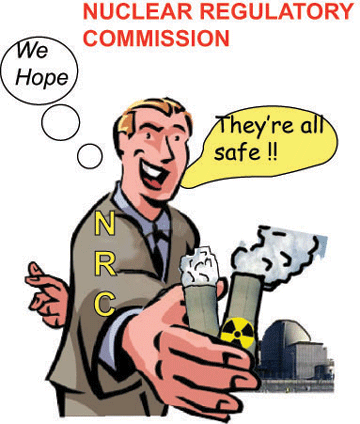 In the U.S. it comes down to the NRC, says Macdonald, because it sets the level of risk that is acceptable. “The utilities are only going to do what the NRC dictates. So it’s really NRC’s responsibility to assess whether this represents a danger to integrity of pressure vessels,” he says.
NRC Opposes European Moves to Tighten Nuclear Safety Post-Fukushima By Spectrum, Peter Fairley 14
Apr 2015 Nuclear power plants’ reactor pressure vessels (RPVs) (at right – yellow marks suggesting c—the massive steel  jars that hold a nuclear plant’s fissioning fuel—face incessant abuse from their radioactive contents. And they must be built with extra toughness to withstand pressure and temperature swings in the event of a loss-of-cooling accident like the one that occurred at Fukushima in 2011. As the triple meltdowns at Fukushima Daiichi showed, the next layer of defense against a nuclear release—the so-called containment vessels—can not be counted on to actually contain molten nuclear fuel that breaches the RPV.
Nuclear safety authorities have recently discovered weaknesses in several RPVs, and their contrasting responses suggest that the ultimate lessons from Fukushima are still sinking into international nuclear power culture—especially in the United States, where the Nuclear Regulatory Commission (NRC) is resisting calls to mandate tougher inspection of RPVs.
Broadly speaking, European regulators have ordered operators to do more to improve safety post-Fukushima than the NRC has. France, for example, is mandating four times as much investment than the U.S. in upgrades such as reinforced bunkers, back-up power, and emergency cooling systems,according to industry estimates cited by Bloomberg Business nuclear safety correspondent Jonathan Tirone.
In February, U.S. diplomats worked to defeat a European initiative to strengthen the Convention on Nuclear Safety, created after the 1986 Chernobyl meltdown. The Europeans wanted the currently voluntary treaty to set mandatory safety standards—a proposal that the United States apparently judged too threatening for U.S. nuclear operators struggling to compete amidst a glut of cheap power generated from natural gas. “The U.S. …worried that the proposal would have required shutting down their plants,” according to Mark Hibbs, senior associate in the Carnegie Endowment for International Peace. Continue reading
The very real danger of huge gas pipeline close to New York Nuclear Power Plant
 Doing the Unthinkable: Giant Gas Pipeline to Flank a New York Nuclear Power Plant Wednesday, 15 April 2015 00:00By Ellen Cantarow, Truthout | News Analysis A very large gas pipeline will soon skirt the Indian Point Energy Center (IPEC), an aging nuclear power plant that stands in the town of Cortlandt in Westchester County, New York, 30 miles north of Manhattan. The federal agencies that have permitted the project have bowed to two corporations – the pipeline’s owner, Spectra Energy, and Entergy, which bought the Indian Point complex in 2001 from its former owner.
A hazards assessment by a former employee of one of the plant’s prior owners, replete with errors, was the basis for the go-ahead. A dearth of mainstream press coverage leaves ignorant the population that stands to be most impacted by a nuclear catastrophe, which experts say could be triggered by a potential pipeline rupture. I urge Truthout’s audience to read an earlier article by Alison Rose Levy, which includes details I haven’t space to recap here.
Since 2011, Spectra Corporation, owner of the 1,129-mile Algonquin Pipeline, which runs from Texas to Beverly, Massachusetts, where it connects with another pipeline running into Canada, has sought to expand the pipeline in order to transport fracked gas north from Pennsylvania. Spectra, one of the largest natural gas infrastructure companies in North America, calls the planned enlargements “The Algonquin Incremental Market Project” (AIM).
AIM includes a two-mile section of 42-inch pipe carrying gas under very high pressures. It is this pipeline segment that will flank IPEC, which stands in a seismic zone. The nuclear complex has a derelict history. In 2001, The New York Timesreported that “the plant has encountered a string of accidents and mishaps since it went into operation on June 26, 1973.” The IPEC has also been on the federal list of the nation’s worst nuclear power plants………
David Lochbaum, a nuclear engineer who graduated from college a few months after the March 1979 Three Mile Island nuclear disaster, has done accident training at many nuclear plants, and has also worked as a technology instructor for the NRC. “Nuclear power plants,” he told Truthout, “are pretty robust. It takes many things to go wrong for a disaster to occur like Fukushima. But a natural gas pipeline poses a threat that could challenge all of them. The biggest threat would be if the pipeline release took out the power supply of the plant. That was the big problem with Fukushima. The tsunami water took out the power and left the plant with no power [but] a few batteries.”
Industry-Compliant Agencies
Blanch, who has worked with the NRC since its inception in 1974, said it is “an agency that has a symbiotic relationship with the industry … If the Nuclear Regulatory Commission imposes [stringent] safety regulations on the industry, it could impact the economic viability of the industry and also the Nuclear Regulatory Commission itself.” He said he became aware of the commission’s industry tilt when he worked as an engineering manager for Northeast Utilities, identified “a serious safety concern” and “saw where the NRC was not really concerned about safety, but more concerned about their survival.” He added, “They will provide an illusion of action; they will take very visible action against small problems, but when it comes to the big problems, they fail to take any action because of its economic impact on the industry.”……..
Computer hackers targeting nuclear power plants
 Hackers have ‘begun targeting nuclear power plants,’ cyber warfare expert warns Jerusalem Post, By YAAKOV LAPPIN 4/16/2015 Computer hackers have begun targeting electric and nuclear power plants around the world, as well as other critical infrastructure sites in increasingly audacious attacks, a senior Israeli cyber security expert warned on Thursday. Col. (res.) Dr. Gabi Siboni, director of the Cyber Security Program at the Institute for National Security Studies (INSS) inTel Aviv, said the recent “major infiltration of Sony Pictures and news that Home Depot and Target were victims of cyber attacks affecting millions of customers is the least of the world’s worries.”
“The disruption and possible infiltration of critical infrastructure is the most severe form of cyber attack. Such attacks on airplanes or air traffic control towers, for instance, means that hackers could cause accidents, or even paralyze entire flight systems. As of now, this area of capabilities is the exclusive domain of developed states. I strongly believe however, that the next 9/11 will happen without suicide bombers aboard the plane with box-cutters but will occur because of a cyber incident perpetrated by a terror organization.”………
Global nuclear industry threatened as safety problems revealed at Flamanville reactor
Unfinished nuclear plants raise safety doubts. April 13, 2015 A new generation of giant reactors, meant to provide fresh hope for nuclear power in Europe, has been found to have a serious safety problem. By Paul Brown Climate News Network LONDON − The future of the world’s biggest nuclear reactor, under construction at Flamanville in northern France, is now in doubt after a serious flaw was found in its steel pressure vessel.
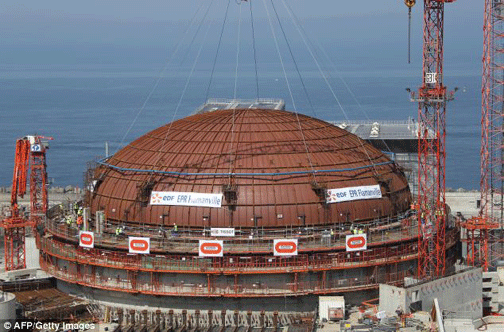
Examination has shown that the steel contains too much carbon, which can weaken the vessel’s structure and breaches safety rules. The Chinese, who have two similar 1,600 megawattEuropean Pressurised Reactors under construction, have been warned that they too may share the potentially catastrophic problem.
Investigations are continuing to check whether the problem can be rectified, but whatever happens it will add more delays and greater costs to the already troubled projects.
The problem also casts doubt on the much-heralded nuclear renaissance in Europe, where EPR reactors are being built not only in France but also in Finland.
Four more are planned for Britain, where they form a cornerstone of the UK government’s policy to fight climate change. A decision on whether to go ahead with the first two in the UK has already been postponed twice, and this revelation will cause further delays.
The French nuclear engineering firm Areva, involved in the EPR’s design and development, found the flawed steel and reported the problem to the country’s nuclear regulator, ASN, which has ordered an investigation. The French energy minister, Ségolène Royal, says the results of tests to check the extent of the problem will be released in October. Continue reading
Danger of nuclear reactors as explained by Alvin Weinberg
 Top US Nuclear Physicist: “Iodine-131 will be lethal after ingestion of 30 billionths of a gram” — Main worry is not a Chernobyl-type accident, rather it’s a melt-through of containment vessel — “Not possible to disprove China Syndrome” http://enenews.com/top-nuclear-physicist-iodine-131-will-be-lethal-after-ingestion-30-billionths-gram-main-worry-chernobyl-type-accident-melt-containment-vessel-possible-disprove-china-syndrome?utm_source=feedburner&utm_medium=email&utm_campaign=Feed%3A+ENENews+%28Energy+News%29 The hazards of nuclear power plants and the related nuclear industries are reviewed
Alvin M. Weinberg, nuclear physicist (Director of Oak Ridge National Lab and pioneered the pressurized water reactors and boiling water reactors used in nuclear power plants, worked on the Manhattan Project, appointed to President’s Science Advisory Committee during the Eisenhower and Kennedy administrations), 1973:
- [A]re there concerns regarding the possibility that these systems may malfunction and cause hazard to people and to the environment? This is a perfectly legitimate question that deserves serious and thoughtful consideration; and it is this aspect of the matter that I shall address… The potential hazard of a nuclear system arises from the toxicity both of the materials that keep the system burning and from the fission product ashes. Plutonium-239… is lethal to man in doses of about 16 thousandths of a gram if ingested in the lungs; Strontium-90, with a half-life of 30 years, will be lethal if about 70 millionths of a gram is ingested; Iodine-131, with a half-life of eight days, will be lethal after ingestion of only about 30 billionths of a gram.
- As I have said, even during the Manhattan Project, we realized that a nuclear reactor could undergo what is known as an excursion [see Chernobyl] – that is, if too many control rods were removed, the reactor power could surge to dangerous levels. This, however, is not the main worry, for such excursions are inherently self-limiting both in time and magnitude.
- Rather, the worry is that in a very high-powered reactor, immediately after the chain reaction has stopped, the fission products at least momentarily continue to generate 7% as much energy… Thus a high-powered chain reactor must continue to be cooled for a considerable time after shutdown if fuel meltdowns are to be avoided. It was Edward Teller who some 25 years ago insisted with great prescience that in these respects nuclear reactors were potentially dangerous, and therefore they should be subjected to the most searching kind of technical scrutiny… The response of the engineer… was to build a… containment vessel around every reactor; the second [was] various back-up safety systems… to prevent the reactor core from melting. Why bother with the back-up cooling systems if the containment vessel in final analysis will catch whatever radioactive debris might be created in an accident and thus prevent harm befalling the public? And indeed this was the attitude in the earliest days… As long as reactors were relatively small we could prove by calculation that even if the coolant system and its back-up failed, the molten fuel could not generate enough heat to melt itself through the containment However, when reactors exceeded a certain size, then it was no longer possible to prove by calculation that an uncooled reactor fuel charge would not melt through its containment vessel. This hypothetical meltthrough is referred to as the China Syndrome for obvious reasons. Since we could not prove that a molten fuel puddle wouldn’t reach the basement of a power reactor, we also couldn’t prove whether it would continue to bore itself deeper into the ground. Whether or not the China Syndrome is a real possibility is moot. The point is, however, that it is not possible to disprove its existence. Thus, for these very large reactors, it is no longer possible to claim that the containment shell, which for smaller reactors could be relied upon to prevent radioactivity from reaching the public, was sufficient by itself. In consequence, the secondary back-up cooling systems… must now be viewed as the ultimate emergency protection against the China Syndrome… if one is trying to be practically 100 percent sure of always being able to cope with a reactor meltdown, then one must… be absolutely certain that the engineered safety features, particularly the emergency core cooling system, will work as planned.
French authorities warn China on safety issues regarding rectors under construction in Guangdong
 The French reactor, at the Flamanville EPR nuclear power plant, is a third-generation pressurised water reactor of similar design and build to the two reactors being installed at a new plant in Taishan. Quality inspectors at Flamanville found an abnormally high concentration of carbon in steel parts capping the reactor vessel’s top and bottom during a series of tests carried out by French nuclear company Areva, which is building the reactor.
The excessive carbon would lead to “lower than expected mechanical toughness values”, nuclear regulator ASN said in a press statement on its website, without giving more details.
The toughness of the reactor shell was crucial because it relates to the ability of the material to withstand the propagation of cracks. The steel shell of a reactor has to be extremely tough to withstand decades of operation.
It was unknown whether the Taishan reactors had the same problem, but the issue might be worth China’s concern, the French authorities said. ASN had “informed” relevant foreign counterparts, the statement said.
“The vessel of a pressurised water reactor is equipment that is particularly important for safety,” the ASN added. “It contains the fuel and takes part in the radioactivity second containment barrier.”
The problematic steel parts at Flamanville were made by Creusot Forge, a subsidiary of Areva, which also made the same parts for the two reactors in Taishan with similar manufacturing technology, according to a Reuters report. It was unclear whether the Taishan reactors had undergone similar tests before they were shipped to China……..http://www.scmp.com/news/china/article/1762861/french-warning-nuclear-reactors-being-built-guangdong
The grim facts on the unsafety of Davis Besse, Columbia, Diablo, New York and other nuclear power stations
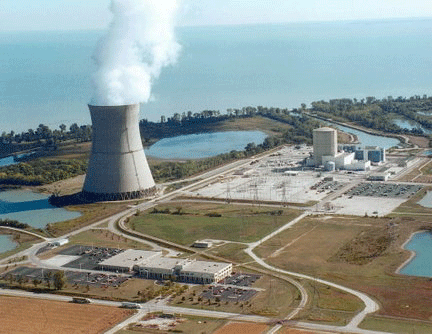 The Real Nuclear Threats, CounterPunch 12 Apr 15 by MIRIAM GERMAN “……….These are just some of the facts about Davis-Besse.
● Because it was built in a flood plain, a 1972 Lake Erie storm caused massive flooding of the entire construction site including the pre-operational reactor.
● In October 1977, a relief valve stuck.
● Uranium fuel must be submerged in water (coolant) at all times to prevent a meltdown. In June 1985, Davis Besse had a loss-of-feedwater accident. The Nuclear Regulatory Commission closed the plant for a year.
● A June 1998 tornado caused loss of external electric power.
● In March 2002, neglected, leaking boric acid in the coolant water had eaten through more than seven inches of the steel reactor lid, leaving only a 3/16″ liner to prevent radiation release. The plant closed for two years, costing ratepayers $600 million. Davis-Besse was fined $33.5 million, the largest in NRC history.
● The corroded lid was replaced before restart in 2004, but in 2010, cracks were found in this new lid, forcing its replacement in 2011.
● To replace aging, deteriorating, damaged parts, an unprecedented four large cuts have been made through the Davis-Besse concrete shield building which prevents release of radiation. Starting in 2011, cracks and voids were discovered in the building’s concrete.
Moniz must look over here, below his feet on US ground, to recognize and acknowledge the bomb fields laying in wait that you still believe are safe, inexpensive and necessary, but which I call ancient relics of poor technology based on the idiocy of a few terrible ideas by self-important arrogant fools who believed nukes would save the world but would instead, kill the very Earth we inhabit. What side of the gambling table are you on? Remember, the cards have already been shown. Fukushima, Chernobyl, Three Mile Island. Hanford.
There is no peaceful nuke and there is no peace with nukes. There is only a mirage.
Columbia Generating Station. Richland, WA. Located on the Columbia River. CGS was built on twelve fault lines. It was not known at the time but now we have facts. It is not built to withstand an earthquake of the 9.0 magnitude the NW is expecting any day. Not even close. With facts, we are armed with the ability to make changes for the sake of humanity. But we only care about being armed for war. There is no containment around the CGS fuel pool. The fuel pool is five stories high. Think Fukushima. Really. Think Fukushima. CGS is the same kind of nuclear reactor as Fukushima. CGS sits ten miles from 56 million gallons of highly radioactive nuclear waste at Hanford. If a meltdown or explosion happens at CGS, it will take Hanford with it. There will be no way to get in to the area to clean it up due to the massively high levels of radiation. The Columbia River flows directly into the Pacific. CGS has problems with the monitoring stacks just about every two to three weeks. They cannot monitor levels of radiation going into the environment from the plant properly without these stacks. On top of all of this, we have records of drug abuse from managers and workers at the plant caught stoned or drunk during surprise drug testing, so many records that we have a spreadsheet that we add to periodically. Would you like to live near CGS?
Where is the IAEA? They are waiting to be flown to Iran.
Diablo Canyon. Corruption. PG&E. Water Bureau. Illegal dumping of hot water into the Pacific. Fault lines. To see a photo of the fault lines at the base of Diablo Canyon and on out just a bit into the ocean off the coast of California is to understand a vision of insanity……..
New York City. Home to well over eight million people and the Indian Point Nuclear Power Plant, just twentyfive miles from the Bronx. Here we have a known leaking nuke plant but the IAEA and all of their grave concerns about safety in Iran can be found no where close to home. Indian Point leaks Tritium. Do you know how bad it is to have that in the ground water, drinking water or rivers and lakes? The Big Apple can turn to molten corium as far as the IAEA, the DOE and the NRC are concerned.
Let’s mention MOX fuel since Kerry and Moniz talk so much lately about oversight and care and safety and transparency from the IAEA to Iran. Plutonium from dismantled nuclear weapons can get used as fuel in nuke plants creating more heat and radioactivity than uranium if it explodes while causing twice as many civilian cancers as the same explosion using uranium. Fact: MOX fuel is the easiest type of fuel to explode; it is the Viagra for nuclear weapons. Yet knowing that it’s the easiest to explode, nuclear engineers still decided to put MOX fuel into nuclear power plants. Pure insanity…….
Miriam German is the director of RadCast.org. She founded No Nukes NW in 2012. http://www.counterpunch.org/2015/04/10/the-real-nuclear-threats/
Fears of a nuclear Electro-Magnetic Pulse (EMP) cause Pentagon to re-open Cheyenne mountain bunker
EMP Nuclear Attack Fears Have US Reopen Cheyenne Mountain, ARUTZ SHEVA Israel International News, By Mark Langfan 4/11/2015, Days after Iran deal, Pentagon acts fearing nuclear missile attack that would burn out America’s electronic-based defenses. The Pentagon has decided to reopen the Cheyenne Mountain Air Defense facility, which housed the heart of America’s air and missile defense of North America. The facility had been mothballed in a “cost-saving” move in 2006.
Last week, Admiral William Gortney, head of US NORAD (North American Aerospace Defense Command) and US Northern Command, reversed that decision and announced the Pentagon was spending an opening ante of $700 million to oversee reactivation of the Cheyenne mountain-embedded facility.
The reason – the Pentagon’s fears of a nuclear Electro-Magnetic Pulse (EMP) attack by a missile that would burn out America’s overly-dependent defense, which is based on modern electronics.
US NORAD and US Northern Command aren’t just acronyms. They represent the last-ditch American defense of the continental United States homeland. NORAD originally stood for North America Air Defense Command, but now stands for North American Aerospace Command. US Northern Command is the area-specific designation of the US military command that is responsible for the continental United States homeland.
Given the current US military fear of an inter-continental ballistic (ICBM) missile attack with an EMP nuclear-device, Admiral Gortney explained that “because of the very nature of the way that Cheyenne Mountain’s built, it’s EMP-hardened. And so, there’s a lot of movement [in the Pentagon] to put [military] capability into Cheyenne Mountain and to be able to communicate in there.”
In early 2013, this author warned against a similar Iranian “Fatwa-compliant” EMP attack against Saudi Arabia, and a North Korea EMP attack against South Korea.
In an even more startling admission, Admiral Gortney revealed that his “primary concern” was whether the Pentagon was “going to have the space inside the [Cheyenne] mountain for everybody who wants to move in there, and I’m not at liberty to discuss who’s moving in there.”
The Cheyenne mountain bunker is a half-acre cavern that was carved into a mountain in the 1960s that was originally designed to withstand a Soviet nuclear attack. During the Cold War, the United States feared a Soviet nuclear attack scenario that would feature an opening Soviet “EMP decapitation” nuclear attack.
Such a nuclear attack was not the launch of a massive Soviet nuclear first-strike against American cities, but instead, a first-strike Soviet “EMP decapitation” attack that would explode a nuclear device high-above the United States, burning out all of America’s command and control communication systems, and thus severing America’s President from being able to order the US military to retaliate.
By first electronically destroying America’s communications systems, the Soviets would thus have “decapitated” the US’s ability to respond to a secondary more massive follow-on Soviet nuclear attack on American cities.
Thus, a successful Soviet nuclear EMP attack on the US would have “trumped” the concept of MAD, or Mutually Assured Destruction, because America would have been unable to retaliate and destroy the Soviet Union in response to a Soviet nuclear attack.
During the Cold War, airmen stationed inside the massive complex were poised to send warnings and firing codes that could trigger the launch of America’s vast web of nuclear missiles. Now, in light of the latest nuclear EMP dangers hanging over the United States, the US military, and the United States of America- itself, once again hopes to be protected by the mountains of Colorado…….http://www.israelnationalnews.com/News/News.aspx/193883#.VSrsY9yUcnk
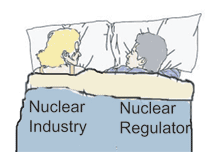
Who’s to blame for the faults in San Onofre Nuclear Plant: not us -says NRC
 NRC: Nuclear plant failure not our fault UT San Diego, By Morgan Lee .APRIL 10, 2015 As it turns the page on the breakdown of the San Onofre nuclear plant, the U.S. Nuclear Regulatory Commission is standing by its role in overseeing the replacement of steam generators that led to a radiation leak and the facility’s early retirement in 2013.
The safety agency also is warning the nuclear power industry that the destructive vibrations among generator tubes carrying radioactive water that occurred at San Onofre could emerge at other reactors over time.
A detailed memo by nuclear commission staff on the lessons learned at San Onofre has concluded that efforts by plant operator Southern California Edison to avoid a more-detailed review of the generators by safety regulators are not necessarily to blame in the breakdown of the plant. Responsibility lies instead with design mistakes overseen by Edison, according to the 70-page memo quietly released last month……..
The commission is directing the nuclear power industry to revise design guidelines that do not sufficiently address the kind of destructive tube vibrations that disabled the replacement generators at San Onofre.
A letter from the agency to industry engineers last year warned that “events at San Onofre not only raise questions about industry standards for designing and fabricating steam generators, but also raise questions about the operation of existing steam generators.” It cited no immediate safety concerns but said active generators could become susceptible as conditions change.
A 2012 radiation leak at San Onofre was traced to rapid wear on generator tubes that carry radioactive water that circulates through the reactor core.
 Meanwhile, the nuclear commission is preparing to dismiss formal accusations that a more-thorough safety review of the San Onofre generators was warranted. That complaint was filed by the environmental group Friends of the Earth in 2012……….http://www.utsandiego.com/news/2015/apr/10/nrc-stands-by-process-at-onofre/
Connecticut’s sole nuclear under scrutiny for security issue
Federal energy regulators and a local oversight panel are set to meet to discuss safety issues at Connecticut’s sole nuclear plant.
Nuclear Regulatory Commission staff members and the state Nuclear Energy Advisory Council will meet in Waterford Tuesday to review operations at the Millstone nuclear plant.
Millstone’s Unit 3 is under heightened oversight due to problems related to the plant’s auxiliary water pump. It’s one of several used to help cool down the reactor.
The Nuclear Regulatory Commission announced increased oversight April 2. The agency didn’t disclose the security problem, but said Millstone’s problem rated a low-significance “greater than green” on a scale ranging from green for very low safety or security significance to red for high safety or security significance.
Unless the finding is successfully appealed, it will result in additional scrutiny. http://www.wfsb.com/story/28780712/us-nuclear-regulators-to-review-millstone-with-state-panel#ixzz3X8UtUviJ
China’s new nuclear reactors lack required modern safety features

 Chinese nuclear reactors ‘did not receive latest safety tests before installation’ French manufacturer said recent test detected fault that could lead to cracks in reactor shell, South China Morning Post , 11 April, 2015 Stephen Chen chen.binglin@scmp.com Two new nuclear reactors in Taishan, Guangdong, did not undergo the same quality tests as a similar reactor in France that was found to have weak spots prone to cracks.
Special tests at the Flamanville EPR nuclear power plant were only carried out last year after France tightened its nuclear safety regulations, France’s Nuclear Safety Authority (ASN) told the South China Morning Post.
No such tests were conducted on the two third-generation EPR Taishan reactors before French nuclear manufacturer Areva shipped them to China. That meant the 50-billion yuan (HK$63 billion) Taishan plant, located about 80km west of Zhuhai and Macau, could be plagued by the same problem and not be detected.
 Weak spots in a reactor’s steel shell is a serious defect – once installed, the shell cannot be replaced throughout the reactor’s 60-year lifespan.
The tests in France found that excessive carbon in the steel that formed the reactor’s top and bottom could lead to unexpected cracks that could later spread.
The news comes as a shock to China’s burgeoning nuclear sector. With the completion date of the first project phrase expected by the end of this year, the Taishan EPR plant was a landmark project for China’s nuclear sector.
The plant’s two advanced 1.75GW pressurised water reactors were to be the world’s largest single-piece electric generators and their operation was said to be the safest, too.
Now it is not certain whether the Taishan reactors would comply with France’s stricter standards……….http://www.scmp.com/news/china/article/1763315/taishan-nuclear-reactors-did-not-receive-most-updated-safety-tests
USA’s Nuclear Regulatory Commission gambles with safety, using legalistic jargon
 US NRC Playing Brazen Legalese Games with Safety (Reactor Pressure Vessel Embrittlement) at Palisades Nuclear Power Station and Elsewhere, Mining Awareness, 9 Apr 15 In the April 18, 2013 US NRC “Summary of the March 19, 2013 Public Meeting Webinar Regarding Palisades Nuclear Plant” one finds brazen legalese statements by the US NRC in order to defend one of Entergy’s aging reactors, Palisades (Note that the NRC also had lawyer(s) working on the corporate side pushing the judge to ignore current concerns at Davis Besse Nuclear Power Station too. Davis Besse and Palisades endanger the largest surface fresh water system on earth.) The NRC inadvertently points out that, most likely, no US nuclear reactor has the more resistant materials required for safety starting in 1977.
Someone asked the NRC:
“Which are the other most embrittled plants in the U.S.? How many PWRs will reach their screening criteria in the next 10 years?”
The NRC responded:
“The NRC currently estimates that the following plants will exceed the PTS screening criteria of 10 CFR 50.61 during their 20-year period of operation beyond their original 40 year licenses. Updated fluence calculations, capacity factors changes, power uprate, new surveillance data, and improved material property information (i.e., the use of direct rather than correlative measurements of the vessel material’s resistance to fracture) can change these estimates…
1. Point Beach 2 (2017)
2. Palisades (2017)
3. Diablo Canyon 1 (2033)
4. Indian Point 3 (2025)
5. Beaver Valley 1 (2033)”
http://pbadupws.nrc.gov/docs/ML1310/ML13108A336.pdf
(It’s not clear if these years are the license expiration dates, or when they are estimated as in most danger of reactor pressure vessel fractures, minus uprates etc, which increase stress and put them at risk more quickly. PTS is Pressurized Thermal Shock. Point Beach is also on the Great Lakes (Lake Michigan, as is Palisades)
According to the NRC, Entergy-Palisades didn’t violate standards because there weren’t any! “Palisades did not violate the NRC’s PTS safety standards in 1981 since the NRC did not have any regulations pertaining to PTS until June 26, 1984.”
The NRC inadvertently explains that US Reactors are not up to even 1977 standards:
“For new plants, the reactor vessel beltline materials should have the content of residual elements such as copper, phosphorus, sulfur, and vanadium controlled to low levels. The levels should be such that the predicted adjusted reference temperature at the ¼ T position in the vessel wall at end of life is less than 200 °F. [These] recommendations … will be issued in evaluating construction permits docketed on or after June 1, 1977.”http://pbadupws.nrc.gov/docs/ML1310/ML13108A336.pdf
“There has been no ground-breaking on new nuclear plants in the United States since 1974. Up until 2013, there had also been no ground-breaking on new nuclear reactors at existing power plants since 1977.”http://en.wikipedia.org/wiki/Nuclear_power_in_the_United_States
Since permitting would normally come before ground-breaking this appears to mean that no nuclear reactors currently in operation are up to the 1977 standards for prevention of embrittlement. 1977 was 37-38 years ago. Jimmy Carter was President and the Cold War was far from over. Apple home computers weighed 11.5 pounds excluding the screen, which probably weighed almost as much. Apple Ipad air weighs less than one pound.
The NRC further states:
“In conclusion, there was no violation of NRC requirements concerning PTS at Palisades. Had Palisades ever violated PTS requirements the NRC would have shut down the plant.
Regulatory Guides do not contain requirements, only recommendations.”http://pbadupws.nrc.gov/docs/ML1310/ML13108A336.pdf
So, since the “Regulatory Guides only contain recommendations”, anything goes? What’s the NRC for then? Making the US tax-payer pay for lawyers and staff to protect the interests of the nuclear power industry? Safety doesn’t matter? Regulations are supposed to be laws. Aren’t they?
Where did concern about the US budget go anyway? A good place to start cuts is the US NRC, which has long been called an instance of regulatory capture. ……..https://miningawareness.wordpress.com/2015/04/09/us-nrc-playing-brazen-legalese-games-with-safety-reactor-pressure-vessel-embrittlement-at-palisades-nuclear-power-station-and-elsewhere/
1 This Month
26 September – International Day for the Total Elimination of Nuclear Weapons





PLEASE OPPOSE HR 8255 AND S.3639 – bills would accelerate satellite deployment, with no environmental review or safeguards – https://ncstd5li.quorum.us/campaign/169331/
To see nuclear-related stories in greater depth and intensity – go to https://nuclearinformation.wordpress.com
-
Archives
- September 2026 (313)
- August 2026 (330)
- July 2026 (355)
- June 2026 (287)
- May 2026 (306)
- April 2026 (356)
- March 2026 (251)
- February 2026 (267)
- January 2026 (308)
- December 2025 (358)
- November 2025 (359)
- October 2025 (375)
-
Categories
- 1
- 1 NUCLEAR ISSUES
- business and costs
- climate change
- culture and arts
- ENERGY
- environment
- health
- history
- indigenous issues
- Legal
- marketing of nuclear
- media
- opposition to nuclear
- PERSONAL STORIES
- politics
- politics international
- Religion and ethics
- safety
- secrets,lies and civil liberties
- spinbuster
- technology
- Uranium
- wastes
- weapons and war
- Women
- 2 WORLD
- ACTION
- AFRICA
- Atrocities
- AUSTRALIA
- Christina's notes
- Christina's themes
- culture and arts
- Events
- Fuk 2022
- Fuk 2023
- Fukushima 2017
- Fukushima 2018
- fukushima 2019
- Fukushima 2020
- Fukushima 2021
- general
- global warming
- Humour (God we need it)
- Nuclear
- RARE EARTHS
- Reference
- resources – print
- Resources -audiovicual
- Weekly Newsletter
- World
- World Nuclear
- YouTube
-
RSS
Entries RSS
Comments RSS

