Special NRC inspection of leak from A southern Illinois uranium-conversion plant
NRC inspecting Illinois uranium-conversion plant after leak, WT By – Associated Press – Tuesday, August 4, 2015 METROPOLIS, Ill. (AP) – A southern Illinois uranium-conversion plant is undergoing a special inspection after a weekend leak of uranium hexafluoride, a gas used to produce enriched uranium for nuclear power plants, Nuclear Regulatory Commission officials said.
A valve installed during maintenance at the Honeywell plant in Metropolis began to leak just before 6 p.m. Saturday, triggering an emergency alert and activation of large water sprays, the NRC said in a news release. The leak was stopped almost two hours later; the company said nobody was injured and the leak did not leave the site.
Honeywell’s Metropolis plant, about 5 miles northwest of Paducah, Kentucky, is the only place in the U.S. that converts uranium ore to uranium hexafluoride, which can be toxic when exposed to moisture in the air………
The company has experienced other uranium hexafluoride leaks, including last October, the (Carbondale) Southern Illinoisan reported (http://bit.ly/1MKIM2G ). In December 2013, Illinois Attorney General Lisa Madigan fined Honeywell $90,000 for three prior releases, in December 2008, December 2010 and October 2011. http://www.washingtontimes.com/news/2015/aug/4/nrc-inspecting-illinois-uranium-conversion-plant-a/
Indian Point nuclear station not safe – should be closed down
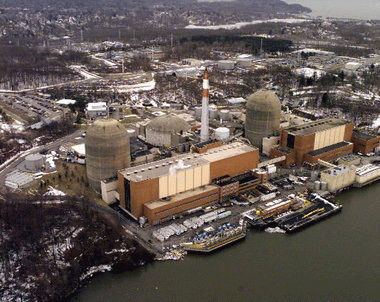 Aging Nuclear Power Plant Must Close Before It Closes Us http://ecowatch.com/2015/06/22/indian-point-aging-nuclear-plant/ Paul Gallay | June 22, 2015 We must face facts regarding the Indian Point nuclear plant. It’s infrastructure is aging, its safety is dubious and most everyone knows it. What many people don’t know is that it can be replaced at little cost to ratepayers—and energy technologies taking its place would create new economic opportunities for New York.
Indian Point—just 38 miles north of New York City—is vulnerable to terrorism, has 2,000 tons of radioactive waste packed into leaking pools and relies on an unworkable evacuation plan. While some argue that transformer accidents—such as the one that occurred last month—can happen at any power facility, they happen with astonishing frequency at Indian Point. Its age is problematic: You wouldn’t rely on a 40-year-old appliance, why extend this trust to a nuclear plant? Moreover, the Nuclear Regulatory Commission (NRC) says Indian Point 3 has the highest risk of earthquake damage of all the nation’s reactors. About 20 million people live within 50 miles of Indian Point. If a catastrophic accident occurred, the consequences would be unimaginable.
The NRC permits Indian Point to evade its own safety standards requiring that electrical cables controlling emergency reactor shutdowns have insulation that lasts 60 minutes in a fire. When the NRC found that the plant’s insulation lasted just 27 minutes, it gave Indian Point an exemption. Your own home likely has more insulation on its electrical cables than does the plant. Continue reading
Decommissioned sites need MORE protection against wildfires, not less!
 In Light of Fast Moving Wildfires; Evacuations, US Senators call on NRC to Stop Waiving Emergency Response Measures at Decommissioned Nuclear Sites (to no avail) miningawareness51 July 15
http://cdfdata.fire.ca.gov/incidents/incidents_current
 Despite calls by Senators in 2014 to stop elimination of emergency response measures at decommissioning nuclear reactors: “In June 2015, the Nuclear Regulatory Commission (NRC) approved elimination of off-site emergency planning for San Onofre, even though they know the waste is extremely dangerous. This means fewer emergency planning staff, reduced funding and less radiation monitoring. … The San Onofre fire staff has been reduced. The nuclear plant’s fire and rescue vehicles will be donated to new homes soon, according to Patrick Baughman, San Onofre fire marshal. San Onofre now has an agreement that makes the Camp Pendleton Fire Department the primary firefighting force for the nuclear plant. No details were provided about how this may affect ratepayers and local emergency services in this Southern California Edison July 9, 2015…” Read the rest here: http://sanonofresafety.org/emergency-planning-resources/ Learn more here: Sanonofresafety.org
Unfortunately, the Dry Cask Storage is not the miracle solution which the Senators and many others wish for. (See more at post bottom. [in original] )…..
Unfortunately, the Dry Cask Storage is not the miracle solution which the Senators and many others wish for. This is especially true due to the thin, flimsy nature of the inner, unvented, casks, which are also of questionable quality, and are set out unprotected on parking lots. Furthermore, Holtec requests NRC exemptions which impact safety and quality on a routine basis! For more info, do a search for Holtec within our blog, and consult Sanonofresafety.org Although most of the focus has been Holtec, the other licensed dry casks do not appear better. A Manhattan-like project for nuclear waste is needed. In the meanwhile, there appears need for adding more spent fuel pools to reduce crowding, and reinforcement of the existing ones, and somehow covering them (vented) against earthquake seiche. The spent fuel must spend some time in the pools anyway. A solution must be quickly implemented. https://wordpress.com/read/post/feed/4410547/767161082
USA to sell nukes to China. Profit for corporations versus national security
 Congress’s Other Nuclear Test A pending 30-year deal with China requires oversight too. WSJ 26 July 15 “……The deal’s basic purpose is to allow China to keep buying nuclear power plants from U.S. suppliers such as Westinghouse Electric, a slice of bilateral trade responsible for thousands of U.S. jobs, according to industry estimates. Yet civil-nuclear business carries proliferation risks, as technology used in power plants can also serve various military purposes.
Republican Senators Marco Rubio and Tom Cotton oppose the deal given China’s record of proliferating to Iran, North Korea and Pakistan. China has also secretly diverted U.S.-produced nuclear-reactor cooling pumps to make its naval submarines more quiet and therefore more stealthy, as confirmed in Congressional testimony by Assistant Secretary of State Thomas Countryman in May. Such diversion violated China’s commitment to “peaceful use” of imported nuclear technology……..
A House amendment to the defense spending bill would require that the DNI and the Chief of Naval Operations weigh in on interagency approvals of future civil-nuclear sales to China, with the aim of mitigating risks of military diversion.
The Nuclear Energy Institute and other industry lobbyists protest that this provision would add needless bureaucratic review. …http://www.wsj.com/articles/congresss-other-nuclear-test-1437910661
Many $millions later, Los Alamos Weapons Engineering Tritium Facility still not safe
Audit: Nuclear lab lets safety gaps languish for years, Center For Public Integrity
Multi-billion-dollar Los Alamos contractor tells investigators it needs more money to meet basic safety expectations By Patrick Malone July 22, 2015
An obscure facility at Los Alamos National Laboratory for nine years provided vital scientific data about a critical gas used in America’s arsenal of nuclear weapons, until it was shuttered four years ago due to a raft of safety problems that have stubbornly persisted.
The Energy Department, which oversees and finances the lab’s work, has poured tens of millions of dollars into fixing the problems, but so far, the expenditures haven’t borne much fruit. The facility – known as the Weapons Engineering Tritium Facility – is “vital” to the lab’s national security mission, but it remains closed, the department’s inspector general said in a report released July 20.
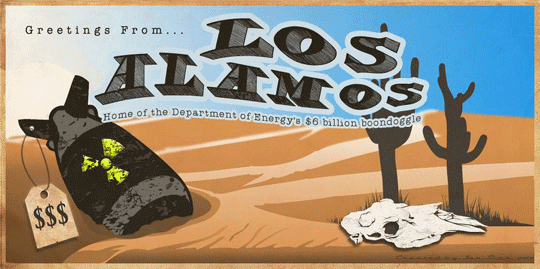
In fact, Los Alamos managers have been unable – after seven years of effort – even to prepare a sound analysis of the site’s safety hazards and the steps being taken to ensure that the radioactive gas at issue does not leak or explode and harm either workers or those living nearby, according to the DOE report.
DOE Inspector General Gregory H. Friedman said in the report that poor hazard analysis has been a recurrent problem at the lab, and said weaknesses in other projects have remained unfixed from one annual evaluation to the next. The lab, he wrote, “lacked sufficient qualified staff to resolve certain safety issues.”
The purpose of the tritium facility is to refine, mix and analyze that high-hazard gas, which is used in small amounts to boost a nuclear bomb’s pulverizing force. Those who worked at the facility struggled to ensure that monitoring equipment accurately tracked oxygen levels, to avert any chance of a sudden combustion during processing, according to the report. The lab’s own assessments, dating back to 2007, warned that the oxygen monitoring system in the building was unreliable. Energy Department staff in April 2013 cited the oxygen monitoring as one of 450 issues that needed to be addressed there.
Although the lab fixed the oxygen monitoring system last year, and so far has spent $17 million to prepare a comprehensive safety plan, it hasn’t completed the task. “There had been higher safety-related priorities” at the lab, Energy Department staff told auditors……..http://www.publicintegrity.org/2015/07/22/17702/audit-nuclear-lab-lets-safety-gaps-languish-years
Terrorists planned an attack on nuclear weapons base
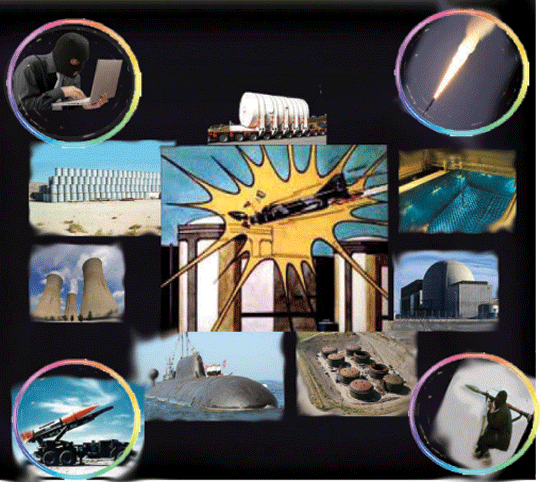 US Nuclear Weapons Base In Italy Eyed By Alleged Terrorists http://fas.org/blogs/security/2015/07/ghedi-terror/ by Hans M. Kristensen Two suspected terrorists arrested by the Italian police allegedly were planning an attack against the nuclear weapons base at Ghedi.
The base stores 20 US B61 nuclear bombs earmarked for delivery by Italian PA-200 Tornado fighter-bombers in war. Nuclear security and strike exercises were conducted at the base in 2014. During peacetime the bombs are under the custody of the US Air Force 704th Munitions Support Squadron (MUNSS), a 130-personnel strong units at Ghedi Air Base.
The Italian police said at a press conference today that the two men in their conversations “were referring to several targets, particularly the Ghedi military base” near Brescia in northern Italy.
Ghedi Air Base is one of several national air bases in Europe that a US Air Force investigation in 2008 concludeddid not meet US security standards for nuclear weapons storage. Since then, the Pentagon and NATO have spent tens of millions of dollars and are planning to spend more to improve security at the nuclear weapons bases in Europe.
There are currently approximately 180 US B61 bombs deployed in Europe at six bases in five NATO countries: Belgium (Kleine Brogel AB), Germany (Buchel AB), Italy (Aviano AB and Ghedi AB), the Netherlands (Volkel AB), and Turkey (Incirlik AB).
Over the next decade, the B61s in Europe will be modernized and, when delivered by the new F-35A fighter-bomber, turned into a guided nuclear bomb (B61-12) with greater accuracy than the B61s currently deployed in Europe. Aircraft integration of the B61-12 has already started.
Potassium Iodide pills to be distributed to residents in area of nuclear facility
 Department of Health distributing free Potassium Iodide to Pennsylvanians near Nuclear power plants, Pittsburgh Actio News,
KI is also available for those who work within the 10-mile radius, but do not live there. Employers can contact the Department of Health at 1-877-PA-HEALTH to make arrangements to pick up tablets for their entire workforce.
School districts within the 10-mile radius have the option of deciding whether to distribute KI for their students. Interested schools work directly with the department to obtain their supply of tablets…….http://www.wtae.com/news/department-of-health-distributing-free-potassium-iodide-to-pennsylvanians-near-nuclear-power-plants/34335576
Increased radiation levels, leak shuts down US nuclear facility
Local News: “Breaking… Alert… leak shuts down US nuclear plant” — Gov’t: Radiation levels ‘above normal’ — ‘Steam plume’ seen in reactor building, workers can’t find where leak is coming from due to safety concerns — Flood warnings issued for area http://enenews.com/newspaper-breaking-news-alert-leak-shuts-down-nuclear-plant-govt-radiation-levels-above-normal-steam-plume-reported-workers-find-leak-coming-due-safety-concerns-flood-warnings-issued-area?utm_source=feedburner&utm_medium=email&utm_campaign=Feed%3A+ENENews+%28Energy+News%29
US NRC Event Notification Report, Jul 23, 2015 (emphasis added): Callaway Plant initiated a shutdown required by Technical Specifications (TS)… TS 3.4.13 Condition A was entered due to unidentified RCS [reactor coolant system] leakage being in excess of the 1 gpm TS limit. The leak was indicated by an increase in containment radiation readings… A containment entry identified a steam plume; due to personnel safety the exact location of the leak inside the containment building could not be determined. At this time radiation levels inside [the] containment are stable and slightly above normal. There have been no releases from the plant above normal levels.
AP, Jul 23, 2015: Missouri Nuclear Plant Shut Down After ‘Non-Emergency’ Leak… Jeff Trammel, a spokesman for St. Louis-based Ameren, called it a “minor steam leak.”… Ameren officials are investigating the cause… it was unclear when the plant would restart… [NRC] inspectors are at the plant.
Missouri Times, Jul 23, 2015: Unplanned Shutdown & Elevated Radioactive Levels at Ameren Missouri’s Callaway 1 Nuclear Reactor Containment Building… Nuclear Regulatory Commission (NRC) issued an event notice for the unplanned shutdown of the Callaway 1 nuclear reactor… The NRC notes that radiation is above normal in the containment building.
Jefferson City News Tribune, Jul 23, 2015 at 2:26p: Alert – Steam leak shuts down Callaway…
Jefferson City News Tribune, Jul 23, 2015:Breaking News – Steam leak shuts down Callaway Plant… Company officials are trying to determine the cause of the problem, which they said “has been contained.”
ABC 17, Jul 23, 2015 — Callaway FLOOD WARNING: Issued at: 9:52 am CDT on July 23, 2015, expires at: 4:00 AM CDT on July 26, 2015. The Flood Warning continues for the Missouri River near Chamois until Friday afternoon. At 7:00 am Thursday the stage was 19.5 feet. Flood stage is 17.0 feet. Minor flooding is occurring.
Previous event at Callaway: Emergency declared at US nuke plant: Fire shuts down reactor — “Reports of black smoke” — Company says no radiation release “above normal operating limits”
Danger for China, in planning inland nuclear facilities
 Drought and earthquakes pose “enormous risk” to China’s nuclear plans, China Dialogue Wang Yi’nan 27.02.2013


China’s nuclear industry is shifting inland, away from the crowded coast. It’s a risky move, argues Wang Yi’nan When the Fukushima nuclear disaster struck, China was building new nuclear power capacity at a rate unprecedented in world history: 40% of all reactors planned or under construction were in China. Targets for installed nuclear generation capacity by 2020 were raised repeatedly – from 40 gigawatts in 2007 to 80 gigawatts in 2010.
Preparations were also under way for more than 20 inland nuclear power plants. The 41-plus gigawatts of capacity already completed or under construction lies along China’s seaboard. Space is running out.
But Fukushima sent shockwaves through the nuclear industry. In China, focus shifted from the speed and scale of expansion to questions of safety and quality. The government placed a moratorium on approvals for new nuclear plants, which lasted for more than a year, a period during which debate on what to do raged – over safety, scale of expansion, technology, site locations and, most crucially, whether or not the process of considering applications to build new inland nuclear power plants should be restarted.
China’s nuclear moratorium may have been lifted, but those arguments continue today……..China’s realities warn against inland nuclear development.
Figures from the China Earthquake Administration’s Institute of Geology show that, since 1900, China has been hit by almost 800 earthquakes of magnitude six or above, causing destruction in all regions except Guizhou, Zhejiang and Hong Kong. Despite having only 7% of the world’s landmass, China – where three tectonic plates meet – gets more than a third of all strong continental earthquakes.
Moreover, China’s per-head freshwater resources are only one quarter of the global average. Inland nuclear power plants require a failsafe, 100% reliable and never-ending supply of water for cooling. Even if a reactor stops operating it still requires water to carry off heat. If the water dries up, we could see a Fukushima-style disaster, with terrible consequences: radioactive pollutants released into nearby rivers and lakes, affecting the safety of water on which hundreds of millions rely.
In June last year, Reuters covered a report by European and US scientists on the vulnerabilities of nuclear and thermal power to climate change. According to the report, “under climate change, a lack of water for cooling is severely restricting generating capacity at nuclear power plants in the EU and US. In the summer seasons of 2003 to 2009, many inland nuclear power plants were forced to shut down due to a lack of cooling water.”
The authors predicted that “due to a lack of water for cooling, between 2030 and 2060 nuclear and thermal generating capacity will drop 4-16% in the US, and 6-19% in the EU,” and went on to stress that “opting to build nuclear and other thermal power plants by the sea is an effective and important strategy to cope with climate change.”
China is densely populated and prone to both drought and earthquakes, making the development of inland nuclear power inadvisable. It has also long sought to emulate the EU and US, regions which have now realised the outlook for inland nuclear power is bleak. China should not make the same mistake………
Safety standards still not being met
Moreover, there are still limits to China’s ability to run nuclear power plants.
During the State Council’s safety audit of 41 reactors in operation or under construction, some plants and fuel recycling facilities were found not to meet new safety standards for flood and earthquake resilience, while some plants did not have procedures for preventing or mitigating major accidents. Others had not evaluated tsunami risks and responses.
The Taishan Nuclear Power Plant has no guidelines for managing a major accident, for example. The Taishan No.2 reactor, Ling’Ao and Tianwan Nuclear Power Plants have procedures only for certain types of major accident……..
China has better and more realistic options to relieve energy shortages and cut emissions. These include more efficient use of resources including coal; the promotion of energy-saving techniques such as the use of energy performance contracting(where energy savings from new buildings systems pay for the cost of a building renewal project) a tool which, if used in China as it is in the EU, would save the equivalent of several Three Gorges Dams’ worth of energy.
Comprehensive clean-energy solutions, incorporating solar power, wind power, bioenergy, pumped-storage hydropower and natural gas peak power plants, can provide China with the clean, reliable and efficient energy it needs for a new type of industrialisation.
China’s development must be built on genuinely safe, reliable, clean and efficient energy. Blindly opting for nuclear power in response to energy shortages and emissions pressures is to drink from a poisoned chalice. https://www.chinadialogue.net/article/show/single/en/5746-Drought-and-earthquakes-pose-enormous-risk-to-China-s-nuclear-plans
Canada’s nuclear safety plans don’t stand up to scrutiny

 Are Canada’s nuclear power plants ready in case of disaster?, The Star.com
 Meltdown at Fukushima forced nuclear facilities across the country to review their fail-safe measures, but the modifications being put in place might still be inadequate. By: Kevin Bissett The Canadian Press, Jul 18 2015
FREDERICTON—More than four years after an earthquake and tsunami triggered a meltdown of three nuclear reactors in Japan, lessons learned are still being put into place at nuclear power plants in Canada.
But one critic is questioning whether the industry and the Canadian Nuclear Safety Commission have gone far enough in preparing for potential disasters, particularly in light of climate change.
Shawn-Patrick Stensil, a nuclear industry observer with Greenpeace, said that, while the technical changes mandated by the commission are good, there also needs to be a new mindset in the nuclear industry after what happened at the Fukushima Dai-ichi facility.
Using a recent licence-renewal hearing for the Bruce nuclear plants in Ontario as an example, he said discussions on tornado strengths were inadequate and more severe weather must be considered as a result of climate change.
“Fukushima should be a warning that we should be looking at these new, more extreme weather events in the risk assessments of all plants globally, and we haven’t done that yet,” Stensil added.
Ramzi Jammal, executive vice-president of the commission, said it launched a review of Canadian nuclear power plants shortly after the March 2011 accident at Fukushima. Two years later, it produced a report and identified changes that must be completed by the end of this year.
“We need to expect the unexpected,” he said.
Before Fukushima, Jammal said the emphasis in the nuclear industry was on design and prevention, but now it’s on prevention and mitigation. “Now we’re saying accidents are going to occur. We are going to design and put into place emergency measures to deal with off-site consequences,” he said.
The effort is to make nuclear power plants completely self-sufficient in situations that would stress a facility beyond most reasonable and probable scenarios, Jammal said.
He said that means making each facility able to provide its own backup power, cooling water and other key safety measures to protect a reactor in the event of earthquakes, tornadoes, blackouts and even terrorism. They need to be self-sufficient for three days to a week, depending on how remote the facility is located.
At New Brunswick’s Point Lepreau nuclear power plant, it has meant a number of measures including increasing the number of diesel generators to four from two, adding a new building for emergency equipment, installing a large diesel storage tank, and adding pumps and hoses to ensure a supply of water to maintain cooling of radioactive fuel…………
Stensil said the industry in Canada must not dismiss possible events because they have a low probability of happening.
There has also been little examination by the nuclear safety commission of an accident involving multiple reactors, said Stensil, who is based in Toronto.
“We have 10 reactors in the GTA (Greater Toronto Area). They’ve never provided data on whether emergency planning can cope with that scale of accident,” he said……..http://www.thestar.com/news/canada/2015/07/18/are-canadas-nuclear-power-plants-ready-in-case-of-disaster.html
Japan’s nuclear regulator says the country’s nuclear safety is inadequate
Japan’s nuclear safety ‘not enough’ IOL. za July 15 2015 By Reuters
Tokyo – Japan’s atomic regulator on Wednesday said falsified documents at Chugoku Electric Power related to radioactive waste showed the country’s nuclear industry still lags on safety more than four years after the Fukushima plant meltdown.
Chugoku Electric on 30 June said it had not conducted the mandatory inspection of equipment for handling low-level nuclear waste, yet had recorded that the checks were carried out.
“From a safety culture point of view, if that kind of thing happens, it’s not good enough,” Nuclear Regulation Authority (NRA) head Shunichi Tanaka said at a regular press conference on Wednesday, when asked about the incident by Reuters………
The NRA is continuing to review the number two reactor at Chugoku Electric’s sole Shimane nuclear plant for relicencing despite the falsification of documents, an NRA official said, when contacted by Reuters.
Chugoku Electric President Tomohide Karita expects the incident may make it harder to gain the consent of local residents to eventually restart the nuclear plant, a Chugoku spokesman told Reuters on Wednesday……..http://www.iol.co.za/business/news/japan-s-nuclear-safety-not-enough-1.1885678#.Vag2XqSqpHw
8 UK nuclear weapons sites require increased regulation: Aldermaston in special measures

 Aldermaston nuclear weapons factory remains in special measures, Get Reading, 10 JULY 2015 BY RAHUL VASHISHT The Aldermaston site remains in special measures for the third year running after failing to improve its safety performance An Aldermaston nuclear weapons factory is in special measures for the third year running after failing to improve its safety performance, says a government regulator.
The Atomic Weapons Establishment (AWE), which produces the UK’s nuclear weapons, joins seven other sites out of 36 requiring increased regulation.
A report published by the Office for Nuclear Regulation (ONR) listed shortages of skilled personnel, the ageing plant and delays in building new facilities as reasons for failure.
It is also facing further action over not meeting legal obligations to treat radioactive waste by February 2014………http://www.getreading.co.uk/news/reading-berkshire-news/aldermaston-nuclear-weapons-factory-remains-9624495
Multiple dangers of MOX fuel used in Fukushima’s No 3 nuclear reactor
MOX fuel rods used in Japanese Nuclear Reactor present multiple dangers, DC Bureau By Joseph TrentoMarch 15th, 2011 The mixed oxide fuel rods used in the compromised number three reactor at the Fukushima Daiichi complex contain enough plutonium to threaten public health with the possibility of inhalation of airborne plutonium particles. The compromised fuel rods supplied to the Tokyo Electric Company by the French firm AREVA.
Plutonium is at its most dangerous when it is inhaled and gets into the lungs. The effect on the human body is to vastly increase the chance of developing fatal cancers.

Masashi Goto, a reactor researcher and designer for Toshiba, told the Foreign Correspondents Club in Toyko the mixed oxide (MOX) fuel used in unit 3 of the Fukushima Daiichi nuclear facility uses plutonium, which is “much more toxic than the fuel used in the other reactors.”
Goto said that the MOX also has a lower melting point than the other reactor fuels. The Fukushima facility began using MOX fuel in September 2010, becoming the third plant in Japan to do so, according to MOX supplier AREVA.
Part of the process of making MOX fuel is to grind plutonium into a fine power before it is robotically inserted into fuel rods. Experts agree these tiny plutonium particles once airborne are extremely dangerous to human health. One of the unique characteristics of mixed oxide fuel is that relatively little of the plutonium in the fuel rods is used up in the fuel cycle in a reactor. “When the plutonium in the fuel rods goes into a reactor for commercial power, a very little of it is going to be consumed. I don’t know what percentage, maybe half percentage or something like that, but it’s going to generate an extraordinary amount of contamination throughout the fuel rods…,” says William Lawler, an expert on radioactive waste…….
Mixed oxide fuel is a combination of finely ground up plutonium particles and uranium oxide fabricated into fuel rods at an AREVA subsidiary in La Hague, France. The fuel is made from reprocessing old reactor fuel. Reprocessing was abandoned by the United States in the 1970s because of the dangers of weapons proliferation.
The CIA has reported that Japan’s nuclear power program was not limited to the peaceful production of electrical power. The program had its roots in a secret weapons program that caused the CIA to conclude as far back as 1964 that Japan could assemble within months a nuclear weapon.
Because of the Japanese public’s fear of nuclear weapons, the various subsequent Japanese governments have kept the program secret and have repeatedly denied its existence when news organizations made inquiries. http://www.dcbureau.org/20110315782/natural-resources-news-service/mox-fuel-rods-used-in-japanese-nuclear-reactor-present-multiple-dangers.html#sthash.NydPfWmn.dpuf
History of safety failures at US nuclear plants
 How the next US nuclear accident could happen, Bulletin of the Atomic Scientists, Hugh Gusterson 5 July 15 “…….We can learn a lot about the potential for safety failures at US nuclear plants from the July 29, 2012, incident in which three religious activists broke into the supposedly impregnable Y-12 facility at Oak Ridge, Tennessee, the Fort Knox of uranium. Once there, they spilled blood and spray painted “work for peace not war” on the walls of a building housing enough uranium to build thousands of nuclear weapons. They began hammering on the building with a sledgehammer, and waited half an hour to be arrested. If an 82-year-old nun with a heart condition and two confederates old enough to be AARP members could do this, imagine what a team of determined terrorists could do.
We have a detailed understanding of this incident thanks to energetic reporting byFrank Munger, Dan Zak, and, finally, a recent tour de force account in the New Yorker by Eric Schlosser, who has established himself as the premier reporter on nuclear accidents waiting to happen. Their cumulative reporting suggests that the Achilles’ heel of US nuclear safety culture lies in a fondness for automated security technologies, the delegation of government functions to private contractors, and a predilection for hollow facsimiles of effective audit procedures.
Where some other countries often rely more on guards with guns, the United States likes to protect its nuclear facilities with a high-tech web of cameras and sensors. Under the Nunn-Lugar program, Washington has insisted that Russia adopt a similar approach to security at its own nuclear sites—claiming that an American cultural preference is objectively superior. The Y-12 incident shows the problem with the American approach of automating security. At the Y-12 facility, in addition to the three fences the protestors had to cut through with wire-cutters, there were cameras and motion detectors. But we too easily forget that technology has to be maintained and watched to be effective. According to Munger, 20 percent of the Y-12 cameras were not working on the night the activists broke in. Cameras and motion detectors that had been broken for months had gone unrepaired. A security guard was chatting rather than watching the feed from a camera that did work. And guards ignored the motion detectors, which were so often set off by local wildlife that they assumed all alarms were false positives….
Instead of having government forces guard the site, the Department of Energy had hired two contractors: Wackenhut and Babcock and Wilcox. Wackenhut is now owned by the British company G4S, which also botched security for the 2012 London Olympics, forcing the British government to send 3,500 troops to provide security that the company had promised but proved unable to deliver. Private companies are, of course, driven primarily by the need to make a profit, but there are surely some operations for which profit should not be the primary consideration.
Babcock and Wilcox was supposed to maintain the security equipment at the Y-12 site, while Wackenhut provided the guards. Poor communication between the two companies was one reason sensors and cameras were not repaired. Furthermore, Babcock and Wilcox had changed the design of the plant’s Highly Enriched Uranium Materials Facility, making it a more vulnerable aboveground building, in order to cut costs. And Wackenhut was planning to lay off 70 guards at Y-12, also to cut costs.
Incidentally, we hear similar stories coming out of Los Alamos, where the private contractor responsible for packaging nuclear waste for the Waste Isolation Pilot Project put pressure on an undertrained workforce to pack as many barrels of nuclear waste as possible everyday, if necessary by cutting safety corners to maximize profit.
These are the hazards of outsourcing essential state security functions to private contractors: They prioritize profit and, like the Soviet bureaucratic organizations Sonja Schmid blames for Chernobyl, they often find it hard to work together……
This time the nuclear facility was broken into by highly principled peace activists intent on symbolically spilling their own blood to make a point. Next time the intruders may be more malevolent, intending to spill others’ blood. If there is a next time, be prepared for an inquiry that shows a misplaced faith in automated security technology, private contractors cutting corners to make a buck, and government managers astonished that their reviews didn’t catch the problem. http://thebulletin.org/how-next-us-nuclear-accident-could-happen8441
Japan company discloses possible failure of container lid bolts for low-level nuclear waste
 Container lid bolts for low-level nuclear waste might be failing http://www.japantimes.co.jp/news/2015/06/28/national/container-lid-bolts-low-level-nuclear-waste-might-failing/#.VZBiDxuqpHw KYODO, STAFF REPORT JUN 28, 2015
The containers carry drums filled with radiation-tainted clothes and equipment discarded by nuclear power plant workers. The items are mixed with cement and sealed inside the drums before making the voyage to a storage facility in the village of Rokkasho, Aomori Prefecture.
The problem was first discovered in February, but Nuclear Fuel Transport failed to report it to the ministry for more than four months after judging it to be a “peculiar case,” the ministry said Saturday. The first case involved the discovery of one broken bolt among four used to secure the lid of a single container. It was found during a check of empty containers at the company’s storage facility in Rokkasho, it said.
Last Monday, it found another broken bolt while preparing to transport waste from Kansai Electric Power Co.’s Mihama nuclear power plant in Fukui Prefecture, the company said.
When another broken bolt was found Thursday at the Rokkasho facility, the company conducted further checks and found two more there, it said.
There are 3,300 such containers, made between 2011 and 2014, around the country. It will take a while to check them all and for transport operations to resume, domestic media reports said.
All of Japan’s commercial nuclear reactors are idle and must pass new stringent safety checks adopted in the wake of the triple core meltdown at the Fukushima No. 1 nuclear plant in 2011 before going back online.
For years, Japan shipped spent nuclear fuel to France and Britain for reprocessing because its commercial reactors generated nearly a third of its electricity needs before the Fukushima disaster.
1 This Month

of the week – THE ONENESS of HUMANITY
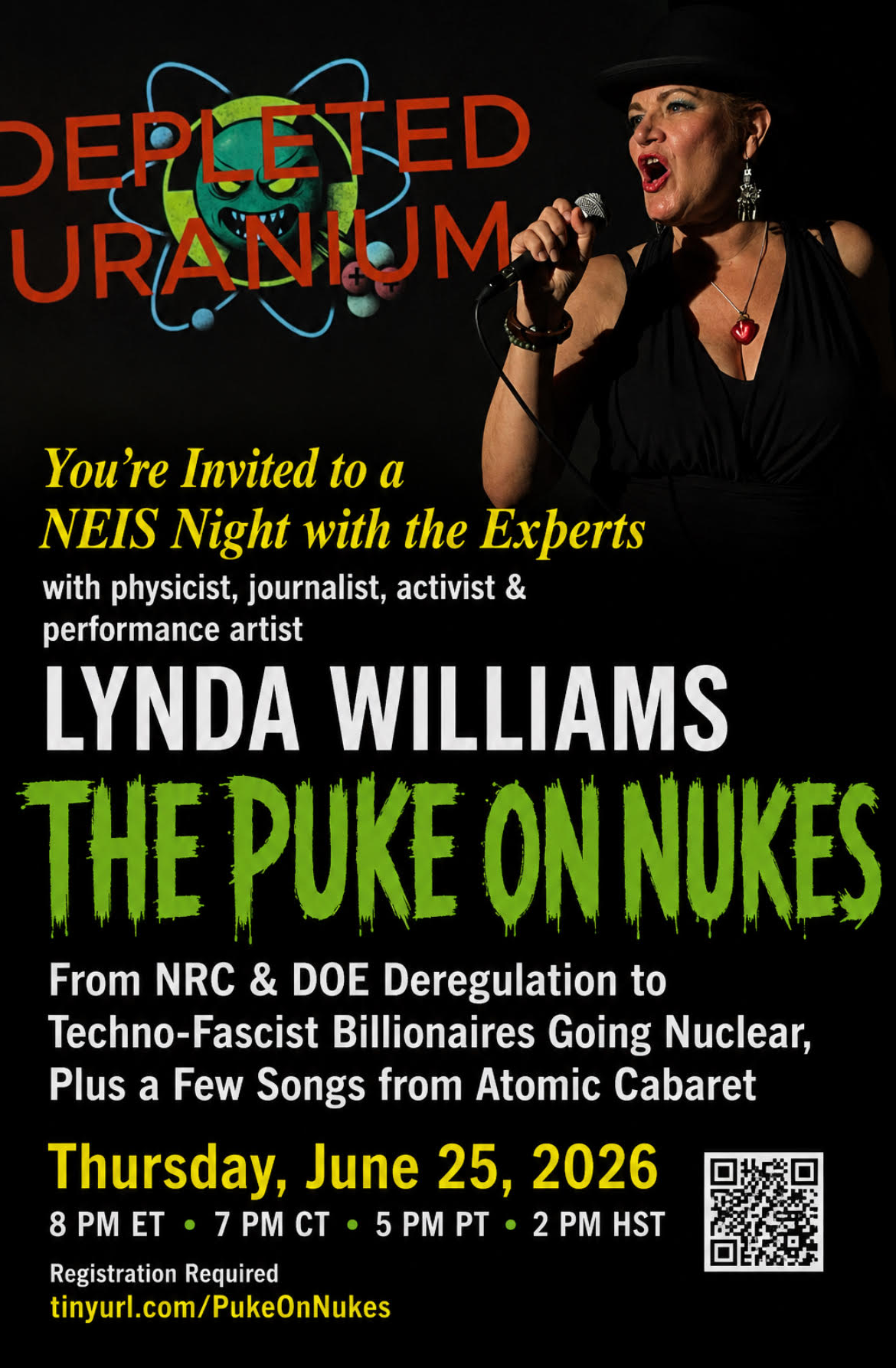
25 June- THE PUKE ON NUKES
Thursday, June 25, 2026
7pm Central Time (8pm ET, 6pm MT, 5pm PT) UTC – 5
From NRC & DOE Deregulation to Techno-Fascist Billionaires Going Nuclear, Plus a Few Songs from Atomic Cabaret REGISTER
26 June – Radiation Trainwreck at the NRC / Join the Protect Better Campaign – https://us02web.zoom.us/meeting/register/4ZlZ5_qLSHGiLSCg8FF6Bg#/registration

1st July – Webinar Waste of Space: The Environmental Harm of Military and Civil Space Activity st July, 7 pm

Report Launch Online: We are seeing an increasing exploitation of space for military and commercial purposes. This must change.

Protect Sazan Island from the Trump family! https://secure.avaaz.org/campaign/en/protect_sazan_island_from_the_trump_family_loc/?bqFCVab&v=174511&cl=22707147157&_checksum=5e9dde668860e8231c33699735e16a1fbf22ab2cb01da50c999fe8732b9775ef&utm_source=email&utm_medium=blast_email&utm_campaign=174511


Cuba Is Not a Failed State – It Is a Besieged State
PETITION: “Global Appeal to Endorse Palestinian Right of Return of Refugees”
To see nuclear-related stories in greater depth and intensity – go to https://nuclearinformation.wordpress.com
-
Archives
- June 2026 (241)
- May 2026 (306)
- April 2026 (356)
- March 2026 (251)
- February 2026 (268)
- January 2026 (308)
- December 2025 (358)
- November 2025 (359)
- October 2025 (376)
- September 2025 (257)
- August 2025 (319)
- July 2025 (230)
-
Categories
- 1
- 1 NUCLEAR ISSUES
- business and costs
- climate change
- culture and arts
- ENERGY
- environment
- health
- history
- indigenous issues
- Legal
- marketing of nuclear
- media
- opposition to nuclear
- PERSONAL STORIES
- politics
- politics international
- Religion and ethics
- safety
- secrets,lies and civil liberties
- spinbuster
- technology
- Uranium
- wastes
- weapons and war
- Women
- 2 WORLD
- ACTION
- AFRICA
- Atrocities
- AUSTRALIA
- Christina's notes
- Christina's themes
- culture and arts
- Events
- Fuk 2022
- Fuk 2023
- Fukushima 2017
- Fukushima 2018
- fukushima 2019
- Fukushima 2020
- Fukushima 2021
- general
- global warming
- Humour (God we need it)
- Nuclear
- RARE EARTHS
- Reference
- resources – print
- Resources -audiovicual
- Weekly Newsletter
- World
- World Nuclear
- YouTube
-
RSS
Entries RSS
Comments RSS
 nuclear-news