Threat of out of control fire to radioactive trash site
 I wonder if, in bushfire prone Australia, the South Australia Nuclear Fuel Chain Commission’s fudgy old pro nukers have considered increasing fire risks and the vulnerability of nuclear facilities?
‘Catastrophic’: Underground fire creeps towards nuclear waste site, news.com.au, OCTOBER 12,  2015 BENEATH the surface of a US landfill lurk two things that should never meet: a slow-burning fire and a cache of Cold War-era nuclear waste, separated by no more than 365 metres.
Government officials in Missouri have quietly adopted an emergency plan in case the smouldering embers ever reach the waste, a potentially “catastrophic event” that could send up a plume of radioactive smoke over a densely populated area near the city’s main airport.
Although the fire at Bridgeton Landfill, near St. Louis has been burning since at least 2010, the plan for a worst-case scenario was developed only a year ago and never publicised until last week, when St. Louis radio station KMOX first obtained a copy……..
Directly next to Bridgeton Landfill is West Lake Landfill, also owned by Republic Services. The West Lake facility was contaminated with radioactive waste from uranium processing by a St. Louis company known as Mallinckrodt Chemical. The waste was illegally dumped in 1973 and includes material that dates back to the Manhattan Project, which created the first atomic bomb in the 1940s.
The Environmental Protection Agency is still deciding how to clean up the waste. The landfill was designated a Superfund site in 1990.
The proximity of the two environmental hazards is what worries residents and environmentalists. At the closest point, they are 1,000 to 1,200 feet apart.
If the underground fire reaches the waste, “there is a potential for radioactive fallout to be released in the smoke plume and spread throughout the region,” according to the disaster plan.
The plan calls for evacuations and development of emergency shelters, both in St. Louis County and neighbouring St. Charles County. Private and volunteer groups, and perhaps the federal government, would be called upon to help, depending on the severity of the emergency…………
Last month, Koster said he was troubled by new reports about the site. One found radiological contamination in trees outside the landfill’s perimeter. Another showed evidence that the fire has moved past two rows of interceptor wells and closer to the nuclear waste.
Koster said the reports were evidence that Republic Services “does not have this site under control.”……..http://www.news.com.au/technology/environment/catastrophic-underground-fire-creeps-towards-nuclear-waste-site/story-e6frflp0-1227565910467
At least four Russian cruise missiles have crash-landed in Iran
 Russian missiles crash in Iran: what we know, Vox World, by Max Fisher on October 8, 2015
- At least four Russian cruise missiles, headed for Syria, have reportedly crash-landed in Iran, Pentagon sources tell CNN and other outlets.
- So far neither Russian nor Iranian sources have confirmed the incident, though Iran’s semi-official Fars News Agency is carrying the story (but crediting CNN).
- It is not known whether the missiles detonated or whether there are any casualties. Iran has enough empty space that it’s possible the missiles crashed harmlessly…….http://www.vox.com/2015/10/8/9482023/russia-missiles-iran-crash
Nuclear power building – UK’s worry of China’s poor health and safety record

 nuclearnews No 2 nuclear power Oct 15 ..…….. it is China’s poor health and safety record which is most worrying. With the power of the Chinese Government and the UK Government’s enthusiasm for Chinese money the concern is that the UK’s nuclear regulators will be sidestepped.
China’s health and safety standards have been thrust into the spotlight this year by a series of chemical explosions. An explosion at a chemical plant in the eastern Chinese province of Shandong shortly before midnight on 31st August 2015 was the second to occur at a chemical plant in Shandong province in a matter of days.
Although no casualties were reported, the blast happened about a fortnight after explosions in the port city of Tianjin, northern China, which killed over 145 people. In the wake of the Tianjin blast, the Communist Party has sacked the head of China’s safety regulator, who was previously the vice mayor of the city. Shortly after, 12 government officials and company executives were detained. (6)
 According to Ben Chu, author of ‘Chinese Whispers: Why Everything You’ve Heard About China is Wrong, the disaster in Tianjin was the latest consequence of a system that places personal profit before public safety. He says in China today behind every industrial accident lies a reeking morass of corruption.
Chinese state media reported that the son of a former local police chief was secretly a joint owner of the Tianjin warehouse that went up in a devastating fireball last week, killing 145 people, injuring 674 and damaging some 17,000 homes. He used his official connections to obtain licences for the warehouse, even though it flagrantly breached regulations prohibiting the storage of hazardous chemicals (sodium cyanide in this case) near residential areas. (7)
Dangers of UK-China plan for nuclear power at Bradwell Estuary
 Will Bradwell get a Chinese Reactor? nuCLEAR news No 2 nulcear power October 2015 It is now pretty clear that David Cameron will sign an agreement with the Chinese Government, at the time of the State Visit of President Xi Jinping on 20th October, that will enable two Chinese state-owned nuclear companies to develop the site at Bradwell which is currently owned by EdF, says the Blackwater Against New Nuclear Group. (BANNG)
The development could happen rather quicker than anyone might have imagined, says the group because of the financial problems and delays with Hinkley Point. “Cameron’s folly means the sacrifice of the Blackwater estuary,” said Professor Andy Blowers, Chair of the Blackwater Against New Nuclear Group (BANNG). “Basically, the estuary will be trashed if this goes ahead.”
“This love-in between the British and Chinese Governments takes absolutely no account of the impact and implications that will be unleashed on the Blackwater estuary. The obstacles, including the problems of cooling water from such a shallow estuary, are massive”. Barry Turner, Vice Chair of BANNG, commented: “For BANNG, the simple fact is that the Bradwell site is totally unsuitable for a new power station no matter who the developer might be.
The delicate Blackwater estuary cannot cope with the demands of a new nuclear power station without its effective destruction. The long-term risks from rising sea-levels and coastal change will be phenomenal leaving not only a power station with all its inherent dangers but an everlasting residue of dangerous radioactive wastes on a site that is likely to disappear over the next two centuries. There is no thought for the future in this and it is immoral to be undertaking such an enterprise on such a location.
Bringing such a monster to the Blackwater is nothing short of monstrous”. In return for helping out with the increasingly expensive Hinkley Point plant in Somerset, the Chinese have been told they can use the site of an old nuclear power station at Bradwell-on-Sea, on the Blackwater estuary, to build a reactor of their own design. “I am not worried about the Chinese. I am worried about us”, says Charles Clover writing in the Sunday Times.
For it is an open question whether British standards of regulation are up to the expectations of people who live in places such as West Mersea, just across the water from Bradwell. “We have some excellent regulations in Britain, but the problem is that all too often we choose to ignore them. I believe the public can live with the risks of the nuclear industry as long as there is transparency, and that there is not an instant return to the culture of secrecy and political influence over regulators that some of us remember from Sellafield in the bad old days. For if we wish to have both electricity and oysters, the problem is ourselves, not the Chinese.” (2) A peaceful protest including a flotilla of boats was held on Mersea Island by campaigners on 4th October. (3)…. http://www.no2nuclearpower.org.uk/nuclearnews/NuClearNewsNo78.pdf
Reality check on what Isil could actually do with nuclear materials
What could Isil actually do if they got their hands on nuclear material?Dirty bomb? Nuclear missile? After reports of Russian criminals trying to sell to Islamic State, we ask what the jihadists could actually do with nuclear material. By Richard Brown, King’s College London, Telegraph UK, 08 Oct 2015 The confirmation that black market gangs have been offering nuclear materials for sale – and have expressly targeted Islamic State buyers – can hardly be received with equanimity.
There is no reason to believe that an organisation with so hellishly violent a track record as Isil would baulk at using such materials offensively if ever they had ready access to them.
It would, however, be premature to leap from news of (failed) transactions to visions of a nuclear-armed Islamic State of Iraq and the Levant (Isil), without first asking what they could actually do with any nuclear material they bought.
Why ‘bomb-grade’ doesn’t always mean that
The term ‘nuclear material’ can, in fact, cover a range of different substances, including those required for nuclear explosions – namely, uranium and plutonium. Neither is at all easy to produce………
Alternative uses for nuclear material
A nuclear explosion is not the only use to which Isil could put ‘nuclear materials’.
There are other radioactive substances than uranium and plutonium, and a more practical and perhaps more tempting prospect would for Isil to use these to produce a radiological dispersal device – a so-called ‘dirty bomb’. Such a device would scatter potentially lethal doses of radioactive material over a large area.
The explosive component could be fairly crude, and the appropriate radiological materials would be easier to obtain used (a small quantity of Caesium-137 or Cobalt-60 would be ideal).
No nuclear explosion would result, but there would be a significant risk of radiation sickness and contamination of a wide area. The psychological and environmental impact could be severe.
That said, the lethality of the device itself might not be especially high; much would depend on the context in which the device was used, and the swiftness with which authorities could begin decontamination.
At any rate, most of the value to the terrorists would come from the scale of disruption the bomb caused, rather than from the radiological death toll……..http://www.telegraph.co.uk/news/worldnews/islamic-state/11918489/What-could-Isil-actually-do-if-they-got-their-hands-on-nuclear-material.html
Many nuclear facilities insecure, vulnerable to cyber-attack
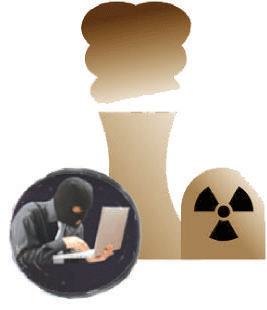 Report finds many nuclear power plant systems “insecure by design” http://arstechnica.com/security/2015/10/report-finds-many-nuclear-power-plant-systems-insecure-by-design/ Use of VPNs in some reactors, lack of security measures pose risks. by Sean Gallagher – Oct 8, 2015 A study of the information security measures at civilian nuclear energy facilities around the world found a wide range of problems at many facilities that could leave them vulnerable to attacks on industrial control systems—potentially causing interruptions in electrical power or even damage to the reactors themselves. The study, undertaken by Caroline Baylon, David Livingstone, and Roger Brunt of the UK international affairs think tank Chatham House, found that many nuclear power plants’ systems were “insecure by design” and vulnerable to attacks that could have wide-ranging impacts in the physical world—including the disruption of the electrical power grid and the release of “significant quantities of ionizing radiation.” It would not require an attack with the sophistication of Stuxnet to do significant damage, the researchers suggested, based on the poor security present at many plants and the track record of incidents already caused by software.
The researchers found that many nuclear power plant systems were not “air gapped” from the Internet and that they had virtual private network access that operators were “sometimes unaware of.” And in facilities that did have physical partitioning from the Internet, those measures could be circumvented with a flash drive or other portable media introduced into their onsite network—something that would be entirely too simple given the security posture of many civilian nuclear operators. The use of personal devices on plant networks and other gaps in security could easily introduce malware into nuclear plants’ networks, the researchers warned.
The security strategies of many operators examined in the report were “reactive rather than proactive,” the Chatham House researchers noted, meaning that there was little in the way of monitoring of systems for anomalies that might warn of a cyber-attack on a facility. An attack could be well underway before it was detected. And because of poor training around information security, the people responsible for operating the plants would likely not know what to do.
That problem is heightened by what the researchers characterized as a “communication breakdown” between IT security professionals and the plant operations staff, and a simple lack of awareness among plant operations people about the potential dangers of cyber-attacks. Cultural differences between IT and nuclear engineering culture cause friction at some facilities, in fact—making it difficult for IT and security staff to get across the problem with the poor security practices in the plants.
Unfortunately, there’s no way to tell how bad the problem really is, because the nuclear industry doesn’t talk about breaches. “The infrequency of cyber security incident disclosure at nuclear facilities makes it difficult to assess the true extent of the problem and may lead nuclear industry personnel to believe that there are few incidents,” the researchers wrote in their summary. “Moreover, limited collaboration with other industries or information-sharing means that the nuclear industry tends not to learn from other industries that are more advanced in this field.”
These issues, combined with a lack of regulation, may lead to an underestimation of risk by nuclear operators and result in a lack of budgeting or planning for reducing the risk of attack.
Even routine sirens from nuclear station can cause social panic
RANDOM SIRENS ALARM NUCLEAR PLANT NEIGHBORS abc 13 eyewwitness News, , October 08, 2015 NEW HILL, NC — Annual maintenance. That’s Duke Energy’s explanation for warning sirens around the Harris Nuclear Power plant going off at seemingly random times over the past week. But no one seemed to know about it.
The first reports started popping up on social media last week.
Local police started getting calls. So did the Town of Apex. But no one could explain why the sirens were going on and off……”You can put a lot of people in panic if that siren goes off and there’s not really nothing going on at the nuclear plant,” Conley said. “People can go a little bananas when they don’t know what it’s meant for.” “It sounds like it’s in your back yard,” said Laura Taylor. “It’s really loud.”
Taylor lives in Apex, one of the surrounding towns and communities that has nuclear warning sirens scattered about. She says she heard the siren go off three times last week.
“It is concerning because you wonder what’s going on,” said Taylor. “Is it just some kind of malfunction or should we be more concerned?” As it turns out, it was neither………http://abc13.com/news/random-sirens-alarm-nuclear-plant-neighbors/1023278/
St Louis landfill fire: risk to nearby nuclear waste prompts plan for disaster
 Disaster plan developed for use if St. Louis landfill fire reaches buried nuclear waste US News By JIM SALTER, Associated Press ST. LOUIS (AP), 6 Oct 15, — Beneath the surface of a St. Louis-area landfill lurk two things that should never meet: a slow-burning fire and a cache of Cold War-era nuclear waste, separated by no more than 1,200 feet.
Government officials have quietly adopted an emergency plan in case the smoldering embers ever reach the waste, a potentially “catastrophic event” that could send up a plume of radioactive smoke over a densely populated area near the city’s main airport.
Although the fire at Bridgeton Landfill has been burning since at least 2010, the plan for a worst-case scenario was developed only a year ago and never publicized until this week, when St. Louis radio station KMOX first obtained a copy. County Executive Steve Stenger cautioned that the plan “is not an indication of any imminent danger.” “It is county government’s responsibility to protect the health, safety and well-being of all St. Louis County residents,” he said in a statement.
Landfill operator Republic Services downplayed any risk. Interceptor wells — underground structures that capture below-surface gasses — and other safeguards are in place to keep the fire and the nuclear waste separate……….
Directly next to Bridgeton Landfill is West Lake Landfill, also owned by Republic Services. The West Lake facility was contaminated with radioactive waste from uranium processing by a St. Louis company known as Mallinckrodt Chemical. The waste was illegally dumped in 1973 and includes material that dates back to the Manhattan Project, which created the first atomic bomb in the 1940s.
The Environmental Protection Agency is still deciding how to clean up the waste. The landfill was designated a Superfund site in 1990.
The proximity of the two environmental hazards is what worries residents and environmentalists. At the closest point, they are 1,000 to 1,200 feet apart. If the underground fire reaches the waste, “there is a potential for radioactive fallout to be released in the smoke plume and spread throughout the region,” according to the disaster plan……..
The plan calls for evacuations and development of emergency shelters, both in St. Louis County and neighboring St. Charles County. Private and volunteer groups, and perhaps the federal government, would be called upon to help, depending on the severity of the emergency………Last month, Koster said he was troubled by new reports about the site. One found radiological contamination in trees outside the landfill’s perimeter. Another showed evidence that the fire has moved past two rows of interceptor wells and closer to the nuclear waste…….http://www.usnews.com/news/us/articles/2015/10/06/disaster-plan-developed-in-case-fire-reaches-nuclear-waste
Cyber security danger to nuclear stations
Nuclear power plants ‘highly vulnerable’ to cyber-attacks,Rt.com 6 Oct, 2015 British nuclear power plants are at risk of cybe-attack, thanks to a “culture of denial” regarding the risks, a report by security think tank Chatham House claims.
The “Cyber Security at Civil Nuclear Facilities: Understanding the Risks” report involved a study of cyber-security at plants across Europe and interviews with 30 senior officials in the nuclear industry and the governments of Japan, France, the UK and the US.
“Cyber security is still new to many in the nuclear industry,” Caroline Baylon, the report’s author, told the Financial Times. “They are really good at safety and, after 9/11, they’ve got really good at physical security. But they have barely grappled with cyber,” she said, adding the industry suffers from a “culture of denial.”
The security issues stem from the increasing digitization of nuclear facilities by using relatively easily available technology to trim expenditure.
“The cyber security risk is growing as nuclear facilities become increasingly reliant on digital systems and make increasing use of commercial ‘off-the-shelf’ software, which offers considerable cost savings but increases vulnerability to hacking attacks,” the report argues.
“Meanwhile, hacking is becoming ever easier to conduct, and more widespread: automatic cyber-attack packages targeted at known and discovered vulnerabilities are widely available for purchase.”
The report says there is a real risk of a devastating incident like the one which occurred at the Fukushima plant in Japan in 2011, when an earthquake and resulting tsunami hit and badly damaged the facility………https://www.rt.com/uk/317774-nuclear-terrorism-cyber-attacks/
Gangs of smugglers tried to sell nuclear materials to ISIS
Smugglers Have Tried to Sell Nuclear Materials to ISIS and Other Terrorists, Report Says http://time.com/4064012/nuclear-material-isis-islamic-state-smugglers/?xid=homepage Desmond Butler, Vadim Ghirda / Associated Press 6 Oct 15 In one case, man expressing hatred for the U.S. tried to sell bomb-grade uranium to a Sudanese buyer. (CHISINAU, Moldova) — The Associated Press has learned that gangs with Russian ties are driving a thriving black market in nuclear materials in eastern Europe, often with the explicit intent of connecting sellers to Middle Eastern extremist groups.
Authorities working with the FBI have interrupted four attempts by gangs shopping radioactive material in Moldova, a small country in Eastern Europe. The latest known case came in February, when a smuggler offered radioactive cesium, specifically seeking an Islamic State buyer.
The most serious case came in 2011, when a man expressing hatred for the U.S. tried to sell bomb-grade uranium to a Sudanese buyer.
Successful busts were compromised by striking shortcomings: Key suspects got away; prison sentences were surprisingly short; and gang leaders may have escaped with the bulk of their nuclear contraband.
Fake parts sold for nuclear submarines
 Man Gets 3 Years for Importing Fake Parts for Nuclear Subs http://abcnews.go.com/US/wireStory/man-years-importing-fake-parts-nuclear-subs-34296872 By THE ASSOCIATED PRESS, HARTFORD, Conn. — Oct 6, 2015 A Massachusetts man has been sentenced to three years in prison for importing counterfeit electronic components from China and Hong Kong for use by American customers, including builders of the U.S. Navy’s nuclear submarines.
Peter Picone (pih-COH’-nee) of Methuen (mih-THOO’-uhn), Massachusetts, was sentenced Tuesday in federal court in Hartford, Connecticut.
The 42-year-old pleaded guilty in June 2014 to conspiracy to traffic in counterfeit military goods. In addition to the prison sentence of three years and one month, the judge ordered him to pay $352,076 in restitution to 31 companies whose circuits he counterfeited.
Assistant Attorney General Leslie Caldwell said Picone sold counterfeit integrated circuits knowing that the parts were intended for use in nuclear submarines.
At his plea hearing, Picone acknowledged that failure of the parts could have led to catastrophic consequences.
British nuclear submarine stricken with technical problems off coast of Iran
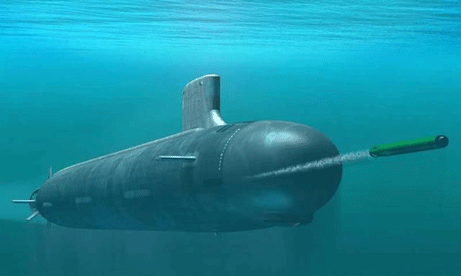 Stranded: Ageing British nuclear submarine in top-secret mission is undergoing repairs off the coast of Iran [includes VIDEO] Daily Mail,
- British nuclear submarine spotted at dock in the Emirati dock of Fujairah
- Port is situated less than 100 nautical miles from the coast of Iran
- A 650ft-long metal barrier covers the submarine to avoid detection
- It is believed to be one of Britain’s four Trafalgar Class submarines
 By MARK NICOL DEFENCE CORRESPONDENT FOR THE MAIL ON SUNDAY 27 September 2015 |
A British nuclear submarine has been caught on camera after it apparently became stricken with technical problems while on a top-secret mission in one of the most dangerous parts of the world.
Satellite images show the Royal Navy vessel undergoing repairs at a port less than 100 nautical miles from Iran.
The nuclear-powered submarine is pictured docked at Fujairah, one of the United Arab Emirates, in the politically sensitive seaway of the Gulf of Oman……….
In 2013, The Mail on Sunday revealed how the ageing Trafalgar submarines had been issued with ‘Code Red’ safety warnings after inspectors found radioactive leaks. The report by the Defence Nuclear Safety Regulator found that cracks in reactors and nuclear discharges were directly attributable to the Trafalgars remaining in service beyond their design date.
The Trafalgars are powered by nuclear reactors and are supposed to stay at sea for up to three months. They are equipped with Tomahawk cruise missiles and sonar equipment that can hear enemy vessels sailing more than 50 miles away.
The submarines have a typical complement of 120 to 130 personnel, up to 20 of them officers. The Trafalgars are being replaced by Astute Class nuclear submarines.
A Ministry of Defence spokesman said: ‘We do not comment on submarine operations.’ http://www.dailymail.co.uk/news/article-3250393/Stranded-Ageing-British-nuclear-submarine-secret-mission-undergoing-repairs-coast-Iran.html#ixzz3myehgajC
Can Nuclear Plants Actually Operate Safely?
Cancer, Coverups and Contamination: The Real Cost of Nuclear Energy 27th September 2015
Andreas Toupadakis Ph.D Contributing Writer for Wake Up World
“…..If we assume that more nuclear power plants are constructed around the world, can anyone guarantee that the nuclear accidents will disappear? No, that is impossible. Not only will the risks not disappear, but logic dictates they will also increase if there are more plants in operation, as will the volume of unmanageable radioactive waste. And let us not forget the unpredictability of earthquakes. Nuclear accidents will always happen just like any other accidents do, which may affect both power plants and waste storage facitilities.
Reliance on nuclear energy not only results in building new nuclear power plants but also relicensing existing ones. The peril of tragic accidents within the industry will inevitably be higher, especially while maintaining plants that are decades old — as we have already witnessed with the ongoing disaster at Fukushima, as well as the overheated reactor at Miami’s Turkey Point facility in 2014. Other nuclear power plant disasters include:
- 1952 Chalk River, near Ottawa, Canada: a partial meltdown of the reactor’s uranium fuel core resulted after the accidental removal of four control rods.
- 1957 Windscale Pile No. 1, north of Liverpool, England: fire in a graphite-cooled reactor spewed radiation over the countryside, contaminating a 200-sq-mile area.
- 1957 South Ural Mountains, Soviet Union: an explosion of radioactive wastes at a Soviet nuclear weapons factory 12 miles from the city of Kyshtym forced the evacuation of over 10,000 people from a contaminated area.
- 1959, Santa Susana, USA: A reactor at the Atomics International field laboratory in the Santa Susana Mountains, California, experienced a power surge and subsequently spewed radioactive gases into the atmosphere. According to a 2009 report from the Los Angeles Times, residents blame the facility for their health issues and say the site remains contaminated.
- 1976, near Greifswald, East Germany: the radioactive core of a reactor in the Lubmin nuclear power plant nearly narrowly avoided meltdown following the failure of safety systems during a fire.
- 1979, Three-Mile Island, near Harrisburg, Pennsylvania: Following a combination of equipment malfunctions, design-related problems and worker error, one of two reactors lost its coolant which caused overheating and partial meltdown of its uranium core, releasing radioactive water and gases.
- 1986, Chernobyl, near Kiev, Ukraine: an explosion and fire in the graphite core of one of four reactors released radioactive material that spread over parts of the Soviet Union, Europe and Scandinavia.
- 1987, Rocky Flats Plant, near Denver, Colorado, USA: Following insider reports of unsafe conditions, investigation found numerous violations of federal anti-pollution laws, including discharging of pollutants, hazardous materials and radioactive matter into nearby creeks and water supplies. A subsequent grand jury report criticized the Department of Energy and Rocky Flats contractors for “engaging in a continuing campaign of distraction, deception and dishonesty”.
- 1999, Tokaimura, Japan: An uncontrolled chain reaction in a uranium-processing nuclear fuel plant spewed high levels of radioactive gas into the air, exposing 69 people, killing one worker, and seriously injuring two others.
- 2011, Fukushima Prefecture, Japan: The troubled Fukishima Daiichi nuclear plant in Japan has experienced a number of ‘incidents’ since its construction in 1971, culminating in total reactor failure when the plant was hit by a tsunami following an earthquake. At the time of the disaster, the plant began releasing substantial amounts of radioactive materials and, more than four years after the incident, the plant is still leaking radioactive water into the Pacific Ocean.
The extent of this recent disaster at Fukushima should not be taken lightly. The water leaking from the ailing plant contains plutonium 239 and its release into the world’s ocean system has global repercussions. Explains chemist John A. Jaksich for DecodedScience.com:
“Certain isotopes of radioactive plutonium are known as some of the deadliest poisons on the face of the Earth. A mere microgram (a speck of darkness on a pinhead) of Plutonium-239, if inhaled, can cause death, and if ingested… can be harmful, causing leukemia and other bone cancers.
“In the days following the 2011 earthquake and nuclear plant explosions, seawater meant to cool the nuclear power plants instead carried radioactive elements back to the Pacific ocean. Radioactive Plutonium was one of the elements streamed back to sea.”
As history has shown us, assurances on safety from nuclear operators and regulators are nothing but preposterous. That is something that the public understands — because it is common sense. No matter how much uncaring, financially invested scientists will try to convince the public of the safety of the nuclear industry, the public does not have a salary from working on nuclear business and so, unlike those working on behalf of the industry, can maintain integrity and common sense……….….http://wakeup-world.com/2015/09/27/cancer-coverups-and-contamination-the-real-cost-of-nuclear-energ
Sloppy management of San Onofre’ s nuclear waste
Documents Detail How Nuclear Material Was Handled at San Onofre Nuclear Generating Station, Expert tells NBC 7 Investigates handling of nuclear material was “sloppy” NBC, By JW August and Lynn Walsh Documents newly obtained by NBC 7 Investigates during secret talks about the condition of the land where the San Onofre Nuclear Generating Station (SONGS) sits detail how nuclear material was handled at the plant since the 1980s.
The documents were released to individuals involved with the secret negotiations about the current condition and future handling of the 25-acre property. According to a source familiar with the negotiations, the secret meetings have been going on for about 20 months and involve all the players with a stake in the prime coastal property.
Those players include the U.S. Navy, which owns the property; the U.S. Marines, whose base surrounds the property; and Southern California Edison (SCE) and San Diego Gas and Electric (SDG&E), both of which hold the lease to the property.
The current lease was signed on April 2011, and according to the agreement, ends on May 12, 2023.
A source close to the lease negotiations told NBC 7 Investigates that SCE and SDG&E want out of the lease as soon as possible. According to the source, the team representing the utilities has told all involved they want nondisclosure agreements signed so no one can go public with any information disclosed during the negotiations.
So far, one or more of the parties involved in the talks are refusing to sign the nondisclosure agreements. Continue reading
Department of Transportation rules violated in shipment of Y-12 uranium
Y-12 uranium shipment reportedly violated DOT rules, Knoxville News Sentinel, Frank Munger, Sep 22, 2015 OAK RIDGE — A federal spokesman at the Y-12 nuclear weapons plant confirmed that a July shipment did not comply with some Department of Transportation regulations for transporting hazardous materials, and he said Y-12 officials have been in contact with DOT and “are cooperating with their findings.”
Steven Wyatt of the National Nuclear Security Administration also confirmed that the “special nuclear material” shipped from Y-12 to a commercial facility was uranium, although he refused to say if it was highly enriched or weapons-grade uranium and would not specify how much uranium was sent to the unnamed facility.
The NNSA, a semi-independent part of the U.S. Department of Energy that oversees the nuclear weapons complex, last week said Y-12 inadvertently shipped more nuclear material than intended to a private facility. After the mistake was discovered, a special team from Y-12 reportedly went to the site and secured the material for return to Oak Ridge…….http://www.knoxnews.com/news/local-news/y12-uranium-shipment-reportedly-violated-dot-rules_22839052
1 This Month
26 September – International Day for the Total Elimination of Nuclear Weapons





PLEASE OPPOSE HR 8255 AND S.3639 – bills would accelerate satellite deployment, with no environmental review or safeguards – https://ncstd5li.quorum.us/campaign/169331/
To see nuclear-related stories in greater depth and intensity – go to https://nuclearinformation.wordpress.com
-
Archives
- September 2026 (313)
- August 2026 (330)
- July 2026 (355)
- June 2026 (287)
- May 2026 (306)
- April 2026 (356)
- March 2026 (251)
- February 2026 (267)
- January 2026 (308)
- December 2025 (358)
- November 2025 (359)
- October 2025 (375)
-
Categories
- 1
- 1 NUCLEAR ISSUES
- business and costs
- climate change
- culture and arts
- ENERGY
- environment
- health
- history
- indigenous issues
- Legal
- marketing of nuclear
- media
- opposition to nuclear
- PERSONAL STORIES
- politics
- politics international
- Religion and ethics
- safety
- secrets,lies and civil liberties
- spinbuster
- technology
- Uranium
- wastes
- weapons and war
- Women
- 2 WORLD
- ACTION
- AFRICA
- Atrocities
- AUSTRALIA
- Christina's notes
- Christina's themes
- culture and arts
- Events
- Fuk 2022
- Fuk 2023
- Fukushima 2017
- Fukushima 2018
- fukushima 2019
- Fukushima 2020
- Fukushima 2021
- general
- global warming
- Humour (God we need it)
- Nuclear
- RARE EARTHS
- Reference
- resources – print
- Resources -audiovicual
- Weekly Newsletter
- World
- World Nuclear
- YouTube
-
RSS
Entries RSS
Comments RSS

