UK’s Hunterston nuclear reactor has cracks in bricks at core
Cracks in bricks at core of Hunterston nuclear reactor , BBC News 20 Nov 15 Cracks have been discovered in bricks which make up the core of one of two nuclear reactors at the Hunterston B power station in Ayrshire.
Operator EDF Energy said the cracks in three graphite bricks were found during planned maintenance on Reactor Three.
The firm insisted there were no safety implications and the finding had no impact on the operation of the reactor.
A similar issue – known as “keyway root cracking” was identified in Hunterston’s other reactor last year……….
‘Energy transition’
The core of the reactors is made up of thousands of graphite bricks.
The station began operating in 1976 and its working life has already been extended to 2023 – well beyond its planned closure date.
WWF Scotland director Lang Banks said the issue with cracks in both reactors emphasised the need “to embrace the clean energy transition”.
He said: “Despite the assurances given by the nuclear industry, with cracks now found in both reactors it’s clear the problem is spreading and that we can expect this facility to become even more unreliable in the future.
“News of more cracks in the country’s ageing fleet of nuclear power stations underscores why we’re right to be taking steps to harness cleaner, safer forms of energy.” http://www.bbc.com/news/uk-scotland-glasgow-west-34867312
Japan: 6.5 earthquake, small tsunami, not far from Sendani nuclear reactors
Japan hit by 6.5 magnitude earthquake, Brock Press, November 17, 2015 Chace King On Nov. 14, a magnitude 6.5 earthquake struck Japan, hitting the coastal island of Kyushu and triggering a small tsunami, according to the U.S Geological Survey.
Initially, the earthquake was thought to be close to a 7.0, but was downgraded later Saturday.
According to the Japanese Meteorological Agency (JMA), the 30 cm tsunami registered off the island of Nakanoshima, part of the Kagoshima region. The earthquake struck 159 km south of the town Makurazaki at a depth of about 10 kilometers, prompting fear that the quake would affect a pair of reactors in Sendani owned by the Kyushu Electric Power Co.

“There was no abnormality at the No. 1 and No. 2 reactors following the quake,” stated spokesman for Kyushu Electric Naoyuki Igawa in an interview with the Japan Times……. Far from uncommon, Japan is hit by roughly 1,500 earthquakes annually. The most deadly in recent history being when in 2011, Japan was hit by an earthquake in eastern Japan, leaving more than 18,000 dead or missing and sending three nuclear reactors into meltdown. http://www.brockpress.com/2015/11/briefs-japan-hit-by-6-5-magnitude-earthquake/
NUCLEAR REGULATORY COMMISSION to change reactor design rules: invites comments
Mitigation of Beyond-Design-Basis Events NUCLEAR REGULATORY COMMISSION , 12 Nov 15
Narrowly avoided accidental nuclear apocalypse in 1983 revealed
 Top Secret Documents Reveal A NATO Training Exercise Nearly Started A Nuclear Apocalypse With Russia http://www.huffingtonpost.co.uk/2015/11/12/top-secret-documents-reveal-a-nato-training-exercise-nearly-started-a-nuclear-apocalypse-with-russia-_n_8542766.html The Huffington Post UK | By Thomas Tamblyn
A recently declassified document has revealed that in 1983, the United States and Russia were almost plunged into nuclear war and here’s the real kicker: It would have been completely by accident
It is thought that the exercise could have, at some stages, brought the two countries closer to war than even the famous Cuban Missile Crisis in 1962.
Codenamed Able Archer, the NYT reveals in its exposé of the training exercise that many NATO commanders were seemingly oblivious to the knife edge that they were creating.
Then US President Ronald Reagan rather eloquently described the situation as ‘Really scary’ after reading the briefing documents that summarised how perilously close the situation had become.
The document was finally declassified earlier this month, some 11-years after the request had been made by the National Security Archive at George Washington University.
Speaking to the NYT about the significance of the event archive director Thomas S. Blanton said: “Turns out, 1983 is a classic, like the Cuban missile crisis, where neither superpower intended to go nuclear, but the risk of inadvertence, miscalculation, misperception were just really high. Cuba led J.F.K. to the test ban. Nineteen eighty-three led Reagan to Reykjavik and almost to abolition.”
What might be the most terrifying piece of news is that before and during the exercise, the Soviets weren’t just using human judgement but were inputting some 40,000 scenarios into a supercomputer in an effort to try and assess how likely a nuclear strike actually was.
Ironically it was the then leader of the Soviet Union Mikhail Gorbachev who summed up the severity of the situation later in 1986:
“Never, perhaps, in the postwar decades has the situation in the world been as explosive and, hence, more difficult and unfavorable as in the first half of the 1980’s.”
Russia’s militarisation of the Arctic, and the danger of its mini nuclear reactors

 Russia’s mini nuclear reactors plan causes concern http://thebarentsobserver.com/security/2015/11/russias-mini-nuclear-reactors-plan-causes-concern Norway’s radiation watchdog says the risk of accidents and releases of radioactive substances will increase in the Arctic. Thomas Nilsen November 07, 2015
A military plan building up to 30 small transportable nuclear reactors for the Arctic was announced earlier this week. The reactors will provide electricity to remote bases currently under development as part of Russia’s Arctic militarization.
“If these plans are given a go-ahead in the future, it will lead to an increased risk of accidents and releases of radioactive substances,” says Ingar Amundsen, Head of Section for international nuclear safety with the Norwegian Radiation Protection Authorities (NRPA). Amundsen was on inspection with three other Norwegian experts at Kola nuclear power when being contacted by the Independent Barents Observer about the Russian military plans.
Norway wants information
He says NRPA was not informed about the plans before reading about it in Russian media this week. “Norwegian authorities will bring up the issue with our Russian counterpart in those forums we have dialogue, to hear if there is realism in these plans,” Ingar Amundsen says.
Since 1995, Norway has co-financed a series of comprehensive nuclear safety projects in Northwest Russia, including decommissioning of Cold War submarines bringing their reactors into safe onshore long-term storage.
Amundsen elaborates on the risks involved in Russia’s announced new military reactors. “Nuclear power plants requires good access to needed infrastructure and a comprehensive control regime for safe operation, Ingar Amundsen says and continues: “This is important to avoid accidents and releases, but also to avoid unauthorized access by strangers to the facility and the nuclear material.” He believes that will be very difficult to achieve with mobile units in remote areas.
Arctic militarization
Russia current militarization of the Arctic includes new bases and re-opening of Cold War bases along the north coast of Siberia and on archipelagoes like the New Siberia Islands, Novaya Zemlya and Franz Josef Land. The aim of creating small nuclear reactors is to fly- or ship them in to the bases and produce electricity- and heat instead of diesel generators and steam boilers.
The reactors are so small they can be transported around by a KAMAZ truck, in a cargo plane, on a sledge or even carried by Russia’s huge Mi-26 cargo helicopters.
The first of the new mini reactors could be ready for testing before 2020, TASS reported on Wednesday.
Murmansk and Severodvinsk
Nothing is said about where to maintain the reactors Today, maintain- and uranium fuel replacement of naval reactors in northern Russia takes place at the submarine yard in Severodvinsk near Arkhangelsk and at icebreaker base Atomflot in Murmansk.
As previously reported by the Independent Barents Observer, small transportable nuclear reactors for use in remote corners of the Arctic is not a new invention.
Both the United States and the Soviet Union built several transportable reactors. In the Arctic, the U.S. military had a secret nuclear reactor in operation for some few years in the 60ies at Camp Century east of Thule airbase on Greenland’s northern ice-sheet. The reactor was then transported on the ice by a tractor with a sledge and placed under the ice to produce electricity and heat for a Arctic missile research facility.
Also in Antarctica, the United States operated a medium-size reactor in the 60ies and 70ies at the McMurdo research station.
In the Soviet Union, a two-megawatt reactor was built in 1961. The reactor was carried around on the chassis of a tank. Another smaller reactor, named NURKA, was located at one of the Northern fleet’s submarine bases on the coast of the Barents Sea, but it is unclear if this reactor ever was used. Several other types of mini-reactors were developed during Soviet-times.
For space, several series of lightweight ultrasmall reactors were use in satellites. http://thebarentsobserver.com/security/2015/11/russias-mini-nuclear-reactors-plan-causes-concern
USA’s Nuclear Regulatory Commission considering 80 year licenses for nuclear reactors!
Debates may lie ahead on how aging risks should properly be measured, if a dispute involving Entergy Nuclear’s Palisades nuclear plant near South Haven, Mich., is a guide. Four citizen organizations — Beyond Nuclear, Don’t Waste Michigan, Michigan Safe Energy Future-Shoreline Chapter and the Nuclear Energy Information Service — oppose Entergy’s proposal for assessing the extent of neutron-caused embrittlement of the reactor, which could lead to critical failures…….
Aging has an economic side, too……..
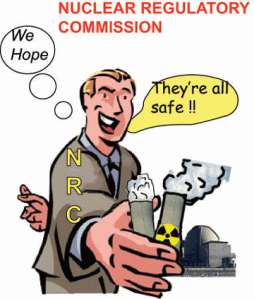 Life span of U.S. reactors is an issue for the Clean Power Plan Peter Behr, E&E reporterEnergyWire: Friday, November 6, 2015 correction appended.
The Nuclear Regulatory Commission will update by year’s end proposed guidelines for assessing the safe life span for nuclear reactors — a central issue for the nuclear industry, the nation’s future electric power supply and the Obama administration’s Clean Power Plan.
The new guidance is linked to NRC’s current judgment that there are as yet no “aging” issues with reactors’ structures and components that would prevent current plants from being licensed out to 80 years of age.
NRC’s Generic Aging Lessons Learned (GALL) Report will address four potential aging risks for reactors caused by decades of thermal shock, radiation and mechanical stress: metal embrittlement in pressure vessels, deterioration of cables, concrete and containment structures, and cracks in reactor components. The report will update inspection and assessment methods for aging issues…….. Continue reading
Virginia nuclear power plant owner Dominium seeks 80 year lifespan for reactors !!

 Dominion plans to extend Surry nuclear reactors to 80-year lifespan BY JOHN RAMSEY Richmond Times-Dispatch, 6 Nov 15 Dominion Virginia Power today will formally seek a second license extension for its Surry nuclear power plant, becoming the first utility in the U.S. to try to push the operating range for nuclear reactors to 80 years.
If successful, the utility’s pair of reactors in Surry County would be eligible to operate past 2050.
At a White House summit on nuclear energy this afternoon, Dominion executives will deliver a letter to the federal Nuclear Regulatory Commission confirming plans to apply for the extension.
The Surry plant, located on the south bank of the James River in southeastern Virginia, saw its first reactor open in December 1972 and its second in May 1973……
As of today, no nuclear plants in the country have been granted the second 20-year extension Dominion is seeking.
Security escort rear-ends semi carrying nuclear weapon in US
 http://www.9news.com.au/world/2015/11/04/17/18/security-escort-rear-ends-semi-carrying-nuclear-weapon US security forces apparently transporting a nuclear weapon suffered an embarrassing slip-up when an armoured escort rear-ended the main vehicle as the convoy sped through a truck stop.
To make matters worse, the high-speed prang occurred just as the bystander filming was being told off by federal police for capturing the incident.
Uploaded to YouTube overnight, the video shows the intimidating convoy of at least ten vehicles and the semi, as well as several helicopters, barrelling through an unnamed town on what looks to be a US interstate highway. Continue reading
UK’s Office for Nuclear Regulation (ONR) cosying up to the nuclear industry
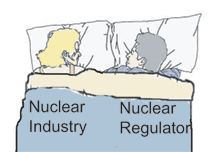 the Office for Nuclear Regulation (ONR) seemed to be dangerously edging towards the corporate financial interests of the nuclear industry rather than the public interests of ensuring national nuclear safety
Alarm over Government’s growth mandate for nuclear regulator, The Independent,
Last year, non-economic regulators were handed guidance entitled “Duty to have regard to growth” by the Department for Business, Innovation & Skills Mark Leftly Associate business editor @MLeftly Anti-nuclear campaigners fear regulators have been forced to cosy up to the industry and sacrifice some of their safety responsibilities as a result of government changes to their role.
At a meeting in Manchester last week, executives from the Office for Nuclear Regulation (ONR), which oversees civil reactors and decommissioning, told representatives from NGOs that they now have to encourage the industry’s economic growth in addition to promoting safety. Continue reading
Explosion and fire in (inactive) nuclear station in Belgium
Explosion rocks nuclear power plant in Belgium https://www.rt.com/news/320381-belgium-nuclear-plant-explosion/ 1 Nov, 2015 An explosion occurred overnight at a nuclear power plant in Doel, northern Belgium, local media reported, adding that the blast caused a fire. The exact damage from the incident remains unknown.
The blast happened around 11pm local time on Saturday. The fire started in Reactor 1 of the plant, but was soon extinguished by personnel.
The explosion didn’t cause any threat to nature, Els De Clercq, spokeswoman from Belgian energy corporation Electrabel that runs the plant, told Het Laatste Nieuws. There was no fuel present at the time of the incident as the reactor had been shut due to its expired operational license.
Doel Nuclear Power Station, one of the two nuclear power plants in the country, is located near the town of Doel in east Flanders. The plant employs about 800 people.
According to the Nature journal and Columbia University in New York, the plant is in the most densely populated area of all nuclear power stations in the EU. About 9 million people live within a radius of 75km of the station.
Ontario’s CANDU nuclear reactors are seriously degraded

 Ontario’s geriatric reactors at Darlington require major surgery http://www.pressenza.com/2015/09/canadas-darlington-nuclear-station-campaign-against-life-extension/ 05.09.2015 – Gordon Edwards While Ontario Power Generation (OPG) plans to permanently shut down the eight nuclear reactors at Pickering by 2020 (two of them are already retired), OPG is seeking an unprecedented thirteen year operating licence for its four nuclear reactors at Darlington. The Darlington reactors – the largest in Canada’s nuclear fleet – are sited on the north shore of Lake Ontario, between Toronto and Port Hope.
The Darlington reactors are seriously degraded and will require extensive rebuilding of the core and primary heat transport system to continue operating — a dirty and dangerous operation euphemistically called “refurbishment” that will cost at least TEN BILLION dollars. Thousands of highly radioactive pressure tubes and calandria tubes will have to be removed robotically and packaged for safe storage for a period of hundreds of thousands of years, along with tens of kilometres of radioactively contaminated “feeder pipes”. These dangerous radioactive wastes will be trucked north to the shore of Lake Huron near Kincardine to join the growing volumes of radioactive waste that are currently stored there.
Previous experience with refurbishment of CANDU reactors at other locations in Ontario and New Brunswick has been characterized by years of delay and billions of dollars in cost over-runs. During a refurbishment operation at the Bruce site, on the shore of Lake Huron, over 500 workers were exposed to inhaling plutonium-contaminated airborne dust for over three weeks in 2009 due to the incompetence or disregard of overseers who neglected to provide the men with respirators, failed to heed a radiation alarm, ignored company records that plainly revealed the presence of such contamination in the pipes that were being removed and subjected to a grinding operation, and neglected to properly test the air for contamination.
Anyone can intervene in the November licensing hearings by sending in a letter or a brief, with the option of appearing in person at the hearings and making a 10-minute oral presentation. It is even possible to testify by telephone using a tele-conferencing setup that the Commission has made available for intervenors; one only has to request it.
The Ontario Government, the sole owner of OPG, can decide not to refurbish the Darlington reactors by instead buying replacement power, investing in community-based energy conservation, and accelerating the installation of alternative energy sources such as solar, wind, and industrial cogeneration facilities. The province of Quebec has a very large surplus of water-generated hydropower at the present time and for the foreseeable future, and calculations have shown that the entire output of the Darlington reactors could be replaced if Ontario purchased excess power from Quebec at a price that would be mutually advantageous to both provinces, and much less expensive than the Darlington refurbishment option.
Although the Canadian Nuclear Safety Commission staff promised to publish a report outlining the consequences of a severe nuclear accident at Darlington involving one, two, or all of the reactors there, they have instead produced a report that describes a release of radioactivity that is ridiculously low — at least 10 to 100 times less than what would be reasonably anticipated in the event of a severe nuclear accident. By misrepresenting the amount of radioactivity that could be released in such circumstances, the CNSC staff is misleading the public and government authorities who are responsible for putting in place emergency planning measures needed to cope with the aftermath of such a severe nuclear accident.
The IAEA recently published a report on the Fukushima triple meltdown in Japan. The following paragraph, taken from the first page of the IAEA report, is particularly applicable to the arrogant attitude of Canadian nuclear authorities who simply do not want to communicate to the public and to decision makers the results of their own internal calculations.
St Louis County becoming another USA radioactive Sacrifice Zone?
 St. Louis Sacrifice Zone: Gov’t’s Secret ‘Catastrophic Event Plan’: Tons Radioactive Waste, 1000s Gallons Tainted Water-Spill, Fires, Before It’s News, October 29, 2015 Thousands of gallons of tainted water spilled Tuesday at the Bridgeton landfill near St. Louis, the second incident in days, as an underground fire could reach radioactive waste dump site in three to six months and seven churches have been set ablaze, increasing the development of another American sacrifice zone. Hundreds recently packed Bridgeton church, demanding to know why St. Louis County silently put an emergency plan for a potential “catastrophic event” at Bridgeton Landfill and adjacent West Lake landfill a year ago. Families are moving, becoming environmental refugees in their own country.
“We are not financially able to uproot our lives, but we’re forced to,” said Tonii Morris, who lives up the street from the Bridgeton landfill. “Staying here is not an option.”
Saturday, a fire broke out near an existing smoldering underground fire that is heading toward an old nuclear waste dump. A sewer pipe connecting Bridgeton Landfill to Metropolitan St. Louis Sewer District treatment facilities overflowed, releasing thousands of gallons of sewage Tuesday. These come as churches in the same area are being burned. At least 20 families are no longer waiting for answers or repairs. They are refugees, among the first to be moving, or have moved.
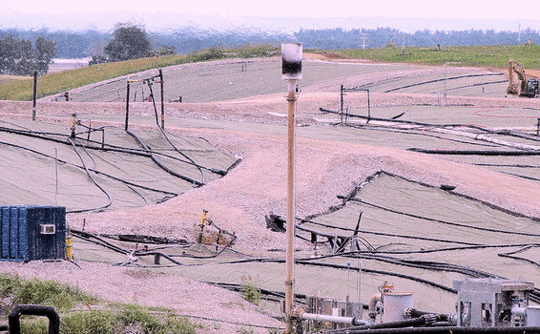
“Tonnage of radiological waste at the Bridgeton-Westlake landfill exceeds Fukushima over 20 fold, and Chernobyl by 163 times. How diluted the Bridgeton nuclear waste is appears unknown,” says Mining Awareness Plus in a comprehensive report, Is the Missouri Landfill Fire a US Chernobyl or Fukushima in the Making?
Saturday afternoon, firefighters rushed to the landfill to extinguish a brush fire. The fire was caused by a faulty switch on an Ameren utility pole inside the landfill’s perimeter fence, Pattonville Fire Protection District’s Battalion Chief Ken Aydelott said. He said a switch overheated, causing hot metal to drop below and ignite the fire. The last small fire at the landfill was in February 2014.
At least 20 families plan to move soon due to the troubled landfills and conflicting reports, according to a questionnaire on a West Lake Facebook page that has grown by 10,000 members in the last month to over 17,000.
Despite officials saying the new leak of tainted water is contained, mothers from North Saint Louis County, outraged about their local landfill on the brink of a nuclear emergency, putting their families at risk, have taken to the streets in protest……..http://beforeitsnews.com/alternative/2015/10/st-louis-sacrifice-zone-catostrophic-event-plan-coverup-tons-of-radioaactive-waste-1000s-gallons-tainted-water-spill-fires-3235920.html?utm_campaign=&utm_source=https%3A%2F%2Ft.co%2F4wD1rKreTN&utm_content=beforeit39snews-floatingtoolbar&utm_medium=twitter&utm_term=http%3A%2F%2Fb4in.info%2Fgoil
Nuclear Regulatory Commission (NRC) concerned about cyber security – is making new rules
US readies new rules for nuclear reactors, The Hill By Cory Bennett – 10/30/15 The government is moving forward with new cybersecurity requirements for nuclear power plants. The rules will require greater reporting of cyber incidents in the hopes of better understanding the digital threats facing nuclear reactors…….
In an effort to get ahead of this threat, the 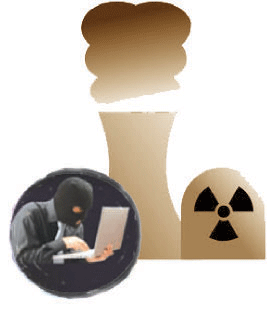 , an independent regulatory agency, on Friday released a new set of reporting requirements. The increased information will aid in the NRC’s “analysis of the reliability and effectiveness” of cybersecurity programs for nuclear power reactors, according to a Federal Register notice.
Heightened awareness of this threat is increasingly important as governments start to target nuclear plants in their burgeoning offensive cyber programs. It’s widely believed the U.S. and Israel were behind a 2010 cyberattack that crippled nearly one-fifth of Iran’s nuclear centrifuges.More recently, South Korea accused North Korea of hacking into one of its nuclear plants. The intrusion exposed sensitive data, but didn’t endanger the plant’s reactors.
A recent report also warned that the nuclear industry is in a “culture of denial” over these hacking risks.
Chatham House, an international affairs think tank, spent 18 months interviewing top nuclear officials and investigating nuclear power plants around the world. The results were not comforting.
“Cybersecurity is still new to many in the nuclear industry,” Caroline Baylon, the report’s author,told the Financial Times earlier this month. “They are really good at safety and, after 9/11, they’ve got really good at physical security. But they have barely grappled with cyber.” Many plants still have control systems linked to the Internet, for example, exposing nuclear reactors to potential digital hijackings.
Overall, the report found 50 cyber incidents at nuclear plants, some of which nearly led to meltdowns. For instance, the safety system at an Alabama nuclear plant was overwhelmed with network traffic, almost triggering a catastrophe……http://thehill.com/policy/cybersecurity/258663-white-house-updates-nuclear-plants-cyber-requirements
Fire erupts within feet of USA radioactive trash dump
 CBS: Fire erupts at another U.S. nuclear site near major city — Witness: Flames within feet of radioactive waste — TV: “You can see the smoke for miles… A big-time scare” — EPA emergency response specialists deployed (PHOTO & VIDEOS) http://enenews.com/fire-another-nuclear-site-major-city-witness-flames-feet-radioactive-waste-tv-smoke-could-be-miles-epa-emergency-response-specialists-deployed-photo-videos?utm_source=feedburner&utm_medium=email&utm_campaign=Feed%3A+ENENews+%28Energy+News%29KTVI, Oct 24, 2015 (emphasis added): Brush fire at West Lake Landfill sparks concern —Smoke could be seen for miles as fire crews responded to a brush fire at the West Lake Landfill in Bridgeton Saturday… The fire was started by a faulty switch… inside the landfill’s perimeter. The switch overheated, causing hot metal to drop below and ignite a fire… Arearesidents and elected officials gathered near the scene of the fire Saturday to see if it would move into a restricted area where an underground fire is burning. Residents were concerned that the fire would reach area whereradioactive waste is buried…
KTVI Transcript, Oct 24, 2015: You can see the smoke for miles… A big-time scare for residents out there tonight… Dawn Chapman, resident: “This fire came within feet of it,within feet of radioactive waste“…
CBS News, Oct 27, 2015: No one knows for sure what will happen if the fire comes into contact with it… some low-level radiation has moved into neighborhoods… But it’s not just the underground fire that is a concern – this weekend a grass fire erupted within some 75 yards of the radioactive waste. This region also sits near an earthquake fault line.
AP, Oct 26, 2015: On Saturday, a fire blamed on a faulty utility pole ignited brush on the West Lake Landfill’s grounds… [EPA official Mark] Hague said testing showed no immediateevidence residents were in peril.
St Louis Public Radio, Oct 27, 2015: Stoking many fears was [a] brush fire at the Bridgeton Landfill… which was first called in to the fire department by a resident. Some took that as asign that the landfill’s owner, Republic Services, does not have an adequate handle on the site… [EPA] sent a letter reprimanding Republic Services for the incident.
St. Louis American, Oct 25, 2015: Saturday’s fire supposedly resulted from a malfunctioning electrical switch… EPA emergency response specialists were deployed to the site of the fire, according to the EPA’s statement. “Personnel will be in the field today taking samples from the surrounding area to confirm there is not a release of contaminants,” it stated… “Pattonville Fire District conducted air monitoring during the event.” The Missouri Department of Natural Resources (MDNR)… reviewed data from its monitors located near the landfills, “and the readings stayed consistent with background,” according to the EPA.
CBS St Louis, Oct 25, 2015: Missouri Attorney General Chris Koster [said] “the fire at the Bridgeton Landfill is ever changing”… Koster says Saturday’s fire is a reminder flames can surface in unexpected places without warning.
See report from earlier this month here: AP: Catastrophic event could release radioactive fallout over major U.S. metropolitan area — Gov’t issues emergency plan as fire burns near nuclear site — Senator: “What we have… could end up as Chernobyl” (VIDEO)
See last week’s reports from Las Vegas-area here: EPA data shows radiation spike in major US city soon after explosions at nuclear waste facility — AP: Drums of buried waste were blasted over site’s fence; Large crater reported (VIDEO)
China far from being nuclear industry hope, could be its nightmare
Just how safe is China anyway? Now if China had a fantastic record of safety in its construction and other industries, maybe the odds should be made a bit longer….
Cheap? Some scepticism is in order How do we know what these reactors really cost? The fact is, we don’t. With China’s nuclear corporations under the control of various organs of state including the Communist Party and the Peoples Liberation Army, official statistics and accounts can simply not be relied upon…..
Nuclear construction in China must be cheaper than in the US and Europe due to lower labour costs. But if it really is that much cheaper it can only be at a huge safety penalty……
Tsunami risk – not if but when…….
The only good news in all this is that nuclear construction in China is not proceeding anything like as fast as Forbes magazine claims. Most of the more modern ‘Generation III’ reactors are well behind in their completion times, echoing the European experience with the failed EPR design.
Fukuzilla? China’s nuclear boom threatens global catastrophe http://www.theecologist.org/blogs_and_comments/commentators/2986056/fukuzilla_chinas_nuclear_boom_threatens_global_catastrophe.html Oliver Tickell 28th October 2015

China’s plans for 400 nuclear reactors threaten global catastrophe, writes Oliver Tickell. In the normal way of things we could expect major accidents every few years, but with 300 reactors along China’s seismically active coast, a major tsunami would be a Fukushima on steroids – wiping out much of China and contaminating the whole planet. Continue reading
1 This Month
26 September – International Day for the Total Elimination of Nuclear Weapons





PLEASE OPPOSE HR 8255 AND S.3639 – bills would accelerate satellite deployment, with no environmental review or safeguards – https://ncstd5li.quorum.us/campaign/169331/
To see nuclear-related stories in greater depth and intensity – go to https://nuclearinformation.wordpress.com
-
Archives
- September 2026 (313)
- August 2026 (330)
- July 2026 (355)
- June 2026 (287)
- May 2026 (306)
- April 2026 (356)
- March 2026 (251)
- February 2026 (267)
- January 2026 (308)
- December 2025 (358)
- November 2025 (359)
- October 2025 (375)
-
Categories
- 1
- 1 NUCLEAR ISSUES
- business and costs
- climate change
- culture and arts
- ENERGY
- environment
- health
- history
- indigenous issues
- Legal
- marketing of nuclear
- media
- opposition to nuclear
- PERSONAL STORIES
- politics
- politics international
- Religion and ethics
- safety
- secrets,lies and civil liberties
- spinbuster
- technology
- Uranium
- wastes
- weapons and war
- Women
- 2 WORLD
- ACTION
- AFRICA
- Atrocities
- AUSTRALIA
- Christina's notes
- Christina's themes
- culture and arts
- Events
- Fuk 2022
- Fuk 2023
- Fukushima 2017
- Fukushima 2018
- fukushima 2019
- Fukushima 2020
- Fukushima 2021
- general
- global warming
- Humour (God we need it)
- Nuclear
- RARE EARTHS
- Reference
- resources – print
- Resources -audiovicual
- Weekly Newsletter
- World
- World Nuclear
- YouTube
-
RSS
Entries RSS
Comments RSS

