Department of Transportation rules violated in shipment of Y-12 uranium
Y-12 uranium shipment reportedly violated DOT rules, Knoxville News Sentinel, Frank Munger, Sep 22, 2015 OAK RIDGE — A federal spokesman at the Y-12 nuclear weapons plant confirmed that a July shipment did not comply with some Department of Transportation regulations for transporting hazardous materials, and he said Y-12 officials have been in contact with DOT and “are cooperating with their findings.”
Steven Wyatt of the National Nuclear Security Administration also confirmed that the “special nuclear material” shipped from Y-12 to a commercial facility was uranium, although he refused to say if it was highly enriched or weapons-grade uranium and would not specify how much uranium was sent to the unnamed facility.
The NNSA, a semi-independent part of the U.S. Department of Energy that oversees the nuclear weapons complex, last week said Y-12 inadvertently shipped more nuclear material than intended to a private facility. After the mistake was discovered, a special team from Y-12 reportedly went to the site and secured the material for return to Oak Ridge…….http://www.knoxnews.com/news/local-news/y12-uranium-shipment-reportedly-violated-dot-rules_22839052
International Atomic Energy’s sobering Report on Fukushima nuclear accident
Japan is not the only nation “rearranging the nuclear deck chairs”
The Titanic was also ill-prepared to evacuate its passengers because it failed to consider the unimaginable and thus mismanaged the risk. It seems the lessons of Fukushima are also being ignored in favor of wishing away risk, and hoping for inspired improvisation. There is thus good reason why citizens across Japan are filing lawsuits to block reactor restarts and some gutsy judges are resisting pressure from the nuclear village and siding with common sense.
Rearranging the deck chairs on the nuclear Titanic BY JEFF KINGSTON JAPAN TIMES 20 Sep 15 The International Atomic Energy Agency’s recently released postmortem on the Fukushima nuclear accident of 2011 makes for grim reading and serves as a timely reminder of why the restart of the Sendai nuclear plant in Kyushu is a bad idea.
When an atomic energy advocacy organization delivers multiple harsh assessments of Japan’s woeful nuclear safety culture and inadequate emergency countermeasures and disaster management protocols, it’s time to wonder how much has really changed in the past five years — and whether restarting any of the nation’s nuclear reactors is a good idea.
In 2012, the government established a new nuclear safety watchdog agency called the Nuclear Regulation Authority (NRA) and it now contends that Japan has the strictest nuclear safety regulations in the world. But is that true? And does it
matter?
David Lochbaum, co-author of last year’s “Fukushima: The Story of a Nuclear Disaster,” the best book on the meltdowns that I’ve read, likens recent reforms to “rearranging the deck chairs on the nuclear Titanic” He’s not buying Japan’s claim of having the world’s strictest guidelines. Continue reading
Sweden tightens rules on drones flying near nuclear stations
 Flouting Nuclear Drone Ban in Sweden Will Land You in Jail, Bloomberg, Jesper Starn, 18 Sep 15,
-
No-fly zones start Oct. 15 to protect national security
-
Swedish police focus on tackling pilots on the ground
The Nordic region’s biggest producer of atomic energy will from Oct. 15 add nuclear plants to a list of sites including airports and hospitals with no-fly zones in an effort to preserve national security. If caught, drone pilots face as long as 6 months behind bars, according to the Swedish police.
Sweden is tightening its rules amid growing international concern about the security threat posed by drones, which have buzzed French nuclear reactors, landed on the White House lawn and even crashed into the stands at this month’s U.S. Open tennis tournament in New York. While France is backing research into tracking and destroying illegal unmanned craft, Sweden is opting to pursue the pilots on the ground……
Greenpeace flew a piloted paraglider over Ringhals in 2013, dropping balloons on the roof of one of the reactor buildings, according to Vattenfall.
While environmental activists have parasailed, hurdled fences and climbed buildings at Swedish nuclear plants in attempts to demonstrate poor security, seaweed and jellyfish have been more effective in cutting output by blocking flows of cooling water.
- Flying a drone over banned areas would void any form of insurance to cover damages caused by the craft, according to Claes Wahlund, the chairman of the Swedish Model Airplane Association.“Flying over a nuclear power plant is not a hobby,” he said by phone on Thursday. “Without insurance, pilots could really be in deep trouble.”Illegal drone flights near Swedish airports forced air traffic to halt at least 10 times this year, Ulf Wallin, spokesman for Swedavia AB, the manager of 10 of the nation’s airports, said Thursday by phone. Two Lithuanian men that flew a drone over a military airport in Lidkoeping, Sweden, in May were fined 2,000 kronor ($240) each, Swedish news service TT reported.
- While Ringhals views any breach of the no-fly zone as a police matter, it’s still assessing ways of detecting drones, Staalnacke said, without being more specific.Under existing law, anyone who destroys a drone, even the police, would be liable to pay the owner to replace it, police spokesman Fuxborg said.Ringhals and Forsmark, another plant owned by Vattenfall on Sweden’s east coast, were granted a temporary flight ban from Sept. 7 until the permanent no-fly zone takes effect Oct. 15. EON SE’s Oskarshamn reactor in the southeast also gets the permanent ban from Oct. 15, Emmy Davidsson, a spokeswoman for the plant, said Tuesday by phone. http://www.bloomberg.com/news/articles/2015-09-17/flouting-nuclear-drone-ban-in-sweden-will-soon-land-you-in-jail
Safety problems at Fort Calhoun nuclear plant
The Saturday Night Live Approach to Nuclear Safety: More Cowbell! Dave Lochbaum, director, Nuclear Safety Project, 15 Sep 15 The April 8, 2000, Saturday Night Live broadcast featured a skit with cast members pretending to be the rock group Blue Oyster Cult in the recording studio with a famous music producer, played by actor Christopher Walken. The skit is remembered for Walken’s character stating “I gotta have more cowbell.”
The NRC’s Reactor Oversight Process (ROP) needs more cowbell, too.
The Fort Calhoun nuclear plant shut down in April 2011 for a refueling outage. The outage was planned to last a handful of weeks while workers replaced spent fuel assemblies with new assemblies and performed routine maintenance and testing activities. The plan went awry when the ROP identified safety problems that needed to be corrected before the reactor could be restarted.
The operators restarted Fort Calhoun in December 2013 after a short refueling outage morphed into a 32-month safety restoration outage. On March 30, 2015, the NRCannounced that it was returning Fort Calhoun to normal handling under the ROP. The NRC also reported expending over 60,000 hours since December 2011 on inspection, assessment and licensing tasks at Fort Calhoun.
60,000 hours is a number without context. To help put this value in context, the NRCreported having expended 6,652 hours, 6,612 hours, and 6,782 hours of total oversight effort at the average nuclear plant in 2011, 2012, and 2013, respectively. So the average nuclear plant received an average of 6,682 hours of oversight from the NRC annually.
Between 2012 and 2014, Fort Calhoun received an average of 18,462 hours of oversight effort each year from the NRC.
Thus, Fort Calhoun received the equivalent of 2.76 nuclear plants’ worth of regulatory oversight attention from the NRC between 2012 and 2014……
The problems that kept Fort Calhoun shut down for 32 months were not introduced in 2009 and 2010 after the NRC returned Fort Calhoun to Column 1—they existed all along. Yet the NRC’s ROP missed them all. The ROP missed every single one of them, until after the first quarter of 2011. After that time, finding safety problems was like shooting fish in a barrel—NRC inspectors could hardly turn around without finding yet another safety problem that had to be fixed prior to restart.
So how could more cowbell improve nuclear plant safety?
Rather than expending so much time and effort ensuring that the barn door has been closed, safety would be better served by noticing that it’s open sooner. Cowbells should have sounded long before the first quarter of 2011.
UCS’s fact sheet documented many safety problems that existed at Fort Calhoun for years before the ROP’s inception in 2000. Two of the safety problems involved the emergency diesel generators (EDGs).
EDGs are among the most safety significant components at the plant. Consequently, they receive considerable oversight attention by the NRC. Yet that attention failed to identify either of these two problems that had existed since at least 1990.
And it was not just one miss or even two misses by one NRC inspector—it was a lot of misses by a lot of NRC inspectors over a lot of years. A search of ADAMS, the NRC’s online digital library, identified 39 inspections conducted at Fort Calhoun by the NRC between 2000 and 2010 inclusive that included some oversight of the EDGs.
Something is fundamentally wrong with safety inspections of highly safety significant components that fail to notice safety problems. Finding safety problems isn’t one of the reasons for conducting the safety inspections—it’s the only reason for doing them.
And yet many safety problems remained undetected until 2011 when it took an army of workers more than two years to correct them all.
Our Takeaway
Fort Calhoun is not an isolated case. It marked the 52nd time that a U.S. reactor had to remain shut down longer than a year while safety problems were corrected. The majority of these year-plus outages involved a myriad of safety problems that had existed for months and sometimes years before being noticed.
And yet many safety problems remained undetected until 2011 when it took an army of workers more than two years to correct them all…….http://allthingsnuclear.org/the-saturday-night-live-approach-to-nuclear-safety-more-cowbell/
Deal about nuclear accidents signed, between Norway and Russia
Norway, Russia sign deal on nuclear accidents Norwegian Radiation Protection Authority and Rosatom have signed a set of joint notification procedures in case of nuclear incidents, Barents Observer, Trude Pettersen, 16 Sept 15 ……..The notification procedures were signed by Harbitz and Director of Rosatom Sergey Kiriyenko during a meeting at a General Conference of the International Atomic Energy Agency (IAEA) in Vienna on Tuesday, NRPA’s website reads.
In recent years the two countries have worked to strengthen the joint notification agreement on nuclear accidents of 1993 through concrete procedures for notification. The procedures that are now ready, have involved several authorities on the Russian side. They should ensure early notification in the event of a nuclear incident, which is crucial for Norway’s emergency preparedness.
Nuclear incidents include both accidents and incidents in peacetime or security crisis and war.
The agreement includes Kola Nuclear Power Plant, Leningrad Nuclear Power Plant, ship reactors, storages of fresh and spent fuel, research reactors and other nuclear facilities in the whole of Norway, as well as in the 300-kilometer border area in Russia, websiteadvis.ru writes……..
There have been several blazes at Russian shipyards in recent years whilst nuclear-powered submarines have been under repair.
2011 saw a serious fire occur aboard the Delta-class nuclear submarine the Yekaterinburg while she was dry docked at a shipyard in the northwestern Russia Murmansk Region. NRPA was informed about the fire through media, and better information exchange has since then been on the agenda http://barentsobserver.com/en/energy/2015/09/norway-russia-sign-deal-nuclear-accidents-16-09
Japan ignores post Fukushima nuclear safety guidelines

 Who Opens a Reactor Next to a Volcano? Japan’s New Nuclear Gamble, The Daily Beast, 11 Sept 15
Massive earthquakes, volcanoes, tidal waves, and natural disasters galore—Japan would seem a rather precarious perch for nuclear power plants. Flooding from Tropical Storm Etau, which overwhelmed the water pumps at the infamous ruins of Fukushima, washing more radioactive waste into the ocean, ought to serve as yet another reminder of how fragile Japan’s atomic energy program really is.
But is anyone paying attention?
Last week the International Atomic Energy Agency sounded a barely heard alarm. In its final report on the March 2011 triple meltdown at the Fukushima No. 1 nuclear power plant, the UN watchdog blasted Tokyo Electric Power Co. for not taking sufficient disaster precautions. “A major factor that contributed to the accident was the widespread assumption in Japan that its nuclear power plants were so safe,” it noted.
The report should have been taken as a warning. It was mostly ignored.
Among its recommendations: “Pre-accident planning for post-accident recovery is necessary to improve decision-making under pressure in the immediate post-accident situation.”
On Sept. 1, Japan’s National Disaster Prevention Day, The Mainichi newspaper ran a story showing that absolutely nothing had been done in the three years since the government ordered new disaster-response guidelines for 17 nuclear research and storage facilities—including the Rokkasho facility in Aomori, which has enough plutonium to make hundreds of nuclear bombs.
Meanwhile, Japan’s first nuclear reactor to be restarted after the shutdown in 2011, at Sendai, went back online on Aug. 11. Things have not been going smoothly.
On Aug. 20, an alarm at Unit No. 1 went off at 2:19 p.m. after seawater apparently leaked into the reactor’s secondary cooling system. Plans to return to full capacity were delayed. The restart had been delayed again and again—and for good reasons………
human error isn’t Japan’s only matter of serious concern: In addition to Etau’s nearly three feet of rain and an onslaught of other typhoons this year, there’s Mount Sakurajima, a volcano 30 miles from the reactor in southern Kagoshima prefecture that’s showing signs of having a major eruption. On Aug. 15, the national meteorological agency advised people within two miles of the crater to leave the area.
The NRA states that the volcano doesn’t pose a threat to the nuclear power plant.
According to Kyushu Electric Power, there are 14 known active volcanoes within 100 miles of the Sendai reactor. The company says its new equipment is fully prepared to withstand 15 centimeters (or about 6 inches) of volcanic ash. In a country that’s home to 10 percent of the world’s known active volcanoes, not everyone is convinced by those assurances.
Why the rush to put a nuclear plant online in the first place?……..
Japan’s big business association [Keidanren] is also under the strong influence of the nuclear power lobby, and it has long demanded that the government restart the plants as soon as possible,” said Prof. Koichi Nakano, an expert on Japanese politics at Tokyo’s Sophia University. “The ‘nuclear village’ is very well represented among the power elite behind the Abe government, so it has long thought that if this government cannot resume nuclear power generation, no other government can.”
“The problem for them is that the public remains very strongly opposed to nuclear power,” Nakano added. “The Sendai facilities in Kagoshima prefecture are far away from any major city in Japan, so presumably they thought that it is a suitable plant to start with. But given the strength of popular opposition, it won’t be easy to restart so many other plants as if nothing happened.”
But in light of the Fukushima disaster and the frequent seismic activity endemic to its Ring of Fire setting, is Japan’s reliance on nuclear energy a wise choice?…….
The restarts illustrate that the lessons of Fukushima are being ignored and that authorities are still wishing risk away,” says Prof. Jeff Kingston, author ofContemporary Japan. “The evacuation plans are a macabre joke. If there is an accident, it won’t be possible to get people out of harm’s way in an orderly and timely fashion. In the event of a tsunami, landslides, and or volcano eruption, many of the roads could become impassable. There is no Plan B.
“The new, so-called strict guidelines do not meet global standards and focus on hardware, whereas the main lesson of Fukushima is that human error was a major factor contributing to the meltdowns,” Kingston added. “It is clear that these significant risks remain unaddressed in the rush to restart. Yet again corners are being cut and public safety is being risked to help the bottom line.”
In the aftermath of Fukushima, former Prime Minister Kan Naoto, who was in charge during 2011’s triple disaster, acknowledged nuclear’s lethal uncertainties—and then one more. “Nuclear power is a huge risk. Not to mention the possibility of human error. And the Fukushima accident also showed the world how vulnerable nuclear power plants could be to terrorism,” Naoto wrote in his memoirs in 2012. “Terrorists don’t have to bomb them, they just need to get inside and cut the power to potentially unleash great destruction.”
Unarmed guards protect Japan’s nuclear power plants, and background checks are not required for employees. Members of organized crime, the yakuza, staff construction teams and work within the plants. The Japanese government has acknowledged in reports that not only is there a threat from outsiders storming the nuclear plants, but also a high risk from workers already inside—in other words, terrorists might walk through the front doors as employees.
And there is another time bomb ticking here for the Abe administration: Japan’s anti-nuclear activists and the courts……….http://www.thedailybeast.com/articles/2015/09/11/who-opens-a-reactor-next-to-a-volcano-japan-s-new-nuclear-gamble.html
Record rain overwhelming Fukushima’s nuclear station’s drainage pumps
Japan’s torrential downpour overwhelmed Fukushima’s drainage pumps sending hundreds of tonnes of contaminated water flowing into the Pacific! Japanese flooding update, The Big Wobble , 10 Sept 15
Rainfall reached 600 millimetres in the area around Joso, with weather officials expecting at least 200mm more in parts of eastern Japan, including Fukushima, the site of the nuclear reactor crippled in 2011, before the downpour stops on Friday.
Report Says Floods May Pose Threat To Radiation Under Fukushima
The torrential downpour has exacerbated a contaminated water problem at the Fukushima nuclear plant as it overwhelmed the site’s drainage pumps, sending hundreds of tonnes of contaminated water flowing into the ocean, a spokesman for operator Tokyo Electric Power (TEPCO) said.
The continuous torrent of rain water is complicating the already difficult situation in Fukushima where, according to an operator of the Tokyo Electric Power (Tepco), the drainage pumps are not able to evacuate all the water that is pouring into the plant, becoming contaminated and damaging the ‘surrounding environment.
Since 2011, the Tempco has been in charge of storing tons of radioactive water used to cool the reactors at the plant, destroyed by the tsunami……..TEPCO is storing huge volumes of water used to cool reactors that were sent into meltdown when a tsunami hit Japan in 2011……..
“This is a scale of downpour that we have not experienced before.
Grave danger could be imminent,” forecaster Takuya Deshimaru told an emergency press conference. Etau, which smashed into Japan on Wednesday, moved out into the Sea of Japan (East Sea) by the end of the day, but a wall of rain continued to lash the country……http://www.thebigwobble.org/2015/09/japans-torrential-downpour-overwhelmed.html
Anxieties in China over the safety of the nation’s nuclear power programme
 China resumes nuclear power plant construction after a four-year freeze By Zhang Yu Source:Global Times Published: 2015-6-15“…China recently ended its pause for approvals of nuclear power plants put into place after the 2011 nuclear accident in Japan. This year, as many as eight nuclear power plants may be launched in China. Some experts are warning that this is going too fast with controversial technology…….
Since 2004, China has been approving projects using advanced nuclear power reactors, including US-based Westinghouse’s AP1000 and France-based Areva’s EPR (Evolutionary Power Reactor), many of which are now under construction. Dubbed generation III reactors, they are designed to withstand the crisis that damaged the Japanese nuclear plant.
Construction of these projects has not been smooth. Sanmen Nuclear Power Station in Zhejiang Province was expected to be the first nuclear power plant in the world that uses AP1000 technology. The first of the two reactors was scheduled to finish construction and start operation in November 2013, but construction is now over 18 months behind schedule. The plant won’t start operation until 2016 at the earliest, an official from China’s State Nuclear Power Technology, the company building the power plant, said in January.
The company has struggled to keep its schedule because of constant changes in design and new problems that emerged during tests, previous reports said.
In a statement by the economic planner of Zhejiang Province in 2013, its energy department said the delay has slowed down the province’s nuclear development and affected the power supply plan in Zhejiang. It has also undermined China’s overall plan to make AP1000 its major technology in new nuclear plants……..
She said hydroelectricity and other new energy means should be developed in inland areas. “Nuclear shouldn’t play an important role in China’s energy structure,” she said.
“The rapid speed of China’s nuclear expansion, and the direction it is expanding – to the most populous inland areas – is unprecedented…Besides, China’s nuclear industry has a tendency to exaggerate its achievements to the central government, so as to gain more funding,” He told the Global Times.
He also warns of a nuclear accident when the total number of nuclear power plants reaches 50 – the total number of nuclear plants built and under construction in China.
“According to past experiences, the likelihood of a disaster rises sharply after a country runs over 50 nuclear power plants, as is the case in the US and Japan,” he said……..http://www.globaltimes.cn/content/927146.shtml
Action needed on the threat of nuclear terrorism
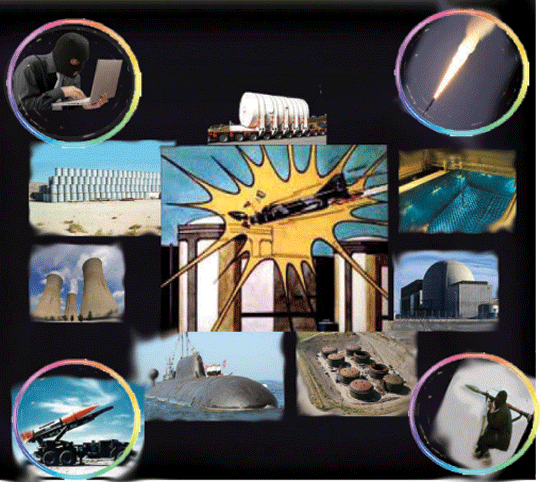 Nuclear terrorism a threat without global security co-operation YUKIYA AMANO THE AUSTRALIAN SEPTEMBER 7, 2015
Nuclear terrorism is, in the words of US President Barack Obama, “the gravest danger we face”. But while few would dispute this characterisation, the world has unfinished business in minimising the threat. Ten years after world leaders agreed to amend the landmark 1987 Convention on the Physical Protection of Nuclear Material to make it harder for terrorists to obtain nuclear material, the new measures have yet to enter into force. The resulting vulnerability needs to be addressed urgently.
In July 2005, signatories to the CPPNM agreed to amend the convention to address the risk of terrorism more effectively. The new measures that were introduced would make it more difficult for terrorists to cause a widespread release of radioactive material by attacking a nuclear power plant or detonating a radioactive dispersal device — commonly known as a dirty bomb.
Before the amendment can enter into force, two-thirds of the 152 signatories to the original convention must ratify it. While significant progress has been made — in July, the US, Italy, and Turkey did so — at least 14 more countries are needed.
The fact that there has never been a major terrorist attack involving nuclear or other radioactive material should not blind us to the severity of the threat. There is evidence that terrorist groups have tried to acquire material to construct a crude nuclear explosive device, or a dirty bomb……….
Since 1995, the IAEA’s member states have reported nearly 2800 incidents involving radioactive material escaping regulatory control. Although only a handful of these incidents involved material that could be used to make a nuclear explosive device, a relatively small amount of radioactive material could be combined with conventional explosives to create a dirty bomb. Such a weapon could be capable of killing many people, contaminating large areas, and sparking mass panic.
The original convention focused only on the international transport of nuclear material, and did not cover the protection of nuclear facilities. The amendment adopted 10 years ago would oblige countries to protect nuclear facilities and any nuclear material used, stored, or transported domestically. It would expand co-operation on locating and recovering stolen or smuggled nuclear material and co-ordinate the response to any attack on a nuclear facility. It would make nuclear trafficking a criminal offence and require signatories to co-operate on national systems of physical protection and minimising the consequences of sabotage…….
Effective international co-operation is crucial. The consequences of a security failure could be a catastrophe that transcends borders. All countries must take the threat of nuclear terrorism seriously. The most effective way to do so would be to ensure that the amendment to the CPPNM enters into force as soon as possible.
Yukiya Amano is director-general of the International Atomic Energy Agency.
Japan’s Monju nuclear reprocessing reactor, plagued by safety errors, offline for most of 20 years
 Errors found in safety management of Monju reactor http://www3.nhk.or.jp/nhkworld/english/news/20150903_28.html Sep. 3, 2015 Japan’s nuclear regulators have found fresh faults with the safety management of the country’s fast-breeder reactor, which is currently offline. They say they have found thousands of errors in safety classifications of the equipment and devices at the Monju reactor.
The operator of the prototype reactor in Fukui Prefecture, central Japan, has been banned from conducting test runs since 2013 following discoveries of a large number of safety inspection oversights.
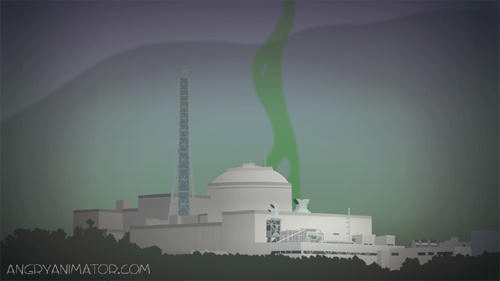
The Nuclear Regulation Authority says it has recently found at least 3,000 mistakes with safety classifications of equipment and devices at the reactor during its regular inspections which are conducted 4 times a year. Its officials say, equipment and devices with high importance were, in some cases, classified in lower ranks in the 3-level system, which suggest the operator might have failed to carry out necessary inspections for them.
The errors found recently include those going as far back as 2007. The fact suggests that government inspectors have also overlooked the operator’s mistakes. The operator, Japan Atomic Energy Agency, built the Monju fast-breeder reactor in the early 1990s to reuse the spent nuclear fuel MOX, a mixture of plutonium extracted from spent fuel and uranium.
But it has been offline for most of the period after it underwent a fire from a leak of sodium, the reactor’s coolant, in 1995.
The operator aims to conduct the reactor’s test run by next March. But it is uncertain when the ban by the authority will be lifted. The plant’s director, Kazumi Aoto, says he will take the government’s report seriously. An NRA inspector, Yutaka Miyawaki, says the regulators will try to identify the actual effects of the errors.
Pilgrim Nuclear Station on the brink of permanent shutdown
Pilgrim nuclear plant one step from shutdown by regulators, Cape Cod Times Pilgrim Nuclear Power Station is now at the bottom of the performance list of the nation’s 99 operating reactors, based on its forced shutdowns and equipment failures, and in a category just one step above mandatory shutdown by federal regulators. By Christine Legereclegere@capecodonline.com Sep 2, 2015 PLYMOUTH –
Only two other plants in the country are currently in that category: Arkansas Nuclear One and Arkansas Nuclear Two. Those two, like Pilgrim, are Entergy-owned.
The Nuclear Regulatory Commission announced the downgrade of the Pilgrim plant today. In a letter to Entergy, the Nuclear Regulatory Commission said the downgrade was due to the plant’s failure to adequately address the issues that have caused the plant’s high number of unplanned shutdowns.
A supplemental inspection will focus on the plant’s shortcomings, “including human performance, procedure quality and equipment performance.”
The results of the supplemental inspection will “provide the NRC with additional information to be used in deciding whether the continued operation of the facility is acceptable and whether additional regulatory actions are necessary to arrest the licensee/plant performance,” the NRC said……..U.S. Sen Edward Markey, D-Mass., issued a statement on Pilgrim’s dubious status. “For decades, I have raised concerns about Pilgrim’s operations, security preparedness, the safety of the surrounding communities in the event of a nuclear accident, and the willingness of Entergy to dedicate sufficient resources to run the reactor safely,” Markey wrote.
The senator noted Pilgrim is the same boiling water reactor design as those that suffered meltdowns at Fukushima. http://capecodtimes.com/article/20150902/NEWS11/150909865
Nuclear Regulatory Commission scraps public rulemaking on weak GE containments,
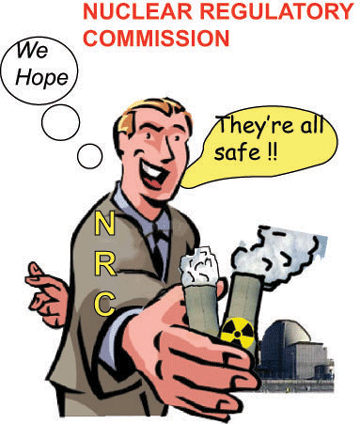 A Fukushima Lesson Unlearned: NRC scraps public rulemaking on weak GE containments, Enformable Paul Gunter 4 Sept 15 The United States Nuclear Regulatory Commission (NRC) typically begins its narrative on the “lessons learned” from the Fukushima Daiichi nuclear catastrophe with Japan’s March 11, 2011 accident. Not surprisingly, the agency has avoided addressing the most critical lesson recognized in the accident’s official investigative report by Japan’s National Diet. In their finding, the unfolding radiological catastrophe is “manmade” and the result of “willful negligence” of government, regulator and industry colluding to protect Tokyo Electric Power Company’s financial interests. Likewise, here in the US, addressing identical reactor vulnerabilities remain subject to a convoluted corporate-government strategy of “keep away” with public safety as the “monkey in the middle” going back more than four decades and, for now, three nuclear meltdowns later.
In the latest development, by a 3-1 vote issued on August 19, 2015, the majority of the four sitting Commissioners with NRC ruled not to proceed with their own proposed rulemaking and bar public comment and independent expert analyses on the installation of “enhanced” hardened containment vents on 30 U.S. reactors. In the event of a severe nuclear accident, roughly one-third of U.S. atomic power plants currently rely upon a flawed radiation protection barrier system at General Electric (GE) Mark I and Mark II boiling water reactors that are essentially identical to the destroyed and permanently closed units at Fukushima Daiichi. The nuclear catastrophe has resulted in widespread radioactive contamination, massive population relocation, severe economic dislocation and mounting costs projected into the hundreds of billions of dollars.
Fundamentally at fault, the GE Mark I and Mark II boiling water reactor “pressure suppression containment system” designed for internalizing such a nuclear accident is roughly one-sixth the volumetric size of pressurized water reactor containment designs like Three Mile Island. Under accident conditions, the reactor pressure vessel and the operation of the emergency core cooling system is depressurized into the “drywell” containment component which in turn routes steam, heat, combustible gases and radioactivity into the “wetwell” component where it is supposed to be quenched and scrubbed in a million gallons of water. The GE design was first identified as too small to contain potential accident conditions in 1972 by Atomic Energy Commission memos. The internal communications would eventually be released years later under the Freedom of Information Act after more GE reactors were granted operating licenses. The memos revealed that the undersized containment system is highly vulnerable to catastrophic failure from over-pressurization in the event of a severe accident. This long recognized chink in GE’s “defense-in-depth” armor was graphically confirmed with the global broadcast of the Fukushima explosions.
Fukushima further demonstrated that “voluntary” GE containment modifications requested by NRC in the early 1990’s are not reliable under real accident conditions. Most U.S. Mark I operators voluntarily installed a hardened vent on the “wetwell” or “torus” containment component. The same modification was installed in Japanese reactors including Fukushima Daiichi. The voluntary containment modifications in the U.S. were carried out under a NRC regulation (10 CFR 50.59) that avoids licensee disclosures in the public hearing process, claiming that the design changes did not raise significant safety issues. Other than the paper trail, even the NRC inspectors were not aware of the final as-built containment modifications…………
The Commission’s August 19th majority vote is effectively a gag order on the American public’s opportunity for formal input to fortify the continued operation of GE Mark I and Mark II reactors against the next nuclear catastrophe. Ironically, the international nuclear industry is simultaneously cashing in on the effort to restart Japan’s nuclear power plants where their Nuclear Regulation Authority has ordered state-of-the-art engineered external filters on severe accident capable hardened containment vents as a prerequisite to resume operation. On August 17, 2015, AREVA issued a press release announcing that it had just delivered it fourteenth filtered containment vent system to the Hamaoka Unit 4 reactor operated by Chubu Electric Power Company where 70% of the Japanese public no longer trust the industry and its regulator and remain opposed to any further nuclear power operations. http://enformable.com/2015/09/a-fukushima-lesson-unlearned-nrc-scraps-public-rulemaking-on-weak-ge-containments/
USA’s Nuclear Regulatory Commission ignores Recommendation on Plans to Address a Core-Melt Accident
 NRC Rejects Recommendation to Require Nuclear Plant Owners to Establish Plans to Address a Core-Melt Accident, UCS, Washington (August 28, 2015)—
The U.S. Nuclear Regulatory Commission (NRC) has rejected the recommendation of the high-level task force it convened after the March 2011 Fukushima disaster to require nuclear plant owners to develop and maintain plans for coping with a core-melt accident. This decision will allow nuclear plants to continue to maintain those plans voluntarily and deny the agency the authority to review those plans or issue citations if they are deficient.
“Once again, the NRC is ignoring a key lesson of the Fukushima accident: Emergency plans are not worth the paper they are printed on unless they are rigorously developed, maintained and periodically exercised,” said Edwin Lyman, a senior scientist at the Union of Concerned Scientists (UCS). “When it comes to these critical safety measures, the NRC is allowing the industry to regulate itself.”
In a decision posted on the NRC’s ADAMS website on August 27, NRC commissioners instructed agency staff to remove a provision of a proposed draft rule aimed at protecting plants from Fukushima-type accidents that would require nuclear plants to establish Severe Accident Management Guidelines, or SAMGs. The staff’s proposal was in response to Recommendation 8 of the NRC’s post-Fukushima staff recommendations, which questioned the effectiveness of NRC’s current practice of allowing plant owners to develop and maintain the SAMGs on a voluntary basis. ……
Yesterday’s decision also removes a provision from the proposed draft rule that would require new reactors to have additional design features to protect against Fukushima-type accidents. By eliminating this requirement, Lyman said, the NRC is relinquishing the opportunity to ensure that new reactors built in the United States will have stronger protection measures than the current reactor fleet. http://www.ucsusa.org/news/press_release/NRC-Rejects-Requiring-Core-Melt-Plans-0522#.VeOCWSWqpHw
Leaked review tells of ‘Significant Design Vulnerabilities’ at Hanford radioactive trash site
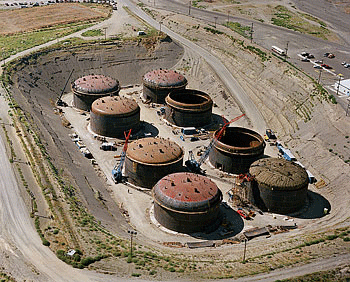 ‘Significant Design Vulnerabilities’ Plague Massive Nuclear Waste Site, Leaked Internal Review Reveals, Common Dreams,
‘The fact that the Department of Energy has not released this report, prepared last year, is alarming and indicative of a safety-last culture.’
A leaked internal review of the nation’s largest nuclear clean-up site found hundreds of “significant design vulnerabilities” and begs questions about the Energy Department’s transparency, a watchdog group says.
The Hanford Nuclear Reservation near Richland, Washington houses radioactive waste from the production of plutonium for nuclear weapons, and the decades-long clean-up effort has been costly and plagued by leaking underground nuclear waste storage tanks.
Seattle-based Hanford Challenge, which advocates for safe clean-up of the site, says it received the Department of Energy document from a whistleblower who has worked at the site for many years as an engineer.
“The fact that the Department of Energy has not released this report, prepared last year, is alarming and indicative of a safety-last culture,” said Tom Carpenter, Executive Director of the group.
The document is a 2014 draft review called “Low-Activity Waste Facility Design and Operability Review and Recommendations.” That LAW facility, Hanford Challenge explains in a statement, “is designed to treat waste from Hanford’s high-level nuclear waste tanks that will be pre-treated to remove the highly-radioactive materials before being mixed with glass formers in a facility designed to vitrify the low level waste.”
From the executive summary of the leaked report: ……
The leaked review comes the same month as whistleblower Walter Tamosaitis, who raised safety concerns regarding operations at the site, reached a $4.1 settlement with Hanford subcontractor AECOM.
And last year, documents obtained by the Associated Press showed there were “significant construction flaws” in some of the double-shell storage tanks at the facility. U.S. Sen. Ron Wyden (D-Ore.) urged the Energy Department to provide an action plan of how it would deal with the risks the flaws pose, writing in a letter (pdf) to Energy Secretary Ernest Moniz: “It is time for the Department to stop hiding the ball and pretending that the situation at Hanford is being effectively managed.”
The Washington site has proven itself an “intractable problem” that “costs taxpayers a billion dollars a year,” author and history professor Kate Brown wrote earlier this year. “Corporate contractors hired to clean up Hanford have made hundreds of millions of dollars in fees and surcharges, and, since little has been accomplished, the tab promises to mount for decades.”http://www.commondreams.org/news/2015/08/26/significant-design-vulnerabilities-plague-massive-nuclear-waste-site-leaked-internal
Sendai’s cooling tubes already leaking! But the pro #nuclear hubris goes on!
Japan Sendai Nuclear Restart — The Hubris Alone Is Killing Me, Let Alone the Volcano and Salt Water Leaks, Nuke Pro 21 Aug 15
I would drop a comment at the link, but I have been banned from Japan Times, so many TIMES that I can’t count. They have no interest in the truth.
————————————————————————————————————–
Kyushu Electric checked the water quality and confirmed an increase in salt content.
Each condenser has some 26,000 tubes inside that are used to pipe seawater around for cooling. Kyushu Electric suspects that holes have opened on such tubes, causing seawater to enter into the condenser. [diagram below by the author of this article]

And this is very dangerous way to think. Perhaps they have 2 sets of heat exchangers, so they can run at 50% whilst one set is completely shut down and worked on. Regardless, this is a stop gap measure, just like at San Onofre if some tubes are already going, there are many more right behind it. So these stories will slip out at the weeks go on.
Heat exchangers that can handle salt water are going to be stainless steel at least and ideally titanium. Industry has gotten a lot better at working with titanium in the last few decades. So those 40 year old heat exchangers at Sendai are probably stainless steel, not at good as titanium.
But in Typical japan Times Fashion, they try to downplay the incident by stating
In Japan, similar problems have occurred about 50 times in the past, but the latest case was the first at the Sendai power plant. In the past, Kyushu Electric experienced two cases at the No. 1 reactor at its Genkai plant in Saga Prefecture in 1997 and 1999.
Classic “don’t worry” it happens all the time. So the pimps of nuke will do anything to keep this plant running. Including putting your life and livelihood at risk………. http://nukeprofessional.blogspot.com.au/2015/08/japan-sendai-nuclear-restart-hubris.html?showComment=1440185210724#c7323011781148838576
1 This Month

of the week – THE ONENESS of HUMANITY
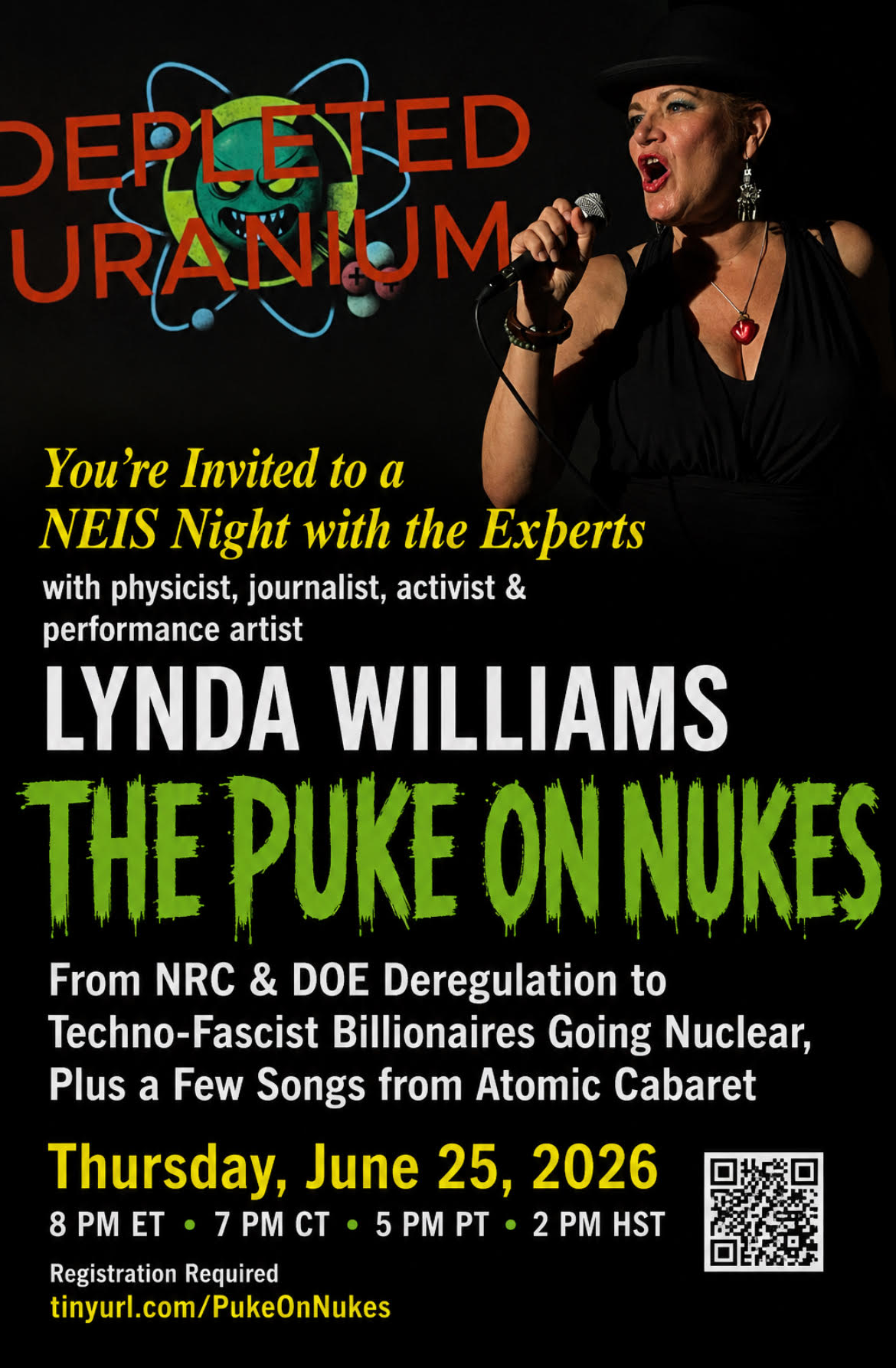
25 June- THE PUKE ON NUKES
Thursday, June 25, 2026
7pm Central Time (8pm ET, 6pm MT, 5pm PT) UTC – 5
From NRC & DOE Deregulation to Techno-Fascist Billionaires Going Nuclear, Plus a Few Songs from Atomic Cabaret REGISTER
26 June – Radiation Trainwreck at the NRC / Join the Protect Better Campaign – https://us02web.zoom.us/meeting/register/4ZlZ5_qLSHGiLSCg8FF6Bg#/registration

1st July – Webinar Waste of Space: The Environmental Harm of Military and Civil Space Activity st July, 7 pm

Report Launch Online: We are seeing an increasing exploitation of space for military and commercial purposes. This must change.

Protect Sazan Island from the Trump family! https://secure.avaaz.org/campaign/en/protect_sazan_island_from_the_trump_family_loc/?bqFCVab&v=174511&cl=22707147157&_checksum=5e9dde668860e8231c33699735e16a1fbf22ab2cb01da50c999fe8732b9775ef&utm_source=email&utm_medium=blast_email&utm_campaign=174511


Cuba Is Not a Failed State – It Is a Besieged State
PETITION: “Global Appeal to Endorse Palestinian Right of Return of Refugees”
To see nuclear-related stories in greater depth and intensity – go to https://nuclearinformation.wordpress.com
-
Archives
- June 2026 (241)
- May 2026 (306)
- April 2026 (356)
- March 2026 (251)
- February 2026 (268)
- January 2026 (308)
- December 2025 (358)
- November 2025 (359)
- October 2025 (376)
- September 2025 (257)
- August 2025 (319)
- July 2025 (230)
-
Categories
- 1
- 1 NUCLEAR ISSUES
- business and costs
- climate change
- culture and arts
- ENERGY
- environment
- health
- history
- indigenous issues
- Legal
- marketing of nuclear
- media
- opposition to nuclear
- PERSONAL STORIES
- politics
- politics international
- Religion and ethics
- safety
- secrets,lies and civil liberties
- spinbuster
- technology
- Uranium
- wastes
- weapons and war
- Women
- 2 WORLD
- ACTION
- AFRICA
- Atrocities
- AUSTRALIA
- Christina's notes
- Christina's themes
- culture and arts
- Events
- Fuk 2022
- Fuk 2023
- Fukushima 2017
- Fukushima 2018
- fukushima 2019
- Fukushima 2020
- Fukushima 2021
- general
- global warming
- Humour (God we need it)
- Nuclear
- RARE EARTHS
- Reference
- resources – print
- Resources -audiovicual
- Weekly Newsletter
- World
- World Nuclear
- YouTube
-
RSS
Entries RSS
Comments RSS
 nuclear-news