safety problems with Britain’s Trident ballistic missile submarine program
 Britain’s nuclear arsenal is a ticking time bomb, The Week, Tom Barlow Brown, 18 Dec 15 the United Kingdom’s nuclear deterrent, the Trident ballistic missile submarine program, worth keeping?
For the British Parliament and much of the media, the problem is mainly the vast amounts of money spent to keep it going. According to the U.K. Ministry of Defense, the program’s total cost is £15-20 billion. Anti-nuclear campaigners give a figure of around £100 billion, give or take. At least, that’s how much it should rack up in costs over its 40 year lifespan.
However, what is less talked about is how both the submarines and the bases that maintain them have suffered from a series of glaring safety mishaps.
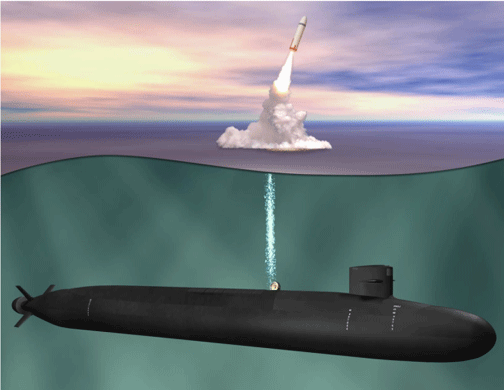
There are four Vanguard-class ballistic missile submarines currently in service with the Royal Navy. These 149.5-meter long, nuclear-powered vessels are relatively new — all of them having launched in the 1990s — but are aging fast. Each Vanguard-class submarine can carry up to 16 Trident II missiles, each one packing 12 independently-targetable nuclear warheads, meaning the nukes split off from the missile and explode in multiple locations. The actual number of deployed missiles and warheads, however, is a closely guarded secret.
Her Majesty’s Naval Base, Clyde in Scotland — otherwise known as Faslane — is the main base for the Royal Navy’s Trident subs, and has been exceedingly prone to accidents. The latest details come from a Royal Navy sailor-turned-whistleblower William McNeilly who published an 18-page report before going on the run.
McNeilly, writing under the pseudonym William Lewis, attacked the “military spin doctors” that he claimed distort the public’s knowledge of safety lapses. He detailed 30 accidents which range from the chilling to the ridiculous.
Among these were a fire in a missile compartment caused by a toilet rolls set too close to a cable, a range of problems with hydraulic systems and a general failure to follow safety procedures. The document also makes it clear that a number of safety issues were due to heavy cutbacks, resulting in a lack of qualified personnel…….
There are other concerns about safety at a different naval base in the United Kingdom — the Devonport dockyard, which is the largest naval base in Western Europe.
The most frightening of these accidents was the loss of power to the “nuclear ring” reactor cooling system of one submarine for 90 minutes. Had power not been restored, such an incident could have had potentially catastrophic consequences resulting in a major nuclear incident.
The dockyard is within walking distance of the city of Plymouth, home to around 250,000 people. Most of these residents would be in danger in the event of a reactor meltdown.
In 2011, a previously classified document authored by the base’s ex-safety regulator Commodore Andrew McFarlane warned that the reactors powering nuclear submarines based at Devonport were possibly unsafe……..
A House of Commons vote to renew Trident is expected in 2016.
After that, a fleet of replacement submarines will enter service in the early 2030s… if everything goes to plan. However, that is still a long way off, and the current class of Vanguard submarines will needs increasing amounts of maintenance to keep them running through the next decade.
The issue of Trident is back in the political limelight again with the current Labour Party and opposition leader Jeremy Corbyn looking to put scrapping the program on his party’s political agenda. In the meantime, it remains to be seen whether the Ministry of Defense will take any action on the program’s safety.
If they don’t, the consequences could be deadly serious.http://www.theweek.com/articles/594745/britains-nuclear-arsenal-ticking-time-bomb
Cyber dangers to Turkey’s planned Russian nuclear plant
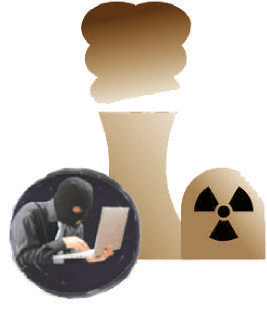 Turkey’s planned Russian nuclear plant vulnerable to cyber threats, Today’s Zaman, 17 Dec 15 Turkey lacks the required policy tools, legal regulations and IT infrastructure to ensure that a planned Russian-made nuclear power plant in Akkuyu is well-guarded against a potential cyber-attack, according to a report released on Thursday that exposes a vital security gap amid the ongoing political crisis with Moscow.
In the wake of the month-long political spat with Moscow, the idea of a Russian-operatednuclear plant on Turkish soil brings to Turkish skeptics’ minds a number of questions from crisis management to security gaps. Russian officials moved to soothe such concerns over the planned nuclear plant, but some civil society groups and Turkish experts are still posing serious questions over the issue. Among the major concerns, the threat of a cyber-attack is considered the most critical, or Turkey’s Achilles heel, according to a report released by the İstanbul-based Centre for Economics and Foreign Policy Studies (EDAM)……. http://www.todayszaman.com/business_turkeys-planned-russian-nuclear-plant-vulnerable-to-cyber-threats_407281.html
Belgium’s nuclear restart causes anxiety in adjacent North Rhine-Westphalia
Belgium ‘playing Russian roulette’ with relaunch of nuclear reactor, says fuming Germany, Rt.com 16 Dec, 2015 Belgium, plagued by a series of nuclear mishaps in recent years, has restarted its ageing Tihange 2 reactor after a nearly two-year shutdown. Neighboring Germany is angered by the relaunch amid fears it could result in a Fukushima-style meltdown.
Belgian power utility Electrabel says it put Tihange 2, first launched in 1983, back in service on Tuesday night “in complete safety.” But officials in adjacent North Rhine-Westphalia (Germany’s most-populous state) say there’s a storm brewing, recalling the fact that three of Belgium’s seven reactors were closed at one point, in two cases due to the discovery of micro-cracks in Tihange 2’s reactor casings.
“The Belgian government is playing Russian roulette. Tihange is a reactor in ruins,” North Rhine-Westphalian Environment Minister Johannes Remmel said Tuesday, according tosudinfo.be.
North Rhine-Westphalia’s economy minister, Garrelt Duin, also warned against the relaunch of Tihange, calling it “a big mistake.”
Four of Germany’s 10 biggest cities (Cologne, Düsseldorf, Dortmund and Essen) are in North Rhine-Westphalia. The city of Aachen, only 60km from Tihange, said it had explored legal options to stop the reopening of the reactor, but those efforts were in vain.
“To restart a reactor that has cracks is irresponsible and dangerous. Given the proximity to the border, the German government should have long been working towards its closure,” Sylvia Kotting-Uhl, spokesman for the German Green Party said in a statement, according to AFP.
“If a failure of the reactor tank leads to a nuclear accident, Germany would also become highly exposed to radiation due to the persistent wind from the west,” she warned.
Growing safety concerns have fallen on deaf ears in Belgium, however. ……https://www.rt.com/news/326086-nuclear-reactor-relaunch-tihange/
New York Governor Cuomo orders investigation of Indian Point Nuclear Station
 Cuomo calls for investigation of Indian Point nuclear plant http://news10.com/2015/12/16/cuomo-calls-for-investigation-of-indian-point-nuclear-plantcuomo-calls-for-investigation-of-indian-point-nuclear-plant/By Ali Stewart December 16, 2015 ALBANY, N.Y. (AP) – Gov. Andrew Cuomo has directed state utility regulators to begin a full investigation of the operations and safety protocols at the Indian Point nuclear power plant on the Hudson River about 30 miles north of Manhattan.
Plant owner Entergy says federal regulators with nuclear expertise say the plant is safe.
Monday evening, one reactor was automatically shut down. The company says the disturbance on the non-nuclear side of the plant is related to a high voltage transmission line. There was no release of radioactivity and no threat to the public.
The other reactor was shut down for three days earlier this month due to a tripped circuit breaker. The two reactors together supply about one-quarter of the power used in New York City and Westchester County.
Concerns about China’s nuclear technology: is it safe?
China’s nuclear technology ambition is worrying: The Yomiuri Shimbun Straits.com 15 Dec 15 In its editorial on Dec 15, 2015, The Yomiuri Shimbun hopes China will follow up on its nuclear ambitions with suitable regulatory measures. We cannot afford to be unconcerned about China’s moves to accelerate construction of nuclear power plants.
Is the safety of these facilities ensured?….
The administration of Chinese President Xi Jinping is planning to further increase the number of nuclear power plants to cope with the nation’s serious air pollution, which stems from coal-fired power generation, and increasing energy demand.
According to local media reports, Beijing will build six to eight nuclear reactors annually in the next five years. By 2030, the number is set to reach 110, surpassing the 99 in the United States.
One major concern is that information about nuclear power plants in China is extremely limited.
China’s nuclear power operations began in 1994, and the number of nuclear reactors has increased rapidly since then.
However, the details of regulatory standards are not disclosed – it is quite obscure what kind of safety measures China is currently taking.
There are limited examples of the Chinese government officially disclosing troubles with the nation’s nuclear power plants to the public, such as leaks of radioactive material or mechanical problems caused by accidents.
The less information available, the more concern there is. The Japanese government must reinforce its measures to collect information on China’s nuclear power plants.
Prevailing westerlies bring yellow sand and air pollutants to Japan from China. If serious nuclear accidents occur in China, there could be serious repercussions for Japan.
It cannot be overlooked the fact that China’s nuclear power plants are concentrated in coastal areas.
After the nuclear accident at Tokyo Electric Power Co.’s Fukushima No. 1 nuclear power plant, Beijing has put restrictions on the construction of nuclear power plants in inland areas. We assume Beijing is wary of the domestic impact from accidents if they occur inland.
China’s nuclear reactors rarely use technologies developed in the country – they are basically an amalgamation of technologies imported from European countries, the United States and Japan.
Japan provides core parts, such as reactor pressure vessels.
In recent years, China’s export drive on nuclear power plants has received worldwide attention…….
Beijing is also constructing Hualong One reactors in Pakistan, and is seeking to launch a promotion drive in South American and African countries.
However, we must point out that Hualong One is a model still under construction even in China itself. It is problematic that a model without sufficient operation records has begun sweeping the whole world…….. http://www.straitstimes.com/asia/east-asia/chinas-nuclear-technology-ambition-is-worrying-the-yomiuri-shimbun
Ukraine’s troubles continue with the toxic Chernobyl site
Fukushima Amplifies Murphy’s Law COUNTERPUNCH DECEMBER 14, 2015 by ROBERT HUNZIKER “……….. In sharp contrast to Japan’s position, Chernobyl’s officialdom has a different take on “permissible annual radiation exposure,” specifically: “The radiation limit that excluded people from living in the 30km zone around the Chernobyl nuclear plant exclusion zone was set at 5mSV/year, five years after the nuclear accident. Over 100,000 people were evacuated from within the zone and will never return,” (Greenpeace Japan). Never ever return!
Nuclear disasters don’t go away easily. For example, Chernobyl is already facing a brand new crisis. The durability of the original decaying blighted sarcophagus expires within the next 12 months. However, the new replacement sarcophagus, the world’s biggest-ever metallic dome, will not be accomplished in time as they are short of funds (615million EUR).

In addition to Ukraine’s internal strife with pro-Russian citizens, the country has serious financial difficulties. All of this amounts to one more “spoke in the wheel” against nuclear reactor proliferation (Incidentally, China has 400 reactors on the drawing board). Who knows if and when a crippled reactor ends up in the hands of a financially strapped country? Then what?
Already, Ukraine has 15 nuclear reactors standing tall, so far, amongst whizzing bullets and powerful rockets. Dismally, Ukraine has conceivably become a nuclear holocaust tinderbox in the midst of cannon fire, rumbling tanks, and surface-to-air missiles, for example, Malaysia Airlines Flight 17 was shot down by a missile, supposedly by accident, on July 17, 2014, all 298 on board died……….. http://www.counterpunch.org/2015/12/14/fukushima-amplifies-murphys-law/
Missing highly enriched uranium canisters probably came from Mayak nuclear facility
In the age of terrorism, disturbing questions remain on nuclear security, WP, By Editorial Board December 14 THREE TIMES in the past 16 years — Bulgaria in 1999, France in 2001 and Moldova in 2011 — containers of highly enriched uranium have been seized by authorities, according to an article published online last month by the Center for Public Integrity, a nonprofit investigative news organization. In each case, the person holding the uranium said it was part of a larger cache for sale.
Such proffers have in the past been made by employees at nuclear facilities in the former Soviet Union who smuggled the material out of their plants. In 1992, a worker diverted approximately 3.3 pounds of weapons-grade uranium from a facility in Russia, taking it home bit by bit, storing it on his balcony. He was arrested at the local train station, planning to travel to Moscow to sell it.
But the three containers of highly enriched uranium have something in common that until now has been kept secret. According to the article, forensic analysis by U.S. and French nuclear scientists strongly suggests that the materials came from the same source. The analysis indicates all three samples were produced in the early 1990s at a Russian nuclear facility, the MayakProduction Association, located near the town of Ozersk in the Ural Mountains region of Chelyabinsk. The uranium could have been removed in the chaotic early years after the Soviet Union collapsed, when many such facilities were poorly guarded, and it may now be anywhere……..https://www.washingtonpost.com/opinions/nuclear-insecurity/2015/12/14/21a7f38a-938e-11e5-b5e4-279b4501e8a6_story.html
Ontario’s nuclear emergency plan is inadequate
Activists say Ontario’s 10 km primary response zone at nuclear plants isn’t safe enough http://news.nationalpost.com/news/canada/activists-say-ontarios-10-km-primary-response-zone-at-nuclear-plants-isnt-safe-enough Keith Leslie, The Canadian Press | December 10, 2015 TORONTO — Environmentalists want the Ontario government to provide evidence for its 10-kilometre limit around nuclear power plants for distribution of potassium iodide (KI) pills that help fight radiation, and say it should be expanded.
Greenpeace and the Canadian Environmental Law Association filed a request under the Ontario environmental bill of rights asking the ministry of health to do an evidence-based review of the policy surrounding distribution of the KI pills.
Radioactive iodine is released in the event of a nuclear accident, and the potassium iodide pills can help protect against thyroid cancer.
The pills were sent to about 200,000 households and businesses around the Pickering, Darlington and Bruce nuclear stations in October, and were given to another 12,500 people who asked for them.
Stensil believes the evidence will show the distribution zone for the pills should be expanded to as much as 50 kilometres.
“Four years after the (2011) Fukushima disaster in Japan — cancer takes a while to develop — a study found increased incidences of thyroid cancer 50 kilometres from the plant,” he said. “All we’re saying is let’s make the decision based on evidence.”
Most nuclear issues are a federal responsibility, but off-site safety plans are the province’s responsibility. Greenpeace says a little-used section of Ontario’s environmental bill of rights requires a government response to their request for a medical review of the policy, and if it refuses, the environmental commissioner must investigate and report to the public.
Last week, the city of Toronto’s executive committee asked the medical officer of health and office of emergency management to investigate the “appropriateness” of the 10 kilometre zone at nuclear plants and whether it should be expanded to 50 kms.
Ontario Power Generation’s Pickering nuclear generating station is 50 kilometres from downtown Toronto.
“Real-world experience and international best practices suggest Ontario’s nuclear emergency plans aren’t sufficient to protect Ontarians in the event of a nuclear accident,” said Theresa McClenaghan, Executive Director of the CELA.
The province initially balked at the Canadian Nuclear Safety Commission’s order to distribute the pills, insisting the federal regulator didn’t have jurisdiction to issue it, so the CNSC made it a condition of renewing licences for Ontario’s nuclear plants.
“The federal regulator stepped into the provincial realm because it felt Ontario was avoiding its responsibility to protect the public in the event of a nuclear accident,” said Stensil.
Nuclear materials and the danger of terrorism
 UN watchdog warns terrorists may seek nuclear material, GMA News, December 8, 2015 MANILA, Philippines – The head of the UN nuclear watchdog agency, who is in the Philippines for an atomic energy conference, warned Monday of the threat of terrorists getting their hands on radioactive material to make “dirty” bombs.
Yukiya Amano, director general of the International Atomic Energy Agency (IAEA), said all countries should secure material which extremists could use to make such a device.
“Nuclear security is a longstanding and real issue. This is a real threat in all countries where nuclear material is available to terrorists,” he said.
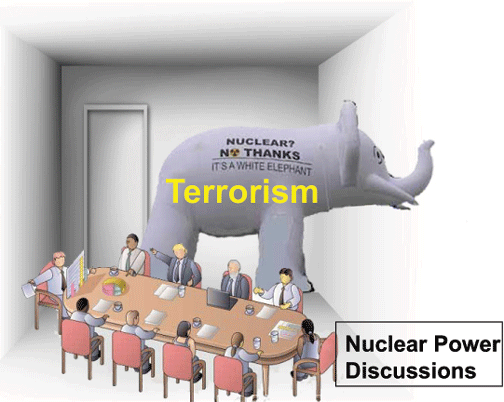
“If nuclear material falls into the hands of terrorists, that can be used for dirty bombs,” he said, referring to devices that use explosives to spread radioactive material over a wide area to poison people.
Amano said such devices, which are much easier to make than an atomic bomb, could cause widespread panic if unleashed in a city…….
Concern about possible terror attacks has risen sharply worldwide recently following a spate of bombings and mass shootings by supporters of the Islamic State group. — Agence France-Presse – See more at:http://www.gmanetwork.com/news/story/547108/news/world/un-watchdog-warns-terrorists-may-seek-nuclear-material#sthash.sXDTLJ0b.dpuf
The dangers of transporting nuclear waste by sea
 Nuclear waste transport risks ,Tor Justad, http://www.shetlandtimes.co.uk/2015/12/08/nuclear-waste-transport-risks-tor-justad “…..I would wish to draw attention to the proposal from the Nuclear Decommissioning Authority to transport nuclear waste by sea from Scrabster to Barrow – a distance of over 400 miles.
This high level nuclear waste/spent fuel emanates from the Dounreay nuclear site and is intended for Sellafield – described as “the most toxic nuclear site in Europe”.
The campaigning group Highlands Against Nuclear Transport (Hant) has been campaigning since 2013 to stop this plan on the grounds that the risk to the environment, fishing, aquaculture and tourism is unacceptable.
Transporting nuclear waste by sea is opposed by environmental groups throughout the world and Hant is of the view that all nuclear waste should remain on the sites where it is produced which is in line with Scottish government policy. Hant provided an input at a Nuclear Free Local Authorities (NFLA) seminar in Lerwick in August 2015 on “Transportation of Dounreay’s nuclear materials by rail or by sea to Sellafield – is it a safe solution for reducing the nuclear legacy in Scotland?” and was pleased to hear from SIC and Kimo representatives at that seminar that they supported Hant’s position.
The need for emergency response vessels stationed around the Northern Isles and Western Isles is important to safeguard these coasts against marine accidents and emergencies of any kind but the need is increased by the proposal to transport nuclear waste.
As is well known, nuclear radiation knows no land or sea boundaries so this issue is of concern to all coastal communities in the Highlands and Islands.
Hant will continue to campaign on this issue and would urge individuals and interested organisations to support this campaign.
10 Control Rods accidentally dropped into nuclear reactor core – Indian Point
 Gov’t: Shutdown at U.S. nuclear plant after 10 control rods accidentally fall into reactor core — Caused by ‘smoldering’ event, Fire Brigade on scene — Incident of this type could lead to overheating, potentially resulting in ‘supercriticality’ — Official: No ‘immediate’ concern (VIDEO) http://enenews.com/govt-shutdown-nuclear-plant-after-rods-accidentally-fall-reactor-core-caused-smoldering-event-fire-brigade-scene-incident-could-lead-overheating-potentially-resulting-supercriticality-officia?utm_source=feedburner&utm_medium=email&utm_campaign=Feed%3A+ENENews+%28Energy+News%29
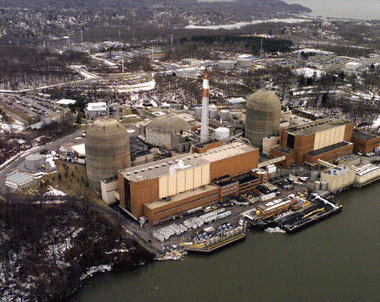 U.S. Nuclear Regulatory Commission Event Notification Reports, Dec 7, 2015 (emphasis added): MANUAL REACTOR TRIP INITIATED DUE TO MULTIPLE DROPPED CONTROL RODS — At 1731 [EST] on December 5, 2015, Indian Point Unit 2 Control Room operators initiated a Manual Reactor Trip due to indications of multiple dropped Control Rods. The initiating event was a smoldering Motor Control Center (MCC) cubicle in the Turbine Building that supplies power to the Rod Control System… The affected cubicle has ceased smoldering and is being monitored by on-site Fire Brigade trained personnel… The cause of the smoldering MCC is being investigated and a post reactor trip evaluation is being conducted by the licensee… The licensee has notified the NRC Resident Inspector and appropriate State and Local authorities.
The Journal News, Dec 7, 2015: One of Indian Point’s two nuclear reactors will remain shut down for the next couple of days following a power loss on Saturday, a company spokesman said Sunday. Unit 2 was powered down around 5:20 p.m. Saturday by operators after about 10 control rods “dropped” into the reactor core, according to the Nuclear Regulatory Committee… Neel Sheehan, a spokesperson for the NRC, said a preliminary investigation indicated the problem stemmed from a sudden power loss to the mechanism holding the rods. The plant’s control rods, made of materials that can absorb neutrons, are used to control the fissioning of atoms that generate power… Government inspectors visited Indian Point on Saturday and Sunday. “No immediate concerns were identified,” Sheehan said in an e-mail, adding that inspectors would return to the site “to follow up on troubleshooting, repair activities and restart planning.”
Gothamist, Dec 6, 2015: In a statement, Gov. Cuomo… said he’s sending a team from the Department of Public Service to investigate the incident and monitor the process of bringing the reactor back online.
Several control rods also appear to have dropped at Virginia’s North Anna nuclear power plant after an earthquake in 2011:
- U.S. NRC Event Notification, Aug 29, 2011: EMERGENCY DECLARED… North Anna Power Station declared an Alert due to significant seismic activity
- U.S. NRC email, Sept 2011: RE: North Anna… At this point, it appears that the grippers for several of the control rods deenergized and dropped.
- Westinghouse patent: A dropped rod… will initially result in a reduction in the total power generated by the core. The reactor will then attempt to meet the load… byincreasing power in the remainder of the core which could lead to local overheatingelsewhere in the core.
- Satoshi Sato, Nuclear Engineer, April 28, 2015 (emphasis added): “I don’t know if you remember, there was the earthquake in 2011 in Virginia. That was a big one… enough to cause vibration to the North Anna reactor resulting in a big spike of neutron flux — orreactor power… and somehow caused the additional radioactivity into the core. So that’ssomething scary, potentially resulting in a supercriticality.” (IEER: “The neutron spike accompanying a sudden supercriticality can lead to an explosion of the reactor core. It is this sort of event which occurred at the Chernobyl reactor”)
Japan’s new nuclear regulatory regime is inadequate
 Time to Stop Nursing the Nuclear Power Industry, nippon.com Yoshioka Hitoshi, 7 Dec 15 “……. Failings of the New Safety Standards
Despite the reforms instituted in the wake of the 2011 meltdown, the fundamental safety issues surrounding nuclear power in Japan remain unresolved.
The final report of the government’s Investigation Committee on the Accident at the Fukushima Nuclear Power Stations, along with a slew of outside reports, points to the culture of complacency that undermined Japan’s pre-2011 nuclear safety regime and left the country—with its high population density and high risk of natural disasters—vulnerable to a catastrophic accident. It was clear that the government needed to institute a far stronger regulatory regime if it wanted to resurrect Japan’s nuclear power program. In September 2012, it launched the Nuclear Regulation Authority, and in July 2013, the NRA adopted new safety standards for reactors in use at nuclear power stations.
Unfortunately, the new regulatory regime is also inadequate to ensure the safety of Japan’s nuclear power facilities.
The first problem is that the new safety standards on which the screening and inspection of facilities are to be based are simply too lax. While it is true that the new rules are based on international standards, the international standards themselves are predicated on the status quo. They have been set so as to be attainable by most of the reactors already in operation.
In essence, the NRA made sure that all Japan’s existing reactors would be able to meet the new standards with the help of affordable piecemeal modifications—back-fitting, in other words. In practice, they need only to add a new layer of emergency management and some back-up equipment to meet the new standards for emergency preparedness. The estimates for earthquake intensity and tsunami height in each locale have been revised upward, but not to the point where they would necessitate fundamental design changes.
The second basic problem is that the new standards do not cover all the levels of “defense in depth” advocated by the International Atomic Energy Agency in its seven-stage International Nuclear Events Scale. They extend only as far as Level 4 (“control of severe conditions including prevention of accident progression and mitigation of the consequences of a severe accident”), stopping short of Level 5 requirements for responding to accidents that threaten the surrounding area through significant release of radioactive materials.
Under the Act on Special Measures Concerning Nuclear Emergency Preparedness, the prefectural and municipal governments within a 30-kilometer radius of a nuclear power facility are given full responsibility for emergency preparedness and evacuation planning geared to nuclear accidents with wider consequences, whose impact extends beyond the confines of the plant compound. Under the law, the plans must incorporate all items on a mandated checklist, but they are not subject to any outside review. The NRA does not view local preparedness or evacuation plans for a nuclear disaster as part of its regulatory regime.http://www.nippon.com/en/currents/d00200/
Japan’s nuclear regulatory body investigating spent nuclear fuel containers
 Regulator probes fuel container strength at Fukushima nuclear plant http://www.japantoday.com/category/national/view/regulator-probes-fuel-container-strength-at-fukushima-nuclear-plantDEC. 06, 2015 -TOKYO — Japan’s nuclear regulatory body has launched an investigation into metallic spent fuel containers at Tokyo Electric Power Co’s Fukushima Daiichi nuclear plant as they may not have sufficient strength.
Members of the Nuclear Regulation Authority raised the issue Friday at a meeting to discuss nuclear safety problems. The body will examine whether the containers made by Kobe Steel Ltd are safe for long-term use.
The nuclear regulation watchdog said it will also launch a probe at Japan Atomic Power Co’s Tokai No. 2 nuclear power plant in Ibaraki Prefecture as the same type of fuel container may be used there.
The fuel storages meet strength criteria set by the Japan Society of Mechanical Engineers. But the metal plates inside them may not be strong enough for use in storing nuclear spent fuel.
TEPCO said it believes the strength of the containers meets the NRA’s safety standards.
Liability and compensation issues for a nuclear India
 India unprepared: what happens in case of a nuclear Bhopal?, Catch News, KUMAR SUNDARAM@pksundaram 4 December 2015
“……..On the issue of liability and compensation, the government has shown scant regard to potential victims. Safeguarding the foreign suppliers from any liability has been a paramount concern.
Nothing could be more absurd and ironic than the fact that since the inception of the Civil Liability for Nuclear Damage Act 2010, the government has been busy finding a way to address the concerns of the foreign suppliers, who want complete indemnification.
The clause 17(b), holding suppliers liable, albeit with severe limitations, was introduced under parliamentary and civil society pressure by a reluctant Manmohan Singh. But the Modi governmentt has dumped the earlier BJP position on nuclear liability, and tried to create an insurance pool to channel the liability back to the exchequer, thus undermining the law.
In the light of India’s vulnerability on the above three counts, the 31st anniversary of the Bhopal Gas Tragedy should be a moment to recognise that, in general, our administrative and political system can only be relied on to be totally inefficient and unaccountable.
As with Bhopal, in the case of a nuclear accident, the government would be unable to provide any relief for victims, especially as the main victims would be adivasis and villagers far away from the public gaze.
Irreversible and wide-ranging consequences……… http://www.catchnews.com/india-news/india-unprepared-what-happens-in-case-of-a-nuclear-bhopal-1449243696.html
Japan’s Nuclear Regulatory Authority fails to conduct on-site checks for plant cables
NRA fails to conduct on-site checks for nuclear plant cables, Japan Times, 5 Dec 15 The Nuclear Regulation Authority failed to conduct on-site inspections to determine if safety equipment cables were installed separately from other cables at nuclear power plants during the safety screening process required for the restart of reactors, it was learned Saturday.
The revelation came to light when it was recently revealed that safety cables at nuclear facilities, including Tokyo Electric Power Co.’s Kashiwazaki-Kariwa plant in Niigata Prefecture, were not separated from other cables, a violation of the new nuclear safety standards introduced in July 2013.
The nuclear safety watchdog’s oversight also includes cables installed for reactors that have already passed safety screenings, including those at Kyushu Electric Power Co.’s Sendai plant in Kagoshima Prefecture.
At all seven reactors at the Kashiwazaki-Kariwa plant, many safety-related cables, including those used to transmit data from water meters and for water injection operations, were found combined with other cables. The seven units are all boiling-water reactors…….
In pre-restart reactor inspections, the NRA does not check to see if safety cables are separated, although inspections are done for fire-extinguishing and other equipment, the officials added.
At the Kashiwazaki-Kariwa plant, the problem cables were first found under the central control rooms for the No. 1 to No. 7 reactors.
The NRA then asked other power companies with boiling-water reactors to check and report if they had similar issues. Power utilities with pressurized-water reactors were also asked to report.
At the Kashiwazaki-Kariwa reactor, mixed cables were found in areas outside the central control rooms.
“At present, we can’t deny the possibility that safety and other cables are mixed at pressurized-water reactors, but how to handle the problem has yet to be decided,” an official at the NRA said. “First, we’ll analyze the report from Tepco.”
Of pressurized-water reactors in Japan, the No. 1 and the No. 2 reactors at the Sendai power plant resumed operations in August and October, respectively.
The No. 3 and No. 4 reactors at Kansai Electric Power Co.’s Takahama plant in Fukui Prefecture, central Japan, and the No. 3 reactor at Shikoku Electric Power Co.’s Ikata plant in Ehime Prefecture have also passed NRA safety screenings. http://www.japantimes.co.jp/news/2015/12/05/national/nra-fails-to-conduct-on-site-checks-for-nuclear-plant-cables/#.VmNeVtJ97Gg
JIJI
1 This Month
26 September – International Day for the Total Elimination of Nuclear Weapons





PLEASE OPPOSE HR 8255 AND S.3639 – bills would accelerate satellite deployment, with no environmental review or safeguards – https://ncstd5li.quorum.us/campaign/169331/
To see nuclear-related stories in greater depth and intensity – go to https://nuclearinformation.wordpress.com
-
Archives
- September 2026 (313)
- August 2026 (330)
- July 2026 (355)
- June 2026 (287)
- May 2026 (306)
- April 2026 (356)
- March 2026 (251)
- February 2026 (267)
- January 2026 (308)
- December 2025 (358)
- November 2025 (359)
- October 2025 (375)
-
Categories
- 1
- 1 NUCLEAR ISSUES
- business and costs
- climate change
- culture and arts
- ENERGY
- environment
- health
- history
- indigenous issues
- Legal
- marketing of nuclear
- media
- opposition to nuclear
- PERSONAL STORIES
- politics
- politics international
- Religion and ethics
- safety
- secrets,lies and civil liberties
- spinbuster
- technology
- Uranium
- wastes
- weapons and war
- Women
- 2 WORLD
- ACTION
- AFRICA
- Atrocities
- AUSTRALIA
- Christina's notes
- Christina's themes
- culture and arts
- Events
- Fuk 2022
- Fuk 2023
- Fukushima 2017
- Fukushima 2018
- fukushima 2019
- Fukushima 2020
- Fukushima 2021
- general
- global warming
- Humour (God we need it)
- Nuclear
- RARE EARTHS
- Reference
- resources – print
- Resources -audiovicual
- Weekly Newsletter
- World
- World Nuclear
- YouTube
-
RSS
Entries RSS
Comments RSS

