Experts warn of terrorist drone attacks on nuclear facilities
Terrorists could use drone bombs to attack nuclear power stations, experts warn http://www.independent.co.uk/news/uk/home-news/terrorists-could-use-drone-bombs-to-attack-nuclear-power-stations-experts-warn-a6805316.html, Ian Johnston 11 Jan 16

The Oxford Research Group looked at more than 200 drones and concluded they “will be used as simple, affordable and effective airborne improvised explosive devices”, the Guardian reported.
“The UK government, police, military and security services will need to introduce countermeasures to reduce or mitigate the risk of commercially available drones being used for attack,” the security think tank warned. “Islamic State [Isis] is reportedly obsessed with launching a synchronised multi-drone attack on large numbers of people in order to recreate the horrors of 9/11.”
The report recommends a licensing system for drones, using lasers and radio jammers to defend potential targets and issuing guidelines to the security forces on when to shoot down drones.
It pointed to a number of incidents where drones were used by protesters, including when a football match between Albania and Serbia was interrupted by a drone flying an Albanian flag.
Call to stop dangerous trucking of radioactive trash from Canada to South Carolina.

 Stop Canada from trucking nuclear waste through area http://www.buffalonews.com/opinion/letters-to-the-editor/letter-stop-canada-from-trucking-nuclear-waste-through-area-20160111 Susan Kims, 10 Jan 16
We’ve recently seen News articles highlighting the need for tighter regulations on shipping thousands of gallons of highly enriched liquid uranium from Canada to South Carolina.

The approved travel route uses the Peace Bridge, south on Niagara Thruway, then west on the mainline Thruway for shipments that started Jan. 1 and run through May 31, 2018. These materials will pass dangerously close, within hundreds of yards, to densely populated residential neighborhoods, with the only barrier being a guardrail or chain-link fence.
Congressman Brian Higgins has recently expressed concern, because terrorist and militant groups are interested in using highly dangerous weapons, especially those utilizing chemical, biological, radiological and nuclear materials. I have an additional concern – the amount of contamination and carnage that could occur if a vehicular accident resulted in a spill. Such a spill in close proximity to dense populations would be devastating.
As a nation, we are concerned that a pipeline transporting oil from Canada to the Gulf of Mexico might produce a spill. Yet we show little concern regarding the possibility of spills of highly hazardous liquid nuclear materials along roadways that abut our neighborhoods. Do we not foresee the possibility of the same impending dangers from transport of nuclear waste on our roads?
Canadian authorities approve nuclear facilities to operate within their borders and should take responsibility for the hazardous waste produced within their borders. Our citizens should not be exposed to possible harm as a result of their decisions.
This should be stopped before tragedy occurs!
Nuclear reactors are most dangerous when very new or very old: a concern regarding China

 Radiation fears in Hong Kong from China’s unproven and possibly faulty nuclear reactors nearby, Post Magazine, Stuart Heaver, 10 Jan 16 “……Age is a concern in China because nuclear plants are most dangerous at the beginning as well as at the end of their life cycles. The 1979 Three Mile Island accident in the US occurred in a reactor that had started operation only three months earlier, and the accident at Chernobyl occurred after only two years of operation. A serious loss of coolant occurred at the French Civaux-1 reactor in 1998, less than five months after start-up.
With regard to external threats, one of the Guangdong plants on the drawing board is proposed for Huizhou, which, it is envisioned, will have two AP1000 reactors up and running by 2025. Earthquaketrack.com reports that no less than 16 earthquakes have shaken Huizhou in the past 30 years, the most recent, on August 31, 2012, having a magnitude of 4.4.
Nature explains that the “culture of safety” is an intangible value but extends beyond legislation and regulation to an innate appreciation of risk. Recent industrial accidents, such as the explosion at the port of Tianjin last August and the mudslide at a construction-waste site in Shenzhen last month, suggest such a culture isn’t particularly strong in China.
“We are very worried about Taishan and the design flaws in the reactor vessel and we would like to know what CGN are doing,” says Frances Yeung Hoi-shan, energy group leader for Greenpeace Asia. “We simply don’t know. Investors were informed that the plant would not open until 2017 but there was little detail.”
It comes as no surprise that Greenpeace Asia has consistently rejected nuclear power as part of Hong Kong’s energy mix – the parent group was initially set up to protest nuclear weapons testing, after all – but it has a separate concern about the proliferation of nuclear plants in Guangdong and how transparent the safety processes will be. In April, the environmental group wrote to the Hong Kong government requesting information about Taishan 1&2 and Yeeng was not impressed with the reply, which only reaffirmed that any major incidents would be reported as an extension of the protocol set up for Daya Bay and that “tests” were being carried out…….http://www.scmp.com/magazines/post-magazine/article/1898583/hong-kong-fallout-chinas-reckless-nuclear-ambitions-feared
Massive gas blowout in Los Angeles now releasing radioactive material
 TV: Radioactive material reportedly now being released from massive gas blowout in LA — Byproduct of Uranium — Expert: “A lot” has been detected in area… Very dangerous… May be coming up from ground into people’s homes — Official: Levels can cause “significant long-term health effects” (VIDEO) http://enenews.com/tv-reports-radioactive-material-being-released-massive-gas-blowout-la-byproduct-uranium-expert-lot-being-measured-area-very-dangerous-be-coming-ground-peoples-living-rooms-bedrooms-nurseries?utm_source=feedburner&utm_medium=email&utm_campaign=Feed%3A+ENENews+%28Energy+News%29
Robert F. Kennedy Jr., Jan 8, 2016: Their animals are dying… their fish are dying in their fish bowls, their dogs are dying, their cats are getting sick. And their children are getting sick — they’re suffering nose bleeds, they’re suffering terrible debilitating migraine headaches, asthma attacks, respiratory infections, eye infections, ear infections, stomach ailments… The health impact — it’s not just methane coming out of that hole… This is global crisis, more importantly this is a local crisis. Because not only do you have methane — you have benzene, toluene, xylene, which are carcinogenic. You have hydrogen sulfide, sulfur dioxide — which are neurotoxic, which can injure your brain, affect memory, injure your kidneys, your liver, your other bodily organs. There’s also a lot of radon gas being measured in the area. People believe — we don’t know if this is true — the gas that is leaking at 2 miles deep is now coming out and pushing that radon up into people’s living rooms, their bedrooms, their nurseries.
Lawyers and Settlements, Jan 7, 2016: The leak has caused a continuous flow of gases and fluids. Methane alone is leaking 100,000 pounds per hour, according to Los Angeles city attorney Mike Feuer. Along with that greenhouse gas is methyl mercaptans (odorants added to gas to aid in leak detection) and aromatic hydrocarbons. More concernedly, health officials have identified benzene and radon, both known carcinogens.
CBS LA, Dec 11, 2015: Dr. Cyrus Rangan, the Director of Toxicology and Assessment for the county, came to CBS2/KCAL9 to answer questions…. It’s been reported that radon is being released… “This is a theoretical possibility,” Dr. Rangan said, “and when you’re addressing a problem that might be several hundred or even several thousand feet deep, you might generate what are called preferential pathways for something like radon, beneath the Earth’s surface, to make its way up to the surface. So primarily our concern about radon is from the worker’s exposure, for the people actually doing the repair job. If we find radon there, we can address the situation. And if radon does exist in the work site then we may need to have to look at the residential community and monitor for it.”
Lawyers and Settlements, Dec 12, 2015: There is the issue of radon, a naturally occurringbyproduct of uranium… as SoCalGas and its partners bore into the ground in an attempt to stem a leak that is unleashing a constant cloud of gas into the atmosphere, radon has crept into the conversation.
Robert Kennedy Jr, Dec 17, 2015: Public officials and the gas industry have a tricky and deceptive way of saying things. Methane itself is not dangerous… methane is an indicator that other gases are involved, including radon and benzene, both carcinogenic and very dangerous… gas can escape through any perforation in the earth and on the way up to the surface, it can encounter the aquifers underground, where it will leave behind chemicals, including benzene and radon.
Erin Brockovich, Dec 22, 2015: [B]enzene and radon [are] the carcinogens that are commonly found in natural gas.
Los Angeles Daily News, Dec 2, 2015: [R]adon gas, which may potentially be released during repair operations, is also a concern [L.A. County Department of Public Health Interim Director Cynthia Harding] said.
Los Angeles Times, Dec 2, 2015: Los Angeles County Supervisor Michael D. Antonovich said a new report by county public health officials had concluded that since the gas leak has continued for so long, emissions levels could produce “significant long-term health effects, including cancer.” Antonovich said the report had identified benzene as the “chemical of greatest concern,” because it is known to cause cancer. It also cited concerns about radon, another known carcinogen.
KPCC, Dec 9, 2015: Public Health Director Cynthia Harding told members of the Board of Supervisors in a Dec. 1 letter [that radon] could also be released as the leak is repaired.
Los Angeles Times, Dec 20, 2015: Health officials are also concerned that the company’s attempt to fix the leak by drilling into the ground to construct a relief well could release radon, a radioactive, naturally occurring and odorless gas that is found in geologic formations and causes lung cancer.
Hong Kong: lack of confidence in China’s nuclear safety system
“In Daya Bay, we adopted French technology, but we now have multiple technologies and much of it is unproven,” says Lai, echoing the official findings reported to China’s State Council in 2012 as part of a nuclear safety review in the wake of Japan’s Fukushima disaster: “China has multiple types of nuclear reactors, multiple technologies and multiple standards of safety”.
Radiation fears in Hong Kong from China’s unproven and possibly faulty nuclear reactors nearby, Post Magazine, Stuart Heaver, 10 Jan 16 Unproven and possibly faulty nuclear reactors are being built on Hong Kong’s doorstep and throughout China, a country not known for its transparency or industrial safety, writes Stuart Heaver
Scientists and conservationists fear the ever-increasing commercial and environmental pressure to expand the nuclear power sector means not enough attention is being paid to safety. Within a couple of decades, Hong Kong could be in close proximity to as many as 39 reactors, spread across Guangdong province. Two of them are nearing completion just 140km west of Hong Kong, in Taishan, in what has been labelled by green groups as the “most dangerous nuclear power plant in the world”.
“China is developing its nuclear capability too fast; they just don’t have enough trained staff or adequate independent safety infrastructure,” says civil engineer Albert Lai Kwong-tak, convenor of Hong Kong think tank the Professional Commons and a long-standing opponent of nuclear energy. Yet, despite the reservations of campaigners, China is not only the world’s biggest market for nuclear technology but, according to the World Nuclear Association (WNA), it is set to “go global”.
“The only country that is building plants to a significant degree is China,” says nuclear industry analyst Mycle Schneider……..
there are still no proven safe means of disposing of radioactive waste and, despite pledges to build a dedicated facility, all of Daya Bay’s spent fuel rods are still in a temporary facility about 5km from the main plant. Continue reading
How safe is Scotland’s nuclear submarine graveyard ?
Questions raised over safety regime at Scotland’s nuclear submarine graveyard, HeraldScotland, Rob Edwards / 11:13 Sunday 10 January 2016 The safety regime at the Rosyth naval dockyard, home to seven defunct nuclear submarines, has been called into question after an emergency exercise failed to demonstrate adequate arrangements for rescuing casualties from an accident.
The UK government’s nuclear safety watchdog has ordered Babcock, the multinational company that runs the Fife dockyard for the Royal Navy, to rerun the exercise, codenamed Nightstar, in March because of mistakes made last September.
An inspection by the Office for Nuclear Regulation (ONR) concluded that there were flaws in the way that staff looked after injured people during the exercise at the base known as ‘Scotland’s nuclear graveyard’. There were also communication and command problems in dealing with the imagined accident.
The problems with the Nightstar exercise on September 30 2015 were disclosed in the ONR’s latest three-monthly report on Rosyth. Though inspectors thought that some of the exercise procedures were adequate, others were not……..
Looking after the submarines to ensure that radioactivity doesn’t leak and contaminate the environment has cost the MoD £13.5 million over the last five years. http://www.heraldscotland.com/news/14194001.Questions_raised_over_safety_regime_at_Scotland_s_nuclear_submarine_graveyard/
Fire at Japan’s Hamaoka nuclear power plant
Fire at Japan nuclear plant put out; no danger to public – operator http://www.channelnewsasia.com/news/asiapacific/fire-at-japan-nuclear-pla/2406296.html
Posted 07 Jan 2016 TOKYO: A fire broke out at Chubu Electric Power Co’s (9502.T) Hamaoka nuclear power plant in central Japan on Thursday, but was quickly put out and there had been no danger to the public, the company said.
The fire started at about 11 a.m. (0200 GMT) in the exhaust fan of the turbine building of the plant’s No.2 reactor, which is currently under being decommissioned, a company spokesman said.
The fan was shut down and the fire was confirmed as put out an hour later, he said. An investigation into the cause of the fire was under way.
The plant’s No.1 and No.2 reactors are being decommissioned, while its No.3, No.4 and No.5 reactors remain shut pending stringent safety checks imposed following the Fukushima nuclear disaster nearly five years ago.
(Reporting by Osamu Tsukimori; Editing by Richard Pullin) Reuters
Timeline of major incidents at Los Alamos National Laboratory
2013: A waste container at the lab is packaged with a volatile mix of nitrate salts and organic kitty litter and is shipped to WIPP.
Feb. 14, 2014: The container ruptures in the underground WIPP facility, leaking radiation. Several workers are exposed, although levels are not considered a health hazard. WIPP is closed indefinitely.
March-December 2014: Federal investigators issue scathing reports finding multiple problems with how waste is handled at the lab. One report finds workers who tried to alert supervisors to problems with waste containers were ignored.
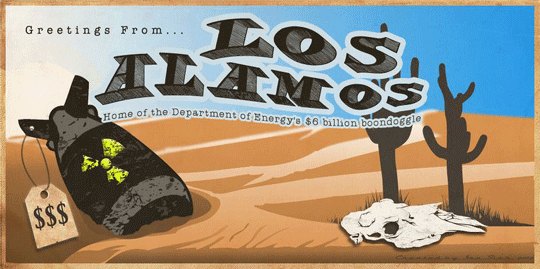
Chronology of major incidents marking Los Alamos National Laboratory’s management history, Local News, Santa Fe, New Mexico , 4 Jan 16 The New Mexican
Jan. 1, 1943: A secret national laboratory is set up in Los Alamos to design a nuclear bomb during World War II. The University of California is named the official lab manager and is paid $5 million for a one-year contract. The U.S. Department of Energy oversees the lab’s operations. J. Robert Oppenheimer is the lab’s director.
1945: An atomic bomb is tested at the Trinity Site in Southern New Mexico on July 16, ushering in the nuclear age………
1988: A new federal law gives the Department of Energy more leverage over lab contractors. The University of California at Los Alamos National Laboratory is exempted from the law. Continue reading
Nuclear sub accident costs $1m, commander loses job
Down periscope: Nuclear sub accident costs $1m, commander loses job Rt.com 5 Jan, 2016 A US Navy commander has lost his job following an accident that damaged a 18,000-ton nuclear guided-missile submarine. The banged-up sub will cost taxpayers at least $1 million to repair, the Navy said.
Captain Dave Adams was relieved of his command of the USS Georgia on Monday, and was reassigned to another post with Submarine Group 10 of Naval Submarine Base Kings Bay in Georgia.
On November 25, 2015, Adams was commanding one of the two alternating crews that operate the USS Georgia when the 560-foot submarine crashed into a channel buoy on its way back to base in Kings Bay……https://www.rt.com/usa/328018-navy-submarine-crash-georgia/
Toronto anxious about city’s unreadiness for a nuclear emergency.
Is Toronto ready for a nuclear radiation emergency? http://www.metronews.ca/news/toronto/2016/01/05/is-toronto-ready-for-a-nuclear-radiation-emergency.html
As KI pill orders skyrocket, critics say Ontario’s nuclear emergency response plan desperately needs a post-Fukushima update. By: Torstar News Service, Published on Tue Jan 05 2016. For 44 years, the Pickering Nuclear Generating Station has operated just five kilometres from Toronto’s eastern edge. The Darlington Nuclear Generating Station sits just over 30 km away. While these plants are essential for keeping the lights on in Toronto, councillors are only just beginning to question the city’s readiness for a nuclear emergency.
On Dec. 1, the city’s executive committee asked the city manager to report back on issues with the Provincial Nuclear Emergency Response Plan, Toronto’s own nuclear emergency response protocols and whether it might be appropriate to expand distribution of potassium iodide (KI) pills beyond the current 10-km radius.
In October, Ontario Power Generation (OPG), which operates both Pickering and Darlington, mailed KI pills — which, taken in the aftermath of a nuclear disaster, can reduce the risk of thyroid cancer — to 200,000 homes and businesses within 10 km of the GTA’s two nuclear power plants.
Anyone living within 50 km of the two plants — an area inhabited by more than 4.5 million people, including the entire city of Toronto — can order them free from preparetobesafe.ca. While just over 600 orders had been placed before a Nov. 10 Torstar News Service story on KI pills, nearly 11,000 additional orders were made by Nov. 15.
“Lessons can be learned from nuclear tragedies in other parts of the world, lessons that can better prepare us and ensure the safety of Toronto residents,” 11 city councillors wrote in their nuclear safety agenda item. “We can also learn from international best practices that shape the emergency response of other regions to ensure we are doing all we can to keep our residents safe.”
Outside city hall, critics are also arguing that the response plan needs to be updated — something the province promised to do after a reactor disaster struck Fukushima, Japan, following a catastrophic tsunami nearly five years ago. Originally drafted in the early 1980s, the provincial response plan hasn’t been revised since 2009.
“Significant work has been done in the past two years related to reviewing and assessing” the response plan, a Ministry of Community Safety and Correctional Services (MCSCS) spokesperson told Torstar. “The objective of this review is to ensure that the PNERP is reflective of a severe, multi-unit nuclear accident comparable to Fukushima.”
The review is expected to be completed this month, with public consultations on a draft plan to begin mid-year. The province would not disclose the details of this new plan.
Although the aging Pickering plant is slated to close in 2020, the multibillion-dollar refurbishing project will extend Darlington’s life by three decades. To critics, a response plan update can’t come soon enough.
Critics on the top issues
Big release of radiation? Big shortcomings
“The province is not planning for an actual big terrible accident like Fukushima,” warns Theresa McClenaghan, executive director of the Canadian Environmental Law Association (CELA). “There’s no detailed planning, resourcing or testing for a big accident that has big emissions out to the atmosphere.”
The emergency plan is based on scenarios in which plant operators would be able to contain and control radioactive releases, McClenaghan says.
“They like to think that if something goes really wrong, they can still control events enough to hold onto any radioactive emissions from the plants for a period of time… But based on Fukushima and Chernobyl, you can’t count on something’s going wrong and everything else going right.
The province’s position:
“(I)n a recent study, the Canadian Nuclear Safety Commission (CNSC) determined that the PNERP would adequately and effectively address a Fukushima type incident.”
Drinking water dangers
“Millions of people get their drinking water from Lake Ontario, but there’s no credible plan on how to deal with tap water contamination in the event of a nuclear accident,” says Greenpeace Canada’s senior nuclear analyst, Shawn- Patrick Stensil.
Both the Darlington and Pickering nuclear power plants sit next to Lake Ontario, and so do three aging nuclear power plants in upstate New York. According to environmental advocacy group Lake Ontario Waterkeeper, nine million Canadians and Americans rely on the lake for their drinking water. Many would be without alterative sources in the event of severe radioactive contamination.
“There’s no planning for this at all,” McClenaghan says. “I have to conclude that they’re assuming that dilution will be the answer.”
The province’s position:
“The PNERP identifies that the Ministry of the Environment (MOE) is responsible for dealing with contaminated water supplies.”
Lack of public awareness
According to a recent poll of 500 people within 10 km of the Darlington Nuclear Generating Station, a majority was unaware of decontamination procedures, the location of monitoring stations or emergency shelters or evacuation plans and routes. Some 80 per cent said they had no emergency plan; 58 per cent admitted to being totally unprepared.
“The polling our group did… shows that there needs to be ongoing and consistent education on what people in the GTA need to do to prepare themselves for a nuclear emergency,” says Durham Nuclear Awareness co-ordinator Janet McNeill.
urham Region is also listed as one of the areas slated for dense growth in the province’s Places to Grow plan.
“They are still putting additional population density in this region, which to me is just an appalling circumstance when we have such poor emergency planning,” McClenaghan adds.
The province’s position:
“The evacuation zones were scientifically determined.”
Expand KI pill distribution
In October, residents and businesses within 10 km of the Pickering and Darlington plants received free supplies of potassium iodide (KI) pills to help prevent thyroid cancer in the event of a radioactive release. While this measure is welcome, it lags behind other jurisdictions.
For example, those within 20 km of New Brunswick’s Point Lepreau Nuclear Generating Station receive pills, while people living within 50 km of Switzerland’s four nuclear power plants get them. On Dec. 1, Toronto’s executive committee voted to study whether the 10-km zone should be expanded to 50 km.
“Even if you did 30-km pre-distribution to every household and 50-km pre-distribution to vulnerable communities and schools, we’d still be far better off than we are today,” McClenaghan says.
The province’s position:
“The current planning basis review is addressing this as well.”
Documents reveal sloppy unsafe radiation management at San Onofre Nuclear Station
“My general impression from what I have seen in that report is San Onofre was very very sloppy, very very careless in handling radioactive material,” he told NBC 7 Investigates. “You basically had hundreds of pieces of contaminated equipment.”
The radiation levels around the concrete cubicle were so elevated “the inspector did not perform a survey inside,” according to the document
 Documents Detail How Nuclear Material Was Handled at San Onofre Nuclear Generating Station, 7 San Diego
Expert tells NBC 7 Investigates handling of nuclear material was “sloppy”
By JW August and Lynn Walsh Documents newly obtained by NBC 7 Investigates during secret talks about the condition of the land where the San Onofre Nuclear Generating Station (SONGS) sits detail how nuclear material was handled at the plant since the 1980s.
The documents were released to individuals involved with the secret negotiations about the current condition and future handling of the 25-acre property. According to a source familiar with the negotiations, the secret meetings have been going on for about 20 months and involve all the players with a stake in the prime coastal property.
Those players include the U.S. Navy, which owns the property; the U.S. Marines, whose base surrounds the property; and Southern California Edison (SCE) and San Diego Gas and Electric (SDG&E), both of which hold the lease to the property. Continue reading
A nuclear expert has serious concerns about safety, in South Africa’s nuclear project
 Serious Nuclear oversight concerns, News 24, Desmund Bernardo , 3 Jan 16 I started my career within the South African Nuclear industry at Koeberg Nuclear Power Station in 1992. The country was going through a serious transition at the time that brought with it excitement as well as trepidation. I had a bright future ahead of me with continuous growth and opportunity. ………
I now ask myself if the NNR is in itself, as an independent government body, skilled enough and have the qualified staff to license current and future licensed staff at Koeberg and future Nuclear Power stations?
To answer this question I had to use common sense and world-best practice. In the USA the NRC is their equivalent of the South African National Nuclear regulator. Within the NRC you find experts and highly skilled professionals that have reached the highest echelons of the American Nuclear industry. These people are accomplished and the Licensees in the industry treat them with utmost respect. The people that oversee and administer exams have at some stage also received a license to manipulate reactor controls. They know what to look out for…….
Today however the invaluable industry experience is sorely lacking within the NNR. Most of the staff in the NNR has never worked within the Nuclear industry at all. Very few have spent time at a Nuclear Power station never mind holding a license to operate from a control room……
Is the Government honest with us when they say that SA is ready to build more Nuclear power stations? Do the Government and the NNR understand their true duty to public safety? Can the President of South Africa assure the public that the employees within the NNR are capable and skilled? Can the NNR assure the public that they will ensure their safety as a watch-dog?
If you are concerned about the oversight issues in the Nuclear industry, the nuclear new build public participation process is a great opportunity for you to raise your concerns and hold the government accountable. Make your voice heard. http://www.news24.com/MyNews24/serious-nuclear-oversight-concerns-20160103
Rain-sodium reaction caused fire in nuclear waste dump
 Beatty waste dump fire blamed on rain-sodium reaction By Wesley Juhl Las Vegas Review-Journal, December 31, 2015
 A fire at a low-level radioactive waste dump in Nye County that shut down a 140-mile stretch of Nevada’s main north-south highway for almost 24 hours in October was caused by rainfall that seeped through a compromised cover and reacted with metallic sodium, according to a report released Thursday.
On Oct. 18, during heavy rainfall, the now-closed, state-owned landfill at the US Ecology dump near Beatty roared to life with explosions and fire. Beatty is about 115 miles northwest of Las Vegas, off of U.S. Highway 95.
A state probe of the incident was launched to consider if the fire was related to the wet weather, and if disposal records kept by the state in Carson City and at the site list any materials that could have reacted with water to cause the fire. Monday’s report details how corrosion of the steel drums containing the metallic sodium allowed the packing fluid to seep out, leaving the metallic sodium exposed to underground elements.
The 305-page report released Thursday collects statements from staffers who were there, aerial maps, results of laboratory analyses and a 195-page study on low-level radioactive waste management from 1981 as an attachment……..
Recommendations for long-term fixes from the Nevada Division of Environmental Protection include setting up enhanced monitoring of the waste facility capable of handling remote video surveillance and radioactivity measurement. The agency suggested an evaluation of the various types of wastes placed in the site and a redesign of a more protective cover cap…….. http://www.reviewjournal.com/news/nevada/beatty-waste-dump-fire-blamed-rain-sodium-reaction
Underground wall ordered by EPA to prevent fire reaching nuclear waste landfill in Bridgestone
EPA orders barrier for nuclear waste landfill in Bridgestone http://www.bignewsnetwork.com/news/239881975/epa-orders-barrier-for-nuclear-waste-landfill-in-bridgestone Big News Network.comThursday 31st December, 2015 LENEXA, Kansas – The US Environmental Protection Agency (EPA) has ordered the installation of a physical isolation barrier separating the radioactively contaminated West Lake Landfill Superfund Site from the smoldering Bridgeton Landfill to make sure that the underground fire does not reach the buried nuclear waste.
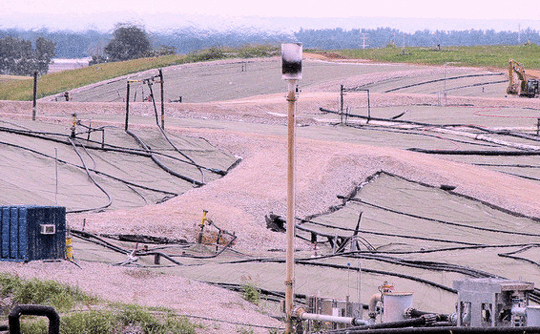
The barrier will consist of an underground wall. The decision also calls for the installation of additional engineering controls, such as cooling loops, to prevent potential impacts that could result if the subsurface smoldering were to come into contact with the radioactive materialscontained in the West Lake Landfill, Mark Hague, EPA regional administrator, said Thursday.
For years landfill owner Republic Services and state and federal regulators have considered a subterranean firebreak separating the smoldering Bridgeton Landfill from the adjacent West Lake Landfill, just a few hundred feet away.
But uncertainty over the location and extent of West Lake’s radioactive contamination has prompted more studies of West Lake, contaminated in 1973 with nuclear weapons processing waste from the Manhattan Project .
Now, EPA says those assessments, conducted with assistance from the US Army Corps of Engineers, are nearly complete. “We now have a better understanding of where those materials are located,” EPA spokeswoman Angela Brees said. “We’re at a point now where we had enough data where we needed to make a decision about a wall.”
The latest report on the radioactive contamination’s location is under final review and will be released soon, she said.
The worrying part is that the underground fire is now within 1,200 feet from the West Lake landfill.
“Finding a solution to mitigate the potential impacts of a subsurface smoldering event is a top priority for the community, and a top priority for EPA,” said Hague. “Today’s announcement is the first step in moving forward with the installation of a physical barrier and other engineering controls to address this issue.”
“We are now working through the highly complex details of implementing our decision and the associated legal steps. Once the plan is finalized, we are committed to providing this information to the public.”
The work of creating an underground barrier will be paid for by Republic Services, owner of both landfills. A spokesman for Republic Services said the company is ready to proceed with the barrier installation work. The company insists there is no risk of the fire reaching the nuclear material, but environmentalists disagree.
Ed Smith of the Missouri Coalition for the Environment said the barrier is not enough. “The only way to ensure a smoldering or surface fire doesn’t impact the radioactive wastes is to remove them,” Smith said, reported abc News.
West Lake was declared a Superfund site in 1990. In 2008, the EPA announced a remediation plan to cap the nuclear waste with rock, clay and soil. Opposition from the environmentalists however forced that the EPA to reconsider its decision.
No new plan has been worked out despite criticism from some lawmakers and residents who feel the agency is moving too slowly.
Japan’s Nuclear Regulation Authority is by no means confident of nuclear energy safety
No endorsement of nuclear safety, Japan Times, DEC 30, 2015 Power companies and the government should not be under the illusion that the safety of nuclear power plants under the new standards of the Nuclear Regulation Authority has been endorsed by the judiciary. While last week’s decision by the Fukui District Court paves the way for Kansai Electric Power Co. to restart reactors No. 3 and 4 at its Takahama Nuclear Power Plant as early as next month, the court urged the utility and the NRA to make constant efforts to aim higher for safety in the operation of nuclear plants.
The Fukui court reversed the decision given by the same court eight months ago under a different judge, who has since been transferred to another court. In April, the court ordered an injunction banning the restart of the Takahama plant on the Sea of Japan coast in Fukui Prefecture on the grounds that the NRA’s plant safety regulations, tightened after the Tepco plant meltdowns to make nuclear power plants resilient against bigger quakes and tsunami as well as severe accidents, were too lax to secure the plant’s safety. If the logic behind the decision was to be upheld, it would have dealt a crushing blow to the restart bid by the power industry and the administration because it negates the validity of the NRA regulation itself.
In its Dec. 24 decision on a complaint filed by Kepco against the April decision, the Fukui court said the NRA’s regulations are based on the latest scientific and technological knowledge and therefore rational. There’s nothing irrational in the NRA’s approval of Kepco’s plans to restart the Takahama plant, the court said in lifting the ban on reactivating the reactors that have cleared the NRA’s safety screening.
The two opposite decisions by the same court appear to symbolize the shakiness of legal judgments on the safety of nuclear power plant operation just four years after the nation experienced the world’s worst nuclear disaster since Chernobyl. Residents in areas around the Takahama plant who sought the injunction banning its restart plan to take the case to a higher court, but Kepco, which started loading nuclear fuel to the No. 3 Takahama reactor the day after the court decision, is ready to reactivate it as early as next month……..
public concern over the safety of nuclear power remains strong. ………In lifting the ban on the Takahama plant’s restart, the Fukui court urged the utility, the national and local governments involved to take multi-layered measures to protect against severe accidents at nuclear power plants, including more effective evacuation plans. The court decision should serve as a reminder that merely clearing the NRA standard does not vouch for the safety of a nuclear power plant. http://www.japantimes.co.jp/opinion/2015/12/30/editorials/no-endorsement-nuclear-safety/#.VoWP0LZ97Gh
1 This Month
26 September – International Day for the Total Elimination of Nuclear Weapons





PLEASE OPPOSE HR 8255 AND S.3639 – bills would accelerate satellite deployment, with no environmental review or safeguards – https://ncstd5li.quorum.us/campaign/169331/
To see nuclear-related stories in greater depth and intensity – go to https://nuclearinformation.wordpress.com
-
Archives
- September 2026 (313)
- August 2026 (330)
- July 2026 (355)
- June 2026 (287)
- May 2026 (306)
- April 2026 (356)
- March 2026 (251)
- February 2026 (267)
- January 2026 (308)
- December 2025 (358)
- November 2025 (359)
- October 2025 (375)
-
Categories
- 1
- 1 NUCLEAR ISSUES
- business and costs
- climate change
- culture and arts
- ENERGY
- environment
- health
- history
- indigenous issues
- Legal
- marketing of nuclear
- media
- opposition to nuclear
- PERSONAL STORIES
- politics
- politics international
- Religion and ethics
- safety
- secrets,lies and civil liberties
- spinbuster
- technology
- Uranium
- wastes
- weapons and war
- Women
- 2 WORLD
- ACTION
- AFRICA
- Atrocities
- AUSTRALIA
- Christina's notes
- Christina's themes
- culture and arts
- Events
- Fuk 2022
- Fuk 2023
- Fukushima 2017
- Fukushima 2018
- fukushima 2019
- Fukushima 2020
- Fukushima 2021
- general
- global warming
- Humour (God we need it)
- Nuclear
- RARE EARTHS
- Reference
- resources – print
- Resources -audiovicual
- Weekly Newsletter
- World
- World Nuclear
- YouTube
-
RSS
Entries RSS
Comments RSS

