Britain axes nuclear protective jobs: who will guard Hinkley IF it goes ahead

 If the nuclear button is finally pressed on Hinkley, who will guard the site? Independent, 29 Jan 16 Parliamentary Business “……..It seems astonishing now but Hinkley Point’s French owner vowed that the new plant – Hinkley’s third since “A” opened in the 1960s – would be built and generating 7 per cent of the UK’s electricity needs by Christmas next year. EDF Energy’s UK boss, Vincent de Rivaz, made that promise in 2007, before the timetable slipped back first to 2019 and then to 2025.
The last completed British nuclear station was Sizewell B in Suffolk, which opened in 1995, while older plants have stopped generating electricity or are preparing for decommissioning. Hinkley C is supposed to be the catalyst for a new fleet of reactors across the UK. ……
Despite the problems, it was still a bit of a shock to see EDF’s board delay a meeting this week in which directors would have made what has been coined a “final investment decision” on the project. After all these years, EDF still doesn’t seem to be fully confident that billions of pounds of investment is worth the risk, and has delayed a decision for at least a month.
…….Mr Lewis took the opportunity to put the boot into George Osborne, saying: “The Chancellor promised he would protect the police but now we know they need to be protected from his cuts. Hundreds of the front-line officers who protect sensitive nuclear power stations and radioactive materials are facing the axe, even though these are top terrorist targets.”
……….. we should be training more of these specialist officers before these new reactors are built. As the CNC puts it, this is “a unique force with a unique role”. Instead, we seem happy to lose 16.35 per cent of those few who know how to protect nuclear sites. ……..http://www.independent.co.uk/news/business/comment/if-the-nuclear-button-is-finally-pressed-on-hinkley-who-will-guard-the-site-a6840836.html
Fatal rockfall at planned French repository site
World Nuclear News 26 January 2016 One person was killed and another injured today by a tunnel collapse within an underground laboratory operated by French waste management agency Andra. The laboratory, near Bure in the Meuse/Haute Marne area, is assessing the site for its suitability to house a national radioactive waste repository.
According to an Andra statement, the working face of the gallery within the laboratory collapsed at 12.20pm. Geophysical surveys were being carried out at the time and the rockfall is believed to have happened as drilling was taking place. The gallery has now been evacuated and its stability is being assessed……. http://www.world-nuclear-news.org/RS-Fatal-landslide-at-planned-French-repository-site-2601165.html
Safety concerns cause China to halt construction of two nuclear reactors
 China admits nuclear emergency response ‘inadequate’ as safety concerns halt construction of two Guangdong reactors, South China Morning Post, Wednesday, 27 January, 2016, Stephen Chen China admitted on Wednesday its nuclear emergency response mechanism is “inadequate” for coping with “new situations and challenges” arising from its nuclear power plants.
The central government also said it had halted construction of two new-generation nuclear reactors in Guangdong province, because of safety concerns, but vowed that they would not be abandoned……..
Concerns over nuclear safety in Hong Kong and Macau have caught particular attention of the central government. A section in the white paper was dedicated to the issue with promise to “answer public concerns in time” and “clear the doubts”.
Xu Dazhe, chairman of the China Atomic Energy Authority, told a press conference on Wednesday that the construction of the two European Pressurised Reactors in Taishan, in Guangdong, had been delayed owing to safety concerns…….
State-owned nuclear companies are also trying to sell their technology and reactors to other countries, including Britain, while considering controversial projects such as building a floating nuclear power plant in the South China Sea to provide remote islands in disputed waters. http://www.scmp.com/news/china/policies-politics/article/1906287/china-admits-nuclear-emergency-response-inadequate
The danger of transporting plutonium
 Too much of a bad thing? World awash with waste plutonium http://www.theecologist.org/News/news_round_up/2986959/too_much_of_a_bad_thing_world_awash_with_waste_plutonium.html Paul Brown 24th January 2016
As worldwide stocks of plutonium increase, lightly-armed British ships are about to carry an initial 330kg of the nuclear bomb metal for ‘safekeeping’ in the US, writes Paul Brown. But it’s only the tip of a global ‘plutonium mountain’ of hundreds of tonnes nuclear power’s most hazardous waste product.
Two armed ships set off from the northwest of England this week to sail round the world to Japan on a secretive and controversial mission to collect a consignment of plutonium and transport it to the US.
The cargo of plutonium, once the most sought-after and valuable substance in the world, is one of a number of ever-growing stockpiles that are becoming an increasing financial and security embarrassment to the countries that own them.
So far, there is no commercially viable use for this toxic metal, and there is increasing fear that plutonium could fall into the hands of terrorists, or that governments could be tempted to use it to join the nuclear arms race.

All the plans to use plutonium for peaceful purposes in fast breeder and commercial reactors have so far failed to keep pace with the amounts of this highly dangerous radioactive metal being produced by the countries that run uranium-fulled nuclear power stations.
The small amounts of plutonium that have been used in conventional and fast breeder reactors have produced very little electricity – at startlingly high costs.
Japan, with its 47-ton stockpile, is among the countries that once hoped to turn their plutonium into a power source, but various attempts have failed. The government, which has a firm policy of using it only for peaceful purposes, has nonetheless come under pressure to keep it out of harm’s way. Hence, the current plan to ship it to the US.
Altogether, 15 countries across the world have stockpiles. They include North Korea, which intends to turn it into nuclear weapons.
UK’s Plutonium represents a massive cost – but no balance sheet liability recorded
The UK has the largest pile, with 140 tons held at Sellafield in north-west England, whereplutonium has been produced at the site’s nuclear power plant since the 1950s, also using spent fuel from civilian nuclear plants such as Hinkley Point and Calder Hall. The government has yet to come up with a policy on what to do with it – and, meanwhile, the costs of keeping it under armed guard continue to rise.
Like most countries, the UK cannot decide whether it has an asset or a liability. The plutonium does not appear on any balance sheet, and the huge costs of storing it safely – to avoid it going critical and causing a meltdown – and guarding it against terrorists are not shown as a cost of nuclear power.
This enables the industry to claim that nuclear is an attractive and clean energy-producing option to help combat climate change.
The two ships that set off from the English port of Barrow-in-Furness this week are the Pacific Egret and Pacific Heron, nuclear fuel carriers fitted with naval cannon on deck. They are operated by Pacific Nuclear Transport Ltd, which ultimately is owned by the British government.
The presence on both ships of a heavily-armed security squad – provided by the Civil Nuclear Constabulary’s Strategic Escort Group – and the earlier loading of stores and the craning on board of live ammunition point to a long, security-conscious voyage ahead.
Sent to the US for safekeeping
The shipment of plutonium from Japan to the US falls under the US-led Global Threat Reduction Initiative (GTRI), or Material Management & Minimisation (M3) programme, whereby weapons-useable material such as plutonium and highly-enriched uranium (HEU) is removed from facilities worldwide for safekeeping in the US.
The cargo to be loaded onto the two UK ships in Japan consists of some 331kg of plutonium from Japan’s Tokai Research Establishment.
This plutonium – a substantial fraction of which was supplied to Japan by the UK decades ago for ‘experimental purposes’ in Tokai’s Fast Critical Assembly (FCA) facility – is described by the US Department of Energy (DOE) as “posing a potential threat to national security, being susceptible to use in an improvised nuclear device, and presenting a high risk of theft or diversion”. Or, as another US expert put it, “sufficient to make up to 40 nuclear bombs”.
Under the US-led programme, the plutonium will be transported from Japan to the US port of Charleston and onwards to the Savannah River site in South Carolina.
Tom Clements, director of the public interest group Savannah River Site Watch, has condemned this import of plutonium as a material that will simply be stranded at the site, with no clear disposition path out of South Carolina. He sees it as further evidence that Savannah River is being used as a dumping ground for an extensive range of international nuclear waste.
Prime terrorist material’ at risk
The British group Cumbrians Opposed to a Radioactive Environment (CORE) has for decades tracked the transport of nuclear materials round the world.
Their spokesman, Martin Forwood, said: “The practice of shipping this plutonium to the US as a safeguard is completely undermined by deliberately exposing this prime terrorist material to a lengthy sea transport, during which it will face everyday maritime risks and targeting by those with hostile intentions.
“We see this as wholly unnecessary and a significant security threat in today’s volatile and unpredictable world.” The best option, CORE believes, would have been to leave it where it was, under guard.
From DOE documents, this shipment will be the first of a number of planned shipments for what is referred to as ‘Gap Material Plutonium‘ – weapons-useable materials that are not covered under other US or Russian programmes.
In total, the DOE plans to import up to 900kg of ‘at risk’ plutonium – currently held in seven countries – via 12 shipments over seven years. Other materials include stocks of HEU – the most highly enriched plutonium (to 93%), also being supplied to Japan by the UK.
The voyage from Barrow to Japan takes about six weeks, and a further seven weeks from Japan to Savannah River – use of the Panama Canal having been ruled out by the DOE in its documents on the shipment. Previously, the countries near the canal have objected to nuclear transport in their territorial waters.
Dangerous situation in Los Angeles gas crater

 LA gas well has ‘destabilized’, large crater develops in area — Officials: “Could be catastrophic” — TV: Risk of massive fire, possible explosion — Expert: “If wellhead fails, the thing is just going to be full blast… a horrible, horrible problem” — Company refuses to provide photos or media access (VIDEO) http://enenews.com/la-gas-destabilized-officials-could-be-catastrophic-tv-experts-highly-flammable-gas-creating-risk-massive-fire-explosion-professor-wellhead-fails-going-be-full-blast-itll-be-horrible-horrible-pr?utm_source=feedburner&utm_medium=email&utm_campaign=Feed%3A+ENENews+%28Energy+News%29
Los Angeles Times, Jan 15, 2016 (emphasis added): Efforts to plug Porter Ranch-area gas leakworsened blowout risk, regulators say — Southern California Gas Co… is trying to avoid a blowout, which state regulators said is now a significant concern after a seventh attempt to plug the well created more precarious conditions at the site. If a blowout occurs, highly flammable gas would vent directly up through the well… rather than dissipating as it does now… State officials said a blowout would increase the amount of leaked gas… That natural gas also creates the risk of a massive fire… The risk of fire already is so high that cellphones and watches are banned from the site… [The gas company’s attempts to stop the leak] expanded a crater around the wellhead, state and gas company officials said. The crater is now 25 feet deep, 80 feet long and 30 feet wide, those officials said… [The gas company] declined repeated requests from The Times… The gascompany would not provide current photos of the site or allow media access… In one internal state report obtained by The Times, an agencyofficial described [one] kill effort as a “blowout to surface.” “A large column of gas, aerated mud, and rock formed a geyseraround the wellhead,” the state observer wrote.
Scott McGurk, senior oil and gas field regulator assigned to daily watch at Aliso Canyon, Jan 15, 2016: The site and wellhead were made more unstable by the gas company’s attempts to stop the leak by pumping a slurry directly into the well… The wellhead sits exposed within the cavernous space, held in place with cables attached after it wobbled during the plugging attempt… During one of [the plugging] attempts Nov. 13, a hole in the ground opened 20 feet north of the well… Gas that had seeped through diffuse rock fissures on the western side of the narrow ridge began streaming instead from the new vent… the vent allowed a “serious amount of gas” to escape.
Gene Nelson, a physical sciences professor at Cuesta College, Jan 15, 2016: “If the wellhead fails, the thing is just going to be full blast… It will be a horrible, horrible problem. The leak rates would go way up.”
Don Drysdale, California Department of Conservation spokesman, Jan 15, 2016: Thepossibility of fire [is] “a concern” even without a blowout.
Los Angeles Times, Jan 16, 2016: [There’s] new evidence the [Puclic Utility Commission] is concerned that the compromised well site in Aliso Canyon is vulnerable to either a blowout… an explosion, or both… PUC includes a warning that damage to the well system, which was subjected to two months of aggressive high-pressure pumping to try to plug the leak, might now permit air to mix with methane in a way that “could be catastrophic.”… [T]he utility began a series of increasingly aggressive attempts to plug the well with heavy mud… those efforts instead scoured a 25-foot-deep crater around the well, blew out a large vent from which gas could escape more freely, and threatened the stability of the wellhead itself… The Department of Conservation says those facilities present “a direct and ongoing threat to public health, safety, and the environment”…
NPR, Jan 15, 2016: Adding to concerns over the disaster, efforts to stop the leak appear to have destabilized the well, the Los Angeles Times reports, raising the risk of a blowout… SoCalGas’ efforts to cap the well have actually increased the risk of a blowout. Seven attempts to plug the leak have made the area less stable… even without a blowout, the leak could catch on fire.
FOX LA transcript, Jan 16, 2016: “Trying to avoid a blowout, state regulators say it’s now a big concern after SoCalGas has tried to plug a leaking well near Porter Ranch seven times. If a blowout happens, experts say highly flammable gas would go up the well, creating a risk of a massive fire — possibly even an explosion.”
Watch FOX LA’s broadcast here (wait for 2nd video to play autonatically)
Japan’s nuclear regulator needs to strengthen inspections, says IAEA
 IAEA: Japan’s nuclear watchdog needs to strengthen inspections, staff competency http://www.japantoday.com/category/national/view/iaea-japans-nuclear-watchdog-needs-to-strengthen-inspections-staff-competency By Mari Yamaguchi JAN. 23, 2016 TOKYO —
Japan has improved its nuclear safety regulation since the 2011 Fukushima disaster, but it still needs to strengthen inspections and staff competency, a team of experts from the International Atomic Energy Agency said Friday.
It was the first IAEA review for Japan’s Nuclear Regulation Authority since it was established in 2012. Japan adopted stricter safety requirements for plant operators, but a law regulating on-site inspections remained mostly unchanged.
The 17-member team, which concluded a 12-day inspection that included the wrecked Fukushima plant, said the Nuclear Regulation Authority demonstrated independence and transparency — crucial elements lacking before the disaster, when an earlier agency was in charge.
The Fukushima Dai-ichi nuclear power plant was hit by a massive earthquake and tsunami in March 2011, triggering triple meltdowns. Government, parliamentary and private investigations have blamed complacency about safety, inadequate crisis management skills, a failure to keep up with international safety standards, and collusion between regulators and the nuclear industry.
The IAEA inspection team urged the Nuclear Regulation Authority to enhance inspection competence and the government to amend its nuclear safety law to make on-site safety checks more effective and flexible.
Mission leader Philippe Jamet, a French regulatory commissioner, said Japan’s inflexible inspection rules do not allow inspectors to move freely at nuclear facilities or respond quickly when there is a problem.
“What we found is that the system that is regulating, that is defining the framework of inspection is very complex and very rigid,” Jamet said at a news conference.
Japan has a comprehensive framework but “it doesn’t give enough freedom for the inspectors to react immediately and to provide results,” he said. “At any time and for any plant, inspectors should be allowed to go where they want.”
A final report by the team is expected in about three months.
Japan’s top nuclear commissioner, Shunichi Tanaka, acknowledged the shortcomings and said, “We have to focus on tackling the challenges of inspection system and human resources.”
Masakazu Shima, a Japanese regulator who assisted the inspection team, said the inspection issue was also raised by an earlier IAEA mission in 2007 but Japan never took action.
Canbada’s national security could be at risk in extending life of Pickering nuclear station
 Decisions at nuclear plant could compromise national security: safety commission, Global News, 20 Jan 16 By Monique Muise and Jacques Bourbeau
Ontario Power Generation Inc. was slapped with a $31,690 fine in a notice of violation issued on Jan. 12. The Canadian Nuclear Safety Commission states that on two occasions, the company “made unilateral decisions to cease corrective actions necessary for compliance with conditions of their Power Reactor Operating Licence” at the Pickering Nuclear Generating Station.
“If not corrected, this behavior could in the future result in unreasonable risks to national security, the health and safety of persons and the environment,” the notice says. “This (penalty) is issued to (Ontario Power Generation) to promote compliance with conditions of their licence and to deter reoccurrence.”……..
Nuclear power plants have always represented a potential security risk given the materials they contain, but in recent years it’s the risk of cyber-attacks that has governments concerned. Nuclear facilities are increasingly reliant on digital systems, which could potentially be hacked and – in a worst-case scenario – trigger a disaster……..
The notice was issued just one day after Ontario’s Liberal government announced that it wants to squeeze four more years of life out of the Pickering nuclear station. It will also start a $12.8 billion refurbishment of the Darlington power station this fall to extend that plant’s life by about 30 years.
Nuclear reactors at the stations were originally scheduled to be decommissioned in 2020. http://globalnews.ca/news/2466527/decisions-at-nuclear-plant-could-compromise-national-security-safety-commission/
Nuclear hazards extend beyond a nation’s borders: Belgium a case in point
 Belgium’s neighbors concerned about nuclear safety, DW 18 Jan 16 Germany, the Netherlands and Luxembourg are all concerned about the re-starting of Belgian nuclear reactors. The government there promises better communication, but seems to feel little urgency to act.
One and a half hours by car – that’s how long it takes to drive from the site of Belgium’s nuclear reactors at Tihange to neighboring Luxembourg. One and a half hours, or 160 kilometers (100 miles), that’s not enough to put the mind of Luxembourg’s state secretary for infrastructure at ease. Which is why Camille Gira, together with parliamentarians and nuclear safety and health experts, came to Brussels on Monday, to meet Belgium’s interior minister, Jan Jambon, for an “exchange of views.”
“We had a couple of questions concerning the safety of Tihange 2,” spokesman Olaf Münichsdorfer told DW, “and we wanted to remind our Belgian counterparts that our citizens are also at risk should there be a nuclear accident there.”
Cracks prompted temporary shut-down
The Tihange 2 reactor had been shut down since March, 2014, following the discovery of tiny cracks in the reactor’s pressure vessel. But in November 2015, the Belgian nuclear authority saw “no obstacle” to restarting the reactor, which became operational again at the end of December 2015.
A recent study commissioned by the Green party group in the European parliament, on the other hand, said the steel used in the pressure vessels was of such poor quality that – had this been known at the time of licensing- the reactor would never have been allowed to start operations. “How is it then possible to license the continuation of the power plants now that we are aware of all these problems,” wondered the Greens EU parliament co-president Rebecca Harms……….
Aside from raising worries in Luxembourg, re-starting the Tihange 2 reactor has sparked great concern in neighboring Germany. With the city of Aachen a mere 70 kilometers from Tihange, some 100,000 citizens in the region had signed a petition initiated by anti-nuclear activists to stop the reactor from going on the grid again – to no avail. Aachen’s authorities are set to brief the public about the current situation, as well as about emergency plans, later this month………
For their part, citizens in neighboring Netherlands are also worried about another nuclear site called Doel. Same as at the Tihange 2 reactor, tiny cracks have also been found at the Doel 3 reactor’s pressure vessel, causing it to be taken off the grid until its restart shortly before the end of the year.
Only a short while later, the plant was closed again for a few days, after a water leak.
The Doel site is also home to Belgium’s oldest reactor, Doel 1, which had been shut down in February 2015, following its 40th anniversary. But the government then decided to extend the lives of Doel 1 and Doel 2 by another 10 years.
Widespread concern has prompted the Dutch minister for infrastructure, Melanie Schultz, to schedule a visit to Doel this Wednesday, together with Belgian Interior Minister Jambon, accompanied by inspectors from the Dutch nuclear authority……….
In Belgium itself, the scientific council of the nuclear authority – known by the initials of its Flemish name, ‘FANC’ – last Friday issued a report proposing to revise existing nuclear emergency plans.
 One recommendation is to distribute iodine pills to the entire Belgian population. Current plans limit the distribution of such pills to people living within a 20-kilometer-radius of nuclear sites.
The scientific body also recommends extending the safety zone around nuclear sites. Then, people living within 20 instead of 10 kilometers from a nuclear site would have to remain in their homes for 24 hours, with doors and windows closed.Already in March, 2015, Belgium’s National Health Council (CSS) had recommended distributing at no cost iodine pills to people living within a radius of 100 kilometers of nuclear plants………
on the whole, the Belgian government seems rather unfazed by the security concerns raised by its neighbors.
According to Jan Vande Putte of Greenpeace Belgium, that has to do with the fact that Belgium’s main utilities provider, Electrabel, still has a strong influence over politicians, especially in the country’s French speaking region of Wallonia – an influence dating back to the times when the state-owned utilities provider was the only player in the country’s energy market.
“This influence has declined over the past years, but it’s still there,” says Vande Putte. And, he adds, there is another interdependency to take into account: that between the nuclear authority and the nuclear sector………http://www.dw.com/en/belgiums-neighbors-concerned-about-nuclear-safety/a-18987796
Stanford experts warn on the nuclear risks for Waste Isolation Pilot Plant in southeastern New Mexico.
“These accidents during the first 15 years of operation really illustrate the challenge of predicting the behavior of the repository over 10,000 years,”
The Stanford experts also suggest more attention to how the buried materials may interact with each other, particularly with salty brine, over centuries.
Buried nuclear waste risky, say Stanford experts http://news.independence-card.com/buried-nuclear-waste-risky-say-stanford-experts/ Stanford Report, January 15, 2016 Radioactive material from the laboratories that design America’s nuclear weapons will have to be buried and kept away from humans for at least 10,000 years. But three Stanford experts say the safety analysis of this project needs to be revised to reflect new strategies that aim to substantially increase the amounts of plutonium to be disposed of. By Dan Stober
The Department of Energy’s long-term plan for dealing with material contaminated with plutonium and heavier elements from the U.S. weapons program is to bury it underground at the Waste Isolation Pilot Plant in southeastern New Mexico.
The Energy Department’s plan aims to safeguard nuclear material for the next 10,000 years. But three Stanford nuclear scientists point out in a new commentary article in the journal Nature that the Waste Isolation Pilot Plant (WIPP) was not designed to hold as much plutonium as is now being considered for disposal there. And, in fact, the site has seen two accidents in recent years.
“These accidents during the first 15 years of operation really illustrate the challenge of predicting the behavior of the repository over 10,000 years,” said Rod Ewing, the Frank Stanton Professor in Nuclear Security at Stanford and a senior fellow at the Center for International Security and Cooperation.
What’s more, there’s more plutonium proposed for disposal at WIPP in the future, a result of treaties with the former Soviet Union and now Russia to decrease the number of nuclear weapons by dismantling them.
A recent assessment of what to do with the plutonium from dismantled weapons has proposed that the material be diluted and disposed of at WIPP. But this analysis does not include a revision of the safety analysis for the site, wrote Ewing and his two Stanford co-authors in the Department of Geological Sciences, postdoctoral scholar Cameron Tracy and graduate student Megan Dustin.
They call on the U.S. Department of Energy, which operates WIPP, to take another look at the safety assessment of the site. Particular emphasis should be on the estimates of drilling activity in the oil-rich Permian Basin, where WIPP is located, and on the effects of such a huge increase in the plutonium inventory for the pilot plant.
“The current regulatory period of 10,000 years is short relative to the 24,100-year half-life of plutonium-239, let alone that of its decay product, uranium-235, which has a half-life of 700 million years,” the researchers wrote.
“We cannot be certain that future inhabitants of the area will even know WIPP is there,” they added. As a result, it is important to understand the impact of future drilling in the area.
The waste is stored 2,150 feet below the surface in hundreds of thousands of plastic-lined steel drums in rooms carved out of a 250-million-year-old salt bed. The repository is at about half of its planned capacity and slated to be sealed in 2033.
The researchers question some of the assumptions used in the safety studies. For example, to determine the odds of oil drilling in the future, the study uses a 100-year historical average drill rate, even though drilling has intensified in recent decades, throwing this assumption into question.
The Stanford experts also suggest more attention to how the buried materials may interact with each other, particularly with salty brine, over centuries. A single storage drum may contain a variety of materials, such as lab coats, gloves and laboratory instruments; thus, the chemistry is complex.
Ewing said that the complacency that led to the accidents at WIPP can also occur in the safety analysis. Therefore, he advises, it is important to carefully review the safety analysis as new strategies for more plutonium disposal are considered.
Major disaster: radioactive material constantly being emitted from LA gas blowout
 Experts: Multiple types of radioactive material constantly being emitted from LA gas blowout — “I’d be running like hell” — “We are getting higher and higher levels…it’s accumulating” — “Poisons spreading through entire San Fernando Valley” home to 2 million people — “Thousands getting sick… it really is a major, major disaster” (AUDIO) http://enenews.com/experts-multiple-types-radioactive-material-being-continuously-emitted-la-gas-blowout-accumulating-getting-higher-higher-levels-poisons-all-moving-down-spreading-entire-san-fernando-valley-th?utm_source=feedburner&utm_medium=email&utm_campaign=Feed%3A+ENENews+%28Energy+News%29Follow up to: Radioactive material reportedly now being released from massive gas blowout in LA — Byproduct of Uranium — Expert: “A lot” has been detected… Very dangerous (VIDEO)
Interviews from Nuclear Hotseat hosted by Libbe HaLevy, Jan 13, 2016 (emphasis added):
Kevin Kamps, Beyond Nuclear’s nuclear waste watchdog (8:30 in): “Another important thing that is very significant is that the radon is continually resupplied… Radon is going to beconstantly generated by the uranium contained in the methane… So really you’ve got achronic constant supply of hazardous radon gas coming out of this breach in California.”
Cindy Folkers, Beyond Nuclear‘s expert on ionizing radiation (16:00 in): “I’m absolutely astounded that they are not measuring for radon that I know of… I can’t believe that they’re not measuring for radon… [Radon] also decays to a number of what are called radon progeny which includes a number of short-lived radioactive substances, some of which are lead and polonium. Both of those can be very biologically damaging… There is question as to the kind of doses that they would be getting of radon, but it still is really very much a worry… I feel like — doing the research that I’ve done — that we are not getting the full story of what’s happening there.”
Richard Mathews, candidate for California State Senate who studied physics & astronomy at CALTECH (32:00 in): “People are really concerned about this, people are seriously getting sick… Thousands of people are getting sick from this — and it really is a major, major disaster… Methane floats away and spreads around the whole world… All the contaminants that are in with the methane are heavier than the air and that includes… benzene and toluene, hydrogen sulfide — all of those are heavier than air — they tend to stay close to the ground and move downhill. This is happening in the hills above the San Fernando Valley [home to nearly 2 million people] and so the poisons are all moving down into the San Fernando Valley and spreading through the entire San Fernando Valley… As the radon and other substances flow around, they are accumulating. They are not easily blown out of the valley, and we are getting higher and higher levels… The lead is going to be around for decades… The initiallead that you get is radioactive. This will be a continuing problem… It could spread through the entire San Fernando Valley… The damage that the radon does stays in your body… andshows up as cancer a decade after, maybe even 80 years later. So we really need to follow through.”
Terry Lodge, attorney (50:00 in): “You have a massive release, probably, of radon going on — and there may actually also be radium particulate… I’d be taking very rapid steps [if I lived in the area], I’d be running like hell. And the reason is, I suspect that there’s little by way of emergency anticipation — what could possibly go wrong? We have this vast underground storage facility… There are not radiation monitors… the problem is sort of the Three Mile Island problem… the radiation emission went way off the meter… there were no redundant rings, there was no monitoring certain distances outside the plant boundary. You don’t even have that at Porter [Ranch]… They don’t know how much radon is being dispersed… [Radon] can be concentrated by rainfall, concentrated by humidity, and inversions… There needs to be some type of soil sampling… air, and all that… So the problem is that radon is around in the Porter Ranch situation — nobody’s prepared for it. They’re not talking about it now — this may months into the crisis.”
Cyber attack: Nuclear Threat Initiative finds 20 countries vulnerable
 20 Nations’ Nuclear Facilities Said to Be Vulnerable to Cyberattack, NYT By DAVID E. SANGER JAN. 14, 2016 WASHINGTON — Twenty nations with significant atomic stockpiles or nuclear power plants have no government regulations requiring minimal protection of those facilities against cyberattacks, according to a study by the Nuclear Threat Initiative.
The findings build on growing concerns that a cyberattack could be the easiest and most effective way to take over a nuclear power plant and sabotage it, or to disable defenses that are used to protect nuclear material from theft. The countries on the list include Argentina, China, Egypt, Israel, Mexico and North Korea.
The survey, by one of the nation’s leading nuclear nonproliferation watchdogs, was based on a nation-by-nation review of basic, publicly available data, and some of the countries may claim they have classified protections in place.
But the list is damning. The group looked, for example, at whether any cyberprotections are required by law or regulation at nuclear facilities, and whether cyberattacks are included in the assessments of potential threats to the security of those installations. One question asked whether there were mandated drills and tests to assess responses to a cyberassault, rather than just a physical attack on the facilities.
“Twenty countries failed on all the indicators,” said Page Stoutland, one of the authors of the report. Because of the secrecy surrounding military nuclear facilities, it was impossible to determine the levels of cyberprotection used to protect nuclear weapons in the nine countries known to possess them.
The report also concludes that President Obama’s global initiative to sweep up loose nuclear material, which will be the subject of his third and final nuclear security summit meeting this March, has slowed substantially…….
The Nuclear Threat Initiative, which publishes an annual index of nuclear security around the world, notes that a dozen countries have eliminated all weapons-usable nuclear materials since the summit meetings began. Many more have greatly improved the security surrounding lightly guarded materials, which are stored every place from hospitals to research reactors on university campuses.
But at the very moment that the black market in nuclear materials remains active, the report found that 24 nations still have more than 2.2 pounds of weapons-usable nuclear material, “much of it still too vulnerable to theft,” and many have just begun to think about their vulnerability to cyberthreats that could enable an attacker to sabotage a site without breaking through fences or risk setting off perimeter alarms.
The most famous cyberattack on a nuclear facility was done by the United States and Israel: the effort to destroy and disable nuclear centrifuges at the Natanz nuclear enrichment plant in Iran. That program, code-named Olympic Games, used a worm that was later named Stuxnet to knock the centrifuges out of operation. It did not release radioactive material into the atmosphere, but it was a vivid demonstration of the vulnerability of nuclear facilities to cyberattack. Iran had completely isolated the Natanz facility from the Internet, but the originators of the program found ways to insert it.
The lesson of Stuxnet, however, has apparently been lost on many nations that have yet to develop requirements that nuclear facilities have cyber protections in place before they can operate.
“Too many states require virtually no effective security measures at nuclear facilities to address the threat posed by hackers,” the study, in which the Economist Intelligence Unit also participated, concluded. Of the two dozen nations with weapons-usable material, nine got the maximum score for cyberindicators, and seven got a score of zero.
In 23 nations that possessed no weapons-usable materials, but had nuclear power plants or other nuclear facilities that contain fuel that could be converted to weapons use, 13 got a zero score.
More than 80 percent of all nuclear stockpiles are classified as military material, meaning they are largely used in weapons programs, and all of those are outside international security review, including the guidelines issued by the International Atomic Energy Agency for the protection of civilian nuclear stocks. http://www.nytimes.com/2016/01/15/world/nuclear-threat-initiative-cyberattack-study.html?_r=0
Global nuclear security system has major gaps – Nuclear Threat Initiative (NTI) Nuclear Security Index
 As Final Head-of-State Nuclear Security Summit Approaches, Nunn and NTI Warn of Slowing Progress on Preventing Nuclear Terrorism 2016 http://news.sys-con.com/node/3634523 NTI Nuclear Security Index finds countries unprepared for cyber attacks on nuclear facilities; introduces new “sabotage ranking” JANUARY 14, 2016 WASHINGTON, Jan. 14, 2016 /PRNewswire-USNewswire/ –– At a time of escalating threats and as world leaders prepare to gather for the final Nuclear Security Summit, the third edition of the Nuclear Threat Initiative (NTI) Nuclear Security Index finds that progress on reducing the threat of catastrophic nuclear terrorism has slowed and major gaps remain in the global nuclear security system. The 2016 NTI Index, which has become a critical resource and tool for assessing the security of the world’s deadliest materials, also finds troubling shortfalls in areas assessed for the first time: how well countries are protecting nuclear facilities against sabotage, as well as the emerging threat of cyber attacks. Continue reading
USA’s Nuclear Regulatory Commission at risk of being hacked
Nuclear commission risks being hacked because of organizational issues: watchdog report http://www.washingtontimes.com/news/2016/jan/13/nuclear-commission-risks-being-hacked-because-of-o/ By Andrew Blake – The Washington Times – Wednesday, January 13, 2016
Computer networks used by the U.S. Nuclear Regulatory Commissionpose a real possibility of being exploited by hackers as a result of inadequate organization among security personnel, a federal report found this week.
The NRC’s inspector general said in a 18-page assessment released on Tuesday that its Security Operations Center, or SOC, isn’t “optimized to protect the agency’s network in the current cyber threat environment.”
Weeks after new reports revealed that hackers had successfully compromised a hydroelectric dam in New York City in 2013, the government watchdog said the NRC’s unclassified computer networks risk being breached because the agency has failed to structure itself in a way that would ensure any unauthorized intrusions are handled appropriately.
NRC staffers told the inspector general that the SOC “does not meet agency needs” and singled out a lack of proactive analyses and timely, detailed reports that could otherwise provide the information necessary to keep its networks properly protected.
“There are no performance goals,” the watchdog found, meaning the NRCcannot possibly assess “whether agency needs are being met.”
More specifically, the report faulted “generic” contracts that have yielded “differing expectations” with respect to roles and responsibilities, as well as “inadequate definitions in agency policies and undifferentiated functional descriptions between different entities responsible for securing NRC’s network.”
“This occurs because although the contract performance criteria are aligned with National Institute of Standards and Technology and NRCinternal guidance, the contract does not clearly define SOC performance goals and metrics that can be used to determine whether agency needs are being met,” the inspector general concluded following a five-month audit of the NRC’s headquarters in Rockville, Maryland.
To keep the NRC’s unclassified networks safe from hackers, the agency must ensure that organizational roles and responsibilities are more clearly defined, the watchdog said.
In the meantime, the inspector general acknowledged in a footnote that the nuclear sector has not been spared from cyberattacks: While federal data has suggested a 9.7 percent surge between 2013 and 2014 with regards to computer security incidents across the board, the NRCexperienced an 18 percent increase in hack attacks during that same span, including instances in which hackers had attempted to gain unauthorized access through malicious code injections, social engineering, policy violations or other attempts.
“A dynamic cyber threat environment demands a high-performing SOC,” the inspector general wrote. “The sophistication and frequency of malicious activity targeting NRC has increased. These forces, combined with the need for NRC users to stay connected with stakeholders and partners through the Internet, make effective information security a critical capability.”
Dangers in transporting nuclear weapons through residential areas
 Fears voiced as nuclear weapons are transported through the Vale of Leven (incl video) Daily Record, 12 JAN 2016 BY MARTIN LAING A CONCERNED resident says movement of warheads in difficult driving conditions put lives at risk
CONCERN has been expressed for public safety after a nuclear convoy was filmed rumbling through residential areas of West Dunbartonshire.
Renton man Les Robertson shot video of the mult-vehicle convoy as it moved past the Co-Op store in Balloch and through the Vale of Leven on Saturday at tea time.
However, a spokesman for the Ministry of Defence denied there was any threat to public safety and said the police had been involved in helping to organise the movement of materials to the Clyde naval base at Faslane and Couplort.
Mr Robertson wrote to the Lennox Herald this week to highlight his fears that the transportation of live nuclear warheads through the area put lives at risk.
He said: “On Saturday, January 9, a nuclear warhead convoy, consisting of four warhead carriers and support vehicles, travelled through West Dunbartonshire on route to Coulport.
“Trident warheads are carried in large crates inside the large green trucks. They are fully assembled and complete. The core of the warhead is a ball of plutonium and uranium. This is surrounded by specially developed conventional high explosives which would be ignited to create the critical mass necessary for a nuclear detonation when launched and targeted.
“The Ministry of Defence says there is little risk of a nuclear detonation during transport but, in an accident, the highly volatile conventional explosive could be set off, causing the warhead to jet plutonium. It estimates that in a serious accident a circle some 550 metres in radius would be affected by blast and fragments of explosive.
“Given the terrible driving conditions on Saturday evening, the risk of an accident was heightened yet a convoy carrying its deadly cargo was allowed to travel close to a busy supermarket in Balloch and heavily populated housing schemes including the Haldane and Dalvait.”……… To view the video, go to www.lennoxherald.co.uk.
St Louis residents have no faith in Planned Barrier Between Fire, Nuclear Waste Dump
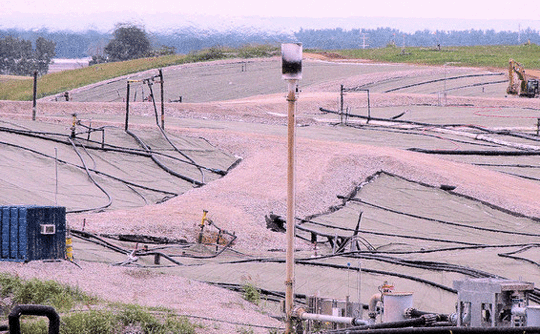 Residents Frustrated With Planned Barrier Between Fire, Nuclear Waste Dump In St. Louis http://www.ibtimes.com/residents-frustrated-planned-barrier-between-fire-nuclear-waste-dump-st-louis-2258034 BY ADAM LIDGETT @ADAMLIDGETT ON 01/09/16 While the U.S. Environmental Protection Agency plans to go ahead with the building of a firebreak between an underground fire and a nuclear-waste site in suburban St. Louis, area residents indicated they are frustrated by the situation, Al Jazeera reported Saturday. A number of them said the plan to construct the wall is not enough and that there should be a more-permanent solution to the problem.
“It’s looking more and more like removal is the only way to guarantee [a safe solution],” Dawn Chapman, who lives close to the waste site, told Al Jazeera. “Life’s over for [people] in this community. They can’t live where they are. They can’t enjoy it.’”
In 2010, an underground fire was detected in a landfill near St. Louis. It posed a pretty big problem in and of itself, but it was compounded by its proximity to another landfill containing Cold War-era nuclear material. The fire at the Bridgeton Landfill is smoldering only about 1,000 feet from tons of radioactive material in the West Lake Landfill, St. Louis Public Radio reported. A firebreak was proposed in 2013, but the EPA wanted then to conduct more tests to determine the amount of radioactive material at the site.
“The only way to guarantee the radioactive content will never come in contact with the subsurface fire in the future is to remove the radioactive material,” Ed Smith, a representative of the Missouri Coalition for the Environment, told Al Jazeera. “We’ve watched the EPA work on the barrier plan now for almost two years whereas they could have been planning for the removal of the radioactive waste.”
It’s unknown how much radioactive waste — dumped there in 1973 as residue of the Manhattan Project — is at the site. Some experts said the contamination could be unprecedented. “We are now working through the highly complex details of implementing our decision and the associated legal steps,” EPA Acting Regional Administrator Mark Hague said in a statement cited by St. Louis Public Radio. “Once the plan is finalized, we are committed to providing this information to the public. EPA will use all available enforcement authorities to ensure implementation of this work.”
1 This Month
26 September – International Day for the Total Elimination of Nuclear Weapons





PLEASE OPPOSE HR 8255 AND S.3639 – bills would accelerate satellite deployment, with no environmental review or safeguards – https://ncstd5li.quorum.us/campaign/169331/
To see nuclear-related stories in greater depth and intensity – go to https://nuclearinformation.wordpress.com
-
Archives
- September 2026 (313)
- August 2026 (330)
- July 2026 (355)
- June 2026 (287)
- May 2026 (306)
- April 2026 (356)
- March 2026 (251)
- February 2026 (267)
- January 2026 (308)
- December 2025 (358)
- November 2025 (359)
- October 2025 (375)
-
Categories
- 1
- 1 NUCLEAR ISSUES
- business and costs
- climate change
- culture and arts
- ENERGY
- environment
- health
- history
- indigenous issues
- Legal
- marketing of nuclear
- media
- opposition to nuclear
- PERSONAL STORIES
- politics
- politics international
- Religion and ethics
- safety
- secrets,lies and civil liberties
- spinbuster
- technology
- Uranium
- wastes
- weapons and war
- Women
- 2 WORLD
- ACTION
- AFRICA
- Atrocities
- AUSTRALIA
- Christina's notes
- Christina's themes
- culture and arts
- Events
- Fuk 2022
- Fuk 2023
- Fukushima 2017
- Fukushima 2018
- fukushima 2019
- Fukushima 2020
- Fukushima 2021
- general
- global warming
- Humour (God we need it)
- Nuclear
- RARE EARTHS
- Reference
- resources – print
- Resources -audiovicual
- Weekly Newsletter
- World
- World Nuclear
- YouTube
-
RSS
Entries RSS
Comments RSS

