Fire erupts within feet of USA radioactive trash dump

 CBS: Fire erupts at another U.S. nuclear site near major city — Witness: Flames within feet of radioactive waste — TV: “You can see the smoke for miles… A big-time scare” — EPA emergency response specialists deployed (PHOTO & VIDEOS) http://enenews.com/fire-another-nuclear-site-major-city-witness-flames-feet-radioactive-waste-tv-smoke-could-be-miles-epa-emergency-response-specialists-deployed-photo-videos?utm_source=feedburner&utm_medium=email&utm_campaign=Feed%3A+ENENews+%28Energy+News%29KTVI, Oct 24, 2015 (emphasis added): Brush fire at West Lake Landfill sparks concern —Smoke could be seen for miles as fire crews responded to a brush fire at the West Lake Landfill in Bridgeton Saturday… The fire was started by a faulty switch… inside the landfill’s perimeter. The switch overheated, causing hot metal to drop below and ignite a fire… Arearesidents and elected officials gathered near the scene of the fire Saturday to see if it would move into a restricted area where an underground fire is burning. Residents were concerned that the fire would reach area whereradioactive waste is buried…
KTVI Transcript, Oct 24, 2015: You can see the smoke for miles… A big-time scare for residents out there tonight… Dawn Chapman, resident: “This fire came within feet of it,within feet of radioactive waste“…
CBS News, Oct 27, 2015: No one knows for sure what will happen if the fire comes into contact with it… some low-level radiation has moved into neighborhoods… But it’s not just the underground fire that is a concern – this weekend a grass fire erupted within some 75 yards of the radioactive waste. This region also sits near an earthquake fault line.
AP, Oct 26, 2015: On Saturday, a fire blamed on a faulty utility pole ignited brush on the West Lake Landfill’s grounds… [EPA official Mark] Hague said testing showed no immediateevidence residents were in peril.
St Louis Public Radio, Oct 27, 2015: Stoking many fears was [a] brush fire at the Bridgeton Landfill… which was first called in to the fire department by a resident. Some took that as asign that the landfill’s owner, Republic Services, does not have an adequate handle on the site… [EPA] sent a letter reprimanding Republic Services for the incident.
St. Louis American, Oct 25, 2015: Saturday’s fire supposedly resulted from a malfunctioning electrical switch… EPA emergency response specialists were deployed to the site of the fire, according to the EPA’s statement. “Personnel will be in the field today taking samples from the surrounding area to confirm there is not a release of contaminants,” it stated… “Pattonville Fire District conducted air monitoring during the event.” The Missouri Department of Natural Resources (MDNR)… reviewed data from its monitors located near the landfills, “and the readings stayed consistent with background,” according to the EPA.
CBS St Louis, Oct 25, 2015: Missouri Attorney General Chris Koster [said] “the fire at the Bridgeton Landfill is ever changing”… Koster says Saturday’s fire is a reminder flames can surface in unexpected places without warning.
See report from earlier this month here: AP: Catastrophic event could release radioactive fallout over major U.S. metropolitan area — Gov’t issues emergency plan as fire burns near nuclear site — Senator: “What we have… could end up as Chernobyl” (VIDEO)
See last week’s reports from Las Vegas-area here: EPA data shows radiation spike in major US city soon after explosions at nuclear waste facility — AP: Drums of buried waste were blasted over site’s fence; Large crater reported (VIDEO)
China far from being nuclear industry hope, could be its nightmare
Just how safe is China anyway? Now if China had a fantastic record of safety in its construction and other industries, maybe the odds should be made a bit longer….
Cheap? Some scepticism is in order How do we know what these reactors really cost? The fact is, we don’t. With China’s nuclear corporations under the control of various organs of state including the Communist Party and the Peoples Liberation Army, official statistics and accounts can simply not be relied upon…..
Nuclear construction in China must be cheaper than in the US and Europe due to lower labour costs. But if it really is that much cheaper it can only be at a huge safety penalty……
Tsunami risk – not if but when…….
The only good news in all this is that nuclear construction in China is not proceeding anything like as fast as Forbes magazine claims. Most of the more modern ‘Generation III’ reactors are well behind in their completion times, echoing the European experience with the failed EPR design.
Fukuzilla? China’s nuclear boom threatens global catastrophe http://www.theecologist.org/blogs_and_comments/commentators/2986056/fukuzilla_chinas_nuclear_boom_threatens_global_catastrophe.html Oliver Tickell 28th October 2015

China’s plans for 400 nuclear reactors threaten global catastrophe, writes Oliver Tickell. In the normal way of things we could expect major accidents every few years, but with 300 reactors along China’s seismically active coast, a major tsunami would be a Fukushima on steroids – wiping out much of China and contaminating the whole planet. Continue reading
After explosions at nuclear waste facility, major USA cities record radiation spike
EPA data shows radiation spike in major US city soon after explosions at nuclear waste facility nearby — AP: Drums of buried waste were blasted over site’s fence; Large crater reported — Emergency Official: US gov’t brought in “resources I’ve never even seen before, it was amazing” (VIDEO) http://enenews.com/epa-data-shows-radiation-spike-major-city-after-explosions-nuclear-waste-facility-ap-drums-buried-waste-blasted-sites-fence-large-crater-reported-emergency-official-govt-brought-resources-ive-ne?utm_source=feedburner&utm_medium=email&utm_campaign=Feed%3A+ENENews+%28Energy+News%29
New York Times (AP), Oct 25, 2015 (emphasis added): Radioactive Dump That Burned in Nevada Had Past Troubles… State officials said this week they didn’t immediately know what blew up… A state fire inspector, Martin Azevedo, surveyed the site on Wednesday. His report, obtained Friday by The Associated Press, described moisture in the pit and “heavily corroded” 55-gallon drums in and around the 20-foot-by-30-foot crater. Debris from the blast spread 190 feet. Two drums were found outside the fence line… Nevada state emergency management chief Caleb Cage said operating records for the damaged trench…weren’t immediately available… [Former Nevada Governor Robert List] expressed doubt that anyone will ever know what’s really underground at the site. “Good luck with that,” he said. “What we found when we did our investigation was they had very, very skimpy records about what was there.”
Vance Payne, Director of Emergency Management for Nye County, Oct 20, 2015 Board of County Commissioners meeting (at 1:18:45 in): Our federal partners from DOE [US Dept. of Energy] put to bearresources I’ve never even seen before, it was amazing. The effort was nothing short of herculean. There was overflights of aircraft with special monitoring equipment that was put in the air just as fast as they were able — when the weather cleared a little bit — and they did it on the ground. The CST team, the Civil Support Team, came down from Reno and they came down in a hurry — it was amazing how fast they moved their teams. They did ground testing, they did mid-level aerial testing, and they did high-level area testing over the towns of Amargosa and Beatty — as well as the entire transportation line north to south on Highway 95 and 373. So I can tell you that No. 1, it was amazing. I can tell you that a lot of effort was put into making sure that our county and communities were as safe as we could probably make them. This morning we’re getting additional reports coming in, and they’ll continue to come in on the testing over the next few weeks. No radioactive materials were detected anywhere on the ground or in the air.
KTNV Las Vegas, Oct 19, 2015 (at 0:45 in): Preliminary air quality tests say the air is fine — but Nye County officials aren’t trusting just that — more extensive surveys are being done, and those results could take days.
Watch: KTNV | County Commission
South Africa’s Flawed Environmental Assessments for New Nuclear Build

 New nuke build: EIA problematic and flawed As South Africa contemplates building nuclear power stations along the coast, the Environmental Impact Assessment (EIA) consultants, GIBB, are holding public meetings to discuss their recently released draft report. The proposed nuclear builds are in Thyspunt (80 km outside Port Elizabeth) and Duynefontein (next to Koeberg, 30 km outside Cape Town).
“Thyspunt is the preferred site for Nuclear 1,” says Gary Koekemoer from NoPEnuke, “and no public meetings were scheduled for the Nelson Mandela Bay area thereby excluding 1.1-million citizens from this process. Further, it is our view that the current EIA process is fundamentally flawed with key information excluded.”
This EIA is the third draft published over eight years and was made available for scrutiny by GIBB consultants at the end of September. “The draft is a 40,000 page document and a quick count of words in the appendices making up the specialists’ reports alone showed that one would have to read around 90,000 words a day just to skim read it all before the public meetings were held,” says Peter Becker from the Koeberg Alert Alliance.
Widespread dissatisfaction has been expressed from many stakeholders around the limited time period allowed for public participation.
At the meetings, GIBB condensed their findings into a simplified scoring system for risks with ratings of Low, Moderate, High, or Fatally Flawed. “The scoring system is inadequate,” says Dr. Piet Human, project leader at the Bantamsklip Organisation. “The scores do not have a scientific or quantitative basis; what is ‘high’ for one may be ‘medium’ for another scientist. This subjectivity is then further compounded by the scores given by GIBBS.”
Becker describes a hypothetical scenario: “If the consultants found that there was a 51% chance that the new nuclear plant would explode catastrophically in the first year of operation, this would not result in a scoring of Fatally Flawed. Their recommendation in this case would be ‘Project can be authorised but with strict conditions and high levels of compliance and enforcement’.”
Bantamsklip was one of the three proposed nuclear sites alongside Thyspunt and Duynefontein but has now been excluded from this Nuclear 1 EIA. However, it remains a viable site for subsequent nuclear builds. A petition of over 10,000 signatures opposing the nuclear build was handed to the GIBB consultants at the Gansbaai meeting.
“We have only had time to look at one specialist report thus far,” continues Dr. Human, “and we reviewed the Social Impact Assessment which is problematic. The technical, scientific and professional credibility of the report is questionable as it uses outdated data, excludes HIV and Gender Related Issues (a new requirement for all large-scale EIA’s in South Africa), and does no comparative analysis of the three sites nor uses recent experiences with large projects such as Medupi.”
The biggest concerns of those in attendance at the meetings included the risk of a catastrophic nuclear accident and the evacuation plan, the environmental impact of radiation leaks into the sea, land or groundwater, the economic impact to the regions concerned owing to the negative perceptions of a nuclear facility in proximity to large-scale business concerns, costs (and the accompanying corruption), political instability and the risk of terrorism, and the massive problem of accumulating high level nuclear waste.
“The decision to build a nuclear plant must be taken with extreme care,” says Koekemoer. “We are concerned that in the gold rush of unsubstantiated promises of development and jobs we have been blinded to Thyspunt’s true value and potential as a significant local and global heritage area.
“Nuclear is not necessary,” he continues. “Renewables are making a significant contribution to our region. In our haste we are only servicing vested interests and it is a decision our grandchildren would shake their heads at.”
Becker concludes, “The GIBB consultants have a legal responsibility to put all the pertinent facts before the decision makers in a complete, unbiased and quantified way in the EIA report. Failing to do so can lead to criminal prosecution in their personal capacities.” There is concern from stakeholders that GIBB is trying to push through this flawed EIA with only token public participation.
The Sea Vista meeting for public participation in St Francis Bay will take place in early November, dates are not yet finalised. The Humansdorp meeting has been rescheduled due to public demand for more time needed and meetings in Nelson Mandela Bay have also been requested but are unconfirmed at this stage.
Submissions may be emailed to nuclear1@gibb.co.za. The full draft EIA report can be found at http://projects.gibb.co.za/en-us/projects/eskomnuclear1reviseddrafteirversion2 and more information can be found at koebergalert.org, bantamsklip.org andnoPEnuke.co.za.
Anxiety over transport of dangerous radioactive trash
both Nevada residents and a host of anti-nuclear groups in states along the likely routes have opposed the plan, saying a mistake is inevitable in the transport of so much fuel, estimated by the Tennessee Environmental Council at 20 tons to 50 tons of irradiated fuel in each canister.

 Radioactive waste could be transported through Chattanooga, anti-nuclear group says http://www.timesfreepress.com/news/local/story/2015/oct/27/radioactive-waste-could-be-transported-through-chattanooga-anti-nuclear-group-says/332775/ {incl maps) The Tennessee Environmental Council, an anti-nuclear watchdog group, says that Chattanooga is a likely waystation for the transport of nuclear waste on its way to Nevada.
A map released by the group shows that radioactive waste from 30 nuclear reactors would pass through Tennessee by rail, each shipment containing more radioactive material than the Hiroshima bomb blast.
Chattanooga would likely see shipments from the Sequoyah nuclear plant pass through on its way south and west, while fuel from the Watts Bar plant would likely be transported north. Other shipments coming from Georgia and beyond could be transported through Chattanooga on its way to Nashville.
Nashville would see far more traffic, the group said, with waste from 21 reactors in 6 states passing through the city’s Radnor Yard. Under a plan that has been in the works for many years, but that has faced stiff opposition from many groups, nuclear fuel that is piling up at plants across the nation would be transported to a more secure facility in Nevada, dubbed Yucca Mountain. The facility, which is buried deep underground, would offer a safer storage option for the dangerous waste, which remains radioactive for thousands of years, officials say.
But both Nevada residents and a host of anti-nuclear groups in states along the likely routes have opposed the plan, saying a mistake is inevitable in the transport of so much fuel, estimated by the Tennessee Environmental Council at 20 tons to 50 tons of irradiated fuel in each canister.
The likely routes to be used to transport the fuel would be “vulnerable to attack or sabotage along the hundreds or thousands of miles that each cask would travel,” the group warned in a news release.
But some on Congress worry that the danger is just as great, if not greater, when nuclear fuel is sitting in storage piles at dozens of sites across the U.S., each of which must be secured separately. Though U.S. President Barrack Obama has defunded the Yucca Mountain site, some lawmakers have proposed overriding objections by Nevada and others in order to store the fuel underground in a central repository. The Tennessee Environmental Council also questioned whether first responders along the routes to Nevada have been trained to handle a “rad waste” accident, which could pose similar or worse hazards than recent derailments of oil trains, or trains carrying dangerous chemicals. To generate support in their efforts to stop nuclear power, the group has coined the routes “Fukushima Freeways,” a reference to a nuclear plant in Japan that exploded after a Tsunami knocked out its power supply.
According to a data sheet supplied by Nevada officials, Tennessee would ship an estimated 2,663 of the large casks by rail, and Georgia would ship another 1,672, with Alabama shipping a further 1,514 casks.
New TVA Nuclear Station has old, possibly unsafe, design
Concern Over Old Design of New TVA Nuclear Plant Public News Service – TN | October 2015 | Download audio SPRING CITY, Tenn. – A Tennessee nuclear reactor more than 40 years in the making now has its operating license from the U.S. Nuclear Regulatory Commission (NRC), and will soon begin producing electricity for Tennessee Valley Authority (TVA) customers. But environmental advocates say the Watts Bar 2 Reactor 50 miles northeast of Chattanooga is without modern safety features that would protect residents and the environment in the event of a natural disaster. Sara Barczak, high-risk energy choices program director with the Southern Alliance for Clean Energy, says while the NRC will continue extensive safety reviews, the license is cause for concern.
Nuclear power worker was learning how to make abomb
Scots nuclear power plant worker caught studying BOMB-MAKING websites at work , Daily Record, 27 Oct 15 THE staff member was marched off the premises at Hunterston B, West Kilbride, this morning after a shocked colleague raised the alarm. A WORKER at a Scots nuclear power plant has been caught studying bomb-making websites at work.
The staff member was marched off the premises at Hunterston B, West Kilbride, this morning after a shocked colleague raised the alarm.
Police are now investigating the worker accessing “inappropriate material” while working at the nuclear facility.
The man, who is believed to be a Muslim who moved recently from England, has worked at the North Ayrshire facility for around four weeks.
He was spotted by a fellow colleague on Monday, who reported his concerns to management.
The contractor works as a ‘special entry assistant’ at the power station, and his role involves him going into the heart of the plant to assist tradesmen.
He was allegedly seen viewing inappropriate websites on homemade explosives on a laptop computer, which he slammed shut after being spotted by a work mate.
When he arrived for work on Tuesday, he was escorted from the premises by security guards and plant owners EDF called in police.
A source at the plant said: “The guy has only worked here for a short time.
“He is a low-level employee, but has access to the reactor, where he basically helps out tradesmen working on it.”……..
A spokeswoman for Police Scotland said the incident was being dealt with by the Civil Nuclear Constabulary (CNC).
No one from the CNC was available for comment. http://www.dailyrecord.co.uk/news/scottish-news/scots-nuclear-power-plant-worker-6716601
All too many failures in nuclear power pipelines
Nuclear Pipe Nightmares, UCS Dave Lochbaum, director, Nuclear Safety Project October 27, 2015 Disaster by Design
If you had a dollar for every foot of pipe—or even just a quarter for every three inches of pipe—used in the nation’s nuclear power plants, you would probably not be reading this post. That chore would be delegated to one or more of your many minions.
Pipes at nuclear power plants carry cooling water to the reactor vessel and spent fuel pool, transport steam to the main turbine, provide hydrogen gas to cool the main generators, supply fuel and lubricating oil to the emergency diesel generators, maintain the fire sprinklers ready to extinguish fires, and numerous other vital functions. Given so many pipes, a success rate of 99.99%—remarkably similar to a failure rate of one broken pipe out of ten thousand pipes—would result in lots of piping failures.
The Electric Power Research Institute’s report revealed lots of piping failures at U.S. nuclear power plants between 1961 and 1997 (Fig. 1). The non-leaking failures are identified by inspections indicating that safety margins had been compromised, forcing the pipes to be replaced before they leak. The leaking failures are identified by puddles on the floor or other obvious signs, again forcing pipes to be replaced.
[excellent charts on original]
The Electric Power Research Institute’s report identified numerous reasons why pipes break (Fig. 2). MIC under corrosion stands for microbiologically induced corrosion—tiny little bugs that eat metal. Pipes can be designed wrong, installed wrong, or weakened via an array of methods during use.
[article goes on to describe pipe failures at:]
Dresden Nuclear Plant
Fission Stories #65 described the January 25, 1994, …..
Browns Ferry Nuclear Plant
On August 14, 1984…..
Surry Nuclear Plant
On December 9, 1986,….
Mihama Nuclear Plant
A 22-inch diameter pipe in the condensate/feedwater system ruptured on August 9, 2004, at the Mihama nuclear plant in Japan …..
Oyster Creek and Dresden Nuclear Plants
LaSalle Nuclear Plant
On May 27, 1985…..
Oyster Creek Nuclear Plant
Fission Stories #29 described how 133,000 gallons drained from the condensate storage tank at the Oyster Creek nuclear plant in New Jersey in September 1996…..
Davis Besse Nuclear Plant
Fission Stories #131 described the March 2002 discovery by workers at the Davis-Besse nuclear plant in Ohio that a crack in a pipe allowing a control rod inside the reactor vessel to be connected to and manipulated by its electric motor outside the vessel had been leaking cooling water from the reactor for as long as six years……
Byron Nuclear Plant
On October 19, 2007, workers brushing away rust on the outer surface of a cooling water pipe at the Byron nuclear plant in Illinois poked a hole in it……
Big Rock Point Nuclear Plant
The NRC described a broken pipe at the Big Rock Point nuclear plant in their annual report to the U.S. Congress on abnormal occurrences in 1998…….
Safety by Intent
The table above from the Electric Power Research Institute indicates that 1,816 failures were identified by testing and inspection at U.S. nuclear power plants between 1961 and 1997 while 2,247 failures were found after pipes had leaked.
This data reinforce a theme too often appearing in nuclear safety posts to our All Things Nuclear blog—testing and inspection efforts are less effective than they need to be. Afederal regulation requires that plant owners have extensive testing and inspection programs that find and fix safety problems in a timely and effective manner. If compliance with this regulation were fact rather than fiction, the data should show more piping failures are found via tests and inspections than by puddles on the floor.
The NRC must figure out why testing and inspection efforts are violating federal safety regulations by failing to find and fix piping failures in a timely and effective manner. http://allthingsnuclear.org/nuclear-pipe-nightmares/
Radioactive trash burning underground near major USA city
 “Nuclear fire” erupts at radioactive facility near major US city — Footage shows underground explosions, massive smoke plumes — AP: “Unknown amount of radioactive waste burned” — EPA sends emergency radiological team — Residents: “We were flat out lied to… Why didn’t they evacuate the town?” (VIDEO) http://enenews.com/nuclear-fire-erupts-radioactive-dump-100-miles-major-city-footage-shows-underground-explosions-massive-smoke-plumes-ap-unknown-amount-radioactive-waste-burned-epa-sends-radiological-emergency?utm_source=feedburner&utm_medium=email&utm_campaign=Feed%3A+ENENews+%28Energy+News%29
CBS Las Vegas, Oct 22, 2015 (emphasis added): Government officials are still looking into what may have caused a low-level radiological storage facility [~100 miles outside Las Vegas] to go up in flames… “We didn’t even hear about it when it happened, according to Cindy Craig, a resident. “We weren’t even get told about it until the next day.”
Las Vegas Review-Journal, Oct 21, 2015: Carol Johnston, owner of KC’s Outpost [in Beatty, Nevada]… said she was serving customers on a patio Sunday when she “heard a big boom” then looked up and saw a big puff of smoke. “Why didn’t they evacuate the town then?” she asked in a telephone interview Wednesday.
CBS Las Vegas, Oct 22, 2015: In the 40-second cellphone video… you can see the explosion in the shooting from the ground causing massive plumes of smoke. The explosion caused the facility to go up in flames. State officials said the fire started inone of 22 covered trenches used to store low-level radioactive material…
AP, Oct 19, 2015: EPA said the unknown amount of low-level radioactive waste that burned had been deposited… before 1992… [USGS previously] found high concentrations of radionuclides underground, the Nuclear Resource and Information Service said.
Las Vegas Review-Journal, Oct 22, 2015: Fire Marshal Chief Peter Mulvihill said [it] “burned very hot“… Items buried in the low-level nuclear waste dump include… nuclear reactor crud…
AP, Oct 21, 2015: Mulvihill said the fire burned unabated after starting Sunday during intense thunderstorms and flash flooding… Now, first-responders have backed off while investigators locate archived paperwork to determine what was buried in the burned trench… [I]ncident managers initially feared about 2,000 people in the sprawling rural area would need to be evacuated if radiation had been detected. Mulvihill told reporters that all but two employees left the… facility adjacent to the radioactive waste dump…
Las Vegas Review-Journal, Oct 20, 2015: “We don’t know exactly what caught fire. We’re not exactly sure what was burning in that pit,” Fire Marshal Chief Peter Mulvihill said… “there was some energetic burning” that blew a hole in the cover soil that caps trench No. 14, where low-level radioactive materials were buried.
AP, Oct 19, 2015: [EPA] is sending a radiological emergency team to look for contamination… EPA spokesman Rusty Harris-Bishop says no dangerousgamma radiation has been detected… The fire eruptedSunday during heavy rain…
KSNV, Oct 20, 2015: [R]esidents are still concerned because of what was burning, and because they say they were “flat out lied to“… As the fire burned, the US 95 was closed for a 140 mile stretch for nearly 24 hours. People waiting in their cars say they were told a much different reason for the traffic jam. “They told us it was debris in the road,” one resident told News 3. “We found out it was a nuclear waste fire.”
KSNV, Oct 20, 2015: This small town voiced big concerns at Tuesday night’s town hall after a fire at a low-level radioactive waste dump… “We don’t find out about it in the city of Beatty until we watch the news the next morning. What if that was extremely hazardous?” [a resident] said. “I’m very, very upset about it.”… many questions remain including what exactly was burning?… “We have absolutely no idea… what it is” [Sheriff Sharon Wehrly] said…
Las Vegas Sun, Oct 23, 2015: Sunday’s nuclear fire… reportedly did not emit above-average doses of radiation.
Las Vegas Sun, Oct 22, 2015: Media buzzed with reports of a low-level nuclear fire… [T]he plume of smoke — determined by the… government to not be hazardous to public health — billowed… residents, though, were unaware of the details of the emergency situation.
Las Vegas Review-Journal, Oct 19, 2015: Mulvihill said investigators would be taking a close and methodical look at the site “once it is safe to go down there.”… [The fire] was allowed to burn itself out over the course of about 12 hours… US Ecology officials said they created “an exclusion zone around the facility” at the request of state regulators… As part of their investigation, state officials said they will be looking at the [dump’s] overall stability…
KTNV, Oct 22, 2015: You can see a column of white smoke… Then multiple underground explosions in trench 14 send more smoke spewing out. The ground erupts… We don’t know what these explosions kicked up into the air but we do know state leaders were well aware of the risks buried at the U.S. Ecology site… Minutes from legislative hearings detail concerns about “unknown contamination levels.” The state expressed concern because it was not sure of the contamination levels or when a fissure might occur.
KTNV transcript, Oct 22, 2015 (at 2:20 in): “We’ve just learned… there are 2 new areas of land that are sinking from recent flooding at the site, and a crater where the fire broke out.”
Watch broadcasts: KTNV | NBC Las Vegas
Los Alamos National Laboratory has radioactive materials stolen
 Radioactive material keeps getting stolen from nuclear lab, feds say http://www.foxnews.com/us/2015/10/23/radioactive-material-keeps-getting-stolen-from-nuclear-lab-feds-say/ Federal officials say workers have stolen radioactive materials from Los Alamos National Laboratory in New Mexico multiple times this year.
The Albuquerque Journal reported Friday that the items were taken from an area that stores contaminated materials before they’re shipped elsewhere. A federal court filing says there have been 76 thefts by Los Alamos personnel in 2015.
An affidavit says lab officials contacted federal investigators on Sept. 30 to say a subcontractor’s employee had stolen items.
The day before, police responded to a call about a man throwing materials into bushes near the lab. Officers found several radioactive items, including a band saw that tested 500 times above the allowable limit for contamination.
A Los Alamos spokesman referred questions to the FBI, which didn’t respond to a request for comment.
50 years later, USA will clean up site of nuclear bomb’s crash in Spain
 Palomares nuclear crash: US agrees Spanish coast clean-up http://www.bbc.com/news/world-europe-34569614 19 October 2015 Almost 50 years after four nuclear bombs fell on the Spanish coast after two US military planes collided, American officials have signed a deal to clean up contaminated land.
None of the bombs detonated in January 1966, but three fell around Palomares and a fourth was found on the sea bed.
Highly toxic plutonium was spread over a 200-hectare (490-acre) area.
On a visit to Madrid, Secretary of State John Kerry agreed to finalise a deal on disposing of contaminated soil.
Under the agreement in principle, signed by Mr Kerry and Spanish Foreign Minister Jose Manuel Garcia-Margallo, the US will remove the soil at Palomares to a site in the US.
Spanish media said the soil would be transported to a site in Nevada. The deal comes a few months before the 50th anniversary of the crash, one of the most serious nuclear incidents of the Cold War.
An earlier consignment of contaminated soil was shipped to a site in South Carolina shortly after the accident and buried in deep trenches.
But further analysis of soil in the area has been carried out in recent years, and the health of residents in the Palomares area is still being monitored.
- On 17 January 1966, a US B-52 bomber carrying four 1.5 megaton bombs collided with a refuelling tanker some 31,000 feet above Palomares on Spain’s Mediterranean coast
- The tanker crew and three people on board the bomber were killed
- One bomb equipped with a parachute landed intact
- Two bombs hit the ground at high speed, scattering plutonium
- A fourth bomb landed five miles off shore and was later recovered by USS Petrel
“I looked up and saw this huge ball of fire, falling through the sky” – Spain waits for US to finish nuclear clean-up
Despite safety problems, South Korea obsessed with plan for massive nuclear station
South Korea’s Nuclear Obsession The fixation on nuclear power ignores Fukushima and the global trend towards renewables. The Diplomat By Daul Jang October 22, 2015 Five Greenpeace activists last week entered the security zone of the Kori Nuclear Power Plant. Arriving via a black inflatable boat, they climbed out and scampered up a rocky slope, unfurling a bright yellow banner in front of the plant’s fence. For 40 minutes they stood their ground as guards looked on, sirens blazed, and warnings from the Coast Guard were broadcast over the loud speaker.
In South Korea, the world’s fourth largest producer of nuclear power, the government is planning to expand the Kori site. With six reactors online, two waiting for operating license approval, and an additional two planned, it will bring the total number to ten reactors by 2022. Yet with 3.4 million people living within the 30 km zone, major companies such as Hyundai Motors located nearby, and popular Haeundae beach also in the vicinity, it reveals a government in denial of the threat to its people and nation.

But for the government and the industry, the argument is that Korea needs nuclear power. But the reality is that industrial economies, both established and rapidly developing nations, are investing in renewables because they are reliable, affordable, quick to install, safe, and are the best generating technology to reduce carbon emissions. In 2014, Germany, Japan, China, India, Spain, Mexico, Brazil and the Netherlands collectively generated more electricity from renewables (excluding large-scale hydro) than from nuclear power.
Even before the tragic Fukushima Daiichi nuclear accident in 2011, the global nuclear industry was in decline. ……..
The meltdown of three nuclear reactors at Fukushima dramatically exposed the reality that multiple reactors at a nuclear power plant site equal catastrophic failure. …….
The majority of South Korean people, like the people of Japan, have understood the lessons of Fukushima – that nuclear power is a technology with unacceptable risks. In contrast, both the Abe government in Japan and the administration of Park Geun-hye in South Korea are deliberately ignoring the lessons of Fukushima. It took the Fukushima Daiichi accident to change the mind of one national leader. South Korea should not have to wait for an accident at Kori to have a similar effect.
Daul Jang is the Project Leader for the Climate and Energy Campaign at Greenpeace East Asia in Seoul. http://thediplomat.com/2015/10/south-koreas-nuclear-obsession/
Chinese firm seeking to build nuclear in UK has history of errors in construction
Errors revealed at Chinese nuclear firm seeking to invest in UK plants, Guardian, Emma Graham-Harrison, 19 Oct 15 Huge quantity of protective steel was left out of initial construction of China General Nuclear Corp’s first reactor, built close to Hong Kong in 1987. One of the Chinese nuclear power firms pushing for a stake in the UK’s energy industry left out hundreds of critical steel rods when building its first reactor nearHong Kong in 1987 because workers misread the blueprint.
The missing parts were added in a higher layer of the foundation, with extra steel to reinforce them, after the extraordinary mistake was discovered. The plant has now been operating safely for more than two decades.
But the nature and scale of the error raises serious questions about the rigour of Chinese nuclear firms and the country’s oversight regime, experts say.
“[This a prospective] partner who, when they built the first nuclear power station in China, forgot to put in a large percentage of the protective steel,” said Professor Steve Tsang, senior fellow of the China Policy Institute at Nottingham University. “Potentially we are putting ourselves in a very difficult situation.”
China General Nuclear Corp built and runs Daya Bay nuclear plant in Shenzhen. It is one of two Chinese power firms expected to invest in the UK’s Hinkley Point power station and potentially build and operate a future nuclear plant, along with China National Nuclear Corporation and French firm EDF.
Chancellor George Osborne, on a trade mission to China last month, said the government would provide £2bn in initial financing for the much-delayed project, which EDF has struggled to fund. ndustry observers believe the Chinese cash for Hinkley is conditional on allowing Chinese firms to build their own plant at Bradwell in Essex. That project would function as a showcase for Chinese technology.
“I understand what the Chinese want, which is to have a demonstration plant, to show they can build inexpensively, quickly and reliably,” said Theresa Fallon, senior associate at the European Institute of Asian Studies.
“But it’s at a time when energy is relatively inexpensive, and this plant is a bit untried technology. I understand there are rules, but there were rules in Hong Kong too when you had the problems in Daya Bay. You are not building a gazebo, it’s really dangerous, serious stuff.”
News of the problems at one of China’s first commercial nuclear power plants only reached neighbouring Hong Kong weeks after the mistake was discovered on 14 September 1987……
A leading Chinese scientist told the Guardian this year that China’s nuclear power expansion plans are “insane” because the country’s safety controls are notrigorous enough.
“China currently does not have enough experience to make sound judgments on whether there could be accidents,” said 88-year-old He Zuoxiu, who worked on China’s nuclear weapons programme. “The number of reactors and the amount of time they have been operating safely both matter.”……http://www.theguardian.com/environment/2015/oct/19/steel-rods-missing-at-chinese-nuclear-firm-seeking-to-invest-in-uk-plants
Nuclear power facilities not up to date with today’s cyber threats
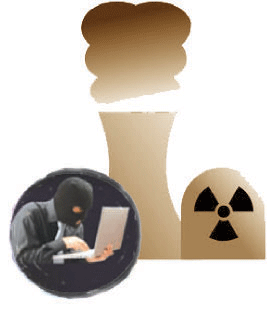 Unheeded cybersecurity threat leaves nuclear power stations open to attack , The Conversation, Nasser Abouzakhar October 17, 2015 There has been a rising number of security breaches at nuclear power plants over the past few years, according to a new Chatham House reportwhich highlights how important systems at plants were not properly secured or isolated from the internet.
As critical infrastructure and facilities such as power plants become increasingly complex they are, directly or indirectly, linked to the internet. This opens up a channel through which malicious hackers can launch attacks – potentially with extremely serious consequences. For example, a poorly secured steel mill in Germany was seriously damaged after being hacked, causing substantial harm to blast furnaces after the computer controls failed to shut them down. The notorious malware, theStuxnet worm, was specifically developed to target nuclear facilities.
The report also found that power plants rarely employ an “air gap” (where critical systems are entirely disconnected from networks) as the commercial and practical benefits of using the internet too often trump security…….
The problem is that the industrial communication protocols and mechanisms still commonly used in nuclear power plants were designed in an era before the internet and cyber-threats were a consideration. These are often insecure and not designed to deal with such challenges. Most of the legacy communication protocols such as Profibus, DNP3 andOPC are still vulnerable to various attacks as they lack any proper authentication techniques.
This means that all a malicious hacker might need to get inside a nuclear power station’s network is Google. Using search terms relevant to the software in use in the plant, Google can turn up direct links to websites leading into its network – with little or no security in the way…… https://theconversation.com/unheeded-cybersecurity-threat-leaves-nuclear-power-stations-open-to-attack-49258
Concerns over Japan’s huge stockpile of weapons grade nuclear material
 China calls on Japan to address world concerns on excessive nuclear stocks http://news.xinhuanet.com/english/2015-10/15/c_134717556.htm BEIJING, Oct. 15 (Xinhua) — China on Thursday called for action from Japan to defuse concerns over its excess of nuclear materials as both Chinese and U.S. think tanks expressed worry in recent reports.
“The international community has always been concerned about Japan’s stockpile of enriched uranium and the risks relating to nuclear proliferation and safety,” Foreign Ministry spokesperson Hua Chunying said.
“The reports suggest there are ways to resolve the surplus nuclear material issue,” she said at a regular news briefing, calling on Japan to be responsible and act to address the international community’s concerns.
The stockpile puts Japan, its neighbors and the world at risk, a joint study by China Arms Control and Disarmament Association and the China Institute of Nuclear Information and Economics said on Friday.
“If, in future, a different country started to stockpile — could be enriched uranium, it could be plutonium — that country could cite Japan as a precedent,” said James Acton, author of a new report on Japan’s reprocessing policy at the Carnegie Endowment for International Peace think tank.
The Chinese study suggests Japan should make a rational plan for its nuclear consumption and address the imbalance, while ensuring the safety and security of these materials.
Citing the latest data from the Japanese government submitted to the International Atomic Energy Agency (IAEA), the Chinese study found Japan has 47.8 tonnes of highly sensitive separated plutonium, 10.8 tonnes of which are stored in Japan, enough to make 1,350 nuclear warheads.
1 This Month

of the week – THE ONENESS of HUMANITY
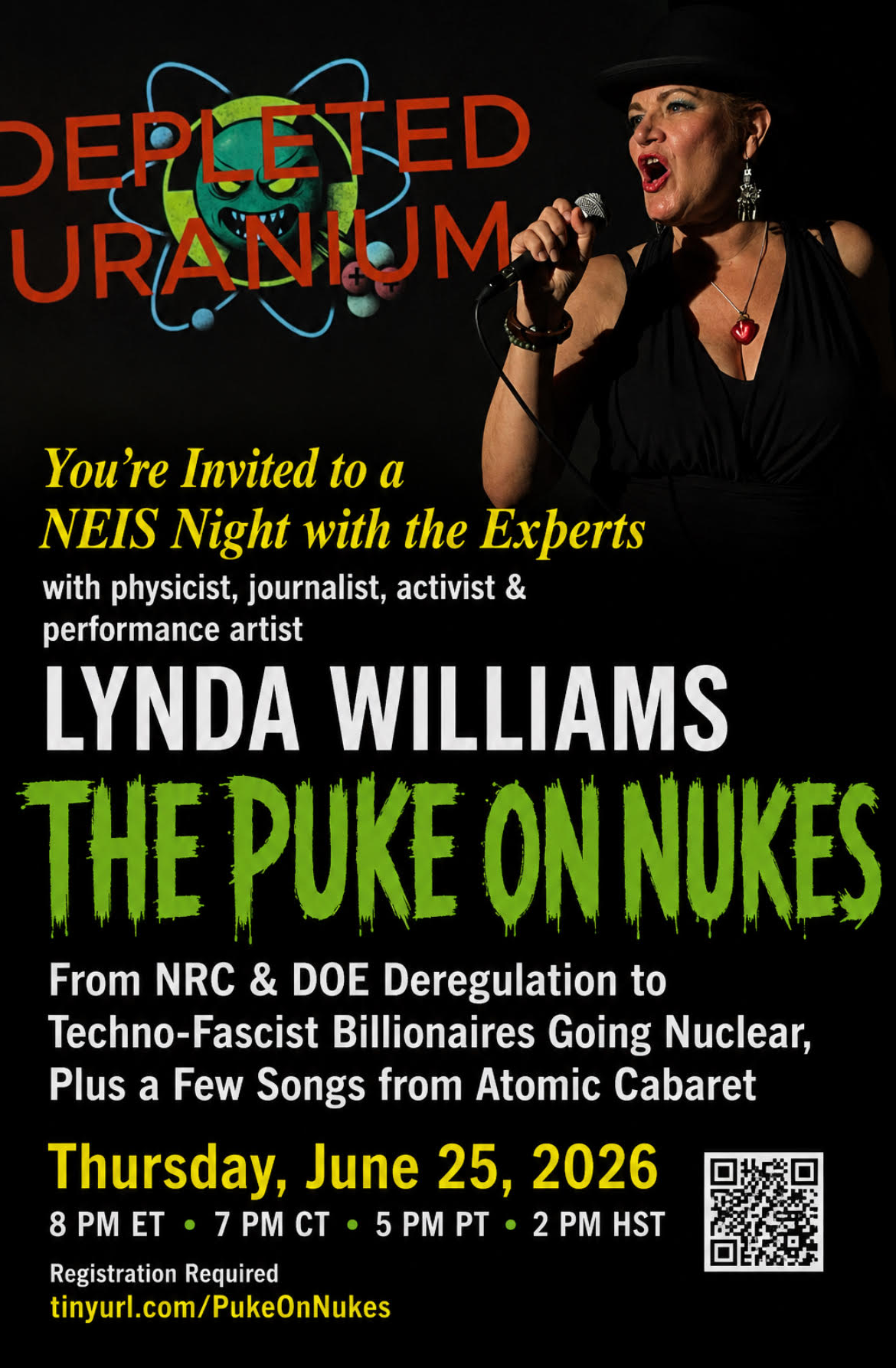
25 June- THE PUKE ON NUKES
Thursday, June 25, 2026
7pm Central Time (8pm ET, 6pm MT, 5pm PT) UTC – 5
From NRC & DOE Deregulation to Techno-Fascist Billionaires Going Nuclear, Plus a Few Songs from Atomic Cabaret REGISTER
26 June – Radiation Trainwreck at the NRC / Join the Protect Better Campaign – https://us02web.zoom.us/meeting/register/4ZlZ5_qLSHGiLSCg8FF6Bg#/registration

1st July – Webinar Waste of Space: The Environmental Harm of Military and Civil Space Activity st July, 7 pm

Report Launch Online: We are seeing an increasing exploitation of space for military and commercial purposes. This must change.

Protect Sazan Island from the Trump family! https://secure.avaaz.org/campaign/en/protect_sazan_island_from_the_trump_family_loc/?bqFCVab&v=174511&cl=22707147157&_checksum=5e9dde668860e8231c33699735e16a1fbf22ab2cb01da50c999fe8732b9775ef&utm_source=email&utm_medium=blast_email&utm_campaign=174511


Cuba Is Not a Failed State – It Is a Besieged State
PETITION: “Global Appeal to Endorse Palestinian Right of Return of Refugees”
To see nuclear-related stories in greater depth and intensity – go to https://nuclearinformation.wordpress.com
-
Archives
- June 2026 (251)
- May 2026 (306)
- April 2026 (356)
- March 2026 (251)
- February 2026 (268)
- January 2026 (308)
- December 2025 (358)
- November 2025 (359)
- October 2025 (376)
- September 2025 (257)
- August 2025 (319)
- July 2025 (230)
-
Categories
- 1
- 1 NUCLEAR ISSUES
- business and costs
- climate change
- culture and arts
- ENERGY
- environment
- health
- history
- indigenous issues
- Legal
- marketing of nuclear
- media
- opposition to nuclear
- PERSONAL STORIES
- politics
- politics international
- Religion and ethics
- safety
- secrets,lies and civil liberties
- spinbuster
- technology
- Uranium
- wastes
- weapons and war
- Women
- 2 WORLD
- ACTION
- AFRICA
- Atrocities
- AUSTRALIA
- Christina's notes
- Christina's themes
- culture and arts
- Events
- Fuk 2022
- Fuk 2023
- Fukushima 2017
- Fukushima 2018
- fukushima 2019
- Fukushima 2020
- Fukushima 2021
- general
- global warming
- Humour (God we need it)
- Nuclear
- RARE EARTHS
- Reference
- resources – print
- Resources -audiovicual
- Weekly Newsletter
- World
- World Nuclear
- YouTube
-
RSS
Entries RSS
Comments RSS
 nuclear-news