The danger of flying nuclear materials between UK and USA
MoD admits flying nuclear materials http://www.theguardian.com/uk-news/2016/mar/01/mod-admits-flying-nuclear-materials-between-uk-and-us
Campaigners highlight safety risks after defence minister admits there have been 23 such flights in the last five years, Guardian, Rob Edwards, 1 Marc 16 , Materials used in nuclear weapons have been flown between the UK and the US 23 times in the last five years, the Ministry of Defence has admitted.
Though the MoD does not give details, the flights are believed to have carried tritium, plutonium and enriched uranium, all vital ingredients of Tridentwarheads. They probably started or ended at the RAF base at Brize Norton in Oxfordshire.
The flights have alarmed politicians and campaign groups, who are worried about accidents causing widespread radioactive contamination. The MoD, however, insists that the transports complied with stringent safety rules.
The Guardian reported on 9 February that two MoD emergency exercises in 2011 and 2012 codenamed Astral Bend envisaged planes carrying nuclear materials crashing. One imagined a leak of enriched uranium and plutonium spreading up to five kilometres across south Wales.
That prompted a question about the nuclear flights in the House of Commons last week by the Scottish National party’s defence spokesman, Brendan O’Hara MP. In response, the government admitted the frequency of such flights for the first time. “In the last five years, 23 flights carrying defence nuclear materials were undertaken,” the defence minister, Penny Mordaunt, told MPs in a written answer.
“All flights were between the UK and the United States on fixed-wing aircraft under the control of UK armed forces.” Details of the cargoes were kept secret “as disclosure would or would be likely to prejudice national security,” she said.
O’Hara said: “This answer is alarming and highlights a practice most of the public are unaware of. The MoD need to outline what risk and safety assessments they made about these flights and precisely when and what areas of UK airspace were used. I fear the MoD does not have a great track record on transparency when it comes to nuclear issues – and this answer clearly begs more questions.”
Experts say that the UK and the US regularly exchange tritium, plutonium and enriched uranium under a mutual defence agreement. Anti-nuclear campaigners have tracked road convoys transporting nuclear materials between the nuclear bomb plants at Aldermaston and Burghfield in Berkshire and RAF Brize Norton.
The independent nuclear engineer, John Large, argued that the MoD’s air shipments would not comply with international safety regulations for civil nuclear transports. A crash could “contaminate large tracts of land with potential radiological consequences for unprotected members of the public”, he said.
Tom Clements, who heads a group monitoring a nuclear weapons plant at Savannah River in South Carolina, claimed that the MoD flights would not meet US standards for civil nuclear shipments. The flights had “disturbing” implications for the world’s attempts to reduce the proliferation of nuclear weapons, he said.
Peter Burt from the UK Nuclear Information Service, a not-for-profit group, highlighted the high risks of air shipments. “The RAF regularly fly nuclear materials over large urban areas such as Bristol, Cardiff, and Swansea, which raises serious questions about what would happen in the event of an accident involving one of these flights,” he said.
The MoD maintained that the air transports were safe. “The transport of defence nuclear materials is carried out to the highest standard in accordance with stringent safety regulations,” said an MoD spokeswoman.
“In over 50 years of transporting defence nuclear materials in the UK, there has never been an incident that has posed any radiation hazard to the public or to the environment.”
Danger of an aging nuclear power plant next to a natural gas pipeline.
There’s a proposed natural gas pipeline next to a nuclear power plant. What could go wrong? Grist By Katie Herzog on 29 Feb 2016 What’s scarier than an aging nuclear power plant? An aging nuclear power plant next to a natural gas pipeline.
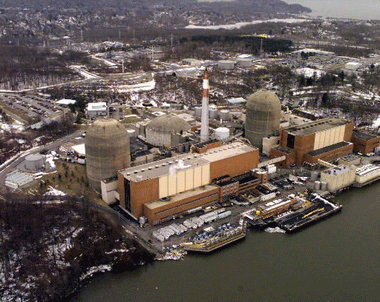
That could be the new reality for the Indian Point Energy Center, a nuclear power station located in Westchester County, just 45 miles north of Manhattan. A proposed expansion of a natural gas pipeline across the power station’s property has environmentalists and other groups concerned that an accident could turn the power plant into an unrivaled disaster. It’s a bit like smoking next to a gas tank — a gas tank filed with nuclear fuel near one of the densest population centers on the planet.
Despite how ill-advised this sounds, the pipeline has already been approved by the Federal Energy Regulatory Commission. Why would they allow such a thing? Well, as the New York Times notes, approval was partly based on reviews carried out by the Entergy Corporation — which happens to be the same company that owns the plant.
New York Gov. Andrew Cuomo, a resident of Westchester County, is not having any of it. Cuomo recently directed his administration to conduct an independent safety analysis of the pipeline project after hearing that radioactive water had leaked from the aging plant and into the groundwater. This is just the latest strike against Indian Point by the Cuomo administration, which called for the plant’s closure last year. “The safety of New Yorkers is the first responsibility of state government when making any decision,” said the governor in a statement.
Cuomo isn’t alone. In Nov. 2015, a group of climate activists known as the Montrose 9 blocked construction of the pipeline, which would transport natural gas from Texas to Massachusetts. In addition to the activists’ concerns about the affects of burning natural gas on the climate, they targeted the Spectra-owned pipeline for its proximity to Indian Point, which the federal government previously listed among the nation’s worst power plants.
The Nuclear Regulatory Commission, however, seems unconcerned. ……http://grist.org/business-technology/theres-a-proposed-natural-gas-pipeline-next-to-a-nuclear-power-plant-what-could-go-wrong/
Engineers concerned at design flaw in US nuclear reactors
U.S. NRC engineers urge fix for nuclear power stations Reuters, By Timothy Gardner 1 Mar
A group of engineers within the U.S. nuclear power regulator is concerned that a design flaw in nearly all U.S. nuclear plants could endanger emergency core cooling systems. The group has urged the regulator to order power station operators to either fix the problem or face mandatory shutdowns.
Seven engineers in late February petitioned the Nuclear Regulatory Commission to order immediate enforcement actions against licensees of U.S. nuclear power plants, in a little-noticed, but public move.
The petition, filed under a standard NRC process, urges the agency to respond by March 21.
The engineers are concerned that a design flaw in nearly all U.S. nuclear facilities leaves them vulnerable to so-called open phase events in which an unbalanced voltage, such as an electrical short, could cause motors to burn out and reduce the ability of a reactor’s emergency cooling system to function. If the motors are burned out, backup electricity systems would be of little help, the petition said.
In early 2012 an unbalanced voltage event forced Exelon Corp’s Byron 2 reactor in Illinois to shut down automatically. The unit was shut for about a week.
Later that year, the NRC alerted nuclear power plant operators in a bulletin to a potential design vulnerability concerning open phase and collected feedback from the operators.
But the agency never ordered the plants to make changes to reduce any open phase vulnerabilities. The petition said 13 open phase events have occurred at U.S. and international nuclear plants over the last 14 years……http://www.reuters.com/article/usa-nuclear-regulator-idUSL2N1692BF
Theft of radioactive material in Mexico
Mexico issues alert after theft of radioactive material, ABC News 29 Feb 16 Five Mexican states have been put on alert after a truck carrying a container of potentially dangerous radioactive material was stolen, the Interior Ministry says.
The National Co-ordination of Civil Protection issued the warning after a company in the central state of Queretaro reported that a ute carrying radioactive iridium-192 had been stolen.
The Ministry said the material “can be dangerous for people if not handled safely” and could cause “permanent or serious injury to a person who is handling or in contact with it for a short time”.
Such damage could occur after contact lasting anywhere from minutes to hours, it added.
Officials said the radioactive material represented a significant health risk if taken outside its container, but was not dangerous if kept sealed…….http://www.abc.net.au/news/2016-02-29/mexico-issues-alert-after-theft-of-radioactive-material/7209140
Indian Point nuclear plant’s 65,000% Spike In Radiation

 65,000% Spike In Radiation Outside New York Nuclear Plant Is Likely Worse Than Fukushima, Activist Post FEBRUARY 27, 2016 BY JAY SYRMOPOULOS Buchanan, NY — An uncontrollable radioactive flow from the Indian Point nuclear power plant continues leaking into groundwater, which leads to the Hudson River, raising the specter of a Fukushima-like disaster only 25 miles from New York City.
The Indian Point nuclear plant is located on the Hudson River, approximately 25 miles North of NYC, and serves the electrical needs of an estimated 2 million people. Last month, while preparing a reactor for refueling, workers accidentally spilled some contaminated water, containing the radioactive hydrogen isotope tritium, causing a massive radiation spike in groundwater monitoring wells, with one well’s radioactivity increasing by as much as 65,000 percent.
Entergy, the Louisiana-based company that owns the plant, chalked up the readings to “fluctuations that can be expected as the material migrates.” According to Entergy, the tritium contaminated water spill was contained within the plant, and never reached the Hudson or any other water source.
“There is no impact to public health or safety,” Entergy spokeswoman Patricia Kakridas told RT.
Of course, the tritium leak is the ninth in just the past year, four of which were serious enough to shut down the reactors. But the most recent leak, however, according to an assessment by the New York Department of State as part of its Coastal Zone Management Assessment, contains a variety of radioactive elements such as strontium-90, cesium-137, cobalt-60, and nickel-63, and isn’t limited to tritium contamination.
Despite the assurances from Entergy, the area around Indian Point is a “cancer cluster,” with the local rate of thyroid cancer rates registering at 66 percent higher than the national average, according to Joseph Mangano, Executive Director of the Radiation and Public Health Project (RPHP).
According to a report by RT: Continue reading
The end of the nuclear age – foreshadowed as Indian Point nuclear station leaks radioactivity
Indian Point Leak Foreshadows the End of the Nuclear Age, Fortune by David Z. Morris @davidzmorris
FEBRUARY 28, 2016, New York could be the next Fukushima as world governments roll back nuclear power.
The Indian Point nuclear power plant in New York State is leaking radioactive contaminant into nearby groundwater, and despite plant operator Entergy’s ELA 0.08% assurances that the leak has “no health or safety consequences,” Governor Andrew Cuomo called earlier this month for a full investigation by state environment and health officials.
The latest revelations add to a mounting list of recent accidents and problems at Indian Point, and Cuomo’s hard stance is nothing new, either. As of November of last year, Cuomo’s office actively opposed the continuing operation of Indian Point.
The plant’s problems are not isolated—leaks have been found at as many as 75% of U.S. nuclear plants. And closing Indian Point would put New York, and the U.S., in line with a sharp global move away from nuclear power following 2011’s meltdown at Japan’s Fukushima Daichi reactor. Japan shut down all of its nuclear plants after the disaster, and only began tentatively restarting a handful in 2015.
Countries including France and Germany have moved to similar phase-outs, with Germany in 2011 pledging to phase out all nuclear power by 2022. Austria and Spain have stopped all construction on new nuclear plants. The U.S. had not constructed a new nuclear power plant in nearly twenty years when, in October of 2015, a plant in Tennessee was given the go-ahead.
Nuclear plants represent huge threats to nearby areas, though the risk of a disaster at any one plant is small. While Stanford researchers have found that Fukushima’s fallout may directly cause only about 300 deaths worldwide, estimates of economic losses range from $250-$500 billion, stemming largely from the removal of 159,128 people from a zone the size of Connecticut—land which will be uninhabitable for centuries.
Fukushima prefecture had a population just short of two million at the time of the disaster. Indian Point sits just 25 miles north of New York City’s 8.5 million inhabitants, as well as real estate many times more valuable than that in northern Japan. During the Fukushima meltdown, the Japanese government established a 20 kilometer (12 mile) evacuation zone around the reactor—but the U.S. embassy recommended that Americans leave areas within 50 miles.
That suggests that a meltdown at Indian Point could lead to the evacuation of New York City. In addition to profound human costs, the immediate economic damage would run into many trillions of dollars. And it is no exaggeration to say that a threat to New York City is a threat to the entire U.S. economy, which it plays a key role in organizing……. http://fortune.com/2016/02/28/indian-point-end-of-nuclear-age/
Increasing safety risks as nuclear reactors age
 Nuclear power in the future: risks of a lifetime http://thebulletin.org/nuclear-power-future-risks-lifetime9185 DAVID LOCHBAUM, 26 Feb 16, A nuclear safety engineer,Lochbaum is one of the nation’s top independent experts on nuclear power.
The chance of one reactor experiencing a meltdown among a fleet of 100 reactors operating within the NRC’s safety goal for 40 years is nearly one in three (32.97 percent), or slightly higher than the risk from taking two turns on a six-chamber revolver during Russian roulette. The chance of a meltdown from that fleet operating for 60 years rises to 45.12 percent, or slightly higher than taking three Russian roulette turns. And the meltdown risk from the fleet operating for 80 years is 55.07 percent, or roughly the risk from taking four and one-half Russian roulette turns.
The bathtub curve. The NRC’s safety goal is a constant number for all reactors at every point during their operation. In reality, the risk over a reactor’s lifetime varies by what is called the bathtub curve due to its shape.

A reactor begins operating with relatively high risk due to material imperfections, assembly errors, worker mistakes, and other break-in problems. The risk levels off during mid-life and then rises late in life due to age-related degradation.
The US fleet of reactors is heading toward, if not already in, the wear-out portion of the bathtub curve where risk increases. Continue reading
2016 Washington Summit on Nuclear Security
The 2016 Washington Summit: Time to Open the Next Chapter in Nuclear Security Council of Councils, Artur Kacprzyk, Analyst, Polish Institute of International Affairs Feb 24, 2016 The fourth and almost certainly final Nuclear Security Summit (NSS) will take place from March 31 to April 1, 2016 in Washington, DC. Washington hosted the first such meeting of heads of states and government in 2010, followed by summits in Seoul (2012) and the Hague (2014). Though the NSS process is about to end, the struggle to prevent nuclear terrorism is not, and at present there is no vehicle with which to carry these efforts forward in a concerted manner. The NSS process has led to significant achievements in securing nuclear materials worldwide, but much more remains to be done.
As terrorist threats persist, nuclear and radioactive materials in numerous countries are still vulnerable, and the international nuclear security architecture continues to be fragmented and predominantly based on nonbinding measures. Although the last summit cannot conclusively resolve nuclear security problems, it presents leaders with an opportunity to chart a new direction of cooperation that would comprehensively address underlying challenges and ensure NSS’s enduring legacy.
Successes of the NSS Process
The NSS process was launched in the wake of U.S. President Barack Obama’s 2009 speech in Prague, in which he described the danger of terrorists acquiring nuclear weapons as “the most immediate and extreme threat to global security” and pledged to lead an initiative to lock down in four years worldwide stocks of highly enriched uranium (HEU) and plutonium—materials that could be stolen and used to construct a nuclear weapon. Both HEU and plutonium are used for both military and civilian purposes.
Falling short of reaching the four-year goal, the NSS has still enabled progress in multiple areas. ………
NSS Shortcomings and Flaws in Nuclear Security Architecture
Despite NSS accomplishments, the process has also suffered from a number of shortcomings, compounded by current adverse international factors. According to the recently published NTI Nuclear Security Index 2016, progress in the implementation of NSS goals has slowed. This is partially due to a series of crises distracting leaders’ attention and summit fatigue. This trend will likely worsen without an appropriate successor to the NSS. At the same time, twenty-four countries still hold nearly two thousand tons of weapons-usable nuclear materials.
So far, one of the most notable shortcomings of the NSS process has been the lack of fundamental changes to global nuclear security architecture. Despite a growing number of ratifications, membership in key international agreements remains limited. Ninety-three states are party to the International Convention on Suppression of Acts of Nuclear Terrorism, while the 2005 amendment to the Convention on Physical Protection of Nuclear Materials (CPPNM) requires twelve more ratifications to enter into force. Additionally, more specific security standards contained in IAEA guidelines are voluntary and not universally implemented. The same applies to IAEA review missions. Above all, there is no obligatory and comprehensive system that would hold states accountable for their nuclear security commitments and require them to share necessary information……….
Conclusions and Recommendations
The 2016 NSS in Washington faces two main tasks. First, participants should take new commitments on issues neglected in previous meetings, particularly related to military stocks and civilian minimization, and expand the endorsement of current gift baskets, especially the Trilateral Initiative. Second, the NSS must clearly determine the way forward for continued efforts.
There is an undeniable need for a new, broad legal instrument that would set the current nuclear security architecture in place and complement existing mechanisms by filling the gaps in terms of standards, transparency, and accountability. Nevertheless, the process of negotiating and ratifying such an agreement would be lengthy. Therefore, there is a need for an additional track of regular consultation to continue the momentum started by the NSS, energizing a wider group of countries, enabling incremental progress, and thus reinforcing parallel negotiations on a treaty………http://www.cfr.org/councilofcouncils/global_memos/p37574
Illegal dumping of nuclear waste in Kentucky
Drilling wastes containing concentrated but naturally occurring radio active materials made their way into Kentucky, state officials confirmed on Thursday. After learning in January that low-level nuclear waste from drilling operations had been dumped illegally in Kentucky last year, state officials are warning this week that all landfills be on the lookout and to not accept any of the radioactive material.
Kentucky Division of Waste Management Director Tony Hatton said officials have confirmed that low-level nuclear waste from drilling operations in Ohio, Pennsylvania and West Virginia was sent to a landfill in Estill County between July and November. Officials are also investigating possible illegal shipments of similar waste to a landfill in Greenup County……..http://www.courier-journal.com/story/tech/science/environment/2016/02/25/nuclear-waste-dumped-illegally-kentucky/80924622/
“disaster waiting to happen” – Indian Point nuclear plant called
Indian Point nuclear plant called “disaster waiting to happen” CBS News,
In the past year alone there have been a number of mishaps at Indian Point, including a power failure in the reactor core, a transformer fire, an alarm failure, and the escape of radiated water into groundwater. The plant sits about 25 miles north of New York City, so a serious mishap could potentially put millions of people in harm’s way.
“It’s a disaster waiting to happen and it should be shut down,” Paul Gallay, president of Riverkeeper, a watchdog organization dedicated to protecting the Hudson River, told CBS News.
The Indian Point Energy Center, located on the bank of the Hudson River in the town of Buchanan, supplies electricity for millions of homes, businesses and public facilities in New York City and Westchester County, just north of the city.
Environmental groups call the latest problem just the tip of the iceberg, and Gov. Andrew Cuomo is joining with organizations like Riverkeeper, the National Resources Defense Council and others in seeking the permanent closure of the plant.
Earlier this month, Entergy Corporation, which owns Indian Point, reported increased levels of tritium-contaminated water at three monitoring wells, with one well’s radioactivity increasing by as much as 65,000 percent.
Tritium is a radioactive form of hydrogen that occurs naturally in small doses and is a byproduct of nuclear reactors. It could enter a person’s body by drinking tritiated water, or it can also be inhaled as a gas or absorbed through the skin. Tritium can reach all parts of the body like normal water and is eventually expelled through urine. The U.S. Nuclear Regulatory Commission (NRC) says tritium emits “very weak radiation and leaves the body relatively quick.”
Little research has been done on the health effects of exposure to increased levels of tritium. But the NRC states: “Exposure to very small amounts of ionizing radiation is thought to minimally increase the risk of developing cancer, and the risk increases as exposure increases.”……..
The Environmental Protection Agency’s (EPA) standard limit for tritium in drinking water, established in 1976, is 20,000 picocuries per liter. (A picocurie is a unit of radiation that could be measured in a laboratory.) By comparison, after the recent leak, samples showed the tritium-laced water at Indian Point had a radioactivity level of more than 8 million picocuries per liter. That level was the highest regulators have seen at Indian Point, Cuomo said, compared to a normal reading of about 12,300 picocuries per liter.
According to a 2014 notice in the Federal Register, EPA is expected to update the standards for tritium in drinking water. EPA did not make anyone available for comment……..
“The good news is, advances in alternate power sources, grid management and energy conservation have brought us to the day when the aging, unsafe Indian Point can close,” Gallay said. He enumerated a number of other available sources of energy for the region, including 600 megawatts thanks to transmission system upgrades and another 500 megawatts available through energy savings achieved through efficiency and renewable energy.
“There will be enough power to keep the lights on in our homes and hospitals, our businesses and schools — in every place that makes our communities healthy and vibrant,” Gallay said. http://www.cbsnews.com/news/indian-point-nuclear-power-plant-called-a-disaster-waiting-to-happen/
Takahama Nuclear reactor leaking radioactive water

 Nuclear reactor in Japan leaking radioactive water amid nationwide restart RT.com 21 Feb, 2016 A nuclear power station in Japan is leaking, this time the Takahama plant, about 380km west of Tokyo. The radioactive water leak comes amid a nationwide push to restart reactors after the catastrophic meltdown at Fukushima five years ago.
The reactor would have been the fourth to come on after the shutdown. The push by the government and utility companies came amid protests across Japan against the continued reliance on nuclear energy, prompted by failures to get the Fukushima crisis under control.
Now Kansai Electric Power says about 34 liters of radioactive water have escaped the plant’s reactor No. 4. An investigation is underway. “Resumption procedures related to the incident have been suspended as we are still investigating the cause,” a Kansai spokesman said, according to AFP……..
In March 2011, following the devastating tsunami and earthquake that shut down Fukushima Daiichi, the government introduced strict new safety checks. But, apparently, not every reactor lucky enough to pass the new standards was returned to normal operation.
In fact, two of Takahama’s reactors (3 and the currently leaking 4) were both given a ‘no’ by a local judge, who firmly sided with the people last April…….. https://www.rt.com/news/333154-nuclear-reactor-japan-leak/
 |
Click here to Reply or Forward
|
69 safety incidents and “near misses” on UK nuclear submarines
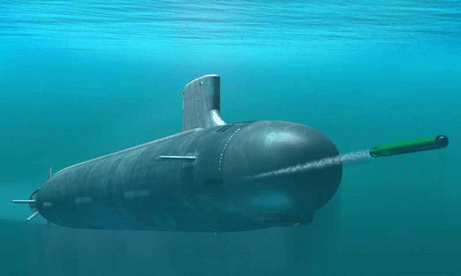 Reactor incidents on new nuclear subs double in one year, Herald Scotland, 21 Feb 16 The Royal Navy’s new nuclear-powered submarines have been plagued by 69 safety incidents and “near misses” over the last four years.
The Astute class of submarines based at Faslane on the Clyde has seen reported reactor incidents at sea or on shore almost double from 12 in 2014 to 21 in 2015. Though the MoD insists that the incidents are all minor, critics warn that they undermine the boats’ reliability and safety………
According to the independent nuclear engineer John Large, the submarines were suffering serious problems. “This continuing experience of the Astute class reactor problems not only imperils the boats when at sea but is likely to result in cutbacks to the number of patrols, voyage durations and the extent of roaming of the high seas,” he said.
John Ainslie, coordinator of the Scottish Campaign for Nuclear Disarmament, pointed out that Astute submarines had been involved in a series of mishaps, including running aground on the Isle of Skye. “It is only a matter of time before one of these incidents results in a serious nuclear accident,” he said……..http://www.heraldscotland.com/news/14291467.Reactor_incidents_on_new_nuclear_subs_double_in_one_year/
Stolen Radioactive Material: What Is Iridium-192?
Live Science, by Tia Ghose, Senior Writer | February 18, 2016 Some security experts are worried that a cache of radioactive material reportedly stolen from an oil field in Iraq could be used by organizations such as the Islamic State group to produce a dirty bomb.
A laptop-size case with about 0.35 ounces (10 grams) of the material, called iridium-192, allegedly went missing from an oil field storage facility in Basra that is run by the American company Weatherford,Reuters reported. Both the company and the Iraqi government declined to confirm the report.
“We are afraid the radioactive element will fall into the hands of Daesh,” a senior security official with the Iraqi government, told Reuters, using an Arabic acronym for the Islamic State group, also called ISIS. “They could simply attach it to explosives to make a dirty bomb.” [Doomsday: 9 Real Ways Earth Could End]……..http://www.livescience.com/53773-what-is-radioactive-iridium-192.html
Belgian terror suspect had video of high ranking nuclear official
Belgium Finds Video of Nuclear Official at Home of Terrorism Suspect, NYT By MILAN SCHREUER and ALISSA J. RUBINFEB. 18, 2016 PARIS — A suspect linked to the Nov. 13 Paris attackers was found with surveillance footage of a high-ranking Belgian nuclear official, the Belgian authorities acknowledged on Thursday, raising fears that the Islamic State is trying to obtain radioactive material for a terrorist attack.
The existence of the footage, which the police in Belgium seized on Nov. 30, was confirmed by Thierry Werts, a spokesman for Belgium’s federal prosecutor, after being reported in the Belgian daily newspaper La Dernière Heure.
The news set off an immediate uproar among Belgian lawmakers, who charged that they and the country had been misled about the extent of the potential threats to the country’s nuclear facilities, as well as about the ambitions of the terrorist network linked to the Islamic State that used Belgium to plot the Paris attacks, which killed 130 people.
The International Atomic Energy Agency also confirmed on Thursday a report by Reuters that radioactive material had gone missing since November in Iraq, where the Islamic State controls broad areas of territory, adding to fears that the group may be able to acquire material for an attack with newly disconcerting dimensions.
The Belgian news media, citing sources close to the investigation, said that the surveillance footage had been retrieved from the home of Mohamed Bakkali, who was arrested after the attacks and is in detention on charges of terrorist activity and murder.
Belgian officials have asserted privately that Mr. Bakkali may have been involved in planning several attacks, not only those in Paris. There are currently eight people in detention in Belgium and charged with involvement in the November attacks.
The purpose of the footage retrieved by the Belgian police was not clear. But experts and officials speculated that it could have been part of a plot to abduct the nuclear official, who was not identified but had access to secure areas of a nuclear research facility in Mol, and force him to turn over radioactive material, possibly for use in a dirty bomb.
Sébastien Berg, a spokesman for Belgium’s Federal Agency for Nuclear Control, confirmed that the agency had been informed right away of the existence of the footage and said that employees had been told to increase their vigilance on the work floor. But he acknowledged that no additional guards had been hired or other measures taken to secure the perimeters of Belgium’s nuclear sites.
“We took increased security measures at all four Belgian nuclear sites, based on the general raised security alert in the country and on concrete indications that showed that the terrorists involved in the Paris attacks had the intention to do something involving one of our four nuclear sites,” Mr. Berg said.
Those sites include two power plants and a private company that produces medical isotopes, in addition to the facility in Mol, where scientists conduct research and experiments on radioactive waste to try to find safer ways to store it and reduce damage to the environment, Mr. Berg said.
One experiment being carried out involves the stocking of nuclear waste in bunkers dozens of meters underground, he said, adding that the facility had large stocks of nuclear waste on hand.
Members of Belgium’s Parliament expressed outrage in a regular session Thursday, saying that the interior minister, Jan Jambon, had told them in January that there was no specific threat to nuclear facilities……..
Extremist organizations have long expressed interest in obtaining radioactive material, and there is a market for stolen nuclear waste. News reports in October documented at least four attempts by Russian gangs to sell radioactive material in Moldova, which were thwarted by local officials in concert with the United States’ Federal Bureau of Investigation.
The International Atomic Energy Agency identified the material missing in Iraq as iridium-192, a highly radioactive isotope that is sometimes sought for use in dirty bombs.
Mr. Berg said that, if acquired, the material at the site in Mol could also be used to make a dirty bomb, which would spread radioactive material over the whole impact zone……. http://www.nytimes.com/2016/02/19/world/europe/belgium-nuclear-official-video-paris-attacks.html?_r=0
Paris terrorist attackers had planned to target Belgian nuclear reactors
 Jihadists who carried out Paris terror attacks had planned to target Belgian nuclear plants, investigators reveal, Daily Mail, 19 Feb 16
- Paris terrorist ‘spied on’ Belgian nuclear official using a video camera
- Target was a director of Belgium’s nuclear research and development
- It is believed the group were planing attacks on Belgian nuclear plants
- The attacks in Paris on November 13 left 130 dead and 352 injured
- For the latest on the Paris attackers visit www.dailymail.co.uk/ParisAttacks
By SARA MALM FOR MAILONLINE and AFP REPORTER
The Paris terrorist attackers had also planned attacks on Belgian nuclear plants, local media reports.
Belgian investigators have found hours of video footage of a senior Belgian nuclear official filmed at the person’s home in the Flanders region.
It is believed that the group that carried out the horrific Paris attacks on November 13 last year, killing 130 and injuring 352, had spied on the person as part of research for an attack.
The ten-hour long video footage obtained by Belgian officials showed the front door of the home of a director of Belgium’s nuclear research and development programme.
The footage was discovered ‘as part of seizures made following the Paris attacks,’ the prosecutor added, refusing to divulge the individual’s identity ‘for obvious security reasons’. ………http://www.dailymail.co.uk/news/article-3452454/Jihadists-carried-Paris-terror-attacks-planned-target-Belgian-nuclear-plants-investigators-reveal.html
1 This Month
26 September – International Day for the Total Elimination of Nuclear Weapons





PLEASE OPPOSE HR 8255 AND S.3639 – bills would accelerate satellite deployment, with no environmental review or safeguards – https://ncstd5li.quorum.us/campaign/169331/
To see nuclear-related stories in greater depth and intensity – go to https://nuclearinformation.wordpress.com
-
Archives
- September 2026 (313)
- August 2026 (330)
- July 2026 (355)
- June 2026 (287)
- May 2026 (306)
- April 2026 (356)
- March 2026 (251)
- February 2026 (267)
- January 2026 (308)
- December 2025 (358)
- November 2025 (359)
- October 2025 (375)
-
Categories
- 1
- 1 NUCLEAR ISSUES
- business and costs
- climate change
- culture and arts
- ENERGY
- environment
- health
- history
- indigenous issues
- Legal
- marketing of nuclear
- media
- opposition to nuclear
- PERSONAL STORIES
- politics
- politics international
- Religion and ethics
- safety
- secrets,lies and civil liberties
- spinbuster
- technology
- Uranium
- wastes
- weapons and war
- Women
- 2 WORLD
- ACTION
- AFRICA
- Atrocities
- AUSTRALIA
- Christina's notes
- Christina's themes
- culture and arts
- Events
- Fuk 2022
- Fuk 2023
- Fukushima 2017
- Fukushima 2018
- fukushima 2019
- Fukushima 2020
- Fukushima 2021
- general
- global warming
- Humour (God we need it)
- Nuclear
- RARE EARTHS
- Reference
- resources – print
- Resources -audiovicual
- Weekly Newsletter
- World
- World Nuclear
- YouTube
-
RSS
Entries RSS
Comments RSS

