St Louis underground fire moves closer to radioactive trash dump
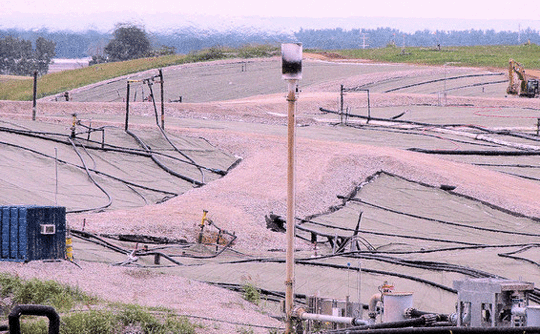 Underground Fire in Mo. Nears Nuclear Waste Dump, Discovery News, FEB 18, 2016 BY PATRICK J. KIGER IN THE ST. LOUIS AREA, A SLOW-BURNING UNDERGROUND FIRE IS CLOSE TO A VAST STORE OF NUCLEAR WASTE BURIED IN A FEDERAL SUPERFUND SITE.
The fire reportedly has been smoldering beneath a nearby landfill since at least 2010. The Washington Post reports that residents are afraid of what may happen if the fire — which is by some accounts as little as 1,500 feet away –reaches the West Lake Landfill in Bridgeton, Mo., a Superfund site filled with decades-old waste from the federal government’s nuclear weapons program. Angry locals also think the U.S. Environmental Protection Agency, which manages the site, hasn’t done enough to stop the fire.
In December, the EPA announced that it would install a physical barrier in an effort to isolate the nuclear waste. The agency also said that it would put cooling loops and other engineering controls to prevent environmental impacts if the “subsurface smoldering event,” as it’s called, were to reach the waste. An EPA administrator told the Post that the barrier would take a year to build.
But residents aren’t comforted by that timetable, and think the government, despite years of warning, has done too little to stave off a possible environmental disaster. A 2014 St. Louis County Emergency Operations Plan, obtained by a local TV station, reveals that local officials feared a “catastrophic event” with “a potential for radioactive fallout to be released in the smoke plume and spread throughout the region.”……
About 8.700 tons of nuclear waste, mixed with 39,000 tons of contaminated soil was moved to the Superfund site from another dump between July and October 1973, according to a U.S. Nuclear Regulatory Commission report. It was covered by a three-foot-deep layer of uncontaminated soil.
EPA may be running out of time to fix the problem. In early February, the U.S. Senate passed a bill introduced by Sens. Claire McCaskill, (D-Mo.), and Roy Blunt (R-Mo.), that would take control over the building remediation measures away from EPA and give it to the U.S. Army Corps of Engineers. The House hasn’t yet taken action on the legislation.
But Congress may bear some responsibility for the agency’s slowness. According to a 2015 Government Accountability Office report , legislators cut EPA’s funding for cleanup of Superfund sites by nearly half since the late 1990s. http://news.discovery.com/earth/underground-fire-in-mo-nears-nuclear-waste-dump-160218.htm
Defective pressure vessel could seal the tomb of the EPR nuclear reactor
 French Nuclear Safety Authority has discovered a serious fault in the construction of the pressure vessel http://www.bridgwatermercury.co.uk/news/14275656.LETTER__the_French_Nuclear_Safety_Authority_have_discovered_a_serious_fault_in_the_construction_of_the_pressure_vessel/ Allan Jeffery, Bridgwater 14 Feb 16 Before Hinkley C can be built, the EPR reactor of the same design being built at Flamanville in France must be completed and be established generating before 2020, or else the UK government’s guarantees and financial agreements fall apart.
So it is not surprising that EDF tried to go unnoticed as it drove a convoy carrying the steel lid and pressure vessel from Chalon, where it was produced across France to Flamanville, though this was documented and publicised by Greenpeace last week.
In April the French Nuclear Safety Authority, (the ASN) discovered a very serious default in the composition of the steel used in the pressure vessel. Tests showed excessive presence of carbon, which makes the steel more brittle and subject to breakage. The pressure vessel contains the huge amounts of atomic fission energy in the core.
EDF was quick to minimise the problem and promised other tests. If EDF was serious with the safety measures the company should await the validation of the ASN of the test results that might be released in late 2016 or early 2017.
As Yannick Rousselet from Greenpeace France quoted, “Once again, EDF is turning a blind eye to all the issues, continuing as though no one else would notice and going forward anyway until there is no turning back.”
The nuclear industry is desperate and that new failure in safety could have serious consequences, not only in France, but also in China (Taishan) and England at Hinkley Point, which are among the other vessels produced with the same steel.
If the tests confirm the safety problem, EDF would have to replace the whole vessel, and have to break open and remove the first pressure vessel at Flamanville, adding huge costs and further delays, which would bring the final blow to the industrial jewel already dying.
This defective lid could seal the tomb of the EPR reactor!
Radioactive packages lost or stolen in Canada

 Nuclear and Radioactive Packages Keep Going Missing in Canada, VICE News By Justin Ling
February 13, 2016 If you’ve ever lost your wallet or car keys, you’ve got something in common with the people who run Canada’s nuclear facilities, who keep misplacing nuclear and radiological material.
Last year alone, 14 radioactive packages were lost or stolen, according to the annual report from the Canadian Nuclear Safety Commission (CNSC), and less than half were later recovered. That’s on top of the dozen of other nuclear packages from recent years that have yet to be found.
The report doesn’t detail the circumstances of the losses or thefts, except to say that they were either “sealed sources” — a secure container carrying nuclear or radioactive material — or “radioactive devices.”
The lapses, at a time when security services pledge neurotic devotion to tracking and recovering dangerous goods that could reach the black market, are thanks in part to a handful of private companies that are mishandling radioactive material. n the nuclear watchdog’s 2014/2015 annual report, it identified 27 companies that were mislabeling or mishandling nuclear material, or which had inadequate security protections.
In some cases, CNSC lightly rapped the knuckles of companies, including a New Brunswick brewery which, according to the government body, had “several non-compliances related to safety requirements for nuclear gauges.”
Pump House Brewery, at the time, told CBC News that the problem amounted to some missed paperwork.
In other cases, the problems were more serious and resulted in fines…….https://news.vice.com/article/nuclear-and-radioactive-packages-keep-going-missing-in-canada
Russia’s aging nuclear reactors, and the Kola station shutdown
Kola nuclear plant shutdown blamed on deteriorated cable, ending silence on the malfunction, Bellona, February 11, 2016 by Charles Digges, The cause of a surprise reactor shutdown at Russia’s Kola Nuclear Power Plant’s No 4 reactor on Tuesday was finally explained by the station’s press service as “deterioration of the insulation of a power cable in the course of conducting scheduled tests on an auxiliary systems’ pump.
The initial emergency shutdown of the reactor on Tuesday morning at about 9:37 am Moscow time was originally reported without an explanation – something nuclear experts on Russia said is exceedingly rare, and cause for concern.
The reactor’s age and clearances to run above nominal generating capacity near the city of Murmansk added to worries during the day-long silence on why the No 4 unit had been pulled from the grid……..
To what extent the burnt-out cable represents any threats to safety, however, will only be clear after an investigation by a committee to be appointed by Rostekhnadzor, Russia’s Federal Service for Environmental, Technological and Nuclear Oversight.
According to Andrei Ozharovsky, a Moscow-based nuclear adviser with Bellona, such investigations can be protracted for months, and their results aren’t generally made public.
Worries arose about the sudden, and initially unexplained shutdown because of two aspects in the reactor’s operational history.
First, the reactor, which is a VVER- 440 unit, is running on a 25-year engineering lifespan extension, meaning it will not be taken out of service until 2039, when it’s 60 years old….
Second, the reactor since 2012 has been a part of an experiment to run at various intervals at 107 percent its nominal production capacity. The reactor had also been run at expanded capacities in 1986 and 1987 under Soviet rule, but the Chernobyl disaster of 1986 mothballed that for almost a decade and a half.
Alexander Nikitin, chairman of the Environmental Rights Center Bellona said on Thursday by email that, “it’s not important here how long the reactor has worked or will work – what’s important is that they allowed [such extensions] to begin with.”
As to the experiments in boosting No 4’s power output, Nikitin said, “Difficulties can arise when a reactor is operated at any power, even at the minimum controllable level – but the official decision to stretch the power output and all other corresponding parameters to above normal, of course, adds to risks.”……
The Kola Nuclear Plant’s No 3 reactor in 2011 received 25-year operational extension, pushing its closure back to 2036.
The plant is likewise expecting to get the nod to run the No 3 reactor at boosted power outputs of 104 to 107 percent.
The boosted power regimens are not specific to Russia’s Kola nuclear station. Another six of Russia’s 31 reactors are operating above nominal capacity.
All four of the Balakovo nuclear stations periodically operate at 104 percent, and one of the reactors at the Rostov nuclear plant has clearance to run at 107 percent. http://bellona.org/news/nuclear-issues/2016-02-kola-nuclear-plant-shutdown-blamed-on-deteriorated-cable-ending-silence-on-the-malfunction
Fire/Explosion Reported at North Carolina Nuclear Plant
Officials:  — Emergency Alert Declared — Fire/Explosion occurred after “unexpected power decrease” in reactor — “Emergency response facilities staffed” — “Abnormal event with potential to impact plant equipment or public health and safety” (VIDEO) http://enenews.com/officials-emergency-alert-declared-nuclear-plant-fireexplosion-reported-after-unexpected-power-decrease-reactor-emergency-response-facilities-staffed-abnormal-event-potential-impact-public-he?utm_source=feedburner&utm_medium=email&utm_campaign=Feed%3A+ENENews+%28Energy+News%29
U.S. Nuclear Regulatory Commission, Feb 8, 2016 (emphasis added): Facility: BRUNSWICK [Nuclear Plant in N.C.]… Emergency Class: ALERT… EMERGENCY DECLARED… RPS [Reactor Protection System] ACTUATION – CRITICAL… MANUAL SCRAM AND ALERT DECLARATION DUE TO ELECTRICAL FAULT RESULTING IN FIRE/EXPLOSION… Unit 1 declared an Alert… due to an explosion/fire in the Balance of Plant 4 kV switchgear bus area.Prior to the Alert declaration, the operators initiated a manual SCRAM due to an unexpected power decrease from 88% to 40%. The licensee has visually verified that there isno ongoing fire and is investigating the initial cause of the event… [T]he licensee reported the following… “a manual reactor scram was initiated due to loss of both recirculation system variable speed drives as a result of an electrical fault. At this time, a Startup Auxiliary Transformer (SAT) experienced a lockout fault; interrupting offsite power to emergency buses 1 and 2. Emergency Diesel Generators (EDGs) 1, 2, 3, and 4 automatically started”… The licensee has notified… DHS, FEMA, USDA, HHS, DOE, DHS NICC, EPA… FDA… and Nuclear SSA…
WWAY, Feb 7, 2016: Electrical damage sets off alert at Brunswick Nuclear Plant… An Alert is the second in increasing significance of four nuclear emergency classifications.
WECT, Feb 8, 2016: [Unit 1] remains in shutdown mode, while officials work through “detailed process/procedures to fully understand this event and make the needed repairs”… An alert… is used when abnormal events have the potential to impact plant equipment or public health and safety… No estimated timeline has been given for getting Unit 1 back into service.
North Carolina Department of Public Safety, Feb 7, 2016: Duke Energy notified the emergency management agencies… of damaged electrical equipment at the Brunswick Nuclear Plant…
Duke Energy, Feb 7, 2016: Alert declared and exited at Brunswick… federal, state and local officials were notified, and Brunswick plant emergency response facilities were staffed…
At Pilgrim nuclear power plant, security officer skipped more than 200 fire watches
NRC: Nuclear plant employee skipped assigned fire watches http://www.bostonherald.com/news/local_coverage/2016/02/nrc_nuclear_plant_employee_skipped_assigned_fire_watches Associated Press Thursday, February 11, 2016 PLYMOUTH, Mass. — The owner of the Pilgrim nuclear power plant in Plymouth faces possible punishment from federal regulators because a former security officer admitted to skipping his hourly fire watches then falsifying records to make it appear as if they been completed.
In a letter to Entergy, the Nuclear Regulatory Commission said its investigators found the security officer skipped more than 200 fire watches from 2012 to 2014.
An NRC spokesman tells the Cape Cod Times (http://bit.ly/1KHRoIV ) that Entergy could be assessed a civil fine of up to $140,000 per day per violation, but at this point a civil penalty will likely not be assessed.
Entergy says its own investigation reached a similar conclusion. The employee was fired. Entergy is still considering how it will respond.
Pilgrim has been scheduled to close by 2019.
Armed transport ships spotted in Panama Canal, headed for secret mission to later transport plutonium
 UK-Flagged Ships Set to Transport Plutonium from Japan to US Located in Panama Canal http://www.srswatch.org/uploads/2/7/5/8/27584045/srsw_news_on_plutonim_ships_in_canal_feb_6_2016.pdf Ships on Secret Mission to Carry 331 Kilograms of Plutonium to US DOE’s Savannah River Site in South Carolina as Part of Nuclear Security Summit Preparation; Plutonium to be Stranded at SRS
A catelogue of safety failures revealed in mock nuclear accident tests

 Top secret mock nuclear accidents reveal catalogue of failures, The Ferret, Rob Edwards on February 9, 2016 Top secret mock nuclear accidents testing the responses of the military and emergency services have revealed numerous mistakes that would have led to “avoidable deaths”, according to official assessments.
The Ministry of Defence (MoD) was so concerned about the problems that it carried out “an overarching, fundamental review” of arrangements for handling serious nuclear weapons incidents behind closed doors last year.
Assessments of emergency exercises by the MoD’s internal watchdog, theDefence Nuclear Safety Regulator (DNSR), expose a string of mishaps including life-threatening delays, equipment shortages, coordination failures and communication breakdowns. One report criticises officials for “substantially understating” the scale of the dangers facing the public in a staged briefing for the media.
The MoD took more than two years to agree to hand over reports on three nuclear bomb exercises in 2011 and 2012, despite freedom of information lawrequiring documents to be released within 20 working days. The reports, redacted by the MoD to keep details confidential, are being published today by The Ferret, in tandem with The Guardian (see below).
Two of the exercises imagined aircraft carrying nuclear weapons ingredients crashing and spreading plutonium and other radioactive contamination up to five kilometres away. They were both codenamed Astral Bend, one taking place at the Caerwent military base in south Wales on 24 February 2011, the other at Heyford Park in Oxfordshire on 27 March 2012.
At the 2011 exercise there was a major mix-up over how to deal with contaminated casualties. The fire service was criticised by DNSR for refusing to allow ambulance teams to take away seriously injured people until they had been decontaminated.
“The interpretation of the absolute necessity to decontaminate every casualty or person from within the determined “hot zone” did, and would in the event of such an incident, lead to avoidable deaths,” concluded the DNSR report………
DNSR pointed out that exercises had shown the need for “an overarching, fundamental review” of emergency response arrangements. This review was carried out in 2015, according to the MoD, but it has not been published.
The independent nuclear consultant,John Large, argued that if there were an accident close to an urban area the emergency response “would be totally inadequate to protect many hundreds if not thousands of members of public.”……….
Anti-nuclear groups claimed that the exercise assessments exposed “major weaknesses” in the MoD plans for responding to nuclear accidents. “The MoD’s rickety old nuclear safety arrangements are not up to the job of keeping the public, emergency responders, or MoD personnel safe,” said Peter Burt from the Nuclear Information Network.
He added: “While ministers are racing ahead to replace the Trident nuclear weapons system, work on improving nuclear emergency plans seems to be a much lower priority and is proceeding at a much more sedate place.”
An earlier Astral Bend exercise on 12 May 2010 envisaged a US plane carrying nuclear weapons crashing and spreading radioactive contamination. Official assessments released in 2011 concluded that the MoD specialist response team “struggled to manage”…….
John Ainslie from the Scottish Campaign for Nuclear Disarmament suggested that a nuclear weapons accident was “inherently very dangerous” and the emergency response was likely to be inadequate. He said: “If there is a real incident then we can expect there to be fatal delays in treating casualties and misleading information provided to the public,” he said.
The reports released by the Ministry of Defence…….. Photos thanks to Nukewatch. https://theferret.scot/nuclear-bomb-accidents-could-cause-avoidable-deaths-say-mod-reports/
The UK ghost ships with the deadly nuclear cargo
Guarded from terrorists by Royal Navy sub and 50 commandos…the UK ghost ships with enough nuclear fuel for 80 missiles, Daily Mail,
- Pacific Heron and Pacific Egret ships will sail to Japan for plutonium
- Precious 331kg load could make an incredible 80 nuclear warheads
- Vessels are accompanied by military ships and armed with cannons
By MARK NICOL DEFENCE CORRESPONDENT FOR THE MAIL ON SUNDAY 7 February 2016
Two top secret British ‘ghost ships’ carrying enough plutonium for a huge nuclear arsenal wend their way through the world’s oceans –guarded against terrorists by 50 commandos.
It may sound like a tantalising target for a villain in a James Bond film, but what is potentially the most dangerous secret mission in history is deadly reality.
Two vast container ships – the Pacific Heron and the Pacific Egret – left Barrow-in-Furness, Cumbria, last month on the first leg of their incredible journey.
Their mission is to sail to Japan to collect 331kg of plutonium – enough to make 80 nuclear warheads – which was leased by the UK to a Japanese research facility.
The ships are almost certainly shadowed by a Royal Navy submarine and surface vessels and are heavily armed with 20mm cannon.
They are sailing across the Atlantic before passing through the Panama Canal and into the Pacific on their way to Japan.
Their ultimate destination is a US nuclear storage facility in South Carolina, and the return journey to the American eastern seaboard from East Asia would normally again be made via the Panama Canal.
But this would leave the vessels vulnerable to attack – and their terrifying radioactive cargo could in theory devastate much of Central America.
So instead, they are likely to take the long and dangerous journey around the storm-lashed Cape Horn at the tip of South America, one of the most hazardous shipping routes in the world.
The Heron and the Egret, which each weigh about 6,700 tons when fully loaded, belong to the UK’s Nuclear Decommissioning Authority (NDA). It is expected that each ship will be guarded by as many as 25 commandos.
Nuclear expert John Large told The Mail on Sunday last night: ‘The cargo is invaluable and part of a secret trade in fissile materials between the likes of the UK and US. The biggest risk is a fire or an external missile strike.
‘This is bomb-grade nuclear material and a terror group or rogue state would want to intercept it.’…..http://www.dailymail.co.uk/news/article-3435476/Guarded-terrorists-Royal-Navy-sub-50-commandos-UK-ghost-ships-nuclear-fuel-80-missiles.html
Volcano erupts rather close to Sendai nuclear station
Sakurajima Volcano erupts violently just a few miles away from nuclear power plant [good video and pictures] MIRROR UK, 5 FEB 2016 BY ELAINE LINES
Fountains of lava spewed out of the mountain but there were no reports of any immediate damage. A Japanese volcano about 30 miles from a nuclear plant violently erupted last week, shooting ash nearly 2 km into the night sky.
Fountains of lava spewed from the Sakurajima mountain, but there were no immediate report of damage and operations at the power station were not affected.
Following what they termed an “explosive eruption,” Japan’s Meteorological Agency raised the warning level on the peak to grade three, meaning people should not approach the mountain.
- Kazuhiro Ishihara, a professor at Kyoto University, told NHK national television: “It appears that stones have been thrown about 2 km from the crater, but this area is quite far from any communities.”
Television footage showed red streams of lava bursting from the side of the volcano, but Ishihara said he thought the impact of the eruption would not be that serious…….
- Japan lies on the “Ring of Fire” – a seismically active horseshoe-shaped band of fault lines and volcanoes around the edges of the Pacific Ocean – and has more than 100 active volcanoes. http://www.mirror.co.uk/news/world-news/sakurajima-volcano-erupts-violently-just-7315024
Kyushu Electric Power Co. scraps plan for emergency facility at Sendai nuclear station
 Scrapped emergency plan puts Kyushu Electric’s safety commitment in doubt, Asahi Shimbun, February 01, 2016 Kyushu Electric Power Co. and the Nuclear Regulation Authority are at odds over the utility’s decision to scrap its plan to build an emergency facility at its Sendai nuclear power plant in Kagoshima Prefecture.
In December, Kyushu Electric requested the NRA’s permission to withdraw the plan, which the company had announced before two reactors at the nuclear plant were restarted in August and October 2015. The nuclear safety watchdog has called on the company to review its request.
This “important base-isolated building” is supposed to serve as a key disaster response center if a serious accident occurs at the nuclear plant. Why is the company trying to withdraw the plan to build such a facility after the two reactors resumed operations?
It is hardly surprising that local citizen groups have criticized the move as a breach of the legal principle of fairness and equality.
Kyushu Electric is causing itself to lose the trust of the public. The NRA’s response to the utility’s decision is reasonable.
The company’s Sendai nuclear plant was the first to meet the NRA’s stricter safety regulations drawn up after the Fukushima nuclear disaster in 2011. Consequently, the plant has been operating since August last year.
During the nuclear crisis at the Fukushima No. 1 nuclear plant, a seismically isolated building proved capable of serving as an on-site response center and played an important role in the aftermath of the accident.
Unlike ordinary earthquake-resistant buildings, which are designed to withstand violent shaking, base-isolated buildings are designed to reduce their movements during earthquakes.
When it applied for the NRA’s safety screening to restart the Sendai reactors, Kyushu Electric said it would construct by the end of March this year a three-story base-isolated building housing an emergency response center with a floor space of about 620 square meters.
The company said it would use an alternative emergency response center about a quarter in size for the purpose until the planned facility was built.
The utility, however, decided to change the plan, saying the alternative center, completed in September 2013, meets the requirements under the new safety standards.
Instead of constructing a new base-isolated building, the company plans to continue using the alternative facility and build a new support center……
But the company has not said when the support center will be built. The NRA has pointed out that Kyushu Electric Power has also not explained its claim that the support center will improve safety.
Indeed, the new safety standards do not require the emergency response center to be housed in a base-isolated building…….
Kyushu Electric has also said it has made no decision on whether it will build a base-isolated building to house an emergency response center in its Genkai nuclear power plant in Saga Prefecture.
How the company’s changed plan will pan out will have significant effects on the safety inspections of other nuclear plants as well as utilities’ efforts for greater safety…..http://ajw.asahi.com/article/views/editorial/AJ201602010032
LA gas disaster – a mini Chernobyl?
Breaking: They may have “lost control entirely of entire field” involved in LA gas disaster, and it’s coming up everywhere… We learned there’s many other leaks -Attorney — Officials: Loud sound of gas escaping heard half mile away; A “mini-Chernobyl” — AP: Leak “out of control”… amount released “seriously underestimated” (VIDEO)http://enenews.com/breaking-company-entirely-lost-control-entire-gas-field-involved-la-methane-disaster-leaking-everywhere-learned-many-other-wells-leaking-attorney-official-mini-chernobyl-ap-leak-control-tv-a?utm_source=feedburner&utm_medium=email&utm_campaign=Feed%3A+ENENews+%28Energy+News%29
Porter Ranch Town Hall Meeting, Jan 22, 2016 (emphasis added) — Patricia Oliver, attorney (at 11:30 in): “Now it’s kind of simple — if you have a well blow-out, you quit injecting [more gas] underground… No order had been issued [to stop this] though… We sent a letter [to the Division of Oil, Gas & Geothermal Resources (DOGGR)] saying, “Stop all of the injections, until you can stop the leak”… So we sent a letter on Dec. 1 asking them to stop all injections… Nine days later, they said, “Stop injecting gas”… You’d think that at least temporarily settled it — because if [SoCalGas] didn’t like that, SoCalGas could have temporarily appealed… I have no record of appeal… AQMD [Air Quality Management District] inspected the facility on Nov. 10… and they found all these wells that weren’t accessible — 16 approximately… We don’t know yet why they were inaccessible. We also learned that 15 wells were leaking. We also don’t know why that happened. I spoke at the AQMD hearing this last week and said, “I’m concerned that the fact that now you guys are looking at these injection wells — you don’t know what that means.” You see, DOGGR knows what that means — and that’s a sign that SoCalGas lost control entirely of the entire field and it’s leaking everywhere… So we were like, “We want proof. Now if it’s just coincidental, and you show us why that’s not what’s happening, that’s fine, but provide the evidence”… Families have a right to know what’s going on in that oil field.” (Audience applauds)
Rep. Brad Sherman, U.S. House of Representatives, Jan 21, 2016 (at 17:45): “This the largest natural gas leak in history. We were up there yesterday… what we heard was a loud sound of natural gas escaping that you could hear quite loudly from over half a mile away.”
The Guardian, Jan 11, 2016: Residents attack slow response to what official called ‘a mini-Chernobyl’… “This is a mini-Chernobyl,” Mike Antonovich, the LA county supervisor, told a public hearing at the weekend… [It] is the largest leak of… methane known to experts.
CBS/AP, Jan 15, 2016: A new report shows the level of toxins released… has been seriously underestimated, state regulators said… The findings were released in response to [SoCalGas’ admission that they] underestimated the number of times the cancer-causing chemical benzene has spiked.
AP, Jan 22, 2016: AP, Jan 22, 2016: Officials Waited Months To Monitor California’s Massive Gas Leak — A massive natural gas leak… had been out of control for more than a month when the county’s acting health director said in November that long-term impacts of the cancer-causing chemical benzene should be measured. It took many more weeks to implement the testing… “We can always look back and say, ‘Why didn’t we start with an expanded monitoring program?’” said Angelo Bellomo, deputy county director for health protection… Rob Jackson, an environmental scientist at Stanford University, said… it had undermined the ability to measure health impacts.
Anxieties over safety in the region, as Japan restarts 3rd nuclear reactor
Third reactor restart spurs fears over shaky Kansai evacuation plans BY ERIC JOHNSTON STAFF WRITER , JAPAN TIMES, TAKAHAMA, FUKUI PREF 29 JAN 16 . – Kansai Electric Power Co. on Friday restarted its Takahama No. 3 reactor, the nation’s third unit to go back online under new safety regulations but the first to run on mixed oxide (MOX) fuel, which contains plutonium extracted from spent nuclear fuel.
The restart has revived concerns, especially in neighboring Kansai, about the feasibility of plans to evacuate residents within 30 km of the plant in the event of an accident. It is also unclear where the spent fuel from the reactors will eventually be stored.
The restart was largely welcomed by local businesses and the town of Takahama, which rely on the subsidies and service industry trade that nuclear power brings…….
In the neighboring port city of Maizuru in Kyoto Prefecture, Mayor Ryozo Tatami said Kepco needs to make sure that restarting the reactor won’t lead to an accident. He also called on Tokyo to strengthen its disaster planning for such an event. The Takahama plant’s No. 4 reactor is expected to be restarted next month.
The Takahama plant lies on the Sea of Japan coast in southern Fukui Prefecture, with only a few access roads in and out of the area. About 180,000 people live in 12 towns and cities within 30 km of the site, in Fukui, Kyoto and Shiga.
While plans exist on paper to evacuate some Fukui residents to Hyogo, Kyoto, and Tokushima prefectures, many municipalities there don’t have detailed plans for receiving evacuees. This could possibly mean the only relief might come from Maizuru, which hosts the Japan Coast Guard and a Maritime Self-Defense Force base within 30 km of Takahama…….
the plans assume people will have the physical ability to flee. “There is no evacuation plan in place for the tens of thousands of people with special needs — inpatients and outpatients at hospitals and various facilities, those in day care, and those with handicaps living at home. When others can flee, there are no vehicles to transport these people nor medical care prepared at the evacuation site,” said Aileen Mioko Smith, executive director of the antinuclear group Green Action.
“Restart of the Takahama plant is a human rights injustice toward children and those with handicaps,” she said.
Kansai officials critical of the restart include Kyoto Gov. Keiji Yamada, who said Thursday he did not feel adequate local consent had been obtained due to concerns about evacuation issues. That same day, Shiga Gov. Taizo Mikazuki said there was a lack of sufficient disaster planning.
On Friday, Osaka Mayor Hirofumi Yoshimura added his voice to the opposition, saying the rules for disposing spent nuclear fuel — the lack of mid-term and final storage facilities — remained unclear. The city of Osaka owns about 9 percent of Kepco’s stocks.
Fukui hopes the two restarts will translate into more central government subsidies for hosting the plant. The prefecture received ¥30.6 billion in nuclear related subsidies in fiscal 2014. The latest available figures for Takahama show it received over ¥35 billion between 1974 and 2013……..
anti-nuclear activists say it is not just a matter of price, and that many people may choose to go with suppliers of electricity from renewable energy or other nonnuclear sources.
“The household electricity market will open up to more competition, especially from firms selling non-nuclear generated electricity. Customers will move away from Kepco if it tries to sell power from its nuclear plants, and the company won’t be able to survive,” said Kiyoko Kubo of Wakasa Net, an antinuclear group based near Takahama.http://www.japantimes.co.jp/news/2016/01/29/national/third-reactor-restart-spurs-fears-over-shaky-kansai-evacuation-plans/#.VqvMftJ97Gg
Japan’s Nuclear Regulator – a toothless body
France Peddles Unsafe Nuclear Reactors to India, Drawing Protest , 29 January 2016 By Kumar Sundaram, Truthout | News Analysis “…….India’s nuclear regulator, the Atomic Energy Regulatory Board (AERB), is itself a toothless body, which depends on the Atomic Energy Commission (AEC) for its finances and human resources, an agency, which it is supposed to supervise. India’s newly proposed nuclear regulator – the Nuclear Safety Regulatory Authority – would be an even weaker body than the AERB, according to the former head of AERB, Dr. A K Gopalakrishnan. In fact, India is the only country to further dilute its already lax safety regulation under the AERB to accommodate foreign-imported reactors, as Areva’s EPR might not even pass the licensing procedures of the existing AERB.
Safety concerns at Jaitapur are legitimate and extremely serious. The EPR design has come under severe criticism from the French nuclear regulator, ASN. In April 2015, the ASN warned Areva about some very crucial vulnerabilities in its design. It has found the reactor pressure vessel (or the core of the reactor) to be vulnerable. Yet two days after the publication of ASN’s report, Prime Minister Modi reaffirmed the commitment to buy the EPRs during his visit to Paris.
Independent experts and the government’s own institutions have also cautioned about active seismic fault lines in the region passing exactly beneath the proposed reactor site. There have been 92 earthquakes in Jaitapur over the past 20 years……..http://www.truth-out.org/news/item/34627-france-peddles-unsafe-nuclear-reactors-to-india-drawing-protest
In politically unstable regions, nuclear power faces special cyber attack danger
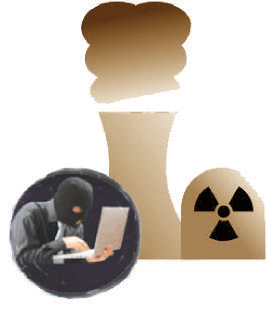 Report: Nuclear plants in unstable regions vulnerable to cyberattacks, UPI By Allyson Chiu, Medill News Service WASHINGTON, D.C., January 28, 2016 — Nuclear power plants need to improve security systems to safeguard against non-traditional terrorist attacks, but that’s challenging for developing countries, experts said Thursday…….
a report released Thursday by the Stimson Center, a Washington think tank, said many nations do not have the resources to adequately protect their nuclear facilities from insider or cybersecurity attacks.
“In particular countries in close proximity to terrorist groups with vulnerable or unstable economies, the potential for incidents is much higher,” said Debra Decker, the report’s co-author and Stimson Center senior adviser.
West African nations like Nigeria are battling terrorist groups including Boko Haram. In the Middle East, territory in Syria has been taken by the Islamic State. Both countries are considering nuclear power programs, according to the World Nuclear Association.
Attacking a nuclear power plant can disrupt power grids or even cause a nuclear meltdown. Kathryn Rauhut, co-author of the Stimson report, said the Fukushima power plant in Japan — destroyed by a meltdown caused by a tsunami — could also have been vulnerable to cyberterrorism.
“Rather than the tsunami taking out backup power supply, you could just have that engineered through a cyberattack,” she said. “We hope that nobody would ever use planes or weapons of mass destruction again, but you don’t need to do that, you can wreak the same amount of havoc through cyber intrusions.”
Unlike American nuclear power plants, which are strictly monitored by the Nuclear Regulatory Commission, international plants do not have any binding safety standards, Decker said…….. http://www.upi.com/Top_News/US/2016/01/28/Report-Nuclear-plants-in-unstable-regions-vulnerable-to-cyberattacks/2321454019965/
1 This Month
26 September – International Day for the Total Elimination of Nuclear Weapons





PLEASE OPPOSE HR 8255 AND S.3639 – bills would accelerate satellite deployment, with no environmental review or safeguards – https://ncstd5li.quorum.us/campaign/169331/
To see nuclear-related stories in greater depth and intensity – go to https://nuclearinformation.wordpress.com
-
Archives
- September 2026 (313)
- August 2026 (330)
- July 2026 (355)
- June 2026 (287)
- May 2026 (306)
- April 2026 (356)
- March 2026 (251)
- February 2026 (267)
- January 2026 (308)
- December 2025 (358)
- November 2025 (359)
- October 2025 (375)
-
Categories
- 1
- 1 NUCLEAR ISSUES
- business and costs
- climate change
- culture and arts
- ENERGY
- environment
- health
- history
- indigenous issues
- Legal
- marketing of nuclear
- media
- opposition to nuclear
- PERSONAL STORIES
- politics
- politics international
- Religion and ethics
- safety
- secrets,lies and civil liberties
- spinbuster
- technology
- Uranium
- wastes
- weapons and war
- Women
- 2 WORLD
- ACTION
- AFRICA
- Atrocities
- AUSTRALIA
- Christina's notes
- Christina's themes
- culture and arts
- Events
- Fuk 2022
- Fuk 2023
- Fukushima 2017
- Fukushima 2018
- fukushima 2019
- Fukushima 2020
- Fukushima 2021
- general
- global warming
- Humour (God we need it)
- Nuclear
- RARE EARTHS
- Reference
- resources – print
- Resources -audiovicual
- Weekly Newsletter
- World
- World Nuclear
- YouTube
-
RSS
Entries RSS
Comments RSS

