Is India’s Government Hiding A Serious Accident Underway In Gujarat?
India’s Former Nuclear Regulator Says, Govt Might Be 
 , CounterCurrents By Kumar Sundaram 13 March, 2016 Indiaresists.com The retired chief of India’s nuclear regulator, Dr. A Gopalakrishnan has sent out an urgent note in which he has cautioned that a ‘loss of coolant accident(LOCA)’ might be underway in Gujarat’s Kakrapar Nuclear Power Station(KAPS). A LOCA accidents is the most serious accident that can happen in nuclear plants and it might lead to the meltdown of the reactor fuel core.
The same reactor had a major accident in 1994 when floodwaters drowned Kakrapar. The floodgates meant to release excess water could not be opened and the water kept increasing–which could lead to a major accident–but it was prevented with the efforts of local engineers. Mr. Manoj Mishra, a worker in the power station then who blew whistle on that accident was terminated by the NPCIL. He was denied justice even by the Supreme Court in India which bought the NPCIL’s argument that he cannot be a whistle-blower as he did not have technical degrees. Mr. Mishra had years of experience in the reactor and he was a strong leader of the workers’ union.
Kakrapar is situated not very far from the Vansda-Bharuch earthquake faultline running through Gujarat, which has experienced several major earthquakes.
Exactly on the 5th anniversary of Fukushima, a leak has been reported in the Unit-1 of the Kakrapar Nuclear Power Station near Surat in Gujarat.
Here is the note by Dr. Gopalakrishnan:
The Kakrapar Unit-I nuclear reactor in Gujarat is undergoing a moderately large leakage of heavy water from its Primary Heat Transport (PHT) system since 9.00 AM on March 11,2016. From the very limited information released by the Nuclear Power Corporation of India Limited (NPCIL) and the Atomic Energy Regulatory Board (AERB) of the government , as well as from the conversations I had with press people who have been in touch with nuclear officials, few inferences can be drawn.
Till 7.00 PM on March 12,2016 , the DAE officials have no clue as to where exactly the PHT leak is located and how big is the rate of irradiated heavy water that is leaking into the reactor containment . However, some reports indicate that the containment has been vented to the atmosphere at least once , if not more times , which I suspect indicates a tendency for pressure build up in that closed space due to release of hot heavy water and steam into the containment housing . If this is true, the leak is not small , but moderately large , and still continuing. No one confirms that any one has entered the containment (in protective clothing) for a quick physical assessment of the situation , perhaps it is not safe to do so because of the high radiationfields inside . When NPCIL officials state that the reactor cooling is maintained , I believe what they may be doing is to allow the heavy water or light water stored in the emergency cooling tanks to run once-through the system and continue to pour through the leak into the containment floor through the break .
All this points to the likelihood that what Kakrapar Unit-1 is undergoing is a small Loss-of-Coolant Accident (LOCA) in progress. It is most likely that one or more pressure tubes (PT) in the reactor (which contain the fuel bundles) have cracked open , leaking hot primary system heavy-water coolant into the containment housing . ……….
. It may be possible that , having built more than 20 PHWRs , NPCIL and AERB in recent years have become overconfident and relaxed their strict adherence to this Aging Management Program , which might have been the reason for the current accident.
Let me caution the reader that the above conjecture is based on bits and pieces of reliable and not so reliable information gathered from different people close to the accident details and in positions of authority. Future detailed evaluation may or may not prove my entire set of conclusions or part of them to be not well-founded. But , technical experts are compelled to put out such conjectures because of the total lack of transparency of the Indian cilvilian nuclear power sector and the atomic energy commission (AEC) , the Dept. of Atomic Energy (DAE) , the NPCIL and the AERB . Public have a need to know and , therefore , the AEC and its sub-ordinate organizations need to promptly release status reports on the progressing safety incident which could affect their lives , to alleviate their concerns and anxieties . It is a series of such lapses in communication over the years which has built up the ever-increasing trust deficit in the DAE system among the general public. All future plans for expanding the civilian nuclear power sector should be put on hold until a truly independent nuclear safety regulator is put in place , who is not controlled by the AEC or the Prime Minister’s Office (PMO) , who will then be answerable to openly communicating with the public on all civilian nuclear power matters.
Kumar Sundaram is a senior researcher with Coalition for Nuclear Disarmament and Peace (CNDP) and Editor of DiaNUke.org http://www.countercurrents.org/sundaram130316.htm
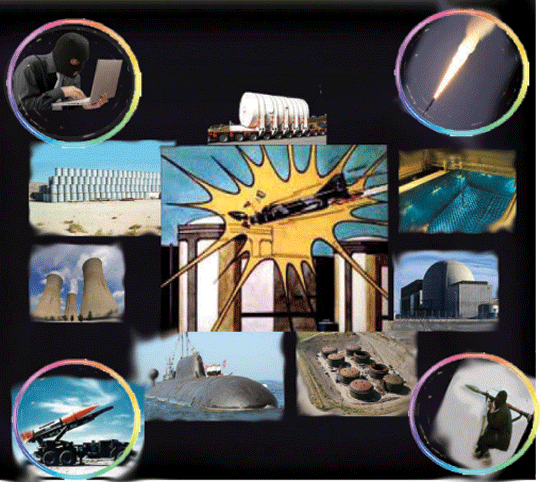 Threat of nuclear terrorism continuesA lingering nuclear threat https://www.washingtonpost.com/opinions/beyond-the-nuclear-security-summit/2016/03/12/15d2c952-e0c5-11e5-846c-10191d1fc4ec_story.html By Editorial Board March 12
WHEN BELGIAN police searched the home of a suspected member of the Islamic State after the Paris terror attacks in November, they found in the suspect’s apartment a curious video. It appeared to be a surveillance recording, made by the suspect, of a senior researcher at a Belgian nuclear center. The authorities speculate that it might have been part of a terrorist plot to capture nuclear materials from the center, perhaps by kidnapping the researcher. The episode has prompted Belgian authorities to deploy armed troops to protect nuclear sites, replacing a private security force.
The potential threat is clear. Much has been done to reduce nuclear weapons stockpiles and materials over the past 25 years, but hazards remain from highly enriched uranium and plutonium spread around the globe. Some 1,800 metric tons of weapons-useable material is stored in hundreds of facilities, including civilian research reactors and military stocks.
Starting in 2010, President Obama cast a spotlight on the problem with international summits at which leaders were pressed to act, including the cleanup of materials that could be used for building a so-called “dirty bomb,” a conventional explosive combined with nuclear materials that, while not a nuclear blast, would nonetheless cause considerable mayhem and disruption. In 2010, when the summits began in Washington, 35 nations had weapons-usable materials; three summits and six years later, it is down to 24.
But now comes the difficult part. Leaders of more than 50 nations will gather in Washington at the end of this month for the fourth and final nuclear security summit. Then what? The summit process has not given rise to an effective global system for securing these nuclear materials. It will take some real imagination and determination to keep up the pressure. We hear the coming summit will produce “action plans,” pledges from the leaders to pursue nuclear security in existing international organizations. It may also set up some kind of smaller, ongoing contact group. But will these be sufficient to sustain the sense of urgency and political drive that the summits generated?
A detailed index published by the Nuclear Threat Initiative shows tangible progress was achieved between 2012 and 2014, but since then efforts havestalled, due to political issues that have diverted attention, bureaucratic inertia, lack of resources and cultural factors. None of these are going away any time soon.
The rapid deterioration of U.S. relations with Moscow has taken a toll, too. Russia has declared it will not attend the summit. Cooperation on nuclear security has all but collapsed under the weight of President Vladimir Putin’s ill-fated adventure in Ukraine. Former senator Sam Nunn (D-Ga.), who pioneered that cooperation, said recently there is a “corrosive lack of trust”between Washington and Moscow, and channels of communication are “few and far between.” Without in any way easing the pressure on Mr. Putin over Ukraine or Syria, the United States and Russia ought to realize that Islamic State terrorists interested in nuclear materials in Belgium are a threat to all countries, and one worth talking about.
Major leak shuts down India’s Gujarat Nuclear Plant
Gujarat Nuclear Plant Shut Down After Major Leak, All Workers Safe http://www.ndtv.com/india-news/gujarat-nuclear-plant-shut-down-after-major-leak-workers-isolated-but-safe-1286198 NDTV, All India | Written by Pallava Bagla March 12, 2016 NEW DELHI:
An emergency has been declared within the nuclear plant at Kakrapar in Gujarat after a major heavy water leak in a nuclear reactor. No worker has been exposed to radiation, said officials, adding that the employees remained sequestered till their shift ended, which is standard operating procedure for a crisis.
The workers were allowed to go home after they had been counted and accounted for as officials checked to ensure that no radioactivity was reported outside the plant.
Officials at India’s nuclear operator, Nuclear Power Corporation of India Limited (NPCIL), told NDTV “The reactor has shut down safely and no radiation has leaked out”. According to Nalinish Nagaich a senior official at NPCIL, no worker was stationed in the affected area.
The nuclear reactor is slowly cooling down and is in a “safe stage” confirmed Dr Sekhar Basu, Chairman of the Atomic Energy Commission.
The heavy water leak affected the reactor’s cooling system. If emergency cooling systems do not kick in after this sort of glitch, the temperature can rise so much that the core of the reactor can melt down completely.
Heavy water, formed with a hydrogen isotope, is used in Indian reactors as a preferred cooling agent.
A Jewish Law insight on the ethics of keeping crumbling Indian Point nuclear power plant
 What Jewish Law Says About Crumbling Indian Point Nuclear Plant, Forward, Jay Michaelson 11 Mar 16, What does an ox’s propensity for violence have to do with a leaky nuclear reactor? One is an ancient, Jewish example of negligence; the other is a very contemporary one. But the ethical imperative is the same:
When there’s an imminent risk of danger to the public, it’s morally wrong to do nothing.
Let’s start with the present. Twenty-five miles north of New York City, the crumbling Indian Point nuclear power plant is leaking radioactive water. And yet what has been the government’s response? Forge ahead with a 42-inch natural gas pipeline right underneath that power plant.
Although The New York Times published an excellent op-ed on the plant this week, that article omitted the pipeline entirely, focusing only on the need to close Indian Point………
New York Governor Andrew Cuomo, to his credit, believes that it’s time to retire the Indian Point plant and, among other things, invest in renewables. So did that New York Times op-ed.
But it seems that one of those “other things” is Spectra Energy’s Algonquin Incremental Market project, a web of natural gas pipelines that stretches from New Jersey to Boston.
In other words, fracking. The AIM pipeline, if completed, will pipe fracked natural gas (that is, methane) from the Appalachians to New England. Cuomo has so far been silent on the AIM pipeline, giving it his tacit approval. FERC, the federal agency responsible for the pipeline, approved it in 2015.
Now, common sense would seem to disagree. Natural gas pipelines rupture all the time; there were 119 pipeline accidents in 2014. Right now, a gas storage leak outside Los Angeles is spewing 62 million cubic feet of methane into the atmosphereevery day. And the AIM pipeline would run just 105 feet away from the Indian Point plant. Twenty million people live within 50 miles.
The icing on the cake? Both the plant and the pipeline lie less than a mile from a fault line.
How is any of this possible?
First, for all the common-sense objections to a huge natural gas pipeline passing underneath a crumbling nuclear power plant on a fault line 25 miles north of the largest city in America, the fact is that both the pipeline and the plant have continually obtained regulatory approvals. And Spectra, the company building the pipeline, points out that it has older, smaller pipelines across the Indian Point property already, and they’ve operated without incident for decades……..
Here’s where that goring ox comes in. Jewish law is clear, in general and in detail, that it is negligent to create a risk to the public. If you let an ox loose, and it gores someone, you are responsible, because you placed the risk in the public domain.
The Indian Point plan is a modern-day ox. But as long as it remains open, or its waste remains on site, so is the Spectra Pipeline.
Indeed, the Pipeline-plus-Plant risk gets even worse. Perversely, the NRC includes terrorism in its purview, but only for the plant itself. The pipeline, meanwhile, has not been deemed a terrorist target at all, even though if you can blow up the pipeline, you might be able to blow up the plant……..
We need religious, as well as environmentalist, voices on this issue. We need to reframe our public discussion of environmental risk to include ethical, moral and religious traditions within it. And if we don’t, we may not be legally liable for what might happen, but I wouldn’t be able to sleep at night. http://forward.com/opinion/335647/what-jewish-law-says-about-crumbling-indian-point-nuclear-plant/#ixzz42dEdxuQo
Belgium’s nuclear sites in danger: military protection to be set up
Belgian army to protect nuclear sites: interior ministry http://www.reuters.com/ article/us-belgium-nuclear- security-idUSKCN0W61KR, 4 Mar 16 Belgium has ordered its military to protect nuclear sites such as power plants in the country to safeguard them against possible militant attacks, the country’s interior ministry said on Friday.
Some 140 soldiers will be mobilized to protect locations such as Belgium’s two nuclear power plants at Tihange and Doel as well as nuclear research and storage facilities, a spokesman for the interior ministry said.
“We are setting up a special police unit for this sort of security task but that will take some time for it to be operational,” the spokesman said, adding that the army would take over in the meantime.
In February, Belgian investigators searching houses linked to suspects in the Islamist militant attacks in Paris last November found a video tracking movements of a man linked to the country’s nuclear industry.
The spokesman said there was no direct link between the discovery of the video and the decision to take the additional security measures. (Reporting by Robert-Jan Bartunek; Editing by Gareth Jones)
Nuclear Regulatory Commissioners urgently call for correcting reactor cooling systems flaw

 Dangerous Flaw Threatens to Close Nation’s Nuclear Fleet Energy Matters, By Roger Witherspoon, 4 Mar 16
After four years of increasingly tense internal discussion, seven Nuclear Regulatory Commission engineers have formally petitioned the governing Commissioners to either order the nation’s nuclear power plants to immediately correct a design flaw governing their reactor cooling systems or order them all to shut down.
The flaw is in the original design of the electrical system, and has escaped notice for decades. According to the engineers’ petition, as well as a series of staff analyses on file at the NRC, the design flaw occurs in what is called a “single phase” condition in which little or no electricity is entering the plant to operate its backup cooling systems in the event of a blackout or other event cutting off power from the grid. The result is that the motors of backup generators are underpowered and this can cause their motors to burn out. When that happens, there is no way to keep the reactor core cool.
The seven members of the Electrical Engineering Branch in the Office of Nuclear Reactor Regulation, led by Acting Chief Roy K. Mathew, stated in the petition that “the staff determined that all nuclear facilities are susceptible to this design vulnerability except one plant, and recommended that the NRC take prompt regulatory action.”
As a result, the petition states, if the plants are not ordered to immediately redesign their electrical systems then the Commissioners should “issue Orders to immediately shutdown the operating nuclear power plants since the licensees are operating their facilities without addressing the significant design deficiency…and with inoperable electric power systems….”
The situation evolved from an unplanned shutdown in January 30, 2012 in Unit 2 of the Byron Station Nuclear Power Plant in Illinois. At the time, it was thought that the shutdowns resulted from a string of unfortunate coincidences. But further examination by the NRC’s electrical engineering branch found something more alarming…………
Officials from Exelon, which owns and operates Byron and 10 other nuclear power plants, as well as inspectors from the NRC initially thought that the shutdown was the result of a series of unfortunate coincidences. But On Feb. 28, 2012, there was a similar interrupted and undetected phase which caused a shutdown at Byron’s Unit 1. And, as in the earlier event, it disabled the plant’s cooling systems. That caused Mathews and the electric unit he led to investigate further and see if there had been any other shutdowns in which an undetected phase disruption disabled the cooling pumps. Their initial look found identical shutdowns at the Beaver Valley Power Station Unit 1 in Pennsylvania in November, 2007; and in New York, the James Fitzpatrick and the neighboring Nine Mile plants, which share a power substation, shut down in December, 2005.
The staff analysis concluded that the design of the electrical systems was “inadequate because it did not consider the possibility of the loss of a single phase… This situation resulted in neither the onsite nor the offsite electric power system being able to perform its intended safety functions” to provide electric power to the plant’s safety systems. Plants are required to have two separate sets of electrical power lines and monitors for their core cooling systems so that operators can still control the reactor even if one line, or train, is damaged by fire or another event.
The loss of a single phase of alternating current, the NRC staff found, “can potentially damage both trains of the emergency core cooling system.” In that case, there is nothing to prevent a meltdown………..
“In addition,” the staff assessment concluded, “the generic AP1000 plant operating procedures are under development and the licensees’ review of the generic procedures did not identify specific operator actions related to phase voltage verifications of the three phases.”
As a result, the electrical group concluded, all of the nation’s nuclear plants are violating the terms of their operating licenses and must either be brought into compliance or shut down.
According to NRC statutes, this is a major issue.
NRC regulations governing the operating licenses dictate that “the safety systems shall be designed so that, once initiated automatically or manually, the intended sequence of protective actions of the execute features shall continue until completion.”
The group’s petition states “any failures in an offsite power system or onsite power system must not disable the safety functions of emergency core cooling and vital safety systems to protect the health and safety of the public.”
With the current system, they assert, the plants are violating a mandatory condition of their operating licenses ( http://bit.ly/21OiouL ). As the issue was debated within the agency, the Mathews group cast a wider net and began looking at the root causes of shutdowns in the US and abroad, while pushing the agency to more forcefully addresses the design problem. To their surprise, they found 13 “open phase events” over a 14-year period, with the latest taking place at the Oconee Nuclear Power Station in South Carolina in December, 2015………… https://spoonsenergymatters.wordpress.com/2016/03/04/dangerous-flaw-threatens-to-close-nations-nuclear-fleet/
Florida Nuclear Station is leaking radioactive material into Biscayne Bay
 FPL nuclear plant canals leaking into Biscayne Bay, study confirms
Radioactive ‘tracer’ detected at up to 215 normal levels near canals
County commission set to discuss cooling canal problems Tuesday
Threat from pollution to public, marine life not addressed in report
A radioactive isotope linked to water from power plant cooling canals has been found in high levels in Biscayne Bay, confirming suspicions that Turkey Point’s aging canals are leaking into the nearby national park.
According to a study released Monday by Miami-Dade County Mayor Carlos Gimenez, water sampling in December and January found tritium levels up to 215 times higher than normal in ocean water. The report doesn’t address risks to the public or marine life but tritium is typically monitored as a “tracer” of nuclear power plant leaks or spills.
The study comes two weeks after a Tallahassee judge ordered the utility and the state to clean up the nuclear plant’s cooling canals after concluding that they had caused a massive underground saltwater plume to migrate west, threatening a wellfield that supplies drinking water to the Florida Keys. The judge also found the state failed to address the pollution by crafting a faulty management plan.
This latest test, critics say, raise new questions about what they’ve long suspected: That canals that began running too hot and salty the summer after FPL overhauled two reactors to produce more power could also be polluting the bay………
Over the last two years, problems with the canals have worsened exponentially. After the 2013 plant expansion to increase power output by 15 percent, the canals began running dangerously high. FPL officials blamed problems on an algae bloom that worsened after the canals were temporarily shut down during the project. But when a summer drought hit in 2014, temperatures spiked. At least twice, when temperatures soared to 102 degrees, the utility was nearly forced to power down reactors.
After obtaining permission from nuclear regulators to operate the canals at 104 degrees, the hottest in the nation, FPL officials began plotting a course to fix the canals by pumping in millions of gallons of fresh water from a nearby canal as well as increasing the amount of water drawn from the Floridan aquifer.
But the growing saltwater plume triggered regulatory scrutiny. After the county complained, the state ordered a new management plan, called an administrative order, to address problems……..
Over the last five years, the report said, cooling canal water typically has tritium at levels 60 to more than 800 times higher than in the bay. Tritium at the bottom of the bay close to the canals ranged from more than 130 to 215 times higher — high enough to suggest a consistent flow from the sprawling cooling system.
County staff concluded the findings are “the most compelling evidence” that canal water has spread into the bay.
Deep seated concern about Canada’s nuclear safety
 Can the Canadian Nuclear Safety Commission do better? http://www.waterkeeper.ca/blog/2016/3/2/can-the-canadian-nuclear-safety-commission-do-better by Mark Mattson.
If your drinking water comes from Lake Ontario, then you’re one of the millions of people who count on the Canadian Nuclear Safety Committee to do its job perfectly. The same is true for other Canadians who work in the nuclear industry or live near a facility.
In an interconnected, hi-tech world, we rely on regulatory agencies to keep us safe. We assume that buildings are well constructed, that toxic products will be banned, that the water coming out of our faucets will be safe to drink – and if any of these things doesn’t happen, we assume we will be warned.
When we are wrong, the consequences can be grave. Think of the Walkerton tragedy or the crisis in Flint.
Of course, the consequences of poor regulation aren’t always obvious. They may be difficult to detect or very distant from the root cause. Imagine low levels of a carcinogen (say PFOA) in a town’s drinking water, for example. If the regulator fails to prevent this, it is unlikely that the residents will detect its presence. Even if rare cancers begin to appear, making the connection can be difficult.
The CNSC is responsible for protecting Canadians from the risks associated with the nuclear industry. This means ensuring that Canada never has to deal with the pandora’s box of problems that would stem from a complete or partial meltdown, or major release of radioactive material into the environment. It means protecting Canadians from those insidious, day-to-day harms that are harder to detect, like low level radiation or the slow release of radionuclides into the watershed. It also means protecting Canadians from the impact of non-nuclear contaminants, habitat loss, and environmental destruction.
If you’ve followed some of our previous work, you’ll know that Waterkeeper questions whether the CNSC effectively serves the public as an impartial regulator. We believe the CNSC relies on an inadequate licensing process, demonstrates limited appreciation of environmental risks, and has a tendency to downplay or ignore concerns raised by the public.
When regulatory agencies show signs of failing to meet their public duties, it’s important to speak up. In fact, any individual or organization that has such concerns has an obligation to share them. After all, you rely on us to help keep you safe, too.
For this reason, Lake Ontario Waterkeeper is joining Greenpeace Canada, Ecojustice, the Canadian Environmental Law Association and others in calling on Prime Minister Trudeau to initiate a twenty year review of the Nuclear Safety and Control Act. This is the legislation that dictates how the CNSC operates.
Reviewing the Act would provide an opportunity to address deep-seated concerns about the CNSC and improve nuclear regulation in Canada. You can read the open letter that has been sent to Prime Minister Trudeau below. (on original)
Trudea called upon to fix Canada’s nuclear law and oversight
Groups urge Trudeau to fix Canada’s nuclear law and oversight, National Observer By Mike De Souza March 8th 2016 Canada needs to fix its nuclear safety law and put a stop to internal political strategizing by its industry watchdog that is putting public safety at risk, Prime Minister Justin Trudeau was told in an open letter released on Tuesday.
The groups released the letter along with a federal strategy document showing that staff at the watchdog were recommending that management consider the “political environment” in 2015 prior to developing any changes needed to improve nuclear oversight.
Greenpeace Canada said this indicates there was political strategizing by the watchdog, theCanadian Safety Nuclear Commission, and demonstrates why the Liberal government has to clean up Canadian nuclear oversight………
All 14 groups, including MiningWatch Canada, EcoJustice and the Canadian Environmental Law Association, said that Japan and the European Union have increased the independence and transparency of their nuclear watchdogs in the wake of the disaster. But the groups argued that the previous federal government, led by former prime minister Stephen Harper, failed to keep pace with the other jurisdictions to prepare the country for any similar disaster in Canada.
“While the (Canadian watchdog) carried out a review of the technical failures that led to radioactive releases at Fukushima, it did not consider how institutional failures and industry-led regulation caused the accident,” said the letter to Trudeau. “This should be addressed as part of a public review process leading to the modernization of the (law).”…..
Greenpeace Canada nuclear analyst Shawn-Patrick Stensil said Trudeau needs to put a stop to the commission’s internal strategizing.
“In public the CNSC says Canada’s nuclear safety laws are fine, but behind closed doors they’re strategizing on how to amend the law without public input,” Stensil told National Observer. “If they’re not being honest with the public about things like this what else are they trying to hide? This is why Trudeau should clean house at the CNSC.”……..http://www.nationalobserver.com/2016/03/08/news/groups-urge-trudeau-fix-canadas-nuclear-law-and-oversight
Japan’s Nuclear Regulator urges vigilance, has doubts on efficacy of underground ice wall around Fukushima
Japan’s nuclear watchdog chief urges safety vigilance by government, utilities, Japan Times, KYODO MAR 8, 2016 The head of the Nuclear Regulation Authority is urging the government and utilities to redouble their vigilance to ensure reactor safety, warning them not to drop their guard simply because units have cleared the NRA’s tough safety screening.
NRA Chairman Shunichi Tanaka, chairman of the Nuclear Regulation Authority, said passing the screening is “not enough” during an interview Monday ahead of Friday’s fifth anniversary of the Fukushima No. 1 disaster……..
The NRA chairman said the situation at Fukushima No. 1 is calm, with cleanup work making steady progress.
But he expressed doubts about the efficacy of an underground ice wall that Tepco has built around reactor buildings to prevent groundwater from flowing into their basements.
The wall “will not essentially help reduce the risk” of an increase in toxic water, he said……http://www.japantimes.co.jp/news/2016/03/08/national/japans-nuclear-watchdog-chief-urges-safety-vigilance-government-utilities/#.Vt80nX197Gh
Tokyo came close to nuclear catastrophe – former Japan PM Kan
 Fukushima: Tokyo was on the brink of nuclear catastrophe, admits former prime minister, Telegraph UK, 6 Mar 16 Five years on from the tsunami, the former Japanese prime minister says the country came within a “paper-thin margin” of a nuclear disaster By Andrew Gilligan, Tokyo Japan’s prime minister at the time of the 2011 earthquake and tsunami has revealed that the country came within a “paper-thin margin” of a nuclear disaster requiring the evacuation of 50 million people.
In an interview with The Telegraph to mark the fifth anniversary of the tragedy, Naoto Kan described the panic and disarray at the highest levels of the Japanese government as it fought to control multiple meltdowns at thecrippled Fukushima Daiichi nuclear power station.
He said he considered evacuating the capital, Tokyo, along with all other areas within 160 miles of the plant, and declaring martial law. “The future existence of Japan as a whole was at stake,” he said. “Something on that scale, an evacuation of 50 million, it would have been like a losing a huge war.”
Mr Kan admitted he was frightened and said he got “no clear information” out of Tepco, the plant’s operator. He was “very shocked” by the performance of Nobuaki Terasaka, his own government’s key nuclear safety adviser. “We questioned him and he was unable to give clear responses,” he said.
“We asked him – do you know anything about nuclear issues? And he said no, I majored in economics.”
Mr Terasaka, the director of the Nuclear and Industrial Safety Agency, was later sacked. Another member of Mr Kan’s crisis working group, the then Tepco chairman, Tsunehisa Katsumata, was last week indicted on charges of criminal negligence for his role in the disaster……….
Dramatic CCTV footage from the plant, released in 2012, showed a skeleton staff – the so-called “Fukushima 50” – struggling to read emergency manuals by torchlight and battling with contradictory, confusing instructions from their superiors at Tepco. At one stage, an appeal went out for workers to bring batteries from their cars so they could be hooked up to provide power for the crippled cooling systems.
Total disaster was averted when seawater was pumped into the reactors, but the plant manager, Masao Yoshida, later said he considered committing hara-kiri, ritual suicide, in despair at the situation…….
[Mr Kan] – “I knew that even based on what little we were hearing, there was a real possibility this could be bigger than Chernobyl. That was a terrible disaster, but there was only one reactor there. There were six here.”
Although the Fukushima disaster caused no immediate deaths from radiation, it did force the evacuation of almost 400,000 people, most of whom have still been unable to return to their homes. Hundreds of thousands more fled in panic and much of Fukushima province ceased functioning.
An area within 20km (12.5 miles) of the plant remains an exclusion zone, with no-one allowed to live there. Some studies have identified a higher incidence of child cancer in the wider region.
Mr Kan said that the nuclear accident is “still going on” today. He said: “In reactors 2 and 3, the radioactive fuel rods are still there and small amounts of [radioactive] water are leaking out of the reactor every day, despite what Tepco says.”
He said the experience had turned him from a supporter of nuclear power into a convinced opponent. “I have changed my views 180 degrees. You have to look at the balance between the risks and the benefits,” he said. “One reactor meltdown could destroy the whole plant and, however unlikely, that is too great a risk.”……..
He criticised his successor as prime minister, Shinzo Abe, for restarting some of the country’s nuclear power stations, all of which were shut down after the crisis, saying that Japan had “not learned the lessons enough” and was “closing its eyes” to the risk of a second disaster. He has joined protest demonstrations against the plant reopenings.
“There is a clear conflict between government policy and the wishes of the public,” he said. “Additional protective measures against tsunamis have been taken, such as raising the protective walls, but I don’t think they go far enough. We shouldn’t be building nuclear power plants in areas where there is a population to be affected. After the tsunami, Japan went without nuclear power for years, so it can be done.”…….. http://www.telegraph.co.uk/news/worldnews/asia/japan/12184114/Fukushima-Tokyo-was-on-the-brink-of-nuclear-catastrophe-admits-former-prime-minister.html
Sucked into nuclear power plant pie – scuba diver
Scuba diver sucked into nuclear power plant pipe relives horrific experience living in ‘complete darkness’ , Mirror UK, 6 MAR 2016 BY DAVID RAVEN
Christopher Le Cun was in complete darkness when he was sucked through a 16ft-wide nuclear plant water pipe. A scuba diver broke down in tears after reliving the harrowing ordeal of when he was sucked into a nuclear plant water pipe and was forced to contemplate suicide.
Christopher Le Cun was diving off the coast of Hutchinson Island in South Florida when he was suddenly gulped “like a wet noodle” into the huge pipe – which pulls through 500,000 gallons of water a minute and is used to cool nuclear reactors.
The pipe is 16ft wide and a quarter of a mile long.
Christopher – who is launching a legal case against the owners of the nuclear plant, Florida Power and Light (FPL) – said he was in complete darkness when he was sucked into the giant tube, and couldn’t see a hand in front of his face.
Because the pipe at the St Lucie Nuclear Power Plant is so long it took Christopher five whole minutes before he reached its end………. http://www.mirror.co.uk/news/uk-news/scuba-diver-sucked-nuclear-power-7504504
Radiation exposure to 20 workers at Faslane nuclear base
Workers exposed to radiation at Faslane nuclear base, Scotsman, 5 Mar 16 Twenty workers were exposed to radiation at the Faslane nuclear base as a result of a safety breach, according to newly released documents.
The workers were inadvertently exposed to a low dose of ionising radiation as they were repairing a leaking tank on a Trident nuclear weapons submarine at the same time a nearby reactor was undergoing trials………[other radiation incidents at Faslane] ……
SNP defence spokesperson Brendan O’Hara MP said: “The MoD – once again – stands accused of a very poor approach to radiation safety at the Faslane base……..
‘’These incidents and how they were subsequently handled, pose real and serious questions , not just about nuclear safety procedures at the base – but also whether the regulator the ONR is doing enough – and quickly enough – to address these concerns.
‘’The MoD must investigate and explain why these failings occur and lay out precisely what it is doing to get it sorted.’’……..http://www.scotsman.com/news/workers-exposed-to-radiation-at-faslane-nuclear-base-1-4046659
Design flaws in America’s nuclear reactors: NRC engineers call for shutdown, if not fixed
 NRC engineers urge shutdown of nuclear plants if design flaw not fixed, Utility Dive By Robert Walton | March 3, 2016
Dive Brief:
- A group of engineers in the U.S. Nuclear Regulatory Commission say they have identified a design flaw in nearly all nuclear reactors in the country that should result in their mandatory shutdown unless operators fix the problem, Reuters reports.
- In late February, the engineers petitioned the NRC to order immediate enforcement actions to correct the design flaw, which they say could result in damage to cooling systems and ultimately lead to an emergency situation. The filing asks the agency to respond by March 21 and is a part of a standard NRC process, according to the news outlet.
- The filing stems from an incident in January 2012, when Exelon’s Byron 2 unit in Illinois experienced an automatic reactor trip from full power after an undervoltage condition was detected. The unit was shut down for a week, in what is known as an open phase condition created by an unbalanced voltage. The NRC engineers say such an event could cause an electrical short, reducing the abilituy of cooling systems to operate.
Dive Insight:
In a little-noticed public filing, a group engineers from within the NRC are calling for an investigation into the nuclear vulnerability, and why it has not been fixed when the issue has been known since Exelon’s 2012 event.
Union of Concerned Scientists nuclear expert Dave Lochbaum told Reuters the agency “snatched defeat from the jaws of victory,” with its failure to address the issue after it became known in 2012. And the engineers say there has been at least 13 open phase events over the past 14 years.
Lochbaum said it was a positive sign the engineers filed, indicating no fear of reprisals. But the issue means “something is not right with the safety culture at the agency.” ……..http://www.utilitydive.com/news/nrc-engineers-urge-shutdown-of-nuclear-plants-if-design-flaw-not-fixed/414919/#.VthYQXYJX1Y.twitter
Nuclear reactor outage caused by bird droppings
Bird poop apparently caused New York nuclear reactor outage http://www.cbsnews.com/news/bird-poop-apparently-caused-new-york-nuclear-reactor-outage/ALBANY, N.Y. — Bird poop was the likely cause of a December shutdown at a nuclear power plant outside New York City, according to the operator.
An Indian Point reactor safely shut down for three days starting Dec. 14 following an electrical disturbance on outdoor high voltage transmission lines, Entergy Corp. said. An outside expert is analyzing whether what’s technically called bird “streaming” was the culprit.
In a report to the Nuclear Regulatory Commission last month, the New Orleans-based company said the automatic reactor shutdown was apparently from bird excrement that caused an electric arc between wires on a feeder line at a transmission tower.
“If it has nowhere to send its electricity, the generator senses that and automatically shuts down,” Entergy spokesman Jerry Nappi said.
Plant managers told the NRC they were revising preventive maintenance for additional inspection and cleaning and installing bird guards on transmission towers.
Nappi said he couldn’t recall a similar incident in the past several years from birds at Indian Point, which is located along the Hudson River north of New York City. He didn’t immediately know what type of bird was suspected. No carcass was found, he said.
Nuclear Regulatory Commission spokesman Eliot Brenner said it’s not uncommon for wildlife to trigger electrical outages on transmission lines regardless of the generation source of the electricity. “Squirrels are the biggest offenders,” he said.
He didn’t know if the NRC was specifically tracking animal-related reactor outages. “They’re kind of few and far between, but certainly not unheard of,” he said.
A recent radioactive leak at the plant had prompted renewed calls for the site to be shut down, amid growing concerns about the potential damage a nuclear accident could cause in one of the most densely populated parts of the country. In the past year alone there have been a number of mishaps at Indian Point, including a power failure in the reactor core, a transformer fire, an alarm failure, and the escape of radiated water into groundwater. The plant sits about 25 miles north of New York City.
Neil Sheehan, a representative for the U.S. Nuclear Regulatory Commission, told CBS News last month that the NRC is continuing to review the recent tritium leakage at Indian Point.
“We recently sent a radiation protection specialist to the plant to assess the situation and learn more about what happened. He was assisted by our three Resident Inspectors assigned to the plant on a full-time basis,” he said in an email.
NRC is also currently reviewing Indian Point’s renewal license, which would authorize it to continue operating for another 20 years. But environmental groups say the region needs to utilize other options to meet its energy needs.
1 This Month
26 September – International Day for the Total Elimination of Nuclear Weapons





PLEASE OPPOSE HR 8255 AND S.3639 – bills would accelerate satellite deployment, with no environmental review or safeguards – https://ncstd5li.quorum.us/campaign/169331/
To see nuclear-related stories in greater depth and intensity – go to https://nuclearinformation.wordpress.com
-
Archives
- September 2026 (313)
- August 2026 (330)
- July 2026 (355)
- June 2026 (287)
- May 2026 (306)
- April 2026 (356)
- March 2026 (251)
- February 2026 (267)
- January 2026 (308)
- December 2025 (358)
- November 2025 (359)
- October 2025 (375)
-
Categories
- 1
- 1 NUCLEAR ISSUES
- business and costs
- climate change
- culture and arts
- ENERGY
- environment
- health
- history
- indigenous issues
- Legal
- marketing of nuclear
- media
- opposition to nuclear
- PERSONAL STORIES
- politics
- politics international
- Religion and ethics
- safety
- secrets,lies and civil liberties
- spinbuster
- technology
- Uranium
- wastes
- weapons and war
- Women
- 2 WORLD
- ACTION
- AFRICA
- Atrocities
- AUSTRALIA
- Christina's notes
- Christina's themes
- culture and arts
- Events
- Fuk 2022
- Fuk 2023
- Fukushima 2017
- Fukushima 2018
- fukushima 2019
- Fukushima 2020
- Fukushima 2021
- general
- global warming
- Humour (God we need it)
- Nuclear
- RARE EARTHS
- Reference
- resources – print
- Resources -audiovicual
- Weekly Newsletter
- World
- World Nuclear
- YouTube
-
RSS
Entries RSS
Comments RSS

