Area not far from Tokyo hit by 6.4 earthquake

 6.4 quake hits Japan southeast of Tokyo, Rt.com 23 Sep, 2016 A powerful 6.4-magnitude earthquake rocked Japan some 230km southeast of the country’s capital, Tokyo, at a depth of 10km on Thursday night, the US Geological Survey (USGS) reported on its website.
Japan’s Meteorological Agency reported that the earthquake “has caused no damage to Japan,” while adding that “slight sea-level changes in coastal regions” may be observed.
No immediate tsunami warning has been issued.
Small tremors were reportedly felt in nine Japanese prefectures, including in Fukushima and Tokyo……..https://www.rt.com/news/360331-tokyo-southeast-quake-reaction/#.V-R_nRi_Fis.facebook
Recurring problems cited at Westinghouse nuclear plant
The State, BY SAMMY FRETWELL sfretwell@thestate.com COLUMBIA, SC
The report, compiled by plant operator Westinghouse, says the company wasn’t always tough-minded enough about safety and it didn’t ensure employees knew enough about nuclear safety while operating some of the factory’s equipment.
Westinghouse’s report cited “long standing deficiencies’’ that led to a buildup of uranium in excess of federal nuclear safety standards in part of the Bluff Road plant……….
Buildups of atomic material are of concern because they can lead to nuclear accidents, although that did not occur in this case. Nuclear safety advocates say Westinghouse needs to redouble its efforts to make sure other, more serious problems don’t arise……..http://www.thestate.com/news/local/article103589917.html
Risk of another Chernobyl or Fukushima type accident plausible, experts say
 Risk of another Chernobyl or Fukushima type accident plausible, experts say, Pressenza, 20.09.2016 – Silvia Swinden This is the title of a report on Science News that should make us think twice about the construction of Hinckley point C, apart from issues of cost and nuclear waste.
“A team of risk experts who have carried out the biggest-ever analysis of nuclear accidents warn that the next disaster on the scale of Chernobyl or Fukushima may happen much sooner than the public realizes.” says the report, and continues:
“Researchers at the University of Sussex, in England, and ETH Zurich, in Switzerland, have analysed more than 200 nuclear accidents, and — estimating and controlling for effects of industry responses to previous disasters — provide a grim assessment of the risk of nuclear power.
“Their worrying conclusion is that, while nuclear accidents have substantially decreased in frequency, this has been accomplished by the suppression of moderate-to-large events. They estimate that Fukushima- and Chernobyl-scale disasters are still more likely than not once or twice per century, and that accidents on the scale of the 1979 meltdown at Three Mile Island in the USA (a damage cost of about 10 Billion USD) are more likely than not to occur every 10-20 years.
“As Dr Spencer Wheatley, the lead author, explains: “We have found that the risk level for nuclear power is extremely high……….
“The research team for this new study gathered their data from reports, academic papers, press releases, public documents and newspaper articles. The result is a dataset that is unprecedented — being twice the size of the next largest independent analysis. Further, the authors emphasize that the dataset is an important resource that needs to be continually developed and shared with the public.”
At a time when renewable sources of energy are becoming more efficient and cheaper, it is irresponsible to commit the future of several generations to a project that can only be justified as a convenient business for a minority of wealthy voters and perhaps the consequence of the UK’s increasing isolation in view of Brexit, that will make it progressively less able to resist the forces of international capital.
In view of its risks it is time to include Nuclear Energy (at least in its present design) as a form of violence and violation of human rights of a population that is never truly consulted on these issues. http://linkis.com/www.pressenza.com/20/fvUSg
180 mishaps in UK nuclear waste transport vehicles

 UK nuclear weapons convoys ‘have had 180 mishaps in 16 years’ Vehicles carrying nuclear weapons have had collisions, breakdowns and brake failures, disarmament campaign says, Guardian, Rob Evans, 21 Sept 16, Military convoys carrying nuclear weapons through Britain’s cities and towns have experienced 180 mishaps and incidents, including collisions, breakdowns and brake failures during the last 16 years, according to a report produced by a disarmament campaign.
The incidents catalogued in the report – based on official logs released under theFreedom of Information Act – include fuel leaks, overheated engines, clutch problems, and other mechanical faults in the convoys.
At other times, according to the report, the convoys went the wrong way, were diverted, and lost communications with commanders. The rate at which the incidents have occurred has risen in recent years, with 43 in the last three years.
In its report published on Wednesday, the International Campaign to Abolish Nuclear Weapons (Ican) warns that a serious accident involving the convoys could spread radioactivity over cities, contaminating communities and increasing cancer risks.
The convoys pass through cities and towns between Scotland and southern England. However, an opinion poll commissioned by Ican shows that nearly two-thirds of British adults did not know that the military transports nuclear warheads on British roads, prompting the campaigners to argue that members of the public have not given their consent to the dangers they pose.
Materials for nuclear weapons are driven through or flown over 122 local councils in the UK, including densely-populated areas such as Bristol, Birmingham, Cardiff, Edinburgh, Glasgow, Leeds, Liverpool, Sheffield, Manchester and Newcastle, according to Ministry of Defence data…….
The Ican report describes how nuclear warheads are carried in dark green, 44-tonne trucks between a bomb factory at Burghfield near Reading in Berkshire and a naval depot at Coulport on Loch Long near Glasgow, where they are loaded onto submarines.
The 900-mile round trips, usually spread over one or two days, are completed between two and six times a year, with the most recent onereported to have been completed this week.
According to Ican, the convoys – comprising up to 20 vehicles including police cars and a fire engine – use a variety of routes. One from Burghfield, where the warheads are assembled and maintained, goes along the M40, round Birmingham and past Preston on the M6, and then the M74 to Glasgow……..
Matt Hawkins, spokesman for Ican, said the report “painted a grim picture of the great risks posed by nuclear convoys”, adding that nuclear weapons “only add danger to our lives, exposing us all to the risk of radiation leaks or an attack by terrorists on one of these convoys”.
In 2003, following pressure from the Guardian, the MoD was forced to publish a list of accidents involving nuclear weapons between 1960 and 1991 after decades of secrecy. It showed that the weapons had been dropped, struck by other weapons and carried on a truck that slid down a hill and toppled over. https://www.theguardian.com/uk-news/2016/sep/21/uk-nuclear-weapons-convoys-have-had-180-mishaps-in-16-years
Nuclear dangers: the 15 costliest nuclear disasters
 The 15 costliest nuclear disasters and the nuclear risks of the future,Treehugger, Christine Lepisto (@greenanswer) September 20, 2016 The names Chernobyl and Fukushima connote nuclear disaster. But do you remember Three Mile Island? Have you ever heard of Beloyarsk, Jaslovske, or Pickering? These names appear among the 15 most expensive nuclear disasters.
- Chernobyl, Ukraine (1986): $259 billion
- Fukushima, Japan (2011): $166 billion
- Tsuruga, Japan (1995): $15.5 billion
- Three Mile Island, Pennsylvania, USA (1979): $11 billion
- Beloyarsk, USSR (1977): $3.5 billion
- Sellafield, UK (1969): $2.5 billion
- Athens, Alabama, USA (1985): $2.1 billion
- Jaslovske Bohunice, Czechoslovakia (1977): $2 billion
- Sellafield, UK (1968): $1.9 billion
- Sellafield, UK (1971): $1.3 billion
- Plymouth, Massachusetts, USA (1986): $1.2 billion
- Chapelcross, UK (1967): $1.1 billion
- Chernobyl, Ukraine (1982): $1.1 billion
- Pickering, Canada (1983): $1 billion
- Sellafield, UK (1973): $1 billion
A new study of 216 nuclear energy accidents and incidents crunches twice as much data as the previously best review, predicting that
“The next nuclear accident may be much sooner or more severe than the public realizes.”
The study points to two significant issues in the current assessment of nuclear safety. First, the International Atomic Energy Agency (IAEA) serves the dual masters of overseeing the industry and promoting nuclear energy. Second, the primary tool used to assess the risk of nuclear incidents suffers from blind spots.
The conflict of interest in the first issue is clear. The second issue may not be transparent to the layperson until they understand more fully how industry conducts the probabilistic safety assessments (PSAs) which are the source of the standard predictions of the risk of nuclear accidents. …….http://www.treehugger.com/energy-disasters/15-costliest-nuclear-disasters-and-nuclear-risks-future.html
Alarm, and lawsuit, over dangers of trucking nuclear waste interstate in America
Plans to truck nuclear waste on the interstate sounding alarms, Tribune Democrat, By John Finnerty, jfinnerty@cnhi.com 19 Sep 16 HARRISBURG – Government plans to truck nuclear waste along the interstate in western Pennsylvania and five other states is akin to allowing a series of potential “mobile Chernobyls on steroids,” said Kevin Kamps, radioactive waste watchdog for the group Beyond Nuclear.
Environmentalists are sounding alarms about the possible consequences, especially if a truck crashes, catches fire and causes the waste to escape its container.
Kamps likened the possibility to the 1986 disaster in the Ukraine that killed 30 people, injured hundreds more and contaminated huge swaths of land.
In 2013, the department said a study isn’t needed because earlier reports have already been done. But those studies focused on solid waste – not liquid – and environmentalists say this would be the first time liquid nuclear waste has been moved in North America.
“Transporting even solid, high-level radioactive waste – such as irradiated nuclear fuel from commercial atomic reactors – is already, itself, very high risk,” Kamps said………
environmental groups say the Energy Department doesn’t need to move the waste in the first place.
In at least one similar situation, nuclear waste in Indonesia was diluted so that it no longer contained weapons-grade uranium, said Mary Olson, director of the southeast office of the Nuclear Information and Resource Service, another group involved in the lawsuit.
That waste was solidified and placed in storage, rather than moved back to the United States, she said.“The same plan could be applied to the Chalk River waste,” she said.
An Energy Department public affairs office didn’t respond to a request for comment……
The Nuclear Energy Institute estimates that Pennsylvania’s nuclear power plants have 7,100 metric tons of used fuel in storage. Only Illinois has more used nuclear waste warehoused at its power plants.
“The barriers to moving waste from U.S. reactor sites are many, but when that waste moves, it will take tens of thousands of containers on trucks and rail cars to do it,” Olson said.
Some estimates suggest 50,000 truckloads will be needed to haul all of the waste now stored at power plants. “So, the 150 trucks from Canada are significant. Any time this material is moved, it is significant,” Olson said. “But the Chalk River shipments are still like Little League compared to moving the 40 years of waste accumulated at reactor sites.
“When those gates open,” she said, “it will be a flood.”
Scotttish politicians slam the danger, secrecy, of hazardous air transport of nuclear wastes
 There’s no safe way to move nuclear waste’: Scottish Politicians slam nuke flight that needed armed cop convoy http://www.dailyrecord.co.uk/news/scottish-news/gun-cop-8859315, 18 SEP 2016 BY JIM LAWSON Green MP John Finnie and Caithness MP Paul Monaghan among those to voice concerns about flying nuclear waste to the US. THE first flight believed to be carrying British nuclear waste to America took off from Wick Airport amid tight security yesterday.
Scots politicians and anti-nuclear campaigners have slammed the deal, brokered by David Cameron and Barack Obama, to move the waste.
 The airport was closed from early morning as armed police patrolled the perimeter.
Twenty miles away in Thurso, more armed officers escorted a lorry from the
Dounreay nuclear plant through the town. It was carrying two heavily reinforced containers.
At 11.40am, a police convoy brought the containers on to the runway.
A US Air Force transport plane landed 10 minutes later and loading began almost immediately. The plane took off two-and-a-half hours later.
The plan to transport highly enriched uranium from Dounreay to the US emerged late last year.
Dounreay bosses won’t confirm or deny the scheme, but Cameron revealed after talks with Obama earlier this year that uranium from the plant would be moved to South Carolina.
Other types of uranium will be sent to Europe in exchange and used to make medical isotopes. But Dr Richard Dixon, director of Friends of the Earth, said: “There is no truly safe way to move this waste.”
Caithness MP Paul Monaghan said the deal was “morally reprehensible” and Green MP John Finnie said people would be stunned that nuclear waste was being transported by plane.
Nuclear expert John Large said: “The risk in transport by air is the fuel being engulfed in fire, the packages breaking down and the fuel igniting.”
The runways at Wick have been extended at a cost of £18million to take the US planes, and Highland Council have published an order allowing local roads to be closed for five hours at a time until March 2018.
 Police refused to comment on yesterday’s operation for security reasons.The first flight believed to
be carrying British nuclear waste to America took off from Wick Airport amid tight security yesterday.
Scots politicians and anti-nuclear campaigners have slammed the deal, brokered by David Cameron and Barack Obama, to move the waste.
The airport was closed from early morning as armed police patrolled the perimeter.
Twenty miles away in Thurso, more armed officers escorted a lorry from the Dounreay nuclear plant through the town. It was carrying two heavily reinforced containers.
At 11.40am, a police convoy brought the containers on to the runway.
A US Air Force transport plane landed 10 minutes later and loading began almost immediately. The plane took off two-and-a-half hours later.
The plan to transport highly enriched uranium from Dounreay to the US emerged late last year.
 Dounreay bosses won’t confirm or deny the scheme, but Cameron revealed after talks with Obama earlier this year that uranium from the plant would be moved to South Carolina.
Other types of uranium will be sent to Europe in exchange and used to make medical isotopes. But Dr Richard Dixon, director of Friends of the Earth, said: “There is no truly safe way to move this waste.”
The runways at Wick have been extended at a cost of £18million to take the US planes, and Highland Council have published an order allowing local roads to be closed for five hours at a time until March 2018.
Police refused to comment on yesterday’s operation for security reasons.
It could have been an ISIS terrorist. Lucky it was only a peace protestor holding up nuclear weapons convoy
 If just two peace protestors can get this close and hold up a nuclear weapons convoy why couldn’t ISIS?
- 78-year-old anti-nuclear campaigner lies under military truck in Stirling
- The vehicle thought to be carrying nuclear warheads was part of a convoy
- Police intervened and stopped traffic so it could continue trip to Scotland
By JESSICA DUNCAN FOR MAILONLINE 17 September 2016
The incredible moment a 78-year-old retired teacher managed to hold up four military trucks thought to be carrying nuclear warheads has emerged online.
Shocking moment retired teacher, 77, holds up nuke convoy
The vehicles with their large police convoy were spotted passing through Raploch, in Stirling, at around 5pm yesterday after they had left the Atomic Weapons Establishment Burghfield near Reading on Wednesday to make their way up to Coulport, Scotland.
But they were stopped by two activists including Brian Quail, an anti-nukes campaigner who is also believed to be a former teacher, and his younger colleague Alasdair Ibbotson, 21.
Speaking to the Mail Online Mr Ibbotson, who is a student and Green Party supporter, said: ‘I have been campaigning for nuclear weapon disarmament since I was 16. I am passionate about it because at the end of the day it causes the mass murder of millions of people, and is just wrong on every level.
‘The money spend on trident could be better spent on our NHS.
‘And if a pensioner and a student can stop them, anyone else with actually ill intent could do.
‘The MOD need to think about how this and whether they should use the road at all.‘We knew the convoy was passing through the area around that time because we have a national network tracking when they leave the Atomic Weapons Establishment Burghfield and head to Coulport in Scotland.
‘We don’t know what was on board but we do know they are currently undertaking an upgrade programme and we believe regular parts are being taken between the two bases to be reassembled.’
Mr Quail and Mr Ibbotson were seen working as a duo to stop one of the vehicles.
Mr Ibbotson first jumped out in front of one of the vans with his hands above his head while the OAP quickly lay on the floor wedging himself in front of one of the back wheels.
Police on motorbikes rushed to drag the first protester to the roundabout but it took over two minutes and more than six police personnel to remove Mr Quail from under one of the vans.
The younger man has another attempt to lie down on the road as police move him to the pavement before ten members of the police are required to get them into the back of police vans.
The incident also brought rush hour traffic to a standstill as police swarmed the area and other road users got out of their cars to see what’s happening.
It is reported that the convoy was held up for over 20 minutes as police apprehended the two protesters.
The five minute clip, posted by Stirling University Campaign for Nuclear Disarmament (CND), is filmed at a roundabout in the city and begins with the person behind the camera saying that the footage is being filmed ‘about a mile from the town centre’ over the sound of police sirens.
The police escort and first lorry make it past the protesters but the third vehicle in the convoy is forced to slam on its brakes as the two men dart out in front of it with their hands above their heads.
With the incident causing an ever-increasing tailback of rush-hour traffic, it takes over six officers to eventually remove the man and sit him up on the nearby pavement.
A spokesman for Police Scotland said: ‘Two males have been arrested and charged for a breach of the peace after a military convoy was disrupted as it made its way through Stirling on Thursday, September 15.
‘Both men, aged 21 and 78, have been reported to the Procurator Fiscal and are expected to appear in court at a later date…………. http://www.dailymail.co.uk/news/article-3792600/If-stop-Terrifying-moment-77-year-old-retired-teacher-student-21-holds-nuclear-weapons-convoy.html
Fears of radioactive leak from spent nuclear fuel facility in Norway
Ife need more time to investigate the reason for radioactivity , TU (Google translate from Norwegian) Norway nuke disaster rough draft from Norwegian. ØYVIND LIE 4. APRIL 2016 –
As TU has previously discussed, fearing Norwegian Radiation radioactive leak from the Institute for Energy Technology (Ife) its storage facility for spent nuclear fuel at Kjeller in Akershus.
According to a Swedish expert, hired by Ife, it should be “extensive corrosion” on the containers in the old stave well with fuel from the 1950s and 1960s, and “strong suspicion” that it is leaking into groundwater.
Need more time
NRPA therefore notified that they would impose Ife investigating why around spell well for radioactivity before April 15th.
That time, however, too short for Ife.
“In order to establish an appropriate program that can provide information about a possible contamination situation today, but also with the intent to monitor conditions in the future, it is necessary with good planning and necessary preparations,” writes Ife in an email to the NRPA.
This program involves including drilling of beans to take samples below the level where the fuel is stored and if necessary also around……. http://www.tu.no/artikler/ife-trenger-mer-tid-for-a-undersoke-grunnen-for-radioaktivitet/346002
Major volcanic eruption predicted within 25 years, near Japan’s Sendai nuclear station
New data points to major eruption of Japanese volcano Buildup of magma could trigger a repeat of Sakurajima volcano’s deadly eruption of 1914, scientists say, Guardian, Justin McCurry in Tokyo, 15 Sept 15 A major volcanic eruption in Japan threatening the safety of tens of thousands of people is possible within the next three decades, say experts who have used new techniques to identify a buildup of magma in one of the country’s most active volcanoes.
In a study published on Tuesday in the Scientific Reports journal, a team that included experts from Bristol University and the Sakurajima Volcano Research Centre in Japan said the new techniques showed a “substantial growing magma reserve” inside Sakurajima, located just off the coast of Kagoshima city, in south-west Japan.
The team said the magma buildup could trigger a repeat of the volcano’s deadly eruption of 1914, which killed 58 people and caused widespread flooding in Kagoshima, home to more than 600,000 people.
Dr James Hickey, the lead author of the study, said the team had found a new way to map the natural “plumbing system” inside volcanoes that could improve authorities’ ability to predict eruptions and issue earlier evacuation guidance.
“What we have discovered is not just how the magma flows into the reservoir, but just how great the reservoir is becoming,” Hickey said. “We believe that this new approach could help to improve eruption forecasting and hazard assessment at volcanoes not just in this area, but worldwide……
Sakurajima is about 30 miles from two nuclear reactors that were restarted last year, as Japan resumed its nuclear power programme after the March 2011Fukushima meltdown……..
The magma is entering the volcano at a faster rate than it can be released through small, frequent eruptions, leading the researchers to conclude that a much bigger eruption is possible within the next three decades.
“The 1914 eruption measured about 1.5 km cubed in volume – a massive event,” Hickey said. “From our data we think it would take around 130 years for the volcano to store the same amount of magma for another eruption of a similar size – meaning we are around 25 years away.” https://www.theguardian.com/world/2016/sep/13/new-data-points-to-major-eruption-of-japanese-volcano
Earthquakes cause South Korea to halt four nuclear reactors
Four South Korea nuclear reactors suspended due to earthquakes http://www.reuters.com/article/us-southkorea-quake-nuclearpower-idUSKCN11I1X5
South Korea’s nuclear operator said early on Tuesday it suspended operation of four reactors at a nuclear power complex as a precaution late on Monday after two earthquakes struck the country’s southeast.
The earthquakes, of magnitude 5.1 and 5.8, occurred on Monday night near the city of Gyeongju, according to South Korea’s meteorological agency.
The 5.8 magnitude earthquake was the strongest recorded in South Korea, an official at the meteorological agency said.
Two injuries had been reported as a result of the quake, but no serious damage had been immediately reported, the agency said.
State-run Korea Hydro and Nuclear Power Co shut down the Wolsong No.1, Wolsong No.2, Wolsong No.3 and Wolsong No.4 reactors, with a combined capacity of 2,779 megawatts, an official with the operator said.
It was not immediately clear when the four reactors would restart. The shutdown of the four takes the number of reactors offline in the country to seven, according to KHNP website. KHNP, owned by state-run utility Korea Electric Power Corp (KEPCO), operates 25 nuclear reactors in Asia’s fourth-largest economy.
(Reporting by Jane Chung,Ju-min Park; Editing by Tony Munroe and Alison Williams)
Serious safety problems at Finland’s Fennovoima nuclear project
Economic Affairs minister: Fennovoima nuclear project safety severely lacking http://yle.fi/uutiset/economic_affairs_minister_fennovoima_nuclear_project_safety_severely_lacking/9157634, 10 Sept 16
The Fennovoima nuclear power plant project has to develop its safety culture if it wants to secure a building permit, says Minister of Economic Affairs Olli Rehn. The Fennovoima nuclear power plant project faces severe problems in its safety culture, according to Minister of Economic Affairs Olli Rehn.
Rehn met with the top echelon of the Radiation and Nuclear Safety Authority (STUK) to talk about safety and other issues relating to the Fennovoima project. Rehn says that the project is seriously lacking in its attention to project management and subcontractor resourcing.
“Big changes have to be made this autumn if the project’s credibility is to be regained,” Rehn told Yle.
On Wednesday Yle reported that Fennovoima has not delivered the planning documents for the Russian-backed plant within the time frame agreed upon with STUK.
Rehn stressed that Fennovoima’s safety concerns have to be fully in hand before any building permit can be issued.
Rehn spoke with the STUK top brass on Friday about the booted chief of main Fennovoima owner Voimaosakeyhtiö SF. The company fired its manager after he had brought up safety concerns with STUK.
“I consider it very serious that problems of this magnitude have arisen in Fennovoima,” Rehn says. “It is now the company’s duty to solve them and reinstitute trust in the project.”
Nuclear terrorism fears: Japan to check background of nuclear workers
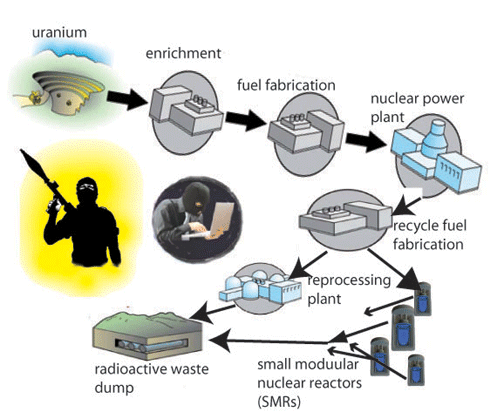 Japan to check background of nuclear workers to prevent terrorism, Kyodo News, TOKYO, Sept. 7, Kyodo Japan’s nuclear watchdog decided Wednesday to make operators of nuclear power plants and other nuclear facilities check the background of their workers to prevent terror attacks.
Following the recommendation of the International Atomic Energy Agency, the Nuclear Regulation Authority will introduce the new regulation in late September, although the actual implementation is expected to be from next year or later due to necessary procedures, such a revision of the rules regarding the handling of nuclear materials.
It is also unclear how the new measure will be effective in preventing terrorism as the operators will conduct the background checks based on information workers provide themselves, rather than by referrals to police or other law enforcement authorities….. (subscribers only) http://english.kyodonews.jp/news/2016/09/432517.html
Decrepit old nuclear facilities a safety worry in America

 Photos show nuclear facilities in dangerous disrepair By Nicole Gaouette and Barbara Starr, CNNWashington (CNN) Story highlights
- Nuclear officials describe critical utility, safety and support systems that are failing
- Many facilities date from World War II and intended to operate for as little as one decade
US nuclear security facilities are dangerously decrepit and putting national security goals at risk, according to nuclear officials who are asking Congress to back the administration’s push to modernize the system.
Dangers of Sellafield nuclear site – a concern for nearby Isle of Man
Isle of Man government ‘concerned’ about Sellafield safety, BBC News, 8 September 2016 Isle Of Man / Ellan Vannin The Manx government is “concerned” about the safety of the Sellafield nuclear site, a spokesman said.
On Monday, the BBC’s Panorama programme uncovered several safety concerns, from staffing levels to waste storage.
The Mannin Branch of the Celtic League has called on the Manx government to campaign for a full, independent inspection of the plant in Cumbria…….
The Isle of Man is located about 34 miles (55km) from the nuclear fuel reprocessing plant.
Due to its potential impact on the Manx fishing industry, the Manx government began monitoring radioactivity levels in the Irish Sea in 1989.
A government spokesman said: “Seafood fished in Manx waters can contain traces of radio-nuclides associated with effluent discharges from Sellafield to the Irish Sea, therefore these are monitored regularly to confirm that they remain well below maximum safe limits.”
The BBC investigation was prompted by a whistle-blower – a former senior manager who was worried by conditions at the plant…….http://www.bbc.com/news/world-europe-isle-of-man-37307763
1 This Month
26 September – International Day for the Total Elimination of Nuclear Weapons





PLEASE OPPOSE HR 8255 AND S.3639 – bills would accelerate satellite deployment, with no environmental review or safeguards – https://ncstd5li.quorum.us/campaign/169331/
To see nuclear-related stories in greater depth and intensity – go to https://nuclearinformation.wordpress.com
-
Archives
- September 2026 (305)
- August 2026 (330)
- July 2026 (355)
- June 2026 (287)
- May 2026 (306)
- April 2026 (356)
- March 2026 (251)
- February 2026 (267)
- January 2026 (308)
- December 2025 (358)
- November 2025 (359)
- October 2025 (375)
-
Categories
- 1
- 1 NUCLEAR ISSUES
- business and costs
- climate change
- culture and arts
- ENERGY
- environment
- health
- history
- indigenous issues
- Legal
- marketing of nuclear
- media
- opposition to nuclear
- PERSONAL STORIES
- politics
- politics international
- Religion and ethics
- safety
- secrets,lies and civil liberties
- spinbuster
- technology
- Uranium
- wastes
- weapons and war
- Women
- 2 WORLD
- ACTION
- AFRICA
- Atrocities
- AUSTRALIA
- Christina's notes
- Christina's themes
- culture and arts
- Events
- Fuk 2022
- Fuk 2023
- Fukushima 2017
- Fukushima 2018
- fukushima 2019
- Fukushima 2020
- Fukushima 2021
- general
- global warming
- Humour (God we need it)
- Nuclear
- RARE EARTHS
- Reference
- resources – print
- Resources -audiovicual
- Weekly Newsletter
- World
- World Nuclear
- YouTube
-
RSS
Entries RSS
Comments RSS

