Terror-Plagued Pakistan Just Turned On Another Nuclear Reactor, Daily Caller ANDREW FOLLETT, Energy and Science Reporter , 18 Oct 16
Pakistan’s fourth nuclear power plant began providing electricity to citizens Sunday with some help from China, despite concerns about radical Islamist groups operating in the country.
Engineers began final testing of the new 340 megawatt reactor at the Chashma Nuclear Power Plant, which is expected to reach its full capacity in December with the help of China. Local Pakistani Islamic radical groups and the Islamic State have expressed interest in stealing nuclear material from the country’s reactors to build a dirty bomb.
Nuclear (Information) Power, UCS, DAVE LOCHBAUM, DIRECTOR, NUCLEAR SAFETY PROJECT | OCTOBER 18, 2016DISASTER BY DESIGN/SAFETY BY INTENT #54
Safety by Intent
Robin Morgan wrote that “Knowledge is power. Information is power.”
Among many lessons learned from the March 1979 core meltdown at Three Mile Island was the need to collect, assess, and disseminate relevant operating experience in a timely manner. In other words, nuclear information has the power to promote nuclear safety, but only when that information is shared so as to replicate good practices and eradicate bad ones. Both the Nuclear Regulatory Commission (NRC) and the nuclear industry undertook parallel efforts after Three Mile Island to improve operating experience efforts.
NRC’s Information Sharing
The centerpiece of the NRC’s operating experience efforts is its generic communications program. The NRC instituted this program before the Three Mile Island accident, but took steps following the accident to expand the program and to shorten the time between events and advisories. The NRC also lowered the threshold used to screen the information to share more operating experience with plant owners.
The NRC has issued thousands of generic communications since the Three Mile Island accident.Bulletins and Generic Letters typically alert owners to a potential problem and require them to either confirm their facilities are not vulnerable or implement measures to reduce vulnerabilities.Regulatory Issue Summaries and Information Notices typically apprise owners about operating experience but do not require that the owners take specific actions in response.
Examples illustrating these various generic communications are:
Bulletin 2003-01, “Potential Impact of Debris Blockage on Emergency Sump Recirculation at Pressurized Water Reactors,” warned owners that a rupture inside containment of a pipe filled with steam or water could generate large amounts of debris as the high pressure fluid jetting from the broken pipe ends scoured coatings off equipment, insulation off piping, and even paint off walls…….
Generic Letter 2007-01, “Inaccessible or Underground Power Cable Failures that Disable Accident Mitigation Systems or Cause Plant Transients,” warned owners about a rash of unexpected failures of electrical cables. Many of the electrical cables had been qualified for 40 years of service, but failed before the end of their qualified lifetimes due to submergence in water. Several of the failed cables had been routed through underground metal conduits and buried concrete trenches. Groundwater or rainwater leaked into the conduits and trenches, subjecting the cable insulation to more rapid deterioration than anticipated………
Information Notice 2011-13, “Control Rod Blade Cracking Resulting in Reduced Design Lifetime,” warned owners of boiling water reactors about experience at a foreign nuclear plant. Workers discovered severe degradation of the control rods caused by irradiation-assisted stress-corrosion cracking. …….
Regulatory Issue Summary 2015-11, “Protective Action Recommendations for Members of the Public on Bodies of Water,” reminded owners of their obligations under Appendix E, “Emergency Planning and Preparedness for Production and Utilization Facilities,” to 10 CFR Part 50. Specifically, the regulatory issue summary reinforced the NRC’s expectation that owners’ emergency plan measures account for all affected members of the public whether on land or on water.
Regulatory Issue Summary 2014-12, “Decommissioning Fund Status Report Calculations—Update to Low-Level Waste Burial Charge Information,” informed owners that they could use data in Revision15 of NUREG-1307, “Report on Waste Burial Charges: Changes in Decommissioning Waste Disposal Costs at Low-Level Waste Burial Facilities,” in preparing periodic funding status reports required by 10 CFR 50.75(f). Owners are required to estimate the cost of decommissioning their facilities based on (1) labor rates, (2) energy costs, and (3) low-level waste disposal costs. The U.S. Department of Labor periodically publishes data on labor and energy costs that owners can use. The regulatory information summary identified a source of low-level waste disposal cost data acceptable to the NRC.
Nuclear Industry’s Information Sharing
The nuclear industry formed the Institute for Nuclear Power Operations (INPO) in December 1979 as part of its responses to the Three Mile Island accident. Information sharing is one of several functions performed by INPO to support the nuclear industry……..
UCS’s Disaster by Design/ Safety by Intent series of blog posts is intended to help readers understand how a seemingly unrelated assortment of minor problems can coalesce to cause disaster and how effective defense-in-depth can lessen both the number of pre-existing problems and the chances they team up.
Is Lancashire ‘at risk of nuclear contamination’? Langashire Evening Post , 12 Oct 16 Nuclear convoys carrying warheads routinely drive on the M6. If one crashed, or was attacked by terrorists, more than 260,000 people could be in danger of contamination, according to a new report. Nuclear bomb convoys on the M6 are putting more than a quarter of a million people at risk from radioactive contamination in Lancashire, according to a report by campaigners.
Anti-nuclear campaigners warn 165 schools, seven hospitals and four railway stations could all be affected if transporters carrying Trident warheads crashed along the route through the county. The International Campaign to Abolish Nuclear Weapons UK, which compiled the report, is demanding an end to the road convoys which routinely pass close to the city en route from the South of England to Scotland. It claims an accident or an explosion could pose a serious threat to people in a 10-kilometre radius. That puts Fylde coast towns and villages including Pilling, Garstang, Great Eccleston, Elswick, Inskip, Wharles, Treales, Newton, and Clifton, within the radius.
There is a fully-prepared and well-tested major incident plan for the whole of Lancashire which is co-ordinated by Lancashire County Council in partnership with Lancashire Constabulary, Lancashire Fire and Rescue Service and all Lancashire-based councils. “Yet most of the millions of people in the communities they pass by are unaware of what’s happening – and the risks they could be facing,” said the report’s author Rob Edwards. The “Nukes of Hazard” reveals that the Ministry of Defence has confirmed there were eight accidents involving nuclear weapons convoys between 1960 and 1991.
But, following Freedom of Information requests, the MoD has now revealed a further 180 “safety incidents” have happened between 2000 and 2016. The report says convoys have crashed, broken down, got lost and have suffered brake failure and other mechanical problems. “A terrorist attack on a nuclear convoy, according to the MoD, could cause considerable loss of life and severe disruption both to the British people’s way of life and to the UK’s ability to function effectively as a sovereign state. “ Convoy accidents could spread radioactive contamination over at least 10 kilometres, depending on the direction of the winds. “Hundreds of thousands of people could find their lives seriously disrupted as communities are evacuated, essential infrastructure disabled and emergency services overwhelmed. “Contamination and worries about cancer would linger for decades.”……….
The campaign group Nukewatch says the 20-vehicle convoys, made up of huge dark green trucks accompanied by military Land Rovers and police, carry warheads from a bomb factory at Berkshire to the Royal Navy armaments depot near Glasgow. The 900-mile round trip is carried out between two and six times a year and has two routes, one via Leeds and Newcastle and the other past Birmingham and Preston heading north to Glasgow. Components for the warheads are made at the Atomic Weapons Establishment (AWE) at Aldermaston in Berkshire. From there they are transferred to nearby AWE Burghfield to be assembled, before making the long road journey north to Coulport on Loch Long, north of Glasgow. At Loch Long the carriers are unloaded and the warheads placed in underground bunkers. When needed they are moved to the explosive handling jetty at Coulport and fitted into the Trident submarines………. http://www.lep.co.uk/your-lancashire/south-ribble/bamber-bridge/is-lancashire-at-risk-of-nuclear-contamination-1-8176201
On the domestic front, opposition to nuclear decision-making is silenced. Our colleagues in Ukraine, who have been voicing safety concerns, were sued in 2015 by Energoatom, Ukraine’s nuclear operator, and the state nuclear regulator joined in later. Eventually, the court backed the plaintiffs, who argued the public critique of the nuclear revival programme was inappropriate. Meanwhile, EU institutions keep on paying to support Ukraine’s aging nuclear fleet and claim to support democracy and rule of law in the country.
Nuclear proponents, Ukrainian governmental officials and the state nuclear power operator Energoatom argue these extensions are necessary. But is it really? And who benefits from the continued operation of Ukraine’s aging nuclear fleet? Continue reading →
IAEA chief: Nuclear power plant was disrupted by cyber attack, Yahoo News By Andrea Shalal, October 11, 2016 BERLIN (Reuters) – A nuclear power plant became the target of a disruptive cyber attack two to three years ago, and there is a serious threat of militant attacks on such plants, the head of the United Nations nuclear watchdog said on Monday.
International Atomic Energy Agency (IAEA) Director Yukiya Amano also cited a case in which an individual tried to smuggle a small amount of highly enriched uranium about four years ago that could have been used to build a so-called “dirty bomb”.
“This is not an imaginary risk,” Amano told Reuters and a German newspaper during a visit to Germany that included a meeting with Foreign Minister Frank-Walter Steinmeier.
“This issue of cyber attacks on nuclear-related facilities or activities should be taken very seriously. We never know if we know everything or if it’s the tip of the iceberg.”
Amano declined to give details of either incident, but said the cyber attack had caused “some disruption” at the plant, although it did not prove to be very serious since the plant did not have to shut down its operations. He said he had not previously discussed the cyber attack in public.
“This actually happened and it caused some problems,” he said, adding while the plant did not have to shut down, it “needed to take some precautionary measures.”……..
Concerns about cyber attacks on nuclear sites have grown in recent years after the emergence of computer malware that can be used to attack industrial controls. The issue flared again after Belgian media reported that the suicide bombers who killed 32 people in Brussels on March 22 originally looked into attacking a nuclear installation.
Korea Hydro & Nuclear Power Co Ltd, which operates 23 nuclear reactors in South Korea, said in 2014 it was beefing up cyber security after non-critical data was stolen from its computer systems, although reactor operations were not at risk.
In April, German utility RWE increased its security after its Gundremmingen nuclear power plant was found to be infected with computer viruses. The company said they did not appear to have posed a threat to operations.
Security experts say blowing up a nuclear reactor is beyond the skills of militant groups, but the nuclear industry has some vulnerabilities that could be exploited…..
In order to gauge the spread of radioactivity in the event of a leak, authorities need to consider the prevailing conditions, Guardian, Paul Brown, 11 Oct 16,
he way the wind is blowing at the time of a nuclear disaster is crucial to the action the authorities need to take to protect the civilian population. Among the first priorities is issuing iodine tablets to protect people’s thyroid from absorbing the radioactive particles from the fallout that may later cause cancer.
But in October 1957, when a plume of radioactivity spread out from the burning pile at Windscale in Cumbria, the reaction of the authorities was not to warn the public but to reassure them. Everything was under control. Children continued to pick potatoes in the fields surrounding the plant while the radioactivity showered down on them.
While this disaster was not quite on the scale of Chernobyl orFukushima, there was a radioactive plume that spread for hundreds of miles on a westerly wind across the north of England and deep into Europe. However, on the first day of the disaster, the wind was said to be blowing from the east, across the Irish Sea and dusting Ireland in radioactive fallout.
It remains a sensitive issue and Ireland remains implacably opposed to Britain’s continuing nuclear programme. This is partly based on the belief of those along the Irish coast, closest to Sellafield, that a spate of birth defects in the area after the fire was a result of exposure to radioactivity.
The official inquiry into the accident was later acknowledged as a whitewashdesigned to protect the UK’s atomic weapon programme. The pages for the Met Office’s October record of wind direction at the Windscale plant were missing and replaced with a note “No records, mast dismantled”.
Waste Isolation Pilot Plant sees third ceiling
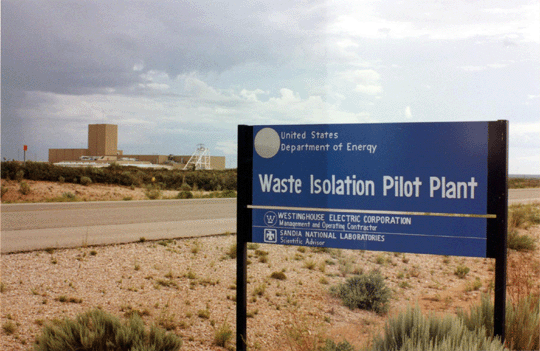
collapse, Aiken Standard, By Thomas Gardinert gardiner@aikenstandard.comOct 8 2016 New Mexico’s Waste Isolation Pilot Plant has suffered its third ceiling collapse.
The first collapse was discovered Sept. 27, and the following two happened this past week. The third collapse was identified on Friday morning and was found to have followed the cave-in earlier in the week.
According to a WIPP update sent Friday evening, the area of the collapse continues to remain restricted for workers and employees. According to SRS Watch Director Tom Clements, who has been inside the facility, material regularly comes off of the walls and ceiling.
WIPP is an underground facility, cut into salt beds. Over time, groundwater and other natural forces are designed to form the salt deposits around the waste containers. He said the facility was designed to encase the nuclear waste buried there to permanently dispose of the material…
The WIPP facility was shut down in 2014 after a containment leak and an underground salt-truck fire. The facility is set to reopen in December 2016 and shipments are expected to resume in the fall of 2017.
WIPP is the intended resting place for some of the nuclear material at South Carolina’s Savannah River Site near Aiken. The Energy Department is currently disposing of plutonium through a process called dilute and dispose. That material is among those eventually intended for WIPP disposal.
According to the WIPP update, emergency evacuation routes were also out of date. The routes were still based on the facility before sections were closed, including the areas where the cave-ins occurred. The update said, “The Department of Energy identified a deficiency in the WIPP Mine Escape and Evacuation Plan, which still relied on evacuation routes established before some areas had been posted as prohibited. NWP had identified compensatory measures – immediate changes that could be made while the Evacuation Plan is formally updated.”
What to do with radioactive waste has long been the Achilles heel of nuclear energy. Plans for storing all waste in Nevada seemed good by all the states, except Nevada. Not wanting to be the nations nuclear waste dump, the Yucca Mountain Nuclear Waste Repository site has been cancelled. Now the waste sits mainly at the plants in “temporary” storage. The steel canisters buried in thick concrete, inert gas and water are estimated to protect for a hundred years. With the radioactivity dangerous for 400,000 to a millions years, you get a good idea of just how “clean” nuclear energy is, let alone subsidize it.
Despite Three Mile Island, Daiichi Power Plant in Japan and Chernobyl, the industry still poo-poos the danger. At Chernobyl, after the initial explosion, the 185 tons of melting nuclear waste was still melting down. When it reached the water a thermonuclear explosion would have occurred. It was estimated it would have wiped out half of Europe and made Europe, Ukraine and parts of Russia uninhabitable for 500,000 years. This was prevented when three workers volunteered to dive in the radioactive water and open the valves to drain the pool and prevent a second explosion, knowing it would mean death by radioactive poisoning. They succeeded in draining the pool, but died of radiation sickness within a few weeks. Their bodies remained radioactive and were buried in lead coffins.
If a similar “incident,” as the nuclear industry insists they be called, happens in Clinton, do you think Rep. Bill Mitchell, the Clinton School Board, DeWitt County Board of any of the 700 workers or any other advocates of keeping the plant open will step forward?
Preparing the country for nuclear terrorism http://thebulletin.org/preparing-country-nuclear-terrorism9985JEROME M. HAUER Jerome M. Hauer has served in cabinet-level positions at the local and state level and as an acting assistant secretary for the Office of Public Health Emergency Preparedness at the US Department…
The candidates for president of the United States continue to discuss preventing nuclear proliferation and the threat of nuclear terrorism, yet we hear little about how well prepared the nation is to manage the aftermath of terrorist use of an improvised nuclear device. Some may think the notion of such an attack is apocryphal. So allow me to explain just how likely such a possibility is, how devastating the result of such a detonation would be, and—in particular—just how poorly prepared the United States is to respond.
In 2005, Kofi Annan, former secretary general of the United Nations, said, “Nuclear terrorism is still often treated as science fiction. I wish it were. But unfortunately we live in a world of excess hazardous materials and abundant technological know-how, in which some terrorists clearly state their intention to inflict catastrophic casualties. Were such an attack to occur, it would not only cause widespread death and destruction, but would stagger the world economy … [creating] a second death toll throughout the developing world.
In 2007, US Sen. John McCain was quoted as saying, “My greatest fear is the Iranians acquire a nuclear weapon or North Korea and pass enough highly enriched uranium (HEU) to a terrorist organization. And there is a real threat of them doing that. Just 55 kilograms, roughly 122 pounds of HEU, can be used to make a 10 kiloton IND, similar to the bomb dropped over Hiroshima.”
In 2005, Graham Allison, director of Harvard University’s Belfer Center for Science and International Affairs at Harvard University’s John F. Kennedy School of Government, asked, “Is nuclear mega-terrorism inevitable? Harvard professors are not known for being subtle or ambiguous, but I’ll try to the clear. Is the worst yet to come? My answer: Bet on it. Yes.
Matthew Bunn, also at the Belfer Center, argued in 2007, “Theft of the essential ingredients of nuclear weapons is not just a hypothetical worry, it is an ongoing reality.”
Nuclear physicist Frank Barnaby has been quoted as saying “The really frightening thing about HEU is that it is so easy to make an atom bomb out of it. You only need a couple of PhD students and a small amount of material. I think we should be very frightened about the possibility of nuclear terrorism; I’m surprised it hasn’t happened yet.”
The aftermath of a detonation of a relatively small improvised nuclear device—one that is roughly the yield of the bomb dropped on Hiroshima—in a US city would be almost unimaginably gruesome. In New York City, for example, most buildings within one quarter of a mile would be destroyed. Some 300,000 to 400,000 people would be killed instantly, with several hundred thousand more requiring various levels of medical care. Electrical and communications systems would be severely damaged, at best. And medical and other responders would face radiation dangers and a host of other problems.
In a search of both media and scholarly literature, however, I was able to find only one mention of US preparedness for nuclear terror. “The United States is unprepared to mitigate the consequences of a nuclear attack,” Pentagon analyst John Brinkerhoff wrote in a July 2005 confidential memo to the Joint Chiefs of Staff. “We were unable to find any group or office with a coherent approach to this very important aspect of homeland security.”
Several federal agencies have been aggressively working to address this deficit. The Department of Health and Human Services’ Office of the Assistant Secretary for Preparedness and Response has made significant strides in medical and public health preparedness. But much more work needs to be done across the federal behemoth.
After spending untold millions of dollars since its establishment, the Department of Homeland Security—the umbrella agency in which the Federal Emergency Management Agency resides—still does not have adequate radiation detection technology for use in the aftermath of a nuclear detonation and confuses local responders with inconsistent units of measure for radiation emitted by various nuclear isotopes. In Homeland Security advisories to first responders, the terms REM, rad, Sieverts and Gray are thrown about as if interchangeable. They’re not, and knowing the difference is important if responders are to feel and be safe in the aftermath of a nuclear blast.
Because there is such a clear history of concern about the threat of nuclear terrorism, the presidential candidates must cross the bridge from merely accepting the possibility of an attack with an improvised nuclear device, to planning an effective response that reduces the mass morbidity and mortality such an attack inevitably will cause—and then leads beyond the attack, toward recovery.
The road to preparedness. The detonation of a Hiroshima-yield improvised nuclear device in New York would level or significantly damage a significant portion of the city and instantaneously kill and maim hundreds of thousands of people. Trauma, burns, and radiation damage to organ systems are just some of the injuries that would place extraordinary demands on health care systems. In most multi-casualty incidents, there are one or two triage points where victims are taken for assessment and routing to treatment. Following a nuclear detonation in a major city, there could be need of 25 to 75 such triage points—or more—because of the vast geographical footprint of the detonation and the number of victims involved. Coordination will be difficult; much of the communication infrastructure will be demolished or rendered unusable. Moving patients to definitive care will be a monumental task and deciding which patients are triaged for medical care and which are triaged to receive end-of-life services will vary by triage point.
C. Norman Coleman and colleagues at the Department of Health and Human Services have developed criteria for establishing a triage network in the event of a nuclear explosion, but training for emergency physicians and pre-hospital care providers has not been integrated into the fabric of primary or continuing education for those responders.
Finally, studies—including research I conducted in 2012— have shown that between 30 and 50 percent of critical personnel will not be present at or be unable to travel to work in the aftermath of a nuclear detonation. Many of those non-responding responders will want to be with their families; others will fear the personal health threat of radiation.
This dismal picture of US preparation for an incident of nuclear terrorism could be improved with strong leadership at the White House, particularly from the homeland security advisor to the president. The following areas need support, both in terms of funding and in developing uniform plans for managing a nuclear incident in a major city:
Threat-based funding is important. We no longer have the luxury of giving money to buy toys—aka equipment that is unlikely to be used—to smaller cities and rural counties. Walla Walla, Washington is a lot less likely to be attacked with an improvised nuclear device than Washington, DC. But hundreds of millions of dollars have been wasted on inappropriate terrorism-response “toys” for small governments that will likely never use them. A robust, mobile medical infrastructure needs to be created—one that is capable of handling tens of thousands of patients at once. The Department of Defense will be central to any response plan developed by Health and Human Services; the White House should make certain they are cooperating on that plan—starting yesterday.
The president should request and Congress should approve additional funding for communication systems that don’t rely on the local infrastructure likely to be destroyed or heavily damaged in a nuclear terror attack. Satellite-based operability would meet the need, making a seamless transition to undamaged communication channels available in high-threat cities. Competition as to which cities are included in such a system needs to be transparent, and political gamesmanship must be discouraged. The communications issue is too central to any effective response to delay it through influence peddling.
HHS funding should be increased to accelerate research on medical countermeasures for acute radiation sickness. Such research is being conducted, but at an insufficient scale, given to potential for mass death that an improvised nuclear device poses. This research program should be the new Manhattan Project.
A commission that includes the best minds in radiation, emergency medicine, emergency medical services, the fire service, law enforcement, the Defense Department, HHS, radiation medicine, and high target states and cities should be formed to address the gaps in response plans for a nuclear detonation. That commission should finalize a report to the new president in 180 days. There is no room for delay.The report should suggest the funding required to close each gap.
A federal government structure for responding to an improvised nuclear device detonation in a major city should be completed within one year in the new administration.
I realize that the program I’ve suggested is daunting. But it’s absolutely not an insurmountable goal. Millions of lives depend on it. What is more important to an incoming administration than saving millions of lives?
What if Hurricane Matthew Hits Florida’s Nuclear Reactors?, Clean Energy Footprints, October 5th, 2016Hurricane Matthew has already caused devastation in Haiti and elsewhere in the Caribbean. Tracking this dangerous storm’s path, which Bloomberg reported as a “$15 billion threat,” as it moves towards Florida, Georgia, the Carolinas and potentially up the Eastern seaboard is proving difficult. But despite unclear predictions, communities are wisely mobilizing and calling for evacuations (or are already in the process of doing so) and/or declaring states of emergency.
Extreme weather events have widespread ramifications on our electricity systems. A Department of Energy review of responses to Hurricanes Irene and Sandy from nuclear reactors in the Northeast highlighted a number of strategies to protect the reactors. According to the Department of Energy, “Some reactors were shut as a precaution to protect equipment from the storm; others were forced to shut down or reduce power output due to damage to plant facilities or transmission infrastructure serving the plant; and still others were forced to reduce power output due to reduced power demand caused by widespread utility customer outages.”
Two nuclear power plants exist on Florida’s eastern coast: the St. Lucie and Turkey Point facilities. Based on the current National Hurricane Center projections, it appears that Hurricane Matthew will come closest to the St. Lucie nuclear facility early Friday morning. Storm surge near the St. Lucie nuclear reactors may reach 2-5 feet, and with hurricane force winds of 130 miles per hour. Meanwhile, a significant water quality problem in the Southeast is the ongoing pollution at Florida Power and Light’s (FPL) Turkey Point cooling canal system. It’s unclear what effects high winds and storm surge could have on Turkey Point’s open air industrial sewer.
After flooding caused a nuclear meltdown at the Fukushima Daiichi nuclear reactor in Japan, the Miami News Times published an article, “Five reasons Turkey Point could be the next nuclear disaster.” The article noted: “Just like in Japan, Turkey Point is susceptible to a meltdown caused by a natural disaster. A hurricane-spurred tidal surge from Turkey Point’s neighboring Biscayne Bay could create catastrophic conditions identical to those in Japan. With power down, the plant would be forced to rely on emergency diesel generators to pump water to cool the reactors….those generators would ‘certainly’ become inundated with water from the tidal surge, causing them to drown and fail.” (Southern Alliance for Clean Energy and Tropical Audubon with Friends of the Everglades filed a lawsuit this summer to resolve the pollution problem caused by Turkey Point.)……….http://blog.cleanenergy.org/2016/10/05/nuclearhurricanematthew/
Japan nuclear reactor shuttered for safety work, Channel News Asia 06 Oct 2016 TOKYO: A reactor at the centre of Japan’s national debate over nuclear power was halted on Thursday (Oct 6) under stricter post-Fukushima safety standards, as Tokyo struggles to bring back atomic energy.
Utility Kyushu Electric is shutting down the No. 1 reactor at its Sendai plant in southern Kagoshima for a few months of inspections and maintenance, leaving Japan with just two operating reactors.
But there is speculation that the reactor’s safety work could drag on longer.
Thursday’s shutdown follows demands from the region’s top politician that Kyushu Electric conduct extra safety inspections at its two operating reactors in the Sendai plant – after deadly quakes hammered a neighbouring prefecture in April.
Last month, the company refused governor Satoshi Mitazono’s demands to immediately shut down the reactors over safety concerns.
But it agreed to what it called “special inspections” in addition to regular maintenance work. Sendai’s No. 2 reactor will be shut down for a similar review starting in December………
Opposition to nuclear power has seen communities across the country file lawsuits to prevent restarts, including the Sendai plant.
the real problem is that the nuclear industry lost its credibility almost at its inception, and has never recovered. It was hastily launched, endowed with the sort of government indulgence that breeds sloppiness, and has tried to conceal its faults through secrecy and legal bluster
GIL SCOTT HERON – WE ALMOST LOST DETROIT
50 years after ‘we almost lost Detroit,’ America’s nuclear power industry faces even graver doubts, LA Times, 5 Oct 16 Michael HiltzikContact ReporterThe history of nuclear power in the United States has been marked by numerous milestones, many of them bad — accidents, construction snafus, engineering incompetence, etc., etc. One anniversary of an incident that has cast a long shadow over the nuclear power industry’s claim for safety will be marked this week. On Oct. 5, 1966 — that’s 50 years ago Wednesday — Detroit Edison’s Fermi-1 nuclear plant suffered a partial meltdown, caused by a piece of floating shrapnel inside the container vessel.
One anniversary of an incident that has cast a long shadow over the nuclear power industry’s claim for safety will be marked this week. On Oct. 5, 1966 — that’s 50 years ago Wednesday — Detroit Edison’s Fermi-1 nuclear plant suffered a partial meltdown, caused by a piece of floating shrapnel inside the container vessel. Continue reading →
Watchdog Finds Flaws in Canada’s Nuclear-Safety Practices Audit recommendations focus on documenting and on conducting site inspections WSJ, PAUL VIEIRA Oct. 4, 2016 OTTAWA—Canada’s nuclear-safety regulator is facing criticism from the country’s environmental watchdog for failing to prove it conducted adequate power-plant inspections and falling short on staffing levels.
The shortcomings were highlighted in an independent audit released Tuesday by the Canadian Nuclear Safety Commission, which is tasked with ensuring the country’s nuclear power plants are operating safely……
Canada’s commissioner of the Environment and Sustainable Development looked at the nuclear agency’s operations over a two-year period ended March 31, 2015, and focused on whether the regulator adequately managed its site inspections.
“We concluded that the (Canadian Nuclear Safety Commission) could not show that it had adequately managed its site inspections of nuclear power plants,” Commissioner Julie Gelfand wrote. The audit issued five recommendations for the regulator to improve operations, focused largely on documenting and conducting site inspections……http://www.wsj.com/articles/watchdog-finds-flaws-in-canadas-nuclear-safety-practices-1475609449
Feds Leave Radioactive Waste Stranded In Wildfire Danger
Zone http://www.mintpressnews.com/feds-leave-radioactive-waste-stranded-wildfire-danger-zone/191781/DOE announces it will not meet deadline for removal of radioactive containers held above-ground at northern New Mexico nuclear weapons lab, By Sarah LazareThe Department of Energy admitted Friday it will not meet a deadline to remove dangerous radioactive waste, currently stranded above-ground in unsafe conditions at a New Mexico nuclear weapons laboratory, before wildfire season hits.
At least 3,706 cubic meters of radioactive waste are being stored at the Los Alamos National Laboratory complex after the Waste Isolation Pilot Plant, an underground nuclear waste dump in southeastern New Mexico, was shut down indefinitely in February due to an airborne radiation leak.
Officials in New Mexico have warned that the waste at Los Alamos could be within the reach of wildfires and must be transferred elsewhere by the end of June. According to the Associated Press, “The agreement for removal of the waste by June 30 was reached after a massive wildfire lapped at the edge of lab property three years ago, raising concerns about the thousands of barrels of waste that were being stored outside.”
“The waste at Los Alamos is trapped with no place to go,” Arnie Gundersen, chief engineer and nuclear safety advocate at Fairewinds Associates, told Common Dreams.
The Los Alamos radioactive materials are “transuranic waste” that is described by the DOE as “clothing, tools, rags, debris, soil and other items contaminated with radioactive material generated during decades of nuclear research and weapons development.”
Concerns have been raised about the safety of these barrels after it was posited that changes in methods of packaging at Los Alamos, from use of inorganic to organic cat litter to absorb moisture, may be responsible for a chemical reaction with nitrate salts and set off the “heat event” behind the WIPP leak. Officials are still trying to determine the cause of the accident and are investigating the potential danger of the more than 500 nuclear waste containers originating from Los Alamos that were packed with organic cat litter.
The DOE had been sending some Los Alamos radioactive waste to a Texas facility for temporary storage until WIPP is functional. Upon discovering that Los Alamos shipments may be dangerous, the DOE halted all shipments, citing public safety.
But Gundersen warns that these barrels of waste could pose a threat in Texas and Los Alamos, where they are being stored above-ground. “It is worse in the summer, because it is hotter in the summer, and the reactions become less stable,” he said.
In a statement (pdf) released Friday, the New Mexico Environment Department said it is “disappointed, but not surprised” that the DOE will not meet its deadline to remove the waste.
Meanwhile, it is still not clear when WIPP will reopen. The facility, which was never supposed to leak, is the bedrock of the U.S. government’s current approach to dispose of military-generated plutonium-contaminated transuranic waste from decades of nuclear bomb production and testing.
Critics have warned that WIPP’s failure raises serious questions about the overall federal strategy for disposing of nuclear waste.
As for For Hinkley Point C, it now appears inevitable that the Flamanville reactor will not be completed by its target date of the end of 2020, indeed it may very well never be completed at all. Under the terms of agreement for the plant’s construction accepted by the European Commission, this would render the UK government unable to extend promised credit guarantees to HPC’s financial backers.
for EDF, Areva, their shareholders and the entire French nuclear industry, the end really could be nigh.
The problem is that parts of the vessel and its cap contain high levels of carbon, making the metal brittle and potentially subject to catastrophic failure. These key components were provided by French nuclear engineering firm Areva, and forged at its Le Creusot.
“The nature of the flaw in the steel, an excess of carbon, reduces steel toughness and renders the components vulnerable to fast fracture and catastrophic failure putting the NPP at risk of a major radioactive release to the environment”, says nuclear safety expert John Large, whose consultancy Large Associates (LA) carried out the Review.
His report examines how the defects in the Flamanville EPR reactor pressure vessel came about during the manufacturing process, and escaped detection for years after forging. It then goes on to investigate what other safety-critical nuclear components might be suffering from the same defects.
Steam generators at 28 EDF nuclear sites at risk
After several months of investigation LA found that critical components of a further 28 nuclear plants were forged by Le Creusot using the same process. These are found in the steam generators – large, pod-like boilers – that have been installed at operational EDF nuclear power stations across France.
The conclusion is based on documents provided by IRSN (the independent French Institut de Radioprotection et de Sûreté Nucléaire) that reject assurances given by both EDF and Areva that there is no safety risk from steam generators containing the excess carbon flaw.
In August 2016, IRSN warned the French nuclear safety regulator Autorité de Sûreté Nucléaire (ASN) that:
EdF’s submission was incomplete;
there is a risk of abrupt rupture which could lead to a reactor core fuel melt; and
immediate “compensatory” measures need to be put in place to safeguard the operational NPPs involved.
“As a result of Areva’s failures, a significant share of the French nuclear reactor
fleet is at increased risk of severe radiological accident, including fuel core meltdown”, said Large. ”However, there is no simple or quick fix to this problem.
“The testing and inspection regime currently underway by Areva and EDF is incapable of detecting the extent and severity of the carbon problem and, moreover, it cannot ensure against the risk of rapid component failure. It is most certain that the IRSN finding will equally applies to replacement steam generators exported by Areva to overseas nuclear power plants around the world.”
EDF reactors face protracted closure, credit rating falls
EDF stated yesterday that it will carry out further tests on 12 nuclear reactors during their planned outages in the coming months – and that extended periods of outage are to be expected. “There are outages that could take longer than planned”, an EDF spokesman told Reuters.
“In 2015, we discovered the phenomenon of carbon segregation in the Flammanville EPR reactor. We decided to verify other equipments in the French nuclear park to make sure that other components are not impacted by the phenomenon.”
In anticipation of the nuclear closures, year-ahead electricity prices rose in the French wholesale power market, forcing power rises across Europe up to a one-year high.
Meanwhile Moody’s has downgraded EDF credit ratings across a spectrum of credit instruments. EDF’s long-term issuer and senior unsecured ratings fell from A2 to A3 while perpetual junior subordinated debt ratings fell to Baa3 from Baa2. Moody’s also downgraded the group’s short-term ratings to Prime-2 from Prime-1.
According to Moody’s,
“the rating downgrade reflects its view that the action plan announced by EDF in April 2016, which includes government support, will not be sufficient to fully offset the adverse impact of the incremental risks associated the Hinkley Point C (HPC) project on the group’s credit profile.
“Moody’s believes that the significant scale and complexity of the HPC project will affect the group’s business and financial risk profiles. This is because the HPC project will expose EDF and its partner China General Nuclear Power Corporation (CGN, A3 negative) to significant construction risk as the plant will use the same European Pressurised reactor (EPR) technology that has been linked with material cost overruns and delays at Flamanville in France and Olkiluoto 3 in Finland. In addition, none of the four plants using the EPR technology currently constructed globally is operational yet.”
Once rating agencies have had time to evaluate the seriousness of EDF’s current problems with reactors packed with unsafe crirical components, further downgrades may follow. “The ratings could be downgraded if (1) credit metrics fall below Moody’s guidance for the A3 rating; or (2) EDF were to be significantly exposed to AREVA NP’s liabilities”, the agency warns.
Flamanville EPR heading for the scrapheap
The Review also shows that the reactor pressure vessel of the Flamanville EPR, which is already installed, does not have a Certificate of Conformity issued by ASN. This means that it does not comply with the European Directive on Pressure Equipment, nor does it meet the mandatory requirement of the ASN, which since 2008, stipulates that any new nuclear reactor coolant circuit component has to have a Certificate of Conformity before its production commences.
“Without a Certificate of Conformity the reactor pressure vessel and steam generators currently installed in Flamanville 3 will almost certainly have to be scrapped”, said Roger Spautz, responsible for nuclear campaign at Greenpeace France.
The review, he added, ”reveals evidence that at the Creusot Forge plant, Areva did not have the technical qualifications required to meet exacting nuclear safety standards. The plant was not under effective control and therefore had not mastered the necessary procedures for maintaining the exacting standards for quality control in the manufacture of safety-critical nuclear components.”
Areva has now acknowledged that ineffective quality controls at le Creusot Forge were mainly responsible not only for the flaws in the Flamanvile 3 EPR, but across other operational nuclear power plans – and that the technical failures date back to 1965.
Moreover, ASN has indicated that in the nuclear components supply chain three examples of Counterfeit, Fraudulent and Substandard Items (CFSI) have occurred in the year ending 2015.
The recent ASN publication (24th September 2016) of a list of the NPPs affected by the AREVA anomalies and irregularities demonstrates that the phenomenon not only has reached alarming proportions but is continuing to grow under scrutiny.
The number of components affected by irregularities and installed in NPPs in operation increased by 50 in April 2016 from 33 to 83 by 24th September this year. Irregularities affecting the Flamanville EPR increased from two to 20 over the same period.
Also at risk: Sizewell B, Hinkley C finance, Taishan EPRs
LA’s Review also relates these developments in France to the UK, specifically: the currently operating Sizewell B NPP in Suffolk; and the now contracted construction programme for the Hinkley Point C NPP.
Sizewell B which includes a number of components sourced from Le Creusot which need urgent examination and / or replacement in order to prevent unsafe operation. The fact that this could escape the UK’s nuclear regulators also indicates, says Large, that “the Office for Nuclear Regulation (ONR) did not delve deep enough into the situation as now revealed by ASN.”
As for For Hinkley Point C, it now appears inevitable that the Flamanville reactor will not be completeted by its target date of the end of 2020, indeed it may very well never be completed at all. Under the terms of agreement for the plant’s construction accepted by the European Commission, this would render the UK government unable to extend promised credit guarantees to HPC’s financial backers.
“Now that ASN has deprioritized efforts on the under-construction Flamanville 3 NPP because of its pressing urgency to evaluate the risk situation for the operating NPPs”, says Large, ”there is a greater likelihood that Flamanville 3 will not reach the deadline for operation and validation of its technology by the UK Credit Guarantee cut-off date of December 2020.”
Also at risk are the two EPRs that Areva and EDF are currently constructing at Taishan in China. These are now at the most advanced stage of any EPR projects in the world, however there are increasing fears that they contain faulty components.
The vessels and domes at Taishan were also supplied by Areva, and manufactured by the same process as that utilised by Le Creusot. It is suspected that Chinese nuclear regulators may have decided to overlook this problem and hope for the best. However if they discover that the steam generators, which along with the reactor vessels have already been installed, are also at risk of catastrophic failure, that might prove a risk too far – even for China.
The danger for EDF and Areva is that the massive commercial liabilities they may be accruing for faulty reactors supplied to third parties, together with the tens of billions of euros of capital write-downs for projects they have to abandon, and the loss of generation revenues due to plant outages, could easily exceed their entire market capitalisation.
In other words: for EDF, Areva, their shareholders and the entire French nuclear industry, the end really could be nigh.
Oliver Tickell is contributing editor at The Ecologist.