Cleanup at Idaho Nuclear Landfill on Hold After Pit Collapse https://www.usnews.com/news/best-states/idaho/articles/2017-05-18/cleanup-at-idaho-nuclear-landfill-on-hold-after-pit-collapse
Officials are trying to determine what caused the side of a pit at a nuclear waste landfill in Idaho to collapse. May 18, 2017, By REBECCA BOONE, Associated Press BOISE, Idaho (AP) — Some cleanup efforts at a nuclear waste landfill in Idaho were placed on hold while workers try to figure out what caused a collapse in a dig area that sent an excavator into a pit.
The excavator was digging up transuranic waste — which is waste contaminated with highly radioactive elements.
No radiation was released during the May 11 incident, and no one was injured, said Erik Simpson with Fluor Idaho, a contractor hired to clean up the site at the Idaho National Laboratory.
The excavator was digging at the 97-acre (392,545-sq. meter) Subsurface Disposal Area near Idaho Falls when the side of the pit collapsed.
Simpson said the excavator slid partway into the 21-foot (6 -meter) deep pit. The operator remained in his protective cab for about 90 minutes.
David Lowry’s Blog 15th May 2017 The cyber security attack on Friday has highlighted the vulnerability of UK national infrastructure to malicious cyber threats. So far it is the impact on the NHS that has hit the headlines.
But it could be far worse: what if it were our nuclear power plants that were disrupted? Next week- from 22 to 24 May – the Vienna –based World Institute for Nuclear Security (WINS) , headed by the former head of security at Sellafield, Dr Roger Howsley, is participating in the 2nd Annual Industrial Control Cyber Security Nuclear Summit, in Warrington, organised by Cyber Senate entitled with an important presentation entitled“Transformation, Preparedness and Developing Cyber Security Assurance”.
It is instructive to listen to the words of Russian cyber security expert, Eugene Kasperksy, founder and ceo of the Moscow-based Kasperksy Labs, warns governments engaged in cyber warfare that “everything you do – it’s a boomerang: it will get back to you.”
Four years ago he warned that Russian nuclear power plant infected by Stuxnet malware programme – widely believed to have been created by the US and Israel – had infected a Russian nuclear power plant.
Speaking at the Canberra Press Club 2013 in Australia’s capital city. Kasperksy recounted a story from “the Stuxnet time” when a friend of his working in an unnamed nuclear power plant reported that the plant’s computers were “badly infected by Stuxnet”. Kaspersky criticized government departments responsible for engineering cyber-attacks, The Stuxnet virus was first discovered in June 2010 and was found to specifically target industrial control systems manufactured by Siemens. The initial target of the virus is widely thought to have been the centrifuges used in Iran’s uranium enrichment programme. Although the goal of the virus was extremely specific, its method of proliferation was indiscriminate and the code has since been found on computers across the world…… http://drdavidlowry.blogspot.co.uk/2017/05/cyber-threats-you-aint-seen-nothin-yet.html
Thousands of workers were forced to shelter after a roof collapsed at a waste site created in the 1950s and mostly ignored since then, Center for Public Integrity, By Peter CaryPatrick Maloneemail, May 13, 2017
A series of warnings by state and federal experts, stretching back more than thirty years, preceded this week’s cave-in of a tunnel in Hanford, Washington, that holds lethally radioactive debris from the U.S. nuclear weapons program, according to government documents.
A report in 1980 for the Energy Department, which oversees safety and cleanup work at the site, said that wooden beams holding up the tunnel had lost a third of their strength by then. A contractor for the department pointed to the issue again in 1991, warning that by the year 2001, the beams would be further degraded.
A group of academic experts, working under contract to the department, said more alarmingly in a 1,969-page report in August 2015 that the roof of the tunnel in question had been seriously weakened and that a “partial or complete failure” could expose individuals even 380 feet away to dangerous levels of radiation.
No action was taken by the department in response, and earlier this month — the precise date remains uncertain because conditions at the site were not closely monitored — a portion of the roof collapsed at the tunnel, creating a 20-foot square hole. Afterward, the managers of the Hanford site were forced on May 9 to order 3,000 workers to shelter indoors. But instead of shoring up the beams inside the tunnel in question, they poured in 54 new truckloads of dirt.
The tunnel was one of two at the Energy Department’s Hanford reservation used as dumping grounds from 1960 to 2000 for radioactive machine parts, vessels, and other equipment. It was, in short, a tangible expression of the department’s policy of covering over some of its nuclear bomb-making detritus and effectively pretending it isn’t there.
The neglect followed a blunt warning 26 years ago from the State of Washington — cited in a 1991 Energy Department contractor’s report — that the tunnels were not a safe repository and that the wastes should be moved elsewhere.
Under an agreement overseen by a federal court in eastern Washington, the department was supposed to start crafting a way to deal with the tunnel’s lethal dangers by September 2015, but it missed the deadline and promised to do it later this year as part of an overall agreement with the state and the Environmental Protection Agency to push back completion of the site’s overall cleanup from 2024 to 2042. (Hanford remains the most toxic site in America and the government’s most costly environmental cleanup task.)…….
In the 1991 report, by Los Alamos Technical Associates, Inc., the authors made clear after conducting an internal inspection of the tunnel that the DOE knew the timbers holding up the roof had been substantially weakened as early as 1980. It predicted that by 2001, they would be at 60 percent of their original strength and recommended another evaluation in 2001. But records indicate that it never happened.
A Department of Ecology inspection in 2015 noted that because the tunnels were closed up, “no permanent emergency equipment, communications equipment, warning systems, personal protective equipment, or spill control and containment supplies” were located inside — deficiencies that could complicate emergency efforts in the case of a tunnel fire or other safety incident.
Hotspot on Unloading Equipment Reveals Failed Radiation Shielding, Beyond Nuclear 17 May 17 Savannah River Site (SRS), South Carolina— According to a U.S. federal agency document just released on Friday May 12, the first of 100-150 truckloads of highly radioactive liquid waste from Canada has been unloaded at the Savannah River Site, and the transfer container has not provided fully adequate radiological shielding to protect workers.
A document published by the Defense Nuclear Facilities Safety Board (DNFSB), a U.S. federal agency, has confirmed that the first truck shipment of “Target Residue Material (TRM),” or “liquid Highly Enriched Uranium (HEU),” arrived from Chalk River Nuclear Lab, Ontario, Canada at the U.S. Department of Energy’s (DOE) HCanyon in SRS, the week ending April 21. (The document was not made publicly available until May 12, however).
But the lifespan of rail car tunnels designed to temporarily store radioactive material is much shorter than the half-life of the waste itself, as witnessed by the 20-by-20-foot hole that was spotted above one of the caverns on Tuesday morning.
The two tunnels were built more than 50 years ago as a stopgap measure. Today, there is still no permanent solution as the cleanup drags on, with administration after administration claiming their commitment to safety as it pushes back deadlines.
The feds have spend $19 billion at Hanford, and the deadline for completion is 2060, or 115 years after the first plutonium for a nuclear explosion was produced. It’s a national embarrassment, with serious consequences for this region.
Workers are plugging the hole of the partially collapsed tunnel with a sand and soil mix. Fifty-four truckloads were dumped as of Wednesday night. No airborne radioactivity has been detected. The tunnel, constructed of wood and concrete, has stored eight rail cars filled with contaminated material since the 1960s, the Tri-City Herald reported. The other tunnel is larger, containing 28 rail cars filled with waste.
The fact that radioactive material is still being stored in such a way says everything about the failure of the federal government to come up with a permanent solution. A 2015 U.S. Department of Energy report said the tunnels were susceptible to earthquakes or deterioration, and the nearby Yakama Nation was warned, the Associated Press reported. The tribe says nothing was done.
Earlier reports also warned the tunnels would deteriorate due to time and radiation.
The state of Washington has filed a legal order outlining its expectations, including a plan for the safe storage of materials in those tunnels.
The tunnels aren’t even the worst of it. A total of 177 tanks with 56 million gallons of radioactive sludge are buried beneath Hanford and close to the Columbia River. At least 67 tanks have leaks. If the Columbia River were to be contaminated, it would be catastrophic for the entire Northwest.
The long-term plan has been to convert the waste into glass logs by a process known as vitrification. The logs would be put into permanent storage deep beneath Yucca Mountain in Nevada. But the planned $17 billion vitrification plant has been plagued by design and safety concerns. Politics has stymied the Yucca repository. Former Nevada Sen. Harry Reid, who served as Senate majority leader, blocked it.
In yet another twist, a recent Government Accountability Office report advises abandoning vitrification and encasing the waste in a cement-like mixture. It’s always something.
President Donald Trump’s initial budget increased U.S. Energy Department spending on cleanups, from $6.1 billion to $6.5 billion. New Secretary of Energy Rick Perry has much to learn about Hanford, and he will be counted on to follow up on the tunnel breach.
But it takes a truckload of faith to believe the curse will be lifted.
Intelligence community to Trump: When it comes to global warming, you’re wrong, Mashable, BY ANDREW FREEDMAN, 12 May 17 Each year the intelligence community puts together a “Worldwide Threat Assessment” report, and it inevitably scares the hell out of Congress and the public by detailing all the dangers facing the U.S. (Hint: there are a lot of them.)
This year’s report, published Thursday and discussed at a congressional hearing, makes for particularly disquieting reading.
While it focuses on the increasing danger that North Korea’s nuclear weapons program poses as well as cyberterrorism threats, one environmental concern stands out on the list: climate change. According to the new report, delivered to the Senate Intelligence Committee by Dan Coats, the director of national intelligence (DNI), warns that climate change is raising the likelihood of instability and conflict around the world.
This is surprising given the Trump administration’s open hostility to climate science findings.
“The trend toward a warming climate is forecast to continue in 2017,” the report states, noting that 2016 was the hottest year on record worldwide. Climate scientists have firmly tied this to human-caused emissions of greenhouse gases, though the report does not make that link.
“This warming is projected to fuel more intense and frequent extreme weather events that will be distributed unequally in time and geography. Countries with large populations in coastal areas are particularly vulnerable to tropical weather events and storm surges, especially in Asia and Africa,” the report states………..http://mashable.com/2017/05/11/trump-intel-report-cites-climate-change-risks/#iCN3X703iiqw
How ‘Worst-Case Scenario’ At New Brunswick Nuclear Plant Could Affect Down East Maine, Maine Public, 12 May ByJENNIFER MITCHELL Point Lepreau is a nuclear power plant just across the border in St. John. Next month its operating license expires, and the Canadian Nuclear Safety Commission is considering whether to renew it for another five years. While that’s not a long amount of time for a 30-year-old plant, there are passionate arguments for and against its operation and implications for an entire region.
This is the second of two parts. To read Part 1, a tour of Point Lepreau, click here.
Back in the 1950s, an U.S. Atomic Energy Commission film, “The Magic of the Atom,” was meant to ease the anxiety people might feel about living and working near a nuclear power plant.
“Today, if you were to take a trip in almost any direction across our great country, you might suddenly come upon a sign like this: Atomic City,” the film’s narrator says.
But after the 1979 disaster at Three Mile Island, nuclear plants developed a more sinister reputation, and ever since, facilities like Point Lepreau have been battling that legacy………
there are some who are speaking out against the facility’s license renewal.
“The health risks are too great. There is no way to make nuclear safe,” says Willi Nolan of Kent County, New Brunswick.
Nolan says she has made it her business to follow up on past major nuclear accidents, and she says the potential devastation to the environment is a deal breaker.
“I just spent some time with four survivors of Fukushima and I’m told, you know, after the worst-case scenario happened there, that there are now people dropping on the streets, 30 years old, 40 years old. We’re still not finished with Chernobyl. There are still human health effects, cancers, childhood conditions,” she says.
When it comes to a nuclear plant meltdown, there are two basic zones of concern: the critical emergency zone that extends for a 10-mile radius, and then what’s known as the ingestion pathway. That spans a 50-mile radius and, in the case of Lepreau, would include towns like Eastport, Calais, Lubec, and East Machias.
But how much do emergency responders in those towns know about nuclear events?
“Very little,” says Mike Hinerman, who runs Washington County’s Emergency Management Agency…….
the biggest problem, experts say, would come in the weeks, months and years after the event, because anything grown in or harvested from that 50-mile ingestion pathway could be tainted — for decades.
“What do you do with apples? What do you do with fish? What do you do with clams?” says Robert Gardiner, MEMA’s technological hazards manager……..a major Lepreau event would devastate the county’s economy, affecting everything from shipping at Eastport to aquaculture, forest products, fishing, tipping, hunting and tourism, and of course the region’s wild blueberries……..
Nuclear Waste From the Cold War Is Being Stored in Unsafe Conditions. Time to Fix the Problem is Running Out, TIME, Nicholas K. Geranios and Manuel Valdes / AP, May 11, 2017 (RICHLAND, Wash.) — The collapse of a tunnel containing radioactive waste at the Hanford nuclear weapons complex underscored what critics have long been saying: The toxic remnants of the Cold War are being stored in haphazard and unsafe conditions, and time is running out to deal with the problem.
“Unfortunately, the crisis at Hanford is far from an isolated incident,” said Kevin Kamps of the anti-nuclear group Beyond Nuclear.
For instance, at the Savannah River Site in South Carolina, which opened in the 1950s and produced plutonium and tritium, the government is laboring to clean up groundwater contamination along with 40 million gallons of radioactive liquid waste stored in tanks that are decades past their projected lifespan. The job is likely to take decades.
In addition to the tunnel collapse discovered Tuesday, dozens of underground storage tanks at the Hanford Nuclear Reservation in Washington state — some dating to World War II — are leaking highly radioactive materials.
The problem is that the U.S. government rushed to build nuclear weapons during the Cold War with little thought given to how to permanently dispose of the resulting waste.
Safely removing it now is proving enormously expensive, slow-going, extraordinarily dangerous and so complex that much of the technology required simply does not exist. The cleanup has also been plagued with political and technical setbacks.
For example, the nation’s only underground nuclear waste repository, in New Mexico, closed to new shipments in 2014 after an improperly packed drum of waste ruptured. The site just recently reopened.
The U.S. Department of Energy spends about $6 billion a year on managing waste left from the production of nuclear weapons. “The temporary solutions DOE has used for decades to contain radioactive waste at Hanford have limited lifespans,” said Sen. Ron Wyden, an Oregon Democrat and frequent Hanford critic. “The longer it takes to clean up Hanford, the higher the risk will be to workers, the public and the environment.”
U.S. Energy Secretary Rick Perry acknowledged the problem with nuclear waste, saying the nation can no longer delay fixing the problem because lives are at stake.
During a tour Wednesday of the Los Alamos National Laboratory in New Mexico, Perry said the federal government has failed to remove the waste in a timely manner and he pledged to make progress.
A recently approved bipartisan federal budget deal for this fiscal year includes $2.3 billion for the ongoing Hanford cleanup, which matches the amount that Sen. Patty Murray, a Washington Democrat, worked to include last year. President Donald Trump is expected to release his 2018 proposal later this month.
Washington Gov. Jay Inslee said the state plans to issue an order making sure the federal government determines the cause of the tunnel collapse. The order will also require the Energy Department to assess if there’s an immediate risk of failures in any other tunnels and take actions to safely store waste in the tunnels until a decision is made about how to permanently handle the material.
Collapsed tunnel sealed at U.S. nuclear site after accident, Chicago Tribune, Nicholas K. GeraniosAssociated Press, 11 May 17, Workers at a Washington state nuclear site where a tunnel filled with nuclear waste in railroad cars partially collapsed have safely sealed off a large sinkhole that emerged as a result of the collapse, U.S. Energy Secretary Rick Perry said Thursday.
Authorities also revealed that the 400-square foot (37-square meter) sinkhole they filled with soil could have been there since last weekend before it was discovered Tuesday. That’s because the area around the Hanford Nuclear Reservation’s waste-filled tunnels is not observed every day by workers who patrol the site’s sprawling grounds………
Washington state officials on Wednesday demanded that the federal Energy Department immediately assess the integrity of all the Hanford tunnels.
“The infrastructure built to temporarily store radioactive waste is now more than a half-century old,” said Maia Bellon, director of the state Department of Ecology, which oversees and regulates the federal government’s Hanford cleanup.
The 360-foot long (110-meter) rail tunnel that collapsed was built in 1956 from timber, concrete and steel and covered with 8 feet (2.4 meters) of dirt. Eight flatbed railroad cars loaded with radioactive material were parked there in 1965.
A much larger nearby tunnel built in 1964 has 28 railroad cars with radioactive waste.
The Energy Department was warned in a 2015 report it commissioned that both tunnels were vulnerable to a collapse from an earthquake or deterioration of tunnel building materials caused by intense radiation, the report said.
The nearby Yakama Nation said it has warned about the safety of the tunnels for several years.
“No preventative action was taken,” the tribe said in a statement.
The tribe also said the tunnels should be cleaned of radioactive waste and radiation long before a deadline of 2042 set by a cleanup agreement between the federal and state governments.
Nuclear Waste From the Cold War Is Being Stored in Unsafe Conditions. Time to Fix the Problem is Running Out, TIME, Nicholas K. Geranios and Manuel Valdes / AP, May 11, 2017 (RICHLAND, Wash.) “………Officials said they detected no release of radiation and no one was injured in the collapse, though thousands of workers were forced to take shelter for several hours as a precaution. The cause of the collapse was not immediately known.
A gravel road was built to the collapse site, and workers wearing protective suits and breathing masks planned to fill the hole with 50 truckloads of dirt, the Energy Department said.
The rail tunnel was built in 1956 out of timber, concrete and steel, topped by 8 feet of dirt. It was 360 feet long (110 meters). Radioactive materials were brought into the tunnel by railcars. The tunnel was sealed in 1965 with eight loaded flatbed cars inside.
Gerry Pollet, a Washington state legislator and longtime Hanford critic, said the collapse of a waste storage tunnel at Hanford had been feared for years.
“This disaster was predicted and shows the federal Energy Department’s utter recklessness in seeking decades of delay for Hanford cleanup,” he said.
He noted the Energy Department last year received permission to delay removing waste from the tunnels until 2042. The waste was supposed to be gone by 2024, Pollet said.
The radiation levels of the waste in the tunnel that collapsed would be lethal within an hour, Pollet said.
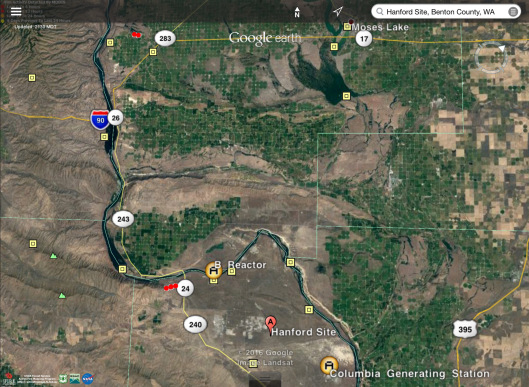
Hanford, a 500-square-mile expanse in remote interior Washington about 200 miles from Seattle, was created during World War II as part of the Manhattan Project to build the atomic bomb.
Hanford made most of the plutonium for the nation’s nuclear weapons, including the bomb dropped on Nagasaki, Japan, during the war. It now contains the nation’s greatest volume of radioactive waste left over from the production of weapons plutonium.
The cleanup there has cost $19 billion to date and is not expected to be finished until 2060, at an additional cost of $100 billion.
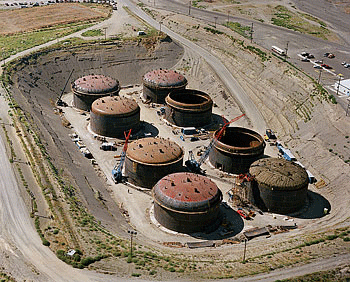
The most dangerous waste at Hanford is 56 million gallons stored in 177 underground tanks, some of which have leaked.
Plans to embed the toxic stew in glass logs for burial have floundered. Construction of a $17 billion glassification factory has stopped because of design and safety issues.
The plan is to bury the glass logs at a nuclear waste dump carved inside Nevada’s Yucca Mountain, a project that has been on the drawing board for three decades but has run into resistance from Nevada politicians, including former U.S. Sen. Harry Reid.
President Donald Trump has proposed $120 million to restart the licensing process for the dump.
Tunnel collapses at Hanford; no radiation released, officials say http://www.king5.com/news/local/hanford/tunnel-collapses-at-hanford-no-radiation-released-officials-say/438227872Hundreds of workers were told to take cover at the Hanford Nuclear Reservation after a tunnel full of highly contaminated materials collapsed Tuesday morning. But officials say no radiation was released and no workers were hurt.Officials say a collapsed patch of ground above the tunnel was larger than first believed. The U.S. Department of Energy said the collapse covered about 400 square feet (37.1 square meters) instead of the 16 square feet (1.4 square meters) first reported.
Nuclear waste storage tunnel caves-in at Hanford
Hundreds of workers were told to go into a “take cover” position after the tunnel in a plutonium uranium extraction (PUREX) plant collapsed.
The agency says the rail tunnels are hundreds of feet long, with about eight feet (2.4 meters) of soil covering them. The U.S. Department of Energy says the incident caused the soil above the tunnel to sink between 2 and 4 feet (half to 1.2 meters).
“I would underscore this is confined to a small area of the Hanford site,” Destry Henderson, deputy news manager for the Hanford Joint Information Center, told NBC News. “The facility does have radiological contamination right now but there is no indication of a radiological release,” Henderson said.
A manager sent a message to all personnel telling them to “secure ventilation in your building” and “refrain from eating or drinking.”
A source said “take cover” status was expanded to the entire site at 10:35 a.m. The source also said that crews doing road work nearby may have created enough vibration to cause the collapse, and that Vit Plant employees were in cover mode as well.
NHK World, May 1, 2017 (emphasis added): Wildfire continues in Fukushima — A wildfire has been raging for more than 2 days near the damaged Fukushima Daiichi nuclear power plant. The area is part of a zone designated as “no-entry” due to high radiation levels… Fukushima and Miyagi prefectures and the Self-Defense Forces are using helicopters to fight the blaze. They are also looking at the possibility of using ground crews. Footage from an NHK helicopter on Monday morning showed smoke rising from wide areas and fires burning in several locations
Mainichi, May 1, 2017: Wildfire rages in highly radioactive Fukushima mountain forest — A fire broke out in a mountain forest near the crippled Fukushima No. 1 Nuclear Power Plant on the evening of April 29, consuming an area approximately 20 hectares in size, according to prefectural authorities… As the fire continued to spread, however, helicopters from the GSDF, Fukushima Prefecture and other parties on May 1 resumed fire extinguishing operations from around 5 a.m. … As of May 1, there were no major changes to radiation levels in the heart of Namie and other areas near the fire scene, according to the Ministry of the Environment. “We will continue to closely watch changes in radiation doses in the surrounding areas,” said a ministry official.
Common Dreams, May 1, 2017: Sparking Fears of Airborne Radiation, Wildfire Burns in Fukushima ‘No-Go Zone’; Contaminated forests such as those outside fallout sites like Fukushima and Chernobyl ‘are ticking time bombs’ — A wildfire broke out in the highly radioactive “no-go zone” near the crippled Fukushima nuclear power plant over the weekend, reviving concerns over potential airborne radiation… Local officials were forced to call in the Japanese military… In a blog post last year, Anton Beneslavsky, a member of Greenpeace Russia’s firefighting group who has been deployed to fight blazes in nuclear Chernobyl, outlined the specific dangers of wildfires in contaminated areas. “During a fire, radionuclides like caesium-137, strontium-90 and plutonium rise into the air and travel with the wind,” Beneslavsky wrote. “This is a health concern because when these unstable atoms are inhaled, people become internally exposed to radiation.” Contaminated forests such as those outside fallout sites like Fukushima and Chernobyl “are ticking time bombs,” scientist and former regional government official Ludmila Komogortseva told Beneslavsky. “Woods and peat accumulate radiation,” she explained “and every moment, every grass burning, every dropped cigarette or camp fire can spark a new disaster.”
Sputnik News, May 1, 2017: Japanese Authorities Fighting Wildfire in Evacuation Zone Near Fukushima NPP… There were no reports either about the wind direction or the changes in the background radiation level in relation to the fire.
The plant’s operator, Nuclear Power Corporation of India Ltd (NPCIL) said the Unit-II is likely to restart on May 11.
“The unit was shut down due to steam and water leakage. We have to first cool the reactor and then set right the system,” H.N. Sahu, Site Director, KNPP told IANS over phone from Kudankulam in Tirunelveli district around 650 km from here.
The NPCIL has two 1,000 MW nuclear power plants at KNPP built with Russian equipment.
The first unit was shut down on April 13, for annual maintenance and refuelling, a process that would take around two months.
Unviable economics of nuclear power catches up with Cameco, Independent Australia, Jim Green 9 May 2017 CAMECO’S INCIDENTS AND ACCIDENTS: 1981‒2016
This table lists many of Cameco’s accidents and controversies since 1981 — leaks and spills, the promotion of dangerous radiation junk science (in WA and elsewhere) appalling treatment of Indigenous people, systemic and sometimes deliberate safety failures and so on.
Date and Location
Description of Incident
1981−89:
Saskatchewan, Canada
153 spills occurred at three uranium mines in Saskatchewan from 1981 to 1989. Cameco was fined C$10,000 for negligence in relation to a 1989 spill of two million litres of radium- and arsenic-contaminated water from the Rabbit Lake mine.
1990, May 13:
Blind River Uranium Refinery
Leak shuts down the Canadian refinery. Approximately 178 kg of radioactive uranium dust leaked into the air over a 30-hour period.
1993:
Canada/US
Inter-Church Uranium Committee from Saskatchewan reveals export of at least 500 tons of depleted uranium to the US military by Cameco, despite several Canadian treaties to export uranium only for “peaceful purposes”.
1998:
Kyrgyzstan
A truck en route to a Cameco gold main spills 2 tons of cyanide into the Barskoon River, a local drinking water and agricultural water source. 2,600 people treated and more than 1,000 hospitalized.
2001−
onwards:
Ontario
A 2003 report by the Sierra Club of Canada provides details of 20 major safety-related incidents and unresolved safety concerns at the Bruce nuclear power plant.
2002:
Kyrgyzstan
Fatality at Cameco’s Kumtor Gold Mine. Death of a Kyrgyz national, buried in the collapse of a 200 meter-high pit wall.
2003, April:
McArthur River, Saskatchewan
Cave-in and flood of radioactive water at the McArthur River mine. A consultant’s report found that Cameco had been repeatedly warned about the water hazards right up until the accident happened.
2004:
Key Lake uranium mill, Canada
Canadian Nuclear Safety Commission approves Key Lake license renewal, despite continuing pit sidewall sloughing into the tailings disposed in the Deilmann pit. One million cubic meters of sand had already slumped into the tailings.
2004, April:
Port Hope, Ontario
Gamma radiation discovered in a school playground during testing in advance of playground upgrades. Although the Canadian Nuclear Safety Commission and AECL tried to dismiss the findings, the material under the school had to be removed when it was converted to low-cost housing in 2011. The contaminated material came from the uranium processing facility in Port Hope, now owned by Cameco.
2006, April:
Cigar Lake, Saskatchewan
A water inflow began at the bottom of the 6-meter wide shaft, 392 meters below the surface. All the workers left the area and removed equipment. According to a miner, “the mine’s radiation alarm kept going off, but the radiation technician merely re-set the alarm, assuring us that everything was fine.”
2006, Oct.: Cigar Lake, Saskatchewan
Cameco said its “deficient” development of the Cigar Lake mine contributed to a flood that delayed the mine project by three years and would double construction costs.
2007:
Port Hope, Ontario
Substantial leakage of radioactive and chemical pollutants into the soil under the uranium conversion facility ‒ leakage not detected by monitoring wells.
2008:
US/Canada
Uranium mines owned by Cameco in Nebraska, Wyoming, and Canada have all had spills and leaks. Cameco made a settlement payment of $1.4 million to Wyoming for license violations, and $50,000 to Nebraska for license violations.
2008, January:
Rabbit Lake mill
Seepage underneath the mill discovered after a contract worker noticed a pool of uranium-tainted ice at an outdoor worksite.
2008, May:
Port Hope, Ontario
It was discovered during soil decontamination at the suspended Port Hope uranium processing facility that egress from degraded holding floors had contaminated the harbour surrounding the facility, which flows into Lake Ontario.
2008, June:
Key Lake
Canadian Nuclear Safety Commission intends to approve the license renewal for Cameco’s Key Lake mill although CNSC staff assigned ‘C’ ratings (“below requirements”) in four out of 10 program areas assessed, including waste management, fire protection, environmental protection, and training.
2010:
Rabbit Lake
Uranium discharges from Rabbit Lake (highest by far in Canada) showed increase rather than the predicted decrease in 2010.
2011: Ship from Vancouver to China
A number of sea containers holding drums of uranium concentrate are damaged and loose uranium is found in the hold.
2012, August:
Port Hope, Ontario
Spill of uranium dioxide powder resulted in one worker being exposed to uranium and three other workers potentially exposed during clean-up.
2012:
Northern Saskatchewan
Draft agreement between Cameco, Areva and the Aboriginal community of Pinehouse includes extraordinary clauses such as this: “Pinehouse promises to: … Not make statements or say things in public or to any government, business or agency that opposes Cameco/Areva’s mining operations; Make reasonable efforts to ensure Pinehouse members do not say or do anything that interferes with or delays Cameco/Areva’s mining, or do or say anything that is not consistent with Pinehouse’s promises under the Collaboration Agreement.”
2012, June 23: Blind River refinery, Ontario
Three workers exposed to airborne uranium dust after a worker loosened a ring clamp on a drum of uranium oxide, the lid blew off and about 26 kg of the material were ejected into the air.
2013‒ongoing: Canada
Cameco is battling it out in tax court with the Canada Revenue Agency (CRA). Up to US$1.6 billion in corporate taxes allegedly went unpaid. Cameco also involved in tax dispute with the US IRS. According to Cameco, the IRS is seeking an additional $32 million in taxes, plus interest, and may also seek penalties.
2013: English River First Nation, Canada
English River First Nation sign deal with Cameco and Areva, agreeing to support Millennium uranium mine and drop a lawsuit over land near the proposed mine. Some English River First Nation band members reacted strongly to the agreement. Cheryl Maurice said. “I am speaking for a group of people who weren’t aware that this agreement was being negotiated because there was no consultation process.”
2013, June: Saskatchewan
Federation of Saskatchewan Indian Nations Chief Perry Bellegarde says the provincial government should not issue any new permits for potash, uranium or other resource development until First Nations concerns are addressed. Bellegarde said the province’s lack of a revenue-sharing deal with First Nations stemmed from “economic racism.” “Do not issue a licence to Cameco or Areva or BHP until indigenous issues are addressed,” he said.
2013, August:
Troy, Ohio, USA
A fire occurred on a truck carrying uranium hexafluoride which originated from Cameco’s refinery in Port Hope, Ontario. Nuclear regulators in Canada – where the cargo originated – and in the US were not informed of the incident.
2013, Sept.:
Northern Saskatchewan
Sierra Club Canada produces a detailed report on Cameco’s uranium operations in Northern Saskatchewan. It details systemic corporate failure by Cameco as well as systemic regulatory failure.
2014, Jan.:
Port Hope
About 450 Port Hope homeowners have had their soil sampled and properties tested in the first phase of the biggest radioactive clean-up in Canadian history. Some 1.2 million cubic metres of contaminated soil will be entombed in a storage facility. More than 5,000 private and public properties will undergo testing to identify places which need remediation. Port Hope is riddled with low-level radioactive waste, a product of radium and uranium refining at the Eldorado / Cameco refinery. The clean-up will cost an estimated US$1.3 billion.
2014, March
A statement endorsed by 39 medical doctors calls on Cameco to stop promoting dangerous radiation junk science. The statement reads in part: “Cameco has consistently promoted the fringe scientific view that exposure to low-level radiation is harmless. Those views are at odds with mainstream scientific evidence.”
2015
A uranium supply contract was signed by Cameco and India’s Department of Atomic Energy on April 15, 2015. Nuclear arms control expert Crispin Rovere said: “As with the proposed Australia–India nuclear agreement, the text of the Canadian deal likewise abrogates the widely accepted principle that the nuclear recipient is accountable to the supplier. This is ironic given it was nuclear material diverted from a Canadian-supplied reactor that led to the India’s break-out in the first place. It would be like the citizens of Hiroshima deciding it would be a good idea to host American nuclear weapons within the city – the absurdity is quite astonishing.”
2015: Saskatchewan
Cameco’s uranium operations in Saskatchewan are facing opposition from the Clearwater Dene First Nation. A group called Holding the Line Northern Trappers Alliance has been camping in the area to block companies from further exploratory drilling in their territory. The group set up camp in November 2014 and plans to remain until mining companies leave. Concerns include Cameco’s uranium deal with India and the health effects of Cameco’s operations on the Indigenous people of northern Saskatchewan.
2015:
Key Lake mill, Canada
Cameco personnel identify the presence of calcined uranium oxide within a building. Five workers receive doses exceeding the weekly action level of 1 mSv.
2016: Smith Ranch ISL uranium mine, Wyoming, USA
The US Nuclear Regulatory Commission finds that a supervisor from Cameco subsidiary Power Resources deliberately failed to maintain complete and accurate records of workers’ exposure to radiation. The NRC issues a Notice of Violation to Cameco.
2016: Smith Ranch ISL uranium mine, Wyoming, USA
The Nuclear Regulatory Commission issued a Confirmatory Action Letter to Cameco subsidiary Power Resources documenting actions that the company has agreed to take before resuming shipments of radioactive sludge to a Utah facility. The letter followed two incidents in which containers of radioactive barium sulfate sludge, a byproduct of uranium ore processing, arrived at their destination with external contamination from leakage during transport.
Nuclear-safety concerns linger at Westinghouse plant, The STate, 8 May 17 BY SAMMY FRETWELLsfretwell@thestate.comThe U.S. Nuclear Regulatory Commission will increase scrutiny of a Columbia atomic fuel factory after nearly a year of concerns about safety and the buildup of uranium at the 48-year-old plant.
Since finding an accumulation of uranium in an air pollution control device last summer, the NRC has cited one additional violation related to the same piece of equipment in the Westinghouse nuclear fuel plant off Bluff Road, federal records show.
In the most recent case, the company potentially allowed uranium to build up for 23 hours late in 2016 in the pollution control device. Westinghouse did not properly restart nozzles on the device, known as a scrubber, that keep processed water flowing, a Jan. 27 NRC violation notice says.
That finding, to be discussed Tuesday night at a meeting in Columbia, follows the discovery months earlier that enough uranium had built up in the scrubber to have caused a small burst of radiation. No explosion occurred, but the issue was significant enough for Westinghouse to shut down part of the plant for several months while it worked to make improvements. The closed portion of the plant has since been restarted.