The government cannot guarantee Britain will have enough nuclear inspectors when it leaves the EU. The Office of Nuclear Regulation has recruited four new safeguards inspectors but says it needs more time to fill the specialised roles. Nuclear minister Richard Harrington said there was “plenty of time” to recruit the staff needed. But he stopped short of offering a firm guarantee. The government has stressed that nuclear safeguards – the processes by which the UK shows its civil nuclear material is not diverted into weapons programmes – are different from nuclear safety – the prevention of nuclear accidents. Mr Harrington said the UK was committed to leaving Euratom in March 2019. (1)
Industry figures have warned about significant disruption to energy production in the UK if there is not a new inspection regime ready to go to, to replace the one currently overseen by Euratom.
Dr Mina Golshan gave evidence on behalf of the Office for Nuclear Regulation to the Safeguards Bill Committee on 31st October 2017. (2) Dr Golshan completely ducked addressing the most important aspect of the bill, according to nuclear security expert Dr David Lowry. It is- not the operational technicalities which concern Lowry, but the diplomatic acceptability of a nation state asserting that it will replace an independent international safeguards verification regime with a self verified regime, albeit one that intends to be populated by the appropriate expertise from a current recruitment drive.
Dr Golshan also overlooked the fact the current trilateral safeguards agreement (UK-EURATOMIAEA) has an opt out of safeguards application to fissile material, under its article 14, if the Government so decides; and this has actually been done over 600 times since September 1978, when the trilateral safeguards agreement came into force. Foreign states regard this as UK ‘doit-yourself’ nuclear proliferation on an industrial scale, as comments at successive NPT review conferences attest, but ministers routinely ignore.
Department of Energy Cites Savannah River Nuclear Solutions, LLC for Worker Safety and Health Program Violation https://energy.gov/articles/department-energy-cites-savannah-river-nuclear-solutions-llc-worker-safety-and-health-0, NOVEMBER 8, 2017 WASHINGTON, D.C. – The U.S. Department of Energy (DOE) today issued a Preliminary Notice of Violation (PNOV) to Savannah River Nuclear Solutions, LLC (SRNS) for a violation of worker safety and health requirements. The violation is associated with worker retaliation by SRNS against an employee at the Savannah River Site in 2015.
DOE’s Office of Enforcement conducted an investigation following a determination by the DOE Office of Hearing and Appeals (OHA) that SRNS subjected the employee to a reprisal prohibited under the Enhancement of Contractor Protection from Reprisal for Disclosure of Certain Information Act, Title 41 United State Code, Section 4712. The OHA Decision and Order required SRNS to provide relief for the employee in the form of compensation and reinstatement.
In addition to the prohibitions specified in the Act, subjecting an employee to reprisal for expressing a workplace safety and health concern also constitutes a violation of 10 C.F.R.
Part 851, DOE’s Worker Safety and Health Program rule. The PNOV cites one Severity Level I violation of requirements enforceable under 10 C.F.R. Part 851, Worker Safety and Health Program in the area of contractor management responsibilities and worker rights. DOE proposes an escalated civil penalty of $320,000. DOE considers the safety significance of the Part 851 violation as particularly egregious given the involvement of SRNS senior management in the retaliatory act.
Section 234C of the Atomic Energy Act of 1954, as amended, authorizes the Energy Department to pursue regulatory enforcement under 10 C.F.R. Part 851 against DOE contractors for violations of worker safety and health requirements. DOE’s enforcement program encourages contractors to identify and correct worker safety and health program deficiencies at an early stage, before they contribute to, or result in more serious safety and health events.
SRNS is the management and operations contractor for the Savannah River Site located in Aiken, South Carolina.
Futurity, by Emil Venere-PurdueNovember 8th, 2017 A new system that uses artificial intelligence to find cracks captured in videos of nuclear reactors could help reduce accidents as well as maintenance costs, researchers report.
“Regular inspection of nuclear power plant components is important to guarantee safe operations,” says Mohammad R. Jahanshahi, an assistant professor in the Lyles School of Civil Engineering at Purdue University.
“However, current practice is time-consuming, tedious, and subjective and involves human technicians reviewing inspection videos to identify cracks on reactors,” Jahanshahi says.
The fact that nuclear reactors are submerged in water to maintain cooling complicates the inspection process. Consequently, direct manual inspection of a reactor’s components is not feasible due to high temperatures and radiation hazards. Technicians review remotely recorded videos of the underwater reactor surface, a procedure that is vulnerable to human error.
Checking the tape
Researchers are proposing a “deep learning” framework called a naïve Bayes-convolutional neural network to analyze individual video frames for crack detection. An innovative “data fusion scheme” aggregates the information from each video frame to enhance the overall performance and robustness of the system……..
Cracks lead to leaks
The United States is the world’s largest supplier of commercial nuclear power, which provides around 20 percent of the nation’s total electric energy. Between 1952 to 2010, there have been 99 major nuclear power incidents worldwide that cost more than $20 billion and led to 4,000 fatalities. Fifty-six incidents occurred in the United States.
“One important factor behind these incidents has been cracking that can lead to leaking,” Jahanshahi says. “Nineteen of the above incidents were related to cracking or leaking, costing $2 billion. Aging degradation is the main cause that leads to function losses and safety impairments caused by cracking, fatigue, embrittlement, wear, erosion, corrosion, and oxidation.”……..
The research team also is using deep learning to detect corrosion in photographs of metal surfaces, a technology that could potentially inspect structures such as light poles and bridges. The researchers reported the details of that work in a paper accepted for publication in the Journal of Structural Health Monitoring.
Future research will include work to further improve the technologies.
The Flagstaff City Council officially opposed the transportation of uranium ore and other radioactive materials through the city and neighboring communities at its meeting Tuesday night.
The resolution, however, will have no ability to control the route trucks hauling the material will take. At a meeting last month, City Attorney Sterling Solomon and Assistant to the City Manager Caleb Blaschke said the city is preempted from regulating the transportation of uranium ore and all hazardous materials by the U.S. Department of Transportation.
The council voted 6-1 on a resolution stating the city’s opposition to the transportation of uranium ore and reaffirming Flagstaff as a “nuclear free zone.” Councilman Scott Overton was the lone “no” vote on the resolution.
At Tuesday’s meeting, 15 members of the public, including a representative from the Havasupai Tribal Council and state Representative Wenona Benally, spoke. All public speakers voiced their support for the resolution and some asked the council to take the move a step further and craft a legally binding ordinance to stop the transportation of uranium ore through Flagstaff…….
The council also directed the city staff to lobby the federal government to change its policy preempting local control over the material’s transportation.
Members of the public, including many from a group called “Haul No,” filled the council chambers Tuesday evening and erupted into thunderous applause when the resolution passed.
Evans said other towns and cities in northern Arizona look to Flagstaff to set an example as the largest city in northern Arizona.
“I believe the legacy of uranium mining in northern Arizona is unjust,” she said.
The comments from Nuclear Regulation Authority Chairman Toyoshi Fuketa suggest Japan may not make headway in meeting its electricity generation targets. By 2030, the country was expecting nuclear to power about one-fifth of its generation. However, utilities are having difficulty grappling with tougher rules on protecting reactors from natural disasters in the earthquake-prone country.
Following the Fukushima nuclear disaster in 2011, the world’s worst since Chernobyl in 1986, the NRA was set up in 2012 to draft new safety standards that have been described as among the world’s toughest.
Since then, 12 reactors at six nuclear plants have passed the safety requirements needed to restart, but only four reactors are currently operating. One more reactor that resumed operations after meeting the requirements has been shut down for scheduled maintenance.
Most of the approvals have been for reactors in western Japan and not on the east coast where Tokyo Electric Power Company Holdings Inc.’s Fukushima No. 1 station is located. The plant suffered multiple reactor meltdowns after an earthquake on the northeast coast caused a tsunami that swamped the site.
“We have accumulated experience in safety reviews, but comparatively speaking, many of the plants in eastern Japan that we are reviewing now have difficult natural conditions,” Fuketa, 60, said in the interview. “It’s doubtful the pace of approvals would quicken.”
A majority of Japanese oppose nuclear power after Fukushima, and restarts are a delicate political issue rather than just a matter of meeting technical safety requirements.
When asked if he could place a number of how many reactors may be approved for a resumption of operations in the next five years, Fuketa said: “I honestly do not know.”
About a dozen other reactors are going through safety checks as part of a relicensing process under the new rules.
Fuketa is known for taking tough positions during safety reviews of reactors and has been instrumental in directing the clean-up of the wrecked Fukushima plant.
The government set an energy mix plan in 2015 that forecasts relying on nuclear power to generate between 20 to 22 percent of the country’s electricity in 2030. That requires having about 30 reactors operating by then.
The nation’s nine regional power utilities and a wholesaler, Japan Atomic Power Co., have 42 nuclear reactors for commercial use, with a total generating capacity of 41,482 megawatts.
TV5Monde 4th Nov 2017, [Machine Translation]The French nuclear power plant Bugey is located only
70 km from Geneva. The Swiss Federal Government of Geneva is concerned
about the obsolescence of the cooling circuits of the four reactors of this
nuclear power plant, one of the oldest in the French park. Interview with
Antonio Hidgers, Minister of Energy of Geneva. http://information.tv5monde.com/info/surete-nucleaire-geneve-s-inquiete-de-la-centrale-de-bugey-201543
I’ve always wondered: do nuclear tests affect tectonic plates and cause earthquakes or volcanic eruptions? The Conversation, Jane Cunneen Do underground nuclear tests affect Earth’s tectonic plates, and cause earthquakes or volcanic eruptions? – Anne Carroll, Victoria
Apart from escalating global fears about conflict, North Korea’s recent nuclear tests have raised questions about geological events caused by underground explosions.
Some media reports suggest the tests triggered earthquakes in South Korea. Others report the explosions may trigger a volcanic eruption at Paektu Mountain, about 100km from the test site.
So can an underground test cause an earthquake? The short answer is yes: a nuclear explosion can cause small earthquakes. But it is unlikely to affect the earth’s tectonic plates or cause a volcanic eruption.
Although a nuclear explosion releases a lot of energy in the immediate region, the amount of energy is small compared to other stresses on tectonic plates………
Earthquakes from nuclear testing
The 3 September 2017 North Korean nuclear test generated shock waves equivalent to a magnitude 6.3 earthquake. Eight minutes later, a magnitude 4.1 event was detected at the same site. This may have been linked to a collapse of a tunnel related to the blast.
Several small earthquakes measured since the event may have been induced by the nuclear test, but the largest is only a magnitude 3.6. An earthquake of this size would not be felt outside of the immediate area.
The largest induced earthquake ever measured from nuclear testing was a magnitude 4.9 in the Soviet Union. An earthquake of this size can cause damage locally but does not affect the full thickness of the earth’s crust. This means it would not have any effect on the movement of tectonic plates.
Historical data from nuclear testing (mostly in the USA) shows that earthquakes associated with nuclear testing typically occur when the explosion itself measures greater than magnitude 5, 10–70 days after the tests, at depths of less than 5km, and closer than around 15km to the explosion site. More recent studies have concluded that nuclear tests are unlikely to induce earthquakes more than about 50km from the test site……..
Monitoring nuclear tests
The Comprehensive Nuclear Test Ban Treaty Organisation (CTBTO) has a global monitoring system to detect nuclear tests, including seismometers to measure the shock waves from the blast and other technologies.
Seismologists can analyse the seismic data to determine if the shock waves were from a naturally occurring earthquake or a nuclear blast. Shock waves from nuclear blasts have different properties to those from naturally occurring earthquakes.
Testing was much more common before the CTBTO was formed: between 1945 and 1996 more than 2,000 nuclear tests were conducted worldwide, including 1,032 by the USA and 715 by the Soviet Union.
Last month, the Norwegian Nobel Committee handed a group dedicated to abolishing nuclear weapons its Peace Prize. Now, the Swedish government is looking into expanding its existing network of nuclear fallout shelters, according to news website the Local. A first proposal was included in a report released several weeks ago and followed a review of existing shelters this year, Swedish officials confirmed Friday, saying that the proposed changes were still under consideration by the government.
Sweden has 65,000 shelters, which would provide space for up to 7 million people, but that leaves an estimated 3 million inhabitants without protection.
At least one European country takes the risk of a nuclear war even more seriously: Switzerland may have fewer people than Sweden, but it has built about four times as many nuclear shelters — easily enough for the country’s entire population and then some.
In Sweden and elsewhere, the nuclear shelters are also supposed to protect the population from other hazards, like a biological weapons attack or more-conventional warfare. Often located in publicly accessible buildings, such as schools or shopping centers, they can usually also be used as storage sites or garages and are funded with taxpayer money.
In contrast, in Switzerland all houses above a certain size must include shelters in the basement, putting the financial burden on citizens themselves. That rule was abolished in 2011 by the Swiss parliament, but reintroduced months later after the Fukushima nuclear accident in Japan.
The accident brought back memories of Chernobyl in 1986, and led to a renewed public debate in Europe over the risk of radiation. In Germany — where public shelters are far less common than in Sweden or Switzerland — Chancellor Angela Merkel decided to abandon nuclear energy entirely, despite having championed it for decades. It was her biggest political U-turn in her now 12 years in office.
Such preparations and protective measures may appear strange to Americans. Public nuclear shelters are practically nonexistent in the United States, although there have been recent reports of an increase in demand.
Until recently, few Swedes knew the location of the closest nuclear shelter in their neighborhood. (The government now offers an online map.) Sweden stopped expanding its shelter network almost two decades ago, when nonproliferation supporters appeared to be on the winning side of history. Then came Iran’s nuclear program, the Fukushima accident, Russian military operations, North Korea’s missile tests — and President Trump.
Whereas confidence among Europeans that President Barack Obama would “do the right thing regarding world affairs” ranged between 70 and 90 percent in a number of surveyed nations during his term, those numbers plummeted after Trump’s inauguration and have only gone down since. Only 7 percent in Spain and 11 percent in Germany now say they have confidence in Trump. Top officials in Germany have also directly contradicted Trump’s North Korea policies, and have voiced concerns that the White House may overreact to nuclear provocations and escalate the war rhetoric being exchanged with North Korea.
Europeans are similarly worried that decades-long nonproliferation efforts could be dismantled virtually overnight, leading to a new arms race. In 2009, the Obama administration negotiated a treaty with Russia in which both countries agreed to cap the number of deployed warheads. Trump reportedly called the agreement a bad deal in his first phone call with Russian President Vladimir Putin earlier this year, although administration officials have since backtracked.
Sweden’s new shelter locations indicate that at least some of the concerns are connected to Russia. One of the regions where most new shelters are expected to be constructed in the coming years is the island of Gotland, where military defenses were recently expanded with the declared aim of stopping a possible Russian invasion.
Asia Times 30th Oct 2017, Shaun Burnie: The global nuclear industry developed over the past fifty
years dependent upon vast quantities of steel components supplied by a relatively small number of specialized manufacturers. One of them is Kobe Steel Ltd.
The steelmaker, a pillar of corporate Japan, is embroiled in the early days of disclosure of falsification of steel manufacturing data that extends to products used in planes and trains, to motor vehicles and spacecraft.
And nuclear power plants. Kobe Steel and its broad collection of subsidiaries have supplied products to the nuclear industry both in Japan and around the world since the 1960’s. It’s a fair bet that every one of the 60 nuclear reactors operated in Japan since 1966 had some component supplied by Kobe Steel. http://www.atimes.com/article/nuclear-tentacles-kobe-steel/
Washington Post 1st Nov 2017, About 20 miles from Armenia’s capital city of Yerevan sits the antiquated
Metsamor nuclear power plant. The plant (located in a town also called
Metsamor) has long been a cause for concern for at least two reasons: It
was built without containment vessels, and it sits in a seismic zone.
In fact, it was closed in 1989 after a devastating earthquake hit nearby. In
2011, National Geographic even suggested that it might be the world’s
most dangerous nuclear plant. According to a 1995 Washington Post article,
the plant was reopened because Armenia was desperate to have energy after
its neighbor, Azerbaijan, imposed an energy blockade. According to the
article, back then, “As many as one-third of Armenia’s 3.6 million
people have left, for months at a time or longer, because winters are
unbearable and factories stand idle.”
The collapse happened at the Punggye-ri nuclear test site in the northeast of the country on October 10, according to Japan’s TV Asahi. The disaster has prompted fears of a massive radioactive leak which could spark a Chernobyl- or Fukushima-style disaster, The Sun reported.
A North Korean official said the collapse happened during the construction of an underground tunnel, South Korea’s Yonhap news agency reports.
Some 100 people are said to have been trapped by the initial tunnel collapse, with a further 100 lost in a second collapse during a rescue operation, Asahi reported.
Lee Eugene, a spokeswoman at South Korea’s unification ministry, said: “We are aware of the report but do not know anything about it.”
The accident is believed to have been caused by Kim Joing-un’s sixth nuclear test which weakened the mountain, according to the report. It was reported earlier this year that the mountain under which the base is believed to be hidden was at risk of collapsing and leaking radiation into the region.
Experts said if the peak crumbles, clouds of radioactive dust and gas would blanket the region, the South China Morning Post reported.
The Punggye-ri test site is carved deep into the side of Mount Mantap. Geophysicist Wen Lianxing and his team at the University of Science and Technology of China in Hefei, Anhui province, said they were “confident” underground detonations were occurring underneath the mountain.
They posted an analysis of data collected from more than 100 seismic monitoring sites across China.
This has narrowed down the location of Pyongyang’s nuclear tests with a margin of error of just 100m. They’ve all been under the same mountain.
Seismic data showed the underground test triggered an earthquake of magnitude 6.3, around 10 times more powerful than the fifth test a year ago.
Satellite images showed the blast caused numerous landslides around the Punggye-ri test site, according to the Washington-based 38 North monitoring project.
But Chinese nuclear weapons researcher and chair of the China Nuclear Society Wang Naiyan told the Morning Post a collapse could spark a major environmental disaster.
He said: “We call it ‘taking the roof off’. If the mountain collapses and the hole is exposed, it will let out many bad things.
“A 100 kiloton bomb is a relatively large bomb. The North Korean government should stop the tests as they pose a huge threat not only to North Korea but to other countries, especially China.”
Satellite photos taken just a day after the blast reveal new gravel and scree fields shaken loose by the blasts at an elevation of about 2205m.
Analysts said these appeared more numerous and widespread than those caused by previous detonations — which would be in keeping with the increased size of the bomb.
Wang said there are limited mountains in North Korea that are “suitable” to conduct a nuclear test.
He said if the North had simply drilled into the side of the mountain, this increased the risk of “blowing the top off”.
News of the tunnel collapse comes after it emerged Russia and the US have both flown nuclear bombers near the country as tensions grow over Kim’s nuke threats.
Nuclear devices are often tested underground to prevent radioactive material released in the explosion reaching the surface and contaminating the environment.
This method also ensures a degree of secrecy.
A test site is carefully geologically surveyed to ensure suitability — usually in a place well away from population centres.
The nuclear device is placed into a drilled hole or tunnel usually between 200-800m below the surface, and several metres wide.
A lead-lined canister containing monitoring equipment is lowered into the shaft above the chamber.
The hole is then plugged with gravel, sand, gypsum and other fine materials to contain the explosion and fallout underground.
The release of radiation from an underground nuclear explosion — an effect known as “venting” — would give away clues to the technical composition and size of a country’s device.
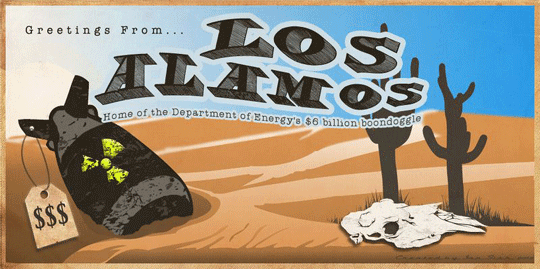
IT’S known as the birthplace of the atomic bomb. But a letter written to the bomb’s laboratory has us all extremely concerned. Matt Young@MattYoung, IN 2011 something alarming happened at a United States nuclear weapons laboratory that was deliberately kept quiet.
According to The Centre for Public Integrity, a pair of workers with “cavalier attitudes” at the Los Alamos National Laboratory stuffed “so much plutonium into a small space that they came close to triggering an accidental nuclear chain reaction, all to get some photos”.
“Plutonium is the unstable, radioactive, man-made fuel of a nuclear explosion, and it isn’t amenable to showboating,” it said. “When too much is put in one place, it becomes ‘critical’ and begins to fission uncontrollably, spontaneously sparking a nuclear chain reaction, which releases energy and generates a deadly burst of radiation.”
And it gets much, much worse.
Los Alamos National Laboratory in Santa Fe, New Mexico — responsible for the design of nuclear warheads — was a top secret facility during World War II and the birthplace of the atomic bomb.
But it is in a state of chaos — in fact, it has been for years.
A damning letter by the Defense Nuclear Facilities Safety Board, released this week and seen by news.com.au, said it had found “numerous weaknesses” in the lab’s safety standards dating back to 2014.
It had also failed recent safety tests indicating how it would respond to an emergency including radioactive leaks or earthquakes.
Referred as Project Y after it was established in 1943, the laboratory was one of a series of top secret labs in the United States given codewords to maintain secrecy at the time.
It was known as the “heart” of the nuclear project and was primarily responsible for the Manhattan Project, which developed the first ever nuclear weapons. The scientists within its labs were responsible for the creation of several atomic bombs, including the Fat Man, which was detonated in the Japanese city of Nagasaki in August, 1945.
It is also responsible for the hydrogen bomb.
Since the end of WWII, the lab continued its focus on bomb designs. It is still open today and is one of the largest science and technology institutions in the world with a focus on national security, space exploration and nuclear fusion, among other “non-war” technology.
“Though the world is rapidly changing, this essential responsibility (nuclear) remains the core mission,” it states on its website.
It is also “responsible for the safety, security, and effectiveness of the nuclear explosive packages in the stockpile”.
But over the years, more and more mistakes have begun to leak from its labs, with critical, radioactive material breached, dumped and mishandled.
Last week, the US Department of Energy, which is responsible overseeing the United States’ nuclear arsenal, put out a final request for proposals to manage the site.
British navy sailors on nuclear Trident submarine fired after failing drug tests, ABC News, 29 Oct 17,Britain’s navy has fired nine sailors serving on a nuclear-armed submarine after they tested positive for cocaine, the country’s defence ministry says.
The crew were from HMS Vigilant, one of four Royal Navy submarines which operate the Trident nuclear missile system.
“We do not tolerate drugs misuse by service personnel. Those found to have fallen short of our high standards face being discharged from service,” a Royal Navy spokesman said.






 nuclear-news