Extreme caution needed, as controlled explosions of chemicals are continued at Sellafield nuclear facility
Bomb disposal experts are continuing controlled explosions of chemicals at
the Sellafield nuclear reprocessing plant. It follows a routine audit of
chemicals stored in a laboratory. The Army’s explosive ordnance disposal
team have been on-site since last weekend dealing with a canisters of
solvents present since 1992.
Sellafield Ltd said there were concerns they
could become hazardous if exposed to oxygen. A spokeswoman said the
solvents are “widely used in industry” but “extreme caution” is being
exercised. The disposal will continue over the weekend with the site
operating as normal with the exception of the laboratory.
http://www.bbc.co.uk/news/uk-england-cumbria-41783748
Japan Atomic Power Co. wants to extend life span of nuclear station near Tokyo

 Operator set to request 20 years extra for Tokai nuclear plant http://www.asahi.com/ajw/articles/AJ201710270036.html, THE ASAHI SHIMBUN, October 27, 2017 Japan Atomic Power Co. is preparing to apply for a 20-year extension to operate the aged Tokai No. 2 nuclear plant beyond its 40-year life span, sources said.
Such an extension would be the first among Japan’s aged boiling-water reactors, which include those at the crippled Fukushima No. 1 nuclear power plant.
Tokai No. 2 nuclear plant’s reactor, which went into service in 1978, is in a heavily populated area not far from Tokyo.
The company deems the 20-year extension of the plant in Tokai, Ibaraki Prefecture, as imperative to securing a stable revenue stream, the sources said.
However, the plan is expected to bring a host of challenges to the operator.
One is how to secure funds so as to cover the costs to improve safety at the old facility required under the more stringent nuclear regulations set after the 2011 Fukushima disaster.
Another is to ease concerns of local governments of the area where nearly 1 million residents could be affected in the event of a serious accident.
The move toward the extension comes as the Nuclear Regulation Authority is set to rule that the plant has met standards set in the new regulations necessary for a restart, the sources said.
The Tokai No. 2 plant, about 120 kilometers from the heart of the capital, houses one unit capable of generating 1.1 gigawatts.
If Japan Atomic Power proceeds with its plan to apply for the extension, it needs to submit the application to the NRA by Nov. 28.
The Tokai No. 2 plant narrowly escaped a catastrophe like the one at the Fukushima No. 1 nuclear plant when it was struck by the magnitude-9.0 Great East Japan Earthquake and tsunami on March 11, 2011.
It took Japan Atomic Power three and a half days to shut the reactor down when the disaster knocked out power. One of the three emergency generators installed there became dysfunctional after they were submerged by tsunami.
Some experts said it could have become impossible to keep cooling the reactor if the tsunami had been 70 centimeters higher.
Japan Atomic Power is keen to extend the operation of the Tokai No. 2 nuclear plant as the facility is the only venue that will feasibly bring it revenue. It has no option but to apply for the extended operation,” said an official familiar with the management of the company.
Apart from the Tokai No. 2 nuclear plant, Japan Atomic Power owns three other reactors: one at the Tokai nuclear plant, also in Tokai, and two at the Tsuruga nuclear plant in Tsuruga, Fukui Prefecture.
The one at the Tokai nuclear plant and one unit at the Tsuruga nuclear plant are on their way to being decommissioned.
Prospects for whether the company can win approval for a restart of the remaining reactor at the Tsuruga nuclear plant are bleak, as it has been reported that the facility was likely built on an active seismic fault.
If the company pulled the plug on the Tokai No. 2 nuclear plant, it would mean that it would be left with no revenue sources.
That expected management crisis could likely affect the bottom line of utilities such Tokyo Electric Power Co., the operator of the Fukushima No. 1 nuclear plant, which has a stake in Japan Atomic Power.
The Tokai No. 2 nuclear plant supplies power to TEPCO and Tohoku Electric Power Co., and although extending its operation would keep those revenue sources open, it would also come with a huge price tag.
The company said Oct. 26 that the estimated costs of the safeguarding measures for a restart of the plant will balloon to about 180 billion yen ($1.58 billion), more than double the 78 billion yen projected initially.
The total sum is expected to further increase if Japan Atomic Power chooses to operate the plant beyond the 40-year limit, according to the sources.
The plant’s extended operation could prove to be a big headache for local governments nearby.
Municipalities within a 30-kilometer radius are required to draw up evacuation plans to prepare for a contingency in the post-Fukushima crisis years.
Hammering out workable plans for close to 1 million residents in the area is expected to be difficult, the sources said.
Even the Ministry of Economy, Trade and Industry, which oversees the nuclear industry, is cautious about the extension.
“The consequences would be too enormous if an accident did occur,” said a ministry official.
(This story was written by Tsuneo Sasai and Yusuke Ogawa.)
False data on nuclear equipment from Kobe Steel – sent to Japanese company
 Kobe Steel sent products with tampered data to nuclear companies, Cars, trains, planes … and nuclear facilities. REUTERS, Oct 27th 2017 TOKYO — Kobe Steel supplied parts with false specifications for nuclear equipment owned by Japan Nuclear Fuel Ltd, JNFL said on Friday, adding that the products were not used.
Call to Japan’s nuclear regulator to investigate potentially flawed Kobe Steel products in the Japanese nuclear industry
Greenpeace 25th Oct 2017, Japan’s nuclear regulator must take urgent action to launch a
comprehensive investigation into the supply and widespread use of
potentially flawed Kobe Steel products in the Japanese nuclear industry,
Greenpeace and five other NGOs demanded today.
The groups submittedanalysis of Kobe Steel’s supply chain to the nuclear industry together
with a demand letter to The Nuclear Regulation Authority (NRA) commissioner
Toyoshi Fuketa on 24 October.
http://www.greenpeace.org/japan/ja/news/press/2017/pr201710251/
Concern over condition of France’s aging nuclear reactors: 20 of the 58 currently shut down
 Reporterre 23rd Oct 2017, [Machine Translation] To date, 20 reactors out of 58 of the French nuclear fleet are shut down. Many are expected to restart by the end of November, but their aging and general condition is worrying.
Reporterre takes stock with a map detailing the situation of each plant. Winter will be tough for
French nuclear power plants. This Monday, October 23, 20 of their reactors are stopped. Of these, at least 8 were put to rest because of a malfunction or a safety problem. On the others, many are currently undergoing maintenance that also seek to repair the anomalies that accumulate in recent years.
A situation highlighted by Reporterre in a map detailing the central location by central. Last malfunction, the Nuclear Safety Authority (ASN) unveiled in mid-October that the cooling pumps of 29 nuclear reactors were affected by significant corrosion. In case of earthquake or flood, the
pipes could yield. This is one of the causes of the Fukushima accident. According to the ASN, the renovation of the ducts was started immediately on all the reactors, but these will require more complete repairs before being totally secure.
https://reporterre.net/CARTE-EXCLUSIVE-Les-deux-tiers-du-parc-nucleaire-francais-en-panne-ou-a-l-arret
With North Korean missiles, Japan’s nuclear sites form a terrible danger, of possible accident
Nuclear plants, the Achilles heel in missile tests, remain exposed, By HIROYUKI KAWAI/ The Asahi Shimbun October 24, 2017 North Korea’s missile launches have prompted the government to issue alerts on TV and mobile phones, urging people to take cover in case something goes wrong.
But one puzzling question is why the government has not addressed the risks of keeping nuclear power plants in operation even when missiles are flying over Japan.
North Korea test-fired ballistic missiles 15 times last year and 13 so far this year.
In August, Pyongyang announced plans to fire intercontinental ballistic missiles over the prefectures of Shimane, Hiroshima and Kochi before they splash down in waters around the U.S. territory of Guam.
Instead, North Korea’s latest missile, fired on Aug. 29, flew over Hokkaido, Japan’s northernmost main island, and fell into the western Pacific Ocean………
The Japanese government has issued orders to intercept North Korea’s missiles, citing the need to safeguard people’s lives and assets against projectiles falling on Japanese territory. The government is on alert around the clock to issue such orders.
Evacuation drills have been staged in many regions.
When the J-Alert warning was issued soon after North Korea’s missile launches to urge people to take precautions, subway and Shinkansen bullet train services were suspended in some regions.
However, despite this state of high alert, nuclear power plants remain online.
While stressing the missile threat from North Korea, the government has made no mention of the danger to nuclear power plants.
An attack against a nuclear power plant could bring catastrophic consequences.
Experts say the operation of a single reactor for one year produces a level of radioactive material equivalent to 1,000 of the atomic bomb dropped on Hiroshima.
The destruction of a nuclear plant in a missile strike could put the nation’s very survival at stake.
That is why nuclear power plants are likened to nuclear warheads for potential adversaries……..
Even if a nuclear reactor completes an emergency shutdown after a missile launch is confirmed, the nuclear facility’s safety is not guaranteed.
The collapse of other nuclear plant components by a missile would present a formidable challenge for plant operators in dealing with decaying heat from nuclear fuel in the reactor. Averting a meltdown would be almost impossible under these circumstances as was demonstrated by the 2011 Fukushima disaster.
If a missile directly hit a nuclear reactor, we would all know what to expect.
The vulnerability of nuclear plants in light of a possible missile attack has been pointed out in a lawsuit demanding the suspension of operations at a nuclear facility.
When the presiding judge asked the utility the reason for not halting the plant, the company could not provide an immediate response.
North Korea is fully aware that Japan’s Achilles heel in national defense is its nuclear power plants…… If there exists even a 1 percent risk of conflict, nuclear power plants should be taken off-line as a safeguard measure. That is about ensuring the nation’s security…. http://www.asahi.com/ajw/articles/AJ201710240001.html
Call to get rid of radioactive redundant nuclear submarines from Scottish dockyard
Dundee Courier 24th Oct 2017,Radiation levels around Rosyth dockyard increased last year according to
the latest monitoring report. Levels across the UK were well within dose
limits, said the Scottish Environment Protection Agency (SEPA) following
the publication of its Radioactivity in Food and the Environment (RIFE 22)
Report.
However, local SNP MSP Douglas Chapman has made a renewed call for
the “excruciatingly slow” timescale for dismantling Rosyth’s seven
redundant nuclear submarines to be hastened. Mr Chapman, said: “It’s
encouraging that SEPA’s latest report shows radioactivity doses are well
within limits.
“However, Rosyth should not be a sanctuary for toxic
submarines and this is something I have raised in Parliament as
constituents are fed-up with the subs rotting in their own backyard. Yes,
they are to be dismantled and removed, but the timescale is excruciatingly
slow. “‘I’m encouraging SEPA to progress its work with the MoD to
manage the area effectively and help rid Rosyth of the subs so that the
space in the dockyard basin can be used for more economically productive
uses.”
Stresses on North Korea’s nuclear test mountain – becoming unstable?
After six tests, the mountain hosting North Korea’s nuclear blasts may be exhausted, SMH, Anna Fifield, 21 Oct 17 Tokyo: Have North Korea’s nuclear tests become so big that they’ve altered the geological structure of the land?
Some analysts now see signs that Mount Mantap, the 2200-metre-high peak under which North Korea detonates its nuclear bombs, is suffering from “tired mountain syndrome”.

The mountain visibly shifted during the last nuclear test, an enormous detonation that was recorded as a 6.3-magnitude earthquake in North Korea’s northeast. Since then, the area, which is not known for natural seismic activity, has had three more quakes.
“What we are seeing from North Korea looks like some kind of stress in the ground,” said Paul G Richards, a seismologist at Columbia University’s Lamont-Doherty Earth Observatory.
“In that part of the world, there were stresses in the ground but the explosions have shaken them up.”
Chinese scientists have already warned that further nuclear tests could cause the mountain to collapse and release the radiation from the blast.
North Korea has conducted six nuclear tests since 2006, all of them in tunnels burrowed deep under Mount Mantap at a site known as the Punggye-ri Nuclear Test Facility. Intelligence analysts and experts alike use satellite imagery to keep close track on movement at the three entrances to the tunnels for signals that a test might be coming.
After the latest nuclear test, on September 3, Kim Jong Un’s regime claimed that it had set off a hydrogen bomb and that it had been a “perfect success”.
After the latest nuclear test, on September 3, Kim Jong Un’s regime claimed that it had set off a hydrogen bomb and that it had been a “perfect success”.
Images captured by Airbus, a space technology company that makes earth observation satellites, showed the mountain literally moving during the test. An 85-acre area on the peak of Mount Mantap visibly subsided during the explosion, an indication of both the size of the blast and the weakness of the mountain.
Since that day, there have been three much smaller quakes at the site, in the 2 to 3 magnitude range, each of them setting fears that North Korea had conducted another nuclear test that had perhaps gone wrong. But they all turned out to be natural.
If the mountain collapses and the hole is exposed, it will let out many bad things.
Wang Naiyan, former chairman of the China Nuclear Society
That has analysts Frank V. Pabian and Jack Liu wondering if Mount Mantap is suffering from “tired mountain syndrome”, a diagnosis previously applied to the Soviet Union’s atomic test sites.
“The underground detonation of nuclear explosions considerably alters the properties of the rock mass,” Vitaly V. Adushkin and William Leith wrote in a report on the Soviet tests for the United States Geological Survey in 2001. This leads to fracturing and rocks breaking, and changes along tectonic faults.
Earthquakes also occurred at the US’ nuclear test site in Nevada after detonations there.
“The experience we had from the Nevada test site and decades of monitoring the Soviet Union’s major test sites in Kazakhstan showed that after a very large nuclear explosion, several other significant things can happen,” Richards said. This included cavities collapsing hours or even months later, he said.
Pabian and Liu said the North Korean test site also seemed to be suffering.
“Based on the severity of the initial blast, the post-test tremors, and the extent of observable surface disturbances, we have to assume that there must have been substantial damage to the existing tunnel network under Mount Mantap,” they wrote in a report for the specialist North Korea website 38 North.
But the degradation of the mountain does not necessarily mean that it would be abandoned as a test site – just as the United States did not abandon the Nevada test site after earthquakes there, they said. Instead, the US kept using the site until a nuclear test moratorium took effect in 1992.
For that reason, analysts will continue to keep a close eye on the Punggye-ri test site to see if North Korea starts excavating there again – a sign of possible preparations for another test.
The previous tests took place through the north portal to the underground tunnels, but even if those tunnels had collapsed, North Korea’s nuclear scientists might still use tunnel complexes linked to the south and west portals, Pabian and Liu said.
Chinese scientists have warned that another test under the mountain could lead to an environmental disaster. If the whole mountain caved in on itself, radiation could escape and drift across the region, said Wang Naiyan, the former chairman of the China Nuclear Society and senior researcher on China’s nuclear weapons programme.
“We call it ‘taking the roof off’. If the mountain collapses and the hole is exposed, it will let out many bad things,” Wang told the South China Morning Post last month……http://www.smh.com.au/world/after-six-tests-the-mountain-hosting-north-koreas-nuclear-blasts-may-be-exhausted-20171021-gz5ixm.html
Sellafield authorities play down the seriousness on chemical emergency at nuclear reprocessing site

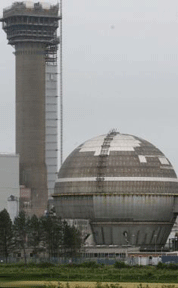 Times 22nd Oct 2017, The emergency removal of unstable chemicals from Sellafield yesterday hasraised fresh concerns over safety at the nuclear site.
Army bomb disposal specialists were called to the nuclear fuel reprocessing plant in Cumbria
after a routine audit found canisters of potentially explosive solventsdating back to the early 1990s.
Officials sought to reassure the public that it was “not a radiological event” and that the solvents had been
safely destroyed in two controlled explosions. However, one expert who
spoke on condition of anonymity claimed that although the solvents were not
radioactive they had been kept in the main laboratory near far more
dangerous materials. “This substance was in a dangerous oxidised state and
if it had exploded in that location it had the potential to distribute
radioactive material over the site and beyond,” the engineer said.
“Sellafield appears to be downplaying the severity of it to the public.”
The chemicals are understood to include tetrahydrofuran, an organic solvent
that can become unstable when exposed to air. Sellafield Ltd, part of the
government’s Nuclear Decommissioning Authority, said that after the
disposal the site was “working as it would be on any other Saturday“.
https://www.thetimes.co.uk/edition/news/sellafield-chemicals-scare-defused-by-army-98pkzxcln
Cyberattacks targeting nuclear facilities, an increasing threat
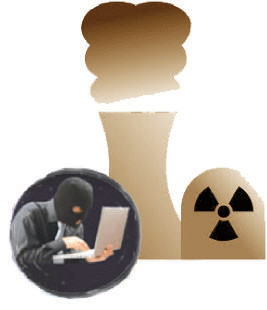
 U.S. says cyberattacks have targeted nuclear, energy, aviation, water and critical manufacturing industries, Japan Times, 21 Oct 17 REUTERS TORONTO/HOUSTON – The U.S. government issued a rare public warning that sophisticated hackers are targeting energy and industrial firms, the latest sign that cyberattacks present an increasing threat to the power industry and other public infrastructure.
The Department of Homeland Security and Federal Bureau of Investigation warned in a report distributed by email late on Friday that the nuclear, energy, aviation, water and critical manufacturing industries have been targeted along with government entities in attacks dating back to at least May.
The objective of the attackers is to compromise organizational networks with malicious emails and tainted websites to obtain credentials for accessing computer networks of their targets, the report said.
U.S. authorities have been monitoring the activity for months, which they initially detailed in a confidential June report first reported by Reuters. That document, which was privately distributed to firms at risk of attacks, described a narrower set of activity focusing on the nuclear, energy and critical manufacturing sectors……..
The report said the attacker was the same as one described by Symantec in a September report that warned advanced hackers had penetrated the systems controlling operations of some U.S. and European energy companies……https://www.japantimes.co.jp/news/2017/10/22/world/u-s-says-cyberattacks-targeted-nuclear-energy-aviation-water-critical-manufacturing-industries/#.We0JJI-CzGg
Danger of military explosives, depleted uranium weaponry flying in and out of Ireland airport
 US Military Cargo, Explosives, Depleted Uranium Weaponry Transit through Ireland’s Shannon Airport https://www.globalresearch.ca/us-military-cargo-explosives-depleted-uranium-weaponry-transit-through-irelands-shannon-airport/5613597
Chemical incident at UK’s Sellafield nuclear station: plutonium kept in degrading plastic bottles
 Evacuations after emergency at UK nuclear plant, explosives experts rush to scene, BOMB disposal specialist have been called to the Sellafield nuclear plant to deal with a chemical incident. Sunday Express, By SIMON OSBORNE, Oct 21, 2017 “…….Initial reports suggest the incident involved five bottles containing a number of non-nuclear chemicals. …..”An operational decision will be taken in due course on how best to dispose of the material.”
Sellafield reprocesses and stores nearly all of Britain’s nuclear waste.
There have been safety concerns at the plant after a tip-off from a whistleblower, including allegations of inadequate staffing levels and poor maintenance.
The programme discovered that liquid containing plutonium and uranium has been kept in thousands of plastic bottles for years. The bottles were only intended for temporary storage and some of them are degrading.
Researchers were was also told that parts of the facility are dangerously rundown.
Sellafield insisted the site in Cumbria is safe and has been improved with significant investment in recent years. http://www.express.co. uk/news/uk/869238/sellafield- nuclear-reprocessing-plant- chemical-alert-bomb-disposal- experts
Seaweed clogging up cooling system of EDF’s Hunterston B nuclear station in Scotland
Largs and Millport News 20th Oct 2017, A seaweed solution is being sought by EDF Energy to prevent cooling water being clogged up with seaweed. Hunterston B has made an application to
Marine Scotland to remove seaweed from the seabed next to the cooling water
intake jetty to help to reduce the amount of seaweed entering the cooling
water system. The consultation period on the application has ended,
responses have been received and the station is awaiting a license decision
from Marine Scotland.
Two years ago, a reactor at the nuclear power station
had to be taken offline due to high levels of seaweed in the waters around
the plant. The plant relies on water taken from the sea for cooling. Back
in 2015, in a letter to stakeholders, station director Colin Weir said:
“Hunterston B power station’s reactor 3 was manually shut down at 18.40
on Monday 1 June due to severe seaweed ingress, accompanied by strong winds
and storm surges. “This was done as a precautionary measure when it was
clear that the seaweed levels weren’t reducing. “Reactor 4 was also
reduced in power and remains operating at a reduced power.”
Mr Weir said staff at the station were monitoring the weather and seaweed levels would
begin the return to normal service when it was determined conditions were
“in a stable state”. At the time, cooling to the reactor was maintained
at all times and there were no health, safety or environmental impacts.
http://www.largsandmillportnews.com/news/15607469.Seaweed_solution_sought_for_Hunterston_B/
Defense Nuclear Facilities Safety Board – (nuisance to the nuclear industry) to be got rid of?
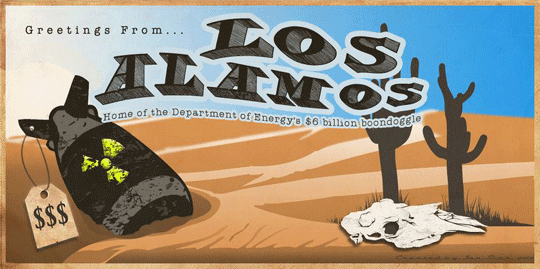 Efforts underway to remove ‘redundant’ nuclear safety board, Santa fe – New Mexican , By Rebecca Moss | The New Mexican, Oct 19, 2017
Dangerous Whitehaven coal mine plan – CLOSE TO RADIOACTOVE SELLAFIELD SITE !
 Keep Cumbrian Coal in the Hole, Crowd Justice, https://www.crowdjustice.com/case/keep-cumbrian-coal-in-the-hole/ 20 Oct 17 , by Keep Cumbrian Coal in the Hole Group of Cumbrians opposed to the first deep coal mine in the UK for 30 years.
OLD KING COAL RESURRECTED?
There is a statue in Whitehaven, a poignant memorial to coal miners who lost their lives.
“End of an Era” …..Only apparently it isnt!
Now there is a plan to expand the dangerous Whitehaven mines with undersea coal mining. There has been lots of greenwashing heaped on the plan by West Cumbria Mining to reopen Whitehaven coal mine, the most gaseous, dangerous pit in the Kingdom. In 1815, Sir Humphrey Davy’s invention of the miner’s safety lamp was first tested in Whitehaven Coking Coal Mine because of its reputation for “firedamp” (methane) and fatal explosions.
That was in the pre atomic age. Now in the same area, just 8km away we have the most dangerous nuclear site in the world, Sellafield. “Windscale – later renamed Sellafield, 8km away is too close”
“We are particularly concerned in regard to the potential impact upon the wider marine and coastal environment of the discharge of water into the sea, which has been pumped from the flooded anhydrite mine.” National Trust
“ The application site is in proximity (Solway Firth 1.5km) to a European designated site (also commonly referred to as Natura 2000 sites), and therefore has the potential to affect its interest features.”Natural England
“The impact of any level of subsidence upon the terrestrial or marine heritage assets and designated sites and landscapes could be significant and permanent, therefore having a detrimental impact ..The history of contamination of watercourses in the areas raises concerns for some local residents in relation to the impact of the development on the complex hydrology of the area.” Colourful Coast Partnership
“Our position is to object to the proposed development on the grounds of the adverse impact on groundwater, surface water and biodiversity.”Environment Agency
“It is clear that this is a very large mine, with a very long life span…of 20-50 years and a peak of 2.8 million tonnes a year. Assuming a 40 year life (following construction), and an average of 2 million tonnes a year, that is a total production of 80 million tonnes, which will emit around 175 million tonnes of carbon dioxide. The level of emissions and proposed life-time of the mine is of major concern….We would also query whether or not there has been robust enough analysis of the potential for seismicity (and subsidence) relating to well-known nuclear facilities in the wider area, including Sellafield and proposed new facility at Moorside? What potential is there for seismicity to effect these and other facilities (including the low level waste repository at Drigg) and the possible high level waste radioactive waste facility which has been proposed in West Cumbria for some time.” Friends of the Earth
“The application should be rejected because it is not in the national interest. From reviewing the documents submitted by West Cumbria Mining it is clear that the intention is to export the coal to Europe and Asia…The application to mine is too close to the Sellafield nuclear site and the proposal for another nuclear power station at Moorside. Underground mining can have a significant impact on the surrounding areas, recently a coking coal mine in Russia triggered an earthquake.” Coal Action Network
Just some of the “Star Species” found in this Heritage Coast and Marine Conservation Zone are listed by the RSPB as: Fulmar, Guillemot, Herring Gull, Kittiwake, Razorbill and so many more that would be impacted on by the plan for a new coal mine with possible subsidence of the Irish Sea bed impacting on food sources such as sandeels (and not to mention disturbing decades of Sellafield discharges which have settled there).
TAKE ACTION
1 This Month
26 April – Chernobyl: Inside the Meltdown airs on National Geographic on Sunday 26th April from 4pm

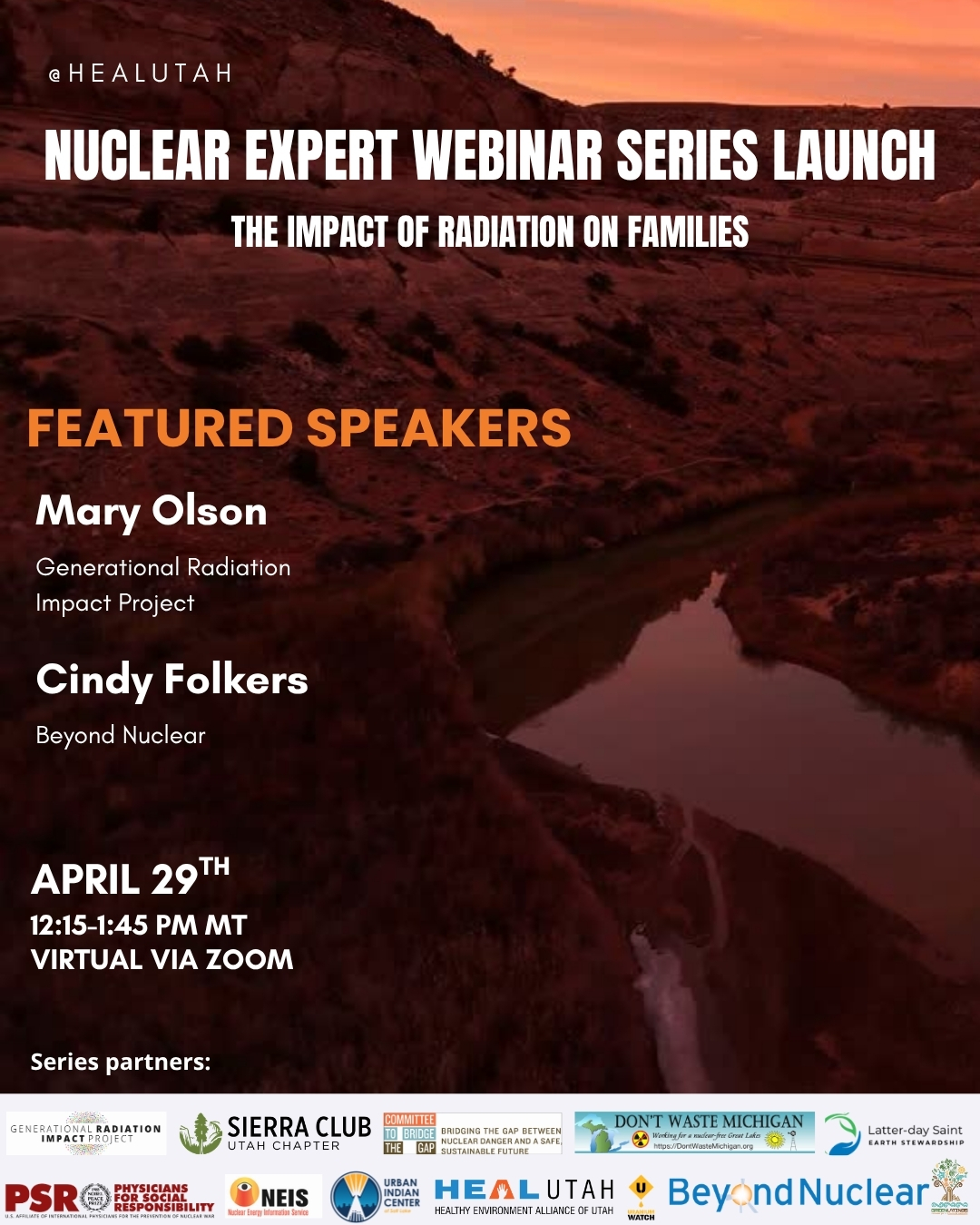
29 April – Nuclear Expert Webinar #1 – Radiation Impacts on Families with Mary Olson and Cindy Folkers
- 12:15 PM MT – 1:45 PM MT
- Location: Virtual – REGISTER TODAY

4 May -West Suburban Peace Coalition to discuss Iran war at May Educational Forum
Monday, May 4, 7:00 – 8:00 PM Central Standard Time
Title: : How Trump’s Narrative Tries to Shape the Reality of the War on Iran.
Contact Walt Zlotow, zlotow@hotmail.com 630 442 3045 for further information
14 May – online event From Bombs to Data Centres: the Face of Nuclear Colonialism

Pine Ridge Uranium is the real threat, not Tehran- Tell Burgum: Stop the Extraction.
Chernobyl: The Lost Tapes – A good documentary on Chernobyl on SBS available On Demand for the next 3 weeks– https://www.sbs.com.au/ondemand/tv-program/chernobyl-the-lost-tapes/2352741955560
To see nuclear-related stories in greater depth and intensity – go to https://nuclearinformation.wordpress.com
-
Archives
- April 2026 (356)
- March 2026 (251)
- February 2026 (268)
- January 2026 (308)
- December 2025 (358)
- November 2025 (359)
- October 2025 (376)
- September 2025 (257)
- August 2025 (319)
- July 2025 (230)
- June 2025 (348)
- May 2025 (261)
-
Categories
- 1
- 1 NUCLEAR ISSUES
- business and costs
- climate change
- culture and arts
- ENERGY
- environment
- health
- history
- indigenous issues
- Legal
- marketing of nuclear
- media
- opposition to nuclear
- PERSONAL STORIES
- politics
- politics international
- Religion and ethics
- safety
- secrets,lies and civil liberties
- spinbuster
- technology
- Uranium
- wastes
- weapons and war
- Women
- 2 WORLD
- ACTION
- AFRICA
- Atrocities
- AUSTRALIA
- Christina's notes
- Christina's themes
- culture and arts
- Events
- Fuk 2022
- Fuk 2023
- Fukushima 2017
- Fukushima 2018
- fukushima 2019
- Fukushima 2020
- Fukushima 2021
- general
- global warming
- Humour (God we need it)
- Nuclear
- RARE EARTHS
- Reference
- resources – print
- Resources -audiovicual
- Weekly Newsletter
- World
- World Nuclear
- YouTube
-
RSS
Entries RSS
Comments RSS
 nuclear-news