We call it the tomb,” says Christina Aningi, the head teacher of Enewetak’s only school.
“The children understand that we have a poison in our island.” It’s “Manit Day” on Enewetak Atoll, a celebration of Marshall Islands culture when the Pacific nation’s troubled past seems a distant memory. Schoolchildren sit cross-legged on the coral sands as they sing of the islands and atolls, the sunshine and the breeze; “flowers and moonlight, swaying palm trees”.
They were born decades after the last nuclear explosion ripped through the warm Pacific air with a thunderous roar. But it’s hard to escape the long echo of the bombs.
“Gone are the days when we live in fear, fear of the bombs, guns and nuclear,” they sing.
“This is the time … this is my country, this is my land.”
But those old fears, thought to be long buried, are threatening to reawaken in their island paradise.
In the late 1970s, Runit Island, on the remote Enewetak Atoll, was the scene of the largest nuclear clean-up in United States history. Highly contaminated debris left over from dozens of atomic weapons tests was dumped into a 100-metre wide bomb crater on the tip of the uninhabited island. US Army engineers sealed it up with a half-metre thick concrete cap almost the size of an Australian football ground, then left the island.
Now with sea levels rising, water has begun to penetrate the dome.
A report commissioned by the US Department of Energy in 2013 found that radioactive materials were leeching out, threatening the already tenuous existence of Enewetak locals.
“That dome is the connection between the nuclear age and the climate change age,” says Marshall Islands climate change activist Alson Kelen.
“It’ll be a very devastating event if it really leaks. We’re not just talking the Marshall Islands, we’re talking the whole Pacific.”
The United States detonated 43 atomic bombs around the island chain in the 1940s and 50s.
Four of Enewetak’s 40 islands were completely vaporised by the tests, with one thermonuclear blast leaving a two-kilometre-wide crater where an island had been just moments before.
Enewetak’s population had been re-located to another island in the Marshalls ahead of the tests. Residents would only be allowed to return home more than three decades later — some on the island today can still recall returning to Enewetak as children.
As part of the clean-up process, Washington set aside funds to build the dome as a temporary storage facility, and initial plans included lining the porous bottom of its crater with concrete.
But in the end, that was deemed too expensive.
“The bottom of the dome is just what was left behind by the nuclear weapons explosion,” says Michael Gerrard, the chair of Columbia University’s Earth Institute in New York.
“It’s permeable soil. There was no effort to line it. And therefore, the seawater is inside the dome.” ocals rarely set foot on Runit Island. They’re fearful of the lingering radiation from the dome and because it’s been ruled off-limits.
To this day, only three islands along Enewetak Atoll’s slender rim are considered safe enough for human habitation. “[The other islands were] too hot, too radioactive to worry about,” says Giff Johnson, publisher of the Marshall Islands Journal, the country’s only newspaper.
“There was no point [cleaning them up].”
After the fall-out from the atomic testing, life for the people of Enewetak went from a traditional existence of fishing and subsistence living to one where the waters that once supported their livelihoods were now polluted.
On the main island, where most of the atoll’s few hundred people now live, concerns about the radioactive contamination of the food chain has seen a shift away from a traditional diet of fish and coconut.
The US Department of Energy has even banned exports of fish and copra from Enewetak because of the ongoing contamination.
The vast bulk of foodstuffs are now brought into the island by barge, and that means islanders are reliant on imported canned and processed goods like Spam that have triggered health problems such as diabetes. The shelves of Enewetak’s only store are largely filled with American brand chocolate bars, lollies and potato chips.
Locals sometimes visit Runit to scavenge from scrap copper left behind by the Americans, selling it for a few dollars to a Chinese merchant.
For 30 years, Jack Niedenthal has helped the people of neighbouring Bikini Atoll fight for compensation for the 23 atomic tests conducted there. “To me, it’s like this big monument to America’s giant f–k up,” says Niedenthal. “This could cause some really big problems for the rest of mankind if all that goes underwater, because it’s plutonium and cement.”
Some of the debris buried beneath the dome includes plutonium-239, a fissile isotope used in nuclear warheads which is one of the most toxic substances on earth.
It has a radioactive half-life of 24,100 years.
Cracks are visible in the dome’s surface and brackish liquid pools around its rim.“Already the sea sometimes washes over [the dome] in a large storm,” says Columbia University’s Michael Gerrard. “The United States Government has acknowledged that a major typhoon could break it apart and cause all of the radiation in it to disperse.”
While Professor Gerrard would like the US to reinforce the dome, a 2014 US Government report says a catastrophic failure of the structure would not necessarily lead to a change in the contamination levels in the waters surrounding it.
“I’m persuaded that the radiation outside the dome is as bad as the radiation inside the dome,” says Professor Gerrard.“And therefore, it is a tragic irony that the US Government may be right, that if this material were to be released that the already bad state of the environment around there wouldn’t get that much worse.”
But that is cold comfort to the people of Enewetak, who fear they may have to be relocated once again if the dome collapses or crumbles.
“If it does [crack] open most of the people here will be no more,” says Ms Aningi.
“This is like a graveyard for us, waiting for it to happen.”
North Korean test caused 6.3 magnitude earthquake injuring up to 150 children Explosion triggered aftershocks in North Hamgyong Province within minutes State defectors South and North Development revealed the fatalities today Devastation hit farms, destroyed home and gave soldiers radiation sickness Regime accused of not warning locals of the imminent nuclear missile tests Pupils injured in the earthquake were in class as usual when it hit their school
By Sebastian Murphy-bates For Mailonline 27 November 2017 Dozens were killed when North Korean dictator Kim Jong-un’s most powerful nuclear missile test yet caused buildings to collapse.
Houses and a school near his nuclear base at Punggye-ri were brought down when his tests caused a 6.3 magnitude earthquake injuring up to 150 pupils in North Hamgyong Province.
This explosion triggered aftershocks within eight minutes, hitting structures in a nearby village.
The huge reactors—California’s last—sit on a bluff above the Pacific, west of San Luis Obispo, among a dozen earthquake faults. They operate just 45 miles from the San Andreas. That’s half the distance from the fault that destroyed four reactors in Fukushima, Japan, in 2011. Diablo’s wind-blown emissions could irradiate the Los Angeles megalopolis in less than six hours if an earthquake destroyed the plant.
The death toll could be in the millions, the property damage in the trillions of dollars. The owner of the plant, Pacific Gas & Electric (PG&E), would not be legally liable.
Last year, a deal to shut down Diablo’s two reactors in 2024 and 2025 was struck by the state, PG&E, surrounding communities and some environmental groups. Diablo’s federal licenses expire in those years, and PG&E agreed not to seek renewals. The power, it said, could be replaced with wind turbines and solar panels.
But the $1.7 billion in rate hikes stipulated in the deal still must be approved by California’s Public Utilities Commission (PUC). A proposed decision by administrative law Judge Peter Allen would limit them to less than $200 million.
The PUC must now factor Allen’s decision into how much it allows PG&E to charge. If it honors Allen’s opinion, the company must then decide whether it will continue to operate the reactors, which increasingly look like money losers.
The company’s standing is not exactly sterling. Massive fires that swept through Northern California in October killed at least 43 people, turning some 5,700 structures and whole forests, rural communities and parts of Santa Rosa into smoldering ash (the Trump administration has just omitted from its latest budget any federal aid to the region).
The San Jose Mercury News has speculated that PG&E may have been responsible for the conflagration by failing to maintain power lines that were blown over in a windstorm. Local fire departments were already complaining that trees and underbrush were being sparked by poles and wires PG&E had failed to maintain, though maintenance is required by law.
PG&E now faces a firestorm of lawsuits that could soar well into the billions. Criminal prosecution is also possible.
In 2010, a fire killed eight people and torched an upscale San Bruno neighborhood. The cause was badly maintained gas lines—for which PG&E had been cited repeatedly. Fines exceeded $1.4 billion, but criminal prosecution remains unresolved.
Other costly lapses have plagued PG&E through the years. Some involve Diablo itself, which opened in the mid-1980s amid America’s biggest “No Nukes” civil disobedience campaign, involving thousands of arrests.
Linda Seeley of San Luis Obispo’s Mothers for Peace says the company faces impossible hurdles in dealing with its thousands of tons of radioactive waste. In addition, she notes, “Many very expensive components in the two reactors must be replaced far before the proposed 2024-5 shutdown dates. Our concern is that PG&E may try to sneak through without paying to maintain the reactors even at basic safety levels.”
Michael Peck, a former Nuclear Regulatory Commission in-house inspector at Diablo, has warned that the reactors cannot survive a major earthquake and should close immediately. He has since been transferred to Chattanooga, Tenn.
“Diablo may no longer be profitable,” Seeley has said on my “California Solartopia” show on radio station KPFK. “The cost of wind and solar has dropped so fast it may not pay PG&E to run those plants anymore, even without doing the basic maintenance.”
Because much of Diablo’s aging workforce is retiring or looking elsewhere for job security, PG&E wants subsidies to retain skilled staff to run the place. Judge Allen specifically rejected much of the rate hike designed to meet that crisis.
California’s State Lands Commission is being sued by the World Business Academy, a Santa Barbara think tank, over key leases granted in the 1970s. The commission granted PG&E a waiver on conducting legally required environmental impact statements (gubernatorial candidate Gavin Newsom was among those who voted in favor). Should the business academy win its suit, or should the PUC honor Allen’s decision, and PG&E alter its timetable, those leases might be revisited. Without them, Diablo would almost certainly be forced to shut.
Challenges have also been raised over approval by the California Coastal Commission of Diablo’s cooling system.
Seeley and other activists have asked the public to pressure the PUC, state agencies and politicians like Newsom to shut Diablo sooner rather than later.
“Until they can specify the exact date and time the San Andreas and those other faults will go off,” Seeley said in a recent phone interview, “nobody should feel safe.”
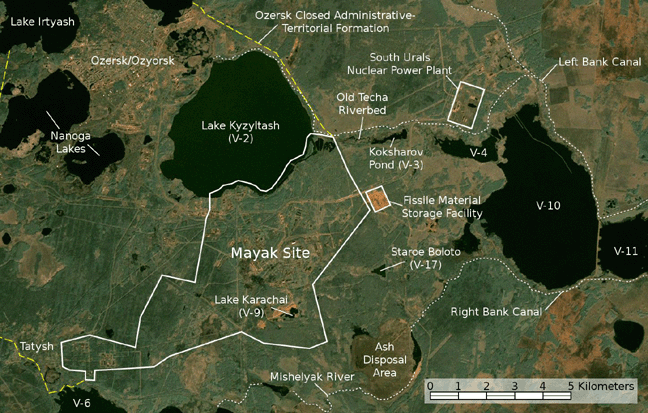
Authorities finally admit that Argayash was at the centre of a radiation cloud. Henry Foy in Argayash , 24 Nov 17
Argayash is a cynical, mistrustful town. Decades of being lied to by the government about being down the road from a leaking nuclear plant does that to a place. So too does watching generations of people dying of radiation-related ailments while officials assure them nothing is amiss.
A small, two-road settlement where homes roofed with corrugated iron and Soviet-era Lada cars nod to its poverty, Argayash is one of a handful of towns surrounding the Mayak Production Facility in southern Russia, one of the world’s biggest radiation emitters where a litany of tragic accidents has made it a byword for the dangers of the atomic industry.
This week, 76 years after radiation first began seeping from Mayak into the surrounding rivers, lakes and atmosphere, Russian authorities admitted that Argayash was at the centre of a radiation cloud containing “exceptionally high” levels of radioactive isotope ruthenium-106, which spread so far west that it reached France. The radiation was detected by Russia’s meteoological agency in late September, but only revealed on Monday, after local politicians had spent weeks denying rumours of a leak and rubbishing reports from EU agencies that had tracked the cloud’s movement.
The levels of the isotope in Argayash were almost 1,000 times the normal level. Officials say it is not harmful to public health. “Nobody tells us anything. They keep it secret,” says Lilia Galimzhanova, a cook at a café in the town. “We are afraid. We are afraid for our children and grandchildren.” “But we know that the air, the environment is very bad here,” she says. Her 80-year-old mother suffers from radiation poisoning from Mayak. “We are not protected by anyone here . . . We are survivors.”
The source of the leaked isotope, which does not occur naturally and is produced during the processing of nuclear fuel, has not been confirmed. Rosatom, which operates the Mayak facility, has repeatedly denied it is to blame. “[Mayak] is not a source of increased content of ruthenium-106 in the atmosphere,” Rosatom said in a statement. On Thursday, the company published a message poking fun at journalists on its Facebook page, inviting them to tour the plant, which it sarcastically dubbed “the cradle of ruthenium”. The local region’s chief oncology specialist has told concerned residents to stop worrying, advising them to instead “watch football and drink beer”.
But local residents see little to laugh about. Many scoff at official denials, having heard similar for decades, even as they watched family and friends die from radiation-related ailments. “We are not told anything about Mayak,” says Nadia, an 18-year-old medical student living in the town, 1,700km east of Moscow. “The government should not keep things secret when people suffer.” “People in the west know more about this than we do here,” she adds.
Ms Galimzhanova only heard of the radiation that had enveloped her town when a friend in Germany read about it in a western newspaper. Before the authorities admitted its existence, text messages had been sent to residents saying that high levels of pollution from nearby industrial factories meant people should stay indoors. Regardless of the potential health risks, many here say the government’s initial silence, denial and obfuscation has dredged up painful memories of a past that refuses to stay buried. Secretly constructed in the 1940s, Mayak was at the forefront of the USSR’s scramble to catch up with the US nuclear programme. As it raced to produce weapons-grade plutonium, a vast amount of nuclear waste was discharged into nearby lakes and the Techa river. Then, in 1957, nuclear waste storage tanks at the site exploded, raining fallout over hundreds of towns — and releasing more radiation than any other nuclear accident except Chernobyl and Fukushima. Ten years later, an adjacent reservoir used for waste disposal dried out, and powdered radioactive dust was blown over the area.
Not that local people were evacuated, or even warned: Mayak’s very existence was only acknowledged in the late 1980s, as information began to circulate about the long-term contamination. An estimated 450,000 were exposed to radiation from the accidents and the discharging of waste into the water supply, Russian authorities said in 1993, making Mayak one of the world’s biggest sources of harmful radiation. But anti-nuclear campaigners say safety breaches continued: a 2005 court case revealed nuclear waste was still being dumped into rivers as late as 2004, while Rosatom only sealed off the radioactive lake that caused the 1967 disaster in 2015.
An estimated 450,000 were exposed to radiation from the accidents and the discharging of waste into the water supply, Russian authorities said in 1993, making Mayak one of the world’s biggest sources of harmful radiation. But anti-nuclear campaigners say safety breaches continued: a 2005 court case revealed nuclear waste was still being dumped into rivers as late as 2004, while Rosatom only sealed off the radioactive lake that caused the 1967 disaster in 2015.
“Previous experience has taught us that they lie and suppress information,” said Andrey Talevlin, co-chairman of the Russian Social-Ecological Union NGO. “We can’t trust what they say, whether they mislead the population on purpose or not.”
Mr Talevlin, an academic and environmental activist who this week was branded a “foreign agent” by Russian state TV after he called for an investigation into the ruthenium leak, says that suppression of anti-nuclear groups in Russia has rapidly increased over the past two decades. A fellow activist, Nadezhda Kutepova, fled to France in 2015 seeking political asylum after a similar media campaign accused her of “industrial espionage”. President Vladimir Putin’s spokesman said this week that the Kremlin has “no information” regarding any possible causes of the radiation. And some in Argayash say it is little more than an occupational hazard of living in one of Russia’s most industrialised regions.
The authorities say they do not know anything about it. And we must trust them,” says Jamshed, who runs a greengrocer on the town’s main Lenin Street. “Nobody has proven anything. And even if something is proved, I am sure our government will immediately take measures,” he says, looking over his locally-grown vegetables.
Aging Tokai No. 2 nuclear plant should be decommissioned http://www.asahi.com/ajw/articles/AJ201711240017.html November 24, 2017 Japan Atomic Power Co.’s Tokai No. 2 nuclear power plant in Tokai, Ibaraki Prefecture, seems doomed to be decommissioned given the strong doubts and practical difficulties surrounding the company’s plan to restart the reactor at the plant.
Japan Atomic Power plans to apply to the Nuclear Regulation Authority to extend the operating life of the idled reactor at the plant beyond the legal life span of 40 years in principle.
The currently offline reactor will reach the end of its legal life span in one year. The operator is seeking to persuade the NRA to make an exception of the reactor for bringing it back on line.
It has been estimated that the required safety measures will cost the company at least 170 billion yen ($1.52 billion). In an unusual move, the nuclear safety watchdog has told Japan Atomic Power, which is on a fragile financial footing, to come up with a workable plan to raise the funds to finance the measures.
With the local communities and governments around the plant struggling to develop required plans for emergency evacuations, there is strong skepticism about the feasibility of the company’s plan to restart the reactor.
Since there is little chance of the company’s other reactors being restarted, the fate of Japan Atomic Power hinges on whether the Tokai No. 2 plant will be allowed to come on stream again.
But that doesn’t justify taking it as a given that the company will get the green light for restarting the reactor. Japan Atomic Power, the major electric utilities with major stakes in the company and the Ministry of Economy, Trade and Industry, which regulates the power industry, should carefully reassess the future of the company without assuming that the reactor will start running again.
The 40-year legal life for nuclear reactors is an important rule to reduce the risk of accidents involving aging reactors. It was introduced following the disastrous accident at the Fukushima No. 1 nuclear power plant in 2011.
The operational life can be extended by up to 20 years if approved by the NRA.
When the law was revised, however, the government said such extensions would be highly exceptional cases.
But Kansai Electric Power Co.’s applications for life extensions for its three aging reactors have all been approved.
If the Tokai No. 2 plant is added to the list, the rule will move closer to becoming a dead letter.
There are no special reasons for restarting the old reactor, such as a serious risk of a power shortage.
Japan Atomic Power’s plan should not be given a go-ahead simply to help the embattled company.
The Tokai No. 2 plant is located at the northern tip of the Tokyo metropolitan area. Some 960,000 people live within 30 kilometers from the plant, more than in any other 30-km radius of a nuclear plant. Local governments located within the zone are required to develop evacuation plans.
It is obviously difficult to secure safe evacuation routes, facilities to accept evacuees and the means to transport them for the entire 30-km zone around the plant.
None of the 14 municipalities that are subject to the requirement has worked out an evacuation plan.
The outlook for local government support for the plan is also dismal.
The government of Ibaraki Prefecture and the mayor of Tokai intend to base their decisions on local public opinion as to whether to give their consent to the plan.
Recent Asahi Shimbun surveys of local voters found that opponents to the plan far outnumbered supporters.
Five other cities around the plant are demanding the consent rights similar to those given to Tokai in order to take part in the decision-making process.
Japan Atomic Power and the major utilities that own the firm should confront these realities.
The utilities that are under contract to buy electricity from Japan Atomic Power continue paying more than 100 billion yen of basic fees in total every year even though the company currently generates no power to sell with all its reactors out of operation.
It should not be forgotten that the money comes from the electricity bills paid by consumers.
It has been proposed that Japan Atomic Power should serve as a vehicle for the consolidation of the power industry driven by the decommissioning of aged nuclear reactors.
Instead of simply shelving the problem, the parties involved should accelerate their efforts to map out a viable future for the company.
Problems persist a decade after discovery of chronic radioactive leaks Chicago Sun Times, 11/19/2017, Brett Chase and Madison Hopkins | Better Government Association More than a decade after the discovery of chronic leaks led to national outrage, a $1.2 million government settlement and a company vow to guard against future accidents, an investigation by a government watchdog group found.
Since 2007, there have been at least 35 reported leaks, spills or other accidental releases in Illinois of water contaminated with radioactive tritium, a byproduct of nuclear power production and a carcinogen at high levels, a Better Government Association review of federal and state records shows.
No fines were issued for the accidents, all of which were reported by the company.
The most recent leak of 35,000 gallons occurred over two weeks in May and June at Exelon’s Braidwood plant, southwest of Chicago. The same facility was the focus of a community panic in the mid-2000s after a series of accidents stirred debate over the safety of aging nuclear plants.
A 2014 incident at Exelon’s Dresden facility in Grundy County involved the release of about 500,000 gallons of highly radioactive water. Contamination was later found in the plant’s sewer lines and miles away in the Morris, Ill., sewage treatment plant……..
Industry watchdogs and government whistleblowers contend oversight is compromised by a cozy relationship between companies and the NRC.
Government regulators concede they must balance the safety needs of aging plants, which require more maintenance, versus ordering cost-prohibitive upgrades at facilities that inherently are just a slip-up away from catastrophe.
No player in the nuclear industry is bigger than Exelon, the Chicago-based energy company that last year reported $31 billion in revenue and operates 14 nuclear plants in Illinois, New York, New Jersey, Pennsylvania and Maryland.
Five of the six Illinois plants reported leaks over the last decade, records show. Clinton, in DeWitt County, had no leaks and Byron, in Ogle County, reported only one that contained low levels of radioactivity…….
At least seven of the 35 documented accidents since 2007 involved contamination of groundwater. Other contamination was found in sewers and other water systems where it isn’t supposed to be………
The BGA investigation also found:
Of the 35 documented incidents, 27 occurred at Dresden. Following the big 2014 leak, which emanated from an aboveground storage tank, Exelon asked a state inspector whether the public would have access to the incident report under open records laws, a state report showed.
An NRC report on the 2007 Quad Cities leak noted radiation levels went “well beyond that seen anywhere else in the industry” and that plant staff estimated the leak had been active for years before it was discovered.
In 2010, Exelon’s Marseilles generating plant in LaSalle County reported a spill from a storage tank, initially estimated at more than 150 gallons but later classified as “unknown.” Groundwater tritium tests later showed levels 59 times the EPA’s drinking water limit. Exelon said no tritium left the plant’s boundaries, but records show plant workers continued to monitor a body of highly contaminated groundwater sitting on plant property at least five years after the accident.
In 2009, Dresden reported another hole in a storage tank led to a leak of as much as 272,000 gallons of radioactive water. Onsite groundwater testing showed levels of tritium 160 times higher than allowed under federal standards for drinking water.
Sea level rise factors into nuclear waste discussion Pilgrim advisory panel reviews issues related to dry cask storage. Cape Cod Times, PLYMOUTH , 17 Nov 17,— Entergy Corp.’s plan to store more than 4,000 highly radioactive spent fuel assemblies in massive casks about 25 feet above mean sea level at Pilgrim Nuclear Power Station raised considerable concern among members of the Nuclear Decommissioning Citizens Advisory Panel at a meeting Wednesday.
Concerns ranged from the potential for the metal-lined casks to corrode over time and leak, to the possibility that sea level rise could put them underwater in a storm.
The spent fuel will likely be stored in multipurpose dry casks, manufactured by Holtec, that are 18 feet tall and 11 feet in diameter. Once filled, they weigh 173 tons. The casks will stand on two concrete pads outside the reactor. The first pad is already in place and holds eight loaded dry casks. It can accommodate about 38.
The second pad is yet to be built and its location is still under study. It will likely be close to the first. Highly radioactive metal now in the reactor’s core also will be stored in casks, Entergy representative Joseph Lynch said.
The plant is scheduled to shut down permanently by May 31, 2019. The 21-member advisory panel was appointed to advise the governor on matters related to the plant’s decommissioning.
The reactor’s location on the coast of Plymouth raises issues such as flooding potential and cask corrosion.
Lynch provided data, based on the company’s most recent flood study, that showed a Category 5 hurricane, with waves swelling to 9 feet, could raise the sea level to 22.4 feet.
Although Lynch said the data demonstrated “we have margins,” panel members and members of the public who attended the meeting said those margins were too tight…….
Rising sea levels should be factored into planning, said Duxbury resident James Lampert. “I’m concerned, and this panel should be concerned, that we’re always taking today’s snapshot,” Lampert said. “There’s no plan to move any of this stuff. You have to assume these casks may be on the two pads for 50 or 100 years.”
Lampert asked how much of the fuel was so-called “high burn-up” — a question Lynch could not answer. According to the Nuclear Regulatory Commission website, high burn-up spent fuel is hotter and more radioactive…….
Dry cask storage of lower burn-up spent nuclear fuel has been done since 1986, but dry storage of high burn-up spent fuel is more recent, according to the U.S. Office of Nuclear Energy website. About 200 dry casks have now been loaded with at least some high burn-up fuel, the site says, and almost all spent nuclear fuel being loaded in the United States is now high burn-up.
NRC spokesman Neil Sheehan declined “for security reasons” to say how much spent fuel at Pilgrim is high burn-up.
Lampert also asked the panel to review a study by research scientist Gordon Thompson on weapons capable of penetrating dry casks.
Mary Lampert, president of the citizens group Pilgrim Watch, called projections that plants already closed, such as Vermont Yankee, would be free of stored fuel by 2052 “fantasy,” since there is still no national repository to permanently handle spent fuel.
Gov. Charlie Baker and the decommissioning panel should be looking at the worst-case scenario, she said.
The multipurpose dry casks made by Holtec are not the best choice, she said.
“Holtec casks are designed for the short term,” she said. “Diablo Canyon’s casks are showing early signs of stress corrosion.”
Although the casks are permitted for 20 years by the NRC, they will likely be relicensed for 40 or even 60 years, Lynch said.
Probe Finds Ongoing Radioactive Leaks at Illinois Nuclear Plants VOA News, 17 Nov 17, Radioactive waste continues to pour from Exelon’s Illinois nuclear power plants more than a decade after the discovery of chronic leaks led to national outrage, a $1.2 million government settlement and a company vow to guard against future accidents, an investigation by a government watchdog group found.
Since 2007, there have been at least 35 reported leaks, spills or other accidental releases in Illinois of water contaminated with radioactive tritium, a byproduct of nuclear power production and a carcinogen at high levels, a Better Government Association review of federal and state records shows.
No fines were issued for the accidents, all of which were self-reported by the company.
The most recent leak of 35,000 gallons (132,000 liters) occurred over two weeks in May and June at Exelon’s Braidwood plant, southwest of Chicago. The same facility was the focus of a community panic in the mid-2000s after a series of accidents stirred debate over the safety of aging nuclear plants.
A 2014 incident at Exelon’s Dresden facility in Grundy County involved the release of about 500,000 gallons (1,900,000 liters) of highly radioactive water. Contamination was later found in the plant’s sewer lines and miles away in the Morris, Illinois, sewage treatment plant.
Another leak was discovered in 2007 at the Quad Cities plant in Cordova. It took eight months to plug and led to groundwater radiation readings up to 375 times of that allowed under federal safe drinking water standards.
Exelon had threatened to close the Quad Cities plant, but relented last year after Gov. Bruce Rauner signed bailout legislation authorizing big rate hikes……..
David Lochbaum, an analyst with the nonprofit Union of Concerned Scientists, says “Leaks aren’t supposed to happen. Workers and the public could be harmed. There is a hazard there.”
Among the 61 nuclear power plants operating in the U.S., more than half have reactors that are at or near the end of their originally expected lifespans — including the Dresden and Quad Cities plants.
Faulty Areva fuel rods sent to nuclear reactors, Swiss plant closed
* Areva sent faulty fuel roads to several nuclear plants
* Says no danger, declines to identify which reactors
* Swiss Leibstadt closed, no comment on EDF reactors
By Geert De Clercq and John Revill PARIS/ZURICH, Nov 17 (Reuters) – French nuclear group Areva delivered defective fuel rods for nuclear reactors but said on Friday that there was no safety risk. Swiss media, however, reported that a Swiss nuclear plant was closed due to problems with the rods.
Areva said in a statement that following the discovery of a leaking fuel rod at its Paimboeuf, France, zirconium-tube manufacturing plant, tests had showed that some fuel rods which should have been rejected were delivered to utilities companies.
Fuel rods which already have been loaded in reactors can continue operating without impairing plant safety and none of the affected rods have caused leaks, Areva said.
An Areva spokesman said that utilities operating the faulty tubes had been informed but declined say to which companies were involved, citing “industrial confidentiality”.
He declined to say whether French utility EDF, Areva’s main customer, had received faulty rods. EDF has had to close several reactors in the past two years due to manufacturing problems at Areva foundry Creusot Forge.
Swiss broadcaster SRF reported that the Leibstadt nuclear plant in northern Switzerland has been closed till the end of the year because of faulty Areva fuel rods.
A spokeswoman for the Leibstadt plant confirmed that a supplier had informed the utility that there was a problem with 16 new fuel rods, but declined to identify the supplier.
She added that the supplier later also said that six fuel rods which had already been installed were also faulty. The rods – which hold the uranium pellets that generate heat in the reactor core – had been installed in the last three-four years.
“The rods that were already installed had not caused any problems but we removed them as a precaution. There was no safety issue,” she said.
The Swiss Federal Nuclear Safety Inspectorate has been informed and that the plant – which had been set to reopen Nov. 7 following maintenance – will remain closed till end December.
Environmental groups that support the current administration’s nuclear energy phaseout policy have based their arguments on the potential dangers posed by natural disasters like earthquakes.
In a statement made yesterday, the Korean Federation for Environmental Movement reiterated the need to scale back nuclear energy operations in southeastern Korea, saying, “On the heels of the Gyeongju earthquake last year, there has been a quake on the Yansan fault line.”
Last September’s 5.8-magnitude earthquake in Gyeongju was the most powerful recorded in South Korean history. With the November 15 earthquake in nearby Pohang, only about 20 km away, the Yeongnam region has seen record-setting natural disasters in successive years.
At the recent community event at the MICA Tuesday 10th October
representatives of the Courier and Mersea Island Environmental Alliance
(MEIA) spoke to various Magnox personnel regarding the lack of an emergency
plan to evacuate the island in case of a nuclear emergency, specifically a
terrorist act against the site.
Magnox responded with the following
statement: “As a result of the efforts Magnox has made to reduce hazards
on Bradwell site we have been able to satisfy the regulator that an
off-site plan is no longer required to protect the local community. We will
continue to maintain an appropriate level of monitoring as required by our
regulators. The local authority still maintains response plans under the
Civil Contingencies Act and these plans will cover any required response to
the site.”
MEIA commented: “Magnox is clearly referring to the
decommissioning and for that their statement is incorrect and unhelpful as
the question was specific. Our question was on the regional Bradwell
nuclear store which will be full of nuclear waste and our concern is that
if the store was targeted by terrorists the consequences could be
catastrophic.
Bradwell has already been identified by the Government as a
potential target being both close to the major army barracks at Colchester
and by its proximity to London. That risk will increase with potential
Chinese new build. Any terrorist attack on the Bradwell regional nuclear
store immediately threatens the local population, in particular those
living closest and others on Mersea under canvas and in holiday
accommodation.
Cllr Peter Banks, Green Party candidate and member of BANNG
and West Mersea Town Council remarked: “What about the fact that the
Graphite Core is classed as high level waste and represents a threat too.
The large reactor one and two buildings represent an easy target, less
chance of missing… At the last LCLC Site Closure Director Bob Nicholls
announced they were building a cover to one of the pits ‘even though
there was no radiation threat’… which begs the question why would they
do that?”
Peach Bottom nuclear plant operator fails drug test, Lancaster Online, AD CRABLE | Staff Writer, 16 Nov 17, A control room operator at the Peach Bottom nuclear plant has been barred from the controls after the employee failed a controlled substance test.
Plant owner Exelon notified the U.S. Nuclear Regulatory Commission last week that a licensed operator tested positive following a fitness-for-duty test.
The NRC is investigating and has asked Exelon for more information. The operator’s test showed the presence of a controlled substance, according to Neil Sheehan, an NRC spokesman.
The operator’s access to the plant has been frozen, pending further reviews of the employee, Sheehan said.
“We consider control room operators to be in a position of high responsibility and, in line with that, a failed test indicating substance use that could impair job performance is taken very seriously,” he said.
“A positive drug or alcohol test involving a control room operator is a rare occurrence. It takes years of training to become an operator and then regular retraining and requalification in subsequent years.”
Every U.S. nuclear power plant owner is required to maintain a comprehensive fitness-for-duty program that includes random and for-cause testing for drug and alcohol use.
World War 3: US military command ‘ERROR’ sent North Korea ‘false nuclear arsenal’ info
US MILITARY command tweeted false information about its nuclear arsenal sparking fears of an escalation from paranoid North Korea. Express UK, By TARYN TARRANT-CORNISHAn article that falsely boasted of “secret” US silos and B-1 bombers that can drop nuclear warheads was quickly debunked by experts online.
It is feared this move could lead to a catastrophic escalation of tensions with a military force seeming to confirm Pyongyang’s suspicions that B-1s can carry nukes, Asian security expert Van Jackson has warned.
The article that US Strategic Command shared said: “The USS Kentucky is part of what is called the ‘nuclear triad’.
“The triad are the three components of a nuclear defence system: land-based missiles fired from secret silos, B-1 bombers that can drop them from the air, and submarine launched ballistic missiles.” This could provoke a retaliation from North Korea next time the US flies a B-1 bomber over the Korean peninsula, it is feared.
Energy undersecretary wants nuclear safety reports hidden from public, Independent watchdog agency entertained the idea Center for Public Integrity ,By Patrick Malone , 10 Nov 17
The head of the federal agency that produces U.S. nuclear weapons has privately proposed to end public access to key safety reports from a federal watchdog group that monitors ten sites involved in weapons production.
Frank Klotz, administrator of the Energy Department’s National Nuclear Security Administration, made the proposal to members of the Defense Nuclear Facilities Safety Board in an October 13 meeting in his office overlooking the Smithsonian Castle on the National Mall, multiple U.S. officials said.
Klotz contended that recent media stories about safety lapses that relied partially on the board’s weekly disclosures were potentially counterproductive to the NNSA’s mission, the officials said. His solution was presented as the Trump administration considers an acceleration and expansion of nuclear warhead production at the federally-owned sites inspected by the board in eight states, including California, New Mexico, South Carolina, and Tennessee
Four of the safety board’s five members heard Klotz’s appeal, and one of them — Bruce Hamilton, a Republican — responded by drafting and briefly circulating a proposal among the members to stop releasing the board’s weekly and monthly accounts of safety concerns at nuclear weapons factories and laboratories.
Under Hamilton’s proposal, these accounts of accidents and problematic incidents — prepared by board staff that routinely visit or are stationed at these federally-owned sites — would be replaced by oral reports by those staff members to their superiors in Washington, which would not be divulged to the public, according to multiple federal officials, who asked not to be named due to the sensitivity of the topic under discussion.








 nuclear-news