Cyber attack targets UK’s nuclear industry
 Telegraph UK, Wil Crisp, 30 NOVEMBER 2019 GCHQ cyber experts have been called in after a digital attack on a major player in Britain’s nuclear power industry triggered a security crisis.
The National Cyber Security Centre (NCSC), an arm of GCHQ, has been secretly providing assistance to a nuclear power company in the UK that has struggled to recover after being hit by a cyber attack, The Telegraph can reveal.
A Nuclear Decommissioning Authority (NDA) report, obtained using freedom of information legislation, said officials are “aware that an important business in the Nuclear Power Generating Sector has been negatively impacted by a cyber attack and has had to rely on expertise from the NCSC to help them with recovery”.
The document,... (subscribers only) https://www.telegraph.co.uk/business/2019/11/30/cyber-attack-targets-uks-nuclear-industry/
Hungary wants EU to weaken nuclear licensing rules, as it wants to expand Rosatom nuclear project
Hungary makes EU bid to soften nuclear licensing rules to ease Paks expansion, BUDAPEST (Reuters) – Hungary has submitted draft legislation to the European Commission to amend the country’s nuclear safety protocols to custom-fit a 12 billion euro Russian-led nuclear plant expansion project that it wants to speed up, eight sources told Reuters. Marton Dunai, 27 Nov 19,
The EU review was confirmed by an EU official requesting anonymity, as well as several Hungarian government sources. Eight sources, including high-ranking government officials, confirmed the plan.
Hungary wants to expand its 2-gigawatt Paks nuclear power plant with two Russian-made VVER reactors, each with a capacity of 1.2 gigawatts.
The project, awarded in 2014 without a tender to nuclear giant Rosatom, an arm of the Russian government, is often cited as a sign of exceptionally warm ties between Hungarian premier Viktor Orban and Russian President Vladimir Putin, a connection that has unnerved Western allies.
However, Rosatom struggled to meet EU and Hungarian safety criteria, delaying the project by several years, and the Russian and Hungarian governments now want to accelerate it.
Under the proposed new rules, license applications to build the reactor hole and surrounding insulating slurry wall could be considered before the entire project receives the green light – a break with prior protocol, which only allowed partial licenses to be considered once the construction license was granted.
Hungary’s top official in charge of energy policy, Technology Ministry State Secretary Peter Kaderjak, confirmed to Reuters the government was working with the European Commission to recast nuclear power plant construction rules.
Kaderjak called the Paks 2 project “the cornerstone of Hungary’s energy and climate strategy”.
“We are seeking ways to cut the project execution time as short as possible, fully respecting nuclear safety,” he said. “That explains this draft amendment.”
RISKY MOVE
The modification carries risks and makes the project much more difficult to abandon or modify as the framework, literally, will be set in stone, according to seven sources with knowledge of the matter who spoke to Reuters on condition of anonymity.
But the move could help the Hungarian government in its haggling with Moscow to modify the current build-and-finance package. Hungary wants to extend the current payment start date of 2026, which was fixed when the project was first conceived.
Russia wants to avoid paying delay penalties – by putting off the completion deadline to about 2029 and by having Hungary ease regulatory hurdles such as this one, these sources said.
The changes will appear in a government decree called the Nuclear Safety Regulations once the European Commission’s nuclear arm, the Euratom Supply Agency, approves the changes.
An EU source also confirmed the Commission was assessing draft legislation against the EU’s latest Nuclear Safety Directive, adding it had three months to make recommendations, a deadline that is not yet up.
“In this framework, the Hungarian authorities have made several such notifications to the Commission in recent years,” the EU source told Reuters. “The latest of these notifications was received this year and is currently being assessed.”
Asked about the changes, the HAEA told Reuters that reactor hole and slurry wall work, and some equipment that takes a long time to manufacture, may undergo the licensing process parallel with the evaluation of the construction license application.
“Licenses cannot be granted before the construction license is issued – except for work on soil solidification, soil removal, and the water insulation work to section off the work area, especially the slurry wall permits.”
Experts estimate the reactor hole to be several hundred meters wide and several hundred meters long, up to 100 meters deep, surrounded by a concrete slurry wall more than a meter thick. This phase alone could take a year or more to execute.
The changes are designed to save time so once the overall construction license is issued work can begin on the power plant buildings.
But experts warned the slurry wall and reactor hole could cost hundreds of millions of euros, and hastening them carries risk: if the HAEA find faults with the overall design, it may require changes that conflict with the concrete already poured, causing a potential cost spike and long delay.
“Even with these permits Paks 2 carries responsibility for any work it executes, as the ongoing construction licensing process could influence all other licensing,” the HAEA said.
Reporting by Marton Dunai; Editing by Dale Hudson 9full story) https://www.reuters.com/article/us-hungary-nuclearpower-exclusive/exclusive-hungary-makes-eu-bid-to-soften-nuclear-licensing-rules-to-ease-paks-expansion-idUSKBN1Y01WQ

For the 8th time this year, a Hanford worker exposed to nuclear radiation
The 324 Building sits over a leak of radioactive cesium and strontium into the soil beneath it at the site about one mile north of Richland and about 300 yards west of the Columbia River.
“Although individually the contamination levels (on workers) have been low and no dose has been assigned to workers, collectively the number of personnel contamination events indicate a negative trend in contamination control that corrective actions taken to date have been inadequate to address,” the Department of Energy wrote in a Nov. 14 letter to its contractor on the project, CH2M Hill Plateau Remediation Co.
Earlier the same day that DOE sent the letter, CH2M had stopped work at the Hanford nuclear reservation’s 324 Building — one of several temporary halts to at least some of the work there this year.
Joe Franco, the DOE deputy manager at the DOE Richland Operations Office, told CH2M in the letter that he would not allow work to resume in the highly contaminated areas of the 324 Building until the company had developed a plan of correction and DOE had agreed on the path forward……. https://www.tri-cityherald.com/news/local/hanford/article237601614.html?fbclid=IwAR2PEXSoItPKGXYQxV0lOc3NJ2-KFlstPIvbdexqiIgP_i23UgMl9bBqGg4
Safety problems with Holtec’s dry canisters for nuclear wastes
EDF’s misleading and deficient safety report on Hunterston nuclear station
|
1km emergency zone around cracked reactors will do, says nuclear firm, The Ferret, 22 Nov 19, The power company, EDF Energy, has come under fire for advising that the emergency zone to protect people around its cracked nuclear reactors at Hunterston could be shrunk to a kilometre.The current zone – within which evacuation, sheltering and anti-radiation pills are planned in the event of an accident – is a radius of 2.4 kilometres from the nuclear power station on the Ayrshire coast.
……. Campaigners have criticised EDF’s move, warning that an accident could send a plume of radioactive contamination over Glasgow and Edinburgh. They have called for the emergency zone to be expanded, not contracted. EDF stressed that its advice was that one kilometre was the “minimum” recommended distance. North Ayrshire Council is consulting with local residents before it decides what distance to implement. The Ferret revealed in October that the graphite cores of two ageing nuclear reactors at Hunterston B have begun to crumble as cracks spread and widen. According to the UK government’s Office for Nuclear Regulation (ONR), at least 58 fragments and pieces of debris have broken off the graphite bricks that make up the reactor cores. The older reactor, three, has an estimated 377 core cracks and has been shut down since 9 March 2018. ONR is assessing the safety case to decide whether it can be allowed to restart in 2020. Reactor four, which has an estimated 209 cracks, was shut down for over ten months before ONR allowed it to restart in August – but only for four months. EDF is currently planning to shut it down again on 10 December……… EDF accepts, however, that food restrictions may be required over a much wider area. “It is recommended that advice be issued within 24 hours to restrict consumption of leafy green vegetables, milk and water from open sources/rain water in all sectors of the detailed emergency planning zone and downwind of the site to a distance of 43km,” it says. …….Campaigners have previously warned that a serious accident at Hunterston could spread a cloud of radioactive contamination over Glasgow, Edinburgh and the central belt, if the wind was blowing in that direction. It could be like the Chernobyl accident in Ukraine in 1986, they claimed. Radiation consultant, Dr Ian Fairlie, described EDF’s report as “deficient” and “misleading”. The suggested emergency zone was “much too small”, he argued, and there was a “lack of openness and clarity” that would leave local people uncertain what to do in the event of a major accident. He added: “The issue of the pre-distribution of prophylactic potassium iodate tablets is not mentioned. This already occurs in most European countries, and should occur here as well in order to avoid the health consequences of breathing in radioactive iodine which is a gas.” Rita Holmes, who chairs Hunterston’s local stakeholder group, pointed out that at the moment only 13 households close to the plant were given iodine tablets in advance. “It would seem a simple precaution and unwise not to pre-distribute within a wider area,” she told The Ferret. “Despite EDF’s assessment, I hope that our local authority, Ayrshire civil contingencies team and ONR will decide to extend the detailed emergency planning zone and pre-distribute stable iodine to people within a wider area. I certainly don’t expect, given the ageing reactor cores, that the zone would be shrunk.” The 50-strong group of nuclear-free local authorities argued it would be “incongruous” if the emergency zone was reduced, given the deterioration of the Hunterston reactors. “Clear question marks remain over their future operation,” said the group’s policy advisor, Peter Roche. In our view the precautionary principle would suggest a much larger emergency planning zone is drawn to provide greater reassurance to the local population.” Friends of the Earth Scotland pointed out that seven years after the explosions at the Fukushima nuclear reactors in Japan in 2011, some areas more than 20 kilometres away were still prohibited zones. “The current Hunterston zone is already very modest in comparison to the very large area which would be affected in the event of a serious accident at the plant,” said the environmental group’s director, Dr Richard Dixon. “With increasing worries about the safety of the reactors at Hunterston now is definitely not the time to reduce the level of protection on offer to the local community,” he argued. “EDF are the last people who should propose what size the exclusion zone should be around their own nuclear sites because it is in their financial and PR interests to make the zone as small as possible.”……..https://theferret.scot/emergency-zone-hunterston-nuclear-reactrors/ |
|
Russian Watchdog Detects ‘Radiation Incident’ in South China Sea
|
Russian Watchdog Detects ‘Radiation Incident’ in South China Sea https://www.themoscowtimes.com/2019/11/22/russian-watchdog-detects-radiation-incident-in-south-china-sea-a68287
A Rospotrebnadzor statement said radiation levels are not high enough to threaten the Russian population. The Russian government’s consumer protection watchdog Rospotrebnadzor said Friday it has detected a “radiation incident” in the South China Sea.“Based on data received from the Global Environmental Monitoring System, there’s an increase in background radiation in the South China Sea in connection with a radiation incident,” Rospotrebnadzor said in an online statement. It added that the radiation levels did not “currently threaten the Russian population” and that it “has increased its radiation monitoring in the adjacent border areas.” A website run by far-right U.S. talk show radio host Hal Turner claimed Wednesday that unidentified military sources had allegedly detected an underwater nuclear explosion in the area that caused powerful shockwaves. The U.S. tech news website Gizmodo cited two scientists who dismissed the report as fake. Gizmodo reported that uRADMonitor Global Environmental Monitoring Network data used in the initial report registered “negligible” radiation and noted that two other agencies in the region showed normal radiation readings. Military analysts reported Saturday that an 11,000-ton Chinese nuclear missile submarine had surfaced among Vietnamese fishing boats in the South China Sea in September. |
|
|
NRC likely to extend licence for Westinghouse nuclear fuel factory, despite its history of spills and leaks
 Nuclear safety regulators take heat for downplaying threat from atomic fuel plant, The State BY SAMMY FRETWELL, 17 Nov 19, Federal nuclear safety regulators drew criticism Thursday night for concluding that an aging atomic fuel plant could operate another 40 years without having much impact on the environment of eastern Richland County.The 50-year-old Westinghouse nuclear fuel factory, located between Interstate 77 and Congaree National Park, has had a recent history of missteps, including spills and leaks that have focused attention on the facility and it’s safety culture. Nuclear safety regulators take heat for downplaying threat from atomic fuel plant, The State BY SAMMY FRETWELL, 17 Nov 19, Federal nuclear safety regulators drew criticism Thursday night for concluding that an aging atomic fuel plant could operate another 40 years without having much impact on the environment of eastern Richland County.The 50-year-old Westinghouse nuclear fuel factory, located between Interstate 77 and Congaree National Park, has had a recent history of missteps, including spills and leaks that have focused attention on the facility and it’s safety culture.
But as its troubles have surfaced, the company has sought federal permission for a new operating permit. A recent Nuclear Regulatory Commission report said the facility will continue to have leaks if its permit is renewed, yet those problems won’t have much affect on the surrounding landscape. The study said the plant was safe enough to operate if it receives a new 40 year license because pollution will be monitored and cleaned up before it leaves the property. Those speaking at a public hearing Thursday — mostly environmentalists — said they can’t understand why the NRC thinks a plant with a multitude of problems will operate safely for the next four decades. They called on the agency to conduct a more detailed study known as an environmental impact statement. If the NRC does approve a new license, it should be for less than 40 years, those speaking at the meeting said. “There have been releases to the environment, there are ongoing impacts to the environment and there are likely to be future impacts to the environment,’’ Congaree Riverkeeper Bill Stangler said, adding that the NRC has plenty of time to study the matter because the current license doesn’t expire until 2027…… The NRC’s environmental assessment, which was the subject of the meeting, will help the agency decide whether to issue the 40-year license so the plant can continue operating. A twin report that focuses on safety inside the plant is still under way. It also will be considered by the NRC in making a licensing decision, likely in April. ….. Despite its’ economic impact on the Columbia area, Westinghouse has failed to prevent extensive groundwater contamination since opening 50 years ago. Toxins such as nitrate, uranium and Technetium 99 have fouled groundwater, some of which is moving toward the Congaree River…… not everyone was satisfied that the NRC has done its job or comfortable with the agency’s assurances. Tom Clements, a nuclear safety watchdog from Columbia, said the NRC didn’t study the Westinghouse plant thoroughly enough to justify a new license. The agency’s environmental assessment left out key information and downplayed the threat of expected spills and leaks in the future, he said. One issue is the source of Technetium 99, a radioactive pollutant discovered in groundwater, he said. The NRC doesn’t have a clear picture of where the nuclear material is coming from. Clements said Westinghouse should have to operate for one year without major incidents before a license should be granted. The license should be for 10 years, instead of 40, if it needs approval, he said. The Westinghouse plant has had groundwater contamination dating to the 1980s, and through the years, the plant has been cited by the NRC over nuclear safety mistakes. But issues since 2016 have refocused attention on the facility, which is nestled in a wooded, rural area along the Congaree River of eastern Richland County. https://www.thestate.com/news/local/environment/article237369084.html |
|
Bulgaria nuclear reactor capacity reduced over generator malfunction
Bulgaria nuclear reactor capacity reduced over generator malfunction, SOFIA (Reuters) 18 Nov 19– Bulgarian nuclear power plant Kozloduy said on Saturday that its 1,000 MW Unit 5 was running at half capacity after one of its main circulation pumps shut down, activating the safety system.
New type of uranium nuclear fuel has safety risks
 Nuclear fuel alternatives after Fukushima have challenges ahead, https://www.manchester.ac.uk/discover/news/nuclear-fuel-alternatives-after-fukushima-have-challenges-ahead/ 15 Nov 19, Nuclear fuel alternatives after Fukushima have challenges ahead, https://www.manchester.ac.uk/discover/news/nuclear-fuel-alternatives-after-fukushima-have-challenges-ahead/ 15 Nov 19,
Research at The University of Manchester suggests that the preferred candidate fuel to replace uranium oxide in nuclear reactors may need further development before use. Dr Robert Harrison led the research, published in the journal Corrosion Science, with colleagues from the University and the Dalton Nuclear Institute. “Since the 2011 Fukushima accident,” explains Dr Harrison, “there has been an international effort to develop accident tolerant fuels (ATFs), which are uranium-based fuel materials that could better withstand the accident scenario than the current fuel assemblies.” One of these ATFs is a uranium silicon compound, U3Si2. This material conducts heat much better than the traditional uranium oxide fuels, allowing the reactor core to be operated at lower temperatures. In an emergency situation, this buys more time for engineers to bring the reactor under control. However, there are many unknowns about how U3Si2 will behave in the reactor core. “One of these unknowns,” says Dr Harrison, “is how it will behave when exposed to high temperature steam or air, as may happen during manufacturing or a severe accident during reactor operation.” To investigate just how accident tolerant ATFs are, Dr Harrison and his colleagues investigated how Ce3Si2 – a non-radioactive material analogous to U3Si2 – behaved under exposure to high-temperature air. Using advanced electron microscopy techniques, available at The University of Manchester Electron Microscopy Centre (EMC), the researchers were able to study the reaction products after Ce3Si2 was exposed to air at temperatures of up to 750oC. They discovered the material was prone to forming nanometre sized grains of silicon and silicon oxide, as well as cerium oxide. These nano-grains may allow for enhanced corrosion of the fuel material or the escape of radioactive gasses formed during reactor activity. This is because the formation of nano-grains creates more grain boundary areas – interfaces between grains, which provide pathways for corrosive substances or fission gases to migrate along. “Similarly,” adds Dr Harrison, “it would also allow for hazardous gaseous fission products produced during the splitting of uranium (such as xenon gas that would normally be trapped within the material) to diffuse out along these grain boundaries and be released, which would be potentially harmful to the environment.” While Dr Harrison stops short of saying that these ATFs are more unsafe under accident conditions than the current fuels they are looking to replace, he would argue they are currently not any better, and “aren’t as tolerant to accident conditions as once hoped”. Dr Harrison concludes “However, with the new insight developed in this work it will be possible to develop and engineer ATF candidates to better withstand these accident conditions, perhaps by adding other elements, such as aluminium, or manufacturing composite materials to give higher protection of the fuel material”. The full title of the paper is “Atomistic Level Study of Ce3Si2 Oxidation as an Accident Tolerant Nuclear Fuel Surrogate”, and the DOI is 10.1016/j.corsci.2019.108332
|
|
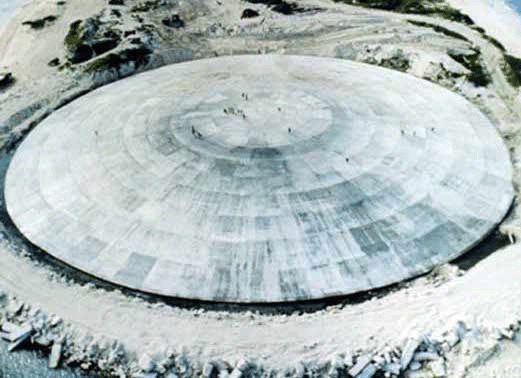
Nuclear tomb: The Runit Dome is chipping and cracking
|
Radioactive ‘Tomb’ in Pacific Filled With Nuclear Waste Is Starting to Crack, Science Alert ARIA BENDIX, BUSINESS INSIDER, 12 NOV 2019
In the Marshall Islands, locals have a nickname for the Runit Dome nuclear-waste site: They call it ‘The Tomb’. The sealed pit contains more than 3.1 million cubic feet (87,800 cubic meters) of radioactive waste, which workers buried there as part of efforts to clean hazardous debris left behind after the US military detonated nuclear bombs on the land. From 1977 to 1980, around 4,000 US servicemen were tasked with cleaning up the former nuclear testing site of Enewetak Atoll. They scooped up the contaminated soil, along with other radioactive waste materials such as military equipment, concrete, and scrap metal. It all went into the Runit Dome, which the servicemen then covered with concrete. In total, the crater holds enough radioactive waste to fill 35 Olympic-sized swimming pools. Most of that is irradiated soil carrying plutonium, an isotope that can cause lung cancer if inhaled. But as seas have gotten higher in the area – the water has risen about 7 millimetres per year since 1993 – water has begun to seep into the soil beneath the dome. Unlike the sealed dome on top, the bottom of the pit was never lined with concrete. So now, rising tides threaten to submerge the tomb – or crack it open. The Runit Dome is chipping and crackingPrior to the nuclear tests in the 1940s and 1950s, residents of Enewetak Atoll were exiled from their homes and relocated to nearby islands. Today, only three of the atoll’s 40 islands have been dubbed safe for human habitation. They are currently home to around 650 residents. The island that hosts Runit Dome remains unoccupied. In 2013, the US Department of Energy reported that radioactive materials could be leaking from the dome into the marine environment, but said such an occurrence would “not necessarily lead to any significant change in the radiation dose delivered to the local resident population.” But sea levels around the Marshall Islands are rising. By 2030, they could be between 1.2 and 6.3 inches (3 cm to 16 cm) higher than they are now, resulting in more storm surges and coastal flooding. By 2100, the dome could be submerged in water. Locals fear that mounting damage to the structure could present a new set of health risks. The dome recently began to crack and chip, increasing the odds that strong waves could force the structure open. A disaster like that would send even more radioactive waste into the nearby ocean or lagoon, which could even force locals to leave the island once again. “If it does [crack] open, most of the people here will be no more,” Christina Aningi, a teacher on Enewetak Atoll, told the Australian Broadcasting Corporation. “This is like a graveyard for us, waiting for it to happen.”…….https://www.sciencealert.com/a-tomb-in-the-marshall-islands-contains-a-huge-amount-of-radioactive-waste |
|
France extends nuclear reactors outage after earthquake
France extends nuclear reactors outage after earthquake, France 24 13 Nov 19, French utility EDF on Tuesday extended outages at three nuclear reactors at its Cruas plant until Nov. 15 following a 5.1 magnitude earthquake in southeast France that forced it to temporarily suspend electricity generation at the site.A sensor at the plant was activated during the earthquake in the region on Monday, requiring the state-controlled utility to carry out further checks for potential damage.
A spokesman for EDF said the outage extension would allow enough time for thorough visual and advanced checks across the plant, including in the nuclear buildings to ascertain that the units could function properly when they restarted.
France’s ASN nuclear safety agency on Monday said it was monitoring the situation and would decide when the reactors could restart.
The outage at the three reactors reduced French power generation by 2,700 megawatts (MW)……https://www.france24.com/en/20191112-france-extends-nuclear-reactors-outage-after-earthquake
Leak shuts down V.C. Summer nuclear plant
|
Leak shuts down V.C. Summer nuclear plant, The State , BY SAMMY FRETWELL, NOVEMBER 09, 2019 Dominion Energy has shut down the V.C. Summer nuclear reactor in Fairfield County after the utility found a “small leak’’ in the atomic power plant’s coolant system, a spokeswoman said Saturday afternoon.
Leaking material has not escaped into the environment, the company said. Dominion didn’t have to shut down the reactor, but it chose to do so while it addresses the leak, spokeswoman Rhonda O’Banion said in an email. O’Banion said there is no danger to the public. The utility said plant operators had been monitoring a small leak for several weeks, before finally deciding to shutter the plant so the leak could be fixed. The company declined to say how long the power plant might be shut down, noting that when the unit will “return to service is market sensitive information.’’……https://www.thestate.com/news/local/environment/article237204218.html |
|
Decommissioning Fukushima nuclear station – cost-cutting culture is causing mistakes
 Nuclear regulator says cost-cutting culture creating mistakes, delays at Fukushima plant, https://mainichi.jp/english/articles/20191107/p2a/00m/0na/025000c
November 8, 2019 (Mainichi Japan) TOKYO –– Decommissioning efforts following the disaster at the Fukushima Daiichi Nuclear Power Station have been hit by delays and a series of mistakes contravening safety rules relating to the operation of nuclear facilities.
In response to the issues, the Nuclear Regulation Authority (NRA) is carrying out a survey into whether operator Tokyo Electric Power Co. (TEPCO) has sufficient staffing numbers working on the project, and is seeking to have TEPCO’s board improve its preparations.
According to the secretariat of the NRA, this summer there were errors in the wiring of electrical cables to the No. 5 and 6 reactors, which caused problems when smoke started to emerge from equipment attached to the reactors.
Furthermore, drinking facilities are being continually installed in controlled zones with high levels of radioactivity where they are forbidden from being built, and it has emerged that workers have drunk water from those areas. In October, the NRA identified both incidents as contravening safety regulations.
Elsewhere, the continuation of work to remove spent nuclear fuel from storage pools at the No. 3 reactor has been delayed. NRA Chairman Toyoshi Fuketa said, “It appears the absolute number of such workers (who manage the work at the power station) is insufficient. If small mistakes continue, it creates the danger of leading to big mistakes.”
Ryusuke Kobayashi, head of the Fukushima Daiichi NRA Regional Office, attended a regular meeting of the NRA on Nov. 6. Regarding the situation at the power station, he said, “There’s a strong focus on cost-cutting at the site. It has an atmosphere which makes it difficult to speak out and say there are too few people working there.” At a press conference after the meeting, chairman Fuketa stressed that it was essential for more staff to be secured.
In response to the NRA, a representative at TEPCO said, “It’s believed an easing of vigilance at the site has been one reason (for the mistakes). The number of human errors has stayed at between 100 and 200 each year for the last five years. We want to proceed with a plan to resolve this considering the specific characteristics of the working environment at the site.”
(Japanese original by Yuka Saito and Suzuko Araki, Science & Environment News Department)
Cybersecurity concerns complicate nuclear digital upgrades
|
As Dominion, others target 80-year nuclear plants, cybersecurity concerns complicate digital upgrades, Utility Dive , By Matthew Bandyk, Nov. 4, 2019,
At a lab on the campus of Purdue University, researchers are testing something that has never been done before in the U.S. energy industry, but has potentially huge implications for the future of nuclear power. They are attempting to demonstrate how to operate a nuclear reactor with all-digital, network-connected instruments and controls, while, at the same time, mitigating the cybersecurity risk of someone hacking into those digital systems.
Earlier this year, federal regulators granted Purdue University Reactor Number One, a research reactor that has been running since 1962, a license to go entirely digital, eschewing the analog wires and tubes that were state-of-the-art at the start of the atomic age and continue to dominate many of the nuclear power reactor fleet’s most important safety systems. While U.S. nuclear plants have been incorporating digital technology over time, many important systems designed to prevent the release of dangerous radiation are still typically analog. For cybersecurity reasons, the digital controls that do exist have to be “air gapped,” meaning they are physically isolated from outside networks. At Purdue, researchers are using the safety of the laboratory to take the exact opposite approach. The digital controls will have wireless connections that the researchers assume can be hacked so they can test how a digital control room can maintain the safety of the reactor even in the face of a cyber threat. “Can we detect that there was an intrusion and how does that affect the rest of the facility?” Clive Townsend, the reactor’s supervisor, explained to Utility Dive.
Extending nuclear livesThis research comes at a time when the U.S. nuclear industry is seeking to go further than they have before with digitization. The reactor fleet is getting old and, for the most part, not being replaced by new reactors. If nuclear power is going to continue generating anywhere near the more than half of U.S. CO2 emissions-free electricity that it provides now, extending the life of existing nuclear plants is necessary. As a result, the nuclear industry has been stressing the advantages of digital systems for life extension, including the ability to more easily replace digital equipment as it ages compared to analog equipment that may be decades-old and no longer available.
“It is urgent that we get on with this,” Doug True, the chief nuclear officer for the industry trade association the Nuclear Energy Institute (NEI), said at a May briefing on digital instrumentation and control before the U.S. Nuclear Regulatory Commission (NRC). “We have plants that are aging, we have plants that are making decisions about moving into subsequent license renewal where digital controls are important.” “By narrowing [the cybersecurity guidance for nuclear plants], you are assuming you know exactly what the adversary is going to do, and that’s a mistake.” Edwin Lyman, Acting Director of the Nuclear Safety Project, The Union of Concerned Scientists: – Last week the NRC approved a key milestone for Florida Power & Light’s application to renew its license for the Turkey Point nuclear plant for another 20 years, potentially allowing Turkey Point to be operate for a total of 80 years, something no U.S. nuclear plant has achieved.
One of the plants right behind Turkey Point in the application process for an 80-year license is Dominion Energy’s Surry Power Station in Virginia, where two reactors started operating in 1972 and 1973, respectively, and without license extensions, will have to retire by 2032 and 2033. “We are evaluating converting several analog systems to digital” at Surry, Dominion spokesman Kenneth Holt told Utility Dive. Those systems include the annunciators — the panels in the control room full of indicators that light up with warning signs about the reactor status — and the equipment that shows the position of control rods within the reactor core.
It is difficult to find replacement parts” for many of the analog systems, Holt said. In some cases, “the manufacturer went out of business 20 years ago.” Cyber challengesStrict rules on cybersecurity, however, pose a challenge to the goal of introducing more digital equipment into a plant. Any digital device or piece of software that the NRC has determined is connected to the systems meant to prevent radiological sabotage undergoes rigorous and continual scanning, updates and other actions to ensure it has not been and cannot be compromised by cybersecurity threats. In addition, any plant employee who has access to this equipment must undergo regular background checks, tests for reliability and trustworthiness and psychological assessments.
There has been some disagreement between the industry and regulators as to which digital equipment should be subjected to the highest level of scrutiny. The NRC’s broad application of its cybersecurity rules has “resulted in reactor licensees having to implement cyber security controls on hundreds to thousands of digital assets, most of which have no direct relationship to radiological sabotage,” like digital indicators on non-safety-related equipment, fax machines, hand-held calibration devices, radios, pagers and calculators NEI wrote in its petition. The group is asking the NRC to narrow its application to only those digital assets that, if compromised in a cyber attack, “would be inimical to the health and safety of the public.”
That change would lead to a “substantial reduction in burden” for plant operators’ use of digital equipment, while “maintaining adequate protection against cyber attacks,” the petition said. But NEI filed that petition in June 2014, kicking off an NRC review that is still ongoing. As reactors continue to age, the NRC is conducting cybersecurity inspections of the country’s nuclear plants. Those inspections will likely be likely wrapped up by the fourth quarter of 2020, according to a recent NRC update.
The NRC’s caution about changing the cybersecurity rules is appropriate, according to Edwin Lyman, the acting director of the Nuclear Safety Project at the Union of Concerned Scientists. In an interview, Lyman said the unpredictability of cybersecurity threats means that regulators should keep the guidance for what equipment is subject to the strongest cybersecurity protections as broad as possible. “By narrowing [the guidance], you are assuming you know exactly what the adversary is going to do, and that’s a mistake,” Lyman said. A piece of equipment that may not initially appear to be directly related to radiological sabotage could become critical if a cyber attack is combined with a physical attack, according to Lyman. For example, a hack of digital communications devices used by plant security could not lead to a radiological accident by itself, but if the devices were hacked while a physical attack threatened the reactor core, security’s ability to respond and prevent the attack could be compromised. …. despite the benefits, some plant operators have found these types of digital upgrades to be difficult to justify due to the upfront cost and the time and effort spent going through the regulatory process to get NRC approval for the changes. ……. NEI officials point out, however, that the test reactor is a tiny fraction of the size of an operating power reactor, so the results of its work with all-digital systems may not always apply to the industry at large. ……. https://www.utilitydive.com/news/as-nuclear-plants-look-to-digitize-controls-and-enhance-performance-cyber/566478/ |
|
Senator Elizabeth Warren questions Holtec Exemption from Emergency Planning Requirements at the Pilgrim Nuclear Power Station
 Senator Warren Statement on Holtec Exemption from Emergency Planning Requirements at the Pilgrim Nuclear Power Station, https://www.warren.senate.gov/newsroom/press-releases/senator-warren-statement-on-holtec-exemption-from-emergency-planning-requirements-at-the-pilgrim-nuclear-power-station 4 Nov 19, Boston, MA – United States Senator Elizabeth Warren (D-Mass.) released the following statement today following news federal regulators at the Nuclear Regulatory Commission (NRC) plan to exempt Holtec International from emergency planning regulations as the firm works to decommission the Pilgrim Nuclear Power Station: Senator Warren Statement on Holtec Exemption from Emergency Planning Requirements at the Pilgrim Nuclear Power Station, https://www.warren.senate.gov/newsroom/press-releases/senator-warren-statement-on-holtec-exemption-from-emergency-planning-requirements-at-the-pilgrim-nuclear-power-station 4 Nov 19, Boston, MA – United States Senator Elizabeth Warren (D-Mass.) released the following statement today following news federal regulators at the Nuclear Regulatory Commission (NRC) plan to exempt Holtec International from emergency planning regulations as the firm works to decommission the Pilgrim Nuclear Power Station:
“I’m disappointed to learn Holtec will be exempt from important emergency preparation and planning safeguards as it decommissions the Pilgrim Nuclear Power Station,” said Senator Warren. “The Southeastern Massachusetts community has rightly continued to raise important questions about the plant’s decommissioning and they deserve answers, not more strong-arming.”
In October 2018, Senator Warren raised concerns about safety and lack of public input during Pilgrim’s shutdown last year and raised similar concerns regarding communications with local residents in her statement. In August 2019, she called for community concerns to be addressed before Pilgrim was allowed to change hands from Entergy Nuclear Operations, Inc. to Holtec.
|
|
1 This Month



26 September – International Day for the Total Elimination of Nuclear Weapons


PLEASE OPPOSE HR 8255 AND S.3639 – bills would accelerate satellite deployment, with no environmental review or safeguards – https://ncstd5li.quorum.us/campaign/169331/
To see nuclear-related stories in greater depth and intensity – go to https://nuclearinformation.wordpress.com
-
Archives
- September 2026 (257)
- August 2026 (330)
- July 2026 (355)
- June 2026 (287)
- May 2026 (306)
- April 2026 (356)
- March 2026 (251)
- February 2026 (267)
- January 2026 (308)
- December 2025 (358)
- November 2025 (359)
- October 2025 (375)
-
Categories
- 1
- 1 NUCLEAR ISSUES
- business and costs
- climate change
- culture and arts
- ENERGY
- environment
- health
- history
- indigenous issues
- Legal
- marketing of nuclear
- media
- opposition to nuclear
- PERSONAL STORIES
- politics
- politics international
- Religion and ethics
- safety
- secrets,lies and civil liberties
- spinbuster
- technology
- Uranium
- wastes
- weapons and war
- Women
- 2 WORLD
- ACTION
- AFRICA
- Atrocities
- AUSTRALIA
- Christina's notes
- Christina's themes
- culture and arts
- Events
- Fuk 2022
- Fuk 2023
- Fukushima 2017
- Fukushima 2018
- fukushima 2019
- Fukushima 2020
- Fukushima 2021
- general
- global warming
- Humour (God we need it)
- Nuclear
- RARE EARTHS
- Reference
- resources – print
- Resources -audiovicual
- Weekly Newsletter
- World
- World Nuclear
- YouTube
-
RSS
Entries RSS
Comments RSS
 nuclear-news