PG and E face bankruptcy- transparency needed on decrepit Diablo Canyons nuclear reactors

|
December 18, 2019, by Common Dreams
The same pattern of lethal neglect and deferred maintenance that made PG&E the proven culprit in murderous wildfires is being repeated at Diablo Canyon. by Mimi Kennedy, Harvey Wasserman But in the interim, it must be brought to light that no squaring of PG&E’s accounts—with the people of California, the utility’s fire victims, the governor, the Public Utilities Commission, the banks, or the planet – will be complete unless there is a transparent public inspection of, and credible mechanical and fiscal accounting for, Diablo Canyon’s two aging reactors (see our petition at www.solartopia.org). The two central coast nukes are scheduled to shut by 2025, a fact that gives some policymakers a false sense of safety and a convenient cover to avoid thinking about the devastating possibility of an earthquake that would render a major population center uninhabitable and its agricultural economy barren. Why kick up a fuss if the problem’s going away in five years? Here’s why: The same pattern of lethal neglect and deferred maintenance that made PG&E the proven culprit in murderous wildfires is being repeated at Diablo Canyon. But the nuclear reactor units are more than thirty years old. Diablo Unit One was long ago found to be seriously embrittled, which means its piping is almost certainly cracked due to age. Its list of deferred maintenance procedures is a by-now notorious PG&E trademark. Its waste management procedures are suspect. The site is surrounded by more than a dozen interlinked earthquake faults. Can we really trust the operation of these immensely complex machines over the coming sixty months to a company we don’t trust to safely deliver electricity in a light breeze? We don’t need to: the power Diablo generates can be made up for by truly renewable energy sources. Now is the time—before PG&E’s bankruptcy is resolved—for the governor, the California Public Utilities Commission, and other public authorities to conduct a transparent inspection of PG&E’s nuclear facility at Diablo. A truthful appraisal of the reactors—what PG&E might claim as its biggest single asset—is impossible without a thorough inventory of the reactors’ structural liabilities Technically, such inspections are the bailiwick of the Nuclear Regulatory Commission. The NRC is currently a captive agency, with three of its five commissioners appointed by Trump. They have advocated a drastic scale-back of on-site safety inspections, allowing the nation’s 96 aging reactors to become progressively more dangerous to our population. But PG&E’s bankruptcy creates a condition outside the NRC’s purview: the court must ensure that the aggrieved parties are given a full understanding of the financial value and risks of the assets at stake. All US reactors, Diablo among them, lack private insurance. A federal fund to which providers contribute to cover their liability for catastrophic accidents contains less than $13 billion, a drop in the bucket compared to what even one such accident would cost. And who will run these two hotly contested nukes after the bankruptcy settlement? Public ownership is being hailed as a possible, progressive solution. Does that mean We the People unwittingly assume liability for the incalculable health, ecological, and property damages if the San Andreas fault (or any other) reduces Diablo to radioactive rubble and sends an apocalyptic Chernobyl cloud through the central valley, down to Los Angeles, up to the Bay Area, and into Northern California, so recently reduced to ash by PG&E? The high-stakes debate over what to do with what was once the world’s largest electric utility has been suspiciously silent on Diablo’s two 800-pound gorillas. So hear this scream: The question of ownership – private or public – cannot be answered without accounting for the structural safety and potential liabilities of the two decrepit megaliths at San Luis Obispo. The governor, the CPUC, the courts, and the company must provide the public with a detailed, independent, and credible look at the innards of these two immense machines before any bankruptcy proceedings can conclude or any future for California’s electric supply can be mapped out. Call them all now!!! |
|
|
Anger as EDF tries to shrink emergency zone around Scottish nuclear plant
Follow The emergency zone around Hunterston B, an ageing nuclear power plant in Scotland, sprawls for more than 2km in every direction. Residents of this zone are regularly given iodine pills to take in the event of a nuclear disaster.However, French state-owned EDF Energy has come under fire for attempting to reduce the emergency zone to 1km, potentially exposing residents further away to harmful levels of radiation if an accident were to take place.
Activists claim the zone should be expanded rather than contracted. A recent change in the law has placed the responsibility for zoning around nuclear facilities with local authorities, rather than the Office of Nuclear Regulation (ONR).
North Ayrshire...(subscribers only) https://www.telegraph.co.uk/business/2019/12/16/anger-edf-tries-shrink-emergency-zone-around-scottish-nuclear/
Legal action regarding defective welds in EPR nuclear reactor
Crilan 16th Dec 2019, On July 20, 2018 and following the “Sortir du nuclear” network and Greenpeace France, CRILAN filed a complaint with the Cherbourg Public Prosecutor concerning defective welds, particularly those relating to
crossings of the containment. This December 16, 2019, following ASN
inspections and in connection with the complaint by Réseau “Sortir du
nuclear” and Greenpeace France, CRILAN files a complaint with the Public
Prosecutor of Paris for serious breaches relating to the qualification of
some equipment installed on the EPR.
These are materials participating in
the safety demonstration: mechanical (pumps, valves) or electrical (relays,
circuit breakers, etc.). This qualification is based in particular on
studies and tests. It must be the subject of documentation and traceability
of reservations and “open” points, which has not always been the case.
As EDF is subject to regulations on basic nuclear installations, violations
committed may be penalized.
Angst in Utah over dangers of nuclear waste transport to “temporary” storage
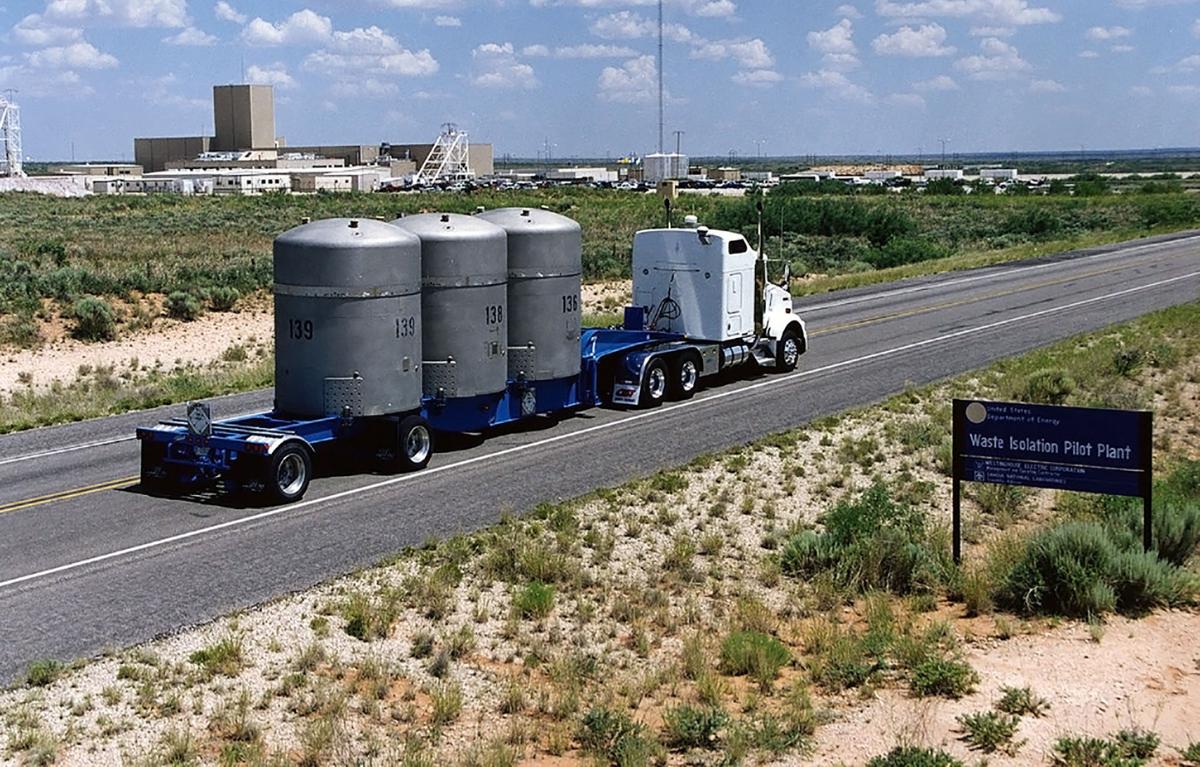
“Congress should be pursuing hardened on-site storage for this waste at or near its current location. This is the solution that can most safely contain it and not put others at-risk,”
“Washington is bowing to the political clout of industry while placing unnecessary and potentially costly risks on public health
|
Nuclear Waste Policy Amendments Act hurts Utah http://suindependent.com/nuclear-waste-policy-amendments-act-hurts-utah/
The Nuclear Waste Policy Amendments Act of 2019 inherently puts innocent citizens at risk should an accident occur during transportation. By Steve Erickson, 13 Dec 19, On Dec. 11, organizations announced their opposition to House Resolution 2699, the Nuclear Waste Policy Amendments Act of 2019, and urged the Utah’s federal delegation to vote against this bill. These organizations include the Healthy Environment Alliance of Utah, Citizens Education Project, Utah Physicians for a Healthy Environment, Uranium Watch, the Nevada Nuclear Waste Task Force, and the Utah Sierra Club.
HR 2699 aims to open consolidated interim storage facilities for high-level radioactive waste throughout the southwest. Continue reading
|
How India’s Kudankulam Nuclear Power Plant (KNPP) got hacked
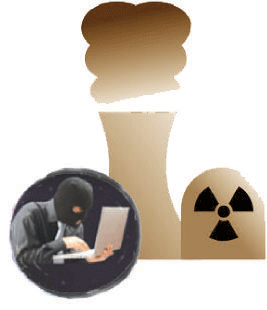 How a nuclear plant got hacked, Plugging nuclear plants into the internet makes them vulnerable targets for nation-state attack. By J.M. Porup, Senior Writer, CSO December 9, 2019 If you think attacking civilian infrastructure is a war crime, you’d be right, but spies from countries around the world are fighting a silent, dirty war to pre-position themselves on civilian infrastructure — like energy-producing civilian nuclear plants — to be able to commit sabotage during a moment of geopolitical tension.
What follows is an explanation of how India’s Kudankulam Nuclear Power Plant (KNPP) got hacked — and how it could have been easily avoided.
The KNPP hack The news came to light, as it so often does these days, on Twitter. Pukhraj Singh (@RungRage), a “noted cyber intelligence specialist” who was “instrumental in setting up of the cyber-warfare operations centre of the National Technical Research Organisation (NTRO),” according to The New Indian Express, tweeted: “So, it’s public now. Domain controller-level access Kudankulam Nuclear Power Plant. The government was notified way back. Extremely mission-critical targets were hit,” noting in a quote tweet that he was aware of the attack as early as September 7, 2019, calling it a “causus belli” (an attack sufficiently grave to provoke a war).
In a later tweet, Singh clarified that he did not discover the malware himself. A third party “contacted me & I notified National Cyber Security Coordinator on Sep 4 (date is crucial). The 3rd party then shared the IoCs with the NCSC’s office over the proceeding days. Kaspersky reported it later, called it DTrack.”
At first the Nuclear Power Plant Corporation of India (NPCI) denied it. In a press release they decried “false information” on social media and insisted the KNPP nuclear power plant is “stand alone and not connected to outside cyber network and internet” and that “any cyber attack on the Nuclear
Power Plant Control System is not possible.”
Then they backtracked. On October 30, the NPCI confirmed that malware was in fact discovered on their systems, and that CERT-India first noticed the attack on September 4, 2019. In their statement, they claimed the infected PC was connected to the administrative network, which they say is “isolated from the critical internal network.”
“Investigation also confirms that the plant systems are not affected,” their statement concludes.
Power Plant Control System is not possible.”
Then they backtracked. On October 30, the NPCI confirmed that malware was in fact discovered on their systems, and that CERT-India first noticed the attack on September 4, 2019. In their statement, they claimed the infected PC was connected to the administrative network, which they say is “isolated from the critical internal network.”
“Investigation also confirms that the plant systems are not affected,” their statement concludes.
A targeted attack
Contrary to some initial reporting, the malware appears to have been targeted specifically at the KNPP facility, according to researchers at CyberBit. Reverse-engineering of the malware sample revealed hard-coded administrator credentials for KNPP’s networks (username: /user:KKNPP\\administrator password: su.controller5kk) as well as RFC 1918 IP addresses (172.22.22.156, 10.2.114.1, 172.22.22.5, 10.2.4.1, 10.38.1.35), which are by definition not internet-routable.
That means it is highly likely the attacker previously broke into KNPP networks, scanned for NAT’ed devices, stole admin credentials, and then incorporated those details into this new malware, a second-stage payload designed for deeper and more thorough reconnaissance of KNPP’s networks.
“This was a very targeted attack on just this plant,” Hod Gavriel, a malware analyst at CyberBit, tells CSO. “Probably this was the second stage of an attack.”
The malware discovered, however, did not include Stuxnet-like functionality to destroy any of KNPP’s systems. “This phase was only for collection of information, it wasn’t sabotageware,” Gavriel says. ….. https://www.csoonline.com/article/3488816/how-a-nuclear-plant-got-hacked.html
Release of radioactive dust at Dounreay contravened regulations
|
RADIOACTIVE DUST ACCIDENTALLY RELEASED AT NUCLEAR SITE CONTRAVENED MULTIPLE REGULATIONS, INVESTIGATION FINDS, Newsweek
BY ARISTOS GEORGIOU ON 12/13/19 Environmental authorities in Scotland have said that an accidental release of radioactive dust from a nuclear site “contravened multiple” regulatory conditions, according to reports.
The contaminated dust vented out of a uranium recovery plant at Dounreay—a nuclear research center which is in the process of being decommissioned—earlier this year after a valve failed during a system test in February, the BBC reported. This caused a “disturbance” of contaminated dust in the ventilation system and a subsequent discharge into the facility itself and the atmosphere…… https://www.newsweek.com/radioactive-dust-nuclear-site-multiple-regulatory-conditions-investigation-1477168 |
|
Los Alamos National Laboratory lost 250 barrels of nuke waste
The contractor that’s been in charge of Los Alamos National Laboratory’s operations for the past year lost track of 250 barrels of waste, while the company heading the legacy cleanup mislabeled and improperly stored waste containers and took months to remedy some infractions, according to the state’s yearly report on hazardous waste permit violations.
Triad National Security LLC, a consortium of nonprofits that runs the lab’s daily operations, had 19 violations of its permit from the New Mexico Environment Department. Newport News Nuclear BWXT Los Alamos, also known as N3B, which is managing a 10-year cleanup of waste generated at the lab, was cited 29 times.
Triad’s most notable violation was shipping 250 barrels of mostly mixed waste to the Waste Isolation Pilot Plant in Carlsbad without tracking them. Mixed waste contains low-level radioactive waste and other hazardous materials. Inspectors found records still listed the waste at the national lab. …..
A disastrous “kitty litter” incident happened under Los Alamos National Security, in which a waste barrel was packaged in error with a volatile blend of organic cat litter and nitrate salts, causing the container to burst and leak radiation at the Southern New Mexico storage site. WIPP closed for almost three years, and the cleanup cost about $2 billion.
The National Nuclear Security Administration, a division of the U.S. Department of Energy that oversees the lab, declined to renew LANS’ contract in 2015. Triad took over operations in November 2018. Among Triad’s duties is to dispose of waste at the lab generated from 1999 to the present.
N3B won a $1.4 billion contract in December 2017 to clean up waste produced at the lab before 1999.
The company was cited for a slew of mislabeled waste containers during the year. Inspectors also found some waste barrels, which are stored under tent-like domes, coated with snow or rainwater.
N3B also failed to remedy within 24 hours the flaws that inspectors found in equipment or structures that could present an environmental or human-health hazard, the report said. Inspectors discovered N3B took as long as 18 months to fix cracks in concrete and asphalt surfaces…….. https://www.santafenewmexican.com/news/local_news/state-report-lanl-lost-track-of-barrels-of-nuke-waste/article_e9de8348-17cc-11ea-bae3-c71a1aadd222.html
Dangers of nuclear crises in the Arctic: countries prepare for emergencies.
Arctic Council creates new expert group on nuclear emergencies https://thebarentsobserver.com/en/arctic/2019/12/arctic-council-creates-new-expert-group-nuclear-emergencies
The Arctic countries take major steps to prepare strategies and share information to improve preparedness in case of radiological and nuclear incidents. By Thomas Nilsen, December 11, 2019
Two fatal accidents during the summer of 2019 was a wake-up call for radiation emergency authorities monitoring northern waters.
On July 1st, the nuclear-powered special purpose submarine Losharik catches fire when on mission outside the Kola Peninsula. Six weeks later, a nuclear-powered cruise missile explodes while being recovered from the seabed outside Nenoksa naval weapons testing site in the White Sea.
While Russia has been very reluctant to share information about what happened at the two accidents, the country is a team-player when the Arctic Council now has agreed to establish a dedicated expert group on radiation and nuclear incidents.
The formal decision was taken at the meeting of the Arctic Council’s Working Group on Emergency Prevention, Preparedness and Response (EPPR) in Reykyavik on December 4th.
All eight Arctic states will appoint experts and observer states are encouraged to participate. To strengthen the group’s role, the International Atomic Energy Agency (IAEA) is invited to join the meetings.
Inside the Arctic Circle, the number of nuclear-powered vessels has increased sharply over the last decade.
Tensions between Russia and NATO have led to more sailings with reactor-powered submarines, especially in the Norwegian, Barents- and White Seas, but also under the ice in the high Arctic. Northern Norway saw a record number of 12 visiting NATO nuclear-powered submarines in 2018. And while the Arctic Council members met in Reykjavik last week, Russia’s Northern Fleet still had a number of attack submarines sailing the Norwegian Sea. So did at least one American nuclear-powered submarine as reported by the Barents Observer.
Secondly, increased shipping and industrial activities along Russia’s Northern Sea Route are supported by more and larger nuclear-powered icebreakers.
Unfortunate, the history of operating reactors and deploying nuclear weapons to the Arctic has a bad record with radioactivity released to the environment and exposure to people; nuclear weapons testing at Novaya Zemlya, the crash of a U.S. bomber with plutonium warheads at Thule airbase on Greenland, sinking submarines like the Komsomolets, Kursk and K-259. Several other submarines have suffered serious reactor accidents and in the Kara Sea, thousands of containers wit radioactive waste is dumped together with 16 reactors.
The Arctic Council, though, can not engage in anything related to military activities.
The list of potential incidents with possible releases of radioactivity exposing people living or working in the Arctic is long. How to share knowledge and information about each countries’ preparedness capacities will certainly be on the agenda when the new expert group’s first formal meeting, likely to take place next spring on the Faroe Islands.
Chair of the expert group in the starting period, Øyvind Aas-Hansen with the Norwegian Radiation and Nuclear Safety Authority, tells the Barents Observer that one interesting topic that might be brought to table is defining the risk potential for emergencies due to nuclear and radiological material and activities that pose a threat in the Arctic.
«We aim at protecting Arctic inhabitants and their livelihoods and the Arctic environment,» Øyvind Aas-Hansen explains.
He said it is needed to «identify minimal preparedness and response arrangements and capabilities applicable to the Arctic region.»
Aas-Hansen said it could be special needs for coordinating emergency prevention and response that are «specific to the Arctic region.»
Both the United States and Russia have serious experiences from dealing with nuclear accidents in cold climate, like the US clean-up work after the Thule accident in 1968 and Soviet clean-up work after the leakages from Building No. 5 in Andreeva Bay in the early 1980s.
More reactors at sea
The Barents Observer has recently published an overview (pdf) listing the increasing number of reactors in the Russian Arctic. The paper is part of Barents Observer’s analytical popular science studies on developments in the Euro-Arctic Region.
According to the list there are 39 nuclear-powered vessels or installations in the Russian Arctic today with a total of 62 reactors. This includes 31 submarines, one surface warship, five icebreakers, two onshore and one floating nuclear power plants.
Looking 15 years ahead, the number of ships, including submarines, and installations powered by reactors is estimated to increase to 74 with a total of 94 reactors, maybe as many as 114. Additional to new icebreakers and submarines already under construction, Russia is brushing dust of older Soviet ideas of utilizing nuclear-power for different kind of Arctic shelf industrial developments, like oil- and gas exploration, mining and research. “By 2035, the Russian Arctic will be the most nuclearized waters on the planet,” the paper reads.
Also, existing icebreakers and submarines get life-time prolongation. The average age of the Northern Fleet’s nuclear-powered submarines has never been older than today. Several of the submarines built in the 1980s will continue to sail the Barents Sea and under the Arctic ice-cap until the late 2020s.
In August, Russia’s first floating nuclear power plant, “Akademik Lomonosov”, will be towed from Murmansk to Pevek, a port-town on the northeast coast of Siberia.
Other plans to use nuclear reactors in the Russian Arctic in the years to come include many first-of-a-kind technologies like sea-floor power reactors for gas exploration, civilian submarines for seismic surveys and cargo transportation, small-power reactors on ice-strengthen platforms.
In the military sphere, the Arctic could be used as testing sites for both Russia’s new nuclear-powered cruise-missile and nuclear-powered underwater weapons drone. Both weapons were displayed by President Vladimir Putin when he bragged about new nuclear weapons systems in his annual speech to the Federation Council last year.
An Arctic Council summary report, presented to the Ministerial Meeting in Rovaniemi in May as a deliverable by the Emergency Prevention, Preparedness and Response (EPPR) Working Group highlight the risks: “The presence of radiological and nuclear material in the Arctic poses a risk for serious incidents or accidents that may affect Arctic inhabitants and their communities, the Arctic environment, and Arctic industries, including traditional livelihoods such as fisheries and local food sources.”
For Norway, Russia and Iceland, a nuclear accident in the Barents Sea could be disastrous for sales of seafood. The three countries export of cod and other spices is worth billions of Euros annually.
Flammable hazard stalls LANL’s plutonium operations, waste shipments
Flammable hazard stalls LANL’s plutonium operations, waste shipments, Sante Fe New Mexican , By Scott Wyland , swyland@sfnewmexican.com
-
- Dec 9, 2019 Concerns that a calcium residue might be flammable prompted officials at Los Alamos National Laboratory to curtail plutonium operations and suspend waste shipments in early November, according to a federal report.
The lab suspended most waste generation and certification at its plutonium facility and halted all waste shipments after officials questioned the accuracy of documentation, particularly on how much calcium-and-salt residue remained in transuranic waste after processing, the Defense Nuclear Facilities Safety Board, an independent oversight panel, said in a Nov. 15 report that was publicly released Friday.
Calcium is used to help reduce oxidation in plutonium. Traces of the substance typically linger after processing, and if they are too high, they can ignite when exposed to open air, the report says…… https://www.santafenewmexican.com/news/local_news/flammable-hazard-stalls-lanl-s-plutonium-operations-waste-shipments/article_dad5a96c-186c-11ea-ac96-a345865823f1.html
Floating small nuclear reactors bring serious risks
nuclear experts have highlighted crucial negatives that cast doubt on the floating nuclear utopia.Jan Haverkamp, Greenpeace Netherlands senior expert nuclear energy and energy policy, sees the three main disadvantages of Akademin Lomonosov to be the big human factors risk, its problematic construction, and the pollution of the Arctic region with nuclear waste.
this project is reintroducing a major pollution risk in an area which functions as a climate regulator for the globe – “the Arctic pristine area, which is a very important natural area for the entire balance on the planet,”
Is floating nuclear power a good idea? Power Technology By Yoana Cholteeva, 9 Dec 19, Floating nuclear power promises to provide a steady source of energy at hard-to-reach locations, but at the same time the dangers inherent in nuclear power make some question whether it’s safe enough for areas where help is hard to find. Is floating nuclear power really a good idea? Yoana Cholteeva investigates.
Russian nuclear company Rosatom announced the arrival of the world’s first floating nuclear power plant, Akademik Lomonosov, in September 2019 when the technology was transported to the port of its permanent location in Russia’s Far East. The 144m-long and 30m-wide vessel has now docked at the port in Pevek, off the coast of Chukotka, where it will stay before its commissioning next year.
Akademik Lomonosov will use small modular reactor technology and is equipped with two KLT-40C reactor systems with 35MW capacity each. It has been designed to access hard-to-reach areas where it can operate for three to five years without the need for refuelling. It also has an overall life cycle of 40 years, which may be extended to 50 years Continue reading
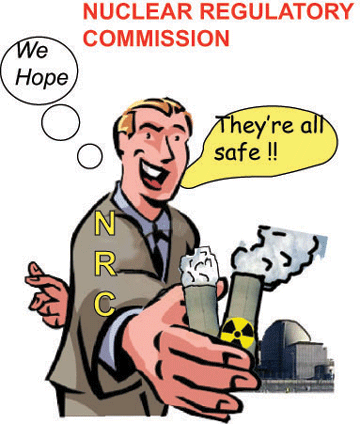
Florida nuclear station gets license for 80 Years
| D |
FPL’s Turkey Point first US nuclear plant to get license out to 80 years, Utility Dive, By Kavya Balaraman Dec. 7 2019,
Dive Brief:
The majority of nuclear power plants in the U.S. are currently on a renewed license — extending their initial 40-year operational lifespan to 60 — but as more reach the 60-year mark, the NRC is gearing up for “subsequent license renewals,” which would authorize the plants to operate for another two decades. …….
Damon Moglen, senior strategic advisor of the Climate and Energy Program at Friends of the Earth, called the development “a licensing disaster waiting to happen.” The Turkey Point facility remains vulnerable to climate change, he said, and the region is expected to experience rising sea levels by the 2050s.
This decision in no way serves the public and the environment, it only serves the interest of a very precise industry looking to protect its profits,” he said. https://www.utilitydive.com/news/fpls-turkey-point-first-us-nuclear-plant-to-get-license-out-to-80-years/568593/
|
|
Another shutdown at French nuclear power station Golfech
France Bleu 2nd Dec 2019. A nuclear reactor again shut down at the Golfech power station after a leak. The production unit number 2 of the Tarn-et-Garonne power plant was stopped this Monday, December 2 in the morning, after the discovery of a steam leak in a non-nuclear part. This reactor had just been restarted just four days ago.
Need for scrutiny of troubled Hunterston nuclear reactor before restarting it
 Largs & Millport Weekly News 3rd Dec 2019, A WATCHDOG’S vital scrutiny meeting scheduled to take placed before troubled reactors are switched back on at Hunterston Power Station has been cancelled – because of the general election. The Hunterston Site Stakeholders Group had been due to meet on December 5 where they would have quizzed EDF on the decision to reactivate two reactors blighted by safety concerns. It was revealed this week that reactor four is due to go back online fully from February 15 and reactor three on January 15.
Councillor Ian Murdoch believes that it is imperative that a scrutiny
meeting takes place before the reactors are switched back on after cracks
were found in their graphite cores. The acceptable threshold of cracks has
been extended from 350 to 700 by regulators ONR, who recently gave
permission for Hunterston reactor 4 to be brought back online for a four
month spell.
Technical fault shuts down Belgian nuclear reactor
Belgian nuclear reactor shuts down after technical fault https://www.brusselstimes.com/belgium/81820/nuclear-reactor-at-belgian-power-station-goes-into-automatic-shutdown-after-technical-fault-safely-electricty-doel/ Evie McCullough
The Brussels Times, 04 December 2019 A reactor at the Tihange nuclear power station in the town of Huy went into shut down on Wednesday morning after a technical problem automatically triggered the process, the plant’s operator Engie Electrabel confirms.
Tihange 1 went into shut down because of a problem with a pump in the “non-nuclear” part of the reactor, the operator explained in a Tweet.
The shutdown was carried out safely and procedures were followed throughout, with investigations into the fault still taking place at around 12:50 PM.The reactor is currently scheduled to stay in shut down mode until Thursday evening, although this could change depending on the results of the analysis of the fault that triggered the shutdown, Le Soir explains.
Tihange, which represents about 15% of total electricity production capacity in Belgium, is one of two nuclear energy production sites in the country- the other is located in Doel.
Big risk factors for Middle East countries in adopting nuclear power

  Facing the Nuclear Storm Facing the Nuclear StormCountries across the Middle East are building or have already started operating their nuclear power plants. To assess how “resilient” their nuclear energy systems are, one must look at a number of important risks and factors The Cairo Review By Ali Ahmad, and Benedetta Bonometti 1 Dec 19, Soon enough, countries with nuclear power in the Middle East will have to face a storm when it comes to operating their power plants safely. That is why the focus on introducing resilient energy systems is receiving much attention in developed and developing countries alike.
Across the globe, a variety of natural and human-induced risks and threats have caused substantial disruptions to the delivery of energy services and affected millions of people. From the massive July blackout in New York City that was linked to a sweltering heat wave to the conflicts in Yemen, Libya, and Syria that have caused power outages and severe damage to power generation and transmission, the need for resilient energy infrastructure is becoming more relevant than ever.
Energy resilience remains an evolving concept, but for now, it can be understood as the ability of an energy system to adapt to possible disruptive and challenging environments such as a tsunami or a heat wave, and to resume service provision swiftly. However, studies and experience have demonstrated the pivotal role that preemptive measures play when envisaging a resilient energy system. The link between energy resilience and the proposals to build nuclear energy power plants across the region lies in the scale of the region’s nuclear ambitions. Currently, there are six regional countries, including Iran, the United Arab Emirates (UAE), Egypt, Turkey, Jordan, and Saudi Arabia, which are developing nuclear power programs, with varied degrees of commitment. In a global energy landscape that is tilting toward renewable energy and an increased interest in decentralized systems, which combined together make for strong or resilient structures, one important question to ask is how the introduction of nuclear power will affect the resilience of national energy systems in these countries. This is especially important considering the exclusive set of risks associated with having a nuclear power program. Nuclear Vulnerabilities and Disruptions Pre-operation risks Nuclear power plant projects are exposed to numerous threats before they start operating. In fact, lengthy construction times, which are common in such projects, increase the probability of project cancellation before the plants start generating electricity. The years-long lead times, or in other words the time it takes to carry out financial and licensing procedures as well as construction, make nuclear projects vulnerable to financial and political risks and could lead to plant closure. The most common financial problems which arise from escalating costs and construction delays are due to either stringent licensing processes and/or project mismanagement. Moreover, other sources of energy could become cheaper and more competitive, especially as gas or oil discoveries are made more often (such as the discovery of offshore gas fields like Egypt’s Zohr). Nuclear energy programs in turn become highly sensitive political issues to the extent that a change of governments, as in the case of the so-called Arab Spring, might halt the construction of planned nuclear power plants. Fuel supply The main threat to front-end activities regarding fuel supply is the disruption of enriched uranium supply. Uranium fuel disruptions would more likely be linked to the regional political climate given that the global supply chains of uranium fuel face no major impediments. …….. Attacks against critical nuclear facilities The recent drone and missile attacks on Saudi Arabia’s ARAMCO facilities temporarily crippled its oil production, inflamed regional tensions, and sent shockwaves around the globe. Had the attack been on a nuclear power facility, the consequences could have been much more grave………. Foreign workforce …….. The involvement of foreign workers, which may be necessary when the host country lacks the required human capital to run its own nuclear power program, may raise several issues. …….. Climatic effects When thinking of possible climatic effects on the resilience of the nuclear power plants in the region, heat waves are particularly concerning due to their impact on the temperature of the reactor’s cooling water. …. Spent nuclear fuel considerations Spent nuclear fuel, in other words the irradiated (and radioactive) fuel waste generated by nuclear fission, must first cool down for a number of years in water-filled storage pools before it is ready to be handled and transported. Spent fuel pools will always be full as new spent fuel will continuously replace fuel that is removed. Consequently, various threats to the storage pools are possible. Firstly, like the case with nuclear reactors, natural disasters and extreme weather conditions could threaten the functionality of the storage pools. Secondly, spent fuel pools may also be identified as targets during armed conflicts. …… Major risks exist that show the contradiction between the development of nuclear energy in the Middle East and the emerging narrative of energy resilience. Nuclear power is not only vulnerable to climatic and nature-induced extreme events but also to attacks by state and non-state actors. The recent attacks on Saudi Arabia’s oil infrastructure are reminders that the higher the value of the target, the more critical it becomes. With nuclear power becoming a reality in the region, efforts by governments, academia, and civil society need to focus on promoting its resilient, safe, and secure operation. As a start, we need to invest in risk mitigation strategies and mechanisms as well as better emergency response and preparedness that utilize unhindered and depoliticized technical cooperation between all states in the region. Since the effects of nuclear accidents are often cross-border, even countries that do not have nuclear power programs must be part of these efforts. Ali Ahmad is the director of the Energy Policy and Security Program in the Issam Fares Institute for Public Policy and International Affairs at the American University of Beirut. Ahmad is the author of numerous journal articles on nuclear energy and security with a focus on the Middle East region. Read More
Benedetta Bonometti is a graduate student in public policy with a specialization in energy, resources, and development at Sciences Po Paris. Her research interests focus on fossil fuel and nuclear energy policies in the Middle East. Read More https://www.thecairoreview.com/essays/facing-the-nuclear-storm/
|
|
1 This Month



26 September – International Day for the Total Elimination of Nuclear Weapons


PLEASE OPPOSE HR 8255 AND S.3639 – bills would accelerate satellite deployment, with no environmental review or safeguards – https://ncstd5li.quorum.us/campaign/169331/
To see nuclear-related stories in greater depth and intensity – go to https://nuclearinformation.wordpress.com
-
Archives
- September 2026 (257)
- August 2026 (330)
- July 2026 (355)
- June 2026 (287)
- May 2026 (306)
- April 2026 (356)
- March 2026 (251)
- February 2026 (267)
- January 2026 (308)
- December 2025 (358)
- November 2025 (359)
- October 2025 (375)
-
Categories
- 1
- 1 NUCLEAR ISSUES
- business and costs
- climate change
- culture and arts
- ENERGY
- environment
- health
- history
- indigenous issues
- Legal
- marketing of nuclear
- media
- opposition to nuclear
- PERSONAL STORIES
- politics
- politics international
- Religion and ethics
- safety
- secrets,lies and civil liberties
- spinbuster
- technology
- Uranium
- wastes
- weapons and war
- Women
- 2 WORLD
- ACTION
- AFRICA
- Atrocities
- AUSTRALIA
- Christina's notes
- Christina's themes
- culture and arts
- Events
- Fuk 2022
- Fuk 2023
- Fukushima 2017
- Fukushima 2018
- fukushima 2019
- Fukushima 2020
- Fukushima 2021
- general
- global warming
- Humour (God we need it)
- Nuclear
- RARE EARTHS
- Reference
- resources – print
- Resources -audiovicual
- Weekly Newsletter
- World
- World Nuclear
- YouTube
-
RSS
Entries RSS
Comments RSS
 nuclear-news