Serious effects on Europe’s nuclear power if Europe puts sanctions on Russia

 Sanctions on Russia have potential for nuclear impact, PennEnergy, July 23, 2014 By Diarmaid Williams International Digital Editor Recent events in Ukraine have put Europe’s energy security again under scrutiny, and while there is great concern about the bloc’s vulnerability to Russia retaliating to sanctions by turning of the gas, not as much attention has been paid to the nuclear power aspect.
It is an important supplier of the raw material for nuclear fuel, uranium, accounting for 18 per cent of EU supplies.
The BBC reports that 30 per cent of the enrichment work to make uranium suitable for power generation is done by Russian companies.
Meanwhile, many countries within the EU have a significant number of older, Russian-designed nuclear reactors – 18 in all. Finland has two – and all the reactors in Bulgaria, the Czech Republic, Slovakia and Hungary (who are in deals with Russia to build two more) are Russian-designed.
These states are heavily reliant on their nuclear capacity, with 50 per cent of Slovakia’s electricity and 45 per cent of Hungary’s being accounted for by these plants.The fuel for a reactor also has to be supplied in a form – called a fuel assembly – that meets the specifications of the particular reactor, and for Russian-designed nuclear reactors the fuel comes from a Russian company, TVEL. Anything that disrupts the supply of the fuel assemblies needed for these countries’ reactors would be a serious problem for them. A recent European Commission report argued that, “Ideally, diversification of fuel assembly manufacturing should take place, but this would require some technological efforts because of the different reactor designs.”
Because of the implications to countries’ power sectors and, subsequently, their economies, many are reluctant to back aggressive sanctions against Russia……..http://www.pennenergy.com/articles/pei/2014/07/sanctions-on-russia-have-potential-for-nuclear-impact.html
United Nations verifies that Iran has changed all enriched uranium into safer form

 UN: Iran Turns Nuclear Material Into More Harmless Forms http://www.huffingtonpost.com/2014/07/20/iran-nuclear_n_5604070.html By GEORGE JAHN 07/20/2014 VIENNA (AP) — The United Nations says Iran has turned all enriched uranium closest to the level needed to make nuclear arms into more harmless forms.
Tehran had committed to the move under an agreement with six powers last November that essentially froze its atomic programs while the two sides negotiate a comprehensive deal. They extended those talks Saturday to Nov. 24.
Iran had more than 200 kilograms (over 250 pounds) of 20 percent enriched uranium when the agreement was reached and began reducing it shortly after. The U.N.’s International Atomic Energy Agency said Sunday in a report obtained by The Associated Press that all has now been converted or diluted.
At 20 percent, enriched uranium can be converted quickly to arm a nuclear weapon. Iran denies wanting such arms.
New law on renewable energy funding passed in Germany, accepted by European Union
German green energy law clears final hurdle http://af.reuters.com/article/commoditiesNews/idAFL6N0PM3KB20140711?pageNumber=2&virtualBrandChannel=0 FRANKFURT, July 11 (Reuters) – Germany’s upper house of parliament, the Bundesrat, approved on Friday revamped legislation on funding renewable energy, clearing the way for the law to come into force on Aug. 1.
The far-reaching law, which seeks to cap support payments for renewables without jeopardising the country’s shift towards a low carbon economy, had hung in the balance, after months of negotiations, due to wrangling with European Union authorities over its compatibility with state aid guidelines.
But Brussels granted its consent this week, providing encouragement to the Bundesrat, which represents Germany’s 16 states, to vote through the reform package to the renewable energy act (EEG) in its Friday session.
“Germany has embarked on a long project to derive the energy supply of an industrial nation from renewable energy sources, which is historically without parallel,” Stefan Wenzel, environment minister of the state of Lower Saxony, told the Bundesrat.
Germany’s lower house of parliament, the Bundestag, approved the reform package two weeks ago. On Wednesday, European Competition Commissioner Joaquin Almunia said Berlin had allayed concerns that German industry might receive unfair advantages through exemptions from obligatory payments towards the cost of funding green energy. He also said Germany had cleared up two other remaining issues – the need to bring foreign renewable power into planned auctions for green energy from 2017 and to change the system of allowing industrial companies, which produce their own power, full discounts on the EEG after that date.
In 2011 Germany embarked on a strategy to accelerate its exit from nuclear energy in light of Japan’s Fukushima crisis, stepping up its renewables expansion and lowering its dependence on power stations that run on gas and coal.
Green energy from sources such as wind or sunshine has already reached a share of 25 percent of Germany’s power mix and is meant to reach 45 percent by 2025 and 60 percent by 2035.
The EEG reform is aimed at lowering the cost of green energy funding for consumers, among a number of other elements that will be introduced in future, including compensation of conventional producers for loss of market share. (Reporting by Markus Wacket and Vera Eckert; Editing by Gareth Jones)
India’s nuclear deal with USA, Russia and France is a very bad one
 India – now nuclear and environmental dissent is a crime Ecologist, Kumar Sundaram 4th July 2014 “…….Nuclear power is the new must-have India made advance promises for reactor purchases from France’s Areva, Russia’s Atomsroy export and US giants like Westinghouse and GE in exchange for these countries’ support for an exemption for India at the Nuclear Suppliers’ Group (NSG) in 2008.
India was thus permitted to engage in international nuclear commerce despite its status as a nuclear weapons state outside the Nuclear Non-Proliferation Treaty.
It is under the pressure of the commitment to the international nuclear lobby that the Indian government has been bulldozing everything that stands in their way:
- undermining and diluting safety norms,
- pushing through environmental clearances at gun-point,,
- neglecting the adverse economics of these projects,
- crushing grassroots democratic dissent, and
- trying to exempt the nuclear suppliers from liability in the event of any accident….http://www.theecologist.org/News/news_analysis/2460076/india_now_nuclear_and_environmental_dissent_is_a_crime.htm
Nuclear Suppliers Group (NSG) has doubts about India becoming a member
Nuclear export group divided over ties with India – diplomats Yahoo 7 news July 2, 2014, By Fredrik Dahl VIENNA (Reuters) – An influential global body that controls atomic exports is divided over establishing closer ties with India, meaning the nuclear-armed Asian power may have to wait a while longer before joining.
Diplomatic sources said different opinions were voiced in a debate on relations with India – a non-signatory to the Non-Proliferation Treaty (NPT) – at an annual meeting of the 48-nation Nuclear Suppliers Group (NSG) last week in Buenos Aires.
The United States, Britain and other members have argued in favour of India joining the trade body, established in 1975 to ensure that civilian nuclear trade is not diverted for military aims……the country would be the only member of the suppliers’ group that has not signed up to the NPT, a 189-nation treaty set up four decades ago to prevent states from acquiring nuclear weapons.
This has caused some NSG states to raise doubts about India joining their club, which plays a pivotal role in countering nuclear threats and proliferation. Some also argue that it could erode the credibility of the NPT, a cornerstone of global nuclear disarmament efforts……..https://au.news.yahoo.com/world/a/24372928/nuclear-export-group-divided-over-ties-with-india-diplomats/
Iran reduces its planned nuclear enrichment program
Iran eases demands for nuclear capacity at Vienna talks: Western diplomats BY LOUIS CHARBONNEAU AND PARISA HAFEZI VIENNA Thu Jul 3, 2014 (Reuters) – Iran has reduced demands for the size of its future nuclear enrichment program in talks with world powers although Western governments are urging Tehran to compromise further, Western diplomats close to the negotiations said on Thursday.
The diplomats, who spoke to Reuters at the start of a two-week round of negotiations between Iran and the United States, Britain, France, Germany, Russia and China, said that despite some movement from Tehran it would not be easy to clinch a deal by their self-imposed deadline for a deal of July 20.
Tehran’s shift relates to the main sticking point in the talks – the number of uranium enrichment centrifuges Iran will maintain if a deal is reached to curb its nuclear program in exchange for a gradual end of sanctions. Ending the decade-long dispute over Iran’s nuclear ambitions is seen as instrumental to defusing tension and averting a new Middle East war.
“Iran has reduced the number of centrifuges it wants but the number is still unacceptably high,” a Western diplomat told Reuters on condition of anonymity and without further detail……….
Other disputes include the duration of any nuclear deal, the timetable for ending the sanctions, and the fate of a research reactor that could yield significant quantities of plutonium, an alternative fuel for nuclear weapons.
The current round of talks in the Austrian capital will run until at least July 15. (Additional reporting by Fredrik Dahl in Vienna and Mehrdad Balali in Dubai; Editing byMark Heinrich) http://www.reuters.com/article/2014/07/03/us-iran-nuclear-exclusive-idUSKBN0F810H20140703
Hungary to borrow $13.7 billion from Russia, to expand nuclear power
 Hungary approves multi-billion nuclear loan ENCA 23 June 2014 – BUDAPEST – Hungarian lawmakers on Monday approved a multi-billion-euro loan from Russia for an upgrade of the country’s only nuclear power plant, a deal critics say increases Hungary’s dependence on Moscow.
In January, Prime Minister Viktor Orban struck an agreement with Russian President Vladimir Putin for Russia’s atomic energy corporation Rosatom to build two new reactors at the Paks plant — located about 100 kilometres south of Budapest.
The loan agreement, which was signed in March but required approval by Hungary’s parliament, stipulated that Moscow would lend Budapest up to 10 billion euros ($13.7 billion) — around 80 percent of the estimated cost.Parliament gave the loan the green light by 100 votes for, 29 against with 19 abstentions.
Details of the deal were not published nor was any formal bidding process for the plant’s expansion ever launched, prompting an ongoing enquiry from the European Commission into possible breaches of EU law. http://www.enca.com/hungary-approves-multi-billion-nuclear-loan
Despite differences, nuclear pact between Iran and West may be within reach
 Iran: Nuclear Pact ‘Within Reach,’ Despite Yawning Divide http://www.nationaljournal.com/global-security-newswire/iran-nuclear-pact-within-reach-despite-yawning-divide-20140613 Iran said a landmark nuclear pact may be “within reach,” though a chasm persists between negotiators on key issues, the Wall Street Journal reports.
“We’re both very close and very far” from a deal with the five permanent U.N. Security Council member nations and Germany, Iranian Deputy Foreign Minister Abbas Araqchi said on Thursday. The sides are seeking terms to lift sanctions on Iran and to impose long-term limits on its atomic efforts, which are seen by Washington and its allies as a cover for pursuing a nuclear-bomb capability.
“We all want to get the job done by July 20,” Araqchi added, referring to the expiration date for an interim accord that his nation reached in November with China, France, Germany, Russia, the United Kingdom and the United States.
“Our focus remains on the July 20 deadline and that has not changed,” State Department spokeswoman Jen Psaki told reporters.
Analysts, though, warned that a renewal of the short-term deal appears to be a growing possibility, Agence France-Presse reported on Thursday.
“I doubt that an extension is being formally discussed, because that would be to admit failure to meet the July 20 deadline,” former U.S. State Department official Mark Fitzpatrick said. “But some discussion of it must be underway informally.” Western powers may only agree to an extension if Tehran indicates it “will make substantial concessions and come down from hard-line positions,” said Mark Hibbs, a nuclear expert with the Carnegie Endowment for International Peace.
He added, though, that the sides “have been drafting documents in preparation for an eventual extension for a long time.”
Questions raised about UK independence as it co-operates closely with USA over nuclear warheads
Exclusive: UK to step up collaboration with US over nuclear warheads Documents released under FoI reveal ‘enhanced collaboration’ plans, raising questions over independence of UK deterrent Richard Norton-Taylor The Guardian, Friday 13 June 2014 Britain is stepping up its cooperation with the US over the design of nuclear warheads, raising new questions about the independence of the UK deterrent, according to documents disclosed after a freedom of information request.
A document prepared for a visit by a senior American nuclear official to the Aldermaston atomic weapons establishment (AWE) refers to “enhanced collaboration” on “nuclear explosive package design and certification”, on “maintenance of existing stockpiles”, and the “possible development of safer, more secure, warheads”.The partially censored document refers to a letter Tony Blair wrote to George Bush in 2006 asking for US help in maintaining Britain’s “nuclear delivery system” and the white paper of the same year, which gave the green light for replacing the existing fleet of Trident nuclear missile submarines.
One document describes the MDA as an agreement that enables Britain and the US “nuclear warhead communities to collaborate on all aspects of nuclear deterrence including nuclear warhead design and manufacture”.
A briefing paper drawn up for ministers and Ministry of Defence officials argues that physical “movements under the MDA do not involve nuclear weapons or devices” and therefore the agreement does not contravene the letter of the nuclear non-proliferation treaty (NPT).
Most of the documents now released were drawn up at the time of the last renewal of the MDA in 2004. They make it clear Whitehall did not welcome a debate in parliament about the mutual defence pact……
Peter Burt of Nuclear Information Service, who obtained the papers, told the Guardian: “The UK and US are setting a dreadful example to the rest of the world by renewing the MDA, and are seriously undermining the credibility of international efforts to prevent the proliferation of nuclear weapons.”
He added: “If Iran and North Korea had signed a similar agreement for the transfer of nuclear weapons technology, the UK and US would be branding them pariah nations and screaming for the toughest of international sanctions to be imposed.”
Renewing the MDA showed the “worst kind of two-faced hypocrisy” and demonstrated that neither nation was serious about meeting its legal obligations under the NPT, Burt said.
The MoD said the agreement would be renewed by the end of the year http://www.theguardian.com/world/2014/jun/12/uk-us-mutual-defence-agreement-exclusive
Iran cutting nuclear reactor output of plutonium, by a new design
Iran says ‘redesigning’ nuclear reactor to cut plutonium capacity Iran’s atomic energy chief offers to reduce Arak nuclear output to about one-tenth of previously planned level. Haaretz, By Reuters | Jun. 12, 2014 Iran is “busy redesigning” a planned research reactor to sharply cut its potential output of plutonium – a potential nuclear bomb fuel, a senior Iranian official said in comments that seemed to address a key dispute in negotiations with world powers.
The future of the Arak plant is among several issues that negotiators from Iran and six world powers need to resolve if they are to reach a deal by late July on curbing the country’s nuclear programme in exchange for an end to sanctions……..
The amount of plutonium the reactor will be able to yield will be reduced to less than 1 kg (2.2 pounds) from 9-10 kg (20-22 pounds) annually in its original design, he said. Western experts say 9-10 kg would be enough for 1-2 nuclear bombs and that Arak’s capacity should be scaled back.
“We are currently busy redesigning that reactor to arrange for that alteration,” Salehi was quoted by IRNA as saying.
After talks with senior U.S. officials earlier this week, Iran questioned whether the July 20 deadline for a permanent settlement with the powers was feasible. If not, Tehran said the negotiations could be extended for six months. http://www.haaretz.com/news/middle-east/1.598410
Stark difference between President Obama and Prime Minister Abbott, on climate change
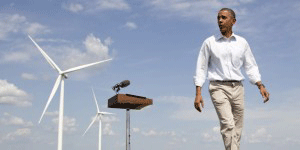 Climate change gulf looms between Barack Obama and Tony Abbott, Guardian, 11 June 14 US president’s call for action in US TV interview stands in stark contrast to the attitude of the Australian prime minister Climate change may be the most significant long-term challenge facing the planet, Barack Obama has said in a newly aired TV interview, emphasising the growing differences with Tony Abbott who insists it is certainly not the most important issue facing the world.
As Obama and Abbott prepare for their first formal meeting in Washington on Thursday, the differences between their positions on global warming are clearer than ever, and according to diplomatic sources the president will not seek to downplay them.
Obama’s remarks in an interview broadcast on US television on Tuesday night come as his administration increases its diplomatic push to achieve a successful new international agreement on greenhouse reduction efforts next year and unveils the detail of tough new rules to force reductions in emissions from US power stations……….
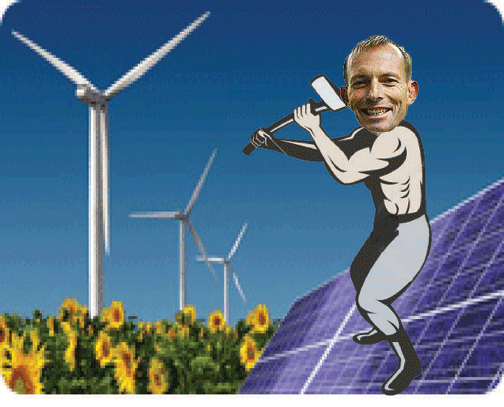 Abbott has downplayed the link between climate change and extreme weather events. For example during severe bushfires last year he said: “Climate change is real, as I’ve often said, and we should take strong action against it … but these fires are certainly not a function of climate change – they’re just a function of life in Australia.” When the executive secretary of the UN Framework Convention on Climate Change, Christiana Figueres, said the fires showed the world is “already paying the price of carbon”, Abbott said “the official in question is talking through her hat”……….
The Coalition’s Direct Action policy is designed to meet only the minimum target of a 5% reduction by 2020 – despite advice from the independent Climate Change Authority that preconditions for a higher target, which previously had bipartisan agreement, have been met. The Coalition has said it will participate in the Paris meeting but has not given any indication of what Australia’s post-2020 target will be, or how it will be determined.
Australia’s policy is entirely voluntary. Companies can choose to bid into a series of “reverse auctions” for government funding. The new US policy requires power generation to reduce emissions by 30%, with states determining the mechanism by which they achieve this. States such as California which have emissions trading schemes will use them to achieve the goal……..http://www.theguardian.com/environment/2014/jun/11/climate-change-gulf-looms-between-barack-obama-and-tony-abbott
India’s nuclear liability law poses a challenge to Russia-India nuclear power agreement
 Russia agrees on India’s nuclear liability law http://economictimes.indiatimes.com/industry/energy/power/russia-agrees-on-indias-nuclear-liability-law/articleshow/36359852.cms MOSCOW: Russia has in principle agreed on the Indian nuclear liability law, paving the way for signing a contract for unit 3 and 4 of the Kudankulam Nuclear Power Plant in July, Russian officials said today. “The (liability) law enacted is certainly challenging. We are working with our colleagues (counterparts) in India and the issue has been resolved,” said Kirill Komarov, Deputy Director General on Development and International business, Rosatom State Corporation. “We have just signed the protocol. The approvals will take some time. We have are awaiting nod from the Indian side. The India’s over view authority (Atomic energy Regulatory Board) is yet to give its nod. “They are also checking seismic activity in the area. So by July we should be ready with a roadmap after which we can start implementing the General Framework Agreement signed between the two countries,” said told a press conference. Unit 1 of the KKNPP has attained 100 per cent capacity of 1000 MW while the second unit should start generating power from this year. Units 1 and 2 of Tamil Nadu-based Kudankulam Nuclear Power Plant (KKNPP) have been built with the help of Russian assistance at the cost of Rs 17,200 crore. Insuring nuclear power plants is a daunting task because of its high cost and there is no single governmental insurance entity in the country that can insure these installations .. .. http://economictimes.indiatimes.com/articleshow/36359852.cms?utm_source=contentofinterest&utm_medium=text&utm_campaign=cppst
USA gives Vietnam a better nuclear deal than it gave to UAE
Pride and pragmatism: The UAE’s nuclear strategy, Bulletin of the Atomic Scientists 2 JUNE 2014 Lauren Carty When the United States and the United Arab Emirates (UAE) signed an agreement for nuclear cooperation in 2009, the terms of the deal were quickly heralded as a gold standard for US nuclear negotiations and nonproliferation goals. Not only did the UAE agree to forgo uranium enrichment and nuclear waste reprocessing—an unprecedented concession in a bilateral agreement of this type—but the United States also retained the right to order the UAE to remove special fissionable material “if exceptional circumstances of concern from a nonproliferation standpoint so require.”
For its part, the United States agreed that it would not extend terms more favorable than these to any other non-nuclear-weapon state in the Middle East in a peaceful nuclear cooperation agreement. The Emirates, however, probably did not foresee the United States backing off its high standards in future agreements with countries outside the Middle East, such as the 2014 agreement with Vietnam that is awaiting Congress’ likely approval. In spite of the Emirates’ subtle animosity over the more flexible US-Vietnam agreement, they have taken it in stride, and have actually used it as an opportunity to lead and exert dominance over the Arab world, as well as to boast of their commitments to sustainability and clean energy technologies.
A double standard? Unlike any other US nuclear agreement to share certain nuclear technologies with its allies, the 2009 arrangement included the stipulation that the UAE must import low enriched uranium rather than building its own enrichment facilities. Some analysts were puzzled when, five years later, the United States entered into a nuclear cooperation deal with Vietnam that allowed the country to enrich uranium. If the gold standard had been established with the UAE in 2009, why did the United States not apply it to Vietnam? Outmaneuvering China is one answer to this question, along with the fact that Vietnam hardly has the infrastructure to undertake a viable enrichment program. These considerations gave the United States incentive to create nuclear foreign policy on a case-by-case basis.
Whatever the reasons for the discrepancy, the UAE is fully aware that it received the short end of the stick………
Nuclear power is just part of the UAE’s strategy for meeting future energy demands. Abu Dhabi—one of the seven emirates that make up the UAE—has become the headquarters for the International Renewable Energy Agency, an organization of 163 countries including the United States and the European Union. Another emirate, Dubai, looks to gain recognition for its environmental sustainability efforts, aiming to be in the top 10 carbon-neutral cities in the world by the end of the decade……http://thebulletin.org/pride-and-pragmatism-uae%E2%80%99s-nuclear-strategy7219
How easily nuclear brinkmanship can slide into nuclear war
The U.S. state presumably does not intend to provoke a hot war with Russia and China.. But directing intensive protowar against powerful nuclear-armed states is to risk the possibility of ‘sleep walking’ into the abyss through miscalculation, or through a gradual hightening of conflicts which finally go out of control.
Nuclear Brinksmanship: Obama’s ProtoWar Against Russia and China By Eric Sommer Global Research, May 31, 2014 Counterpunch Russia and China are both under attack by a multi-pronged U.S.-led ‘proto-war’ which could erupt into ‘hot war’ or even nuclear war. ‘Protowar’ or ‘proto-warfare’ is the term I have coined to describe the use of multiple methods intended to weaken, destabilize, and in the limit-case destroy a targeted government without the need to engage in direct military warfare.
Protowar methods include threats against the targeted country; economic sanctions; military encirclement around its borders. cyber-warfare, drone warfare, and use of proxy forces from within or from outside the country for political and/or military action against the local government.
U.S.-led protowars also invariably include propaganda campaigns against the targeted governments. The media campaigns are waged by the five giant media conglomerates which now control 90% of the U.S. media and which are directly linked to the U.S. foreign-policy establishment through various means including corporate memberships in the Committee for Foreign Relations.
You can recognize these media campaigns because they frequently employ the words ‘human rights’ or ‘democracy’ as the pretext for U.S. state protowars against other countries. Sometimes, of course, these words cannot possibly be applied at all, as in the massive support currently given to the murderous military dictatorship in Egypt or the midevilist kingdom of Saudi Arabia. In these cases the U.S. media and government substitute the words ‘U.S. National Interest’ for ‘human rights’ as the pretext for targeting another country.
Proto-warfare often precedes, or leads up to, hot wars, as when a decade of economic sanctions, media demonization, and media-supported lies about ‘weapons of mass destruction’ led up to the Iraq war. Thousands of young American men and women were sent over to kill and be killed, or to be injured or traumatized, to say nothing of the up to a million Iraqis who died as a result of the war. However, Iraq did not possess nuclear or other weapons of mass destruction, so there was no danger of a nuclear conflagration. Matters are much different with respect to Russia and China, both nuclear powers.
The ProtoWar Against Russia and China
U.S.-led proto-warfare against Russia and China has a number of elements. To begin with, it conforms to two popular doctrines in U.S. foreign policy circles. The first doctrine states that the U.S. must never allow another super-power to emerge, and must remain the unchallenged dominant force on Earth. This doctrine is clearly set-out in the original version of the U.S. Defence Department policy document known as ‘the Wolfowitz doctrine:
“Our first objective is to prevent the re-emergence of a new rival, either on the territory of the former Soviet Union or elsewhere, that poses a threat on the order of that posed formerly by the Soviet Union. This is a dominant consideration underlying the new regional defense strategy and requires that we endeavor to prevent any hostile power from dominating a region whose resources would, under consolidated control, be sufficient to generate global power.”
The document containing this statement and similar notions was changed for public consumption after the original provoked an outcry when it was leaked to the press. The second doctrine underpinning proto-warfare against Russia and China is that U.S. dominance of the planet depends on control of the Eurasian land mass, on which Russia and China occupy key positions. This doctrine has been heavily promoted by former US National Security Advisor Zbigniew Brzezinski. “For America,” he has written, ” the chief geopolitical prize is Eurasia… Eurasia is the globes largest continent and is geopolitically axial. A power that dominates Eurasia would control two of the worlds’ three most advanced and economically productive regions… Eurasia is thus the chessboard on which the struggle for global primacy continues to be played.
In pursuit of Eurasian dominance a whole gamut of protowar tools are now being used by the U.S. in its campaigns against Russia and China. Militarily, the U.S.-led Nato military alliance has progressively squeezed Russia’s’ strategic space by enlisting one former Russian aligned state in Eastern Europe after another. Now, with a U.S.-supported coup-imposed government in power in Kiev, there is open talk of Nato also incorporating Ukraine, a country right on Russia’s’ border……………
On the other side of Eurasia, U.S. military encirclement of China has also recently proceeded apace. Military bases and transfers of billions of dollars in military equipment have been positioned around China for years in areas such as South Korea, Taiwan, and Japan.
Now, with the Obama administrations’ so-called ‘pivot to Asia’, a new more ambitious program called ‘Air-Sea battle plan’ involves deployment of large amounts of very hi-tech military systems and equipment in the pacific area all aimed at China.
At the same time, new U.S. military bases are being opened across the Pacific arena, from the Philippines to Australia, with no other conceivable target but China.
In conjunction with this Pacific military build-up, the U.S.state is attempting to use previously minor disputes over ownership of maritime resources to turn a number of smaller Asian nations into proxies to help it destabilize China. These nations include Japan, South Korea, Vietnam, and the Philippines. By offering its support, and in some cases promises of military assistance in any maritime conflict with China, the U.S. has stoked the ambitions and aggressive nationalist tendencies of these smaller nations vis-a-vis China.
Coinciding with the military build-up against China is extensive cyber-penetration of China by the U.S. NSA (National Security Agency), as revealed by whistle-blower Edward Snowden.
This penetration includes wholesale capture of hundreds of thousands or millions of Chinese mobile text messages; the monitoring of mobile phone conversations of Chinese leaders; and serious intrusions into the computer network backbone system of Beijings’ Tsinghua university, which is linked to large numbers of Chinese research centers including labs engaged in sensitive military-related work………
The danger of the U.S.Eurasian protowar erupting into hot war – or even nuclear war – stems from a single factor: Previous U.S.-led protowars which erupted into hot wars were against countries like Serbia, Iraq, or Libya. Those countries did not have nuclear weapons and could not effectively defend themselves against U.S. military and other pressures Russia and China are in a different category – they are nuclear- armed and can defend themselves.
The U.S. state presumably does not intend to provoke a hot war with Russia and China.. But directing intensive protowar against powerful nuclear-armed states is to risk the possibility of ‘sleep walking’ into the abyss through miscalculation, or through a gradual hightening of conflicts which finally go out of control. . In 1914, with the European powers of the day already on edge, it took just the assassination of a minor duke in a peripheral country to trigger World War I. As an old adage has it, “If you play with fire, you may get burned.” http://www.globalresearch.ca/nuclear-brinksmanship-obamas-protowar-against-russia-and-china/5384644
Niger still short-changed in new uranium deal with AREVA
 Niger, Areva in hard-won uranium deal, Yahoo 7 Finance, 26 May 14—The government of Niger and French nuclear energy group Areva announced on Monday that they had signed a deal to renew a decades-old agreement for the operation of two uranium mines.
Under the deal, negotiated for 18 months, Areva agreed that a 2006 mining law sharply increasing taxes on mineral extracted would apply to the Somair and Cominak operations in the north of the country which it partially controls.
“We have heard the government’s legitimate call for higher receipts coming from uranium,” said Luc Oursel, Areva CEO, on a visit to Niamey to sign the deal.
However, a joint statement said that the operations would be exempt from sales tax over the course of the five-year deal.
The revenue issue had been the main sticking point in the talks since the government considered that the previous contracts, which expired at the end of last year, were unfavourable to the country, the fourth-biggest producer of uranium in the world.
The French arm of charity Oxfam, which has been a sharp critic of state-controlled Areva’s uranium dealings with Niger, said the new deal continued to shortchange Nigeriens, who stood to lose “10 to 15 million euros a year.” ($13.6 to $20.5 million)……. https://au.finance.yahoo.com/news/niger-areva-hard-won-uranium-085912953.html
1 This Month




PLEASE OPPOSE HR 8255 AND S.3639 – bills would accelerate satellite deployment, with no environmental review or safeguards – https://ncstd5li.quorum.us/campaign/169331/
To see nuclear-related stories in greater depth and intensity – go to https://nuclearinformation.wordpress.com
-
Archives
- September 2026 (339)
- August 2026 (330)
- July 2026 (355)
- June 2026 (287)
- May 2026 (306)
- April 2026 (356)
- March 2026 (251)
- February 2026 (267)
- January 2026 (308)
- December 2025 (358)
- November 2025 (359)
- October 2025 (375)
-
Categories
- 1
- 1 NUCLEAR ISSUES
- business and costs
- climate change
- culture and arts
- ENERGY
- environment
- health
- history
- indigenous issues
- Legal
- marketing of nuclear
- media
- opposition to nuclear
- PERSONAL STORIES
- politics
- politics international
- Religion and ethics
- safety
- secrets,lies and civil liberties
- spinbuster
- technology
- Uranium
- wastes
- weapons and war
- Women
- 2 WORLD
- ACTION
- AFRICA
- Atrocities
- AUSTRALIA
- Christina's notes
- Christina's themes
- culture and arts
- Events
- Fuk 2022
- Fuk 2023
- Fukushima 2017
- Fukushima 2018
- fukushima 2019
- Fukushima 2020
- Fukushima 2021
- general
- global warming
- Humour (God we need it)
- Nuclear
- RARE EARTHS
- Reference
- resources – print
- Resources -audiovicual
- Weekly Newsletter
- World
- World Nuclear
- YouTube
-
RSS
Entries RSS
Comments RSS

