Iran’s constructive and pragmatic approach to nuclear talks

 Iran is playing a win-win game at the nuclear talks Al Arabia News Camelia Entekhabi-Fard Monday, 1 September 2014 “……. being too optimistic or too pessimistic is not constructive. Simply put, Iran’s foreign policy has been changed due to the regional and international circumstances…….
President Rowhani and his nuclear negotiating team took very constructive and major steps in order to restore Iran’s image and to try to solve disputes.
They seem to be succeeding because the supreme leader decided to change course and achieve the ambitions they had since the revolution, but in a different way. He understands the importance of being engaged in regional and international matters to play a part rather than sit back in isolation, worrying about national security.
In my opinion, what made Iran’s supreme leader back the nuclear talks and show flexibility, according to his own statement, are the events in the region and the opportunities for Iran to become a regional power once again.
The events in Iraq and Syria,the rise of extremism and Iran’s geopolitical and regional importance coalesce to make Iranians feel like they could gain by changing their language and the way they presen themselves in the region.
Nuclear bombs can’t feed the masses
Ukraine: Cool the Rhetoric; Focus on the Outcome
Johnson’s Russia List, jackmatlock.com – Jack Matlock – August 26, 2014 “……Neither Russia nor the United States has any right, under what is generally accepted as international law, to be involved in selecting a government in Ukraine. Russia, however, has an infinitely greater stake in that government’s orientation than has the United States and a much greater ability to affect what happens on the ground…….
We are not in a new cold war, but the participation of our political leaders in public accusations, demands, and threats has helped recreate much of that atmosphere. This acrimonious public dialogue, at times descending to little more than name calling, set off destabilizing vibrations that become amplified by feedback at each exchange……..

The spate of official name-calling seems to be abating, and that is encouraging, for only quiet, realistic diplomacy is going to steer the warring parties in Ukraine away from the disastrous course they have chosen………
The planned meetings this week by Russian and Ukrainian representatives with European and, in some instances, American diplomats provide opportunities to nudge the warring parties to end the violence and to negotiate their differences………http://russialist.org/ukraine-cool-the-rhetoric-focus-on-the-outcome/
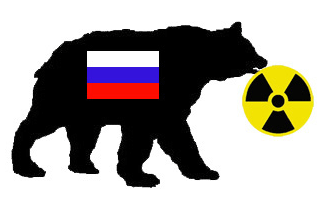
“The Russian Aggression Prevention Act” (RAPA) moves the US towards nuclear war with Russia


Nuclear war is suicide for humans, but our leaders still have their fingers on the nuclear triggers. There seems to be absolutely no awareness, either in our Federal government or in the American public, of the existential danger posed by nuclear war. Such ignorance is embodied by The Russian Aggression Prevention Act, which if enacted will put us on a direct course for nuclear war with Russia
 “The Russian Aggression Prevention Act” (RAPA): A Direct Path to Nuclear War with Russia The Russian Aggression Prevention Act”, introduced to Congress by U.S. Senator Bob Corker (R-Tenn.), will set the US on a path towards direct military conflict with Russia in Ukraine. Global Research, BySteven Starr , Senior Scientist, Physicians for Social Responsibility August 22, 2014
Any US-Russian war is likely to quickly escalate into a nuclear war, since neither the US nor Russia would be willing to admit defeat, both have many thousands of nuclear weapons ready for instant use, and both rely uponCounterforce military doctrine that tasks their military, in the event of war, to preemptively destroy the nuclear forces of the enemy.
RAPA provides de facto NATO membership for Ukraine, Georgia, and Moldova via RAPA
The Russian Aggression Prevention Act, or RAPA, “Provides major non-NATO ally status for Ukraine, Georgia, and Moldova for purposes of the transfer or possible transfer of defense articles or defense services.” Major non-NATO ally status would for practical purposes give NATO membership to these nations, as it would allow the US to move large amounts of military equipment and forces to them without the need for approval of other NATO member states. Thus RAPA would effectively bypass long-standing German opposition to the US request to make Ukraine and Georgia part of NATO.
Germans rightly fear placing US/NATO troops and US Ballistic Missile Defense (BMD) in Ukraine, given the profound and long-standing Russian objections against the expansion of NATO (especially to Ukraine and Georgia) along with deployment of European US/NATO BMD. Germany is acutely aware of the distinct possibility that the civil war raging in Ukraine could evolve into a Ukrainian-Russian war. Under such circumstances, deployment of US/NATO forces in Ukraine would make it virtually inevitable they would come into fight with Ukraine against Russia. Continue reading
Saudi Arabia’s role in Ukraine crisis, and the ignorance of journalists

 Media Propaganda and the Ukraine Crises Paul Rogov, 25 Aug 14 “………..Coverage of the Ukrainian plight is cynical, if not insensitive. Many corporate journalists are simply uninformed about the region. Many of these journalists believe the war in the Ukraine will lead to “WWIII” and that it began with ousted former President Victor Yanukovych, when he fled on February 22nd. But this is incorrect.
The Ukrainian crises, an ethnic war of Slavic subjectivity, which began prior to the inception of the Soviet Union, extended through not one, but two World Wars, the collapse of a superpower and chaos of post-Soviet economies. In fact, it goes back to medieval times.
U.S. military analysts know, as NATO knows, that the entire Ukraine could be taken by Russian armed forces rather quickly. While the Ukraine conscripts its soldiers and security forces deteriorates in the Eastern region, the Ukrainian military are weak yet somehow mysterious “victorious” too—disembodied, yet possessing a well-guided singularity of purpose.
According to one article released on May 4th Fars News headlined “S. Arabia Relocating Takfiri Fighters from Syria to Ukraine.” Saudi Arabia sent extremist militants against Eastern Ukrainian freedom fighters. An unidentified Arab security official told Fars News that:
“A large number of terrorist Takfiri fighters in Syria, who bear Saudi and Chechnian nationalities and receive financial and military backup from the Saudi intelligence agency, have been transferred to the Ukrainian capital, Kiev, on several planes to help the Ukrainian army in its fight against the pro-Russian population. The forces have been immediately dispatched to Kramatosk city in Eastern Ukraine, and are now fighting beside the Ukrainian army forces against the pro-Russians under the name of militias who support the government.”
On top of Saudi Arabia’s involvement in the Ukraine (which no Western journalist talks about), Western corporate media bungled what happened in Odessa. There is no disputing that a Ukrainian extremist, right-wing group called Right Sector set the fires in Odessa of Trade Union buildings that senselessly burned alive and killed innocent people, while the U.S. State Department issued no statement that the deaths were due to Ukrainian fascists.
The Western corporate media is a collective failure as it constantly fails to realize that the Ukraine has never been a true European country. The same Western corporate media always presumes the Ukraine wants to be in all of its articles, where Ukrainian independence is concerned. Just pick up any major U.S. periodical or rather read off the Internet the presupposed rhetoric the Western corporate media utilizes.
The only time the Ukraine was tied “gloriously” to Europe in any concrete way was by its collaboration with Nazi Germany.
Russia, not too long ago, proclaimed that Ukraine’s assault in Slovyansk ended the chance for peace. Heads of State, Putin and Obama, as well as journalists are issuing statements and journalists are not citing their sources. This brings us to the issue of how the mainstream media is going to spin us right into a world war.
The questions that should be asked are numerous, but some examples would be: Who broke the story first that the Ukraine was heading for war? Who shot who first? Who burned alive who first? Isn’t it convenient how a right-wing coup occurred after “a democratically elected election”? Any form of slaughter in this case (and the prospects of U.S. or NATO involvement) is ridiculous and evil. How many more photos does one need to see of corpses for us to understand that the U.S. is in the shadows?
The Western corporate media have managed to evade talk of the money and the resources necessary for the Ukraine to even be considered a member of the E.U. and have totally hopped over the fact that the Ukraine’s ousted President Viktor Yanukovich secured “a $15 billion bailout from Russia in December 17th, 2013, offering respite for an economy heading ever closer to default but also drawing accusations he has sold his country out to its former Soviet master.”
The Ukrainian government is just as corrupt as its Russian counterpart, yet the U.S. government and the mainstream media does not seem to understand that the political and economic weakness of Ukraine itself. The Ukraine’s inability to put its house in order is a result of inner tensions within the political climate of the Ukraine……http://paulrogov.wordpress.com/2014/08/25/media-propaganda-and-the-ukraine-crises/
China to fund and build new nuclear plant on UK’s Dengi coast

 Chinese nuclear giants set to replace decommissioned Bradwell power station with atomic planthttp://www.essexchronicle.co.uk/Chinese-nuclear-giants-replace-decommissioned/story-22813169-detail/story.html By PeteWalker August 24, 2014 Chinese nuclear power giants are reportedly zoning in on Bradwell as the site for a new atomic plant.
The Sunday Times reports today that the area on the Dengie coast, currently home to the decommissioned Magnox nuclear power station, has been picked as a favourite.
China General Nuclear Power Corporation and China National Nuclear Corporation agreed to help finance Britain’s first new atomic power plant, for nearly 20 years, about two years ago.
Bosses shortlisted other sites in Lancashire, Hartlepool, Wales and Gloucestershire – but the national newspaper says Essex is the preferred option following talks this month.
The presence of openly Nazi militias attacking ethnic Russians in Ukraine creates extreme anger in Russia
“The Russian Aggression Prevention Act” (RAPA): A Direct Path to Nuclear War with Russia The Russian Aggression Prevention Act”, introduced to Congress by U.S. Senator Bob Corker (R-Tenn.), will set the US on a path towards direct military conflict with Russia in Ukraine. Global Research, By Steven Starr , Senior Scientist, Physicians for Social Responsibility August 22, 2014
 “……………RAPA intensifies support for ethnic cleansing in Eastern Ukraine In Russia, Putin now is under intense domestic political pressure to send Russian forces into Eastern Ukraine, in order to stop the attacks by the Ukrainian military on the cities there, which were once part of the Soviet Union.These attacks have created an absolute humanitarian catastrophe.
On August 5, 2014, the Office of the United Nations High Commissioner for Refugees reported that740,000 Eastern Ukrainians had fled to Russia. They go there because Russia is close, and because most of the refugees are ethnic Russians, a fact that explains why the Russophobes in Kiev have been quite willing to indiscriminately bombard their cities.
What is taking place in Eastern Ukraine amounts to “ethnic cleansing,” the forced removal of ethnic Russians from Eastern Ukraine. This is a process that is fully supported by the US; RAPA would greatly enhance this support.
Ukrainian military forces have surrounded Donetsk – a city of almost one million people – and have for weeks conducted daily attacks against it using inaccurate multiple-launch rockets, heavy artillery fire, ballistic missiles carrying warheads with up to 1000 pounds of high explosive, and aerial bombardments. Water supplies, power plants, train stations, airports, bridges, highways, and schools have all been targeted, along with the general population. In Lugansk, a city of more than 440,000 people, a humanitarian crisis has been declared by its mayor, because the siege of the city has left it with little medicine, no fuel,intermittent power, and no water since August 3 (three weeks at the time of this writing).
After the separatists of Eastern Ukraine demanded autonomy from Kiev, and then reunion with Russia, the government in Kiev branded them as “terrorists”, and sent its military forces against them in what they euphemistically call an “anti-terrorist operation.” Framing the conflict this way makes it politically acceptable to refuse to negotiate with the separatists, and easier to justify in the US and Europe, which have grown accustomed to “the War on Terrorism.” However, the thousands of Ukrainians being killed and hundreds of thousands of being driven from their homes are just ordinary people, trying to live ordinary lives.
The New York Times reports the Ukrainian military strategy has been to bombard separatist-held cities and then send paramilitary forces to carry out “chaotic, violent assaults” against them. Many of the Ukrainian paramilitary forces were recruited from ultra-nationalist, neo-Nazi political parties; theAzov battalion flies the “Wolfs Hook” flag of Hitler’s SS divisions. Considering that more than 20 million Russians died fighting the Nazis during World War II, the presence of openly Nazi militias attacking ethnic Russians in Ukraine creates extreme anger in Russia……….http://www.globalresearch.ca/the-russian-aggression-prevention-act-rapa-a-direct-path-to-nuclear-war-with-russia/5397171
Arab initiative at UN meeting will focus on Israel’s nuclear arsenal
Arab states, Israel set to clash at U.N. nuclear meeting The Daily Star :: Lebanon News :: http://www.dailystar.com.lb Reuters VIENNA: As war rages in Gaza, Arab states will likely try to heighten  diplomatic pressure on Israel over its assumed nuclear arsenal at next month’s annual meeting of the U.N. nuclear agency’s 160 member states, diplomats said Friday.
An Arab initiative to single out Israel for criticism was defeated in voting last year.
But Western diplomats opposed to the Arab move said the unresolved Gaza conflict may influence any wavering countries at this year’s debate, although there was no direct link between the issues.
“It is all about getting out the undecided vote. And it will be all about Israel widely and not about the actual nuclear issue,” one Vienna-based diplomat said.
“I would expect ongoing conflict to lead many [Arabs and any others critical of Israel] to want to lash out in any forum available.”
An Arab resolution on what it calls Israeli Nuclear Capabilities would be non-binding even if it were to be approved by the Sept. 22-26 General Conference of the International Atomic Energy Agency.
However, lobbying by both sides underlines its symbolic significance as well as deep divisions.
Israel is believed to possess the Middle East’s only nuclear arsenal, and frequently draws condemnation from Arab countries and Iran which say that it threatens regional peace and security…….http://www.dailystar.com.lb/News/Middle-East/2014/Aug-23/268217-arab-states-israel-set-to-clash-at-un-nuclear-meeting.ashx#axzz3BFYUb8Ga
Australia breaks international Treaty, in selling uranium to India
 Seen from the perspective of adherence to non-proliferation norms and commitments If Australia exports uranium to India, Australia would violate its obligations of the Treaty of Rarotonga, which binds it from not indulging in such trade. Article 4 of the Rarotonga Treaty requires India to comply with safeguards requirements of Article III(1) of the Nuclear Nonproliferation Treaty (NPT). Article III(1) of the NPT is about reaching a comprehensive safeguards agreement with IAEA. Instead, India has only acknowledged safeguards on certain foreign-supplied reactors and facilities. India’s safeguards agreement is based upon the IAEA’s ‘facility specific’ safeguards.
Australian uranium sale to India will be subjected to weak monitoring safeguards or ‘facility specific’ of IAEA, contrary to nuclear deals Australia has with other countries
AUSTRALIAN PROSPECTIVE NUCLEAR TRADE WITH INDIA – THE CONTROVERSYhttp://www.eurasiareview.com/21082014-australian-prospective-nuclear-trade-india-controversy/AUGUST 21, 2014 EURASIA REVIEW BY HASAN EHTISHAM
These protests have been a regular feature in Koodankulam (Tamil Nadu), Jaitapur (Maharashtra) and Gorakhpur (Haryana) and at least five activists have lost their lives since 2010 in their struggle against the Indian government’s decision without taking the affected parties on board. Radioactive waste from uranium mining in the country’s east is reportedly affecting adjacent communities. Thousands of Indians suffer from the effects of uranium mining as related to poor technical and management practices.
Australia controls the planet’s largest known uranium reserves. Uranium is a controversial and debatable subject in Canberra, because it can be used both for civil and military purposes. Australia had previously cancelled plans to sell uranium to India as it is not a signatory to the Nuclear Non-Proliferation Treaty, but it was Indo- US nuclear deal which paved the way for the ban’s lifting.
The move of lifting the ban came despite a parliamentary report on nuclear safety regulation in India had emphasized grave nuclear safety concerns and organizational flaws comparable international norms. India’s auditor general in this report has designated the country’s nuclear industry as insecure, disordered and in many cases, unregulated. The report underlined the fact that there is no national policy on nuclear and radiation safety after almost 30 years and is not much ardent to adopt world standards and best practices.
It is an unpredictable and unjustified security situation into which Australia is selling uranium. Australian government’s idea to sell uranium to India was strongly criticized by the Australians but the government seems inclined to disregard it. Analysts in Australia are opposing the Uranium sale without preconditions and any meaningful concessions from India, like Indian ratification of the Comprehensive Test Ban Treaty and stopping the production of nuclear bomb making material.
Seen from the perspective of adherence to non-proliferation norms and commitments If Australia exports uranium to India, Australia would violate its obligations of the Treaty of Rarotonga, which binds it from not indulging in such trade. Article 4 of the Rarotonga Treaty requires India to comply with safeguards requirements of Article III(1) of the Nuclear Nonproliferation Treaty (NPT). Article III(1) of the NPT is about reaching a comprehensive safeguards agreement with IAEA. Instead, India has only acknowledged safeguards on certain foreign-supplied reactors and facilities. India’s safeguards agreement is based upon the IAEA’s ‘facility specific’ safeguards.
Australian uranium sale to India will be subjected to weak monitoring safeguards or ‘facility specific’ of IAEA, contrary to nuclear deals Australia has with other countries.Andrew Davies from the Australian Strategic Policy Institute highlighted IAEA’s inability to screen exactly where uranium sent to India from Australia if comprehensive monitoring safeguards are not applied. “For example, if 100 tones go into a civilian nuclear program and 90 tons of products come out, they don’t know where the missing product was diverted from,” he convincingly argues.
A defense research group, IHS Jane’s has revealed that India is increasing its uranium facility that could support the expansion of nuclear weapons. India is trying to buy foreign sources of uranium so she can use its domestic reserves for a nuclear arms race with Pakistan. India is expanding its nuclear power programme to use its own uranium for the production of more nuclear weapons. Adding Australian uranium into India’s energy mix would have serious fall outs on prevailing strained relations between India and its nuclear-armed neighbors. Can Australia trust India to not use Australian uranium for weapons manufacture?
Non-proliferation is a top agenda item when it comes to Pakistan, Iran or North Korea, but it is an inoperable standard when it is India or Israel. The commencement of nuclear trade with India – first by Washington in 2008 and currently by Canberra – has immense repercussions. It will profoundly upset the proliferation equation for other countries in the region. India-Australia nuclear deal will aggravate India-Pakistan nuclear rivalry and exacerbate Pakistan’s security dilemma. Both countries have nuclear weapons, so this commitment by Aussies will no doubt intensify the India-Pakistan tensions. Nuclear trade with India will profoundly upset strategic stability of the South Asian region.
Hong Kong still restricting foodstuffs imported from Japan’s irradiated areas
 The government of Hong Kong rejected Japanese request to lift restriction on Japanese imports http://fukushima-diary.com/2014/08/government-hong-kong-rejected-japanese-request-lift-restriction-japanese-imports/ Iori Mochizuki On 8/13/2014, Hayashi, the Minister of Agriculture, Forestry and Fisheries visited Hong Kong to request the government of Hong Kong to lift the restriction on Japanese imports however Ko Wing Man, the chief of the department of food and hygiene rejected the offer.
Since Fukushima accident, the government of Hong Kong stop importing vegetables, fruits, milk, milk based drinks and powdered milk from 5 prefectures to consist of Fukushima, Ibaraki, Tochigi, Gunma and Chiba.
Ko Wing Man commented “Lifting the restriction is difficult at this moment.”.
Positive progress in U.N.s nuclear diplomacy with Iran
U.N. Nuclear Chief Positive After ‘Useful’ Iran Visit: Reuters http://www.nbcnews.com/news/world/u-n-nuclear-chief-positive-after-useful-iran-visit-reuters-n182671 18 Aug 14,
Iran has given a firm commitment to cooperate with a U.N. nuclear watchdog investigation into suspected atomic bomb research, the head of the agency said after what he described as a “useful” visit to Tehran on Sunday. Yukiya Amano made the trip ahead of an Aug. 25 deadline for Iran to provide information relevant to the International Atomic Energy Agency’s long-running inquiry into what it calls the possible military dimensions of the country’s nuclear program.
The issue is close ly tied to Iran’s negotiations with six world powers aimed at ending a decade-old standoff over its atomic activities and dispelling fears of a new Middle East war. Iran denies its program has any military objectives.
Since Rouhani was elected in mid-2013, Tehran has promised to work with the U.N. agency to clear up the suspicions about its nuclear aspirations. After meeting Amano, Rouhani said on his English-language Twitter account that Iran was “determined to forge accord with the IAEA in the shortest possible time span. God willing, it can be done in less than a year.”
Australia now seen by China as a military threat – due to pact with USA
China Declares Australia a Military Threat Over US Pact http://www.therealnewsmatters.com/2014/08/china-declares-australia-military.html By Joshua Philipp, Epoch Times , 17 Aug 14 China’s state-run media have declared Australia a threat to its national security, after Australia finalized a 25-year military pact with the United States.
The United States currently has 1,200 troops from the Marine Corps and Air Force training with Australian troops for humanitarian and disaster relief. The defense agreement will increase the number of U.S. troops at Darwin in northern Australia to 2,500.
The Chinese regime is none too pleased about the agreement, however.
Li Jie, rear admiral of China’s People’s Liberation Army Navy, told Want China Times that Australia could pressure China’s supply lines in the Strait of Malacca in a conflict over the South China Sea.
“Australia is therefore likely to become a threat to China’s national security,” it states.
Global Times reported that if a war broke out between China and Vietnam or the Philippines, the United States could deploy submarines and aircraft from Australia….
http://www.theepochtimes.com/n3/877760-china-declares-australia-a-military-threat-over-u-s-pact/
Serious flaws in India-Japan Nuclear Deal
 Reasons to Oppose the India-Japan Nuclear Deal – Nuclear Free by 2045 ? Dennis Riches 14 Aug 14 In late July and early August, a leading member of India’s Coalition for Peace and Nuclear Disarmament, Kumar Sundaram, visited several Japanese cities in order to speak to the mass media and Japanese citizens about the proposed Japan-India nuclear energy agreement. He timed his visit to Japan to precede
  that of Indian Prime Minister Narendra Modi at the end of August. Modi will meet with his Japanese counterpart in hopes of finalizing a deal to allow the purchase of vital components of nuclear power plants that are proposed or under construction
Finland’s Environment Minister call sto end nuclear deal with Russia, and increase renewable energy
 Greens’ Niinistö calls for gov’t to reconsider Rosatom for nuclear plant uutiset 15 Aug 14 Cooperating with the Russian nuclear contractor Rosatom would be a step backward in Finland’s attempts to reduce energy dependency on Russia, says Green League party chair and Environment Minister Ville Niinistö. The Minister said that energy production should remain in domestic hands.
 Green Environment Minister Ville Niinistö said he believes that giving the Russian nuclear plant builder Rosatom a permit to construct a new nuclear power facility in Finland would be strange, given that the rest of the European Union is working to reduce dependency on Russian energy. Rosatom is a Russian state-owned nuclear power construction company…….
He pointed out that the Czech Republic had rejected a bid by Rosatom to build a nuclear power plant and that Britain is also re-evaluating possible cooperation with Rosatom in light of the crisis in Ukraine.
Niinistö also called for a national programme to increase the use of home-grown renewable energy. http://yle.fi/uutiset/greens_niinisto_calls_for_govt_to_reconsider_rosatom_for_nuclear_plant/7414053
Ukraine tensions cause stalling of U.S.-Russia nuclear deal
U.S.-Russia Nuclear Deal Stalls as Tensions Over Ukraine Rise NYT, By DAVID E. SANGER and WILLIAM J. BROADAUG. 2, 2014 WASHINGTON — The growing confrontation between Washington and Moscow over Ukraine has derailed a recent accord that promised one of the most expansive collaborations ever between the countries’ nuclear scientists, including reciprocal visits to atomic sites to work on projects ranging from energy to planetary defense.
It was only 11 months ago that the American energy secretary — Ernest J. Moniz, a former M.I.T. professor who has championed scientific programs that would bury the Cold War competitions between the United States andRussia — went to Vienna to sign the agreement, an indication of how recently the Obama administration believed it had a chance of building on a quarter-century of gradual integration of Russia with the West.
Handshakes and congratulations exchanged with Mr. Moniz’s Russian counterpart, Sergey V. Kirienko, sealed an arrangement that would let Russian scientists into, among other places, the heart of the American nuclear complex at Los Alamos National Laboratory in New Mexico, where the first atomic bomb was constructed 70 years ago, and a dozen sister laboratories devoted to the making of the American nuclear arsenal. In return, American scientists would be allowed deep into Russian nuclear facilities, including the birthplace of the Soviet bomb……
Today, the real-life accord is on ice. This year, the Energy Department canceled nuclear meetings, symposia and lab visits with Russia……http://www.nytimes.com/2014/08/03/world/europe/us-nuclear-deal-with-russia-fails-as-tensions-rise.html?_r=0
Russia considers leaving 1987 intermediate range nuclear forces (INF) treaty
Moscow may walk out of nuclear treaty after US accusations of breach http://www.theguardian.com/world/2014/jul/29/moscow-russia-violated-cold-war-nuclear-treaty-iskander-r500-missile-test-us
Russia may be on the point of walking out of a major cold war era arms-control treaty, Russian analysts have said, after President Obama accused Moscow of violating the accord by testing a cruise missile.
There has been evidence at least since 2011 of Russian missile tests in violation of the 1987 intermediate range nuclear forces (INF) treaty, which banned US or Russian ground-launched cruise missiles with a 500 to 5,500-mile (805 to 8,851km) range. But the Obama administration has been hesitant until now of accusing Moscow of a violation in the hope that it could persuade Vladimir Putin, the Russian president, to stop the tests or at least not deploy the weapon in question, known as the Iskander, or R-500.
Washington has also been reticent because of the technical differences in definition of what constitutes the range of a missile under the INF treaty. That ambiguity now seems to have dropped away. According to Pavel Felgenhauer, a defence analyst and columnist for the independent Russian newspaper Novaya Gazeta, Russia has indeed broken the treaty by testing the R-500 which has a range of more than 1,000km.
“Of course, this is in gross violation of the 1987 treaty, but Russian officials including Putin have said this treaty is unfair and not suitable for Russia,” Felgenhauer said. “The United States doesn’t have [medium-range missiles] but other countries do have them, such as China, Pakistan and Israel, so they say this is unfair and wrong.”
Russian press reports have suggested the missile may even be in deployment, with state news agency RIA Novosti reporting in June that the “Russian army currently uses its Iskander-M and Iskander-K variants.” Felgenhauer said he doesn’t believe the missile has been deployed, although he said it’s entirely possible that Russia will leave the treaty amid tensions with the US.
“The present situation of a new cold war in Europe – and not even cold, at least not in Ukraine right now – it’s a situation in which Russia can abrogate the 1987 treaty, and the possibilities are rather high,” Felgenhauer said.
Russian officials have previously criticised the 1987 treaty, including former defence minister Sergei Ivanov. In 2013, Ivanov, then presidential chief of staff, said of the treaty: “We are fulfilling it, but it can’t last forever.”
- According to Kremlin-linked analyst Sergei Markov, Russia has a far greater need for medium-range cruise missiles than the |US, because military rivals including China are located near its borders and because Moscow lacks the Americans’ long-range bombing capabilities.”Russia would be happy to leave this agreement, and I think Russia is using the Ukraine crisis to leave the agreement,” Markov said.
As for Russia’s complaints about US aegis missiles, Felgenhauer said they reflect the genuine belief among Kremlin top brass that the US missile defence has a secret attack capability and poses a threat to Russia.
“This was a normal Soviet practice that missile interceptors had the in-built capability to be used as an attack missile,” Felgenhauer said.
1 This Month




PLEASE OPPOSE HR 8255 AND S.3639 – bills would accelerate satellite deployment, with no environmental review or safeguards – https://ncstd5li.quorum.us/campaign/169331/
To see nuclear-related stories in greater depth and intensity – go to https://nuclearinformation.wordpress.com
-
Archives
- September 2026 (339)
- August 2026 (330)
- July 2026 (355)
- June 2026 (287)
- May 2026 (306)
- April 2026 (356)
- March 2026 (251)
- February 2026 (267)
- January 2026 (308)
- December 2025 (358)
- November 2025 (359)
- October 2025 (375)
-
Categories
- 1
- 1 NUCLEAR ISSUES
- business and costs
- climate change
- culture and arts
- ENERGY
- environment
- health
- history
- indigenous issues
- Legal
- marketing of nuclear
- media
- opposition to nuclear
- PERSONAL STORIES
- politics
- politics international
- Religion and ethics
- safety
- secrets,lies and civil liberties
- spinbuster
- technology
- Uranium
- wastes
- weapons and war
- Women
- 2 WORLD
- ACTION
- AFRICA
- Atrocities
- AUSTRALIA
- Christina's notes
- Christina's themes
- culture and arts
- Events
- Fuk 2022
- Fuk 2023
- Fukushima 2017
- Fukushima 2018
- fukushima 2019
- Fukushima 2020
- Fukushima 2021
- general
- global warming
- Humour (God we need it)
- Nuclear
- RARE EARTHS
- Reference
- resources – print
- Resources -audiovicual
- Weekly Newsletter
- World
- World Nuclear
- YouTube
-
RSS
Entries RSS
Comments RSS

