South Korea and China in agreement on threat of North Korea’s nuclear activities
China agrees North Korea’s nuclear activities a serious threat, says South Mon May 26, 2014 SEOUL (Reuters) – South Korea and China agreed on Monday that recent nuclear activity by North Korea posed a serious threat to the peace and stability of the region and Pyongyang must not conduct a nuclear test, Seoul said after a meeting of their top diplomats.
Renewed activity at North Korea’s nuclear test site has indicated Pyongyang may be preparing a fourth nuclear test in contravention of U.N. sanctions.
Analysis have suggested the North may be close to miniaturising a nuclear warhead to mount on a missile, alarming regional powers that have for two decades tried to rein in Pyongyang’s atomic programme.
Chinese Foreign Minister Wang Yi held talks with his South Korea counterpart Yun Byung-se to discuss the North’s nuclear programme, as well as an upcoming visit by Chinese President Xi Jinping to Seoul this year, South Korea’s foreign ministry said.
“The two ministers agreed to step up cooperation based on the united position that they object to the North’s nuclear test and that recent nuclear activities by the North pose a serious threat to the peace and stability of the Korean peninsula and the region,” the ministry said.
China, North Korea’s lone major ally, is usually very guarded in its opinion on Pyongyang’s nuclear programme, usually expressing its desire for a nuclear-free “Korean peninsula” and careful not to be seen to be taking sides…….http://af.reuters.com/article/worldNews/idAFKBN0E61LJ20140526
Iran has sharply reduced enriched uranium – IAEA report

 IAEA Confirms: Iran Sharply Reducing Uranium Stockpile http://news.antiwar.com/2014/05/23/iaea-confirms-iran-sharply-reducing-uranium-stockpile/ 20 Percent Enriched Uranium Almost Used Up by Jason Ditz, May 23, 2014 Many of the contents of the IAEA report on Iran were already leaked the day before it came out, and the good news of Iran abiding by the P5+1 interim nuclear deal was as expected. There’s more to the report, however. One of the biggest pieces of data in the report shows Iran’s stockpile of 20 percent enriched uranium, the highest level they made, has sharply fallen as the nation continues to convert it into fuel for the Tehran Research Reactor.
Though 20 percent is far short of the level needed for nuclear weapons, it was repeatedly pushed by the US as a “threat,” and Iran stopped enriching at that level at the start of the nuclear deal. Only about 40 kg are left to be converted to fuel rods, a trivial amount. The Tehran Research Reactor, built by the US in 1967, provides materially all of the medical isotopes in Iran. The aging facility will eventually be replaced with a modern one using unenriched uranium, but in the meantime Iran has created what seems to be all of the fuel rods it can use for the conceivable lifespan of the facility.
Iran is now only enriching to 3.5 percent, the level used in the Bushehr Power Plant. Iran is in talks with Russia to build more power plants in the nation, with a deal for as many as 8 reported to be close.
Indian government contemplating nuclear attack on Pakistan?
 Narendra Modi will have to ‘press the nuclear button’ if Pakistan does not ‘mend its ways’, says Shiv Sena chief Uddhav Thackeray DNA, 25 May 2014 – : Mumbai | Agency: PTI “……..In a statement issued in Mumbai, Sena president Uddhav Thackeray said, “So far only India has taken initiative of forgetting the past and starting afresh. Hence, it is difficult to trust Pakistan. But we trust Modi’s leadership and hence we do not want to create hurdles for him. If Pakistan does not mend its ways, Modi will have to press the nuclear button.” ………http://www.dnaindia.com/india/report-narendra-modi-will-have-to-press-the-nuclear-button-if-pakistan-does-not-mend-its-ways-says-shiv-sena-chief-uddhav-thackeray-1991286
USA charges Chinese officials with nuclear cyberspying
 Chinese officials indicted in nuclear cyberspying case, By Eric Tucker, The Times of Israel, 19 May 14 US announces unprecedented charges against military hackers who targeted big-name firms, stole trade secrets WASHINGTON (AP) — The United States announced on Monday unprecedented cyber espionage charges against five Chinese military officials accused of hacking into US companies to gain trade secrets The hackers targeted big-name makers of nuclear and solar technology, stealing confidential business information, sensitive trade secrets and internal communications for competitive advantage, according to a grand jury indictment……..
The indictment says that five hackers — members of the People’s Liberation Army — worked from a building in Shanghai to steal proprietary information from the companies and the labor union, including communications that could have helped Chinese firms learn strategies and weaknesses of American companies involved in litigation with the Chinese government or Chinese firms.
The defendants are all believed to be in China and it was unclear whether they would ever be turned over to the US for prosecution. But the Justice Department, publicizing the charges, identified all five by name and issued “wanted” posters………
The indictment will put a greater strain on the US-China relationship and could provoke retaliatory acts in China or elsewhere.
“What we can expect to happen is for the Chinese government to indict individuals in the United States who they will accuse of hacking into computers there,” said Mark Rasch, a former US cybercrimes prosecutor. “Everybody now is going to jump into the act, using their own criminal laws to go after what other countries are doing.”
Rasch said the indictments attempt to distinguish spying for national security purposes — which the US admits doing — from economic espionage intended to gain commercial advantage for private companies or industries, which the US denies it does. Classified documents disclosed by former National Security Agency analyst Edward Snowden described aggressive US efforts to eavesdrop on foreign communications that would be illegal in those countries.
“These five people were just doing their jobs. It’s just that we object to what their jobs are,” Rasch said. “We have tens of thousands of dedicated, hard-working Americans who are just doing their jobs, too.”
Unlike in some countries, there are no nationalized US industries. American officials have flatly denied that the government spies on foreign companies and then hands over commercially valuable information to American companies. http://www.timesofisrael.com/chinese-officials-indicted-in-nuclear-cyberspying-case/#ixzz32JH7SA85
Poverty-stricken African nations exploited by mining companies, especially Australian uranium miners
THE SCRAMBLE FOR URANIUM IN AFRICA http://www.phantomreport.com/the-scramble-for-uranium-in-africa 19 May 14, Africa’s resources are extracted by outsiders, with benefits only reaching the involved non-African mining companies and non-African end-users of the commodity. Africa is the next frontier to meet energy needs. Oil and gas are being exploited as never before, exacerbating conflict in Darfur and Nigeria, social inequality in Angola, and environmental damage in Chad.
At the same time, renewed demand for uranium is being explored on the continent more than at any other time in history.
Yet the continent’s huge potential for renewable energy is not fully being realised. The government of Malawi granted a uranium mining licence to an Australian uranium mining company without having any legislation on the mining, handling and transportation of radioactive materials. Malawi is now home to twelve potential uranium mines.
In Niger mining companies from Australia, Canada, France and other parts of the world are scrambling for licences to explore uranium in a country which is already the world’s sixth producer of uranium. In the Central African Republic (CAR) there is a scramble amongst Chinese, American and French companies which are all interested in mining the Bakouma region.
In Tanzania the Australian Omega Corp obtained the Mkuju River concessions through its subsidiary, Mantra Resources. Other Australian juniors are represented in Tanzania, including Sabre Resources, Goldstream Mining, Uranex and Deep Yellow.
In Zambia, the Australian Energy Ventures through its subsidiary Africa Energy Resources started drilling the Kariba Valley in May 2008. Another Australian enterprise, Albion Ltd,, is also undertaking exploration.
North Korea warned by China against conducting 4th nuclear test
China warns North Korea against fourth nuclear test, Australia Network News, 20 May 14 China has used diplomatic channels to warn North Korea against conducting a fourth nuclear test after the reclusive state renewed its threat of “counter-measures” against perceived US hostility.
North Korea, which regularly threatens the South and the United States with destruction, is already under heavy sanctions imposed by several UN resolutions beginning in 2006 but has defied pressure to abandon its missile and nuclear programs.
It last conducted a nuclear test in February 2013.
“China has told North Korea that there is no justification for a new nuclear test and that they should not do it,” a Western diplomat who was briefed by Chinese officials said.
The sources said China had used diplomatic channels in Beijing and Pyongyang to convey its anxiety about the possibility of a fourth test to the North……http://www.abc.net.au/news/2014-05-20/an-china-warns-nkorea/5463466
Long standing issues complicate nuclear negotiations with Iran
 The phantom at the Iran nuclear talks: weaponisation, Guardian, Julian Borger 15 May 14, How far should Iran go to resolve concerns over past weapons research to reach a comprehensive deal? ………. there is another issue waiting in the wings – the past. The general western intelligence consensus is that Iran had an organised weaponisation programme exploring how to build a warhead up to 2003, and that if research continued it was in a more dispersed manner………
even if Iran started working on weapons in the wake of the Iran-Iraq war (in which it saw the West as backing Saddam’s use of chemical weapons against Iran) but was now prepared to give up any such aspirations, it might still refuse to contemplate a confession. It would be a huge embarrassment in view of the Supreme Leader’s fatwa against nuclear weapons. Tehran could also see pressure for such a confession as a trick designed to justify a military attack. The question then for the West is whether to allow those fears stand in the way of deal that would constraint Iran’s future programme.
The mood music being put out by diplomats in Vienna suggests that the issue will not be a deal breaker for now. One solution, set out in a detailled report produced by the International Crisis Group, is for the problem to be kicked down the road. A comprehensive deal clinched in the next few months would commit Iran to resolving the issue satisfactorily with the IAEA. It would not let Iran off the hook but neither would it jeopardise non-proliferation gains that could be achievable now. http://www.theguardian.com/world/julian-borger-global-security-blog/2014/may/15/iran-nuclear-talks-weapons
Cause for optimism in Iran nuclear deal with the West
Optimism Grows for a Comprehensive Iran Nuclear Deal Several Core Elements of Agreement Have Emerged WSJ, By JAY SOLOMON And
LAURENCE NORMAN May 12, 2014 WASHINGTON—Several core elements of agreement between Iran and the West have emerged in recent weeks, heightening optimism that a comprehensive deal can be reached by the July 20 deadline, according to U.S., Iranian and European officials involved in the diplomacy.
Still significant differences remain that could scuttle a deal or force negotiators to extend talks, officials briefed on the talks said.
“People are less pessimistic than they have been in the past—certainly,” one European official said. “There are certain areas where some kind of consensus” is emerging. “But in certain areas, there is still a huge gulf.” One of the key areas of agreement is the future of an Iranian plan to convert its heavy-water reactor in the city of Arak to produce significantly less weapons-grade plutonium, according to various officials.
Iran also has begun to more substantively address evidence presented in parallel talks with the U.N’s nuclear watchdog, the International Atomic Energy Agency, that it conducted research and testing to develop atomic bombs, the officials said.
However, the U.S. and Europe are demanding significant progress in accounting for past work as part of the agreement. Iran, which has denied it ever sought nuclear weapons, is being pressed to agree in coming days to provide answers on several other aspects of its past work.
Negotiators will begin drafting terms of a final agreement on the future of Tehran’s nuclear program this week in Vienna. A deal would end a decadelong standoff between Tehran and the West and put into place greater assurances that Iran won’t be able to build a bomb, in return for a major easing of Western sanctions……..
The meetings in Vienna will mark the fourth round of high-level talks between Iran and the five permanent members of the United Nations Security Council plus Germany—known as the P5+1—since the two sides reached an interim agreement last November.The interim deal resulted in Tehran freezing parts of its nuclear program in return for an easing of some Western sanctions. It will expire on July 20 but could be extended by six months if both sides agree they need more time.
The main area of disagreement continues to be the scope of Iran’s uranium-enrichment facilities, which could be used to produce weapons-grade fuel for a bomb, according to U.S. and European officials. Tehran currently has 19,000 centrifuges used to enrich uranium and has plans to build 30,000 more.
The Obama administration, conversely, is demanding Tehran scale back its capacity to as little as 5,000 operating machines to ensure Iran can’t quickly “break out” and rush to build a nuclear bomb in less than six months.
Iran and the P5+1 are seeking to develop a formula that limits both the number and quality of centrifuges as well as stockpiles of fissile materials to guard against the capability to quickly build a bomb.
But Iran’s theocratic leader, Ayatollah Ali Khamenei, has repeatedly stated in recent weeks that he won’t accept a significant scaling back of his country’s nuclear capabilities.
U.S. and European officials said they were unsure whether Mr. Khamenei’s position on the centrifuges is a tactical move ahead of the drafting sessions this week in Vienna, or if he has set a red line for his negotiators……..http://online.wsj.com/news/articles/SB10001424052702303851804579558162293087156
President Rouhani calls for more clarity in the nuclear debate
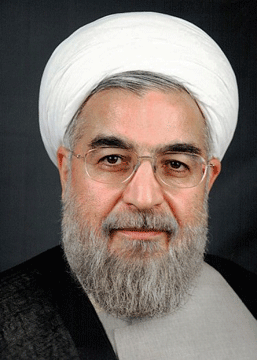 Iranian president calls for more open, better-informed nuclear debate https://au.news.yahoo.com/world/a/23426769/iranian-president-calls-for-more-open-better-informed-nuclear-debate/ May 11, 2014, By Michelle Moghtader and Mehrdad Balali DUBAI (Reuters) – President Hassan Rouhani said on Sunday he wanted Iran to do a better job of explaining its nuclear programme to prevent “evil-minded” people misleading world opinion, two days before Tehran resumes talks with world powers on its disputed atomic activity.
Iran and the United States, France, Germany, Britain, China and Russia will reconvene in Vienna to try to iron out differences over how to end a long standoff over suspicions that Tehran has sought the means to develop nuclear weapons.
Western powers have long demanded greater openness from Iran to address those concerns and head off the risk of a downward spiral towards a new Middle East war, with Israel threatening to attack its arch-foe if diplomacy does not rein it in.
“What we can offer the world is greater transparency,” Rouhani, a relative moderate who replaced a conservative hardliner who antagonised the West – said in a speech at a ceremony celebrating Iran’s scientific achievements.
In his remarks, Rouhani reiterated that Iran was not seeking nuclear weapons and would never halt its atomic programme, which was for peaceful purposes. He also repeated a denial of Western charges that Iran has carried out any secret nuclear bomb work.But along with achieving scientific progress, Rouhani added, Iran ought to develop its abilities in the legal, political and information realms to prevent “the enemy” making problems for its nuclear developments.
“If one engages in a technological endeavour but is not doing good legal and political work, then the enemy might come up with a fictional excuse to cause trouble for you,” he said.
The Islamic Republic’s leaders normally use the term “the enemy” to refer to the United States and Israel.
“If you don’t have good public relations and are not able to communicate well, then you might find other evil-minded people misleading world public opinion,” Rouhani said.
“So our effort today is to even out our efforts on multiple levels … We don’t want to retreat one step from our pursuit of technology, but we want to take a step forward on the political front.”
His comments appeared to be a criticism of hostile statements from within the hardline conservative establishment, including his predecessor Mahmoud Ahmadinejad, who called U.N. resolutions against Iran on the nuclear dispute a “worthless piece of paper”………..
“RIGHT DIRECTION”
Ahmadinejad’s strident rhetoric during his eight years in office on issues like the Holocaust and Israel served to shore up international resolve to curb Iran’s nuclear programme.
Iran in January halted its most sensitive nuclear operations under a preliminary deal with world powers, winning some relief from painful economic sanctions that have damaged its oil-dependent economy by forcing a sharp reduction in crude exports.
Rouhani said Iran if it so chose could resume enrichment of uranium gas to a fissile purity of 20 percent – its most sensitive nuclear activity because it is a relatively short technical step away from the level required for nuclear weapons.
“We wanted to tell the world that our activities are moving in the right direction: If we say we can enrich to 3.5 percent, we can do it. If necessary we will do (it to) 20 percent,” he said.
Iran agreed under its Nov. 24 deal to shelve enrichment to 20 percent. It has since diluted some of its 20 percent-enriched stockpile to a lower concentration and converted some into an oxide less suited to processing into bomb-grade material.
Iran has justified its 20 percent enrichment drive by saying it was meant to replenish the fuel supply of a Tehran medical research reactor. But Western officials are sceptical, saying Iran had refined far more than it required for such a purpose.
While Iran stopped 20 percent enrichment in January, it is allowed under the November pact to keep producing uranium refined to up to 5 percent, the level required for fuelling civilian nuclear power stations.
USA signs up to Central Asian Nuclear-Weapon-Free Zone Treaty
 United States Signs Protocol to Central Asian Nuclear-Weapon-Free Zone Treaty http://www.state.gov/r/pa/prs/ps/2014/05/225681.htm
Office of the Spokesperson
The United States is not eligible to be a party to the CANWFZ Treaty itself, but as an NPT nuclear weapons state is eligible to join the Treaty’s Protocol. The Protocol provides legally-binding assurances not to use or threaten to use nuclear weapons against CANWFZ Treaty parties. The United States understands the importance of such negative security assurances to states that have foresworn nuclear weapons and abide by their nuclear non-proliferation obligations.
The Administration is satisfied that the CANWFZ Treaty is consistent with U.S. and international criteria for such zones. The United States believes that such zones, when fully and rigorously implemented, contribute to our nonproliferation goals and to international peace and security. The United States has concluded that the CANWFZ Treaty and its Protocol will not disturb existing U.S. security arrangements or military operations, installations, or activities. The CANWFZ Treaty and its Protocol will also promote regional cooperation, security, and stability and provide a vehicle for the extension of legally-binding negative security assurances, consistent with the strengthened negative security assurance announced in the 2010 U.S. Nuclear Posture Review.
The United States previously signed similar protocols to the Treaties of Pelindaba and Rarotonga concerning nuclear-weapon-free zones in Africa and the South Pacific, respectively, and has ratified the protocols to the Treaty of Tlatelolco, which established a nuclear-weapon-free zone for Latin America and the Caribbean. With respect to the nuclear-weapon-free zone treaty in force in Southeast Asia, the United States looks forward to continuing consultations with zone parties to explore possible U.S. support for signature and ratification of the applicable protocol.
Iran’s President Rouhani up against hard-liners, over nuclear talks
Hassan Rouhani faces growing criticism in Iran over nuclear talks, Simon Tisdall in Tehran, theguardian.com, Sunday 4 May 2014
At a meeting at the former American embassy building in central Tehran on Saturday, a newly formed group of MPs and rightwing activists calling itself “We’re Worried” claimed Iran‘s negotiating team was ignoring national interests in the nuclear talks, which resume on 13 May in Vienna.
“The whole nation believes the main intention of the United States is to fully halt the Iranian nuclear programme,” said Fatemeh Alia, a central committee member of the hardline Islamic Revolution Resistance Front, previously allied to the former president Mahmoud Ahmadinejad…….
The US and Britain have expressed guarded confidence that a final nuclear deal with Iran can be reached by the deadline of 20 July, describing the talks as “very substantive”.
Rouhani and his chief negotiator, Mohammad Javad Zarif, have echoed those sentiments. “Iran is optimistic about the results of the talks and has taken great steps to reach a comprehensive deal and aims to achieve a win-win result,” Rouhani told Iranian television last week.
Rouhani hit back angrily at his critics. “Through lies and hype some people are trying to derail the government from its path, and this is against national interests and the leader’s order … Iran does not compromise on the people’s interests,” he said………http://www.theguardian.com/world/2014/may/04/hassan-rouhani-iran-nuclear-talks
Japan’s Prime Minister Abe hastens sale of nuclear power plant to UK
 Abe’s visit spurs signing of deal to build nuclear plant Ft.com, By Kiran Stacey and Guy Chazan 2 May 14, Britain’s nuclear power industry was given a boost on Thursday as one of Japan’s largest companies
  took a step closer to building a £10bn nuclear power plant in the north-west.
Toshiba, the engineering and technology company, signed an agreement giving it the right to build at Sellafield, in west Cumbria, during a visit by Shinzo Abe, Japanese prime minister, to London, in an effort to boost trade and investment between the two countries.

The land option agreement for the new nuclear site will involve total payments by Toshiba and its partners to Britain’s Nuclear Decommissioning Authority of over £200m by the time the option is exercised, the energy department said……….
The NuGen consortium, a joint venture between Toshiba/Westinghouse and France’s GDF Suez, owns a site near Sellafield in west Cumbria that has been earmarked for three new reactors. …….
The leaders of the two countries also agreed to launch negotiations on sharing supplies and transport services between their militaries, as well as accelerating a plan to jointly develop military equipment.
Mr Abe’s willingness to discuss military co-operation is a sign of his efforts to make Japan a more significant player on the world stage, something he refers to as making a “greater contribution to peace”.
But while officials in both countries welcomed the deal as a sign of healthy trading ties, the warm words mask deeper Japanese unease about Britain’s role in Europe. Mr Abe used his visit to Downing Street to press home the urgency of signing a trade agreement between Japan and the EU, something he wants to achieve by 2015……….http://www.ft.com/intl/cms/s/0/6fa6824e-d144-11e3-bdbb-00144feabdc0.html#axzz30asoDSeZ
Iranian public ready to back a fair nuclear deal
| Iran FM says people would support fair nuclear deal, The Daily Star, Lebanon News, |
| April 27, 2014 TEHRAN: Foreign Minister Mohammad Javad Zarif said Sunday that the majority of Iranians would support a comprehensive nuclear deal that “respects Iran’s rights and the demands of the people.”
“That would be the only agreement that myself and President (Hassan) Rouhani will agree (to),” Zarif said during a joint news conference in Tehran with his Austrian counterpart Sebastian Kurz. When asked whether hardliners could derail the nuclear talks, Zarif said: ” Iran is not a monolith … we will have those who will not favour an agreement, but at the end of the day what will count is the view of the majority of the Iranian people.” In November, Iran clinched a deal with world powers under which it froze some nuclear activities in return for limited relief from crippling international sanctions. Tehran has been engaged in negotiations with the P5+1 — Britain, China, France, Russia and the United States, plus Germany — aimed at reaching a lasting accord on its nuclear ambitions……. http://www.dailystar.com.lb/News/Middle-East/2014/Apr-27/254561-iran-fm-says-people-would-support-fair-nuclear-deal.ashx#ixzz30DTTdBDN |
Quiet optimism over deal between Iran and the West
Iran nuclear talks: Quiet optimism over deal between Islamic State and the West on weapons programme The INdependent 24 April 14 All sides in the effort to resolve the stand-off between the West and Iran over its alleged nuclear weapons ambitions have agreed to hold a new round of expert-level negotiations in New York beginning 5 May amid tentative indications that so far, at least, positive progress is being made. Keeping its side of an interim bargain struck last November and implemented in January, the Joint Plan of Action, the White House has this month released $1bn-worth of Iranian assets in two instalments, the last on 15 April. And last week the International Atomic Energy Agency (IAEA) reported that Iran has so far fulfilled its part of what was agreed, dramatically reducing its stockpile of 20 per cent enriched uranium.
While significant hurdles remain before a final and comprehensive deal can be reached ahead of an informal deadline of 20 July, quiet optimism is gathering around the talks. That assessment stands in sharp contrast with almost every other foreign affairs dossier currently on President Barack Obama’s desk, be it concerning Syria, Russia, Ukraine or the faltering Middle East peace process.
The talks in New York, to be held at the UN on the fringes of a Non-Proliferation Treaty meeting, will be followed up by high-level talks between foreign ministers of Iran as well as the so-called P5+1 – China, France, Russia, the UK, and the US, plus Germany – in Vienna on 13 May.
If the negotiations are still on track it is in spite of loud opposition from hard-line critics of the putative deal both in Iran, on Capitol Hill and, as ever, from inside Israel. Yet those at the negotiating table, including the Iranians, have so far seemed determined to ignore those pressures.
“There is the political will to get an answer,” Iran’s Foreign Minister, Mohammad Javad Zarif, remarked during a visit to Abu Dhabi last week. “The domestic audience will be satisfied if we have a good deal. Of course some people will never be satisfied but that is fine because we have a pluralistic society.” He crucially has the support of the Iranian President, Hassan Rouhani, as well as the Supreme Leader Ayatollah Ali Khamenei……..
Meanwhile, in Washington the White House continues to resist calls from some in Congress to stall the release of Iranian assets that had been frozen by sanctions as well as Israeli exhortations to take a stronger line with Tehran. Further encouragement has been drawn by an Iranian concession announced last week radically to reduce the amount of plutonium that could be made at a new heavy-water reactor at Arak. There had been fears that its scientists could switch to plutonium from enriched uranium to build a bomb.
“I’m actually starting to believe that an agreement is possible,” David Petraeus, the former CIA director, told an audience at Harvard University this month. He went on: “It could be that it’s possible before this particular six-month deadline expires,” referring to the target of concluding an agreement by 20 July…….http://www.independent.co.uk/news/world/politics/iran-nuclear-talks-quiet-optimism-over-deal-between-islamic-state-and-the-west-on-weapons-programme-9275504.html
Concern over radiation level in foodstuffs from Japan
 Concerned officials now considering ban on Japan food items — Nuclear scientists previously told gov’t to halt all imports after finding high radiation levels — Never implemented due to fear of hurting bilateral relationship http://enenews.com/concerned-officials-now-consideingr-ban-on-japan-food-items-nuclear-scientists-previously-told-govt-to-halt-all-imports-after-finding-high-radiation-levels-never-implemented-due-to-fear-of-hur?utm_source=feedburner&utm_medium=email&utm_campaign=Feed%3A+ENENews+
The Nation,Apr. 18, 2014: Pakistan may ban Japan edible items […] in case if traces of radioactive material are found on them. Federal Minister of Commerce Khurum Dastgeer Khan told the Senate on Thursday, currently the Ministry of National Food Security and Research is tasked to conduct thorough research to determine either the edible items from Japan were infected by radioactive rays or not. […] Senator Suriya Amiruddin who was interested to know whether there is any proposal under consideration of the Government to impose ban on import of edible items from Japan to avoid negative effect of radiation in those items. […] in April 2011, Pakistan Nuclear Regulatory Authority had directed authorities dealing with Cargo arriving directly or indirectly from Japan to screen all types of consignments including edible/non-edible, for radiation. […] The directives were issued from the country’s well-reputed institution Pakistan Nuclear Regulatory Authority […] The PNRA made clearance mandatory for every consignment being imported from Japan. It is worthy of mentioning here that country’s nuclear scientists had advised the federal government three years back to halt all types of goods from Japan to minimize the threat of radiation following the Fukushima Nuclear Crisis in Japan. The scientists had advised the government after they detected high level of Iodine from the consignments imported from Japan. […] in view that the move to ban imports from Japan may hurt bilateral relationship between the two friendly countries, the Pakistani government never imposed ban on import of goods from Japan.
Khurum Dastgeer Khan, Federal Minister of Commerce: “Concerned officials have been advised to investigate the matter relating to import of edible items from Japan following the incident of radioactivity in Japan. It is up to Ministry of Food Security and Research to advise Ministry of Commerce to continue import of edible items from Japan or impose ban on it.”See also: Award-winning project finds seafood sold in Canada with high radiation levels — Many samples well over contamination limit — “Incredible discovery; Something unexpected may be lurking in Canadian waters” — Believes dangerous Fukushima pollution carried across ocean — “I hope people will open their eyes”
1 This Month




PLEASE OPPOSE HR 8255 AND S.3639 – bills would accelerate satellite deployment, with no environmental review or safeguards – https://ncstd5li.quorum.us/campaign/169331/
To see nuclear-related stories in greater depth and intensity – go to https://nuclearinformation.wordpress.com
-
Archives
- September 2026 (339)
- August 2026 (330)
- July 2026 (355)
- June 2026 (287)
- May 2026 (306)
- April 2026 (356)
- March 2026 (251)
- February 2026 (267)
- January 2026 (308)
- December 2025 (358)
- November 2025 (359)
- October 2025 (375)
-
Categories
- 1
- 1 NUCLEAR ISSUES
- business and costs
- climate change
- culture and arts
- ENERGY
- environment
- health
- history
- indigenous issues
- Legal
- marketing of nuclear
- media
- opposition to nuclear
- PERSONAL STORIES
- politics
- politics international
- Religion and ethics
- safety
- secrets,lies and civil liberties
- spinbuster
- technology
- Uranium
- wastes
- weapons and war
- Women
- 2 WORLD
- ACTION
- AFRICA
- Atrocities
- AUSTRALIA
- Christina's notes
- Christina's themes
- culture and arts
- Events
- Fuk 2022
- Fuk 2023
- Fukushima 2017
- Fukushima 2018
- fukushima 2019
- Fukushima 2020
- Fukushima 2021
- general
- global warming
- Humour (God we need it)
- Nuclear
- RARE EARTHS
- Reference
- resources – print
- Resources -audiovicual
- Weekly Newsletter
- World
- World Nuclear
- YouTube
-
RSS
Entries RSS
Comments RSS

