UN rejectiion of Arab states’ effort to make Israel come clean about its nuclear arsenal
U.N. nuclear assembly rejects Arab bid to pressure Israel BY FREDRIK DAHL VIENNA Thu Sep 25, 2014 (Reuters) – Member states of the U.N. nuclear agency on Thursday rejected an Arab resolution targeting Israel over its assumed atomic arsenal, in a diplomatic victory for the Jewish state and Western countries opposing the initiative.
Arab states had submitted the non-binding text – which called onIsrael to join a global anti-nuclear weapons pact – to the annual meeting of the 162-nation International Atomic Energy Agency, in part to signal their frustration at the lack of progress toward banning atomic arms in the Middle East……….
Fifty-eight countries voted against the Arab proposal and 45 states for, a clearer outcome than in a similar vote last year. Other countries either abstained or were absent.
Intense lobbying by both sides underlined the resolution’s symbolic geo-strategic significance and deep divisions on the issue of nuclear weapons in the Middle East, where some Arab countries joined the United States this week in air strikes on radical Islamist insurgents.
Israel is believed to possess the region’s only nuclear arsenal, drawing frequent condemnation by Arab countries and Iran. It is also the only Middle Eastern country outside the nuclear Non-Proliferation Treaty (NPT).
A draft text circulated at the IAEA meeting by 18 Arab states expressed “concern about the Israeli nuclear capabilities and calls upon Israel to accede to the NPT and place all its nuclear facilities under comprehensive IAEA safeguards.”……..http://www.reuters.com/article/2014/09/25/us-nuclear-iaea-israel-idUSKCN0HK14C20140925
Kow towing to mining industry, Australia violates the Nuclear Non Proliferation Treaty (NPT)
 A BLATANT VIOLATION OF Nuclear Non Proliferation Treaty–SEPTEMBER 26, 2014 By Eurasia Review By Yusra MushtaqAmongst the various accords of Arms Control and Disarmament, the Nuclear Non Proliferation Treaty (NPT) has widely been adhered to by most of the countries, which gives testament to the worth of this treaty. Nevertheless, it also has been the fate of being violated again and again by its own signatory members — most recently by Australia which signed a uranium deal with India, ade-facto, but non-signatory state. Previously, the US a big proponent of NPT, paved the way for this kind of illegal nuclear cooperation with the non-NPT state of India by signing a deal back in 2005. The blatant violation of NPT left no room for India to sign this treaty because it already enjoys full benefits as if it were a NPT member state without any restricted conditions.
Largely based on the three pillars of Non-Proliferation, Disarmament and Peaceful Uses of Nuclear Energy, the NPT serves as a central bargain. “The NPT non-nuclear-weapon states agree never to acquire nuclear weapons and the NPT nuclear-weapon states in exchange agrees to share the benefits of peaceful nuclear technology and to pursue nuclear disarmament aimed at the ultimate elimination of their nuclear arsenals”. There are 190 states which have joined the NPT club. It is extended for indefinite period of time which reflects its obligatory status. In order to make Global Nuclear Non Proliferation and NPT particularly more fruitful, many substantive initiatives have been taken. They are dominated by export controls regime like Nuclear Suppliers Group and enhanced verification measures of IAEA Additional Protocols. The sole aim of all efforts is to end every possible mean to acquire nuclear weapons. Within this context, success becomes a far off cry as NPT is in a fix between global and national interests of respective states.
Australia signed a deal to sell uranium to India to coin the natural blessing of one third of world’s uranium reserves for the sake of national interests. It is the first non-NPT signatory nation with whom Australia has inked a nuclear deal. Australia is the tenth country in the world that has signed a nuclear deal with India. Both the states are joining hands happily while violating the norms of NPT so blatantly. There is a sheer absence of handwringing editorials at the international news desks. Between the celebrations of this so-called triumph, no one is talking of the sanctity of international arms treaties…….
an irony for the Global Non Proliferation Regime that there are high voices for NPT to be adhered to, but at the same time its own vocal members have optimized national interests over the security of the whole globe. All are quiet on the sheer violence on this international violation of a treaty because it’s a matter of great powers vested national interests with a de facto state. For this Lao Tzu, a Chinese philosopher stated; “The more laws and order are made prominent, the more thieves and robbers there will be.” Yusra Mushtaq is a scholar on the issues of defense and security. http://www.eurasiareview.com/26092014-blatant-violation-npt-oped/
Delays and impediments to South Africa getting Russian nuclear power plants
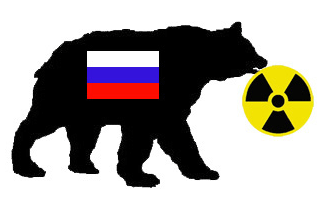
 Analysis: Why we won’t be getting any nuclear power plants from Russia anytime soon, Daily Maverick, DIRK DE VOS SOUTH AFRICA
25 SEP 2014 The Department of Energy recently issued a statement regarding a new partnership in nuclear energy. But let’s not get excited. Nuclear power is a diversion from the real issues in the energy sector – and the culmination of a whole lot of dreaming. By DIRK DE VOS.
The recent media release issued by the Department of Energy, on the agreement regarding a strategic partnership in nuclear energy, will go nowhere.
We are advised that the agreement was signed between the Director-General of state-owned Rosatom but on behalf of the Russian government and Ms Tina Joemat-Pettersen, our minister of Energy, at the 58th session of the Atomic Energy General Conference. While the actual agreement is not available, the announcement reads that it “lays the foundation for the large-scale nuclear power plants (NPP) procurement and development programme of South Africa, based on the construction…of new nuclear power plants with Russian VVER reactors with a total installed capacity of up to 9,6GW (up to 8 NPP units)”. It goes on: “Rosatom seeks to create in South Africa a full-scale nuclear cluster of a world leader’s level – from the front-end nuclear fuel cycle up to engineering and power equipment manufacturing.” (sic) It ends with the sentence: “This agreement opens the door for South Africa to access Russian technologies, funding, [and] infrastructure, and provides a proper and solid platform for future extensive collaboration”.
So, not that clear at all……..
Already, the Rosatom view has been qualified with a senior government source telling Reuters “[t]hey jumped the gun” and Xolisa Mabhongo, an executive at South African state agency Nuclear Energy Corporation confirming that there would be a bidding process before any final contracts were signed.
The whole drive for nuclear power is very hard to understand, especially since it goes against the government’s own policy document, the Integrated Development Plan, which advises that commitments to long range, large-scale investment decisions “should be avoided” in order to ensure “decisions of least regret”. Nuclear builds take a long (a decade) to be completed and therefore do nothing to ease our current pressing energy problems. If nuclear were to get the green light, other shorter-term solutions would still be needed and then, when nuclear eventually comes online, we will find ourselves sitting with thousands of megawatts of excess and extremely expensive baseload capacity. ……….
…..Perhaps “jumping the gun” has something to do with the pressure Rosatom is facing from its various foreign nuclear power station builds, which it says amounts to $100 billion due to tighter economic sanctions imposed against Russia for its role in Ukraine’s civil war. This includes a $8.4-billion nuclear power project in northern Finland (where Rosatom has a 34% ownership stake) and a $10 billion nuclear plant expansion deal brokered between Rosatom and a Hungarian utility company. The Hungarian one is especially interesting. It is reported that Benedek Javor, a Hungarian member of parliament, requested that the EU investigate Rosatom deal because he says that it secured its deal without a public procurement process in violation of EU regulations……….
Despite everything, nuclear energy is just uneconomic and will not solve our immediate energy problems either. Countries that select power supplies through democratic, transparent and market-based methods aren’t building new nuclear reactors. The cost differentials between nuclear energy and anything else can’t be fixed by sharpening pencils – the gulf is just too big. None of this means that we should not be vigilant. Rosatom’s footprints in Hungary and Turkey should be closely tracked.
Perhaps the biggest problem with our government’s apparent fixation with nuclear power is that it diverts attention away from the very many things in our energy sector that desperately require our attention. We can but hope that our decision makers will consult the IRP and put these nuclear dreams aside.DM http://www.dailymaverick.co.za/article/2014-09-25-analysis-why-we-wont-be-getting-any-nuclear-power-plants-from-russia-anytime-soon/#.VCXSO2ddUnl
Ukraine crisis is holding up Russia’s nuclear technology export business
Russia’s Nuclear Energy Ambitions Run Into Trouble Over Ukraine Moscow’s Backing for New Reactors in Several European Countries Fuels Political Tension, WSJ, SEAN CARNEY And JUHANA ROSSI, 23 Sept 14,
Several countries along the European Union’s eastern flank have nuclear projects in the works that are intended to help meet the bloc’s climate-policy goals. Funding, however, has become harder to obtain since Germany turned against nuclear power in the wake of Japan’s Fukushima disaster in 2011.
Russia has been seeking to fill the gap in recent months, but is facing more resistance in some places as the EU tightens its economic sanctions on Moscow.
Finland’s government last week came near to breaking up after a conditional permit was granted to a Russian-backed consortium to build a new plant in the country’s northwest that could cost up to €6 billion ($7.7 billion)…….http://online.wsj.com/articles/europe-wrestles-with-russian-nuclear-diplomacy-1411385720
India-Australia nuclear trade will destabilise the Asia Pacific region
Australia and uranium: the pusher of the Pacifichttps://overland.org.au/2014/09/australian-and-uranium-the-pusher-of-the-pacific/ ByAdam Broinowski 19.Sep.14 “……… The new demand from India will include uranium mined from Ben Lomond near Mt Isa which is likely to be shipped from Townsville Port, and coal mined from the gargantuan Galilee Basin and shipped from Abbott Point, passing through the dredged Great Barrier Reef, or freighted by road to Darwin or Adelaide ports (which hold uranium licenses). The Australia-India uranium agreement supports this concerted and accelerated push.
In cementing a nuclear deal with India, the Abbott government has committed to selling uranium to a nation-state that barely conceals its intentions to expand its nuclear weapons arsenal and that rejects the NPT and Comprehensive Test Ban Treaty (CTBT)………..
First, the Australia-India uranium trade agreement is unsafe. If Japan’s nuclear industry and government have proven unable to properly contain the potential for serious nuclear accidents at its domestic nuclear power plants, then India’s nuclear industry, which is much less reliable and possibly even more corrupt, poses even higher risks of mismanagement.
Internally, India is also unstable, as the government fights an embedded insurgency. It maintains a violently repressive approach to imposing nuclear installations and uranium operations (such as Gorakhpur, Koodankulam, Jaitapur, Jagudoga) upon vulnerable communities, and against the wishes of civil protesters, five of whom have been killed since 2010. While guaranteed only intermittent electricity supply, such communities are experiencing higher rates of disease, congenital malformations and early deaths. In Jagudoga, Jharkhand (19,500 people), those living near the central uranium mine operated by Uranium Corp. of India Ltd. (UCIL), have suffered disproportionately high health problems……….
Second, while Tony Abbott reiterated that ‘suitable safeguards’ were in place to ensure that Australian uranium would be used for ‘peaceful purposes’ and for ‘civilian use only’, such ambiguous terms create false impressions. Nuclear technologies are inherently dual-use (both for civil energy production and military use), and it is disingenuous to claim that a water-tight separation can be ensured. In fact, ten of India’s twenty nuclear facilities do not fall under International Atomic Energy Agency (IAEA) supervisional authority, and India only selectively recognises IAEA safeguards for specific foreign supplied reactors and facilities. With no mechanism to inspect this nuclear technology to ensure that the fuel is not diverted into nuclear weapons production, safety cannot be guaranteed.
Even if the diverted fuel was discovered, neither Australia nor the IAEA could force compliance. An influx of imported foreign uranium will simply make it easier for India to reserve some of its indigenous uranium for enrichment and/or reprocessing weapons-grade plutonium, or for some of Australia’s uranium to be ‘misallocated’ toward military facilities.
In effect, Tony Abbott’s policy to treat India as the exception undermines the IAEA standards within the disarmament regime, and breaches Australia’s obligations to the Rarotonga Treaty for the South Pacific Nuclear Free Zone.
Third, and perhaps most significant, the deal will upset the ‘balance’ between India-Pakistan and in the South Asian region so as to aggravate rivalries and intensify tensions between the two nations, as well as others such as China and Bangladesh………
While leaders such as Abe, Abbott and Modi downplay the reality confronting people affected by radiation exposures from the Fukushima Daiichi nuclear power plant, we should remember that this contamination came, in part, from Australian uranium.
The refusal of executive leaders to acknowledge the dangers of the uranium trade reflects the centrality of nuclear power to the US-led security regime that seeks to dominate non-compliant nations such as China or Russia………
Dr Adam Broinowski is an ARC postdoctoral research fellow at the College of Asia and the Pacific, the Australian National University.
Iran seeks to negotiate about combating ISIS and nuclear power

 Iran seeks give and take on militants, nuclear program BY PARISA HAFEZI AND LOUIS CHARBONNEAU UNITED NATIONS Sun Sep 21, 2014 (Reuters) – Iran is ready to work with the United States and its allies to stop Islamic State militants, but would like to see more flexibility on Iran’s uranium enrichment program, senior Iranian officials told Reuters.
The comments from the officials, who asked not to be named, highlight how difficult it may be for the Western powers to keep the nuclear negotiations separate from other regional conflicts. Iran wields influence in the Syrian civil war and on the Iraqi government, which is fighting the advance of Islamic State fighters.
Iran has sent mixed signals about its willingness to cooperate on defeating Islamic State (IS), a hardline Sunni Islamist group that has seized large swaths of territory across Syria and Iraq and is blamed for a wave of sectarian violence, beheadings and massacres of civilians.
Iran’s Supreme Leader Ayatollah Ali Khamenei said recently that he vetoed a U.S. overture to the Islamic Republic to work together on defeating IS, but U.S. officials said there was no such offer. In public, both Washington and Tehran have ruled out cooperating militarily in tackling the IS threat.
But in private, Iranian officials have voiced a willingness to work with the United States on IS, though not necessarily on the battlefield. U.S. Secretary of State John Kerry said on Friday that Iran has a role to play in defeating Islamic State, indicating the U.S. position may also be shifting………http://www.reuters.com/article/2014/09/21/us-iran-nuclear-exclusive-idUSKBN0HG03T20140921
Resolution in US Senate opposing Canadian nuclear waste dump plan for Lake Huron area

 Senate resolution urges Obama administration to oppose Canadian nuclear waste near Lake Huron Star Tribune, : Associated Press September 21, 2014 TRAVERSE CITY, Mich. — U.S. Sen. Carl Levin has introduced a resolution urging the Obama administration to oppose a Canadian proposal to bury radioactive waste less than a mile from Lake Huron.
A federal panel in Canada is taking testimony on the plan to store low- and intermediate-level waste from nuclear power plants in rock chambers more than 2,000 feet below the surface.
Ontario Power Generation proposes storing low- and intermediate-level waste from nuclear power plants in rock chambers at a site in Kincardine, Ontario, about 140 miles north-northeast of Detroit. ………
According to the resolution, “more than 40 million people in Canada and the United States depend on the fresh water from the Great Lakes for drinking water” and “a spill of nuclear waste into the Great Lakes could have lasting and severely adverse environmental, health and economic impacts on the Great Lakes and the people that depend on them for their livelihood.”
The resolution, co-sponsored by Sens. Debbie Stabenow, D-Mich.; Mark Kirk, R-Ill.; and Tammy Baldwin, D-Wis., urges President Barack Obama and Secretary of State John Kerry “to take appropriate action to work with the Canadian government” to prevent building of a permanent nuclear waste repository within the Great Lakes Basin.
U.S. Rep. Dan Kildee, D-Flint., sponsored a similar measure in the House earlier this month.http://www.startribune.com/politics/national/275945461.html
Iran continues to meet its commitments under the accord with world powers
Iran moving to comply with extended nuclear deal with powers-IAEA BY FREDRIK DAHL VIENNA Fri Sep 19, 2014, (Reuters) – Iran is taking further action to comply with the terms of an extended interim agreement with six world powers over its disputed atomic activities, a U.N. nuclear watchdog report obtained by Reuters on Friday showed.
The findings in a monthly update by the International Atomic Energy Agency (IAEA) – though no major surprise – may be seen as positive by the West as negotiations resumed in New York this week on ending the decade-old nuclear stand-off.
The IAEA document made clear that Iran is continuing to meet its commitments under the preliminary accord that it reached with the United States, France, Germany, Britain, China andRussia late last year and that took effect in January.
In addition, as agreed when the deal was extended by four months in July, it is using some of its higher-grade enriched uranium in oxide form to produce fuel – a step that experts say would make it more difficult to use the material for any bombs……..http://www.reuters.com/article/2014/09/19/us-iran-nuclear-iaea-idUSKBN0HE1R820140919
Efforts by Iran and 6 world powers to unblock nuclear talks
Iran, 6 Powers Seek to Unblock Nuclear Talks, abc news, UNITED NATIONS — Sep 19, 2014, By GEORGE JAHN Associated Press With little more than two months to deadline, Iran and six world powers on Friday launched a fresh effort at narrowing stubborn differences on what nuclear concessions Tehran must agree to in exchange for full sanctions relief.
Nuclear bondoggle for Britain, as EU considers power plan?
EU regulators set to clear Britain’s 19 billion euro nuclear project – sources, Reuters, By By Foo Yun Chee and Barbara Lewis , 17 Sept 14 “……….The EDF-led consortium plans to build two Areva-designed 1,650 megawatt European Pressurised Water Reactors that will produce about seven percent of British electricity needs and will operate for 60 years.
EDF’s long-time Chinese partners, China General Nuclear Corporation (CGN) and China National Nuclear Corporation (CNNC), will take a combined 30-40 percent stake in the consortium, while Areva will take 10 percent.
Areva declined to comment, while the Chinese companies were not immediately available to comment
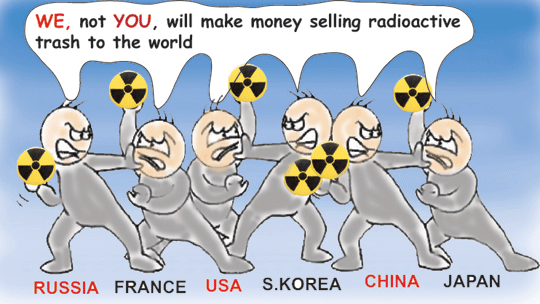
Green politicians and environmental campaigners have said the British financing plan for Hinkley Point cannot be justified either in terms of EU law or value to consumers because of the huge financial cost of nuclear power.
“The proposed deal pays no attention to either European law or the interests of the consumer,” said Andrea Carta, EU legal adviser to campaign group Greenpeace. “Furthermore, the government has failed to run a transparent tender procedure, which should lead the Commission to reject the plan.” https://uk.news.yahoo.com/eu-regulators-set-clear-britains-19-billion-euro-172902698–sector.html#UaQrvxr
Kiev threatens to restart nuclear weapons program
 ‘Inmates running the asylum’: Kiev threatens to restart nuclear weapons program RT.com September 15, 2014 Kiev’s promise to restart its nuclear weapons program if it doesn’t get enough support from the West is completely insane, be it real or just an empty threat, political commentator Daniel Patrick Welch told RT.
“If we cannot protect Ukraine today, if the world doesn’t help us, we will have to go back to the development of nuclear weapons, which will protect us from Russia,” Ukrainian Defense Minister Valery Geletey said in an interview with Ukrainian TV, also claiming that NATO members have already started supplying Kiev with conventional weapons.
NATO members start supplying weapons to Kiev – Ukrainian Defense Minister ……http://rt.com/op-edge/187772-ukraine-nuclear-program-us/
How the entry of Ukraine to NATO will lead to war
Ukraine joining NATO will lead to nuclear war: US expert http://www.presstv.ir/detail/2014/09/08/378045/ukraine-joining-nato-means-nuclear-war/American scholar of Russian studies Stephen Cohen has said that if Ukraine joins NATO, it will lead to a “nuclear war.”
“First of all, by NATO’s own rules, Ukraine cannot join NATO, a country that does not control its own territory. In this case, Kiev controls less and less by the day. It’s lost Crimea. It’s losing the Donbas—I just described why—to the war,” he said.
“Secondly, you have to meet certain economic, political and military criteria to join NATO. Ukraine meets none of them.”
“Thirdly, and most importantly, Ukraine is linked to Russia not only in terms of being Russia’s essential security zone, but it’s linked conjugally, so to speak, intermarriage. There are millions, if not tens of millions, of Russian and Ukrainians married together. Put it in NATO, and you’re going to put a barricade through millions of families. Russia will react militarily,” the scholar explained.
Cohen also noted that the West is mainly to blame for the crisis in Ukraine, Washington’s Blog reported.
“This is a horrific, tragic, completely unnecessary war in eastern Ukraine,” one of America’s top experts on Russia said.
“In my own judgment, we have contributed mightily to this tragedy. I would say that historians one day will look back and say that America has blood on its hands. Three thousand people have died, most of them civilians who couldn’t move quickly. That’s women with small children, older women. A million refugees,” Cohen added.
“If they go ahead with this NATO decision, right plunk on Russia’s borders. Russia will then leave the historic nuclear agreement that Reagan and Gorbachev signed in 1987 to abolish short-range nuclear missiles.”
Tensions between Washington and Moscow have escalated over the crisis in Ukraine.
President Barack Obama on Friday warned his Russian counterpart Vladimir Putin that the United States will not tolerate an attack on any NATO member state, although Ukraine is not a NATO state.
Australia’s blatant violation of Non Proliferation Treaty, in selling uranium to India
Australia blatantly violates the NPT, Iran held to different standard http://www.iranaffairs.com/iran_affairs/2014/09/australia-blatantly-violates-the-npt-iran-held-to-different-standard.html
As if we needed any more proof that the “Iranian nuclear threat” is just a cooked-up pretextwhich is unrelated to any actual nuclear threat, Australia (which holds about 1/3rd of the world’s uranium reserves) has decided to sell uranium to India. That such a deal violates the terms of the Nuclear Nonproliferation Treaty, doesn’t seem to be an issue to anyone. Note the absence of handwringing editorials at the Washington Post and NY Times about the sanctity of international arms treaties etc.
And why should it be a problem, considering that a few years ago the US agreed to violate the same NPT by sharing nuclear technology with India in exchange for buying India’s vote against Iran at the IAEA Board (which sent Iran’s file to the UN Security Council even though Iran had not breached the NPT?)
On the eve of his visit to New Delhi, US Under Secretary of State Nicholas Burns has said that with India voting in favour of the IAEA [International Atomic Energy Agency] resolution on Iran’s nuclear programme, Congressional opposition to the Indo-US nuclear agreement has disappeared and both sides would meet their commitments before President George W. Bush visits India next year.
Of course the US and Australia claim that this stuff is going to non-military use in India but all that means is that the deal would free-up India’s other resources to be used for non-civilian use. There’s nothing in the NPT which allows signatories to make such exceptions anyway.
Now in the meantime, while the US (and Australia) are blatantly violating their own obligations under the NPT, they’re demanding that Iran apply even greater restrictions on its nuclear program than the NPT requires, by for example giving up uranium enrichment. These excessive demands that violate Iran’s legal rights are clearly intended to scuttle the talks, and to keep the “crisis” alive. The US has no intention of peacefully resolving the nuclear dispute with Iran, no matter what.
Russia to copy USA and get a nuclear pre-emptive strike policy?
Note: USA already has a pre-emptive nuclear strike policy
 Russian General Seeks Nuclear First-Strike Option Against US NEWSMAX,, 04 Sep 2014 By Sean Piccoli A Russian defense minister wants his country’s official military doctrine rewritten to allow for a pre-emptive nuclear attack against the United States and NATO, the Russian-language news agency Interfax reports.
Russia categorizes its nuclear arsenal as a defensive measure to be used in the event of an imminent attack that threatens the country’s existence, Interfax reported.
Nuclear war talk has crept back into official Russian discourse amid the fighting in Ukraine, where pro-Russia separatists are being armed by Moscow and supported with Russian ground troops.
The United States and the European Union have jointly condemned Russia’s actions in Ukraine and imposed successively harsher economic sanctions. The rhetoric from Moscow has followed suit…….The Russian general’s remarks came ahead of joint military exercises between NATO and Ukrainian forces that are scheduled to begin on Sept. 16 and “likely to further fuel suspicions between Moscow and the West,” the Toronto Globe and Mail reported. http://www.newsmax.com/Newsfront/Russian-pre-emptive-nuclear-strike/2014/09/04/id/592739/
The one big hurdle to the India-Japan nuclear deal
The hurdles to this deal emanate from Japan’s insistence that no reprocessing of spent fuel would be done in India, and that in the event of a nuclear test by India, the components supplied would be immediately returned to Japan.
The nuclear thorn in India-Japan ties http://www.thehindubusinessline.com/opinion/the-nuclear-thorn-in-indiajapan-ties/article6383865.ece?utm_source=RSS_Feed&utm_medium=RSS&utm_campaign=RSS_Syndication BHASKAR BALAKRISHNAN 5 SEPT 14 The recent visit to Japan by Prime Minister Narendra Modi has brought into focus the ongoing India-Japan negotiations on a civil nuclear agreement. This remains an item of unfinished business, though both sides have declared that it would be pursued with greater vigour. Exactly how important is this agreement in the context of India’s nuclear programme? What factors underlie the Japanese position? Continue reading
1 This Month




PLEASE OPPOSE HR 8255 AND S.3639 – bills would accelerate satellite deployment, with no environmental review or safeguards – https://ncstd5li.quorum.us/campaign/169331/
To see nuclear-related stories in greater depth and intensity – go to https://nuclearinformation.wordpress.com
-
Archives
- September 2026 (339)
- August 2026 (330)
- July 2026 (355)
- June 2026 (287)
- May 2026 (306)
- April 2026 (356)
- March 2026 (251)
- February 2026 (267)
- January 2026 (308)
- December 2025 (358)
- November 2025 (359)
- October 2025 (375)
-
Categories
- 1
- 1 NUCLEAR ISSUES
- business and costs
- climate change
- culture and arts
- ENERGY
- environment
- health
- history
- indigenous issues
- Legal
- marketing of nuclear
- media
- opposition to nuclear
- PERSONAL STORIES
- politics
- politics international
- Religion and ethics
- safety
- secrets,lies and civil liberties
- spinbuster
- technology
- Uranium
- wastes
- weapons and war
- Women
- 2 WORLD
- ACTION
- AFRICA
- Atrocities
- AUSTRALIA
- Christina's notes
- Christina's themes
- culture and arts
- Events
- Fuk 2022
- Fuk 2023
- Fukushima 2017
- Fukushima 2018
- fukushima 2019
- Fukushima 2020
- Fukushima 2021
- general
- global warming
- Humour (God we need it)
- Nuclear
- RARE EARTHS
- Reference
- resources – print
- Resources -audiovicual
- Weekly Newsletter
- World
- World Nuclear
- YouTube
-
RSS
Entries RSS
Comments RSS

