A nuclear deal with the West would give Iran a chance to kickstart the economy
Iranians Hope for Nuclear Deal With West to Kick-Start Economy, NYT By THOMAS ERDBRINK OCT. 28, 2014 For more than a year, President Hassan Rouhani has been dangling the prospect of a bright economic future before the middle classes that elected him, promising to complete a deal with the West to limit Iran’s nuclear program and end the sanctions hobbling the Iranian economy.
While the deadline of Nov. 24 is fast approaching, it is far from clear whether the two camps will agree on a pact. What seems certain, analysts say, is that with oil prices falling seemingly daily — and projected to drop even further — the oil-dependent government of Iran faces growing pressure to settle the nuclear standoff.
Iranian officials will never admit that either sanctions or low oil prices have any effect on their bargaining position in the nuclear talks. Yet, for a country that by some estimates needs an oil price of more than $140 a barrel to balance its budget, the roughly 25 percent drop in oil prices to around $80 a barrel since last summer has to be deeply concerning.
The precipitous decline could force the government to cut back popular benefits, like subsidies for gasoline and utilities and the $12 monthly cash benefit that Iranians have come to consider a birthright. And it could have even broader effects, possibly sending the economy into recession and pressuring the country’s currency……..
In Plan A — Mr. Rouhani’s vision — a nuclear deal would lead to the lifting of all sanctions, and the Iranian economy would become a tempting paradise for foreign investors……….http://www.nytimes.com/2014/10/29/world/middleeast/iranians-hope-for-nuclear-deal-with-west-to-kick-start-economy.html?_r=0
USA and Russia CAN co-operate – to block Europe’s nuclear safety moves!
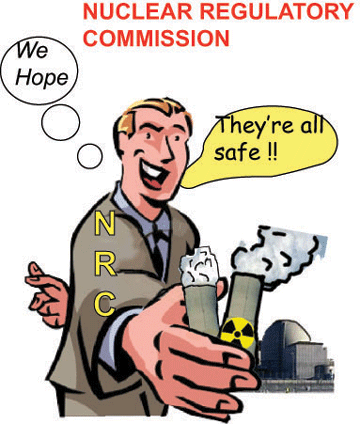


 U.S. Said to Join Russia in Blocking Nuclear Safety Moves, Bloomberg By Jonathan Tirone Oct 23, 2014 The U.S. and Russia are joining forces to block a European plan to raise the protection of nuclear reactors against natural disasters after the meltdowns at Japan’s Fukushima Dai-Ichi power plant, diplomats say.
Envoys from both countries are trying to derail a Swiss-led initiative that would force nuclear operators to invest more on safety, undermining attempts to harmonize global safety regulation, according to eight European and U.S. diplomats who attended meetings in Vienna last week. All asked not to be named in line with rules kept by the Convention on Nuclear Safety, the legal body overseeing the talks……….
Nuclear Secrecy
The U.S.-Russia collaboration reflects a nuclear-safety convention whose secrecy is laid bare in documents obtained by Bloomberg News under a Freedom of Information Act request.
It also underscores the high stakes for an industry trying to bounce back after the Fukushima accident. European attempts to impose higher safety standards would make nuclear power more costly just as plant operators come under price pressure from cheaper natural gas………
Less Stringent
U.S. regulators aren’t requiring the same stringent modifications, according to Edwin Lyman of the Cambridge, Massachusetts-based Union of Concerned Scientists, an advocacy group. European utilities pay as much as five times more to fit out plants to withstand earthquakes and floods as a result, he said………..
While nuclear meltdowns are considered cross-border incidents because of the radioactive fallout that can result, no international authority exists to compel countries to adopt safety standards. Instead, regulators from around the world routinely review each other’s practices to figure out which works best. Laggards face peer criticism that can make them look bad in forums like the convention.
Falsified Data
At the convention’s 2008 meeting — the last before Fukushima — Japan was criticized by peers for being slow to overhaul a reporting system that had been caught using “falsified inspection data,” the documents show. Participants also urged Japan, then the world’s third-largest nuclear-power generator, to review how safe its reactors were against earthquakes……..http://www.bloomberg.com/news/2014-10-23/u-s-said-to-join-russia-in-blocking-nuclear-safety-moves.html
Japan to sign up to convention that removes liability from companies making nuclear reactors
 Japan to ratify international convention on nuclear accident compensation pact THE ASAHI SHIMBUN http://ajw.asahi.com/article/behind_news/politics/AJ201410240041
Japan intends to ratify an international convention that sets a global uniform standard for compensating victims of nuclear accidents.
The move is in line with fears of an increasing risk of a nuclear accident abroad with developing nations accelerating their efforts to construct nuclear power plants.
The convention limits responsibility for nuclear accidents to the operator of the nuclear plant, meaning companies that manufacture nuclear plant equipment would not be liable. That provision would make it easier for Japanese manufacturers to export nuclear technology.
However, critics charge that Japan has not yet adequately assessed the reasons for the catastrophic triple meltdown at the Fukushima No. 1 nuclear power plant in 2011 and that it is wrong to join a convention that would promote nuclear technology exports.
The Abe administration will submit a bill to the extraordinary Diet session now in progress to ratify the Convention on Supplementary Compensation for Nuclear Damage (CSC). Currently, five nations, including the United States, have ratified the treaty, which was adopted in 1997.
However, the treaty has still not entered into force because one provision has not been met–that the total installed nuclear capacity of the ratifying nations be at least 400,000 megawatts.
If Japan ratified the convention, that provision would be cleared. The United States has been lobbying Japan to join the pact. Continue reading
Australia’s environmental law under threat, as Abbott govt ready to seal Trans Pacific Partnership agreement
“The agreement poses a very real risk to the environment,” says Professor Jane Kelsey, an expert on globalisation and economic regulation from the University of Auckland in New Zealand. “If Australia signs an agreement with these mechanisms in place it will make it harder for the government to put new regulations in place.”
That includes any subsidies we might put on renewable energy, or protection we might put in place to save an endangered species.”
Kelsey. “The Abbott government is basically be binding the hands of all future governments on environmental issues.”
So what is the likelihood of Australia ending up signing the agreement as it stands? Prime Minister Tony Abbott has indicated he’s extremely supportive of signing the deal, and Andrew Robb, has stated that negotiations are in the final stages and the treaty is“ready to be sealed”.

 TPP: the free-trade threat to Australia’s environment, ABC 24 Oct 14 FIONA MACDONALD Australia is preparing to sign an agreement that would give international corporations the power to go over the government’s head on environmental issues. Here’s what you need to know about the Trans-Pacific Partnership Agreement.
STRETCHING WIDE, blue and deep, the St Lawrence River in Canada drains America’s Great Lakes to the sea. Along its shores, painted weatherboard cottages cradled by vibrant autumnal trees take in the view of the vast body of water.
This peaceful scene belies the legal battle for what lies underground along this river basin. The Canadian state of Quebec is being sued for CAD$250 million of taxpayers’ money after putting a pause on fracking.
To be clear, Quebec hasn’t decided to ban fracking, it’s simply asked for time to conduct environmental studies to find out whether the process is safe — but mining company Lone Pine Resources has taken the government to an international court, claiming it’s lost millions of dollars in profits as a result of the snap decision.
And if previous trials are anything to go by, there’s a good chance Lone Pine will win, even if it turns out fracking is dangerous to the environment and public health.
It sounds crazy, but it’s legal. And under an agreement Australia is set to sign within 12 months, companies operating in Australia will be able to sue the Government if it makes decisions that hurt their profits — for example, putting in new policies to protect the environment.
The Trans-Pacific Partnership Agreement (TPP) is being negotiated between 12 countries — Australia, Brunei, Chile, Japan, Malaysia, Mexico, Peru, Singapore New Zealand, the US, Vietnam and Canada — with the aim of freeing up and regulating trade between the signatories.
The agreement contains ‘Investor State Dispute Settlement’ (ISDS) clauses. These give big companies who are invested in Australia permission to sue the government in international tribunals if it puts in place new regulations that hurt their profits. These are the same clauses that allowed Philip Morris International to sue the Australian Government for installing plain-packaging tobacco legislation. Continue reading
How America and Britain crushed the government of Australia
THE FORGOTTEN COUP Little Darwin, John Pilger 24 Oct 14 – How America and Britain crushed the government of Australia Across the political and media elite in Australia, a silence has descended on the memory of the great, reforming prime minister Gough Whitlam, who has died. His achievements are recognised, if grudgingly, his mistakes noted in false sorrow. But a critical reason for his extraordinary political demise will, they hope, be buried with him.
Australia briefly became an independent state during the Whitlam years, 1972-75. An American commentator wrote that no country had “reversed its posture in international affairs so totally without going through a domestic revolution”. Whitlam ended his nation’s colonial servility. He abolished Royal patronage, moved Australia towards the Non-Aligned Movement, supported “zones of peace” and opposed nuclear weapons testing.
Although not regarded as on the left of the Labor Party, Whitlam was a maverick social democrat of principle, pride and propriety. He believed that a foreign power should not control his country’s resources and dictate its economic and foreign policies. He proposed to “buy back the farm”. In drafting the first Aboriginal lands rights legislation, his government raised the ghost of the greatest land grab in human history, Britain’s colonisation of Australia, and the question of who owned the island-continent’s vast natural wealth. …………………….
US diplomatic cables published last year by WikiLeaks disclose the names of leading figures in both main parties, including a future prime minister and foreign minister, as Washington’s informants during the Whitlam years……….Whitlam demanded to know if and why the CIA was running a spy base at Pine Gap near Alice Springs, a giant vacuum cleaner which, as Edward Snowden revealed recently, allows the US to spy on everyone. “Try to screw us or bounce us,” the prime minister warned the US ambassador, “[and Pine Gap] will become a matter of contention”.
Victor Marchetti, the CIA officer who had helped set up Pine Gap, later told me, “This threat to close Pine Gap caused apoplexy in the White House… a kind of Chile [coup] was set in motion.”
Pine Gap’s top-secret messages were de-coded by a CIA contractor, TRW. One of the de-coders was Christopher Boyce, a young man troubled by the “deception and betrayal of an ally”. Boyce revealed that the CIA had infiltrated the Australian political and trade union elite and referred to the Governor-General of Australia, Sir John Kerr, as “our man Kerr”…………………..
The Americans and British worked together. In 1975, Whitlam discovered that Britain’s MI6 was operating against his government. “The Brits were actually decoding secret messages coming into my foreign affairs office,” he said later. One of his ministers, Clyde Cameron, told me, “We knew MI6 was bugging Cabinet meetings for the Americans.” In the 1980s, senior CIA officers revealed that the “Whitlam problem” had been discussed “with urgency” by the CIA’s director, William Colby, and the head of MI6, Sir Maurice Oldfield. A deputy director of the CIA said: “Kerr did what he was told to do.”…………………
On 11 November – the day Whitlam was to inform Parliament about the secret CIA presence in Australia – he was summoned by Kerr. Invoking archaic vice-regal “reserve powers”, Kerr sacked the democratically elected prime minister. The “Whitlam problem” was solved, and Australian politics never recovered, nor the nation its true independence.http://littledarwin.blogspot.com.au/
Lest we forget: what was done to Australia’s greatest Prime Minister, Gough Whitlam
Whitlam, the CIA and Nugan Hand http://nuganhand.wordpress.com/2011/01/23/whitlam-the-cia-and-nugan-hand/ November 11: Coup? What coup? [Green Left Weekly], November 21, 2010 By John Jiggens“………Lest we forget.
Former Australian prime ministers Robert Menzies, Howard Holt, John Gorton, Bob Hawke and John Howard all compliantly sent Australian troops to fight US wars. But in the early 1970s, Whitlam’s government had the courage to bring Australian soldiers home from the US war in Vietnam.
For this audacious action, Labor would never be forgiven by then-US president Richard Nixon, the CIA, Rupert Murdoch, the CIA, and corrupt conservative premiers Bob Askin (NSW) and Joe Bjelke-Petersen (Queensland) — who all hated Whitlam as though he were Che Guevara.
Whitlam’s election in 1972 began a short-lived era in which the stated aims of the new Labor government were to promote equality and involve the people in decision-making processes.
Within two weeks of Whitlam’s election, conscription was abolished and draft resisters released from jail. Voting rights were extended to all Australians over 18, and university fees abolished.
Whitlam’s youth constituency also gained community radio stations, and the Whitlam government intended to decriminalise marijuana. Aborigines were granted land rights in the Northern Territory.
Whitlam was less subservient than his Liberal predecessors to Washington’s foreign policy directions. He took a more critical line in foreign policy, condemning Nixon’s 1972 bombing offensive against North Vietnam and warned he might draw Indonesia and Japan into protests against the bombing.
The People’s Republic of China was recognised and the Whitlam government spoke up in the United Nations for Palestinian rights. The French were condemned for testing nuclear weapons in the South Pacific, and refugees fleeing the CIA-backed coup in Chile were welcomed.
Nixon and the CIA found such independence intolerable. After Whitlam was re-elected in 1974, and Jim Cairns became his deputy, Nixon ordered the CIA to review US policy towards Australia. Although the CIA’s response to Nixon has never been released, it seems it began a covert operation to destabilise the Whitlam government began then.
The puppet masters who led the coup were Ted Shackley and Marshal Green. Nixon appointed Green as US Ambassador to Australia in 1973. Nick-named “the coup-master”, Green had been involved in several countries where the CIA had masterminded coups, such as Indonesia (1965) and Cambodia (1970).
Green’s goals were to maintain US bases in Australia and to protect US economic interests.
Green let it be known that if the Labor government honoured one of its key election pledges to reclaiming ownership of oil refineries and mining industries, the US would respond. Green carefully cultivated the Fairfax, Murdoch and Packer dynasties that controlled the Australian media.
Ted Shackley, known as the “Blond Ghost”, joined the CIA in 1951. Over the next two decades, he emerged as the agency’s “dirty tricks” specialist, directing the CIA’s campaign against Cuba and Fidel Castro’s government in 1962.
In 1966 he became Chief of Station in Laos and directed the US secret war there — earning his other nickname, “the Butcher of Laos”.
In 1971, he became head of the CIA’s Western Division (covering North and South America) where he plotted the overthrow of Allende. In 1974, Shackley became head of the Eastern Division of the CIA, covering Asia and Australia.
Shackley’s speciality was financing black operations through the drug trade and he learned the dark art of running drug armies during the secret war in Laos. One of his foot soldiers in Laos was Michael Hand, co-founder of the Nugan Hand bank.
Michael Hand helped forge documents used by the media to discredit the Whirtlam government, while his partner Frank Nugan was the conduit for CIA money to the Liberal Party. Millions of dollars flowed to the conservative parties via Nugan Hand.
Shackley played a key role in the security crisis of November 1975, which revolved around the US military base at Pine Gap. Whitlam had threatened that if the US tried to “bounce” his government, he would look at the presence of US bases in Australia.
The lease for Pine Gap was due for renewal in December 1975. On 10 November 1975, the day before Whitlam was sacked, Shackley sent an extraordinary cable from the CIA to ASIO’s director general, threatening to remove ASIO from the British-US intelligence agreement because he considered Whitlam a security threat.
The cable was published by the Financial Review in 1977 and has been widely reprinted. It shows Shackley’s involvement in the security crisis.
Shackley was furious that Whitlam had accused the CIA of funding the opposition conservative parties and had claimed CIA money was being used to influence domestic Australian politics. In particular, Whitlam was asking questions about the close relationship between Richard Stallings, who ran the so-called joint facility at Pine Gap, and National Party leader Doug Anthony.
“The CIA has grave concerns as to where this type of public discussion may lead”, Shackley’s cable said.
In his 1977 speech calling for a royal commission into the activities of the CIA in Australia, Whitlam called Shackley’s cable “a clear example of the attempted deception of the Australian Government by the American intelligence community … The message was offensive in tone, deceitful in intent and sinister in its implications.”
For the Australian media, the message of Remembrance Day 2010 was clear: sleeping dogs must be allowed to lie. There could be nothing nobler to aspire to than the service of our imperial overlords, and to remind the Australian people that these imperial overlords had subverted a democratically elected government was well off message.
[John Jiggens has been involved in civil liberties and anti-corruption campaigning for many years. He is the author of a number of books, including the recently released The Killer Cop & the Murder of Donald Mackay, about the drug trade, Nugen Hand Bank and the overthrow of the Whitlam government.]
IAEA confirms that Iran is complying with conditions of the nuclear deal with world powers

 Iran acts to comply with interim nuclear deal with powers: IAEA Yahoo News, By Fredrik Dahl VIENNA (Reuters) 20 Oct 14 – Iran is taking further action to comply with an interim nuclear agreement with six world powers, a monthly U.N. atomic agency report showed, a finding the West may see as positive ahead of a November deadline for clinching a long-term deal.
The report by the International Atomic Energy Agency (IAEA), seen by Reuters, made clear that Iran is meeting its commitments under the temporary deal, as it and major powers seek to negotiate a final settlement of a decade-old nuclear dispute.
It said Iran had diluted more than 4,100 kg of uranium enriched to a fissile concentration of up to 2 percent down to the level of natural uranium. This was one of the additional steps Iran agreed to undertake when the six-month accord that took effect early this year was extended by four months in July……..http://news.yahoo.com/iran-acts-meet-terms-extended-nuclear-deal-powers-163649048.html
Australian government sets up a disastrous course for nuclear weapons proliferation
 Australia–India nuclear treaty: a non-proliferation disaster, The Strategist, the Australian Strategic Policy Institute Blog 14Oct 2014 By Crispin Rovere “…….Nuclear suppliers do have a responsibility, however, for ensuring their nuclear material isn’t used to build nuclear weapons, and must maintain strict mechanisms for that purpose. If countries can access nuclear supply without the attendant responsibilities, then support for longstanding non-proliferation regimes will be undermined, countries will see less value in treaties such as the NPT, and a key pillar of the nuclear arms control regime as a whole will be weakened.
The text of the proposed Australian export deal fails that basic test. In addition to a range of other flaws, for the first time in 40 years Australia won’t be able to guarantee how the nuclear material it supplies is being used. Specifically, the agreement allows India to reprocess uranium supplied by Australia to create plutonium, potentially at weapons grade, with no direct accounting by India to Australia for that material, and unusually, no provision for the return of the material in the event of it being misused. As former Director-General of ASNO, John Carlson, explains, Australia currently allows reprocessing only by two export partners, the EU and Japan, each with direct reporting requirements and specific permission being given by Australia as to how the reprocessed material is to be used.
Accordingly, the deal with India isn’t comparable to Australia’s other nuclear export agreements. Australia is privileging India by excluding key provisions normally included to ensure a recipient of nuclear material is accountable to the supplier. Australia’s other nuclear export partners might demand similar concessions, undermining the integrity of the non-proliferation regime as a whole.
Moreover, the concessions made by Australia are unnecessary. ………Not only does this agreement undermine long established non-proliferation regimes and Australia’s credibility as a nuclear supplier, it represents a missed opportunity to strengthen it. Given that what matters most to India is being treated on a par with China and the United States, India should be expected to ratify the Comprehensive Nuclear-Test-Ban Treaty (CTBT) after the US Senate does, just as China has already agreed to do……..
The agreement marks a significant departure from Australia’s longstanding practice. By excluding the normal provisions that ensure a nuclear recipient is directly accountable to the supplier, Australia is abrogating the principle that nuclear suppliers are accountable for how their exported nuclear material is used……..Crispin Rovere is a former PhD student at the Strategic and Defence Studies Centre, ANU and co-author of Non-strategic nuclear weapons: the next step in multilateral arms control. Image courtesy of Flickr user Indiawaterportal.org. http://www.aspistrategist.org.au/australia-india-nuclear-treaty-a-non-proliferation-disaster/
France’s nuclear giant AREVA gets agreement to supply reactors to South Africa

France and South Africa sign nuclear energy agreement By Martine Pauwels, Cécile Feuillatre Paris (AFP) 14 Oct 14, – Paris and Pretoria signed Tuesday an agreement which could open the way for French nuclear giant Areva to bid to build eight nuclear reactors in South Africa worth up to $50 billion (39.5 billion euros).
French Foreign Minister Laurent Fabius and South African Tina Joematt Pettersson signed an intergovernmental agreement on cooperation in nuclear energy development which is necessary for any commercial deal……..http://news.yahoo.com/france-south-africa-sign-nuclear-energy-agreement-133802965.html
Russia’s Rosatom now denying that there is a contract with South Africa

 Nuclear deal was ‘lost in translation’, Business Day BY SIKONATHI MANTSHANTSHA, OCTOBER 10 2014 ROSATOM, THE STATE-OWNED RUSSIAN NUCLEAR COMPANY, SPENT ON THURSDAY AFTERNOON TRYING TO DISOWN ITS EARLIER CLAIM OF HAVING BEEN AWARDED A CONTRACT TO BUILD SA’S PROPOSED FLEET OF POWER STATIONS.
The company blamed a poor translation for its late September statement in which, quoting South African government officials, it said it had been granted the right to build a fleet of nuclear power stations for SA.
The news that Russia would build nuclear power stations came as a surprise as no announcement had been made by the government that it had begun any tender process to procure the 9.6GW it said it would be actively seeking.
“The wording (in the statement) from Rosatom wasn’t well chosen,” said Viktor Polikarpov, regional vice-president for sub-Saharan Africa. “We have to admit that we worded the statement wrongly. It was lost in translation (from the original Russian).”
In this statement Rosatom quoted Energy Minister Tina Joemat-Pettersson. After going to ground and for days being unavailable to confirm the Rosatom claim, the Department of Energy eventually released a statement on its website, which was almost identical to Rosatom’s “translated” statement.
Following this, the department said the statement in no way confirmed SA had reached a deal with Russia. The agreement only envisioned possible future co-operation on nuclear energy issue……….
When Business Day asked for a copy of the co-operation agreement, Mr Polikarpov said the document “is classified … it is not available for public consumption”.
Mr Polikarpov was asked how Rosatom arrived at the $50bn price estimate for the project. After much discussion in Russian with Alex Kirillov, head of marketing in SA, he said this was the estimated cost of Rosatom’s plants……..
Rosatom will apply for a $50bn loan from the Russian government if SA chooses a build, own and operate model, he said……..http://www.bdlive.co.za/business/energy/2014/10/09/nuclear-deal-was-lost-in-translation
European Greens urge principled opposition to EU nuclear deal that will damage renewabl eenergy
 EU nuclear deal will hit renewables http://www.theguardian.com/world/2014/oct/07/eu-nuclear-deal-will-hit-renewables The Guardian, Wednesday 8 October 2014 Today (8 October) the 28-strong outgoing European commission will make a decision on the Hinkley C financial deal, with far-reaching consequences both for the integrity of decision-making in Europe and for the future of European energy policy (Conflict of interest concerns over EDF’s Hinkley nuclear project approval, 1 October).
 In December 2013, the commission raised doubts on almost all aspects of the project, finding the state credit guarantee of £10bn for EDF “incompatible under EU state aid rules”. So why is competition commissioner Joaquín Almunia, backed by former EU president José Manuel Barroso, recommending the commission give the deal the green light? Could it be that the German federal government has been involved in a backroom deal?
The German chancellor, Angela Merkel, has previously achieved exemptions from EU subsidy rules for Germany’s ambitious renewable energy plans. The legislation behind this, which provides feed-in incentives for renewable energy technologies, is helping transform energy generation away from fossil fuels and nuclear; renewables now account for around 30% of Germany’s electricity.
However, in return for these subsidy exemptions, Merkel is rumoured to have agreed to support British nuclear subsidies. So, while the Berlin government is decommissioning its own nuclear power plants and turning to renewables, it is at the same time undermining nuclear phase-out across the rest of Europe. Greens in the European parliament urge departing commissioners to hold fast to their principled opposition to this extremely dodgy deal and set all of Europe, not just Germany, on course for an energy policy for the common good.
Molly Scott Cato Green MEP
Rebecca Harms Green MEP
Claude Turmes Green MEP
Benedek Jávor Green MEP
Michèle Rivasi Green MEP
The need for reconciliation with Iran is now urgent
A deal that offers Iran a nuclear power industry not exceeding its needs and ambitions, and the rest of the world reassurance through intrusive inspections, would do more than bring Iran in from the cold. It would inaugurate a new relationship between the Islamic Republic and the west that could keep together a region that is, in every other particular, coming apart.
Iran nuclear talks: why Tehran must be brought in from the cold
A deal with Iran is vital for the stability of the wider Middle East. The opportunity must be grasped Christopher de Bellaigue The Guardian, Friday 3 October 2014 In Iran a few weeks ago I travelled with my 11-year-old son from Tehran to the ancient fire temple at Takht-e Soleymān, not far from the Iraqi border. At no time during our journey – part of which was made in a clean, comfortable, Chinese-made train – did we feel anything but safe. Our only exposure to violence was in the provincial town of Zanjan, famous for its knife production, where a salesman dry-shaved his own forearm in demonstration of his wares.
No one in their right mind would undertake a comparable journey nowadays inside the borders of any of Iran’s war-torn neighbours: Iraq, Afghanistan, or, a bit further afield, Syria. Iran is the exception along the Middle East’s strategic, resource-rich central belt, a functioning nation state where the central authorities enjoy a monopoly of force, the infrastructure works and the people are overwhelmingly literate and unarmed. Perhaps most significant of all, as capo di tutti capi of the Shia world – wielding clout over its co-religionists in Iraq and Lebanon as well as propping up Bashar al-Assad with military assistance and subsidised oil – Iran could have a vital role in restoring stability throughout Mesopotamia and the Levant.
I say “could” because there is no guarantee that the Iranians will be invited to assume the role that common sense assigns them. It’s one of the perversities of modern politics that the west does not have a decent working relationship with the most important country in the Middle East…….. Continue reading
Movement in European policy makers to overturn approval for UK’s Hinkley Point nuclear power plan
Opposition builds to UK nuclear project in EU executive -sources
* European Commissioners expected to vote on Oct. 8
* Britain has not been forced to make big changes
* Critics predict legal protest if decision approved
By Barbara Lewis and Foo Yun Chee BRUSSELS, Oct 3 (Reuters) – A landmark deal to use British taxpayers’ money to build a 16 billion pound ($25.6 billion)nuclear power station has triggered opposition from a quarter of EU policy-makers, who want to overturn approval from the top European regulator, EU sources said………
critics say it breaches EU law over when government funding is allowed, and representatives of the renewable industry have threatened to bring legal action against the Commission if the Hinkley Point plan is approved.
An internal meeting of senior Commission staff on Monday will examine the decision, and the college of 28 Commissioners including President Jose Manuel Barroso is expected to hold a closed-door vote on Wednesday.
Five separate sources, speaking on condition of anonymity, said seven Commissioners opposed approval of the Hinkley Point funding, and although that would not be enough to block it, it was an unusually high level of opposition.
One source said the number could rise, because there are still a few days left before the vote, and predicted a delay.
“They should make more effort to accommodate objections,” one of the sources said, referring to the department of Competition Commissioner Joaquin Almunia, which has managed the case………
The case is a benchmark for EU member states on both sides of the debate as EU countries such as Germany phase out nuclear and seek to replace it with renewable power, while nations such as Poland, like Britain, favour nuclear…….
Britain classes nuclear as well as renewable power as carbon-free, although opponents of nuclear say it cannot be regarded as an environmental solution because it creates radioactive nuclear waste.
They also say there is no justification for funding an expensive and mature technology, when subsidies are being taken away for renewable energy, which is becoming more and more commercially competitive.
“They are rolling out the red carpet for nuclear and waving a red card for renewables,” Claude Turmes, a Luxembourg member of the Green party in the European Parliament, told Reuters.
European Competition Commissioner Joaquin Almunia is scheduled to leave office at the end of October, and sources said he felt he could not leave the Hinkley Point decision for his successor.
Environmental campaigners say he had no right to leave his successor to tackle the aftermath of a hasty conclusion.
“If the deal is approved, the outgoing Commission will be leaving Brussels in a getaway car after the heist of the century,” said Andrea Carta, EU legal adviser to campaign group Greenpeace. “Taxpayers would be left paying for one of the most expensive power stations in the world.” (1 US dollar = 0.6262 British pound) (editing by Jane Baird) http://www.reuters.com/article/2014/10/04/eu-britain-edf-nuclear-idUSL6N0RY3FE20141004
European Commission goes along with charade hiding costs of UK’s Hinkley C nuclear farce.
The European Commission, in signalling its intention to give the green light to the British Government’s Hinkley C nuclear power plant deal under the ‘state aid’ permission procedure has failed miserably to protect British consumers against the consequences of what must be the highly likely outcome of cost overruns in building the Hinkley C plant. Instead it has issued what must be seen as a smokescreen of ‘protection’ to British electricity consumers by asking the British Government to introduce rules clawing back profits made by EDF. See http://www.reuters.com/article/2014/10/03/eu-britain-edf-nuclear-idUKL6N0RY3FE20141003?irpc=932
 Observers might be forgiven for imagining that the 35 year contract for Hinkley C, underpinned by £10 billion of state loan guarantees paying higher premium prices (£92.50) than privately built onshore windfarms receive for only 15 year contracts, will give EDF and their Chinese partners big profits. However this impression is an artefact of the ludicrous propaganda perpetrated for many years that nuclear power stations are potentially profitable, competitive, operations. They are no such thing. Continue reading
North Korea wanting to resume nuclear talks with world powers
In a wide-ranging interview, he said that reports about the ill health of its leader Kim Jong-un were “fabricated rumours” and that it was not clear whether the US was willing to negotiate the release of three detained Americans.
Russian foreign minister Sergei Lavrov said after talks with North Korea’s foreign minister in Moscow on Wednesday that he saw a possibility thatstalled talks on Pyongyang’s nuclear programme could resume, but it would take time.
“For the six-party talks we are ready, and as far as I think, China and Russia and the DPRK are ready,” So said in the interview in the DPRK’s mission overlooking Lake Geneva.
“But America, they don’t like that kind of talks right now. Because America does not like that, so that’s why the countries like South Korea, Japan also are not ready for those talks.”
North Korea promised to abandon its nuclear programme in 2005 but appeared to renege on the agreement when it tested nuclear devices in 2006 and 2009………http://www.theguardian.com/world/2014/oct/03/north-korea-ready-resume-nuclear-programme-talks-un-envoy-so-se-pyong
1 This Month




PLEASE OPPOSE HR 8255 AND S.3639 – bills would accelerate satellite deployment, with no environmental review or safeguards – https://ncstd5li.quorum.us/campaign/169331/
To see nuclear-related stories in greater depth and intensity – go to https://nuclearinformation.wordpress.com
-
Archives
- September 2026 (339)
- August 2026 (330)
- July 2026 (355)
- June 2026 (287)
- May 2026 (306)
- April 2026 (356)
- March 2026 (251)
- February 2026 (267)
- January 2026 (308)
- December 2025 (358)
- November 2025 (359)
- October 2025 (375)
-
Categories
- 1
- 1 NUCLEAR ISSUES
- business and costs
- climate change
- culture and arts
- ENERGY
- environment
- health
- history
- indigenous issues
- Legal
- marketing of nuclear
- media
- opposition to nuclear
- PERSONAL STORIES
- politics
- politics international
- Religion and ethics
- safety
- secrets,lies and civil liberties
- spinbuster
- technology
- Uranium
- wastes
- weapons and war
- Women
- 2 WORLD
- ACTION
- AFRICA
- Atrocities
- AUSTRALIA
- Christina's notes
- Christina's themes
- culture and arts
- Events
- Fuk 2022
- Fuk 2023
- Fukushima 2017
- Fukushima 2018
- fukushima 2019
- Fukushima 2020
- Fukushima 2021
- general
- global warming
- Humour (God we need it)
- Nuclear
- RARE EARTHS
- Reference
- resources – print
- Resources -audiovicual
- Weekly Newsletter
- World
- World Nuclear
- YouTube
-
RSS
Entries RSS
Comments RSS

