South Africa – Russia nuclear agreement is by no means a done deal
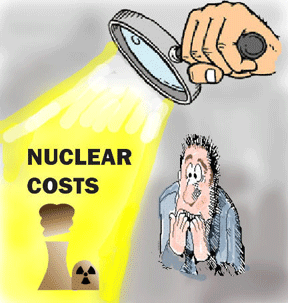

 SA’s nuclear deal with Russia is far from done, Mail & Guardian 20 FEB 2015 LISA STEYN Money is the big problem with the initial agreement Minister Tina Joemat-Pettersson signed last year, given the financial positions of both countries. Russia has emerged as an apparent frontrunner to participate in South Africa’s nuclear build, but selecting the technology is just the first of many challenges that could see a nuclear deal such as this come a cropper.
With the Russian economy in turmoil and the subsequent high cost of borrowing, its ability to raise the funding for its nuclear ambitions in many countries is being called into question – as is its ability to deliver on time.
For South Africa, it is even more of a mystery how the government will provide the loan guarantees that would be required, given that so many have been extended to ailing parastatals such as Eskom and SAA. The state may have hit its limit.
Regardless of which vendor is chosen, the guarantees and the government’s 50% localisation target for the project appear to be insurmountable obstacles, particularly given the challenges faced by the domestic construction industry.
The memorandum of understanding signed between Russia and South Africa last year is far more than a generic agreement, as the government had claimed it is. Rather, it lays the groundwork for government-to-government contracting, in terms that heavily favour Russia, the Mail & Guardian reported last week.
Not only will the agreement be binding for 20 years once in force, but the Russians will also be indemnified from any liability arising from nuclear accidents during the reactors’ life. Russia is also granted a host of regulatory concessions and favourable tax and other financial treatment. The designated competent authorities are South Africa’s department of energy and Russia’s Rosatom State Atomic Energy Corporation.
But unresolved issues could make the deal unworkable. An industry expert, who did not wish to be named, said: “My own view is I don’t think the guys driving it from the South African side have joined the dots. I don’t have huge confidence in the people running it and that they understand the issues.”
Financing
Despite the apparent commitment to forge ahead with Russian technology, the agreement defers a decision about funding.
The Russians are known to have offered South Africa a “build, own, operate” construction deal, according to which Russia would build and run the nuclear station, and sell the power to South Africa at an agreed price. This kind of vendor-assisted financing may be the only way South Africa could afford to go nuclear. But the bigger question now is: Can Russia?
First, sanctions have been imposed on Russia for its military intervention in the Ukraine. Then the oil price tumbled, severely hitting government revenues, which are heavily reliant on oil and gas taxes. Subsequently, the rouble has lost almost 50% of its value since the start of 2014, inflation has soared to 15%, and its sovereign credit rating was cut to sub-investment grade by one agency in January. And, in 2014 alone, $151-billion was taken out of the country.
Some nuclear economists and industry insiders believe this dire state of affairs could affect Russia’s nuclear ambitions, as new builds involve high upfront costs and are extremely sensitive to the cost of financing, which is mainly the interest rates at which the funding is secured…….
Delays
The unnamed industry expert, however, expressed concern that Russia might commit itself to a further agreement but not honour it. He said other nations that had signed nuclear deals with Russia, such as Vietnam, India and Turkey, had all experienced delays………….. http://mg.co.za/article/2015-02-19-sas-nuclear-deal-with-russia-is-far-from-done
South Africa by-passes Constitution in top secret nuclear agreement with Russia
 ‘Top secret’ nuclear plan ducks scrutiny Mail & Guardian 20 FEB 2015 00:00 LIONEL FAULL, SAM SOLE & STEFAANS BRÜMMER Bureaucrats driving the new build programme seem comfortable skirting transparency and fair value. In a “top secret” presentation, the energy department has proposed a closed government-to-government procurement of new nuclear power stations instead of a transparent and competitive tender.
If adopted, this would pave the way for the nuclear co-operation agreement it concluded with Russia in September – or “similar” agreements it concluded with France and China after an outcry that it was favouring the Russians – to be implemented without pitting potential suppliers openly against each other.
This flies in the face of public assurances from the government that it would follow a competitive process.
During his State of the Nation address last week, President Jacob Zuma said all countries that bid “will be engaged in a fair, transparent and competitive procurement process to select a strategic partner, or partners, to undertake the nuclear build programme”.
If the mooted six to eight nuclear power stations are built, it will be South Africa’s most expensive procurement yet, at roughly R1-trillion.
The agreement with Russia, revealed by amaBhungane last week, states that the South African government is prepared to give Russia the exclusive rights to its nuclear build programme for a minimum of 20 years. During that time, Russia could block South Africa from procuring nuclear technology from any other country.
The agreement is not yet binding, as it requires the National Assembly and the National Council of Provinces to ratify it.
The French and Chinese agreements remain undisclosed.
The energy department’s recommendations on the procurement method are contained in a separate document obtained by amaBhungane. It is marked “top secret” and was prepared for presentation to the national nuclear energy executive co-ordination committee in October 2013. This was a Cabinet committee comprising the ministers and government officials directly responsible for implementing the new nuclear programme and was chaired by President Jacob Zuma………..
Despite the apparent global tendency to conclude nuclear tenders one on one, and behind closed doors, the lack of transparency is likely to jar with what South Africa’s Constitution says about procurement.
According to section 217, “when an organ of state … contracts for goods or services, it must do so in accordance with a system which is fair, equitable, transparent, competitive and cost-effective”……..
History doomed to repeat itself
The last time the government bypassed the Constitution on a major public procurement, the deal went badly wrong…….. The lessons of the Airbus debacle are there to be learned, so it remains to be seen whether section 217 will be bypassed again.
The M&G Centre for Investigative Journalism (amaBhungane) produced this story. All views are ours. See www.amabhungane.co.za for our stories, activities and funding sources. http://mg.co.za/article/2015-02-19-top-secret-nuclear-plan-ducks-scrutiny
Debate in Europe over use of Russian Nuclear Technology
PRAGUE—A plan for central European countries to produce their own nuclear fuel using Russian technology has become another flash point in the debate over the continent’s reliance on Moscow for its energy at a time of frayed relations over the conflict in Ukraine.
To its advocates in the Czech and Hungarian governments, the proposal to construct a fuel-assembly plant somewhere in the region would help countries in the European Union’s east build more nuclear power plants,……http://www.wsj.com/articles/tensions-rise-in-central-europe-over-use-of-russian-nuclear-technology-1424439629
Russia- South Africa secret deal exposed: details are fearful ones for South Africa
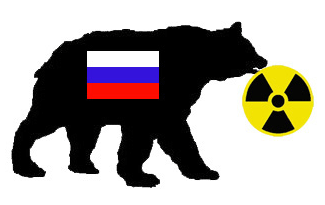 Exposed: Scary details of SA’s secret Russian nuke deal, Mail & Guardian 13 FEB 2015 00:00 LIONEL FAULL The secret nuclear deal our leaders have signed with Russia carries many risks for South Africa. Shocking details of the secret nuclear deal that Energy Minister Tina Joemat-Pettersson signed with Russia last year can, for the first time, be revealed. The text, which has been jealously guarded by her department and Russian nuclear company Rosatom, holds many dangers for South Africa.
It creates an expectation that Russian technology will be used for South Africa’s trillion-rand fleet of new nuclear power stations. And by laying the groundwork for government-to-government contracting, it appears designed to sidestep the constitutional requirement for open and competitive tendering.
Once the agreement comes into force, the Russians will have a veto over South Africa doing business with any other nuclear vendor. And it will be binding for a minimum of 20 years, during which Russia can hold a gun to South Africa’s head, in effect saying: “Do business with us, or forget nuclear.”
The agreement confirms the government’s intention to make “Atomic Tina’s” energy department the procuring agent for the nuclear programme rather than Eskom – where the country’s nuclear expertise lies, despite the utility’s travails. Joemat-Pettersson signed the agreement in Vienna on September 21 last year, three weeks after President Jacob Zuma held talks with his Russian counterpart, Vladimir Putin, at the latter’s country estate.
It led to an immediate outcry as it appeared that Russia was being favoured over other vendor countries………..
The terms of the agreement lean heavily in Russia’s favour. They:
- Indemnify the Russians from any liability arising from nuclear accidents during the reactors’ life. The agreement says South Africa is “solely responsible for any damage both within and outside the territory of the Republic of South Africa”;
- Hand the Russians a host of regulatory concessions and “special favourable treatment” in tax and other financial matters, but offer South Africa no such incentives; and
- Require Russia’s permission if South Africa wants to export nuclear technology it develops locally as a result of learning from the Russians, thereby hindering government’s aim that the nuclear new-build programme will develop a globally competitive local nuclear industry………..
It was first obtained by South African environmental organisation Earthlife Africa Johannesburg by Russian anti-nuclear activist and head of Ecodefense Vladimir Slivyak, who got it from a source in the Russian foreign ministry. It is in Russian, and includes the signatures of Rosatom’s director general Sergey Kirienko and South African energy minister Tina Joemat-Pettersson.
A Russian translator commissioned by Earthlife to translate the agreement into English subsequently also found it publicly available on the ministry’s website. amaBhungane has compared Joemat-Pettersson’s signature on the document with her signature on a current document; they are identical. amaBhungane has also commissioned its own translation of the agreement, which is available to download by clicking on the link at the top of this story. – Lionel Faull
The M&G Centre for Investigative Journalism (amaBhungane) produced this story. All views are ours. See www.amabhungane.co.za for our stories, activities and funding sources. http://mg.co.za/article/2015-02-12-exposed-scary-details-of-secret-russian-nuke-deal
Austria refuses to be bullied by UK over its opposition to subsidies for nuclear power
 Austria Says It Won’t Be Intimidated by U.K. in Nuclear Dispute, Bloomberg, Jonathan Tirone, 12 Feb 15— Austria said it won’t be cowed by alleged British threats over plans by the government in Vienna to contest state subsidies for a new nuclear-power plant at Hinkley Point in southwest England.
“We won’t let ourselves be intimidated,” Austrian Environment Minister Andrae Rupprechter said late Wednesday on Twitter. “No subsidies for atomic power.”
Tensions between Austria and the U.K. flared this week over the $26 billion European Commission-approved subsidy for Hinkley Point. British officials allegedly threatened Austria with retaliation if it appeals the subsidies, according to Austrian diplomatic cables leaked this week in Vienna.
“The U.K. will take every future opportunity to sue Austria in areas that harm or that have strong domestic political implications,” read the cable, written by Austria’s embassy in London, a copy of which was published by the newspaper Kronen Zeitung. “The U.K. has already begun to elaborate countermeasures.”………. http://www.bloomberg.com/news/articles/2015-02-12/austria-says-it-won-t-be-intimidated-by-u-k-in-nuclear-dispute
UK government bullying Austria over UK subsidies to the nuclear industry?

 Diplomatic row with Austria over EDF nuclear power station escalates http://www.independent.co.uk/news/business/news/diplomatic-row-with-austria-over-edf-nuclear-power-station-escalates-10040309.html MARK LEFTLY
  ASSOCIATE BUSINESS EDITOR THURSDAY 12 FEBRUARY 2015 The UK will take “every opportunity to sue or damage Austria” if Vienna does not drop a legal challenge to the construction of a £24.5bn nuclear power station in Somerset, according to a leaked memo.
Austria is staunchly anti-nuclear and will soon formalise an appeal against the EU’s decision to allow the UK government to pay subsidies to the French energy giant EDF to build Hinkley Point C, the first in a new generation of civil reactors.
According to the memo, written by the deputy Austrian ambassador in London, Christoph Weidinger, this has sparked a diplomatic row that could “escalate” when Vienna submits its appeal.
The memo says that a senior Foreign Office official, Vijay Rangarajan, threatened three legal counter-challenges to Austria’s energy practices, a move environmental campaigners at Greenpeace blasted as “bullying”.
Details of the exchange, which occurred last month, come as David Cameron is due to meet the Austrian chancellor, Werner Faymann, at a summit in Brussels today.
Warning that the Austrian challenge will have “negative effects on bilateral relations, because there would be strength of feeling, up to the PM”, the UK is said to have demanded a meeting to explain the damage that Austria could face.
Mr Weidinger said that the UK will complain that Austria’s decision to make electricity distributors mark the source of electricity on bills, allowing householders to snub any energy originating from nuclear stations, violated internal market rules.
Mr Rangarajan is alleged to have warned that the UK will also investigate whether Austria’s challenge to the EDF deal violates an existing treaty and will try to force Austria to take a larger share of electricity from sustainable sources than its European neighbours.
The subisdy deal, which EDF wanted before it risked billions building the plant, involves the UK guaranteeing the French a minimum price for every unit of electricity generated from Hinkley.
The memo states: “The UK has obviously started, including the use of the UK Embassy in Vienna… with systematic preparation of counter measures to damage Austria.”
David Lowry, an environmental consultant, said: “It’s extraordinary that the Foreign Office has gone to this level of diplomatic incident in order to protect the unsustainable.”
A Whitehall source said the UK there was no “bullying” involved. A government spokeswoman said: “We have no reason to believe that Austria, or any other party, is preparing a case which has any merit.”
Obama – Modi discussions resulted in no deal for USA nuclear salesmen
The same stumbling block over parallel safeguards in perpetuity has held up India’s conclusion of nuclear deals with Japan and Australia
 India’s bitter experience over the 1984 gas leak from an American-owned Bhopal city plant that killed about as many people as the Fukushima disaster. Indeed, Japan’s dual liability laws, which indemnify suppliers and make plant operators exclusively liable, should serve as a sobering lesson for India: GE built or designed all the three Fukushima reactors that suffered core meltdowns in 2011, yet the U.S. firm went scot-free, despite a fundamental design deficiency in the reactors.
With complex legal, pricing and other issues still pending, the deal’s commercialization is anything but imminent. In fact, the two sides are yet to sign the administrative arrangements, which they announced had been “finalized.”
It is an open question whether the deal will ever yield substantive energy benefits for India, given the exorbitant price of foreign-origin reactors, the concomitant need for India to heavily subsidize the electricity from such plants, and grassroots safety concerns over the Fukushima-type multi-plant nuclear parks earmarked by India for Westinghouse, GE-Hitachi and Areva, each of which is to sell prototype LWR models presently not in operation anywhere in the world.
The U.S.-India nuclear breakthrough that wasn’t, Japan Times 12 Feb 15 BY BRAHMA CHELLANEY During U.S. President Barack Obama’s recent India visit, a stalled, decade-old civil nuclear deal took center-stage, with the two sides announcing a breakthrough on the contentious issues blocking its implementation — a development that promised to potentially open the path for a Japan-India nuclear deal. It now appears that the breakthrough was more hype than reality and that there is little prospect of the U.S.-India deal’s early commercialization……..
it has now become apparent that the U.S. and India are still locked in negotiations to tie up loose ends and that the much-trumpeted breakthrough was little more than an effort to project a substantive advance during a presidential visit rich in pageantry and symbolism. Obama was the chief guest at India’s Jan. 26 Republic Day parade, a year after Prime Minister Shinzo Abe had that honor.
While claiming a breakthrough, neither side released any details, including on how another sticking point had been resolved: a U.S. demand that New Delhi accept nuclear-material tracking and accounting arrangements Continue reading
Nuclear supplier nations not happy with India’s Liability Law
The nuclear ‘breakthrough’ is mostly hype: http://economictimes.indiatimes.com/news/politics-and-nation/the-nuclear-breakthrough-is-mostly-hype-swaminathan-sa-aiyar/articleshow/46162264.cms Swaminathan SA Aiyar 8 Feb, 2015 ndian officials say the Obama visit broke a seven-year logjam in nuclear cooperation, opening the way for US firms to set up nuclear power plants in India.
The Modi-Obama meeting whipped up a lot of fizz and optimism. Problem: the key issue is not political at all but commercial. The entities that must be convinced are not US presidents but heads of nuclear corporations like GE and Toshiba-Westinghouse. And no corporation so far is convinced that India’s nuclear liability law has ceased to be a hurdle.

An Indo-US agreement was indeed reached on a completely separate issue — tracking the movement of US nuclear materials to ensure India did not divert these to military use. This was an additional roadblock in case of the US. But overcoming this does not settle the much bigger roadblock — unlimited liability — that all four supplier nations are complaining about.
France wants to beat USA in selling nuclear reactors to India
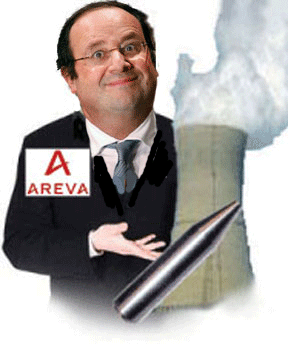 US nuclear ‘breakthrough’ cloud on France deal, Telegraph New Delhi, Feb. 5:France has indicated it may want to use elements of the nuclear liability “breakthrough” India and the US have claimed, in setting up its own reactors in this country, signalling potential for competitive bargaining over the terms New Delhi offers to different nations.
India last year offered France and Russia – the two nations other than the US that have committed to selling nuclear reactors – an insurance pool created by Indian public sector firms to fund any compensation following an accident from their reactors.
The US had so far appeared unconvinced by the insurance pool plan. Its apparent turnaround during President Barack Obama’s India visit last week has sparked speculation in the capital’s diplomatic enclave that New Delhi may have offered Washington a particularly sweet deal……….
France is pandering to Modi’s pet initiative of “Make in India” by promising to build “large parts of the Areva reactors” in India. And unlike the US, France had also never sought any change in the nuclear liability law despite its concerns that the law was draconian and out of line with global standards, the senior French official said…….
The Indian foreign office also pointed to France’s acceptance of India’s liability law.”Every country has a different approach to this matter,” Akbaruddin said, citing the example of uranium India already sources from France. “With France, the template of our engagement is already set.” http://www.telegraphindia.com/1150206/jsp/nation/story_1764.jsp#.VNUrReaUcnk
Transatlantic Trade and Investment Partnership would alloww corporations to sue governments
 Energy market madness is the death spasm of the oil age – renewables now! Ecologist Nafeez Ahmed 4th February 2015 “……..the widely criticized TTIP proposal – the Transatlantic Trade and Investment Partnership – as being a positive force for economies and the renewable energy sector.
The fundamental problem with TTIP, a so-called free trade agreement being negotiated in secret by US and European governments, is that by aiming to reduce regulatory barriers to trade for big business, the agreement aims to fundamentally erode the power of elected governments to enact legislation on food safety, environmental protection, banking and finance, that would in some way undermine corporations from rampaging across the US and EU without concern for people or planet.
One of the most obvious counter-democratic components of TTIP is its aim to introduceInvestor-State Dispute Settlements (ISDS), which would effectively allow corporations to sue governments if their policies cause a loss of profits.http://www.theecologist.org/News/news_analysis/2741146/energy_market_madness_is_the_death_spasm_of_the_oil_age_renewables_now.html
Will USA nuclear companies really be able to sell their reactors to India?

 Is the India nuclear agreement really the ‘breakthrough’ Obama promised? WP, By Annie Gowen and Steven Mufson February 4 NEW DELHI — President Obama stood alongside Prime Minister Narendra Modi in India’s capital just days ago and announced a “breakthrough understanding” that the two countries hoped would pave the way for U.S. firms to sell nuclear reactors to India.
But analysts and experts familiar with the negotiations say that the legal issues remain so complex that private U.S. companies may continue to shy away from new deals in India, despite the developing country’s fast-growing and dire power needs.
So far, the details of the agreement have been sketchy at best……….
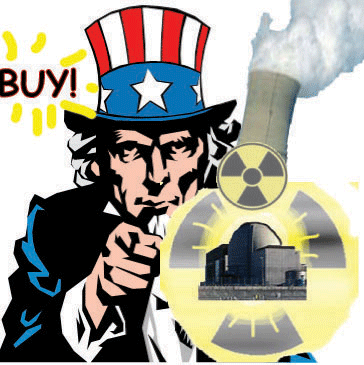 Analysts say the real test will be whether the two U.S.-Japanese companies sign commercial contracts with the Nuclear Power Corporation of India……..
The key issue will be whether the conflict between international and Indian law can be waved away by a memorandum from India’s attorney general. The memorandum would have to say that the 2010 liability law “doesn’t mean what it says,” said a Washington lawyer familiar with the issues, speaking on the condition of anonymity to protect his professional relationships.
A second obstacle has been the requirement in the Hyde Act of 2006 that the Indian government and an independent auditor annually provide information about the form, amounts and location of any uranium supplied to India to make sure it is not diverted for military use……..
India is a special case — and nonproliferation experts have special concerns about it. India’s first nuclear reactor dates to 1956; the country has 21 reactors at seven power plant sites.
The United States and Canada withdrew support for the nuclear program after the country exploded a nuclear device in 1974, and the United States and Japan imposed sanctions after the 1998 tests.
Members of Congress will want to be sure that India cannot skirt the Bush-era legislation and did not simply wear down American negotiators to achieve the present agreement………
Even if the thorny details of the liability question are worked out — a big “if,” analysts say — American companies still face the political realities of India. Although the government concedes that nuclear power must remain part of the country’s energy mix, particularly to counter rising greenhouse gas emissions, nuclear power plants remain unpopular with local residents, and acquiring land to build plants can take years.
In the end, said M.K. Bhadrakumar, a former Indian ambassador who is now an analyst, the “breakthrough” touted by Obama and Modi may end up being more of a diplomatic success than a commercial breakthrough………http://www.washingtonpost.com/world/is-the-india-nuclear-agreement-really-the-breakthrough-obama-promised/2015/02/04/bc0b0dd2-abc1-11e4-8876-460b1144cbc1_story.html
Iranium President Rouhani optimistic about a nuclear deal with the West
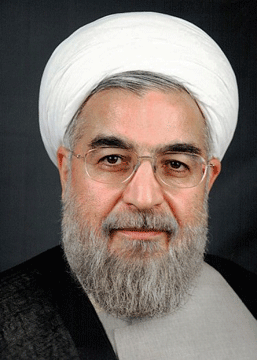 Iranian president says nuclear deal with the west is getting closer, Guardian, Julian Borger and Saeed Kamali Dehghan, 4 Feb 15 Mehr news agency quotes Hassan Rouhani saying sides have ‘narrowed the gaps’ as second report emerges of uranium enrichment deal with US. President Hassan Rouhani has said that a nuclear deal with the west is getting closer, as a report emerged of a possible compromise between American and Iranian negotiators over uranium enrichment.
After meeting the heads of the country’s parliament and judiciary, Rouhani was quoted by the Mehr news agency as saying: “We have narrowed the gaps,” adding that although “some issues and differences remain … The west has realised that it should recognise the rights of the Iranian people.”
Even Ali Larijani, the parliamentary speaker and a noted hardliner on nuclear talks, declared himself “not pessimistic” about the trajectory of the negotiations.
Nuclear talks between Iran and six major powers are due to resume later this month in Geneva ahead of a March deadline for arriving at a basic framework agreement. A comprehensive permanent settlement would be reached by the end of June………
The possible compromise under consideration, according to the AP, would see most of the 10,000 centrifuges in operation left in place but reconfigured so that they would be less productive. One way of doing that would be to spin the centrifuges more slowly. Other measures would be agreed upon to reassure the west that Iran could not make a warhead quickly, such as reducing its stockpile of uranium hexafluoride gas – the form in which uranium can be enriched by centrifuge………http://www.theguardian.com/world/2015/feb/03/iranian-president-nuclear-deal-west
Indian government rolls over to accomodate US nuclear corporations, US military strategy
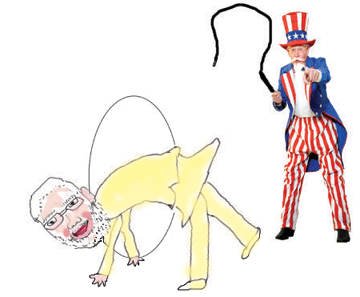 Obama’s visit and the much-hyped nuclear deal, DNA Tuesday, 3 February 2015 Exploiting fully the servile attitude of this Modi government, being offered on a platter, US President Barack Obama, on his recent State visit to India as the guest of our 66thRepublic Day Parade, got what he wanted from India to rejuvenate the beleaguered US economy.
The Left parties opposition to the Indo-US nuclear deal and the subsequent developments which led to the withdrawal of the support from the UPA-I government were based on very serious apprehensions concerning the consequences of this deal. These relate to pressures to transform the Indian independent foreign policy positions towards those of a subordinate US ally; forcing India to further open up its economy to the profit maximisation of US corporations and India being drawn into USA’s strategic and military network as a steadfast accomplice.
The Modi government has reportedly gone ahead to permit the circumvention of US manufactured nuclear reactors’ liability in the case of a nuclear accident. Reports indicate that Section 17(b) of the Act will be interpreted in the Rules to enable the Indian State-owned insurance corporations to offer a cover of Rs750 crores to cover supplier’s liability, while a government back-up will extend this to Rs1,500 crores. India will pay the premium for such an insurance policy to the foreign suppliers. ……http://www.dnaindia.com/analysis/column-obama-s-visit-and-the-much-hyped-nuclear-deal-2057646
If USA nuclear reactors have accidents in India – Indian tax-payers pay: US corporations scot-free!
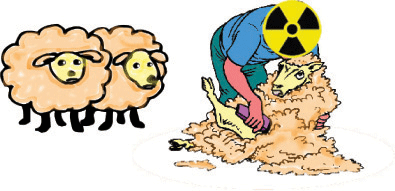 Good News! US Corporations Won’t Have to Pay for Nuclear Disasters in India, FAIR,
But what is the news? Here’s how the paper’s Mandakini Gahlot summarizes the agreement:
Picking up from a stalled 2008 civil nuclear agreement between the two countries, the deal would allow US firms to invest in energy in India. It also resolves a dispute over US insistence on tracking fissile material it supplies to the country and over Indian liability provisions that have discouraged US firms from capitalizing on the agreement.”……
These corporations–who have the political backing of the US government–have succeeded in getting international conventions to agree that “no one other than operators can be held responsible” in the event of a nuclear catastrophe. The suppliers want assurances that these international conventions, and not Indian law, will be applied in the wake of such an event.
The “breakthrough” between Obama and Modi seems to be an agreement that the law will be “tweaked” to let US corporations off the hook in case of a devastating accident. For example, suppliers of nuclear equipment could be redefined as “contractors” and therefore not be liable under Indian law.
Of course, if USA Today explained that Obama had gotten the Indian prime minister to find a loophole that would allow US corporations to avoid having to compensate victims of nuclear disasters that they contributed to, that would be harder to present as a “good news!” story. http://fair.org/blog/2015/01/27/good-news-us-corporations-wont-have-to-pay-for-nuclear-disasters-in-india/
Indian Citizens’ Statement against Capitulation to the US on Nuclear Liability
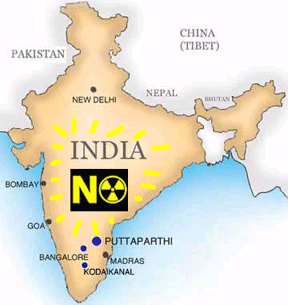 http://kashmirwatch.com/news.php/2015/01/30/indian-citizens-statement-against-capitulation-to-the-us-on-nuclear-liability.html Kumar Sundaram
We are deeply disturbed by media reports that the Indian government has capitulated to aggressive U.S. demands and agreed to a deal that indemnifies American nuclear vendors from the consequences of accidents caused by design defects in their reactors.
Preliminary reports suggest that the government has agreed to create an insurance pool, backed by public sector companies, so that any potential American liability can be redirected back to Indian taxpayers. This creates a “moral hazard”, where the Indian people could end up being responsible for mistakes made by a multinational corporation.
The 2010 Indian liability Act is already a weak law heavily biased towards the nuclear industry. It caps the total liability for an accident at a paltry Rs 1,500 crores and takes away the rights of victims to sue the supplier. The much-discussed supplier liability is very limited: the government alone, as the operator, has a right of recourse against the vendor.
So, we fail to understand the Modi government’s motivation for weakening this law even further. The U.S. has nothing attractive to offer in terms of nuclear commerce. The Indian government has agreed to purchase the AP1000 reactors from Westinghouse, and the Economic Simplified Boiling Water Reactor (ESBWR) from General Electric. Both these designs are untested. The ESBWR technology is so immature that the design received certification from the U.S. nuclear regulatory commission—the first step before a reactor can be constructed—only last September. Recent reports suggest that construction of AP1000 units has run into trouble in China.
Independent estimates suggest that the cost of electricity from these reactors may exceed Rs. 15 per unit. This is much higher than the tariff from competing sources of electricity.
Therefore, the reality behind the grandiose proclamations made by the Indian government is rather sobering. India has agreed to pay billions of dollars for immature American technology, and then ensured that American companies will not be held to account for any design defects.
We hope that progressive forces and concerned citizens throughout the country will unite to oppose this disturbing development.
Signatures: Continue reading
1 This Month




PLEASE OPPOSE HR 8255 AND S.3639 – bills would accelerate satellite deployment, with no environmental review or safeguards – https://ncstd5li.quorum.us/campaign/169331/
To see nuclear-related stories in greater depth and intensity – go to https://nuclearinformation.wordpress.com
-
Archives
- September 2026 (339)
- August 2026 (330)
- July 2026 (355)
- June 2026 (287)
- May 2026 (306)
- April 2026 (356)
- March 2026 (251)
- February 2026 (267)
- January 2026 (308)
- December 2025 (358)
- November 2025 (359)
- October 2025 (375)
-
Categories
- 1
- 1 NUCLEAR ISSUES
- business and costs
- climate change
- culture and arts
- ENERGY
- environment
- health
- history
- indigenous issues
- Legal
- marketing of nuclear
- media
- opposition to nuclear
- PERSONAL STORIES
- politics
- politics international
- Religion and ethics
- safety
- secrets,lies and civil liberties
- spinbuster
- technology
- Uranium
- wastes
- weapons and war
- Women
- 2 WORLD
- ACTION
- AFRICA
- Atrocities
- AUSTRALIA
- Christina's notes
- Christina's themes
- culture and arts
- Events
- Fuk 2022
- Fuk 2023
- Fukushima 2017
- Fukushima 2018
- fukushima 2019
- Fukushima 2020
- Fukushima 2021
- general
- global warming
- Humour (God we need it)
- Nuclear
- RARE EARTHS
- Reference
- resources – print
- Resources -audiovicual
- Weekly Newsletter
- World
- World Nuclear
- YouTube
-
RSS
Entries RSS
Comments RSS

