Obama and Pakistan’s President Nawaz Sharif talking about nuclear weapons

 Nuclear weapons, Taliban in focus as Obama meets Pakistan’s Sharif http://www.reuters.com/article/2015/10/22/us-usa-pakistan-idUSKCN0SG29020151022 WASHINGTON | BY DAVID BRUNNSTROM U.S. President Barack Obama met Pakistani Prime Minister Nawaz Sharif at the White House on Thursday and was expected to stress U.S. concerns over Pakistan’s expanding nuclear arsenal and to press Sharif to help bring the Taliban back to talks.
Washington has been trying to persuade Pakistan to make a declaration of “restraint” over its nuclear program but Pakistani officials said Sharif would tell Obama Islamabad will not accept limits on its use of small tactical nuclear weapons.
Analysts also question whether Sharif has sufficient influence with his own security establishment to get them to press the Taliban to return to talks on Afghanistan.
Afghan President Ashraf Ghani is pushing for a negotiated settlement to the 14-year insurgency, which has escalated since tens of thousands of U.S.-led NATO combat troops withdrew ahead of an end-2014 deadline. The two sides held inaugural talks in Pakistan in July but the process has since stalled.
While the Washington talks were expected to focus on nuclear weapons and Islamist militancy, the Obama administration is preparing to sell Pakistan eight F-16 fighter jets in an attempt to bolster the relationship, a U.S. source familiar with the matter said.
The sale, which Congress could block, would be a symbolic step given Pakistan’s already large fleet of fighters.
U.S. concerns have been growing about Pakistan’s nuclear arsenal, tensions between Islamabad and India, and the continued existence of militant sanctuaries in Pakistan used to target the U.S.-backed Afghan government and U.S. forces.
The insurgency in Afghanistan is hampering Obama’s efforts to withdraw U.S. troops, but Bruce Riedel of the Brookings Institution think tank said it was not clear Sharif had the clout with his own army to get military leaders to pressure the Taliban back into talks.
Pakistan insists smaller tactical nuclear weapons would deter a sudden attack by India, which is also a nuclear power, but Washington worries they may further destabilize an already volatile region because their smaller size makes them more tempting to use in a conventional war.
The Federation of American Scientists said this week that since 2011, Pakistan had deployed two new nuclear-capable short-range ballistic missiles and a new medium-range ballistic missile and was developing two extended-range nuclear-capable ballistic missiles and two nuclear-capable cruise missiles.
It estimated Pakistan’s stockpile had grown to 110 to 130 warheads from 90 to 110 in 2011 and could reach 220 to 250 by 2025, making it the world’s fifth-largest nuclear-weapons state.
Pakistani officials say Washington is demanding unreasonable limits on its nuclear weapons while not offering much in return apart from a hazy promise to consider Pakistan as a recognized recipient of nuclear technology.
(Reporting by David Brunnstrom; Additional reporting by Julia Edwards, Roberta Rampton, Idrees Ali and Andrea Shalal; Editing by James Dalgleish)
50 years later, USA will clean up site of nuclear bomb’s crash in Spain

 Palomares nuclear crash: US agrees Spanish coast clean-up http://www.bbc.com/news/world-europe-34569614 19 October 2015 Almost 50 years after four nuclear bombs fell on the Spanish coast after two US military planes collided, American officials have signed a deal to clean up contaminated land.
None of the bombs detonated in January 1966, but three fell around Palomares and a fourth was found on the sea bed.
Highly toxic plutonium was spread over a 200-hectare (490-acre) area.
On a visit to Madrid, Secretary of State John Kerry agreed to finalise a deal on disposing of contaminated soil.
Under the agreement in principle, signed by Mr Kerry and Spanish Foreign Minister Jose Manuel Garcia-Margallo, the US will remove the soil at Palomares to a site in the US.
Spanish media said the soil would be transported to a site in Nevada. The deal comes a few months before the 50th anniversary of the crash, one of the most serious nuclear incidents of the Cold War.
An earlier consignment of contaminated soil was shipped to a site in South Carolina shortly after the accident and buried in deep trenches.
But further analysis of soil in the area has been carried out in recent years, and the health of residents in the Palomares area is still being monitored.
- On 17 January 1966, a US B-52 bomber carrying four 1.5 megaton bombs collided with a refuelling tanker some 31,000 feet above Palomares on Spain’s Mediterranean coast
- The tanker crew and three people on board the bomber were killed
- One bomb equipped with a parachute landed intact
- Two bombs hit the ground at high speed, scattering plutonium
- A fourth bomb landed five miles off shore and was later recovered by USS Petrel
“I looked up and saw this huge ball of fire, falling through the sky” – Spain waits for US to finish nuclear clean-up
Details emerge on UK’s nuclear deal with China
China to take one-third stake in £24bn Hinkley nuclear power station http://www.theguardian.com/environment/2015/oct/20/china-to-take-one-third-stake-in-24bn-hinkley-nuclear-power-station Details unveiled of deal signed between state-owned companies from China and France to build world’s most expensive plant on UK soil, Guardian, Damian Carrington, 20 Oct 15 China will take a one-third stake in a French-led project to build a new £24bn nuclear power station in the UK at Hinkley Point in Somerset, expected to be the most expensive ever built.
The deal was signed between state-owned companies from China and France just hours before the Chinese president, Xi Jinping , arrived in London for a state visit, and is due to be announced on Wednesday.
It will lead to a final investment decision – the point of no return – by the end of 2015, according to the Financial Times.
The companies – France’s EDF and China General Nuclear Power Corporation – will be the only investors, having failed to attract others. The new completion date for the two reactors at Hinkley Point is 2025, eight years later than first suggested. The deal is strongly backed by the chancellor, George Osborne. The government believes the new plant, which would deliver 7% of the UK’s electricity, represents good value for low-carbon electricity which, barring problems, is always on.
The plant has been promised £92 per megawatt hour (MWh) for 35 years, double today’s average wholesale electricity price, with any shortfall being paid by consumers via household energy bills. Hinkley Point will also be backed by up to £17bn of UK government loan guarantees.
The deal signed this week is also expected to mention Chinese involvement on additional nuclear plants at Sizewell in Suffolk and Bradwell in Essex. China hopes to build 110 nuclear power plants at home and wants to use its own designs at Bradwell as a showcase to help it sell its technology further afield.
But the nuclear push has many criticsover its cost, the time it takes to build and the possible threats to the UK’s national security of having China in control of a plant on UK soil. Osborne’s father-in-law, former energy minister Lord Howell, said the project was “one of the worst deals ever” for British consumers and industry.
Howell, and others, have warned the reactor design planned for Hinkley C has never been completed successfully, pointing to huge cost and time overruns at EDF’s projects at Flamanville in France and Olkiluoto in Finland .
EDF needs the Chinese investment as it is burdened with high levels of debt and is expected to sell €10bn of assets in the next five years, according to the Financial Times. Earlier in October, two of the world’s biggest ratings agencies warned the company it faced credit-rating downgrades if Hinkley Point goes ahead.
A Greenpeace poll this week showed 29% of the UK public supports the Hinkley project, with 34% against it.
A protest camp was set up outside the site this week and Alan Jeffery, a spokesman for the Stop Hinkley campaign said: “We remain mystified about why Osborne wants to throw good money after bad on this project. In the process, he has devastated the UK’s burgeoning renewable energy industry, threatening up to 20,000 jobs in the process. He is doing his best to kill off an innovative industry of the future in order to keep alive a technology of the past.”
However, the Institution of Mechanical Engineers have welcomed the Hinkley plan. “Nuclear is set to play a central and vital role in the UK’s energy future,” said the IME’s Jenifer Baxter. “Although the financial costs of nuclear power seem high, this power station will provide and modernise the diversification we so badly need in ensuring the UK’s lights stay on.”
The meaning of the Iran Nuclear Deal

 Adopting The Iran Nuclear Deal: What Does It Mean?, NPR, OCTOBER 18, 2015 Today marks 90 days since the United Nations Security Council endorsed the landmark nuclear accord agreed between Iran and six world powers (the U.S., Britain, France, Germany China and Russia.)
The Joint Comprehensive Plan of Action (JCPOA)will unfold in a series of steps that include nuclear cutbacks made by Iran and sanctions relief offered by the other countries. The phase that begins now is of special interest to nuclear non-proliferation experts.
Those wanting to keep Iran, or any nation, from newly acquiring nuclear weapons will be very happy to see the steps Tehran has pledged to begin taking now. They will greatly shrink the capacity and scope of the Iranian nuclear program, in ways that sharply limit its ability to produce the kind of nuclear fuel that could be used in a weapon.
Less Enrichment, Tinier Fuel Stockpile, No Plutonium
Under the JCPOA, Iran will now:
Reduce its stockpile of low enriched uranium b y some 98 percent, either shipping it out of the country or diluting it down to its natural state. (Low enriched uranium, usually less than 5 percent purity, is suitable for generating electricity. At about 20 percent, enriched uranium has uses in medical research; Iran has agreed not to enrich uranium to that level for 15 years. Weapons grade uranium is enriched to around 90 percent.)
- Explaining The Past, And Inviting Tougher Inspections This phase of the agreement should also see Iran answering long-held questions by the International Atomic Energy Agency (IAEA) about Iran’s past nuclear activities. Last week, the IAEA announced that Iran had completed responding to IAEA queries on 12 such activities that could have possible military dimensions. The agency is due to report its finding on these issues on December 15th………..
- What About Sanctions Relief?When Iran marks the nuclear deal with events on Monday, it will be focusing on the lifting of international economic sanctions that have depressed its economy, along with falling oil prices. But sanctions relief won’t come until the IAEA certifies that Iran has met all its nuclear obligations. Once that happens, there will be another milestone, known as “implementation day.”…… http://www.npr.org/sections/thetwo-way/2015/10/18/449652662/adopting-the-iran-nuclear-deal-what-does-it-mean
Hinkley deal raises fears about China’s power over Britain’s nuclear project
 Security fears over China nuclear power deal, BBC News, 17 Oct 15 Downing Street is playing down security fears about plans to give China a stake in Britain’s nuclear power industry.
A final decision on the new nuclear plant at Hinkley Point, Somerset, could be announced next week during Chinese president Xi Jinping’s state visit.
Security sources have told The Times the scheme poses a threat to national security – and a senior Tory MP has called for an inquiry.
But No 10 said it would not sign the deal if it thought security was a risk.
Chancellor George Osborne has already announced a £2bn government guarantee to secure Chinese funding for the Hinkley Point C nuclear power station, to be jointly built with French energy giant EDF at an estimated cost of £24.5bn.
The final go-ahead for the deal could be announced next week – paving the way for a second new reactor to built by the Chinese and French consortium at Sizewell, in Suffolk.
If an agreement is reached, work could then start on the first Chinese-designed and built nuclear reactor in Europe, at Bradwell, in Essex, where a previous British-built reactor is in the process of being decommissioned.
How concerned should we be?………….
Construction of the first Hualong One reactor began in May in China’s Fujian province, according to World Nuclear News.
Gaining regulatory approval from the UK authorities for the design would be a major boost to the Chinese National Nuclear Corporation’s hopes of exporting the technology around the world.
‘Trapdoors or backdoors’
But senior UK defence and security sources reportedly are concerned that the state-controlled company, which helped develop China’s nuclear weapons, poses a national security risk.
They fear “trapdoors or backdoors” could be inserted into IT systems, allowing Beijing to bypass British security measures……..
‘Fait accompli’
Bernard Jenkin, Conservative MP for Harwich and North Essex, where the Bradwell plant would be built, has called for the government to produce a “comprehensive assessment of the national security implications” of the Chinese scheme……..http://www.bbc.com/news/uk-politics-34549478
IAEA has completed its investigation of Iran’s nuclear past
IAEA completes investigation into Iran’s nuclear past, Guardian, Julian Borger, 16 Oct 15
The UN watchdog agency will now take two months to write up its report on alleged past work on a warhead, which will be crucial if the comprehensive nuclear deal agreed in July is to take effect The International Atomic Energy Agency (IAEA) has put out a statementconfirming completion of its inquiries into evidence that Iran may have experimented on nuclear weapons design in the past. Now under a road mapagreed with Iran, the agency has until December 15 to analyse and write up its findings.
Completion of the IAEA enquiry is a precondition for the comprehensive nuclear deal – between Iran, the US and five other major powers in Vienna in July – to go ahead, limiting Iran’s nuclear programme in return for sanctions relief. But according to a report today in the Wall Street Journal, the Iranians had been dragging their heels until just before today’s deadline………
President Hassan Rouhani wants to get all this done before Iranian parliamentary elections on February 26, so he can persuade voters that better times are on the way as they go to the polls. It is a tall order, but not impossible – perhaps not as hard as the IAEA’s task over the next two months to craft a report that preserves the hard-won JCPOA deal while not sacrificing its own integrity and legitimacy.http://www.theguardian.com/world/julian-borger-global-security-blog/2015/oct/15/iaea-completes-investigation-into-irans-nuclear-past
USA in Talks on Deal to Limit Pakistan’s Nuclear Arsenal
U.S. Exploring Deal to Limit Pakistan’s Nuclear Arsenal, NYT By DAVID E. SANGER OCT. 15, 2015 WASHINGTON — The Obama administration is exploring a deal with Pakistan that would limit the scope of Pakistan’s nuclear arsenal, the fastest-growing on earth. The discussions are the first in the decade since one of the founders of its nuclear program, Abdul Qadeer Khan, was caught selling the country’s nuclear technology around the world.
The talks are being held in advance of the arrival of Pakistan’s prime minister, Nawaz Sharif, in Washington next week. They focus on American concern that Pakistan might be on the verge of deploying a small tactical nuclear weapon — explicitly modeled on weapons the United States put in Europe during the Cold War to deter a Soviet invasion — that would be far harder to secure than the country’s arsenal of larger weapons.
But outside experts familiar with the discussions, which have echoes of the Obama administration’s first approaches to Iran on its nuclear program three years ago, expressed deep skepticism that Pakistan is ready to put any limitations on a program that is the pride of the nation, and that it regards as its only real defense against India………http://www.nytimes.com/2015/10/16/world/asia/us-exploring-deal-to-limit-pakistans-nuclear-arsenal.html?_r=0
Outline of nuclear deal approved by Iran’s parliament
Iran’s parliament approves outline of bill on nuclear deal http://timesofindia.indiatimes.com/world/middle-east/Irans-parliament-approves-outline-of-bill-on-nuclear-deal/articleshow/49314661.cms AP | Oct 11, 2015, TEHRAN, Iran: Iran’s parliament on Sunday approved an outline of a bill that would allow the government to implement a historic nuclear deal reached with world powers, the official IRNA news agency said.
State TV meanwhile announced that Iran had successfully test-fired a new long-range ballistic missile, the first such test since the nuclear deal was reached in July.
The bill allows the government to withdraw from implementing the agreement if world powers do not lift sanctions, IRNA said. Final approval of the bill is expected later this week after further discussions. The landmark deal would curb Iran’s nuclear program in return for the lifting of international sanctions. Western nations have long suspected Iran of secretly pursuing nuclear arms, allegations denied by Tehran, which says its nuclear program is for purely peaceful purposes.
“The government should stop its voluntary cooperation in implementation of the deal if the other side fails to remain committed to lifting sanctions,” the bill says. It says the response should be the same if new sanctions are imposed or previous ones restored.
IRNA said 139 lawmakers out of 253 present voted for the bill. The chamber has 290 seats.
The session was unusually tense, with hard-liners repeatedly trying to prevent a vote on the deal. Iran’s supreme leader, Ayatollah Ali Khamenei, who makes all final decisions on key policies, has said it is up to parliament to approve or reject the deal.
Lawmaker Ruhollah Hosseinian, an opponent of the deal, said parliament needs to discuss it in detail. Until now, it has only been reviewed by a special parliamentary committee.
“Every (international) agreement must be approved and passed by the parliament. Otherwise, it won’t be legal,” Hosseinian said.
Hard-liners hope to stall approval of the deal in order to weaken President Hassan Rouhani’s moderate administration ahead of February’s parliamentary elections.
Iran’s defense minister general Hossein Dehghan meanwhile hailed the new surface-to-surface missile, saying it “will obviously boost the strategic deterrence capability of our armed forces.” He said the missile, named Emad or pillar in Farsi, was a technological achievement for Iran. He said it can be guided until the moment of impact and hit targets “with high precision.”
State TV showed footage of the huge missile being launched in a desert area, but did not elaborate on its range or the specifics of the test.
The UN resolution endorsing the nuclear deal called on Iran not to undertake any activity related to ballistic missiles capable of delivering nuclear weapons. Iran says none of its missiles are designed for that purpose.
Since 1992, Iran has boasted an indigenous military industry, producing missiles, tanks and light submarines. The government frequently announces military advances which cannot be independently verified.
The Islamic Republic already claims to have surface-to-surface missiles with a range of 2,000 kilometers (1,250 miles) that can hit Israel and US military bases in the region.
Long range missile tested by Iran
Iran Tests Long-Range Missile, Possibly Violating Nuclear Accord http://www.nytimes.com/2015/10/12/world/middleeast/iran-tests-long-range-missile-possibly-violating-nuclear-accord.html?_r=0 By THOMAS ERDBRINK OCT. 11, 2015 TEHRAN — Iran tested a new guided long-range ballistic missile on Sunday, hours before Parliament, in a rowdy session, approved the generalities of the nuclear agreement reached in July between Iran and world powers, the state news agency IRNA reported.
The missile launch may have violated the terms of the agreement, reached in Vienna with six world powers. According to some readings of the deal, it placed restrictions on Iran’s ambitious missile program.
Experts have been debating the interpretation of a United Nations Security Council resolution, adopted a few days after the accord was agreed upon, that bars Iran from developing missiles “designed to carry nuclear warheads.”
Hard-line Iranian officials had for months been demanding new missile tests, a common practice before the negotiations over the country’s nuclear program began in 2013.
The missile — named Emad, or pillar — is a step up from Iran’s Shahab-3 missiles because it can be guided toward its target, the Iranian defense minister, Hossein Dehghan, told the semiofficial Fars news agency. In recent decades, with Iran’s air force plagued by economic sanctions and other restrictions, the country has invested heavily in its nuclear program and has produced missiles that can reach as far as Europe.
“We don’t seek permission from anyone to strengthen our defense and missile capabilities,” Mr. Dehghan said.
Also on Sunday, members of Parliament voted in favor of a bill approving the generalities of the nuclear agreement, but they had been denied information on its details. State television broadcast the session using only audio and archived images of Parliament.
The head of the Atomic Energy Organization of Iran, Ali Akbar Salehi, who had gone to Parliament to defend the deal, said in a speech that a member had threatened to kill him and bury his body “in the cement of the Arak heavy-water reactor.”
Under the nuclear agreement, a heavy-water plant in Arak will be redesigned and turned into a relatively less dangerous light-water reactor. The threat, which sounded like something from an American gangster film, was made in front of witnesses by a hard-line representative, Ruhollah Hosseinian, according to reports.
Middle East getting more havoc, more nuclear weapons, with foreign interventions
Foreign Interventions in the Middle East: More Havoc, Nuclear Weapons, Less Order, San Diego FreePress OCTOBER 9, 2015 BY AT LARGE By Frank Thomas Middle Eastern states are breaking down in an endless escalation of civil wars where Syria, Libya, Yemen, Iraq are collapsing. The resulting power vacuums exploited by rebel factions and demonic jihadist Islamic state are threatening the Middle East. The ancient, ongoing Sunni-Shiite mutual hatreds are afire.
U.S. foreign regime change interventions – by military engagement, funding, training insurgency groups, supporting coups d’etats, protecting regional dictatorships – have boosted instability and mayhem in Syria, Iraq, Libya, Yemen, Egypt, etc. Emerging unscathed in these interventions, the U.S. departs leaving the wreckage behind to go on to the next trouble-spot. Continue reading
The madness of Europe hosting USA’s nuclear weapons
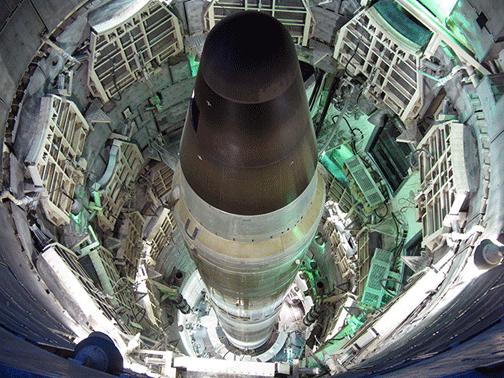 Time for nuclear sharing to end https://www.opendemocracy.net/can-europe-make-it/xanthe-hall/time-for-nuclear-sharing-to-end#.Vhg51kDhUXc.twitter openDemocracy XANTHE HALL 8 October 2015 You have to keep threatening to use nuclear weapons to make nuclear deterrence work. A view from Germany on the planned deployment of new US nuclear weapons. It was already announced some years ago, but last week Germany woke up to the fact that new US nuclear weapons are actually going to be deployed at its base in Büchel. Frontal 21, a programme on the second main TV channel reported last Tuesday that preparation for this deployment was due to begin at the German air force base. The runway is being improved, perimeter fences strengthened, new maintenance trucks arriving and the Tornado delivery aircraft will get new software.
It is a little known fact: Germany (and four other European countries) host nuclear weapons as part of NATO “nuclear sharing”. This means that in a nuclear attack the US can load its bombs onto German (or Belgian, Italian, Turkish and Dutch) aircraft and the pilots of those countries will drop them on an enemy target. This arrangement pre-dates the Non-Proliferation Treaty (NPT), which explicitly disallows any transfer of nuclear weapons from a nuclear weapon state to a non-nuclear weapon state, thus undermining the spirit of the treaty.
This new nuclear bomb – the B61-12 – is intended to replace all its older versions and be able to destroy more targets than previous models. It is touted by the nuclear laboratories as an “all-in-one” bomb, a “smart” bomb, that does not simply get tossed out of an aircraft, but can be guided and hit its target with great precision using exactly the right amount of explosive strength to only destroy what needs to be destroyed. Sound good?
Not to us – a guided nuclear bomb with mini-nuke capability could well lower the threshold for use. And the use of any kind of nuclear weapon would lead to the use of more nuclear weapons – this we know from the policies and planning of all nuclear weapon states. It has already been well established by three evidence-based conferences in recent years on the humanitarian impact of nuclear weapons that any use of nuclear weapons would have catastrophic humanitarian consequences.
This new “magic bomb” is not yet with us. It is still being developed and is planned to be deployed in five years time, if there are no more delays. The development of the B61-12 – euphemistically called a “Life Extension Programme” although it is a full redesign not just an update – has fortunately taken longer than intended, giving us more time to convince European leaders what a bad idea it is to deploy new nuclear weapons in Europe.
The debate is already under way in the “host” countries, most prominently in the Netherlands where the parliament has already voted not to task the new F35 aircraft with a nuclear role. However, the Dutch government is not listening. The German Bundestag voted in 2010 to get rid of the B61, and the government was nominally in favour, but after the change of government in 2013, Foreign Minister Steinmeier put the decision on ice, quoting the new security situation.
Yet the current confrontation between NATO and Russia needs deescalation, not rearmament. Sending a signal to Russia that NATO is modernising its European infrastructure and deploying new high-tech bombs is bound to elicit a reaction. Even as we write, reports are coming in that Russia will respond by withdrawing from the INF-Treaty, basing SS-26/Iskander missiles in Kaliningrad (didn’t they already do that?) and targeting Germany with nuclear weapons.
And what will be the NATO response to all of those threats? When will this escalation become hysteria and the first ‘shot across the bows’ start a nuclear war? Nuclear deterrence is the archetypal security dilemma. You have to keep threatening to use nuclear weapons to make it work. And the more you threaten, the more likely it is that they will be used.
This is the moment where nuclear weapon-free countries need to call out for a ban on nuclear weapons to stop this madness. It is also the right time for nuclear co-dependents, like Germany, to make up its mind to give its nuclear dependency up.
Deploying new nuclear weapons is forbidden by the NPT, which obligates its members to end the arms race. The transfer of nuclear weapons from the US to Germany and any plans to do so also undermine the NPT. As a responsible member state of this important treaty, it is time to denounce nuclear weapons and to join the international community of nuclear weapon-free countries that is signing the ‘Humanitarian Pledge’, calling for the legal gap to prohibit and eliminate nuclear weapons to be closed. Time for Germany to show some real leadership for nuclear disarmament.
If you enjoyed this article then please consider liking Can Europe Make it? onFacebook and following us on Twitter @oD_Europe
Turkey warns Russia it may not get its nuclear technology from Russia
Turkey’s Erdogan warns Russia on nuclear project, natural gas: papers http://news.yahoo.com/turkeys-erdogan-warns-russia-nuclear-project-natural-gas-090830083.html ISTANBUL (Reuters), 8 Oct 15 – Turkish President Tayyip Erdogan told Russia there were other places Turkey could get natural gas and other countries that could build its first nuclear plant, in the wake of Russian incursions into Turkish air space during its air campaign in Syria.
Russian aircraft twice entered Turkish air space at the weekend. Turkish F-16 jets have also been harassed by Syrian-based missile systems and unidentified planes since then.
“We can’t accept the current situation. Russia’s explanations on the air space violations are not convincing,” the Turkish daily Sabah and others quoted Erdogan as telling reporters as he flew to Japan for an official visit. He said he was resentful over what had happened but did not currently plan to speak to Russian President Vladimir Putin.
“These are matters for Russia to think about. If the Russians don’t build the Akkuyu (nuclear plant in southern Turkey) another will come and build it,” he said.
Turkey in 2013 commissioned Russia’s state-owned Rosatom to build four 1,200-megawatt reactors, but a start date for what is Turkey’s first nuclear power plant project has not yet been set.
“We are Russia’s number one natural gas consumer. Losing Turkey would be a serious loss for Russia. If necessary, Turkey can get its natural gas from many different places,” he said.
Around 28-30 billion cubic meters (bcm) of Turkey’s 50 bcm annual natural gas needs are met by Russia.
(Additional reporting by Orhan Coskun; Writing by Daren Butler; Editing by Hugh Lawson)
Serious questions about China’s involvement in Britain’s new nuclear power projects
 Serious issues for George Osborne on China’s role in the UK’s nuclear future The Conversation, Jeffrey Henderson Professor of International Development, University of Bristol October 5, 2015 George Osborne will address the Conservative party conference on Monday fresh from a sales trip to Beijing. His efforts to drive more trade between the two nations saw Chinese state-owned companies invited to participate in the development of nuclear generating plants in Britain. They will have the chance to work with French state-owned company, EDF at Hinkley Point, Somerset and will be the sole operators at Bradwell, Essex. The move has already attracted doubts but there are other vital issues that have yet to be aired. These can be crystallised into five clear questions that Osborne and his government must answer.
Safety concerns
Two Chinese companies are involved with Hinkley Point: China National Nuclear Corporation (CNNC) and China General Nuclear Power Corporation (CGN). The latter was responsible, under its previous guise (China Guangdong Nuclear Power) for building and running China’s first nuclear station, Daya Bay, near Hong Kong. It was initially improperly built – with reinforcement rods missing from the concrete base under the reactor – and there have since been reports of minor leakages of radioactive materials (though this is difficult to check, given China’s lack of transparency).
The deeply corrupt environment in which many Chinese companies operate compounds the possibility of these companies being lax on safety measures and it’s simply not good enough to say that Britain has one of the tightest nuclear safety regimes in the world. Confronted with the power of the Chinese government and the British government’s enthusiasm for unceasing flows of Chinese investment, the risk must be that the regulatory agency will be sidestepped or unable to cope………
Who builds what and with which workers?
The public needs to know whether Chinese construction companies will be involved in building Hinkley Point and other power stations and, if so, whether they will seek to use workers from China. ……..
One of the companies involved at Hinkley Point – China National Nuclear – produces China’s nuclear weapons. This means that as well as the Communist Party, CNNC is almost certainly controlled by the People’s Liberation Army (as all Chinese military-related companies are). Given geopolitical uncertainty (with rising tensions between China, Japan and the US over China’s territorial claims in the East and South China Seas), allowing such a company anywhere near Britain – not to mention in an industry as strategic as power generation – verges on the insane. Has MI5 been consulted on this, and if it has, what was its advice?
At its heart, the question of Chinese state (and thus Communist Party) involvement in Britain’s power generation, is a matter of national security. In its desire to help financial services (the only economic sector it privileges) penetrate the Chinese market, the government’s nuclear quid pro quo means it is set to embark on a potentially very dangerous path. Had this deal been negotiated by Jeremy Corbyn as prime minister, the media would have been wondering if he were in the pay of the Chinese government. But George Osborne? Surely not.
Osborne may address some of these concerns in Monday’s speech, but it seems unlikely. In any case, before any binding commitments are made, it’s vital that the government’s proposal be opened up to public debate and subject to parliamentary scrutiny. https://theconversation.com/serious-issues-for-george-osborne-on-chinas-role-in-the-uks-nuclear-future-48541
France hoping to get Japan to help save failed nuclear company AREVA
 Nuclear energy on agenda during French PM’s trip to Japan French Prime Minister Manuel Valls rounded off a three-day visit to Japan with bilateral talks on the nuclear sector.
It follows an announcement in September by Japan’s Mitsubishi Heavy Industries stating it was considering taking a stake in Areva NP, the reactor-making subsidiary of French nuclear company Areva. In July, French energy giant EDF agreed to buy between 51 and 75 percent of the subsidiary. At the time it announced it would be looking for partners to take a minority stake.
Valls formally asked his counterpart Shinzo Abe for Japan’s help in reorganising France’s nuclear sector……http://www.euronews.com/2015/10/06/nuclear-energy-on-agenda-during-french-pm-s-trip-to-japan/
USA nuclear weapons department helping China develop thorium reactors, despite their military uses
 The U.S. government lab behind China’s nuclear power push HONG KONG |REUTERS Dec 20, 2013 Scientists in Shanghai are attempting a breakthrough in nuclear energy: reactors powered by thorium, an alternative to uranium.
The project is run by the Chinese Academy of Sciences, a government body with close military ties that coordinates the country’s science-and-technology strategy. The academy has designated thorium as a priority for China’s top laboratories. The program has a budget of $350 million. And it’s being spearheaded by the influential son of a former Chinese president.
But even as China bulks up its military muscle through means ranging from espionage to heavy spending, it is pursuing this aspect of its technology game plan with the blessing – and the help – of the United States. China has enlisted a storied partner for its thorium push: Oak Ridge National Laboratory. The U.S. government institute produced the plutonium used for the Manhattan Project and laid important groundwork for the commercial and military use of nuclear power.
The Tennessee lab, as it happens, helped pioneer thorium reactors. The Pentagon and the energy industry later sidelined this technology in favor of uranium……..
Thorium’s chief allure is that it is a potentially far safer fuel for civilian power plants than is uranium. But the element also has possible military applications as an energy source in naval vessels. A U.S. congressman unsuccessfully sought to push the Pentagon to embrace the technology in 2009, and British naval officers are recommending a design for a thorium-fueled ship.
In a further twist, despite the mounting strategic rivalry with China, there has been little or no protest in the United States over Oak Ridge’s nuclear-energy cooperation with China……..
Although it does not yield byproducts that can be readily used to make weapons, thorium does have military applications.
The fuel could be used to power Chinese navy surface warships, including a planned fleet of aircraft carriers. China’s nuclear submarine fleet has struggled with reactor reliability and safety, according to naval commentators, and thorium could eventually become an alternative.
Top British naval engineers last year proposed a design for a thorium reactor to power warships. Compact thorium power plants could also be used to supply reliable power to military bases and expeditionary forces.
Thorium also has military potential for the United States, experts say……..
1 This Month




PLEASE OPPOSE HR 8255 AND S.3639 – bills would accelerate satellite deployment, with no environmental review or safeguards – https://ncstd5li.quorum.us/campaign/169331/
To see nuclear-related stories in greater depth and intensity – go to https://nuclearinformation.wordpress.com
-
Archives
- September 2026 (330)
- August 2026 (330)
- July 2026 (355)
- June 2026 (287)
- May 2026 (306)
- April 2026 (356)
- March 2026 (251)
- February 2026 (267)
- January 2026 (308)
- December 2025 (358)
- November 2025 (359)
- October 2025 (375)
-
Categories
- 1
- 1 NUCLEAR ISSUES
- business and costs
- climate change
- culture and arts
- ENERGY
- environment
- health
- history
- indigenous issues
- Legal
- marketing of nuclear
- media
- opposition to nuclear
- PERSONAL STORIES
- politics
- politics international
- Religion and ethics
- safety
- secrets,lies and civil liberties
- spinbuster
- technology
- Uranium
- wastes
- weapons and war
- Women
- 2 WORLD
- ACTION
- AFRICA
- Atrocities
- AUSTRALIA
- Christina's notes
- Christina's themes
- culture and arts
- Events
- Fuk 2022
- Fuk 2023
- Fukushima 2017
- Fukushima 2018
- fukushima 2019
- Fukushima 2020
- Fukushima 2021
- general
- global warming
- Humour (God we need it)
- Nuclear
- RARE EARTHS
- Reference
- resources – print
- Resources -audiovicual
- Weekly Newsletter
- World
- World Nuclear
- YouTube
-
RSS
Entries RSS
Comments RSS

