Troubled nuclear corporation AREVA wooing Japanese company Mitsubishi
 French PM Valls discusses nuclear, China, culture on Japan visit, 2 Oct 15 Reuters/Toru Hanai/Files
By RFI French Prime Minister Manuel Valls met Japanese PM Shinzo Abe on Saturday during a three-day visit to the country that is Asia’s biggest investor in France. The Mitsubishi conglomerate could buy into troubled French nuclear power company, Areva, he said as his trip started……..
Nuclear power – French nuclear giant Areva is in trouble and its reactor branch is currently being bought by the EDF power company. Valls indicated that he was not opposed to Mitsubishi Heavy Industries investing in the branch in an interview with Asahi Shimbun newspaper and sources travelling with him said it could invest in Areva’s other activities, uranium mining for example. While 47 Japanese nuclear reactors remain closed following the Fukushima disaster, one reopened in August and another should be soon. Japan’s nuclear industry has always been an important client for Areva and EDF……http://www.english.rfi.fr/asia-pacific/20151003-french-pm-valls-discusses-nuclear-china-culture-japan-visit
Iran nuclear deal an example of sensible diplomacy

 People’s Forum: Iran agreement would prevent nuclear weapons http://www.elkharttruth.com/discussions/local-dialogue/peoples-forum/2015/10/02/People-s-Forum-Carl-Helrich-Iran-agreement-would-prevent-nuclear-weapons.html
Carl Helrich of Goshen breaks down the Iran nuclear agreement. Our agreement with Iran is to prevent Iran from pursuing a nuclear weapon. With John Kerry and one of our greatest nuclear physicists Ernest Moniz at the table we were not confused by the physics.
To see why this is a good agreement requires some knowledge of nuclear weapons. The lowest level weapon is a uranium bomb (Hiroshima). This requires 90 percent enriched uranium. The next level is a plutonium bomb (Nagasaki). This is considerably more complex in production and triggering. The problems are known; details are classified. The physics limits sizes of these, which we attained in WWII. Modern American, Russian, British, French, Chinese and probably Israeli arsenals contain fusion weapons, for which size is (in principle) unlimited.
Iran is enriching uranium. The agreement stops enrichment at a level sufficient for power plants, but far short of the 90 percent necessary for a weapon. The time required to “break out” and produce 90 percent will decrease as centrifuge technology improves. The agreement, however, provides the IAEA access to Iran’s sites. And successful breakout still puts Iran at the lowest level in the hierarchy of nuclear weapons. Any attempt to move higher will be evident and we will respond.
The agreement will stop Iran from obtaining a nuclear weapon for 15 years and, because it opens inspection of Iran’s nuclear sites, it also opens communication.
The world will be a better place if no nuclear weapon is ever again detonated in anger. But force can never guarantee that. And we can never erase the knowledge we have of nuclear weapons. Our only hope is in diplomacy and peaceful cooperation among nations.
Europe targets Niger – for its uranium
EUROPE TARGETS WORLD’S MAJOR URANIUM PRODUCER NIGER. In Depth News,
“……….According to Wikipedia, Niger has been a uranium exporter since the 1960s and has had substantial export earnings and rapid economic growth during the 1960s and 1970s. The persistent uranium price slump brought lower revenues for Niger’s uranium sector, although it still provides 72% of national export proceeds.
When the uranium-led boom ended in the early 1980s the economy stagnated, and new investment since then has been limited. Niger’s two uranium mines – SOMAIR’s open pit mine and COMINAK’s underground mine – are owned by a French-led consortium and operated by French company Areva.
As of 2007, many licences have been sold to other companies from countries such as India, China, Canada and Australia in order to exploit new deposits. In 2013, the government of Niger sought to increase its uranium revenue by subjecting the two mining companies to a 2006 Mining Law.
The government argued that the application of the new law will balance an otherwise unfavourable partnership between the government and Areva. The company resisted the application of the new law that it feared would jeopardize the financial health of the companies, citing declining market uranium prices and unfavourable market conditions.
In 2014, following nearly a year long negotiation with the government of Niger, Areva agreed to the application of 2006 Mining Law of Niger, which would increase the government’s uranium revenues from 5 to 12 percent. [IDN-InDepthNews – 27 September 2015]…….http://www.indepthnews.info/index.php/global-issues/2437-europe-targets-worlds-major-uranium-producer-niger
Energy sector cooperation with North Korea in support of a regional Nuclear Weapons Free Zone
 Energy sector cooperation with the DPRK in support of a regional Nuclear Weapons Free Zone NAPSNet Special Report David von Hippel and Peter Hayes,, NAPSNet Special Reports, September 21, 2015, http://nautilus.org/napsnet/napsnet-special-reports/energy-sector-cooperation-with-the-dprk-in-support-of-a-regional-nuclear-weapons-free-zone/
INTRODUCTION
In this paper, we describe the DPRK energy economy, including a description of recent trends in DPRK energy supply and demand. We then summarize the DPRK’s energy security situation and energy sector needs, along with a brief description of potential regional/international cooperation options for providing energy sector development assistance to DPRK. These options include conventional energy, energy efficiency, and renewable energy. They are followed with more general approaches to engagement and an example “package” of cooperation measures. These non-nuclear options are benchmarked to a quantitative estimate of the net present value of the two light water reactors that were to be provided in the US-DPRK Agreed Framework but never completed, as a reasonable benchmark, followed by a review of the DPRK nuclear energy sector and related potential cooperation options and issues related to the DPRK domestic pilot light water reactor and enrichment programs. We conclude by highlighting key insights and opportunities for increasing the DPRK’s energy security in the context of regional energy development in which all states have a stake……….http://nautilus.org/napsnet/napsnet-special-reports/energy-sector-cooperation-with-the-dprk-in-support-of-a-regional-nuclear-weapons-free-zone/
Russia is watching North Korea’s nuclear program closely
Russia Rejects North Korea To Be Recognized As Nuclear State, Value Walk, By: Polina Tikhonova September 27, 2015 Russia does not recognize North Korea as a nuclear state while openly opposing Pyongyang’s nuclear program, according to top Russia’s envoy in South Korea Alexander Timonin. Speaking at a forum marking the 25th anniversary of the establishment of diplomatic relations between South Korea and Russia, Alexander Timonin said the Kremlin will never justify North Korea’s nuclear missiles nor its nuclear program.
Timonin noted that if North Korea wants to claim the right as a sovereign state to use nuclear energy for peaceful purposes, then North Korean leader Kim Jong-un first needs to uphold his father’s pledges made on September 19, 2005 under the Joint Statement to abandon the nuclear program as well as comply with UN resolutions banning Pyongyang from launching long-range missiles.
Timonin also noted that the Kremlin has repeatedly notified North Korean leadership of its stance over Pyongyang’s nuclear program during many diplomatic events.
North Korea is not the only Korea Russia is concerned about. Timonin also expressed Moscow’s concern over possible delivery of an advanced U.S. missile defense system in South Korea.
He warned that Russia and China will have to respond for the sake of their own security in case a Terminal High-Altitude Area Defense (THAAD) battery is delivered to South Korea.
Pyongyang and Moscow have significantly strengthened bilateral ties in the past year, with Russian foreign ministry calling 2015 the ‘Year of Friendship’ with North Korea. However, Kim Jong-un declined to attend Moscow’s Victory Day Parade in May, and has not had a meeting with Russian President Vladimir Putin yet.
Russia is watching North Korea’s nuclear program closely
It doesn’t seem like a ‘Year of Friendship’ at all, considering the latest non-supportive concerns expressed by Russian foreign ministry toward North Korea’s plans to resume nuclear operations and launch missiles announced on Tuesday.
In a statement on Thursday, Russian foreign ministry spokeswoman Maria Zakharova said the Kremlin has been “paying attention” and monitoring the situation ever since North Korea announced plans to launch a missile and resume activities at its Yongbyon nuclear site.
“Russia expresses its concern regarding North Korea’s continued pursuit of rocket launches and nuclear weapons production, activities that have been prohibited by U.N. Security Council resolutions,” Zakharova said, as reported by Yonhap……..http://www.valuewalk.com/2015/09/russia-rejects-north-korea-as-nuclear-state/
Iran nuclear deal praised by Israel’s former military chief
 Former Israeli military chief praises Iran nuclear deal WASHINGTON (JTA) , 27 Sept 15 – Israel’s most recent military chief of staff called the Iran nuclear deal an “achievement.”
“I do agree a better deal could have been reached,” one that more extensively restricted uranium enrichment, Benny Gantz said Friday of the sanctions relief for nuclear restrictions deal reached in July between Iran and six major powers.
“But I see the half-full part of the glass,” he said. “I see the achievement of keeping the Iranians, 10-15 years into the future, postponing their having a nuclear capability at the right price.”……..Gantz is the latest – and perhaps most significant – retired Israeli security official who has suggested the Israeli Prime Minister Benjamin Netanyahu has overstated the dangers of the deal…..
The ex-chief of staff hinted that relations with the United States, frazzled this year by open hostility between the Obama and Netanyahu administrations, needed repair. The U.S. commitment to maintaining Israeli’s qualitative military edge in the region is “unheard of, it needs to be appreciated.”… . http://www.jta.org/2015/09/27/news-opinion/united-states/former-israeli-military-chief-praises-iran-nuclear-dea
China and UK joining in promoting new nuclear technology

 China, UK to fund nuclear research centre http://www.world-nuclear-news.org/NN-China-UK-to-fund-nuclear-research-centre-25091502.html 25 September 2015
China and the UK will work together to co-fund a £50 million ($78 million) nuclear research centre, to be headquartered in the UK. Chinese vice premier Ma Kai and British chancellor George Osborne announced the plan on 21 September during the 7th UK-China Economic and Financial Dialogue summit in Beijing.
The Chancellor also announced a regional collaboration agreement between Cumbria and Sichuan Province, deepening commercial ties between the province and the north west of England’s expertise in nuclear decommissioning and waste management. These developments followed a landmark announcement by Osborne the same day that the UK government would provide up to £2 billion ($3 billion) in support for the planned Hinkley Point C nuclear power plant, which China may participate in.
The UK’s National Nuclear Laboratory (NNL) said on 22 September that it will jointly lead the new UK-China Joint Research and Innovation Centre (JRIC) with the China National Nuclear Corporation (CNNC).
The JRIC – which will incorporate projects in a number of different areas of work across the whole nuclear fuel cycle – will “act as a portal to allow UK companies and academic organizations and their Chinese counterparts to work together on areas of mutual benefit and will support the development of Subject Matter Experts and others with higher level skill in both countries,” NNL said.
Over the coming months NNL and CNNC will work together to establish a program of work for the JRIC and to develop links with other UK bodies including the Nuclear Advanced Manufacturing Research Centre (NAMRC), the National Skills Academy for Nuclear (NSAN), the Nuclear Innovation and Research Advisory Board (NIRAB) and key UK universities working in the nuclear sector.
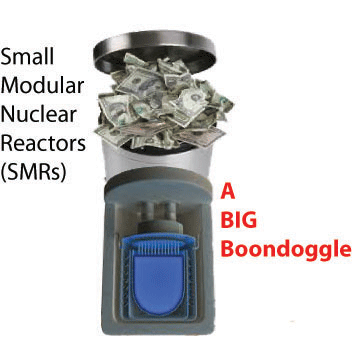 Professor Andrew Sherry, chief scientist at NNL, wrote in a blog on the Department of Energy and Climate Change’s website that there is a strong case for exploring the potential of next generation nuclear technologies. “There is scope for developing new reactor concepts including small and modular reactors, which can provide both electricity and potentially heat, and also for considering even more advanced reactors which can be powered with reprocessed spent fuel to make more efficient use of the uranium fuel, and generate less nuclear waste,” he said. “These advances will need targeted research across the UK, drawing together universities, national laboratories and industry and linking effectively with the international community.“
Iran hastens to meet the terms of the nuclear deal
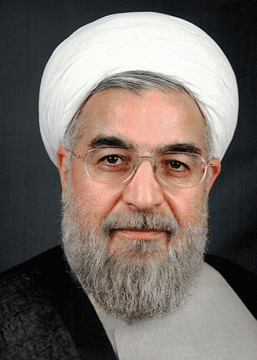 Iran rushes to meet terms of nuclear deal to lift sanctions President Hassan Rouhani keen to end sanctions, as European firms pursue lucrative contracts such as huge railway and airport expansion projects, Guardian, Saeed Kamali Dehghan , 16 Sept 15 Iran is stepping up efforts to implement a landmark nuclear deal by January so as to benefit from sanctions relief, with European companies lining up for what one investor described as the most attractive opportunity in frontier markets globally.
President Hassan Rouhani, who is visiting New York to speak at the UN general assembly next week, said at a meeting with journalists and media executives on Friday that “conditions were ripe” for his administration to start implementing the agreement, struck in Vienna in July, by the end of the year.
His comments were echoed by business leaders and world investors participating in the first international conference studying investment and trade opportunities in Iran since the nuclear accord. The second Europe-Iran forum took place over the course of two days in Geneva, ending on Friday.
European corporations have already begun pursuing lucrative contracts in Iran. ……..http://www.theguardian.com/world/2015/sep/25/iran-nuclear-deal-hassan-rouhani
Britain uncomfortably close to Chinese control of nuclear power system
 The China syndrome, Economist, 25 Sept 15 Britain’s nuclear plans look over-expensive and over-reliant on China “…….. Already the £24.5 billion project to build a nuclear power station called Hinkley Point C in Somerset is expected to finish over-budget and beyond the projected start date of 2023, if it ever starts at all. But on September 21st, after unveiling in Beijing a £2 billion inducement to China to help finance Britain’s first reactor in 20 years, George Osborne exposed himself to further criticism. The country should lead the way on nuclear power as it did in the 1950s, he said. But the implication was, it could only do it with China’s help (see Bagehot).
Critics say this reveals a whiff of desperation about the government’s bet on a nuclear renaissance, ………
Analysts say Mr Osborne is engaged in a complex manoeuvre to ensure that two Chinese firms help finance EDF. The £2 billion guarantee is one inducement. Another is an offer for China to build a reactor of its own at Bradwell in Essex. That has set off further alarm bells, though. Not only would it test confidence in Britain’s Office for Nuclear Regulation, it would also put a critical part of the nuclear industry and the national grid into Chinese hands.
Roland Vetter of CF Partners, an energy trader, doubts a go-ahead for the China project will come soon; licensing new nuclear technology in Britain takes years. It could be a strategic gambit, though. EDF’s boss in Britain, Vincent de Rivaz, notes that British and French companies are keen to help China, which has an ambitious programme of its own to build nuclear power plants. Mr Osborne may also calculate that Hinkley Point will create numerous jobs and building opportunities, the economic benefits of which would accrue quickly.
The costs, meanwhile, would not become apparent until the plant is completed and bills rise. Future governments would reap the fallout, not this one. http://www.economist.com/news/britain/21667932-britains-nuclear-plans-look-over-expensive-and-over-reliant-china-china-syndrome
North Korea’s nuclear belligerence highlights need for diplomacy and global disarmament treaty
The right lessons to take from North Korea’s nuclear belligerence are that nuclear weapons threaten the security of all nations, even those that possess them, and that nuclear double standards are a recipe for proliferation, not disarmament. Continuing to point nuclear weapons at North Korea while asking them not to point them back obviously won’t work.
For biological and chemical weapons, anti-personnel landmines and cluster munitions, a clear treaty prohibition paved the way for their progressive elimination. Establishing a clear moral, political and legal norm against these indiscriminate and inhumane weapons has drastically reduced their use and influenced even countries not signed up to the relevant treaty. Yet the nuclear-armed states show no intent of fulfilling their legally binding obligation to disarm.
Indeed, all are investing massively in modernising their nuclear arsenals. That is why states without the weapons need to take the lead and start negotiations that are open to all states but blockable by none, for a global treaty to prohibit nuclear weapons and provide for their verifiable elimination from the arsenals of all nations
 If we can’t stop an impoverished nation like North Korea making nuclear weapons, our
tactics are clearly wrong The Conversation, Tilman Ruff Associate Professor, International Education and Learning Unit, Nossal Institute for Global Health, School of Population and Global Health, University of Melbourne, 24 Sept 15 The timing of North Korea’s announcement last week that it has resumed “normal operation” of its Yongbyon nuclear reactor – along with a reaffirmation of its belligerent rhetoric against the United States – might be interpreted simply as a response to Chinese President Xi Jinping’s current US state visit.
But that is not to say that it shouldn’t be taken seriously. Continue reading
Britain tries to wrap up Hinkley nuclear deal with China, with $3.1 billion bribe
 In Courting Chinese Companies, Britain to Help Fund Planned Nuclear Plant NYT, By STANLEY REED SEPT. 20, 2015 LONDON — The British government said on Monday that it would provide 2 billion pounds, or about $3.1 billion, in state aid for a nuclear power station planned for Hinkley Point in southwest England.
The announcement of financial support — which was made by George Osborne, the chancellor of the Exchequer, on a visit to China — appeared to be a confidence-building measure aimed at wrapping up a deal, years in gestation, to build Britain’s first nuclear plant since the mid-1990s.
“They are edging toward trying to sign a deal, but it is taking a long time,” said Antony Froggatt, a nuclear analyst at Chatham House, a London research organization.
The British government said that it expected EDF, the French state-controlled utility leading the project, to make a final decision later this year to go ahead with the plant. If EDF moves forward, it will be supported by two Chinese companies, China General Nuclear Corporation and China National Nuclear Corporation, the government said. Mr. Osborne has been courting Chinese companies to help finance the new Hinkley Point station, which will cost at least £16 billion…….
In trying to build nuclear plants, Britain is bucking the trend in the West. ……
The British government is not only offering financing to help with the construction but has guaranteed EDF a much higher price for the electricity it generates than current market rates. The government also says that it may increase financial support for the plant as the project progresses. Last year, the European Union approved Britain’s use of state aid to finance the plant……Still, Britain’s effort to build nuclear plants has proceeded at what seems a glacial pace. The Hinkley Point project is already several years behind its original schedule.
Centrica, a British utility, walked away from an option to take a 20 percent stake in Hinkley Point and another nuclear plant, citing frustration over delay and costs. http://www.nytimes.com/2015/09/21/business/energy-environment/britain-says-it-will-aid-planned-nuclear-plant.html?_r=1
Russia rattled by USA adding to its nuclear weapons stockpile in Germanay
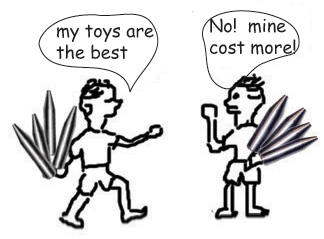 US Nuclear Weapons In Germany: Russia Concerned By American Plans To Add To Stockpile http://www.ibtimes.com/us-nuclear-weapons-germany-russia-concerned-american-plans-add-stockpile-2108265 By Christopher Harress @Charress c.harress@ibtimes.com on September 22 2015 Russia is concerned about U.S. plans to modernize and station additional nuclear weapons in Germany, according to Russian Foreign Ministry spokeswoman Maria Zakharova, who spoke with a German TV channel Tuesday. The channel had reported earlier in the day that the U.S. planned to station 20 nuclear weapons in the European country, as per a line in the 2015 U.S. defense budget.
“We are concerned that these states actually have nuclear weapons as part of the framework of NATO’s nuclear sharing program,” said Zakharova in an interview with Germany’s ZDF television, according to Russian news site Sputnik. Zakharova also said that the move would contravene the Treaty of Nonproliferation of Nuclear Weapons, which was ratified by 191 nations in 1970 to stop the spread of nuclear weapons.
“At the same time in Europe — not just in Germany, but also in Belgium, the Netherlands, Italy and Turkey — U.S. tactical nuclear armaments remain deployed,” said Zakharova, who also claimed that Russia had reduced its own stockpiles fourfold since the 1990s, despite the U.S. keeping its arsenal at strength. “The Americans are modernizing their aerial bombs, and the NATO European members are modernizing their aircraft that carry these weapons,” he said.
The U.S. continues to maintain nuclear carrying facilities in the countries mentioned by Zakharova through a NATO sharing program. As part of nuclear sharing, host countries carry out consultations, make decisions on weapons policy and maintain equipment required for the use of nuclear weapons, including warplanes capable of delivering them. The United Kingdom and France are the only countries in Europe that maintain state-owned nuclear arsenals.
As part of the renewed hostilities between the U.S.-led NATO and Russia, who are clashing over Moscow’s military actions in Ukraine, Russia has threatened to place short- to medium-range nuclear capable missiles in Kaliningrad, an enclave on the Baltic coast controlled by Russia, according to a BBC report. The missiles would have the ability to reach nearly all areas of Europe.
North Korea warned by USA – ‘severe consequences’ if it flouts nuclear ban,

 US threatens North Korea with ‘severe consequences’ if it flouts nuclear ban Guardian, 18 Sept 15
The US secretary of state, John Kerry, says his country’s position is clear: ‘We will not accept North Korea as a nuclear weapons state’ North Korea would face “severe consequences” if it continued with its announced decision to restart a nuclear reactor, the US secretary of state, John Kerry, has said.
Pyongyang has said it is restarting the long-mothballed Yongbyon reactor, which is capable of producing weapons-grade plutonium, and has threatened to launch a rocket, a move seen internationally as a test of ballistic missile technology.
Asked whether Washington could respond credibly to North Korea after striking a deal to allow Iran’s nuclear program to continue, Kerry insisted it could.
“There will be severe consequences as we go forward if North Korea does not refrain from its irresponsible provocations that aggravate regional concerns, make the region less safe, and if it refuses to live up to its international obligations,” he said.
“Our position is clear: we will not accept a DPRK – North Korea – as a nuclear weapons state, just as we said that about Iran.”
Asked what the US could do if North Korea continued to flout bans on its nuclear and missile programs, Kerry said Kim Jong-un’s regime was already experiencing growing diplomatic isolation………
North Korea mothballed the Yongbyon reactor in 2007 under a six-nation aid-for-disarmament accord but began renovating it after its latest nuclear test in 2013.
When fully operational the reactor is capable of producing about 6kg (13lb) of plutonium a year – enough for one nuclear bomb, experts say. http://www.theguardian.com/world/2015/sep/17/us-threatens-north-korea-with-severe-consequences-if-it-flouts-nuclear-ban
AT IAEA’s General Conference Arab States lose bid to monitor Israel’s nuclear sites
Experts guessing about meaning of North Korea’s renewed nuclear threat
North Korea’s renewed nuclear threat keeps experts guessing, Guardian, Julian Borger, 15 Sept 15
Pyongyang’s nuclear weapons complex relaunch seen as sabre rattling – or the prerequisite for another nuclear test. North Korea’s announcement that it had revamped and relaunched its nuclear weapons complex a day after threatening new launches is meant to signal a renewed determination to build long-range nuclear missiles.
The statement on state media on Tuesday warned that US hostility would be met with “nuclear weapons at any time”. However, while many anticipate that the regime will try to launch a satellite with long-range missile technology on 10 October to mark the 70th anniversary of the founding of the Workers party, few are less certain on how significant the announcement really is.
One western expert described it as being of little practical importance since it could be seen as no more than a morale-boosting exercise for the regime, while another said it could presage a fourth nuclear test by the Pyongyang regime. The North Korean nuclear complex at Yongbyon contains a 5 megawatt reactor, capable of producing plutonium as a byproduct, and a newly extended plant for enriching uranium. Both have the capacity for producing weapons-grade fissile material for a bomb, and the announcement, attributed to the director of the nation’s atomic energy institute, said that both had been “rearranged, changed or readjusted and they started normal operation”.
David Albright, president of the Washington-based Institute for Science and International Security, said that trying to estimate what is really going on in Yongbyon from satellite imagery can be a guessing game.
“There is heat coming from the enrichment plant, but that’s not direct evidence that it is functioning. They could just have the heat on,” he said.
He added: “We will have to wait to see if there are signs of normal operation. We could see water being discharged and steam coming off the turbine.”
Albright said that although there were signs that the North Koreans had not been able to get the reactor to work at full capacity, it was still capable of producing three to four kilograms of plutonium a year, once the spent fuel had been reprocessed – enough for a single warhead. He added that it is likely the regime had mastered the science of making warheads small enough to put on missiles…….. http://www.theguardian.com/world/2015/sep/15/north-koreas-renewed-nuclear-threat-keeps-experts-guessing
1 This Month




PLEASE OPPOSE HR 8255 AND S.3639 – bills would accelerate satellite deployment, with no environmental review or safeguards – https://ncstd5li.quorum.us/campaign/169331/
To see nuclear-related stories in greater depth and intensity – go to https://nuclearinformation.wordpress.com
-
Archives
- September 2026 (330)
- August 2026 (330)
- July 2026 (355)
- June 2026 (287)
- May 2026 (306)
- April 2026 (356)
- March 2026 (251)
- February 2026 (267)
- January 2026 (308)
- December 2025 (358)
- November 2025 (359)
- October 2025 (375)
-
Categories
- 1
- 1 NUCLEAR ISSUES
- business and costs
- climate change
- culture and arts
- ENERGY
- environment
- health
- history
- indigenous issues
- Legal
- marketing of nuclear
- media
- opposition to nuclear
- PERSONAL STORIES
- politics
- politics international
- Religion and ethics
- safety
- secrets,lies and civil liberties
- spinbuster
- technology
- Uranium
- wastes
- weapons and war
- Women
- 2 WORLD
- ACTION
- AFRICA
- Atrocities
- AUSTRALIA
- Christina's notes
- Christina's themes
- culture and arts
- Events
- Fuk 2022
- Fuk 2023
- Fukushima 2017
- Fukushima 2018
- fukushima 2019
- Fukushima 2020
- Fukushima 2021
- general
- global warming
- Humour (God we need it)
- Nuclear
- RARE EARTHS
- Reference
- resources – print
- Resources -audiovicual
- Weekly Newsletter
- World
- World Nuclear
- YouTube
-
RSS
Entries RSS
Comments RSS

