Another month in UK’s failing new nuclear programme nuClear News No.94 April 2017 The Trump administration is working to find a new owner for Westinghouse, but doesn’t want the Company to fall under Chinese control. The administration is “keenly aware” of the national security implications attached to the sale of the company, and is trying to pre-empt any possible blocking of a deal by making clear at an early stage that the US government would take a tough stance on any significant Chinese role. A US-led deal for even the profitable operations of Westinghouse could be tricky to arrange though. The only US company with substantial nuclear engineering operations is General Electric, through its joint venture with Hitachi, but its technology is different from Westinghouse’s. Westinghouse has close links to China, where it has four of its AP1000 reactors under construction. As part of the deal for those projects, Westinghouse agreed to transfer intellectual property relating to the plants. More than 75,000 No2NuclearPower nuClear news No.94, April 2017 4 documents were handed over to its Chinese customers in 2010 in the first stage of implementing that agreement. (11) http://www.no2nuclearpower.org.uk/nuclearnews/NuClearNewsNo94.pdf
April 8, 2017
Posted by Christina Macpherson |
business and costs, politics international, USA |
Leave a comment
With Westinghouse Bankruptcy, the Nuclear Energy Story Nearly Over The much touted nuclear renaissance is now over. News Click Prabir Purkayastha 07 Apr 2017 With Westinghouse announcing its bankruptcy, India’s pledge to buy at least 10,000 MW as a part of the India US Nuclear Deal and reiterated by Modi last year, should be given a decent burial. Any agreement with Westinghouse now means that India would be bailing out Westinghouse and the US nuclear industry with Indian peoples’ money.
This also draws to a close all talk about a nuclear renaissance. The three major reactor manufacturers – Toshiba-Westinghouse, GE-Hitachi and Areva, France – are all in major financial difficulties. Only a fool will still believe their promise that the 3rd generation reactors they are developing – none of which have been successfully commissioned as yet – are either safe or cheap.
The Left’s position during the India US 123 Deal was that it neither served India’s strategic interest, nor made sense in energy terms. It also meant abandoning India’s self-reliant nuclear reactor industry for importing costly and unproven US reactors. Though it failed to stop the 123 Agreement in Parliament, the Left successfully led the struggle to modify India’s Nuclear Liability Act, ensuring that nuclear suppliers, like in any other hazardous industry, should be liable for their faulty equipment.
The Fukushima disaster has shown that a nuclear accident can cost up to $200 billion . Even this could be a conservative estimate. The Indian liability law caps operator and suppliers’ liability to just $ 407 million (300 million SDR’s). Though cost of a reactor is in billions of dollars, even this small liability, only a fraction of its cost, was perceived to be too “dangerous” and unacceptable to the US suppliers.
Last year, Modi, announced during one of his US visits that not only would India buy US reactors, a continuation of the assurance given by Shivshankar Menon, the Foreign Secretary under Manmohan Singh (Letter September 10th, 2008 ), but would also assume the liabilities of the US suppliers in case of of a nuclear accident. India offered Mithi Virdi in Gujarat to Westinghouse and Kovvada in Andhra to GE as the two sites. Subsequently on GE’s failure to show any successful contract combined with local resistance in Mithi Virdi, GE’s project was considered cancelled, and its Andhra site offered to Westinghouse.
Fortunately for India, Modi’s assurances have come too late for the US nuclear industry. The much touted nuclear renaissance is now over. In OECD countries, only 7 new reactors are being built with varying degrees of state support. With huge cost and time overruns, the curse of the nuclear industry, all of them are in deep trouble. GE, unsuccessful in selling even one of its so-called advanced design, has virtually pulled out of the nuclear business. After huge and continuing losses, Areva, the French reactor supplier, is being taken over by EdF, the French state-owned energy utility. EdF has already scrapped the new Areva EPR design, with which the Finnish Olkiluoto and French Flamanville plants were being built. This is also the design Areva is trying to sell for the Jaitapur project in Maharashtra.
The major objections of the Left regarding imported reactors have been proven correct. The untried and untested designs have meant numerous changes and difficulties in construction, leading to significant delays and sharp increase in costs. The cost of the two Areva plants of Euro 3 billion each originally, have increased by almost three times .
The Westinghouse story is no different………
In the exchanges between the UPA and the Left during Manmohan Singh’s government, the cost of new nuclear plants from French or US suppliers had come up. The UPA had presented figures for capital cost per KW of $1,500 and the price of power to be Rs. 1.49 paise per unit from imported nuclear plants. The Left had given figures from Olkiluoto and the US, showing that the capital cost would be at least $4,000 per KW and the price of electricity from such plants around Rs. 5 per unit.
The figures from the US and French projects now show that the capital cost per KW for such plants is in the range of $6,000-7,000, and therefore the price per unit of electricity from such plants will not be less than Rs. 8-10 per unit.
Why did the UPA claim such absurdly low figures for nuclear energy? They were either figments of their imagination or took these figures straight from the promotional material of the nuclear suppliers. To claim nuclear energy to be competitive, the nuclear suppliers took a 60-year life of the plant, left out the interest on capital during construction as a component of the cost, and claimed their new designs had much lower capital costs. They then did what are called levellised cost calculations – the cost of electricity over the lifetime of the plant. By this sleight of hand, they reached figures for the cost of nuclear power to be competitive with coal and gas.
Of course, the actual capital costs are much higher than what the nuclear industry was claiming. The regulators and utilities that price the electricity, have also to look at all the cost components including cost of capital, interest on loans, etc., and fix the price that of electricity. What matters to consumers and utilities (distribution companies or state electricity boards) is not the levellised cost of electricity, but the entry cost of nuclear power to the grid. This is what needs to be competitive to other sources. Any such calculations shows that nuclear energy is simply not competitive.
The collapse of Westinghouse, which has either built or licensed its designs to almost half the world’s reactors, shows that the nuclear story is nearly over. The reality is that with the cost of renewables – solar photovoltaics and wind – dropping sharply, the economics are increasingly against nuclear energy. This is apart from danger of catastrophic accidents or danger from long-term storage of radioactive nuclear wastes. It may still sustain itself for some time in countries, where there is a strong indigenous nuclear industry, such as India, China, Korea and Russia. But its days are now clearly numbered. http://www.newsclick.in/westinghouse-bankruptcy-nuclear-energy-story-nearly-over
April 8, 2017
Posted by Christina Macpherson |
business and costs, India, politics, politics international, USA |
Leave a comment

 Learning to live with a nuclear North Korea?, https://theconversation.com/learning-to-live-with-a-nuclear-north-korea-75620 The Conversation, Nick Bisley Executive Director of La Trobe Asia and Professor of International Relations, La Trobe University April 3, 2017
 North Korea has been on a long march to acquire a usable nuclear weapon. Since 2011, when Kim Jong-un replaced his father at the head of the Democratic People’s Republic of Korea, the pace of that march has quickened markedly.
Contrary to claims made by Nikki Halley, the new US ambassador to the UN, North Korea’s leader is not crazy – he has decidedly rational motives. Kim wants nuclear weapons to provide security from a world that he believes threatens North Korea’s existence.
So far, North Korea has conducted five nuclear tests – in 2006, 2009, 2013 and two in 2016. The decision to acquire nuclear weapons was initially prompted by the perception that without such a deterrent, North Korea risked Iraq’s fate: invasion and regime change.
Although North Korea has one of the largest militaries in the world – its army alone has more than 1 million soldiers – it is an antiquated fighting force whose principal advantage is its proximity to South Korea. Its ability to win a fight against a technologically sophisticated opponent is widely questioned. Nuclear weapons offset that weakness markedly.
An independent nuclear capacity would also reduce the country’s dependence on China. Beijing has long believed that North Korea is a useful buffer between it and an American-allied South Korea. Pyongyang realises, however, that were Beijing to change its attitude then it would find itself dangerously exposed.
North Korea perceives it is isolated in a world that is hostile to its existence. However loathsome the regime may be and however badly it misallocates resources to bolster the ruling elite, the reason for acquiring nuclear weapons is entirely rational: they are a vital means for North Korea to protect itself.
Kim has made the acquisition of nuclear weapons a core priority. It is central to government propaganda, figures prominently in nationalist iconography, and indeed the country’s nuclear standing is now enshrined in the constitution.
Most analysts believe North Korea has not yet mastered all three parts of the “nuclear trinity” required to make a usable weapon. This entails first developing a controlled nuclear explosion. The second is miniaturising and hardening that technology so it can work reliably while attached to a means of delivery. The final step is an accurate and reliable delivery system, such as a ballistic missile.
North Korea definitely has the first step and is getting close to both the second and third steps. Barring either a change in heart from the regime about its nuclear ambition or some kind of effective international intervention, North Korea is very likely to have a functioning nuclear weapon within a few years – if not sooner.
The acceleration of the nuclear program – three tests since 2013 compared with two tests between 2006 and 2012 – reflects most obviously the higher priority Kim has placed on it.
Development of missile technology – the third step in the nuclear trinity – has also increased in tempo, with more than 20 tests since January 2016. The recent acceleration is an attempt not just to “sprint” to the finish but also to take advantage of the sense of uncertainty in the region.
North Korea’s more adventurous tendencies are most effectively kept in check when the US and China are able to align their interests and policies. That has most assuredly not been the case over the past year or so.
During his “reassurance tour”, US Secretary of State Rex Tillerson declared that the old policies toward North Korea had failed – and “everything was on the table”. Many interpreted this as a new appetite for strategic risk from the incoming administration.
As with other aspects of America’s Asia policy, Tillerson was light on detail about what new approach Washington might pursue. One assumes it was a major point of debate in Seoul and Beijing. But speculation abounds that pre-emptive attacks may be being considered more seriously than in the past.
The problem with managing North Korea’s nuclear ambition is that there are so few options, and none of them are appealing. As an isolated economy that cares little for international public opinion there are precious few carrots and sticks.
Sanctions have had some effect, but they largely punish the population and not the regime. And they are regularly flouted by China on an opportunistic basis.
Due to the compressed geography of the peninsula, military action would come at a heavy price – North Korea would retaliate by unleashing massive force on South Korea. Seoul is within 60 kilometres of the border with North Korea; pre-emption would be extraordinarily risky.
North Korea will be the most pressing issue at this week’s Donald Trump-Xi Jinping summit. What can be done? There are three main options.
The first is to somehow convince North Korea to step back from its nuclear ambitions, possibly using the stalled Six-Party Talks framework. Given how important it has become to the leadership, both as a security goal and as a sense of national purpose and identity, this seems highly unlikely.
Many once assumed North Korea had started down the nuclear path as an elaborate means to receive international aid. That is, it didn’t actually want them as such, but sought them as a means to extort international financial support. This no longer appears to be the case, if it ever was.
The second option is to coerce North Korea into giving them up. This is equally fraught. Not only is the risk of major war significant, but even short of war, more targeted and better-enforced sanctions seem unlikely to halt the run to the finish line.
The third and least-worst of the options is a tried and tested policy but one that is politically unsavoury. That is, to engage with the regime, bilaterally or in the Six-Party mode. The aim here would be to retard but probably not prevent its nuclear weapon development while devising ways of learning to live with a nuclear North Korea.
Well-managed deterrence can produce a more stable strategic environment in northeast Asia than has existed in recent years. Engagement could also lead to reduced tension, greater stability and possibly even economic reform in North Korea.
Of one thing we can be sure: North Korea acts rationally, and the one outcome above all it wants to avoid is its own demise.
April 7, 2017
Posted by Christina Macpherson |
North Korea, politics international |
Leave a comment
Is North Korea putting a nuclear-tipped bargaining chip on the table? Reuters, By James Pearson and Ju-min Park | SEOUL, 6 Apr 17,
As the leaders of China and the United States sit down for a summit on Thursday, North Korea has made sure it also has something on the negotiating table: A nuclear-tipped bargaining chip.
North Korea launched a projectile on Wednesday, which U.S. officials said appeared to be a liquid-fueled, extended-range Scud missile that only traveled a fraction of its range before spinning out of control and crashing into the sea.
The launch was North Korea’s latest in a long series of missile and nuclear tests that have accelerated in their variation and intensity over the last two years.
And now, experts agree, North Korea is closing in on the ability to hit the United States with a missile, a goal that for decades has been the subject of Pyongyang’s vivid propaganda posters.
“They’ve been able to put a nuke on a missile for a while now,” said Jeffrey Lewis of the California-based Middlebury Institute of International Studies.
“The stated purpose of the last test was to validate the nuclear weapon design that would arm all of North Korea’s missiles,” Lewis said of North Korea’s September 2016 nuclear test – its fifth and largest to date.
Since then, North Korea has further ramped up its tests and rhetoric, emphasizing a consistent message: To create a nuclear device small enough to mount on an intercontinental ballistic missile (ICBM), and fire it at the United States.
“If we push the button, the bombs will be fired and reduce the U.S. to ashes,” an editorial in the ruling Workers’ Party newspaper the Rodong Sinmun said on Wednesday.
North Korea now has the strength to “wipe out” the United States “in a moment” with an H-bomb, the editorial said.
“This is again our warning”.
BARGAINING CHIP From last year, North Korea took the rare step of publicizing images of its missile equipment tests, convincing analysts that Pyongyang’s banned program was further along toward successfully testing an intercontinental ballistic missile (ICBM) than first thought.
“The first few tests might fail, but that’s not good news because they’ll learn,” said Lewis. “How long it takes to make it work is anyone’s guess. Maybe a couple of years, maybe the first time”………
It was not clear if Wednesday’s launch was deliberately timed to coincide with Thursday’s summit between China’s President Xi Jinping and U.S. President Donald Trump in Florida, where North Korea is expected to be a prime topic of discussions.
Some experts think North Korea has tried to make sure the two world leaders are aware Pyongyang has a bargaining chip in any forthcoming moves to clam down on its weapons programs…….http://www.reuters.com/article/us-northkorea-missiles-bargaining-idUSKBN17811R
April 7, 2017
Posted by Christina Macpherson |
North Korea, politics international |
Leave a comment
 Treasury shoots down nuclear deal allegations http://www.news24.com/SouthAfrica/News/treasury-shoots-down-nuclear-deal-allegations-20170402 Jenna Etheridge, News24 Cape Town – National Treasury on Sunday set the record straight on news that was circulating on social media of a nuclear deal allegedly signed by incoming Finance Minister Malusi Gigaba.
ANC member Sibusisiwe Mngadi had alleged on Facebook earlier on Sunday that “the nuclear deal deadline was last night” and that Gigaba had signed it.
She also alleged that President Jacob Zuma’s nephew Khulubuse Zuma would benefit from nuclear plants being built.
“Khulubuse Zuma is the SA holding company for the Nuclear plants. The next 20yrs Khulubuse Zuma will be making more than 50billion. Congratulations, mission accomplished,” she alleged on the post.
Mngadi listed her occupations as a researcher and part-time lecturer at University of KZN in Pietermaritzburg, and an area manager at Msunduzi Municipality.
Some of her followers asked her for proof to support her claims. She replied that people should do their own digging, alluding only to a “parliament document that was signed yesterday”.
Former ANC MP Vytjie Mentor also entered the fray on her personal Facebook profile page, seeming to support the allegations.
“Gigaba signed the Nuclear Deal Last night. It will be R6 trillion with over-runs. All South Africans are now Officially slaves of the Russians, and thus will be the case for the next 100 years,” Mentor alleged.
National Treasury issued a series of tweets on the matter on Sunday night. “The Minister arrived (on) Friday and has not yet gone beyond boardrooms where he met management and later had a telecon with rating agencies,” the treasury account stated.
“He is formally occupying his office tomorrow and will have a briefing meeting with the outgoing Minister Pravin Gordhan in the morning. There are no documents of deals ready for signature on nuclear. Therefore the reports are misleading and mischievous.”
Gigaba’s spokesperson Mayihlome Tshwete also took to Twitter to say he had signed “not a single thing”, not even to sign off for the printing of his business cards. He said Gigaba had not even received any documents from the Director-General.“Sadly, we must now release a statement to deny fake news, then the story will be about the denial,” he lamented.
In government’s updated Integrated Resource Plan (IRP) 2016, which is still under discussion, it intends to add 20 385MW units of nuclear power to the national grid, Fin24 reported.
This will make up approximately one-third of South Africa’s total generation mix.
On December 20, 2016, Eskom, which has taken over from the Department of Energy as owner and operator of the proposed nuclear build programme, issued a Request for Information (RFI) for the procurement of nuclear energy. Comment is currently open for the Request for Proposal (RFP) until April 28.
The RFP is expected to be issued to the market place by the middle of the year and in 2018 Eskom and the Nuclear Energy Corporation SA (Necsa) will choose their preferred bidders and negotiate and finalise contracts.
April 3, 2017
Posted by Christina Macpherson |
politics, politics international, South Africa |
Leave a comment

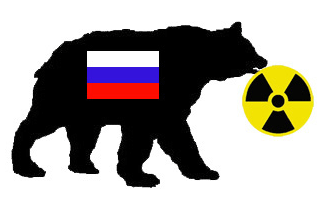
 Gordhan said to have spooked Russian connection on nuclear deal http://www.iol.co.za/news/politics/gordhan-said-to-have-spooked-russian-connection-on-nuclear-deal-8459357
2 April 2017 Staff Reporter Johannesburg – Former finance minister Pravin Gordhan said the masses should be worried when top ANC officials admitted that they didn’t know where a decision was made.
Professor Njabulo Ndebele said the country was in a “deep political and moral crisis” characterised by power and greed.
Zuma’s spokesperson Dr Bongani Ngqulunga said the president was not involved “in the planning of the memorial service and in the cancellation thereof. Any impression created that the president cancelled or ordered the cancellation is erroneous and unfortunate.”
Meanwhile, while Gordhan was doing the presentations in London there was a gentleman called Chenkov who kept on asking many questions about South Africa. He wanted to know if the South African government was looking at developing nuclear energy. Gordhan quickly quashed the idea of nuclear and repeatedly confirmed that the South African government would never develop this energy.
Chenkov had no further questions. After the presentation Chenkov called someone and spoke in Russian but whoever he was speaking to was not impressed and angrily dropped the phone.
It is believed that this person immediately called President Jacob Zuma and threatened him that if he did not immediately trigger the process of changing the finance minister and sign the nuclear deal, as commission had already been paid, he would be taught a lesson.
A shaken Zuma immediately called the minister back home. “You obviously know what happened!”
April 3, 2017
Posted by Christina Macpherson |
politics, politics international, Russia, secrets,lies and civil liberties, South Africa |
Leave a comment
 Survivors Speak Out As UN Negotiates Nuke Ban, Huffington Post, By Ariel Conn,31 Mar 17
“[My nephew was] transformed into a charred, blackened and swollen child who kept asking in a faint voice for water until he died in agony.”
To imagine innocence is to picture children playing. As such, most people and governments are horrified by the idea of children and other helpless civilians suffering and dying, even during war. Finding a way to prevent the unnecessary slaughter of innocents has brought over 115 countries to the United Nations in New York this week to begin negotiations of a historic treaty that would, once and for all, ban nuclear weapons.
The countries are united by concerns that tens or even hundreds of thousands of innocent men, women and children – mothers, sons, fathers, daughters, aunts, uncles, cousins, friends and neighbors – could be killed, quite literally, in a flash.
In a statement to the opening of negotiations, Peter Maurer, president of the International Committee of the Red Cross, or ICRC, said, “The prohibition and elimination of nuclear weapons is a humanitarian imperative.”
Responding to a Humanitarian Imperative
A ban on nuclear weapons is certainly historic, but it’s not without precedence. Prohibiting and eliminating other weapons because of their horrific humanitarian consequences has happened before. In fact, most of the world’s deadliest weapons are currently banned.
At a press conference, Beatrice Fihn, executive director of the International Campaign to Abolish Nuclear Weapons, ICAN, said, “The treaty will finally ban weapons designed to indiscriminately kill civilians, completing the prohibitions on weapons of mass destruction.”
For example, when adults around the world learned of the tens of thousands of children killed by landmines while simply pursuing childhood activities, such as playing in open fields, a global cry arose to bring an end to the indiscriminate weapons. In 1997, 133 countries signed the Mine Ban Treaty, and as of today 162 have signed. According to the International Campaign to Ban Landmines, “only 35 states remain outside the treaty, but most of them do not actually use or produce antipersonnel mines.”
A similar rallying cry heralded the Convention on Cluster Munitions. Cluster munitions often landed without exploding and remained unstable. Their toy-like appearance attracted thousands of children, who were killed and maimed by the weapons. The treaty was adopted in 2008 and is described by clusterconvention.org as an “international treaty of more than 100 States that addresses the humanitarian consequences and unacceptable harm caused to civilians by cluster munitions.”
Today, most countries abide by these treaties, and even countries like the United States, which has not signed either treaty, is either mostly in compliance or is showing signs of improvement………
Relegating Nukes to History A common concern about these negotiations is the notable absence of the nuclear states. However, history, as seen with the landmine and cluster munitions treaties, gives those supporting the negotiations reason to hope.
In his statement for the ICRC, Maurer added, “Of course, adopting a treaty to prohibit nuclear weapons will not make them immediately disappear. But it will reinforce the stigma against their use, support commitments to nuclear risk reduction, and be a disincentive for proliferation. … As with chemical and biological weapons, a clear and unambiguous prohibition is the cornerstone of their elimination.”
Susi Snyder, the nuclear disarmament program manager for PAX in the Netherlands, explained, “This is the start of a negotiation. The impact of the negotiation cannot be guessed or measured until the treaty is done. Even then, as with all treaties and growing norms, the impact will grow over time.”
Fihn added that a treaty would “make it clear that the world has moved beyond these morally unacceptable weapons of the past.” http://www.huffingtonpost.com/entry/survivors-speak-out-as-un-negotiates-nuke-ban_us_58dd5552e4b0fa4c0959872b?
April 3, 2017
Posted by Christina Macpherson |
2 WORLD, politics international, weapons and war |
Leave a comment
If Congress sends Trump this legislation, our new president will be granted the tools and the greenlight from Congress to unravel the Iran deal and put us back on the path to a war with Iran. Unless Democratic senators stand up against this bill soon, opponents of the Iran nuclear deal may wipe away Obama’s diplomatic legacy with Iran faster than even they thought was possible.
Why Give Trump The Keys To War With Iran? https://www.niacouncil.org/give-trump-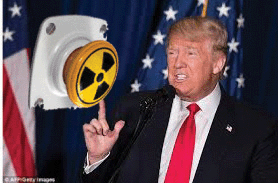
keys-war-iran/ When Trump won the elections, many worried that it could lead to war between the United States and Iran, due to his desire to kill the Iran nuclear deal. Now, thanks to the U.S. Senate, we may be one step closer to this nightmare scenario: The Senate is poised to pass legislation that will place President Trump’s trigger-happy finger on the ignition switch of a deadly conflict with Iran.
Introduced to coincide with the annual American Israel Public Affairs Council (AIPAC) conference that concludes today, the Countering Iran’s Destabilizing Activities Act of 2017 (S. 722) would give Trump new tools to violate the Iran nuclear deal. Perhaps most shockingly, a small group of Senate Democrats have joined Republicans to grant Trump some of the most dangerous authorities that would put the U.S. and Iran back on the path to war. The list of sponsors includes many of the usual suspects ― the consummate Iran hawks who worked to block Obama’s diplomacy with Iran and many of whom have sworn to “rip up” the nuclear deal: Robert Menendez (D-NJ), Bob Corker (R-TN), Marco Rubio (R-FL), Tom Cotton (R-AR), and Ted Cruz (R-TX). But the list of sponsors also includes Ben Cardin (D-MD) ― who opposed the nuclear deal but has said the U.S. should still abide by it ― as well as Bob Casey (D-PA), Richard Blumenthal (D-CT), Michael Bennet (D-CO), Chris Coons (D-DE), and Joe Donnelly (D-IN) who supported the deal.
Yet now these senators are signed onto legislation that requires non-nuclear certifications that would block the president from removing sanctions that are set to expire in later stages of the nuclear agreement. Why would Democratic senators who support the nuclear deal sign on to a measure that would violate the agreement? Because, they have argued, the bill gives the president a case-by-case waiver for the deal-killing provisions. That means that these senators are trusting Donald Trump with new deal-killing authorities and abdicating to him whether the U.S. honors the nuclear deal or “rips it to shreds.”
The bill also enables Trump to re-impose sanctions on Iranian entities that were de-listed pursuant to the accord. And it mandates sanctions that would broadly target any person or entity that ― knowingly or unknowingly ― contributes to Iran’s ballistic missile program, including universities that conduct research and banks that process payments for the government. This would amount to a trickle-down reimplementation of sanctions on much of Iran ― and a violation of the nuclear accord. Finally, the bill would designate the Islamic Revolutionary Guard Corps (IRGC), an elite branch of the Iranian military, as a terrorist group ― a major escalation. The IRGC is a highly problematic organization that has benefitted from years of a sanctions economy at the expense of Iran’s people. It is not unusual for individuals within the IRGC to be sanctioned if they are believed to have connections to Iran’s ballistic missile program. However, designating a foreign military branch as a terrorist organization is an extremely dangerous provocation that Pentagon leaders in multiple administrations have advised against. AIPAC has urged for the IRGC designation for the past decade, yet Barack Obama and even George W. Bush resisted. But now, with Donald Trump in the White House, AIPAC is pressing ahead with its proposal.
If this legislation is passed the U.S. can expect a negative response from Tehran that will undermine moderates in Iran’s upcoming May elections and empower anti-U.S. hardliners. The ranking member of Iran’s Parliament, Alaeddin Boroujerdi, has already signaled that Iranian lawmakers will consider designating the U.S. Army as a terrorist organization in retaliation. It is naïve to assume this exchange will be limited to words. U.S. special forces and IRGC units are currently fighting ISIS on the same front in Mosul. Despite some evidence that IRGC units targeted U.S. troops with IEDs during the height of the Iraq War, there have been no such incidents since U.S. soldiers reentered Iraq in the summer of 2014. In effect, the IRGC and the U.S.-backed coalition have agreed to stay out of each other’s way as they fight a mutual enemy in ISIS. This bill could change that reality by removing any incentive for Iran not to attack U.S. troops in Iraq, forbidding any cooperation with IRGC-backed militias against ISIS, and placing our Iraqi allies in a diplomatic catch-22. It is for this very reason that back in 2007, President Bush’s Pentagon opposed an SDGT designation for the IRGC.
With thousands of AIPAC supporters on Capitol Hill to lobby senators on behalf of the bill, there is a strong chance that this bill could obtain filibuster-proof levels of support. If every Republican supports the bill, and just one more Democrat signs on, AIPAC’s bill will hit 60 votes. If that happens, and Congress sends Trump this legislation, our new president will be granted the tools and the greenlight from Congress to unravel the Iran deal and put us back on the path to a war with Iran. Unless Democratic senators stand up against this bill soon, opponents of the Iran nuclear deal may wipe away Obama’s diplomatic legacy with Iran faster than even they thought was possible. This piece originally appeared in The Huffington Post.
April 1, 2017
Posted by Christina Macpherson |
Iran, politics, politics international, USA |
Leave a comment
Trump has antagonized the leaders of allied countries like Mexico, Australia and Germany, and he has repeatedly demonstrated an extraordinary lack of knowledge about foreign affairs.
This is the president who faces what Warren Christopher, President Clinton’s first secretary of state, called problems from hell. A partial list, compiled by Project Syndicate, includes: intensifying conflicts and dissent within the European Union; the rise of illiberal forces, including welfare chauvinism and exclusionary nationalism; the danger to the continued independence of the buffer states surrounding Russia; a frayed consensus in support of western liberal democratic principles; aggression from a nuclear-armed North Korea and counter threats from the Trump administration of a pre-emptive strike; a foreign policy that The Economist reports has left America’s allies “aghast” — a policy that “seems determined to destroy many of the institutions and alliances created in the past half century.”
 When the President Is Ignorant of His Own Ignorance, NYT Thomas B. Edsall MARCH 30, 2017 How prepared is our president for the next great foreign, economic or terrorist crisis?
April 1, 2017
Posted by Christina Macpherson |
politics international, USA |
1 Comment
Canada’s absence betrays its history on nuclear talks, RAMESH THAKUR AND CESAR JARAMILLO, The Globe and Mail, Mar. 27, 2017 Ramesh Thakur is a professor at the Australian National University and co-convenor of the Asia-Pacific Leadership Network for Nuclear Non-Proliferation and Disarmament. Cesar Jaramillo is executive director of Project Ploughshares in Waterloo, Ont.
Negotiations begin Monday at the United Nations in New York on a “legally binding instrument to prohibit nuclear weapons, leading toward their total elimination.” These talks flow from resolutions adopted late last year by the General Assembly in landslide votes. These negotiations could be the most significant multilateral development on nuclear-arms control since the indefinite extension of the Non-Proliferation Treaty (NPT) in 1995 and the adoption of the Comprehensive Nuclear Test-Ban Treaty in 1996……
Canada’s proud record of leadership in nuclear-arms-control initiatives makes its submission to U.S. obstructionism especially egregious.
Nuclear peace depends on deterrence and fail-safe mechanisms working every single time. Nuclear Armageddon will result from deterrence or fail-safe mechanisms breaking down just once. Similarly, stable deterrence requires rational decision-makers in every nuclear-armed country all the time…….http://www.theglobeandmail.com/opinion/canadas-absence-betrays-its-history-on-nuclear-talks/article34427081/
March 31, 2017
Posted by Christina Macpherson |
Canada, politics international, weapons and war |
Leave a comment
United States and Allies Protest U.N. Talks to Ban Nuclear Weapons, NYT, By SOMINI SENGUPTA and RICK GLADSTONE, MARCH 27, 2017, UNITED NATIONS — Saying the time was not right to outlaw nuclear arms, the United States led a group of dozens of
March 29, 2017
Posted by Christina Macpherson |
politics international, USA, weapons and war |
Leave a comment
India-U.S. civil nuclear pact likely to miss June deadline, THE HINDU, Suhasini Haidar 27 Mar 17 Bankruptcy of reactor maker Westinghouse clouds operationalisation of the deal.
More than two years after India and the U.S. announced that the civil nuclear deal was “done,” its actual operationalisation is in doubt over a number of developments that stretch from a “school scandal” in the Japanese parliament to the Cranberry, Pennsylvania headquarters of Westinghouse Electric, which is expected to file for bankruptcy this week.
Six reactors for A.P. According to the agreement over liability issues and the negotiations that followed former U.S. President Barack Obama’s visit to India in January 2015 and Prime Minister Narendra Modi’s visit to Washington in June 2016, the two sides had agreed to “work toward finalising the contractual arrangements by June 2017” for six reactors to be built in Andhra Pradesh by Toshiba-owned Westinghouse and the Nuclear Power Corporation of India Ltd (NPCIL).
When completed, this was to be the first operationalisation of the India-U.S. civil nuclear deal, which was announced in 2008, and proof that both sides had effectively sorted out all their issues, including over the liability that suppliers must accept in the event of an accident.
The reason for the concern is that the nuclear arrangement hinged on two major factors — the completion of the India-Japan Nuclear Cooperation Agreement (NCA), as Toshiba and other suppliers for reactor parts are bound by Japanese laws and by the actual contract to be negotiated by the U.S.-based Westinghouse…….
When contacted, the U.S. Embassy declined to comment on how the bankruptcy issues would affect the deal. Nuclear officials said it was “likely” the June 2017 commercial contract with Westinghouse would be “delayed”, given that other financial companies, insurance companies would require clarity on the company’s future before agreeing to sign on the contract.
“The truth is the picture is very hazy at the moment,” a senior official of NPCIL said, adding that in the absence of land acquisition procedures for the other India-U.S. nuclear venture with GE-Hitachi for six 1594 MW reactors, the future of the India-U.S. nuclear deal is, for the moment, pinned to the future of Westinghouse itself. http://www.thehindu.com/news/national/indo-us-civil-nuclear-pact-likely-to-miss-june-deadline/article17668572.ece
March 29, 2017
Posted by Christina Macpherson |
India, politics international, USA |
Leave a comment


 North Korea: Why America and China need to deal with Kim Jong-un together http://www.abc.net.au/news/2017-03-26/why-america-and-china-need-to-deal-with-kim-jong-un-together/8385362 By North Asia correspondent Matthew Carney, Nearly every week, Kim Jong-un seems to announce a successful test in his nuclear and missile program, edging him ever closer to his aim of striking America with a nuclear warhead.
Taking the North Korean leader out with military action is now being discussed, but that could lead to much bigger problems and plunge the region into years of chaos and instability. Worse still, it could force a confrontation between China and the US.
On the face of it, the North Korean military looks impressive. It has about 1.2 million troops. But the reality is that the weaponry is outdated and obsolete, much of it from the Soviet era. It’s no match for any modern army, so Mr Kim could be removed effectively.
Christopher Hill, probably the most experienced US diplomat in North Korean affairs, says with Mr Kim in power, there is no chance of dialogue. “Frankly, we don’t have a real insight into his thinking — we do know he seems to be totally uninterested in negotiation,” he said.
The real danger, said Mr Hill, is that the Trump administration has little understanding about how to deal with the North Korea threat, and the US State Department is in disarray. “We have a kind of Home Alone situation at the State Department, so we don’t have a lot of people focusing on this issue at this point,” he said.
Military action could prove costly Despite this, while visiting North Asia last week, US Secretary of State Rex Tillerson ruled out negotiation and put military action on the table. It’s action that could prove costly: a humanitarian disaster, with biological and nuclear weapons at play; a contested occupation as China and America battle for control.
Dr Euan Graham from the Lowy Institute says it could prove more destructive and costly than the Iraq war.
“Kicking in the door is the easy part; once you go in and occupy ground, then if that’s contested you can very quickly find even superpowers’ resources can become thinly spread,” he said.
Mr Hill says people like to compare the situation on the Korean Peninsula with the reunification of Germany, but this would actually be much worse. Frankly speaking, the difference between North Korea and East Germany cannot be described,” he said.
“They are just worlds apart in terms of what Germany had to do and what the South Koreans would have to do.”
These immense challenges make policymakers and experts around the world question the value of removing Mr Kim and his nuclear program.
Dr Graham says the US then has a choice: “Is it better to live with this threat and manage it through deterrence and existing sanctions like it did with China and the Soviet Union for decades? Or does it become so unacceptable that it has to accept the high cost of potential economic recession in north-east Asia and military conflict that could take several thousands if not higher numbers of lives?”
China and America are at oddsThe complicating factor is that the powers at play cannot agree on what North Korea should become. They all have competing strategic needs.
China wants a new regime that will serve its interests, and it fears US troops on its border.
Professor Cheng Xiaohe from Beijing Renmin University says China will have to deal with a flood of refugees.
“Millions of North Koreans will seek safe havens in China or across the 38th parallel into the minefields to seek protection in South Korea,” he said.
“Even hundreds of thousands will take to boats to sail boat to other countries to seek refuge.”
It’s doubtful whether America wants to lead another foreign intervention. The Iraq campaign almost bankrupted the country with little to show in return, and it left hundreds of thousands dead.
South Korea too is losing its desire for reunification. It would cost several trillion dollars at least and threaten South Korea’s thriving high tech economy which is 18 times bigger than North Korea’s.
Dr Jiyoung Song from the Carnegie Council for Ethics in International Affairs says the younger generation in the South have very little in common with their brethren in the North.
Most South Koreans are definitely worried about the economic side — the unification costs, but also the unemployment and competition for jobs and universities.
The only way forward…Mr Hill, who led the push for a negotiated solution with the six-party talks that ended in 2009 after North Korea withdrew and resumed its nuclear program, says the only way forward is to engage with China and plan how to deal with the regime and the aftermath.
“We have to have an in-depth dive deep with the Chinese to really figure out how together we can deal with that and I think we need to do it and do it a lot more,” he said.
But Mr Hill says both sides have to get over their mutual distrust.
“Many Chinese see the demise of North Korea as a Chinese defeat and a US victory,” he said.”They worry that the US might take advantage of this and put US troops right up on the Chinese border.”
Dr Cheng agrees that China is afraid of being played by the US.
“All countries need to work together to settle their differences and adopt a joint line to build that country for peace and stability and carry out post-reunification works,” he said.
But while experts may agree in a call for global engagement, the Trump administration seems to be turning inwards towards more isolationist policies.
March 27, 2017
Posted by Christina Macpherson |
China, North Korea, politics international, USA |
Leave a comment
Top nuclear boss advising May on protecting atomic industry from Brexit blow Energy Voice Alan Shields, 26 Mar 17 The German head of one of the UK’s top nuclear companies is counseling Prime Minister Theresa May’s government on what needs to be done to protect a global hub for the industry from Brexit.
With European Union leaders congregating to celebrate the Treaty of Rome’s 60th anniversary, Urenco Ltd.’s Chief Executive Officer Thomas Haeberle said he’s cautiously optimistic that new rules can be negotiated to guarantee the flow of nuclear materials in and out of the U.K. after the nation leaves the bloc.
“We are making the U.K. government, which is also our shareholder, aware of the requirements our business needs to fulfill in the context of Brexit and of leaving Euratom,” said Haeberle, referring to the European Atomic Community, a part of the EU’s bedrock agreement signed on March 25, 1957 – 26/03/20
Just as bankers have made London a global financial hub, nuclear workers have turned Britain into a central cog servicing the world’s flow of atomic materials. Urenco, the world’s second-biggest maker of reactor fuel, runs a factory in Capenhurst and oversees its global distribution network from Stoke Poges outside of London.
Owned by the U.K. and Dutch governments as well as German utilities EON SE and RWE AG, Urenco has set up a working group that “deals with all the risks and the possible mitigations,” Haeberle said. He spoke with Bloomberg a week before the EU celebrates Euratom’s 60th anniversary, his first interview since becoming CEO in January 2016.
Euratom’s main function is to safeguard nuclear fuel, making sure it isn’t diverted to make weapons. The U.K. will lose that service once it departs the EU. Nuclear fuel suppliers and power plants need certification from Euratom or whatever system succeeds it to buy material on the open market.
For Urenco’s business to continue uninterrupted after the U.K. leaves the EU, negotiators will have to seal new agreements with governments around the world setting out the new regulatory system Britain will follow after it leaves Euratom……..
Companies like Urenco face a potentially “high impact” from Brexit, Moody’s Investors Service wrote in a May 22 note saying that the overall credit impact from leaving the EU will be modest. Urenco, which has 2.1 billion pounds ($2.6 billion) of outstanding debt is rated Baa1, two grades above junk by Moody’s…… https://www.energyvoice.com/otherenergy/134874/top-nuclear-boss-advising-may-protecting-atomic-industry-brexit-blow/
.
March 27, 2017
Posted by Christina Macpherson |
politics international, safety, UK |
Leave a comment
 Tillerson says North Korea nuclear program is ‘imminent’ threat, as China urges talks
Tillerson also said that US-China relations appear to be at a historic inflection point that must be carefully managed. Politico, By NAHAL TOOSI 3/18/17,
North Korea’s nuclear program poses an “imminent” threat that nonetheless requires the United States, China, and other countries to respond with a “staged approach” that includes sanctions, Secretary of State Rex Tillerson said in a rare encounter with the media.
Tillerson, speaking to the conservative Independent Journal Review in an interview published Saturday, also said that U.S.-China relations appear to be at a historic inflection point that must be carefully managed.
China’s foreign minister, meanwhile, urged the United States to remain “cool-headed” on the issue of North Korea and to consider going ahead with talks with Pyongyang.
The U.S. secretary of state is in the final stages of a trip to Asia, having made stops in Japan and South Korea and, this weekend, in China. A good chunk of his discussions have focused on how to handle the challenge posed by the government in Pyongyang, whose recent ballistic missile tests have alarmed the international community.
Tillerson repeatedly framed the North Korean threat as “imminent,” and during his trip he has ruled out negotiations with the country while leaving open the possibility of a pre-emptive military strike to eliminate its nuclear program.
But in his interview with IJR, Tillerson did not promise any imminent public response by the U.S. and others, aside from the ongoing diplomatic flurries. Instead, he said there had to be a “staged approach” to North Korea, one that involves enforcing, and possibly enhancing, international sanctions, while persuading Pyongyang that giving up its nuclear weapons would help it on other levels………
Tillerson also downplayed, but did not entirely rule out, suggestions that Japan and South Korea should develop their own nuclear weapons in a bid to stave off the North Korean threat…….
China’s sway over North Korea is perhaps the most urgent issue the two countries must tackle, Tillerson said. The secretary of state indicated that the Trump administration believes China must do more to enforce sanctions on North Korea, which relies on Beijing as an economic lifeline.
It’s the same stance taken by the Obama administration, which toward the end of its tenure also was increasingly alarmed by the threat posed by North Korea. President Barack Obama is reported to have told Trump that North Korea is the top national security priority facing his new administration. http://www.politico.eu/article/tillerson-says-north-korea-nuclear-program-is-imminent-threat-as-china-urges-talks/
March 20, 2017
Posted by Christina Macpherson |
North Korea, politics international, USA |
Leave a comment


 Gordhan said to have spooked Russian connection on nuclear deal http://www.iol.co.za/news/politics/gordhan-said-to-have-spooked-russian-connection-on-nuclear-deal-8459357







