Russia to dominate Arctic with huge ice-breakers
Russia floated its largest and most powerful nuclear-powered icebreaker last month, upping the ante in what is literally the coldest global gold rush.
The ice-smashing ship was Russia’s sixth reactor-driven polar vessel. The United States doesn’t have a single one.
Moscow’s dominance of the northern seas — courtesy of vast investments — has America and the West worried. Here’s why………http://www.nbcnews.com/news/world/russia-s-latest-nuclear-powered-icebreaker-extends-arctic-dominance-n602381
India and Pakistan communicate with each other on nuclear facilities
 Pakistan, India exchange information on nuclear facilities http://dailytimes.com.pk/islamabad/01-Jan-06/pakistan-india-exchange-information-on-nuclear-facilities ISLAMABAD: Pakistan and India on Sunday exchanged lists of their nuclear facilities on Sunday, a requirement every January 1 under an accord in which they promised not to attack each other’s nuclear installations.
“The governments of Pakistan and India today exchanged lists of their respective nuclear installations and facilities in accordance with Article II of the Agreement on Prohibition of Attacks Against Nuclear Installations and Facilities between Pakistan and India of December 31, 1988,” a Foreign Office statement said.
Zaheer A. Janjua, Director of the India Desk in Pakistan Ministry of Foreign Affairs handed over the list to an officer of the Indian High Commission in Islamabad at the Foreign Office at 11:00am PST, the statement said.
India handed over their list to Muhammad Khalid Jamali, First Secretary of the Pakistan High Commission at the Ministry of External Affairs in New Delhi at 11:30am IST, it added. The statement did not give any details of which installations and facilities are mentioned in the lists. The list usually includes civilian nuclear power plants and gives the exact location of each such installation.
Top foreign ministry officials from Pakistan, led by Foreign Secretary Riaz Muhammad Khan will meet Indian officials on January 17 and 18 in New Delhi for talks on Kashmir and other issues. Railway officials are also slated to meet in New Delhi on January 5 and 6 to discuss reopening a rail link between Munabao and Khokhrapar, which was terminated after a 1965 war between the two countries.
India stopped by China, from joining Nuclear Suppliers Group
China maintains its opposition to India joining a group of nations seeking to prevent the proliferation of nuclear weapons by controlling access to sensitive technology, said the head of the arms control department in China’s Foreign Ministry.
The Nuclear Suppliers Group (NSG) met this week in Seoul, but China said it would not bend the rules and allow India membership as it had not signed the nuclear Non-Proliferation Treaty (NPT), the main global arms control pact.
“Applicant countries must be signatories of the Treaty on the Non-Proliferation of nuclear weapons (NPT),” Wang Qun, the head of arms control department in China’s Foreign Ministry, was quoted as saying in Seoul on Thursday night.
“This is a pillar, not something that China set. It is universally recognized by the international community,” Wang said according to a statement released by the Chinese foreign ministry on Friday.
Opponents argue that granting India membership would further undermine efforts to prevent proliferation. It would also infuriate India’s rival Pakistan, an ally of China’s, which has responded to India’s membership bid with one of its own.
Pakistan joining would be unacceptable to many, given its track record. The father of its nuclear weapons program ran an illicit network for years that sold nuclear secrets to countries including North Korea and Iran. http://www.reuters.com/article/us-india-nuclear-china-idUSKCN0ZA0IF
Exit from the European Union could make it easier for Britain to develop nuclear power
 A British vote to leave the European Union would force broad changes to the bloc’s energy policy, weakening its climate policy and removing a crucial Central European energy ally — but it could also give London far more freedom to pursue nuclear projects.
The U.K. is often an energy outlier in the EU, advocating nuclear power and shale gas sources shunned by others. And it tends to build alliances broadly aimed at keeping interference from Brussels to a minimum.
But both sides have a lot to lose.
A Brexit could undercut long-term climate policies in Brussels and London, and the EU would lose the U.K.’s pro-free market voice, which has historically helped tone down some more statist schemes coming from European capitals.
Here are the five ways that a Brexit would impact Europe’s energy and climate forecast:…….
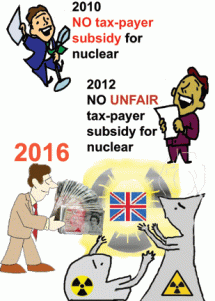 4. The freedom to subsidize — maybe
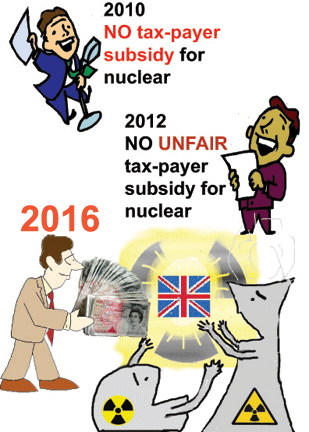
One area the European Commission tries to avoid is state aid, particularly for energy projects.
But even when the Commission gives a green light, there’s the danger that another EU country might try to interfere. That’s what happened with Hinkley Point. Brussels approved a state aid plan in 2014, but Austria, backed by Luxembourg,challenged the decision in the European Court of Justice eight months later…….
Environmental advocates worry it would give the U.K. room to continue rolling back support for renewables in favor of other fuels.
“One of the reasons why the government has had to have a more sensible policy on these issues is because state aid disciplines have stopped it from throwing money at gas-powered stations and fracking and nuclear,” said Nick Mabey, chief executive of the environmental analysis group E3G……..http://www.politico.eu/article/uk-brexit-renewable-energy-hinkley-nuclear-interconnectors-gas-climate-emissions-paris/
Senior EDF managers want Hinkley nuclear project to be postponed
 EDF Managers Tell UK MPs That Hinkley Point C Should Be Postponed http://www.nucnet.org/all-the-news/2016/06/20/edf-managers-tell-uk-mps-that-hinkley-point-c-should-be-postponed
Plans & Construction 20 Jun (NucNet): Senior managers at EDF have told British MPs that a final investment decision (FID) on the planned Hinkley Point C nuclear project should be delayed until problems including the reactor design and “multi-billion litigation” over the Olkiluoto-3 project in Finland have been resolved.
The letter from EDF managers to the UK parliament’s energy and climate change committee is a setback for the proposed £18bn (€23bn, $26bn) nuclear station in Somerset, England. The station is a flagship of the government’s energy policy and is intended to provide seven percent of Britain’s electricity from about 2025.
In April, the state-controlled French company said it was delaying the FID until September while it consulted with trade unions.
A letter dated 13 June and addressed to Angus MacNeil, the chairman of the committee, from the Fédération Nationale des Cadres Supérieurs de l’Énergie (FNCS) union, “advises to delay the FID until better upfront industrial visibility is evidenced”.
Outstanding problems highlighted by in the letter include:
– Areva NP, the designer of the European pressurised water reactor (EPR) planned for Hinkley Point, “is currently facing a difficult situation”.
– The French nuclear safety authority (ASN) may not approve operation of the Flamanville-3 EPR under construction in northwest France due to various anomalies with the reactor vessel bottom and the reactor vessel head.
– There may be “identical flaws” in an Areva EPR being built at Taishan-1 in China.
– Litigation between Areva and the Finnish energy group TVO over delays to the Olkiluoto-3 EPR remain unsettled.
– An EDF offer to purchase Areva expired on 31 March, leaving “governance uncertainties upon the implementation of the Hinkley Point C project”.
The letter says that on 25 May, ASN declared at an annual hearing in the French parliament that financial and economic challenges that both EDF and Areva are facing would be “time consuming”. The necessary reorganisations “would need long delays before a proper recovery happens” and ASN would prioritise regulatory oversight of the existing fleet rather than any new project.
According to the letter, ASN is concerned that while EDF is dedicating its efforts to new nuclear projects, the financing of safety improvements for the normal operation of the French nuclear fleet could be delayed or even given up.
The letter says “heavy evidence” still needs to be brought prior to further commitments, in order to make those commitments “gain robustness and reliability”.
On 7 June, three French workers unions sent a letter to energy minister Ségolène Royale asking for clarification about the “orientation” of the French nuclear industry.
Vincent de Rivaz, the chief executive officer of EDF’s UK subsidiary EDF Energy told MPs last month that he could not give a definite time for when the company will make the FID.
Mr de Rivaz was called to reappear before the committee after indicating at an appearance in March that the FID could be taken by early May. The committee asked him to explain why that had not happened.
The letter is online: http://bit.ly/1Uc8N0F
USA promotes a nuclear arms race in Asia, by Supporting India’s entry to Nuclear Suppliers Group
 Promoting a nuclear race?, Business Recorder June 23, 2016 IKRAM SEHGAL India clandestinely diverted nuclear fuel from the Canadian supplied civilian nuclear reactor in Tarapur for conducting its nuclear test in 1974. Created in 1974 as a direct result of the Indian subterfuge, the Nuclear Suppliers Group (NSG) was meant to prevent in future what India had done, being tasked with regulating nuclear commerce for civilian uses and preventing proliferation of nuclear weapons.
On the back of the US-India nuclear deal in 2008, the Bush Administration applied immense political pressure to exempt India from the NSG’s rules on civilian nuclear trade when it was under US sanctions for proliferation activities. This double standards waiver was engineered when Pakistani’s letter vehemently objecting to it was suddenly and surprisingly withdrawn in Vienna during NSG deliberations at the last minute on the express telephonic instructions from President Asif Zardari. This unparalleled “personal” initiative appeased the US and India but it destroyed the original concept of the NSG and cost Pakistan dearly. It “officially” allowed India to expand its arsenal massively by using imported fuel for civilian nuclear reactors and replenish stocks for weapon production. “Harvard’s Belfer Center” and US think tank “Arms Control Today” confirmed that this defeated the very purpose why the NSG was created in the first place.
What about nuclear balance in South Asia? In an article published by the International Committee of the Fourth International (ICFI), in September 2008 the writers correctly assessed that, “The action the NSG has been goaded into taking by the US has immense and incendiary strategic implications for South Asia, tilling the balance of power between India and its historic rival Pakistan sharply in India’s favour. It also rubbishes the basic principle of the nuclear regulatory regime the US championed earlier that States which pursue nuclear weapons will be “punished” by an embargo on all nuclear trade and those that adhere to the NPT will, in return, be assisted in developing civilian nuclear energy. And, as was foreshadowed in the events at the NSG meeting itself, it will intensify and complicate the ongoing and ever more explosive rivalry amongst the big powers for markets, raw materials, and geo-strategic advantage.”
A Senate hearing on 24 May saw US Senator Markey saying something extremely relevant, “Since 2008 when (we) also gave them an exemption, India has continued to produce fissile material for its nuclear weapons programme virtually un-checked. At that time Pakistan warned us that the deal would increase the chances of the nuclear arms race in South Asia”. Some countries, led by China and Turkey, are resisting this pressure on principle, arguing that if any exception to the rules is made, it should apply equally to both India and Pakistan. Since all 48 member NSG decisions are made by consensus, even one member can block a decision.
India has not honoured its limited commitments under the international non-proliferation regime that earned it the 2008 waiver, adhering to limited IAEA Additional Protocol as well as US laws (Hyde Act) for transparency in use of imported fissile material, agreeing to a moratorium on fissile material production for weapons use; signing and ratifying the CTBT and putting a cap on its nuclear weapons production. In the face of these obvious deficiencies, allowing India NSG membership will intensify the nuclear/strategic arms race in South Asia, undermine NSG’s credibility and will give India the legitimacy of a nuclear weapon state. Bent on using India as a counterweight to China, the US must realise the dangerous confrontation that will erupt in South Asia………http://www.brecorder.com/articles-a-letters/187/59532/
Germany criticises NATO’s warmongering policy towards Russia
Germany slams NATO ‘warmongering’ on Russia Berlin , Yahoo News, 18 June 16 (AFP) – German Foreign Minister Frank-Walter Steinmeier has criticised NATO for having a bellicose policy towards Russia, describing it as “warmongering”, the German daily Bild reported.
Steinmeier pointed to the deployment of NATO troops near borders with Russia in the military alliance’s Baltic and east European member states.
“What we should avoid today is inflaming the situation by warmongering and stomping boots,” Steinmeier told Bild in an interview to be published Sunday. “Anyone who thinks you can increase security in the alliance with symbolic parades of tanks near the eastern borders, is mistaken,” Germany’s top diplomat added.
NATO had announced on Monday that it would deploy four battalions to Estonia, Latvia, Lithuania and Poland to counter a more assertive Russia, ahead of a landmark summit in Warsaw next month…….https://www.yahoo.com/news/germany-slams-nato-warmongering-russia-115515814.html
China not happy with USA’s promotion of India to join Nuclear Suppliers Group
 China Takes Swipe At US Over India’s Nuke Club NSG Bid
“I have not seen the US statement supporting India. But the US is one of those who made the rule that non-NPT countries should not join the Nuclear Suppliers Group,” she said.
“According to my understanding, it (entry of new members) is not on the agenda of the NSG meeting in Seoul. The door is open for the admission of the non-NPT members. It is never closed. It is open. But the members of the NSG should stay focused on whether the criteria should be changed and whether non-NPT members should be admitted into the NSG”, she added.
Talking to journalists about the implications of India’s membership, the Chinese official said, “If the non-proliferation regime is changed how can we explain the Iranian nuclear treaty. We have North Korean issues there. So this concerns the core issue whether NPT and non-proliferation system could be impacted by this.”
On Monday, the United States gave a fresh push to India’s membership by asking members of the NSG to support India’s entry. White House Press Secretary josh Earnest said, “We believe, and this has been US policy for some time, that India is ready for membership and the United States calls on participating governments to support India’s application at the plenary session of Nuclear Suppliers Group (NSG)”……
China has also been batting for its close ally Pakistan’s entry if NSG extends any exemption for India.
The NSG looks after critical issues relating to the nuclear sector and its members are allowed to trade in and export nuclear technology. Membership of the grouping will help India significantly expand its atomic energy sector. http://www.ndtv.com/india-news/china-takes-swipe-at-us-over-indias-nuke-club-nsg-bid-1421679
Financially imprudent for India to let Westinghouse build nuclear reactors
The cost of nuclear diplomacy, THE HINDU, SUVRAT RAJU, 20 JUNE 16 The government’s decision to let Westinghouse build six nuclear reactors in India smacks not only of arbitrary use of executive authority but is also financially imprudent
 In their recent joint statement, Prime Minister Narendra Modi and President Barack Obama “welcomed the start of preparatory work… in India for six AP1000 reactors to be built by Westinghouse…” Judging by the cost of similar reactors under construction in the U.S., these six reactors may cost as much as Rs.4 lakh crore. This makes the deal potentially the largest commercial contract in the offing between the two countries.
Economically unviable When the United Progressive Alliance government announced its intention to start work on two reactors each from Westinghouse and General Electric (GE) in the 12th Plan period (2012-2017), it did little to pretend that these contracts made sense on their own merits. Instead, as the former chairperson of the Atomic Energy Commission, Anil Kakodkar, explained, India had “to keep in mind the commercial interests of foreign countries and of the companies there” and was obliged to purchase these reactors in return for U.S. diplomatic support on other issues.
Last year, GE backed out of this arrangement citing concerns about India’s liability law. This was good riddance; GE was offering India an untested design that it has not yet managed to sell anywhere in the world. But the government’s decision to deepen India’s investment in Westinghouse — even as negative news about the company has accumulated — makes little sense.
In April, Toshiba, which acquired Westinghouse in 2006, announced a $2.3 billion write-down in its value, largely because of persistent concerns about the economic viability of Westinghouse’s AP1000 design. Of more than a dozen orders that Westinghouse expected from within the U.S. a decade ago, only four have materialised. Just last month, a utility called Florida Power and Light postponed its plans for two AP1000 reactors by at least four years. And in February, the Tennessee Valley Authority, a U.S. government company, cancelled its plans for two AP1000 reactors explaining that this was “the fiscally responsible action”.
- the government has persisted in making concessions to Westinghouse. In February, it ratified the “Convention on Supplementary Compensation” (CSC) for Nuclear Damage that contradicts India’s domestic liability law and protects nuclear suppliers from liability for an accident. Now, in the event of a disaster, Indian courts may find it difficult to exercise jurisdiction over Westinghouse that is not based in India and could point to India’s international commitments under the CSC to block any potential claims against it.
- For example, Dow Chemicals has rebuffed attempts to make it contribute to a clean-up in Bhopal by arguing that Indian courts have “no jurisdiction over it”. And in a cautionary tale about how flawed international agreements can subvert the domestic legal system, in 2011, an international arbitration tribunal awarded White Industries Australia Ltd. AU$4 million under a bilateral investment treaty even as its dispute with the Indian government was sub judice in India’s Supreme Court……..http://www.thehindu.com/opinion/op-ed/the-cost-of-nuclear-diplomacy/article8748864.ece
America fails to monitor health of Spanish community affected by hydrogen bomb accident
Decades Later, Sickness Among Airmen After a Hydrogen Bomb Accident, NYT, by DAVE PHILIPPS JUNE 19, 2016 “……….Spain’s Monitoring
The United States promised to pay for long-term monitoring of health in the village, but for decades it provided only about 15 percent of funding, with Spain paying the rest, according to a declassified Department of Energy summary. Broken air-monitoring stations went unfixed and equipment was often old and unreliable. In the early 1970s, an Atomic Energy Commission scientist noted, the Spanish field monitoring team consisted of a lone graduate student.
Reports of two children dying of leukemia during that time went uninvestigated. The lead Spanish scientist monitoring the population told American counterparts in a 1976 memo that, in light of the leukemia cases, Palomares needed “some kind of medical surveillance of the population to keep watch for diseases or deaths.” None was created.
In the late 1990s, after years of pressure from Spain, the United States agreed to increase funding. New surveys of the village found extensive contamination that had gone undetected, including some areas where radiation was 20 times the permissible level for inhabited areas. In 2004, Spain quietly fenced off the most contaminated land near the bomb craters.
Since then, Spain has urged the United States to finish cleaning the site.
Because of the uneven monitoring, the effect on public health is far from clear. A small mortality study in 2005 found cancer rates had gone up in the village compared with similar villages in the region, but the author, Pedro Antonio Martínez Pinilla, an epidemiologist, cautioned that the results could be because of random error, and urged more study.
At that time, a United States Department of Energy scientist, Terry Hamilton, proposed another study, noting problems in Spain’s monitoring techniques. “It was clear the uptake of plutonium was poorly understood,” he said in an interview. The department did not approve his proposal…..
About a fifth of the plutonium spread in 1966 is still estimated to contaminate the area. After years of pressure, the United States agreed in 2015 to clean up the remaining plutonium, but there is no approved plan or timetable…….http://www.nytimes.com/2016/06/20/us/decades-later-sickness-among-airmen-after-a-hydrogen-bomb-accident.html
India paying high cost to save Westinghouse’s nuclear business
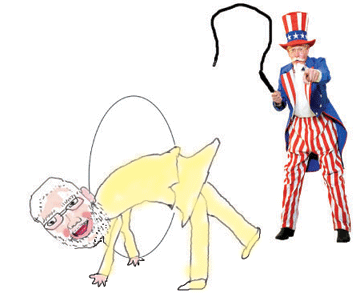 The Cost of Modi’s US Visit: Offering Rs. 2.8 lakh crore to Westinghouse, News Click, Prabir Purkayastha, June 09, 2016
The 4th visit of Modi to the US has very little to show as achievements. No wonder, the headlines screamed about “the start of the preparatory work” on six nuclear reactors as a major achievement. Not content with this, the Westinghouse AP 1000 reactors were even hyped as 5th generation reactors, skipping two whole generations of reactors in between. The earlier AP 600 reactors are recognised as 2nd generation reactors, making the AP 1000 the 3rd generation, which is how they are known in the rest of the world – except to certain gentlemen in the Indian media.
The reality is that after 8 years of negotiations on the Westinghouse reactors, India has now shifted the location from Mithivirdhi in Gujarat to Srikakulam in Andhra Pradesh. The negotiations for the deal with Westinghouse are still stuck, and only a new beginning is being sought with this new site. All that Westinghouse has agreed is that they will do some preliminary work for this new site — “start of the preparatory work”.
In today’s world, nuclear energy is a dying technology. Its costs are too high, its ability to build to schedule is non existent and it faces the challenge of renewables – wind and solar – the costs of which are dropping rapidly. The US, after a brief flirtation with nuclear energy – the so-called nuclear renaissance – has pretty much decided not to invest any further in this technology.
It is only China and India that can revive the dying nuclear industry of the US. Both Westinghouse and GE are without any further orders in the US and in the EU. So it is not the US showing its willingness to “give” us nuclear reactors to India that is the issue; it is India helping to revive a patient – the US nuclear industry – which has currently one foot already in the grave.
How much are we committing to pay to revive a dying Westinghouse? Continue reading
Time that USA government backed its Iran nuclear deal and promoted investment

 The Obama Administration Needs to Double Down on the Iran Deal http://foreignpolicy.com/2016/06/16/the-obama-administration-needs-to-double-down-on-the-iran-deal/If Washington doesn’t move to help get banks and business into Iran, the nuclear deal will collapse. esident Barack Obama spent enormous political capital to cement an agreement with Iran that constrained its nuclear program for more than a decade. That agreement, however, is now at risk of unraveling.
The danger of the agreement collapsing, to the detriment of U.S. interests, is now evident. Under the nuclear accord, Iran agreed to constrain its nuclear program in return for economic reprieve from U.S. sanctions. While Iran has so far lived up to its nuclear-related obligations — addressing U.S. concerns over its nuclear program by reducing its number of operating centrifuges, reconfiguring its heavy-water reactor, and permitting an unprecedented inspections regime — the United States has struggled to fulfill its end of the nuclear bargain.
Hard-liners in Iran are touting the sanctions issue as an example of why the United States cannot be trusted.That message is having an effect: Recent pollingindicates that the Iranian people are growing increasingly skeptical that Washington is acting in good faith in meeting its commitments. Iranian moderates who support the accord, meanwhile, risk being undermined by this development. Absent a turn in Iran’s economic fortunes, the hopes and aspirations of the Iranian people will continue to be denied and their political engagement — as evidenced by recent parliamentary elections, in which Iranian hard-liners were dealt a significant defeat — stymied.
To its credit, the Obama administration is actively seeking to resolve concerns over the sanctions-lifting. A few weeks ago, Secretary of State John Kerry hosted a meeting of the British Bankers Association to encourage major European banks to re-engage their Iranian counterparts. High-level U.S. officials have likewise been touring the world, seeking to provide practical guidance on what the lifting of sanctions means and the scope of remaining U.S. sanctions. More public written guidance will soon be forthcoming.
But such guidance has been insufficient — and is likely to remain so. Following their meeting with Kerry, most of the banks in attendance stated publicly that they would not engage in Iran-related business for the foreseeable future, due to persistent U.S. sanctions risks. Without major European banks willing to re-engage Iran, financing will be unavailable for some of Iran’s bigger trade and investment opportunities.
The Obama administration needs a new game plan.Just as it expended political capital to secure the deal, it must expend the political capital to sustain it. Otherwise, the administration risks snatching defeat out of the jaws of victory and upending this historic diplomatic achievement.
Such additional steps come in two parts. First, the Obama administration will need to provide detailed written guidance to foreign banks and companies explaining what steps are required to ensure that they do not risk exposure to U.S. sanctions. Absent such guidance, non-U.S. banks and companies will continue to lack the confidence to engage in Iran-related dealings.
The Obama administration reportedly has been reluctant to provide the level of detail necessary to instill confidence in companies that they can do business in Iran. For instance, companies have long sought to understand the necessary level of due diligence to avoid exposure to U.S. sanctions — perhaps through a checklist of sorts. But U.S. officials, unwilling to act outside their comfort zone, have rejected calls to provide such detailed guidance, thus failing to address many firms’ primary concern.
Second, the Obama administration will need to take action to ease market entry into Iran. Banks have been hesitant to facilitate trade with Iran so long as Iran remains cut off from the U.S. financial system, and large foreign enterprises have been reluctant to pursue trade and investment opportunities in Iran so long as the U.S. primary trade embargo remains intact.
The administration can resolve these persistent concerns through a broader licensing scheme. For instance, the United States could re-authorize the U-turn license, which permitted U.S. dollar transactions involving Iran to be cleared through a U.S. bank, or license American banks to provide dollars to foreign financial institutions so that dollar-clearing can take place offshore. Similarly, the administration could take a hard look at the sense of maintaining a unilateral trade embargo with Iran while it is encouraging foreign parties to engage in trade with Iran. In lieu of those more dramatic steps, the administration could also license U.S. persons to facilitate certain transactions with Iran, particularly if those U.S. persons are employed in non-U.S. companies.
The politics of such action may not prove appetizing. Uber-hawks in Congress are bent on denying the Obama administration this diplomatic success and will try to block any action aimed at resolving sanctions concerns. But the sustainability of the nuclear accord is dependent on the Obama administration taking these steps. Absent such measures, the Iran deal threatens to unravel with the United States being the scapegoat, as Iran will continue to be denied the benefit of its bargain.
Passing off current problems with the lifting of sanctions to the next administration is not an option. Obama has made a big investment in limiting Iran’s nuclear program — the time is now to secure that investment.
US agencies and prosecutors influence Europe’s banks to impede Iran nuclear deal
Why our nuclear deal with Iran is turning to dust, The Independent, Robert Fisk @indyvoices 16 June 16
Many of Europe’s largest banks won’t do business with Iran for fear of breaching other US sanctions, which have nothing to do with the nuclear agreement – but a lot to do with US agencies and prosecutors.
The Middle East is littered with missed opportunities, lost chances and dreams turned to dust. The Iranian nuclear deal is now heading in the same direction. President Hassan Rohani, hero of the hour and Iran’s new Mr Good Guy in America, even obtained the support of Iran’s Supreme Leader, Ayatollah Ali Khamenei, when he signed off on the agreement with six world powers last year to reduce the country’s nuclear activities in return for an end to Western sanctions. But he’s beginning to look like a patsy.
And all of the old Iranian revolutionaries, the sons of martyrs and the war veterans and the Revolutionary Guard Corps and the managers of its billion-dollar conglomerates are turning out to have been right all along. The sanctions have been lifted – but they haven’t been lifted. Western investments are not, despite all the promises, pouring into Iran because banks – especially European banks – are too frightened of breaching the rest of America’s sanctions laws to do business with the Islamic Republic. Washington both giveth and taketh away; it’s a slogan that every Iranian president should learn.
Mohamed Khatami was the only real statesman the Middle East produced in half a century and he was elected president of Iran in 1997. He wanted a “civil society”, the nearest you can get to a secular nation ruled by Shiite democracy-necrology-government for and by the dead. But the United States treated Khatami with scorn – and so the crackpot Mahoud Ahmedinejad became the next president, a man with whose ravings America’s right-wing felt far more comfortable.
Hadn’t they said all along that Iran’s leaders were anti-Semitic nuclear crazies, even – this from the Israelis – worse than Hitler? Now Rohani, the man-America-could-do-business-with, may lose next year’s presidential election because he, too, forgot the slogan which, at its simplest, reads: don’t trust America.
Iran has not been reintegrated into the global financial system – and it’s not going to be – though the Chinese will be happy to do business. Khamenei’s supporters are now suggesting that the Supreme Leader – not the shrewd but naïve president – is the great hero of modern Iranian history (after Ayatollah Ruhollah Khomeini, of course). The banks, he says, fear the Americans who “have not acted on their promises and [only] removed the sanctions on paper”. Worse still, he’s right. “Khamenei’s life is the one you should be writing about,” one of his believers announced last week. “He is the saviour.” Yes, thanks to America.
For many of Europe’s largest banks won’t do business with Iran for fear of breaching other US sanctions, which have nothing to do with the nuclear agreement – but a lot to do with US agencies and prosecutors, hunting for evidence of Iranian money laundering, the financing of “terrorism” and monetary crime. The French BNP Paribas shelled out £6.3bn for its Iranian dealings a couple of years ago – over five years, along with StanChart and HSBC, the figure comes to a whopping £10.7bn.
So why should the UK’s Standard Chartered, Societe Generale, Credit Suisse or Deutsche Bank line up to pay more fines just because their governments want to do business in Tehran? Some American bankers – this from the Economist – won’t even hand over their business cards to Iranians. Now that’s what you call fear………
While Iran cannot break free of sanctions from which it thought it had been unshackled, its own paid militia in Lebanon – a nation which a Shiite prelate once described as “the lung through which Iran breathes” – is being caught up in the same financial net. So it’s not difficult for the Iranians to spot what they call in Persian the “dasisa” – and what the Hezbollah, in Arabic, refer to as the “muamara” – which means, quite simply: THE PLOT.
Decide for yourself if it’s true. But in Iran, the lifting of sanctions is a promise un-kept, the Revolutionary Guards are smiling and the nuclear deal is, surely, going downhill. A dream, in other words, fast turning into dust http://www.independent.co.uk/voices/why-our-nuclear-deal-with-iran-is-turning-to-dust-a7084981.html
Finland concerned about the uncertain state of France’s nuclear industry

 Finns deeply worried about French nuclear industry Ft.com Richard Milne, Nordic Correspondent , 14 June 16
One of the main international customers for a much-delayed and costly nuclear reactor has expressed deep worries over the future of France’s atomic industry amid signs of political wrangling.
Finland’s TVO was the first customer for French nuclear group Areva’s European Pressurised Reactor technology — due to also be used at the UK’s controversial Hinkley Point power station — but the project has been beset by large cost overruns and a delay of almost a decade.
The two companies had been in negotiations in recent weeks to resolve multibillion-euro legal claims by both parties, as well as pave the way for the sale of a majority stake in Areva’s nuclear reactor business to French utility EDF.
But the sudden breakdown of those talks has rattled TVO, which operates some of Finland’s nuclear power plants. Jarmo Tanhua, chief executive, told the Financial Times of his big concerns about the future of France’s nuclear industry.
“We are afraid of what is happening. One thing is we don’t really understand why we don’t proceed with the negotiations. Our understanding is that it has something to do with the restructuring in France or the politics,” he said.
Mr Tanhua added that his biggest fear was that the French could decide to run down “some parts of the industry or some know-how”, particularly in its EPR technology.
India’s nuclear lobbying
Viewpoint: India’s nuclear lobbying and an increasingly isolated Pakistan, BBC News, By Ahmed RashidLahore 14 June 2016
India’s American-backed bid to join the prestigious Nuclear Suppliers Group (NSG) has once again isolated Pakistan in South Asia.
Pakistan is increasingly finding itself friendless in the region as Iran, Afghanistan and India all find fault with Pakistan’s inability to end terrorism on its soil and in particular to bring the Afghan Taliban to the table for peace talks, as Islamabad promised to do nearly two years ago.
The 48-nation NSG, which sets global rules for international trade in nuclear energy technology, has become the latest diplomatic battleground between India and Pakistan. It is due to hold a crucial meeting this month. The Pakistani military is angry that after Indian Prime Minister Narendra Modi’s recent trip to Washington, the US has been furiously lobbying all member countries to give India a seat at the NSG table.
Pakistan then asked for the same, but its proliferation record is not as good as India’s and it clearly would not succeed. Instead, it has asked China to veto the Indian bid which it is likely to do. However, smaller countries are angry with the US, who they accuse of browbeating them, and complain that neither India nor Pakistan can become members until they sign the nuclear non-proliferation treaty (NPT) which is an essential requirement.
President Obama is going against his own policy of nuclear restraint and disarmament by offering to make India – but not Pakistan – a member of the NSG, when the US has also tied up plans to sell India six nuclear power plants……..http://www.bbc.com/news/world-asia-36518330
1 This Month

of the week– Nuclear Reactor Information Task Force

14 May – online event From Bombs to Data Centres: the Face of Nuclear Colonialism
To see nuclear-related stories in greater depth and intensity – go to https://nuclearinformation.wordpress.com
-
Archives
- May 2026 (92)
- April 2026 (356)
- March 2026 (251)
- February 2026 (268)
- January 2026 (308)
- December 2025 (358)
- November 2025 (359)
- October 2025 (376)
- September 2025 (257)
- August 2025 (319)
- July 2025 (230)
- June 2025 (348)
-
Categories
- 1
- 1 NUCLEAR ISSUES
- business and costs
- climate change
- culture and arts
- ENERGY
- environment
- health
- history
- indigenous issues
- Legal
- marketing of nuclear
- media
- opposition to nuclear
- PERSONAL STORIES
- politics
- politics international
- Religion and ethics
- safety
- secrets,lies and civil liberties
- spinbuster
- technology
- Uranium
- wastes
- weapons and war
- Women
- 2 WORLD
- ACTION
- AFRICA
- Atrocities
- AUSTRALIA
- Christina's notes
- Christina's themes
- culture and arts
- Events
- Fuk 2022
- Fuk 2023
- Fukushima 2017
- Fukushima 2018
- fukushima 2019
- Fukushima 2020
- Fukushima 2021
- general
- global warming
- Humour (God we need it)
- Nuclear
- RARE EARTHS
- Reference
- resources – print
- Resources -audiovicual
- Weekly Newsletter
- World
- World Nuclear
- YouTube
-
RSS
Entries RSS
Comments RSS
 nuclear-news