The nuclear threat can be contained by diplomacy, These issues are manageable if they are given the right degree of priority, John Sawers Ft.com 25 Sep 17 “……… North Korea is the issue of the day. The objective of a denuclearised Korean peninsula, pursued by the previous US administrations, is no longer an achievable goal.
The best that can be hoped for is the suspension of nuclear and missile testing in return for security assurances and practical aid. Sanctions are designed to draw Kim Jong Un into a negotiation with that aim, and to pressure China to take a more active part. But it is very hard to see President Kim pulling back now. And China is more concerned about a new US-led war in Korea or the north collapsing and sending millions of refugees into China, than it is about living with a nuclear armed Pyongyang.
The US only really has two strategic options: contain and deter the threat; or destroy it, which would require regime change. There are always military options. But all who have studied the secret Pentagon plans are sobered by the scale of loss of life in South Korea these would entail. There is also a risk of China reluctantly coming to the aid of the north as it did in the 1950s.
Realistically, it seems the only practical option is containment. That requires missile defence systems to create uncertainty that nuclear-tipped missiles would ever get through to their target, and to deter any use of such weapons by being clear that North Korea would be destroyed if it ever tried to use them.
Mr Kim may be hard for us to comprehend, but he is a rational actor and he is certainly not suicidal. US concern about this isn’t exaggerated by the Trump administration: it has a serious problem on its hands.
However much we may view containment as the only sensible answer, there are still dangers of miscalculation. Mr Kim may be tempted to use his nuclear arsenal to hold others to ransom. There is also a proliferation threat. We have seen how Pyongyang has used its nuclear technology as an export earner. In 2007, the Israelis destroyed a secret nuclear reactor in the Syrian desert that had been designed and built by the North Koreans. Is it conceivable that a future terrorist organisation might be able to obtain such a device? Unlikely. But if they had the means, then Pyongyang would be the first place to go to get it. Pakistan’s ambivalent relationship with terrorist organisations adds to the dangers.
One country where our nuclear weapons concerns had eased is Iran. The nuclear agreement has its weaknesses, especially that it only applies for 10 years. But it is worth having, and Tehran is complying by its technical requirements. If Donald Trump walks from the nuclear deal — as he threatened at the UN last week — then before long he could find he has another North Korea to deal with, this one in the Gulf.
The outlook on nuclear weapons might look grim. But as we showed in the cold war, these issues are manageable with skilful diplomacy and the right investments in defence. We just have to give it the right degree of priority. When I was at MI6, and before that our negotiator with Iran on its nuclear programme, I was always mindful of the nuclear threat. The only issue that can seriously threaten our way of life must be among our top international security priorities. The writer is chairman of Macro Advisory Partners and a former chief of MI6, the British Secret Intelligence Service https://www.ft.com/content/02c58f70-9c80-11e7-8b50-0b9f565a23e1
The US President warned Pyongyang’s foreign minister that if he if ‘he echoes thoughts’ of the country’s leader Kim Jong Un they both ‘won’t be around much longer’.
He was responding after Ri Yong Ho told the United Nations General Assembly on Saturday that targeting the US mainland with its rockets was inevitable after ‘Mr Evil President’ made an ‘irreversible mistake’ by calling Mr Kim ‘rocket man’.
Describing Mr Trump as a ‘mentally deranged person full of megalomania,’ Mr Ri went on to tell the annual gathering of world leaders that the country was now ‘only a few steps away from the final gate of completion of the state’s nuclear force’.
Hitting back on Twitter, Mr Trump wrote: ‘Just heard Foreign Minister of North Korea speak at UN If he echoes thoughts of Little Rocket Man, they won’t be around much longer!’
Shortly before Mr Ri was scheduled to speak at the assembly, the Pentagon announced a fleet of US bombers and fighter jets had flown off North Korea’s coast, in what it called a ‘clear message’ to Pyongyang.
Pentagon spokeswoman Dana White said it underlined the range of military options available to the US.
U.S. knows ‘for sure’ it has A-Bomb, foreign minister says
Korea, Japan, China, Russia may suffer if things get violent
North Korea’s possession of nuclear weapons is preventing the U.S. from launching a first strike against the rogue nation, Russian Foreign Minister Sergei Lavrov said in an interview.
“The Americans won’t strike because they know for sure — rather than suspect — that it has atomic bombs,” Lavrov said Sunday on Russia’s NTV television. “I’m not defending North Korea right now, I’m just saying that almost everyone agrees with this analysis.”
Lavrov said the U.S. attacked Iraq “solely because they had 100 percent information that there were no weapons of mass destruction left there,” refuting arguments the American government made at the time.
Tensions between the nations ratcheted up this weekend as President Donald Trump and North Korea Foreign Minister Ri Yong Ho traded threats. On Saturday, U.S. Air Force B-1B bombers flew over international waters east of North Korea.
Lavrov said thousands of innocent people will suffer, in North Korea and in bordering South Korea, Japan and even maybe China and Russia, in the absence of a diplomatic solution.
Turning to another source of tension, Lavrov also added that he can’t rule out that the U.S. plans for Syria go beyond fighting terrorism. The Americans “swear that they have no goal in Syria other than eliminating terrorists,” he said. “When it happens, we’ll see if this was true or the U.S. nonetheless pursues some political goals, which we yet don’t know of.”
Iraq seeks help with reactor World news briefs, Sept. 23: United Nations, Puerto Rico September 23, 2017
Iraq’s foreign minister is asking nuclear countries for help building an atomic reactor for peaceful purposes, saying the country has a right to use atomic power peacefully. Ibrahim al-Jaafari made the request in his speech Saturday to the U.N. General Assembly’s annual meeting of presidents, prime ministers and monarchs. He called for assistance “to build a nuclear reactor for peaceful purposes in Iraq, to acquire this nuclear technology.” Former Iraqi strongman Saddam Hussein’s previous efforts to build a nuclear reactor were met with an Israeli airstrike in 1981 and years of suspicion about his nuclear intentions. The U.S. cited concerns that Saddam had weapons of mass destruction as the basis for invading Iraq in 2003, but none were ever found. Al-Jaafari cited the Nuclear Nonproliferation Treaty’s provisions allowing countries to pursue peaceful nuclear energy projects. https://www.ohio.com/akron/news/nation/world-news-briefs-sept-23-united-nations-puerto-rico
Amid deepening anxiety over the risk of war between the United States and North Korea, much of the international community is embracing the new Treaty on the Prohibition of Nuclear Weapons. This historic global agreement formally opened for signature at UN headquarters on Wednesday.
Presidents, prime ministers, foreign ministers and ambassadors from 50 nations lined up to ink the accord, affirming their commitment to disarmament and categorically rejecting, for all time, the most destructive weapons ever created. More leaders are expected to sign in the coming days and weeks.
The signatories hope that, over time, the treaty will establish a powerful global norm against the use and possession of nuclear weapons by any state. Their ultimate objective: to convince all the world’s nations to sign and comply with the treaty, eliminating the nuclear-weapon threat completely.
At the signing ceremony, UN Secretary-General António Guterres declared the treaty open for signature. “There remain some fifteen thousand nuclear weapons in existence,” he reminded those gathered. “We cannot allow these doomsday weapons to endanger our world and our children’s future.”
Peter Maurer, the president of the International Committee of the Red Cross, also participated in the ceremony. “Humanity simply cannot live under the dark shadow of nuclear warfare,” he said, describing the new treaty as a light “illuminating a pathway towards a world without nuclear weapons.”
Of the 50 nations that signed the treaty on Wednesday, three—Guyana, the Holy See, and Thailand—also deposited their instruments of ratification, thereby formally consenting to be bound to the treaty. Once 50 such instruments have been deposited, the treaty will enter into legal force.
The large number of signatures on the opening day is a remarkable show of support for a treaty that fundamentally challenges the status quo in nuclear diplomacy—one that goes beyond traditional arms control and non-proliferation approaches and embraces an abolitionist agenda.
In the weeks leading up to the ceremony, the United States worked energetically to dissuade nations from signing, perhaps with the aim of preventing it from entering into legal force. But its behind-the-scenes lobbying appears to have been largely unsuccessful.
If ever there were a moment for leaders to declare their total opposition to nuclear weapons, it is now. The dire international security environment is precisely why this treaty is such a vital initiative.
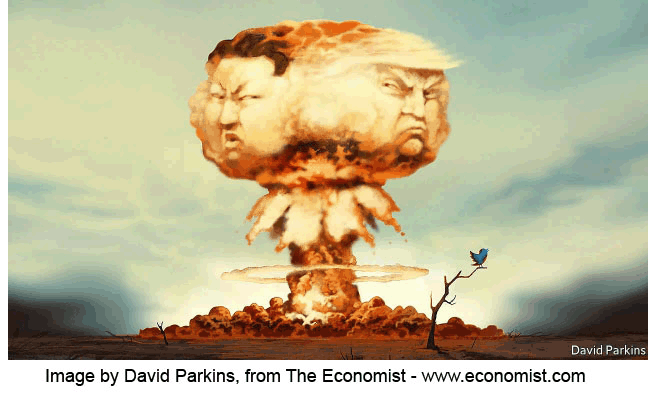
How We Got to North Korea’s Pacific Nuclear Test Threat and What Comes Next It would be the first above-ground detonation in decades and would send tensions into uncharted territory. The Drive BY JOSEPH TREVITHICK, SEPTEMBER 22, 2017 In ever escalating war of words between the United States and Kim Jong-un’s totalitarian regime in North Korea has reached an entirely new level since President Donald Trump threatened to “totally destroy” the Hermit Kingdom in a speech to the United Nations General Assembly. It seems all but guaranteed that the rhetoric will lead to new North Korean provocations, but what’s unprecedented and potentially game-changing is that they could potentially include a full demonstration of a nuclear-armed ballistic missile, or at least an above-ground nuclear weapon test, either which in turn would similarly demand some form of American response.
This latest escalation in tensions between the U.S. government and North Korean officials began on Sept. 19, 2017, when Trump addressed the United Nations General Assembly for the first time with fiery remarks, lashing out at not only North Korea, but also Iran, Cuba, Venezuela, and other critics of American foreign policy more broadly. He vowed to put the United States interests first in all matters and encouraged the other assembled leaders to do the same. But he reserved some of the most incendiary comments for Kim, who he has now nicknamed “Rocket Man,” and his regime.
“The United States has great strength and patience, but if it is forced to defend itself or its allies, we will have no choice but to totally destroy North Korea,” he declared. “Rocket Man is on a suicide mission for himself and for his regime. The United States is ready, willing and able, but hopefully this will not be necessary.”
This particular statement drew “audible gasps” from some of the world leaders in attendance, according to The Associated Press. The North Korean delegation had already walked out in protest before Trump even began speaking……..
The string of threats, especially Nikki Haley’s comments, suggest the United states and its allies could easily handle the increasingly worrisome situation with military force if it runs out of other options. This of course is entirely untrue and major conflict with North Korea would be devastating for all the involved parties.
Not surprisingly, this has not prompted a change in the behavior of the North Korean regime or Premier Kim. As we at The War Zone have noted for months, these statements feed into the country’s existing paranoid and propaganda that the United States and its allies are actively looking to destroy it and forcefully eliminate its government.
It has only appeared to give North Korea more of a reason to continue to develop advanced ballistic missiles and nuclear weapons to achieve some relative parity with the United States in order, if nothing else, to preserve the regime’s very existence. Kim said as much himself in a televised rebuttal on Sept. 21, 2017……
Trump continued the cycle on Sept. 22, 2017, as part of a series of Tweets on various topics. “Kim Jong Un of North Korea, who is obviously a madman who doesn’t mind starving or killing his people, will be tested like never before!” he posted on the social media site.
If his remarks in front of the United Nations seemed likely to generate a North Korean response, the Tweet sounded closer to a direct challenge. Given Kim’s immediate response to Trump’s threat of total destruction, it seems he will have little room but to make a provocative move in response to this new “test.”
After Kim’s own televised address, North Korean Foreign Minister Ri Yong Ho had already said the North Korean response could include detonating a hydrogen bomb in or over the Pacific Ocean. Earlier in September 2017, North Korea tested what experts believe to be a working thermonuclear device…….
In the future, North Korea may simply need to conduct nuclear weapons tests outside of its own borders since the Punggye-ri underground test site may simply not be able to survive the strain of more powerful thermonuclear designs. The nuclear test earlier in September 2017 appeared to cause the tunnel containing the device to collapse, highlighting the limits of underground testing.
Even if the atmospheric test went as intended, it could be difficult to be entirely sure there would be no inadvertent casualties and the resulting fallout could easily fall on civilian mariners or populated areas……..
despite Nikki Haley’s and H.R. McMaster’s insistence that there are available military options to respond to these growing provocations, as well as Trump’s vague threats, any direct action would be fraught with its own dangers. One of the most likely courses of action, shooting down the missile, carries significant risks as the impact of the interceptor could trigger the device or the radioactive debris could fall over populated areas.
Perhaps more importantly to the viability of America’s still largely unproven ballistic missile defense shield, if the intercepting weapon misses or otherwise fails to achieve the desired effect, it would expose a serious vulnerability to not just North Korea, but the rest of the world…..
In particular, systems that engage the missile as it comes falling back down to earth, such as the Terminal High Altitude Air Defense (THAAD) system, have a very narrow window to achieve a “kill.” Furthermore, this means that personnel manning the interceptors would likely be in the direct path the incoming weapon, and if it was fully armed, a nuclear test.
There is very little room for failure in any of these scenarios. Even if the shoot down were to go smoothly, it is possible that it could trigger a larger and immensely destructive conflict on the Korean Peninsula or throughout East Asia. The War Zone’s Tyler Rogoway has highlighted these various issues previously in a deep dive into the United States’ available options in responding to North Korea’s continued provocations……..
All of these options still come with their own risks, though, and there’s still no indication that they would convince Kim to change course. If the North Korean regime’s primary goal is its own survival, it is perfectly rational for them to continue to demonstrate their resolve to respond in kind to American threats.
And despite his comments, Trump’s first step, on Sept. 21, 2017, was to sign a new executive order penalizing any individual or business doing business with North Korea. This follows a trend of steady sanctions against actors and firms outside of North Korea that the United States accuses of enabling the reclusive country’s government.
Trump and other members of his administration repeatedly question Kim’s mental stability, but as we at The War Zone have noted before, he clearly has a coherent plan. We’re still not sure that U.S. government has developed a thought-out strategy to dissuade him from his chosen path.
North Korea ‘threatens Pacific nuclear test’ Sky News, , 22 September 2017 North Korean Foreign Minister Ri Yong Ho says he believes the North could consider a hydrogen bomb test on the Pacific Ocean of an unprecedented scale, South Korea’s Yonhap news agency reports.
Mr Ri was speaking to reporters in New York when he was asked what North Korean leader Kim Jong-un had meant when he threatened in an earlier statement the ‘highest level of hard-line countermeasure in history’ against the United States.
North Korea could consider a hydrogen bomb test, Mr Ri said, although he did not know his leader’s exact thoughts, Yonhap reported.
In an earlier statement Mr Kim said Mr Trump was ‘mentally deranged’ and his comments were ‘the most ferocious declaration of a war in history,’ Mr Kim said the US president’s UN speech on Tuesday confirmed Pyongyang’s nuclear program has been ‘the correct path’.
‘His remarks … have convinced me, rather than frightening or stopping me, that the path I chose is correct and that it is the one I have to follow to the last,’ Mr Kim said in the statement carried by the North’s official KCNA news agency, promising to make Trump ‘pay dearly for his speech’.
Mr Trump had warned the North Korean leader in his UN address on Tuesday that the United States, if threatened, would ‘totally destroy’ the country of 26 million people and mocked Kim as a ‘rocket man’ on a suicide mission………
He offered more vitriol for Mr Trump, saying he was ‘unfit to hold the prerogative of supreme command of a country, and he is surely a rogue and a gangster fond of playing with fire, rather than a politician.’
The presidents of Japan and South Korea welcomed Trump’s announcement of new sanctions against North Korea but privately questioned whether his threat to “totally destroy” the country would lead to the diplomacy they prefer.
Arab and Iranian leaders sat stone-faced during Trump’s bellicose address on Tuesday — while several other world leaders reacted with bemusement, chagrin and confusion to his often-contradictory comments.
Netanyahu could be observed laughing and grinning as Trump described the hard-fought international nuclear accord with Iran as the “worst deal ever” and an “embarrassment” to the United States.
Far from taming his enemies, Trump seems to have inflamed tensions further as the world faces a nuclear-armed North Korea and worries about a deal designed to prevent Iran from building a bomb.
South Korea’s Yonhap News Agency reported Thursday night that North Korea’s foreign minister, Ri Yong Ho, said in New York that his country may test a hydrogen bomb in the Pacific Ocean to fulfill leader Kim Jong Un’s vow to take the “highest level” action.
The Partial Nuclear Test Ban Treaty, which the United States and the Soviet Union signed in 1963, forbade atmospheric and underwater testing of nuclear weapons. No confirmed ocean tests have occurred since then, but North Korea is not a signatory.
North Korea conducted an underground test of what it called a hydrogen bomb on Sept. 3. An ocean test could severely damage the environment as well as expand the security crisis…….
During the weeklong General Assembly, Trump, invoking his reality-TV flair for drama, said he had made a decision on whether to walk away from the Iranian deal, but he would not yet reveal it.
His administration recently continued lifting sanctions against Iran, which was part of the agreement. But next month, Trump must issue a separate certification to Congress on whether Iran is complying with the deal, an every-90-day requirement under U.S. law.
Several administration officials have suggested Trump will not certify compliance even though the U.N.’s nuclear watchdog, the International Atomic Energy Agency, has found Iran in compliance eight times since the deal was signed in 2015. http://www.latimes.com/nation/la-fg-trump-un-assess-20170922-story.html
North Korea: Trump and Kim call each other mad, BBC, 22 September 2017
Kim Jong-un has said remarks by “deranged” US President Donald Trump have convinced him he is right to develop weapons for North Korea.
In an unprecedented personal statement, Mr Kim said Mr Trump would “pay dearly” for a UN speech where he threatened to “totally destroy” the North if the US was forced to defend itself.
Mr Trump responded that the “madman… will be tested like never before”.
The two countries have engaged in ever more heated rhetoric in recent months.
Mr Kim ended his statement by saying he would “surely and definitely tame the mentally deranged US dotard with fire”.
China responded to the war of words, warning that the situation was “complicated and sensitive”.
“All relevant parties should exercise restraint instead of provoking each other,” said Foreign Minister spokesman Lu Kang.
Russia also urged restraint, with Foreign Minister Sergei Lavrov describing the rhetoric between the two leaders as a “kindergarten fight between children”……http://www.bbc.com/news/world-asia-41356836
President Trump at the United Nations: Editorial Board Roundtable, Cleveland,com 22 Sept 17
“…………The reception to Trump’s speech fell along political lines. Nile Gardiner, an analyst at the conservative Heritage Foundation, told CNN that it was a “groundbreaking speech,” while Democratic Sen. Dianne Feinstein of California panned it as “missing an opportunity” to deal with North Korea.
So was Trump on the mark? The edtorial board roundtable offers its opinions and we wait to hear yours in the comments.
If only every international problem could be solved by flicking a red button and unilaterally turning belligerent nations into a pile of radioactive rubble. They can’t be. The world does better when nations work together. The path forward is slow, frustrating, often annoying diplomacy with our allies — and our enemies. Trump’s bluster is dangerous.
Thomas Suddes, editorial writer:
The speech was an embarrassment to our country.
Ted Diadiun, editorial board member:
There’s nothing wrong with a nationalist approach from a U.S. president. Donald Trump was elected at least in part by people who were weary of eight years of Barack Obama’s “Blame America First” posturing. As for the rest of Trump’s speech, the only thing more troubling than believing he is descending to schoolyard belligerence in threatening something he has no intention of carrying out — is that he is not.
Elizabeth Sullivan, director of opinion, cleveland.com:
Tighter sanctions on North Korea could have a harsh humanitarian impactThe Conversation Donald Trump has announced even more sanctions on North Korea, this time targeting anyone who does business there. His move comes hot on the heels of UN Security Council Resolution 2375, passed in response to North Korea’s sixth nuclear test, which marks a new stage in the world’s attempts to squeeze the Pyongyang government.
The resolution takes what was already a tough sanctions regime focused on nuclear and military-related trade and tries to exert broader pressure on the country’s economy, embargoing North Korean textile exports, capping the dispatch of additional North Korean workers overseas, and limiting exports of refined petroleum and crude oil to North Korea.
The US mission to the UN claimed that these measures amount to the “strongest sanctions ever”. But the measures contained within sit at odds with a claim made in the resolution’s article 26, namely that the measures “are not intended to have adverse humanitarian consequences for the civilian population of the DPRK”………
Hit hard
Restricting North Korean energy imports, for one, cannot but have an impact on the North Korean people themselves. A recent report by the Nautilius Institute argues that the military is likely to have access to considerable stockpiles of oil, even as ordinary North Korean citizens do not.
Similarly, the textile sector is a significant provider of jobs: the most recent North Korean census in 2008 showed that nearly 400,000 workers were employed in the textile manufacturing sector – and that was before the rapid growth of Chinese outsourcing to the North……….
Tipping the balance
Because North Korea is the world’s lowest-spending nuclear state, the level of economic stress needed to halt funding to the country’s nuclear weapons programme probably cannot be applied without severe human costs. There is also no guarantee that even extreme levels of hardship brought about by effective sanctions will produce a popular North Korean revolution. During the mass starvation of the 1990s, for example, there were no recorded incidents of significant civil unrest and the regime seemed resilient……..
Tipping the balance
Because North Korea is the world’s lowest-spending nuclear state, the level of economic stress needed to halt funding to the country’s nuclear weapons programme probably cannot be applied without severe human costs. There is also no guarantee that even extreme levels of hardship brought about by effective sanctions will produce a popular North Korean revolution. During the mass starvation of the 1990s, for example, there were no recorded incidents of significant civil unrest and the regime seemed resilient…….
To be sure, not all sanctions are ill-advised. But as the scope of multilateral sanctions is extended to target everyday North Koreans’ livelihoods, it’s crucial to ask whether this approach is likely to succeed. Given just how resilient the North Korean regime has so far been in the face of intense international pressure, the chances seem slim. https://theconversation.com/tighter-sanctions-on-north-korea-could-have-a-harsh-humanitarian-impact-84299
“That’s just common sense,” Haley said, responding to a question on what Trump meant by the comment. “We don’t want war. That’s the last thing anyone wants. We don’t want loss of life.”
Trump turned heads during his first address to the United Nations on Tuesday, calling Kim Jong Un “Rocket Man” and saying if pushed to defend itself or our allies the U.S. “will have no choice but to totally destroy North Korea.”
However, the ambassador echoed the president’s remarks during a press briefing Thursday, saying that if the rogue nation were to attack the U.S. or one of its allies, “The U.S. will respond. Period.”
Haley added the new sanctions announced earlier in the day against North Korea were the latest attempt at a diplomatic solution and push for them to come to the negotiating table: “Until then, that’s just the reality. If they were to strike the United States, of course, we would have to respond back.”
The president signed an executive order Thursday placing new sanctions on the Kim Jong Un-led nation. “A new executive order will cut off sources of revenue that fund North Korea’s efforts to develop the deadliest weapons known to humankind,” Trump said while announcing the order.
Extract-a-fact, By Quentin Parrinello 18th Sept 2017, In 2014, Niger announced it had successfully renegotiated uranium
extraction contracts with French state-owned company Areva to secure a
greater share of the wealth deriving from their uranium resources.
Nuclear agenda in Africa under spotlight, as Rosatom launches wind energy firm, fin 24,Sep 22 2017 Matthew le Cordeur Cape Town – Russia’s nuclear agenda in Africa came under the spotlight this week, after Rosatom announced the launch of a major wind energy subsidiary.
Russia’s state-owned nuclear firm this month announced the formation a new wind energy subsidiary to manage 970 MW of new capacity being developed, but assured Fin24 this week that nuclear energy is still its core business. The firm, NovaWind, will start with a capital backing of about R255bn, according to Wind Power Monthly.
Rosatom is a frontrunner in South Africa’s stalled 9.6 GW nuclear new build programme, which many expect it will win. Various other countries in Africa have shown interest or signed deals for Rosatom’s nuclear reactors. Showing how serious it is about turning Africa into a nuclear energy powerhouse, the firm has an established office in Johannesburg.
With its focus on selling nuclear reactors in Africa, it is curious that the firm is moving into the wind sector, according to Russian environmental policy expert Vladimir Slivyak.
Slivyak, addressing a gathering in Cape Town this week, said he believes Rosatom is looking to increase its focus on the lucrative wind sector. His reasoning was the lack of money in Russia and the need to develop projects outside the country to bring in much-need revenue. With the West moving to wind energy, it made sense to develop this industry, Slivyak explained.
He said it was therefore concerning that Rosatom is pushing its “expensive” reactors to poor countries, which are sold on the notion that they will transform their economies, “like it did for the West”, Slivyak explained. “Why are those same Western countries now ditching nuclear?” he asked.
Slivyak, an anti-nuclear activist based in Moscow, is well known in South Africa for leaking Russia’s agreement with South Africa in 2014.
“It makes sense to move into the renewable energy field,” he said. “We can see that even the nuclear energy market is saying nuclear is bad. The Russian energy industry has started to advertise itself to fight climate change.
“Nuclear power cannot really save this climate change crisis,” he said. “You have to invest a lot of money and even if you do this, you get a small result. There are currently 450 nuclear reactors operating around the world and these were built in the last 50 to 60 years.
“If you take all the money in the world and build another 450 reactors, you would have to spend $4.5trn. This would only see an emission reduction of 6%, while solar and wind energy would see the emissions reduce to 0%,” he said.
“It takes 10 years to build one reactor and several months to build a solar or wind plant,” he said. “With nuclear, you have to invest today and wait 10 to 30 years. With renewables, you invest today, and in half a year you may already get your energy.
Slivyak, an anti-nuclear activist based in Moscow, is well known in South Africa for leaking Russia’s agreement with South Africa in 2014.
.“There is not much money going into nuclear,” he said. “This has been happening for last 15 years, so you can’t blame nuclear’s decline on accidents like Fukushima. It has been because of bad economics and a waste problem it can’t solve.
“If you pump all the money into nuclear, there will be no money for healthcare or education. Then maybe you will wait a few decades before the power station works. If you country goes for nuclear, you will be stuck with it for 100 years.”………
“There is not much money going into nuclear,” he said. “This has been happening for last 15 years, so you can’t blame nuclear’s decline on accidents like Fukushima. It has been because of bad economics and a waste problem it can’t solve.
“If you pump all the money into nuclear, there will be no money for healthcare or education. Then maybe you will wait a few decades before the power station works. If you country goes for nuclear, you will be stuck with it for 100 years.”
“You are the states that are showing moral leadership in a world that desperately needs such moral leadership today,” Beatrice Fihn, executive director of the International Campaign to Abolish Nuclear Weapons, said as a signing ceremony began.
Before the day was out, 50 signatories as different as Indonesia and Ireland had put their names to the treaty; others can sign later if they like. Guyana, Thailand and the Vatican also have already ratified the treaty, which needs 50 ratifications to take effect among the nations that back it.
They would be barred from developing, testing, producing, manufacturing, otherwise acquiring, possessing or stockpiling nuclear weapons “under any circumstances.”
Seven decades after the United States dropped two atomic bombs on Japan during World War II — the only use of nuclear weapons — there are believed to be about 15,000 of them in the world today. Amid rising tensions over North Korea’s nuclear and missile tests, U.N. Secretary-General Antonio Guterres said Tuesday that the threat of a nuclear attack is at its highest level since the end of the Cold War.
“This treaty is an important step towards the universally held goal of a world free of nuclear weapons,” he said Wednesday.
Supporters of the pact say it is time to push harder toward eliminating atomic weapons than nations have done through the nearly 50-year-old Nuclear Non-Proliferation Treaty.
Under its terms, non-nuclear nations agreed not to pursue nukes in exchange for a commitment by the five original nuclear powers — the U.S., Russia, Britain, France and China — to move toward nuclear disarmament and to guarantee other states’ access to peaceful nuclear technology for producing energy.
More than 120 countries approved the new nuclear weapons ban treaty in July over opposition from nuclear-armed countries and their allies, who boycotted negotiations.
The U.S., Britain and France said the prohibition wouldn’t work and would end up disarming their nations while emboldening “bad actors,” in U.S. Ambassador Nikki Haley’s words. French Foreign Minister Jean-Yves Le Drian has called the treaty “wishful thinking” that is “close to irresponsible.” The nuclear powers have suggested instead strengthening the nonproliferation treaty, which they say has made a significant dent in atomic arsenals.
Absent from the signing ceremony were the five permanent U.N. Security Council seat holders — Britain, China, France, Russia and the United States — which all possess the destructive devices.
Nuclear umbrella nations, such as Japan and South Korea, and North Atlantic Treaty Organization members like Germany and The Netherlands did not endorse it either
“Although we share the same feelings about nuclear abolition, (the treaty) differs from Japan’s approach, so we will not be signing it,” Foreign Minister Taro Kono told reporters in New York.
“Unfortunately, the reality is that there are divisions between countries with nuclear weapons and those without, as well as between the countries without them, when it comes to recognizing (both) the inhumanity of nuclear weapons and the severity of the security environment,” he said, adding that Japan will try to bridge those gaps through existing frameworks.
Brazil was the first country to sign onto the ban Wednesday, followed by nations from Algeria to Venezuela.
“Those who still hold nuclear arsenals, we call upon them to join this date with history,” Costa Rican President Luis Guillermo Solis said as he prepared to sign.
In attendance at the signing ceremony were Japanese atomic bomb survivors and the mayor of Nagasaki.
The adoption of the treaty on July 7, when 122 countries voted in favor of banning atomic weapons for the first time after decades of prodding by atomic bomb victims — known as hibakusha in Japanese — and civil society.
The treaty’s backers believe that their path is the best option to prevent future nuclear catastrophes of the kind experienced by Japan in 1945 during the closing days of World War II. The bombings of Hiroshima on Aug. 6 of that year and Nagasaki three days later ushered in the nuclear era.
“The heroic survivors of Hiroshima and Nagasaki — the hibakusha — continue to remind us of the devastating humanitarian consequences of nuclear weapons,” Guterres said.
Also speaking was Peter Maurer, president of the International Committee of the Red Cross, who said the organization received a cable from Hiroshima on Aug. 30, 1945 describing a “city wiped out,” a great number of dead and over 100,000 wounded.
“The world today needs the promise of this treaty: the hope for a future without nuclear weapons,” he said. “Humanity simply cannot live under the dark shadow of nuclear warfare, and the immense suffering which we all know would result.”
In Hiroshima ahead of the signing, hibakusha and other citizens urged that all countries — including Japan — sign and ratify the treaty.
Close to 90 people gathered in front of the Atomic Bomb Dome. After observing a moment of silence, participants held up origami cranes and papers with messages demanding that countries sign the treaty.
The assembly was part of the Peace Wave 2017 campaign, in which citizens start a chain of movements from Japan in hopes of realizing a peaceful world free of nuclear weapons.
The event was planned by an organization of atomic bomb survivors in Hiroshima Prefecture and the Hiroshima Congress against A- and H-Bombs, or Hiroshima Gensuikin.
“If people believe that getting rid of nuclear weapons will lead to peace, a democratic government (sharing the belief) will be born, followed by the signing of the treaty,” said Kunihiko Sakuma, 72, head of the hibakusha organization.
“The governments of the nuclear nations will also change,” Sakuma added, emphasizing the importance of starting a civil movement.
As part of the campaign, more events will be held over the period through Tuesday, which has been set by the U.N. as International Day for the Total Elimination of Nuclear Weapons.




 nuclear-news
“…………The reception to Trump’s speech fell along political lines. Nile Gardiner, an analyst at the conservative Heritage Foundation, told CNN that it was a “groundbreaking speech,” while Democratic Sen. Dianne Feinstein of California panned it as “missing an opportunity” to deal with North Korea.
So was Trump on the mark? The edtorial board roundtable offers its opinions and we wait to hear yours in the comments.
Sharon Broussard, chief editorial writer, cleveland.com:
If only every international problem could be solved by flicking a red button and unilaterally turning belligerent nations into a pile of radioactive rubble. They can’t be. The world does better when nations work together. The path forward is slow, frustrating, often annoying diplomacy with our allies — and our enemies. Trump’s bluster is dangerous.
Thomas Suddes, editorial writer:
The speech was an embarrassment to our country.
Ted Diadiun, editorial board member:
There’s nothing wrong with a nationalist approach from a U.S. president. Donald Trump was elected at least in part by people who were weary of eight years of Barack Obama’s “Blame America First” posturing. As for the rest of Trump’s speech, the only thing more troubling than believing he is descending to schoolyard belligerence in threatening something he has no intention of carrying out — is that he is not.
Elizabeth Sullivan, director of opinion, cleveland.com:
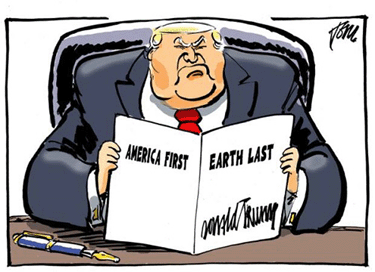
President Trump isn’t putting America first when his rhetoric and actions push us toward war with a nuclear-armed state. …….. http://www.cleveland.com/opinion/index.ssf/2017/09/president_trump_at_the_united.html