Mohammed bin Salman (commonly referred to as MBS) is on a historic visit – the first in nearly 75 years – to Saudi Arabia’s closest ally, the US. In an interview with The Wall Street Journal this week, he called for restrictions that would “create more pressure” on Tehran.
“If we don’t succeed in what we are trying to do [imposing sanctions on Iran], we will likely have war with Iran in 10-15 years,” MBS, who has become the true power behind his aging father, King Salman, said.
Tehran and Riyadh have clashed over various issues in recent years. The Syrian crisis – especially the future of Syria’s government under President Bashar Assad – remains one of the major stumbling blocks.
The trip to the US of the prince’s entourage and meeting with Donald Trump only added fuel to the fire amid already strained relations. Iran sees the whole tour as a cynical exercise in self-promotion ahead of Bin Salman’s assumed ascension to the Saudi throne.
Prior to his coast-to-coast US trip, in which he rubbed shoulders with top politicians and Silicon Valley executives, the 32-year-old Saudi prince said that his country would enter the nuclear arms race if Iran is ever successful in developing a weapon of mass destruction. He also called Iran’s supreme leader the “new Hitler.”
The Iranian Foreign Ministry described MBS as “delusional” and “naïve,” following his allegations that Iran is hosting Al-Qaeda leaders.
The oil-rich kingdom and the US – under President Trump – have repeatedly slammed the landmark 2015 Iranian nuclear deal. Trump seems to be advancing a plan to confront Saudi Arabia’s number 1enemy in the region.
According to Vladimir Sazhin, a senior research associate at the Institute of Oriental Studies of the Russian Academy of Sciences, by withdrawing from the Iranian nuclear agreement, “the US would become a pariah,” since the international community largely approves of the deal and confirms that Tehran is sticking to its obligations.
The Strategic Wisdom of Accommodating North Korea’s Nuclear Status
What if Washington came to terms with a nuclear North Korea but remained on the peninsula? The Diplomat , By Graham W. Jenkins, March 28, 2018
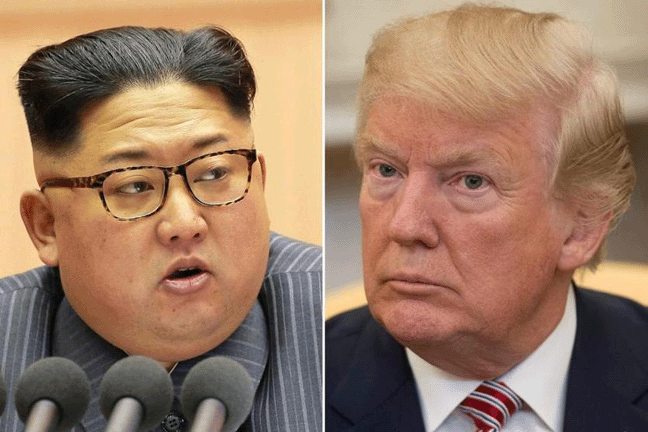
As the North Korean “crisis” continues to unfold, any negotiations, including the possible (albeit unlikely) Trump-Kim summit, represent a significant strategic opportunity for coming decades — even if today’s official policy goals are never achieved.
Pyongyang and Washington must come to terms with two realities: North Korea will not surrender its nuclear arsenal; the United States will not withdraw its support for South Korea. But once the U.S. policymaking apparatus accepts this, the aperture of the possible widens. By tacitly acquiescing to North Korea’s nuclear status — and in the process, securing concessions on advance warning and notifications, among other subjects — the United States could partially supplant China as a patron (in a limited sense), simultaneously shoring up peninsular stability and presenting China with a new security challenge on its own border, requiring the diversion of forces and materiel……..
There are significant drawbacks to outright recognition of North Korea as a nuclear state. Even though by withdrawing from the NPT, North Korea did not violate international law per se, openly admitting that any country can a) exercise Article X and withdraw from the NPT and then b) develop and test a nuclear arsenal, without suffering consequences for it, sets a troubling precedent, to put it mildly. But it is still possible to pursue a policy of splitting the needle: quietly accepting (not officially, but through nonofficial or track II diplomatic efforts) North Korea’s nuclear status while refusing to officially condone it. Such a tacit form of acceptance would also allow the United States to potentially extract concessions from Pyongyang and allow it to maintain its nuclear arsenal, all of which would serve to reduce its reliance on China as a client state, and instead allow it to chart a more independent path, but one in which the United States, China, and South Korea would still be able to deter any major crises.
……… It’s important, too, to condition any U.S. acknowledgement on North Korea making concessions. There is a broad range of requests that would represent positive policy outcomes, depending on the executive branch’s preferences. Advance notice of missile and nuclear testing (or even adherence to the Comprehensive Test Ban Treaty), establishing a “hotline” linking Pyongyang, Seoul, Washington, and Tokyo for crisis management, visible human rights changes like work camp prisoner releases or allowing humanitarian workers into the country, withdrawing artillery from the Kaesong Heights – some combination of these or others should be sufficient to justify changing U.S. policy toward North Korea’s nuclear weapons.
It’s rare that a nation is presented with a win-win-win scenario, but if bold enough to accept this manageable additional risk, the United States can emerge from this missile crisis in a stronger strategic position than before, with an adversary forced to reinforce an additional front and with our own hand strengthened. While the Trump-Kim summit – and indeed, any diplomatic efforts whatsoever – might now be a flight of fancy, with the ascension of John Bolton to national security advisor, negotiations remain the single best means of resolving the current Korean crisis. The United States stands to gain much: not least of all, avoiding a needless war.
National security veterans urge Trump not to scrap Iran nuclear deal, By Zachary Cohen, CNN March 27, 2018 Washington (CNN)A bipartisan group of more than 100 US national security experts — including nearly 50 retired military officers and more than 30 former ambassadors — is urging President Donald Trump to remain in the Iran nuclear deal as sources say it is becoming increasingly likely he will withdraw.
The statement titled “Keep the Iran deal — 10 Good Reasons Why” calls on Trump to “maintain the US commitment to the Iran nuclear deal” as doing so will “strengthen America’s hand in dealing with North Korea, as well as Iran, and help maintain the reliability of America’s word and influence as a world leader.”
“Ditching it would serve no national security purpose,” the statement said.
Penned by a group that calls itself the National Coalition to Prevent an Iranian Nuclear Weapon, the coordinated message comes as US officials are taking a two-track approach to the deal — negotiating with allies to make changes demanded by Trump even as they prepare to walk away from the international agreement.
Yes, John Bolton Really Is That Dangerous, NYT By THE EDITORIAL BOARD, MARCH 23, 2018
The good thing about John Bolton, President Trump’s new national security adviser, is that he says what he thinks.
The bad thing is what he thinks.
There are few people more likely than Mr. Bolton is to lead the country into war. His selection is a decision that is as alarming as any Mr. Trump has made. His selection, along with the nomination of the hard-line C.I.A. director, Mike Pompeo, as secretary of state, shows the degree to which Mr. Trump is indulging his worst nationalistic instincts.
Mr. Bolton, in particular, believes the United States can do what it wants without regard to international law, treaties or the political commitments of previous administrations.
He has argued for attacking North Korea to neutralize the threat of its nuclear weapons, which could set off a horrific war costing tens of thousands of lives. At the same time, he has disparaged diplomatic efforts, including the talks planned in late May between Mr. Trump and the North Korean leader, Kim Jong-un. He not only wants to abrogate the six-party deal that, since 2015, has significantly limited Iran’s nuclear program; he has called for bombing Iran instead. He has also maligned the United Nations and other multilateral conventions, as Mr. Trump has done, favoring unilateral solutions.
Over a 30-year career in which he served three Republican presidents, including as United Nations ambassador and the State Department’s top arms control official, Mr. Bolton has largely disdained diplomacy and arms control in favor of military solutions; no one worked harder to blow up the 1994 agreement under which North Korea’s plutonium program was frozen for nearly eight years in exchange for heavy fuel oil and other assistance. The collapse of that agreement helped bring us to the crisis today, where North Korea is believed to have 20 or more nuclear weapons. ……….
Mr. Bolton is certain to accelerate American alienation from its allies and the rest of the world. Congress may not be able to stop his appointment, but it should speak out against it and reassert its responsibilities under the Constitution to authorize when the nation goes to war.https://www.nytimes.com/2018/03/23/opinion/john-bolton-trump-national-security-adviser.html
Saudi Prince’s Nuclear Bomb Comment May Scuttle Reactor Deal, Bloomberg By Ari Natter
Fresh scrutiny for plan to build U.S. reactors in Saudi Arabia
Lawmakers say Saudis shouldn’t be allowed to enrich uranium
Opposition to a deal for the U.S. to provide nuclear power technology to Saudi Arabia is growing after Crown Prince Mohammed Bin Salman said the kingdom would develop a nuclear weapon if Iran did.
The potential for U.S. companies to participate in the construction of as many as 16 nuclear reactors sought by the kingdom has been seen as a potential lifeline to Westinghouse Electric Co. and others suffering from the flagging nuclear industry at home.
To further that effort, the Trump administration is said to be considering allowing the Saudis the right to enrich uranium, a break from the so-called “gold standard” included in the nuclear-sharing agreement with the United Arab Emirates, which allows power generation but prohibits the enrichment and reprocessing of uranium.
But that idea ran into a buzzsaw during a House hearing on Wednesday, with lawmakers from both parties saying prince’s admission that his country might seek to build nuclear weapons was cause to halt negotiations between the two nations. Energy Secretary Rick Perry met with Saudi officials earlier this month in London to begin talks on the deal. …….https://www.bloomberg.com/news/articles/2018-03-21/saudi-prince-s-nuclear-bomb-comment-may-scuttle-reactor-deal
State Department Approves $1 Billion Arms Sale With Saudi Arabia , Daily Caller HENRY RODGERS Political Reporter 24 Mar 18
The State Department announced it had approved the sales of more than $1 billion in arms to Saudi Arabia Thursday, which includes 6,700 missiles.
The announcement comes two days after President Donald Trump met with Saudi Arabia’s Crown Prince Mohammed bin Salman as part of a three week trip in the U.S. The Saudi Arabian government requested to purchase 6,700 U.S. built anti-tank missiles as well as supplies and parts for old tanks and helicopters, which the State Department approved.
The sale will “support U.S. foreign policy and national security objectives by improving the security of a friendly country, which has been and continues to be an important force for political stability and economic growth in the Middle East,” the Defense Security Cooperation Agency (DSCA) said in a statementThursday, adding it “will not alter the basic military balance in the region.”
One of the people MBS told about the discussion with Kushner was UAE Crown Prince Mohammed bin Zayed, according to a source who talks frequently to confidants of the Saudi and Emirati rulers. MBS bragged to the Emirati crown prince and others that Kushner was “in his pocket,” the source told The Intercept.
The Washington Post reported this week that former Secretary of State Rex Tillerson and National Security Adviser H.R. McMaster “expressed early concern that Kushner was freelancing U.S. foreign policy.” According to the Post, Tillerson once asked staffers in frustration: “Who is the secretary of state here?”
Indeed, Kushner has grown so close to the Saudi and Emirati crown princes that he has communicated with them directly using WhatsApp, a reasonably secure messaging app owned by Facebook and popular in the Middle East, according to a senior Western official and a source close to the Saudi royal family.
UNTIL HE WAS stripped of his top-secret security clearance in February, presidential adviser Jared Kushner was known around the White House as one of the most voracious readers of the President’s Daily Brief, a highly classified rundown of the latest intelligence intended only for the president and his closest advisers.
Kushner, who had been tasked with bringing about a deal between Israel and Palestine, was particularly engaged by information about the Middle East, according to a former White House official and a former U.S. intelligence professional. Continue reading →
La Libre 19th March 2018, More than 40 scientists, intellectuals, engineers and artists: “It is time
for the political world to assume Fukushima” (OPINION).It is time for the
political world to take its mistakes and put an end to the nuclear
industry.
This is not only illegitimate, but it is also an extreme threat
to our future. On June 25 last year, 50,000 people joined hands to demand
the closure of the Tihange plant. The number of protesters surprised many.
Also notable was the lack of reaction from the political world as a result
of this extraordinary event.
There are reasons for this apparent lethargy of the leaders of this country, in the face of this popular demonstration,
perhaps starting with a feeling of guilt, which would be quite appropriate.
Indeed, what has prevailed in the implementation of the nuclear industry is
the lack of democratic debate and false state propaganda, that of an energy
that would be unlimited, cheap and safe; as we recalled the commemoration
of the seventh anniversary of Fukushima, the second accident of a nuclear
power station which has no end, after that of Chernobyl in 1986.
More serious still, in 1960, the leaders of 16 European countries, including Belgium, agreed to sign the Paris Convention which was intended to limit the financial liability of the operator in the event of a nuclear accident, no insurance company willing to cover the nuclear risk considered too high.
Without this unique Convention, the nuclear industry could never have developed in Europe.
It is worth mentioning here that a major accident in Tihange would mean the end of life as we know it and, in fact, the end of Wallonia as a region. That the cost of such an accident would amount to
several trillions of euros, without it being possible to quantify the
sanitary and psychological misery into which the Walloons, sentenced,
either to leave their country abandoning all their property – but to go
where, or to live in a contaminated territory for the poorest of them. That
on this amount, the operator, Engie-Electrabel, would have to pay only 1.2
billion, less than its profit of certain years and less than one thousandth
of the cost of the disaster. http://www.lalibre.be/debats/opinions/plus-de-40-scientifiques-intellectuels-ingenieurs-et-artistes-il-est-temps-que-le-monde-politique-assume-fukushima-opinion-5aae9319cd702f0c1a63ffda
Times 18th March 2018, Ed Davey: Vladimir Putin’s ambitions have been evident for some time, but
the Conservatives’ position has long been incoherent and inconsistent.
During the coalition years, the Conservatives seemed torn between the
national security evidence of the country’s wrongdoings and the billions
of roubles it had to invest.
Russian industrial investment plans would
never have stood up to the sort of detailed scrutiny we gave to Chinese
ones. I was particularly astonished when David Cameron agreed to Putin’s
request that the Russian state nuclear power company, Rosatom, be
introduced to the UK’s civil nuclear power market and develop an
international consortium with Rolls-Royce.
Saudi energy deal push sparks nuclear weapon concerns,The Hill, BY REBECCA KHEEL – 03/18/18 Nuclear nonproliferation advocates are sounding the alarm about a potential nuclear energy deal between Saudi Arabia and the United States, saying the exceptions the kingdom is seeking could lead to nuclear proliferation in a volatile region.
At issue is a deal that would allow the United States to sell nuclear reactors to Saudi Arabia. The Trump administration has already started negotiations, with Energy Secretary Rick Perry reportedly meeting with senior Saudi officials in London last month.
Such deals, known as “123 agreements” after the section of the law that requires them, allow for transfers of nuclear material, equipment or components from the United States to another nation if the other country commits to a set of nine nonproliferation criteria.Saudi Crown Prince Mohammed bin Salman is visiting Washington next week and is sure to press President Trump on the issue.
But comments the crown prince made this week that Saudi Arabia would develop a nuclear bomb “as soon as possible” if Iran does are raising red flags for lawmakers who were already skeptical of the kingdom’s intentions.
“Saudi Arabia’s crown prince has confirmed what many have long suspected — nuclear energy in Saudi Arabia is about more than just electrical power, it’s about geopolitical power,” Sen. Ed Markey (D-Mass.) said in a statement. “The United States must not compromise on nonproliferation standards in any 123 agreement it concludes with Saudi Arabia.”
When the United States entered into a 123 agreement with the United Arab Emirates (UAE) in 2009, the UAE voluntarily agreed to prohibitions on enriching uranium or reprocessing spent fuel to produce plutonium — essential steps in producing nuclear weapons.
Such deals, known as “123 agreements” after the section of the law that requires them, allow for transfers of nuclear material, equipment or components from the United States to another nation if the other country commits to a set of nine nonproliferation criteria.
Saudi Crown Prince Mohammed bin Salman is visiting Washington next week and is sure to press President Trump on the issue.
That agreement has become known as the “gold standard” that nonproliferation advocates say should be part of all 123 agreements. …….
A House Foreign Affairs subcommittee is scheduled to hold a hearing on the potential agreement Wednesday, while Mohammed is still in town. Outside experts are slated to testify.
Rep. Ileana Ros-Lehtinen (R-Fla.), chairwoman of the subcommittee, said she expects the hearing to cover the status of Saudi Arabia’s nuclear plans, the implications of a deal without the gold standard and legislative options to increase congressional oversight “so that the U.S. can ensure national security interests always take precedence over political or commercial considerations in any future nuclear agreement.”
“The administration has been moving full speed ahead on its negotiations with Saudi Arabia regarding a potential 123 nuclear cooperation agreement, and unfortunately, Congress has been left mostly in the dark,” she said in a statement Friday. “The potential ramifications, including proliferation and the easing of enrichment and reprocessing restrictions, highlight the need for long-needed reforms to the outdated congressional review process.” http://thehill.com/policy/defense/378868-saudi-energy-deal-push-sparks-nuclear-weapon-concerns
“Saudi Arabia does not want to acquire any nuclear bomb, but without a doubt if Iran developed a nuclear bomb, we will follow suit as soon as possible,” Prince Mohammed bin Salman told CBS in a 60 Minutes interview that will air in the United States on Sunday.
He also reiterated previous comments he has made likening Iran’s supreme leader Ayatollah Ali Khamenei to Hitler.
“He wants to create his own project in the Middle East very much like Hitler, who wanted to expand at the time,” the prince says in the interview.
“Many countries around the world and in Europe did not realise how dangerous Hitler was until what happened, happened. I don’t want to see the same events happening in the Middle East.”
The Sunni Muslim kingdom has been at loggerheads with revolutionary Shi’ite Iran for decades. The countries have fought a long-running proxy war in the Middle East and beyond, backing rival sides in armed conflicts and political crises including in Iraq, Syria, Lebanon and Yemen.
Prince Mohammed, who also serves as Saudi defence minister, said last year that the kingdom would make sure any future struggle between the two countries “is waged in Iran”, prompting Iranian threats to hit back at most of Saudi Arabia except the holy cities of Mecca and Medina.
Riyadh has criticised the 2015 deal between world powers and Tehran under which economic sanctions on Iran were lifted in return for the Islamic Republic curbing its nuclear energy program. US sanctions will resume unless President Donald Trump issues fresh “waivers” to suspend them on May 12.
The comments by Prince Mohammed, who at 32 is heir to the throne, also have implications for Israel, another US ally which neither confirms nor denies the widespread assumption that it controls the Middle East’s only nuclear arsenal.
Israel has long argued that, should Iran develop nuclear weapons, it would trigger similar projects among the Persian power’s Arab rivals and further destabilise the region.
It has never joined the 1970 nuclear Non-Proliferation Treaty (NPT) and has said it would consider inspections and controls under the NPT only if was at peace with its Arab neighbours and Iran.
Civilian projects
Saudi Arabia is stepping up plans to develop a civilian nuclear energy capability as part of a reform plan led by Prince Mohammed to reduce the economy’s dependence on oil.
The world’s top oil exporter has previously said it wants nuclear technology only for peaceful uses but has left unclear whether it also wants to enrich uranium to produce nuclear fuel, a process which can also be used in the production of atomic weapons.
The United States, South Korea, Russia, France and China are bidding on a multi-billion dollar tender to build the country’s first two nuclear reactors.
Prince Mohammed’s comments, ahead of a trip to the United States next week, could impact the bid by a consortium that includes Toshiba-owned Westinghouse.
US companies can usually transfer nuclear technology to another country only if the United States has signed an agreement with that country ruling out domestic uranium enrichment and the preprocessing of spent nuclear fuel — steps that can have military uses.
In previous talks, Saudi Arabia has refused to sign up to any agreement that would deprive it of the possibility of one day enriching uranium.
Reactors need uranium enriched to around five percent purity but the same technology in this process can also be used to enrich the heavy metal to a higher, weapons-grade level. This has been at the heart of Western and regional concerns over the nuclear work of Iran, Saudi Arabia’s arch-rival which enriches uranium domestically.
Riyadh approved a national policy for its atomic energy programme on Tuesday, including limiting all nuclear activities to peaceful purposes, within the limits defined by international treaties.
“The JCPOA addresses one of the principle threats that we deal with from Iran, so if the JCPOA goes away, then we will have to have another way to deal with their nuclear weapons program,” said U.S. Army General Joseph Votel. JCPOA, or Joint Comprehensive Plan of Action, is the formal name of the accord reached with Iran in July 2015 in Vienna.
Trump has threatened to withdraw the United States from the accord between Tehran and six world powers unless Congress and European allies help“fix” it with a follow-up pact. Trump does not like the deal’s limited duration, among other things.
Votel is head of the U.S. military’s Central Command, which is responsible for the Middle East and Central Asia, including Iran. He was speaking to a Senate Armed Services Committee hearing on the same day that Trump fired Secretary of State Rex Tillerson after a series of public rifts over policy, including Iran.
Tillerson had joined Defense Secretary Jim Mattis in pressing a skeptical Trump to stick with the agreement with Iran.
“There would be some concern (in the region), I think, about how we intended to address that particular threat if it was not being addressed through the JCPOA. … Right now, I think it is in our interest” to stay in the deal, Votel said.
Trump under pressure over chaotic approach to North Korea nuclear talks, Guardian Jon Swaine 12 Mar 18
Republicans: denuclearisation must be prerequisite for meeting
CIA director and White House spokesman contradict each otherDonald Trump faced criticism from Republican allies on Sunday after apparentlyagreeing to meet Kim Jong-unwithout demanding that North Korea start scrapping its nuclear program.North Korea talks: Trump praises own role but Washington frets over details
Senators from Trump’s own party expressed scepticism and urged him to set tougher preconditions, amid growing concerns over the administration’s chaotic approach to nuclear diplomacy.
Senator Cory Gardner of Colorado said Trump should not meet Kim until North Korea produces proof it has begun reversing its years-long pursuit of a nuclear weapon.
“What we have to hear more of is how we are going to get to those concrete, verifiable steps towards denuclearisation before this meeting occurs,” Gardner told Face the Nation on CBS.
Trump’s team has given a series of muddled statements on that precondition. No mention of it was made during an abrupt announcement on Thursday that Trump was willing to hold a summit with Kim by May, in what would be the first ever meeting of the two countries’ leaders…….
The president has offered little clarity. After tweeting about conversations with world leaders on the issue he returned to it in a rambling speech to supporters in Pennsylvania on Saturday evening, saying of North Korean denuclearisation: “They are thinking about that – who knows what’s going to happen?”
The uneven public statements followed an eccentric unveiling of Trump’s historic acceptance of Kim’s invitation. The decision was announced to journalists on the White House driveway by a South Korean official, shortly after Trump’s secretary of state, Rex Tillerson, had said direct negotiations were a distant prospect.
Having lambasted Barack Obama for what they deemed an overly conciliatory approach to Iran during nuclear talks, Republicanswere left struggling to defend Trump’s position.
……. Democrats, too, expressed concerns. “I am very worried that he’s going to go into these negotiations and be taken advantage of,” Senator Elizabeth Warren of Massachusetts said on CNN.Warren said Trump should urgently address a lack of senior diplomats who would probably be needed for successful negotiations. The US has no permanent ambassador to South Korea or assistant secretary of state for the region.
That view was echoed by Ben Rhodes, a former senior aide to Obama, who was involved in the Iran deal and said the Trump administration appeared unprepared for discussions of similar gravity.
Trump’s nuclear summit with Kim ‘will have preconditions’ SMH, 12 Mar 18 Washington: US President Donald Trump’s condition for meeting North Korean leader Kim Jong-un is that there be no nuclear or missile testing, Treasury Secretary Steve Mnuchin said on Sunday.”There shouldn’t be confusion,” Mnuchin told NBC’s Meet the Press when asked about White House press secretary Sarah Sanders’ statement on Friday that there would be no meeting without concrete and verifiable actions by North Korea.
The President has made it clear that the conditions are that there’s no nuclear testing and there’s no missiles and those will be a condition through the meeting.”
North Korean leader Kim Jong Un provides guidance on a nuclear weapons program in this undated photo released by North Korea’s Korean Central News Agency (KCNA) in Pyongyang September 3, 2017. KCNA via REUTERS
North Korea’s Nuclear Ambitions And Abilities, NPR’s Renee Montagne talks with Siegfried Hecker, a former director of the Los Alamos National Laboratory, about North Korea’s nuclear program. National Public Radio. 11 Mar 18
………. HECKER: Well, first of all, I think it’s not very likely to happen, [the meeting between Trump and Kim] . What’s significant in the current situation is they’ve actually said that they would be willing to give up nuclear weapons, you know, if their security is assured, and they’re not threatened. However, to think that’s going to happen in the short term is just not realistic because to build a nuclear weapons program, it’s an enormous number of facilities. It’s a large number of people. It took, well, more or less 50 years but particularly the last 25 years to get to where they are today. They’re not going to turn that over overnight.
…….. MONTAGNE: Well, short of full denuclearization, what other steps could North Korea take to prove, you know, its sincerity in this?
HECKER: So there are very important steps. And one can lay those out. In other words, I look at the things that are highest risk. And those are the things you want them to stop first. So two that were highest on my list – they have, for the time being, said they would do a moratorium. And that’s no more missile tests and no more nuclear tests – because to increase the sophistication of your bombs, you have to do more nuclear tests. The next one would be not to make any more bomb-grade material, which means stop the operation of the reactors. All three of those are verifiable. The problem is on the bomb-grade material, you can also go the uranium route. Those are the centrifuge halls. We know where one of them is. We don’t know where the other one or two are. And that will be extremely difficult to verify. And that’s going to take a long time and a real detailed process with them to get there.
MONTAGNE: From what you know of North Korea from your time on the ground, are they motivated to use these weapons? Is this something to really be afraid of?
HECKER: What I worry about when it comes to the weapons is – one is capability. Second is motivation. And capability – for many years, I was able to say, look. You know, they have the bomb, but they don’t have much. They don’t have a nuclear arsenal. Then comes the motivation part. And would they be motivated to go ahead and attack the United States, Japan or South Korea basically out of the blue? I say absolutely not. They want those weapons to make sure to protect them. Perhaps they want the weapons so that they actually have sort of sufficient maneuvering room, you know, on the Korean Peninsula. What I’ve worried about is not so much that they’re motivated to attack us but rather that we’re going to stumble into a nuclear war.