America to impose “largest-ever” package of sanctions on North Korea
US imposes largest package of sanctions against North Korea, SMH, 24 Feb 18 US President Donald Trump says the United States will impose the “largest-ever” package of sanctions on North Korea, intensifying pressure on the reclusive country to give up its nuclear and missile programmes.
In addressing the Trump administration’s biggest national security challenge, the US Treasury sanctioned one person, 27 companies and 28 ships, according to a statement posted on the US Treasury Department’s website.
The Treasury’s Office of Foreign Assets Control announced the measures, which are designed to disrupt North Korean shipping and trading companies and vessels and to further isolate Pyongyang.
The ships are located, registered or flagged in North Korea, China, Singapore, Taiwan, Hong Kong, Marshall Islands, Tanzania, Panama and Comoros.
Washington “also issued an advisory alerting the public to the significant sanctions risks to those continuing to enable shipments of goods to and from North Korea.” ……….http://www.smh.com.au/world/us-imposes-largest-package-of-sanctions-against-north-korea-20180223-p4z1jp.html
Czech Republic wants Brussels to exempt nuclear project from strict EU rules on government bids.
If it fails, the Czech government is considering striking a nuclear deal with Russia along the same contentious lines as Hungary, which signed with Moscowlast year.
The second option would raise trouble for the Commission, which reluctantly approved Hungary’s Paks II nuclear project last year following long negotiations with Budapest. The decision was widely criticized for seeming to appeal to political interests over technical merits and is now being challenged by Austria for breaching EU state aid rules.
Austria and another Czech neighbor, Germany, strongly oppose any expansion of nuclear power in Europe……… https://www.politico.eu/article/dukovany-czech-risk-wrath-of-eu-over-nuclear-power-project/
The grave danger of USA permissively selling nuclear power to Saudi Arabia
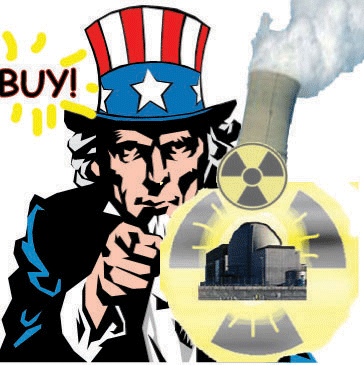
 No to a permissive US-Saudi nuclear deal, Bulletin of the Atomic Scientists, Victor Gilinsky, Henry Sokolski , 22 Feb 18,
Belated consultation with Ireland about Hinkley nuclear plant – may help Ireland to fight other UK nuclear plans
 Irish Examiner 21st Feb 2018, Yesterday’s announcement of a public consultation on the UK’s planned
Hinkley Point C nuclear power station, less than 250km from Rosslare is, to
a degree, reassuring but entirely welcome.
It is a victory of sorts for campaigners who worked tirelessly to have Irish voices heard in the
process. Those groups insist our Government should have opened a
consultation five years ago as is required under international conventions.
The victory may seem facile as construction is under way at Hinkley, a
€23bn project expected to be operational in five years.
The real value of the decision is that it means Irish concerns may influence decisions around
the other five nuclear plants in Britain’s planning pipeline. This
recognition will be especially important in post-Brexit Britain as the writ
of EU nuclear administrators will no longer prevail.
https://www.irishexaminer.com/breakingnews/views/ourview/nuclear-consultation-irish-concerns-will-be-heard-828994.html
Under UN conventions the peoples of neighbouring countries that could be affected by a nuclear project need to be consulted.
An Taisce 20th Feb 2018, An Taisce Welcomes Public Consultation UK Hinkley Point C, Nuclear Power
Plant. The (Irish) Government has today launched public consultations on the UK’s Hinkley Point C, nuclear power station, 5 years after it should have under UN Conventions.
The UK Government is building a nuclear power station, Hinkley Point C, on the north coast of Somerset, some 150 miles
(~242 km) from Ireland’s East Coast. Charles Stanley-Smith, An Taisce’s Communication Officer stated “These consultations have been hard won through court cases and escalation to the compliance committees of two
UNECE conventions on consultation rights and obligations.
This is the hard work of An Taisce, The Environmental Pillar and Friends of the Irish Environment and German MEP Ms Sylivia Kotting-Uhl” He continued “The peoples’ rights to these consultations will become increasingly important
in our ability to address transboundary impacts of UK projects on our environment, health and economy, into the future.
Under UN Conventions, the peoples of neighbouring countries that could be affected by a project need
to be consulted. Post Brexit, we may not be able to rely on EU law to safeguard us, but these are UN conventions For instance, the Irish people will now need to be consulted in terms of any other 5 proposed nuclear
power station on the UK’s west coast”
http://www.antaisce.org/articles/an-taisce-welcomes-public-consultation-uk-hinkley-point-c-nuclear-power-plant
Concern in USA Congress over Saudi Arabia’s real aims in going for nuclear energy
 Congress skeptical of Saudi nuclear energy demands, AL-Monitor February 21, 2018
After years of informal negotiations, the United States is facing mounting pressure to reach a civilian nuclear agreement with Saudi Arabia or risk getting shut out of the Gulf kingdom’s lucrative energy market.
But Riyadh’s refusal to give up on certain capabilities that could be used in a nuclear weapons program has caused concern among lawmakers that the Donald Trump administration may be too keen to strike a deal.
Under Section 123 of the US Atomic Energy Act of 1954, Congress must review any agreement to supply a foreign state with US nuclear technology. While the Trump administration has yet to publicly rule out any concessions, Saudi insistence on retaining the right to enrich uranium and to reprocess plutonium faces significant roadblocks on Capitol Hill.
“I think we have made clear — not that it was necessary — that a 123 agreement that in any way contemplated an enrichment program is going to face a lot of opposition in Congress,” a congressional source familiar with the debate told Al-Monitor. “So I just don’t think that the executive branch is going to go there.”……….
Energy Secretary Rick Perry visited Saudi Arabia and discussed Riyadh’s solicitation for bids to build its first two nuclear reactors late last year. Soon after, Bloomberg reported that the administration was actively considering a 123 agreement that would grant the Saudis wide latitude to pursue uranium enrichment and plutonium reprocessing.
Nonproliferation champions in Congress have been pushing back since. The Wall Street Journal reported this week that Sen. Ed Markey, D-Mass., who sits on the Senate Foreign Relations Committee, told the Saudi ambassador last month that he would force a floor vote and debate on any proposed 123 agreement with Riyadh.
“It seems crazy to loosen important nonproliferation standards just to try to secure an uncertain commercial deal,” Markey told the Journal………
“Members of the Saudi royal family have suggested that they may have an interest in nuclear weapons at some point in the future,” Daryl Kimball, the executive director of the Arms Control Association, told Al-Monitor. “There is considerable concern in Congress about any nuclear cooperation with Saudi Arabia that does not somehow make it harder for the Saudis to acquire enrichment and reprocessing technology in the future.”
……….. http://www.al-monitor.com/pulse/originals/2018/02/congress-skeptical-saudi-nuclear-energy-demands.html#ixzz57rsqvui8
Trump Might Bend Nuclear Security Rules To Help Saudi Arabia get nuclear power
For Saudi Arabia’s crown prince Mohammed bin Salman, the reactors are a matter of international prestige and power, a step toward matching the nuclear program of Shia rival Iran while quenching some of the kingdom’s domestic thirst for energy.
For the Trump administration, the contest poses a thorny choice between promoting U.S. companies and fighting nuclear proliferation. If the administration wants to boost the chances of a U.S. consortium led by Westinghouse, it might need to bend rules designed to limit nuclear proliferation in an unstable part of the world. That could heighten security risks and encourage other Middle Eastern countries to follow suit.
“If the Saudis were to get an agreement without restrictions, it would set a dangerous precedent in the region and [be] a significant break with American nuclear policy for the last 50 years,” said Jon Wolfsthal, a consultant on nuclear weapons who was a director for arms control and nonproliferation at the National Security Council under President Barack Obama.
The issue is a test of President Donald Trump’s foreign policy and his self-professed bargaining prowess. Trump, his son-in-law, Jared Kushner, and Energy Secretary Rick Perry have made pilgrimages to Riyadh to cozy up to the young crown prince and win big contracts for U.S. firms. Yet little has come to fruition.
The key rules governing nuclear sales to Saudi Arabia are spelled out in a document known as a 123 agreement, named after a section in the 1954 Atomic Energy Act.
The United States has 123 agreements with 23 countries, Taiwan and Euratom, a group of 27 nations. The 123 agreement for Saudi Arabia imposes limits on uranium enrichment and the reprocessing of spent fuel, both of which could be used to produce material for nuclear bombs.
Saudi Arabia has argued that it should be free to mine and enrich its own uranium deposits, as long as it abides by the international Non-Proliferation Treaty,which bars the diversion of materials to a weapons program. The China National Nuclear Corp. has signed preliminary agreements with the Saudis to explore nine potential uranium mining areas. Former intelligence chief Prince Turki al-Faisal told Reuters in December that Saudi Arabia would “have the same right as the other members of the NPT, including Iran.”
Mohammed, who harbors ambitions for an invigorated, more diverse Saudi economy, invited foreign firms to submit proposals last fall. In mid-November, executives from the world’s five leading nuclear reactor design and construction firms – including the Pennsylvania-based Westinghouse – made presentations to Saudi officials.
Khalid Al-Falih, Saudi Arabia’s energy and natural resources minister, told Reuters on Dec. 20 that he aims to sign contracts by year’s end.
Henry Sokolski, the executive director of the nonprofit Nonproliferation Policy Education Center who served in President George H.W. Bush’s Pentagon, asked, “How do we feel about the stability of the kingdom? The reactors are bolted to the ground for a minimum of 40 years and a maximum of 80 years. That’s enough for the whole world to change.”
But others say that if the United States doesn’t build the reactors, then Russia’s Rosatom or the China Nuclear Engineering and Construction Group will, providing fewer safeguards against proliferation and eroding U.S. diplomatic strength in the region.
“I would prefer to have America’s nuclear industry in Saudi Arabia than to have Russian or China’s, so I think it’s useful that we’re reengaging with the Saudis. We should try to get the best restraints on enrichment and reprocessing, including a ban for some significant length of time, say 20 or 25 years,” said Robert Einhorn, a senior fellow at the Brookings Institution and a former State Department adviser for nonproliferation and arms control. “We should show some flexibility.”
The need to build nuclear reactors in Saudi Arabia, which has the world’s largest petroleum reserves, isn’t obvious. The kingdom says it wants to curtail the burning of oil to generate electricity at home. Doing so would free up more oil for exports, the kingdom’s main source of revenue.
Saudi electricity consumption doubled between 2005 and 2015. During the peak summer months, when temperatures soar past 120 degrees Fahrenheit, the kingdom burns about 700,000 barrels of oil a day for air conditioning. Add industrial and transportation use, and Saudi Arabia’s domestic crude consumption has neared 3 million barrels a day, more than a quarter of its total output.
Prestige is another lure for Saudi Arabia. Its smaller oil-rich neighbor, the United Arab Emirates bought four South Korean-model nuclear reactors now under construction.
“If ever there was a place that could take care of own energy needs without nuclear, it’s the UAE,” said F. Gregory Gause, a professor of international affairs at Texas A&M University. “I think it becomes a prestige thing, like international airports.”
But the UAE also signed a 123 agreement in January 2009 that is called the gold standard. It agreed not to enrich or reprocess – although a passage says it could reconsider if others in the region start doing so. It plans to buy uranium from the United States and ship spent fuel to Britain or France for reprocessing.
For Saudi Arabia, the UAE’s gold standard set a high bar. “During the Obama administration, we were at an impasse,” said Gary Samore, a former White House arms control coordinator now at Harvard’s Kennedy School of Government. “We wanted them to make a commitment similar to what Abu Dhabi did. We never overcame that issue in our negotiations.”
South Korea’s President Moon urges U.S., North Korea, to talk
 Moon urges U.S., North to talk, Korea JoonGang Daily 19 Feb 18
That is the key to a summit in Pyongyang, Blue House maintains President Moon Jae-in said Saturday it is premature to talk about an inter-Korean summit, making clear that Washington and Pyongyang have to get closer to talking before that can take place.
“Anticipations are high, but I think it is too impetuous,” Moon said when a reporter asked if he will hold a summit with North Korean leader Kim Jong-un. “It’s like the old Korean saying that you are looking for hot water from a well.”
Kim sent his younger sister Kim Yo-jong to South Korea as a special envoy and she delivered an invitation to Moon on Feb. 10 to visit Pyongyang. Moon has yet to formally accept. Moon told his North Korean visitor: “Let’s create the environment for that to be able to happen.” …..
Moon said he is satisfied that various goals he set for the Olympics are being achieved. “One of the most important goals was prompting peace through the PyeongChang Olympics,” he said. “North Korea’s participation successfully eased tensions on the peninsula and the inter-Korean team and joint cheerleading impressed the world.
“Because inter-Korean talks made significant accomplishments, I have expectations for more improvement,” Moon said.
“Consensus is growing that dialogue between the United States and North Korea is necessary,” he said. “We are expecting that the ongoing talks between the two Koreas will lead to talks between the United States and the North and eventually denuclearization talks.”……..
Moon’s attempt to arrange a meeting between chief delegates of the United States and North Korea on the sidelines of the Olympics’ opening ceremony failed very publicly, with U.S. Vice President Mike Pence refusing to engage with the North Korean visitors at a reception and in the viewing box of the opening ceremony. But U.S. officials are increasingly indicating their willingness to talk to the North………http://koreajoongangdaily.joins.com/news/article/article.aspx?aid=3044665
A South Korean province considers co-hosting the 2021 Asian Winter Games with North Korea


 South Korea official floats idea of co-hosting Asian Games with North, SBS News 18 Feb 18
PYEONGCHANG, South Korea (Reuters) – A South Korean province is considering a proposal to co-host the 2021 Asian Winter Games with North Korea in a bid to strengthen inter-Korean ties, South Korea’s Yonhap News Agency said on Saturday, quoting provincial governor Choi Moon-soon.
Gangwon province, host for the current 2018 Pyeongchang Winter Olympics, is considering the idea also as a way of making further use of Olympics venues, Choi was quoted as saying.
North Korea is participating in the Pyeongchang Games at the invitation of the South, which is using them to help ease tensions between the two countries, still technically at war.
The host city for the 2021 event has not been decided yet.
A spokesman for South Korea’s sports ministry said it “hopes to continue sports exchanges with North Korea after the Winter Games” but it had not yet discussed any bid for the 2021 Games……..https://www.sbs.com.au/news/south-korea-official-floats-idea-of-co-hosting-asian-games-with-north
France’s Electricite de France (EDF) boasts new cheaper nuclear reactor – makes Hinkley C nuclear project look unwise.
 Times 17th Feb 2018, EDF has claimed that a new nuclear reactor it is developing will be a
better and cheaper version of the two it is building in Britain. The
state-owned French energy group said that its “optimised” version of the
European Pressurised Reactor being installed at Hinkley Point in Somerset
would be unveiled in 2020 and was destined initially for the French market.
A spokeswoman said that the optimised reactor would be between 25 per cent
and 30 per cent cheaper than the existing version. It is scheduled to be
available for use from 2030. The newspaper Le Monde reported that the new
reactor could cost as little as 6 billion euros or £5.3 billion.
The cost of the two reactors due to come on stream at Hinkley Point in 2025 is
£19.6 billion. Any improvements in EDF’s reactors would raise more
questions about the sustainability of the Hinkley Point C project and
another power station at Sizewell, Suffolk.
However, British experts derided the announcement of an optimised and cheaper reactor as a sign of
the French company’s desperation. Paul Dorfman, founder of the Nuclear
Consulting Group, said EDF’s claim that costs could come down “goes against
all technological logic”. He dismissed the claim as a public relations
exercise to avert a plunge in EDF’s credit rating and as an attempt to woo
President Macron, who is strongly in favour of nuclear power.
https://www.thetimes.co.uk/edition/business/edf-promises-nuclear-reactors-cheaper-than-hinkley-points-9nvq0crlq
Netanyahu says Israel could act against Iran’s ’empire’
Robin Emmott, Thomas Escritt 18 Feb 18 MUNICH (Reuters) – Prime Minister Benjamin Netanyahu said on Sunday that Israel could act against Iran itself, not just its allies in the Middle East, after border incidents in Syria brought the Middle East foes closer to direct confrontation……… https://www.reuters.com/article/us-germany-security-israel-iran/netanyahu-says-israel-could-act-against-irans-empire-idUSKCN1G20C8?feedType=RSS&feedName=newsOne
North Korea wants to mend relations with South Korea – but also to continue nuclear military development
North Korea seeks easing tensions, but vows to advance nuclear power Nikkei Asian Review, 16 Feb 18, BEIJING (Kyodo) — North Korea called on South Korea on Friday to abandon its joint military drills with the United States to improve inter-Korean ties further, while reiterating its eagerness to advance its nuclear capacity to make the country a military power.
“To mend relations between the north and the south and to make a breakthrough toward the unification, military tensions should be reduced as a matter of first priority,” it said in its editorial published on the 76th anniversary of former leader Kim Jong Il’s birth.
Pyongyang has been steadfastly opposed to the annual joint military drills, describing them as preparations for invasion.
The official newspaper of North Korea’s ruling Workers’ Party, meanwhile, said in an editorial Friday that Pyongyang has become a nuclear power thanks to earnest efforts by Kim Jong Il, father of the current leader Kim Jong Un.
“We have to boost our prestige as the world’s strongest nuclear nation,” the Rodong Sinmun, North Korea’s most influential newspaper, said, indicating Pyongyang is still intending to develop nuclear weapons despite a thaw with the South.
Relations between the two Koreas are apparently improving after North Korea decided to join the Pyeongchang Winter Olympics, which began late last week. Through high-level delegates including his sister, Kim Jong Un has invited South Korean President Moon Jae In to visit Pyongyang for a summit.
Washington and Seoul have agreed to suspend their joint military drills until the March 18 end of the Paralympics, to which North Korea has pledged to send its athletes.
Pyongyang, however, has so far shown no sign of giving up its missile and nuclear development programs despite facing U.N. sanctions that ban it from developing or testing nuclear and ballistic missile technology…….https://asia.nikkei.com/Politics-Economy/International-Relations/North-Korea-seeks-easing-tensions-but-vows-to-advance-nuclear-power
It is not wise to be cynical about North Korea’s thawing mood
The West risks missing a chance at peace if it continues to treat North Korea’s change of heart with cynicism Could it be that Trump’s bombast over the airwaves cut through in Pyongyang in a way that conventional diplomacy had failed to do? The Independent UK, Mary Dejevsky @IndyVoices 16 Feb 18
“”…………The mixed messages about the North Korean skaters, however, highlighted – or so it seemed to me – something else: a reluctance on the part of the foreign policy establishment, including the media, to look good news in the face, especially when it has not been expected.
How long ago was it –in fact, a bare six weeks – that Kim Jong-un and the US President were trading very public, very macho, insults, culminating in Donald Trump’s memorable boast that his nuclear button was “much bigger and more powerful” than Kim’s and, what is more, “my button works”.
Even the most hardened pessimist would have to admit that between then and now there has been something of a mood swing. Less than three weeks after the “big button” exchange, North Korea suddenly acted on overtures in Kim’s New Year address to broach talks with the South, and even participated in the Olympics. The IOC delayed its deadline for entries, permitted North Korea’s participation, and the next thing we knew was that North and South were concocting a joint ice hockey team, the North’s nonagenarian de facto head of state was on his way to Seoul, and Kim announced that his sister – his sister – would be going to the opening ceremony, too.
Far from hailing these developments as the possible start of a North-South thaw, however, the Western response seemed – to me, at least, – both fearful and curmudgeonly. Kim Jong-un was suspected of the basest of motives. Might he not be deviously stringing the South along, it was asked, just waiting to demand all sorts of impossible concessions at the last moment that would cast the Seoul government as the villain if it refused?
And was Kim not also staging a vast military parade in Pyongyang on the eve of the official Olympic opening? Well, of course, he was. No self-respecting national leader, least of all an autocrat in the mould of Kim, can be seen to be weak in front of his own people. Shows of strength have a habit of going hand in hand with diplomatic U-turns.
As the North Korean nuclear threat vanished from the headlines, however, it was only to be replaced with another menace from the North. Kim’s very presentable little sister, Kim Yo-jong, was accused of stealing the limelight, diluting the world’s attention that should have been Seoul’s, and presenting an image of the North that was scandalously at odds with the cruel and earth-scorched reality. Don’t allow yourself to be fooled, was the message.
That she was received in Seoul at the highest level and filmed handing over an invitation to President Moon Jae-in to visit Pyongyang was also somehow seen as out of order, another trick to gain diplomatic advantage. Surely it would all turn sour even before the Olympic glow over the South had faded. The North Korean threat was still there.
Far from hailing these developments as the possible start of a North-South thaw, however, the Western response seemed – to me, at least, – both fearful and curmudgeonly. Kim Jong-un was suspected of the basest of motives. Might he not be deviously stringing the South along, it was asked, just waiting to demand all sorts of impossible concessions at the last moment that would cast the Seoul government as the villain if it refused?
And was Kim not also staging a vast military parade in Pyongyang on the eve of the official Olympic opening? Well, of course, he was. No self-respecting national leader, least of all an autocrat in the mould of Kim, can be seen to be weak in front of his own people. Shows of strength have a habit of going hand in hand with diplomatic U-turns.
As the North Korean nuclear threat vanished from the headlines, however, it was only to be replaced with another menace from the North. Kim’s very presentable little sister, Kim Yo-jong, was accused of stealing the limelight, diluting the world’s attention that should have been Seoul’s, and presenting an image of the North that was scandalously at odds with the cruel and earth-scorched reality. Don’t allow yourself to be fooled, was the message.
That she was received in Seoul at the highest level and filmed handing over an invitation to President Moon Jae-in to visit Pyongyang was also somehow seen as out of order, another trick to gain diplomatic advantage. Surely it would all turn sour even before the Olympic glow over the South had faded. The North Korean threat was still there.
Nor should the use by potentates – and not just potentates – of close relatives as personal representatives and trusted go-betweens – be discounted as a ploy. Rather than being designed to detract from the South’s Olympic show, Kim Jong-yo’s trip to Seoul might rather be seen as evidence of her brother’s serious intent and esteem.
And what might have changed the equation? How about the US Secretary of State’s low-key offer of direct talks without preconditions that he made in December? Repeated in Seoul by Vice-President Mike Pence this week (once he had done cold-shouldering the North Koreans for the benefit of the US audience back home), this is what first broke the deadlock. There have been concessions on all sides.
So while the doomwatchers see the Olympic thaw as, at best, a deceptive interlude before the nuclear stand-off inevitably resumes, I would argue, for more optimism. A basis has been laid for detente; there is a real chance now to step back from the brink. The risk now is less that the North is insincere, than that suspicion and cynicism everywhere cause this chance to be missed. http://www.independent.co.uk/voices/north-korea-war-nuclear-us-uk-europe-world-peace-conflict-a8212656.html
Has the softening of North Korea’s image made it harder for the USA hawks to strike?
Has North Korea’s week at the Winter Olympics diminished the nuclear threat? Guardian, Tania Branigan, 15 Feb 18, “……Pyongyang has no intention of giving up its nuclear programme, as Washington demands. Although it has in the past committed itself to peaceful reunification, no one believes it is willing to change in the way that it would be needed. The real issue is that the doomsday clock is ticking closer to midnight since the election of Donald Trump – and any attempt to halt the hands is welcome.
The North is increasingly close to developing a nuclear-tipped ICBM that can hit the continental US. Washington knows it cannot destroy all the country’s capabilities – so hawks are now arguing for a “bloody nose” strategy to warn Kim Jong-un off threatening the US (though he must know any attack would be suicidal). Seoul, just 35 miles from the border, would bear the brunt of any retaliation. A conflict could kill tens of thousands and potentially draw in other regional powers, including China.
The task of Kim Yo-jong and the bevy of cheerleaders has been to normalise the image of a country that looks utterly abnormal to outsiders. ………
Kim has cemented his position, in part through tighter control. He purged and executed his uncle Jang Song-thaek; and he is believed to have ordered the killing of his self-exiled brother, Kim Jong-nam, a year ago. There have been repeated crackdowns on smuggled – especially South Korean – media.
On the other hand he has promised his people a return to prosperity, and though this has mostly been signalled by totemic projects such as a ski resort, there have been some broader economic shifts, such as an increase in marketisation, apparently producing modest improvements in the economy. And, in dispatching the Olympic delegation, and then inviting the South Korean president Moon Jae-in to visit him, he has shown he can reduce tensions as well as increase them.
Sending his sister was doubly inspired. A family member is a more intimate representative than a high-ranking official. And for a patriarchal culture, Kim Yo-jong and the cheerleaders are – by virtue of gender – not only charming and unthreatening but somehow morally elevated, detached from worldly, manly concerns of power (never mind that, in reality, Kim is at the heart of her brother’s regime). ……..
Quiet diplomacy brought South and North Korean athletes together for the Winter Olympics
The Quiet Diplomacy to Save the Olympics in a Nuclear Standoff, NYT.
1 This Month
26 September – International Day for the Total Elimination of Nuclear Weapons





PLEASE OPPOSE HR 8255 AND S.3639 – bills would accelerate satellite deployment, with no environmental review or safeguards – https://ncstd5li.quorum.us/campaign/169331/
To see nuclear-related stories in greater depth and intensity – go to https://nuclearinformation.wordpress.com
-
Archives
- September 2026 (313)
- August 2026 (330)
- July 2026 (355)
- June 2026 (287)
- May 2026 (306)
- April 2026 (356)
- March 2026 (251)
- February 2026 (267)
- January 2026 (308)
- December 2025 (358)
- November 2025 (359)
- October 2025 (375)
-
Categories
- 1
- 1 NUCLEAR ISSUES
- business and costs
- climate change
- culture and arts
- ENERGY
- environment
- health
- history
- indigenous issues
- Legal
- marketing of nuclear
- media
- opposition to nuclear
- PERSONAL STORIES
- politics
- politics international
- Religion and ethics
- safety
- secrets,lies and civil liberties
- spinbuster
- technology
- Uranium
- wastes
- weapons and war
- Women
- 2 WORLD
- ACTION
- AFRICA
- Atrocities
- AUSTRALIA
- Christina's notes
- Christina's themes
- culture and arts
- Events
- Fuk 2022
- Fuk 2023
- Fukushima 2017
- Fukushima 2018
- fukushima 2019
- Fukushima 2020
- Fukushima 2021
- general
- global warming
- Humour (God we need it)
- Nuclear
- RARE EARTHS
- Reference
- resources – print
- Resources -audiovicual
- Weekly Newsletter
- World
- World Nuclear
- YouTube
-
RSS
Entries RSS
Comments RSS

