Hanoi nuclear summit: Where were the women?
This is a far cry from previous administrations that had women running or helping to run nuclear negotiations—Madeleine Albright, Condoleezza Rice, Wendy Sherman, and Rose Gottemoeller, to name a few.
No doubt, there were women present at the margins in Hanoi. White House Press Secretary Sarah Huckabee Sanders was in the room with Vietnamese officials when the Trump administration pitched arms exports from the United States to their hosts. Kim Yo-jong—Kim Jong-un’s younger sister—was spotted holding an ashtray for the North Korean leader and mostly stayed not more than a few feet from her brother throughout the summit. Other women were serving in support roles back in Washington, but that’s not the same as being at the table.
So who are the women that have been most involved in the Trump-Kim summit process so far?……..
By excluding women from active negotiating roles, Washington and Pyongyang reduced their possible chances for success. There is no excuse for this, as there are scores of women experts on North Korea nuclear policy, and more who focus on the peace process. For example, Women Cross DMZ—a group of female activists working to achieve a peaceful end to the Korean conflict—places a special emphasis on the role that women should play in peace negotiations. Their philosophy is not baseless. According to research, peace agreements that are signed by women feature higher-quality content and higher rates of implementation than those not signed by women, and therefore lead to longer-lasting agreements. On the whole, women are also more likely to insist that parties stay at the table until an agreement is made. There were a lot of factors that played into the outcome (or lack thereof) of the summit in Hanoi, but to ensure future success, leaders in Washington and Pyongyang should think about bringing more women to the next negotiations. …… https://thebulletin.org/2019/03/hanoi-summit-where-were-the-women/?utm_source=Bulletin%20Newsletter&utm_medium=iContact%20email&utm_campaign=WomenatSummit_030720
Need for a prcactical treaty to cap and eliminate nuclear cruise missiles
These cruise missiles also can be armed with conventional explosives, and there is no way to distinguish nuclear from non-nuclear ones when they are in flight. Such ambiguity erases the line between conventional and nuclear weapons, and increases the likelihood of accidental Armageddon. This is precisely why, in 1987, Ronald Reagan and Mikhail Gorbachev urgently made progress in eliminating them.
We can, and must, seek to repeat their historic achievement today. We need to remember that arms control is not a pollyannaish exercise, but rather a potent tool of hard national security……….
Recently, Russia’s top arms control diplomat said Russia stands ready for talks on a possible successor to the INF Treaty. “We are ready for dialogue,” said Deputy Foreign Minister Sergei Ryabkov. “If the U.S. is interested, it should spell out its proposal.”
Since it appears nobody has done so, let’s spell it out. Our next agreement should focus less on overall numbers and, instead, seek to cap and eliminate the single most dangerous and destabilizing class of nuclear weapons: all nuclear-tipped cruise missiles of any range. We should start “cruise control” negotiations bilaterally between the United States and Russia, and leave room for other countries that have not yet deployed such systems — including China, India and Pakistan — to join now or later.
For three years, my colleagues and I have been laying the groundwork for such an ambitious global effort to cap and eliminate nuclear cruise missiles. In private talks with current and former senior officials from the United Kingdom, Russia, China, Germany, Japan and other key countries, we have found broad support and enthusiasm for this approach. ……… https://thehill.com/opinion/national-security/433075-nuclear-cruise-control-can-stop-a-spiraling-new-arms-race
Nuclear threat still hangs over India and Pakistan
|
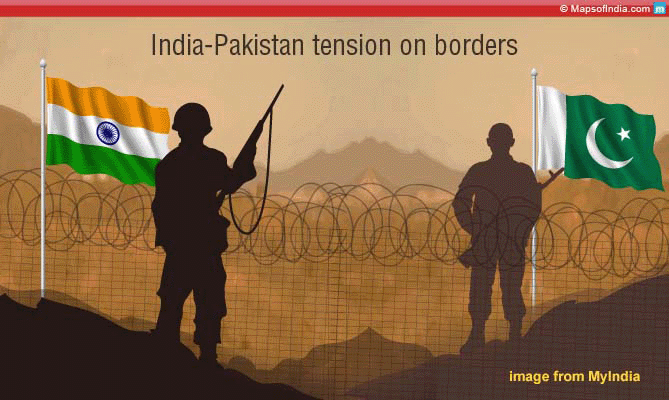
Crisis may be easing, but nuclear threat still hangs over India and Pakistan, Analysis by Brad Lendon, CNN, March 4, 2019 Hong Kong Tensions on the border between India and Pakistan last week pushed the two nuclear-powered South Asian adversaries closer to conflict than at any point in the past two decades.
|
|
|
International Atomic Agency would require Saudi Arabia to have the same nuclear safeguards as Iran has
Before Saudi Arabia Goes Nuclear, It May Have to Follow Iran’s Lead, Bloomberg, By Jonathan Tirone March 7, 2019,
- Kingdom has yet to clinch enhanced atomic monitoring deal
- World powers are meeting with Iran on Wednesday in Vienna.
“………Focus on Saudi Arabia’s nuclear program has risen in the last month after the U.S. Congress opened an investigation into the potentially illegal transfer of sensitive technologies to the kingdom. This week the International Atomic Energy Agency, responsible for verifying that countries don’t divert material for weapons, weighed in on what its inspectors need before the kingdom can start generating nuclear power.
Focus on Saudi Arabia’s nuclear program has risen in the last month after the U.S. Congress opened an investigation into the potentially illegal transfer of sensitive technologies to the kingdom. This week the International Atomic Energy Agency, responsible for verifying that countries don’t divert material for weapons, weighed in on what its inspectors need before the kingdom can start generating nuclear power.
Riyadh’s nuclear program is developing “based on an old text” of safeguard rules, even as it expects to complete its first research reactor this year and plans to tap uraniumreserves, according to IAEA Director General Yukiya Amano, who told journalists this week in Vienna that he’s “appealing to all countries to rescind” those old ways of doing business.
“We’re encouraging all countries to conclude and implement an additional protocol and that includes Saudi Arabia,” said Amano, who’s also in charge of enforcing the 2015 nuclear deal struck between Iran and world powers. The Japanese career diplomat has called the set of rules established by that accord, which U.S. President Donald Trump withdrew from in May, as “the most rigorous monitoring mechanism ever negotiated.”……
the IAEA comments could strike a precautionary note among vendors lining up to service the kingdom’s nuclear ambitions. Receiving the imprimatur of IAEA inspectors, who account for gram-level quantities of nuclear material worldwide, is a precondition for receiving technologies and fuel. Without reaching a new understanding with monitors, Saudi plans for 3.2 gigawatts of atomic power by the end next decade could flounder. …….
Maintaining that level of IAEA access to Iran’s nuclear program is the reason that China, France, Germany, Russia and the U.K. continue to defy U.S. calls to abandon the 2015 deal and reimpose sanctions. Diplomats from those countries convened Wednesday in Vienna in their first meeting since the European Union established a trade channel to skirt U.S. threats.
Snap Inspections in Iran
IAEA complementary access to sites rose under agreement with world powers……https://www.bloomberg.com/news/articles/2019-03-06/before-saudi-goes-nuclear-it-may-have-to-follow-iran-s-lead
Lithuania wants Belarus to convert its Russian-built nuclear power plant to gas
Lithuania to ask Belarus to switch nuclear plant to gas VILNIUS (Reuters) 6 Mar 19, – Lithuanian prime minister Saulius Skvernelis will ask Belarus to convert its Russian-built nuclear power plant to gas provided by Lithuania’s liquefied natural gas (LNG) terminal and a planned gas link between Lithuania and Poland.
The nearly-completed nuclear plant has long been viewed as a threat to its safety and national security by Lithuania, which says it is not built to the highest safety standards, an allegation which is denied by Belarus.
Astravets, which is near the border with Lithuania, is being built by Russia’s Atomstroyexport and financed with a $10 billion loan from by Moscow. It expects to have the first of its two 1.2 gigawatt VVER 1200 reactors online this year and the next one in 2020.
“It’s up to Belarus to make a choice: to keep on having an energy sector which depends on the policies of a single country, or to make a strategic change,” Skvernelis said on Monday, without naming Russia, the dominant supplier of energy to Belarus.
“Lithuania could be a good example and a useful partner for Belarus,” he added.,………
Reporting by Andrius Sytas; Editing by Alexander Smith https://www.reuters.com/article/us-baltics-energy/lithuania-to-ask-belarus-to-switch-nuclear-plant-to-gas-idUSKCN1QL163
South Korean President Moon Jae-in praised North Korea’s offer to dismantle a key nuclear production complex

 Moon Lauds North Korea’s Nuclear Offer, Splitting With Trump, Bloomberg, By Youkyung Lee, March 4, 2019,
- He says a ‘partial’ sanctions lift was discussed in Hanoi
- Moon says Trump, Kim should meet soon to reach agreement
South Korean President Moon Jae-in praised North Korea’s offer to dismantle a key nuclear production complex as an “irreversible” step to undercut its weapons program, breaking with the Trump administration.
In a meeting to discuss the summit last week in Hanoi between Donald Trump and Kim Jong Un, Moon on Monday lauded North Korea’s offer to dismantle the Yongbyon nuclear complex. He also called for pushing ahead with inter-Korean projects currently hindered by sanctions and said the two sides discussed the “partial” lifting of sanctions — backing North Korea’s version of events…….
Moon has endeavored to serve as a bridge between Trump and Kim, and has staked political capital on bringing peace to the divided peninsula. ….
International Atomic Energy Agency chief again confirms that Iran is keeping to the nuclear deal

 Head of UN nuclear agency: Iran keeping to nuclear deal, https://www.foxnews.com/world/head-of-un-nuclear-agency-iran-keeping-to-nuclear-deal4 Mar 19, BERLIN – The head of the U.N. nuclear watchdog says Iran is complying with the 2015 deal with major world powers aimed at preventing the country from building nuclear weapons.
Yukiya Amano made his assessment in a regular update to the International Atomic Energy Agency’s board of governors, confirming a confidential report distributed to member states last month.
He said Monday that “Iran is implementing its nuclear-related commitments under the Joint Comprehensive Plan of Action,” referencing the official name of the 2015 deal.
The U.S. unilaterally withdrew from the deal last year and re-imposed sanctions.
The other signatories — Germany, France, Britain, Russia and China — are trying to keep alive the deal, which offered Iran economic incentives.
Vladimir Putin signs decree suspending Russia’s membership of Intermediate-Range Nuclear Forces Treaty (INF)
Russia officially suspends INF Treaty with US, https://www.aljazeera.com/news/2019/03/russia-officially-suspends-inf-treaty-190304143410145.html
Vladimir Putin signs decree suspending Russia’s obligations under key nuclear arms pact with US. Russia’s President Vladimir Putin has signed a decree suspending Moscow’s participation in a key Cold War-era nuclear arms control treaty, following a similar move by the United States.
In a statement on Monday, the Kremlin said the suspension would last until the US “ends its violations of the treaty or until it terminates”.
In February, Washington gave notice of its intention to withdraw from the landmark 1987 Intermediate-Range Nuclear Forces Treaty (INF), which was established as a major safeguard against nuclear war.
The move by US President Donald Trump set the stage for the bilateral pact’s termination in six months.
Washington accuses Moscow of developing and deploying a cruise missile that violates provisions of the treaty that ban the production, testing and deployment of land-based cruise and ballistic missiles that have a range between 500km and 5,500km.
US officials have also expressed concerns that China, which is not party to the pact, was gaining a significant military advantage in Asia by deploying large numbers of missiles with ranges beyond the treaty’s limit.
Russia has denied any breaches, instead, charging that it was the US that had flouted the pact by deploying missile defence facilities in Eastern Europe that could fire cruise missiles instead of interceptors.
Washington rejects the claim.
The collapse of the treaty has stoked fears of a replay of a Cold War-era European missile crisis during the 1980s, when the US and the Soviet Union both deployed intermediate-range missiles on the continent.
Putin has previously said Russia would seek to develop medium-range missiles, but would not deploy them in the European part of the country or elsewhere unless the US does so.
NATO has supported the US’s decision to withdraw from the pact, but many European leaders have voiced fears over the consequences of its demise.
China has also urged Russia and the US to preserve the treaty.
Despite U.S. Congress’s concerns, Trump is still pushing for sale of nuclear technology to Saudi Arabia
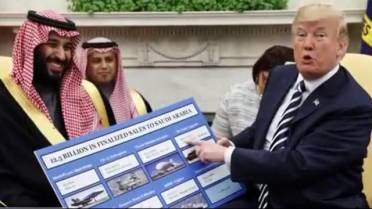 Team Trump Keeps Pushing Deal to Send Nuclear Tech to Saudis
Congress raised ‘grave concerns’ about the Trump administration’s past attempts to send nuclear technology to the Saudis. But Team Trump isn’t done trying. The Daily Beast, Erin Banco, Betsy Woodruff 03.04.19 The Trump administration is still actively working to make a deal to send U.S. nuclear technology to Saudi Arabia, according to two U.S. officials and two professional staffers at federal agencies with direct knowledge of those conversations. American energy businesses are still hoping to cash in on Riyadh’s push for energy diversification,
Punjab Chief Minister Amarinder Singh warns on Pakistan’s readiness to use nuclear weapons
|
Pakistan will not hesitate to go nuclear in war with India: Amarinder Singh, “Whether it was one killed or 100, the message has gone out loud and clear that India will not let the killing of its soldiers and citizens go unpunished,” Singh said. Economic Times , 4 Mar 19, AMRITSAR: Punjab Chief Minister Amarinder Singh on Monday warned that Pakistan would not hesitate to use its nuclear arsenal if it felt it was losing out against India in a conventional war. Pointing out that both India and Pakistan were nuclear powers, he said it was not in either country’s interest to use the weapons of mass destruction but Islamabad could indulge in such a misadventure, if faced with defeat in other battles. ….. https://economictimes.indiatimes.com/news/politics-and-nation/pakistan-will-not-hesitate-to-go-nuclear-in-war-with-india-amarinder-singh/ |
|
|
USA and South Korea cancel big war games – in a conciliatory gesture to North Korea
 US, S. Korea officially call off annual military exercises amid nuclear talks with N. Korea, By KIM GAMEL | STARS AND STRIPES March 2, 2019
SEOUL, South Korea — The United States and South Korea canceled key war games in favor of low-profile drills, the allies said Sunday, in a major concession to North Korea days after its nuclear summit with President Donald Trump collapsed without agreement.
The springtime exercises known as Key Resolve and Foal Eagle, along with their autumn counterpart Ulchi Freedom Guardian, have long been the lynchpin of the alliance between Seoul and Washington.
The drills, which include computer simulations and live-fire bombing runs, also have been a touchstone for tensions as the North considers them a rehearsal for an invasion.
The decision to cancel Key Resolve and Foal Eagle had been widely expected after Trump reiterated his own antipathy for the drills, which he has called “very expensive” and “provocative.”
Rebranding exercises
A rebranded “combined command post exercise” will be held from Monday to March 12, according to a separate statement issued Sunday by the top U.S. and South Korean commanders on the divided peninsula.
Commanders and other military officials insisted they can maintain a strong defensive posture with scaled-back training…… https://www.stripes.com/news/pacific/us-s-korea-officially-call-off-annual-military-exercises-amid-nuclear-talks-with-n-korea-1.571119
Trump’s son-in-law, Jared Kushner, helping Saudi Crown Prince towards getting nuclear weapons?
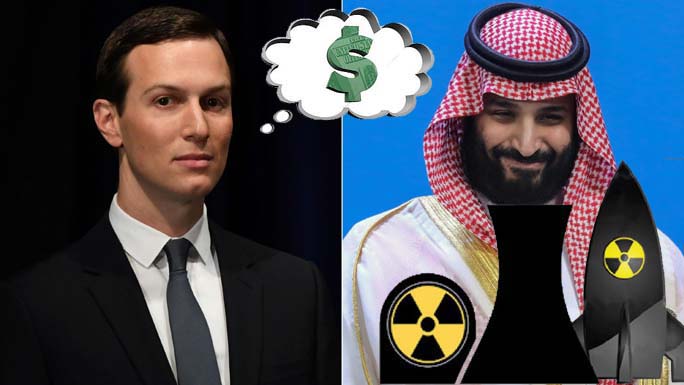
There are too many unanswered questions about the White House’s role in advancing Saudi ambitions. By Nicholas Kristof, March 2, 2019
Jared Kushner slipped quietly into Saudi Arabia this week for a meeting with Crown Prince Mohammed bin Salman, so the question I’m trying to get the White House to answer is this: Did they discuss American help for a Saudi nuclear program?
Of all the harebrained and unscrupulous dealings of the Trump administration in the last two years, one of the most shocking is a Trump plan to sell nuclear reactors to Saudi Arabia that could be used to make nuclear weapons.
Even as President Trump is trying to denuclearize North Korea and Iran, he may be helping to nuclearize Saudi Arabia. This is abominable policy tainted by a gargantuan conflict of interest involving Kushner.
Kushner’s family real estate business had been teetering because of a disastrously overpriced acquisition he made of a particular Manhattan property called 666 Fifth Avenue, but last August a company called Brookfield Asset Management rescued the Kushners by taking a 99-year lease of the troubled property — and paying the whole sum of about $1.1 billion up front.
Alarm bells should go off: Brookfield also owns Westinghouse Electric, the nuclear services business trying to sell reactors to Saudi Arabia.
Saudi swamp, meet American swamp.
It may be conflicts like these, along with even murkier ones, that led American intelligence officials to refuse a top-secret security clearance for Kushner. The Times reported Thursday that Trump overruled them to grant Kushner the clearance.
This nuclear reactor mess began around the time of Trump’s election, when a group of retired U.S. national security officials put together a plan to enrich themselves by selling nuclear power plants to Saudi Arabia. The officials included Michael Flynn, Trump’s national security adviser, and they initially developed a “plan for 40 nuclear power plants” in Saudi Arabia, according to a report from the House Oversight and Reform Committee. The plan is now to start with just a couple of plants.
As recently as Feb. 12, Trump met in the White House with backers of the project and was supportive, Reuters reported.
These are civilian nuclear power plants, and Saudi Arabia claims it wants them for electricity. But the Saudis insist on producing their own nuclear fuel, rather than buying it more cheaply abroad. Producing fuel is a standard way for rogue countries to divert fuel for secret nuclear weapons programs, and the Saudi resistance to safeguards against proliferation bolsters suspicions that the real goal is warheads.
Trump may be vigilant (destructively so) about Iran’s nuclear plants, but in the Saudi case his response seems to be: There’s money to be made! When Israeli Prime Minister Benjamin Netanyahu raised objections to the transfer last year, Axios reported, “Trump and his advisers told Netanyahu that, if the U.S. does not sell the Saudis nuclear reactors, other countries like Russia or France will.”
Trump seems to believe that the Saudis have us over a barrel: If we don’t help them with nuclear technology, someone else will. That misunderstands the U.S.-Saudi relationship. The Saudis depend on us for their security, and the blunt truth is that we hold all the cards in this relationship, not them.
Why on earth would America put Prince Mohammed on a path to acquiring nuclear weapons? He is already arguably the most destabilizing leader in an unstable region, for he has invaded Yemen, kidnapped Lebanon’s prime minister, started a feud with Qatar, and, according to American intelligence officials, ordered the murder of the Washington Post columnist Jamal Khashoggi.
The prince has also imprisoned and brutally tortured women’s rights activists, including one who I’m hoping will win the Nobel Peace Prize, Loujain al-Hathloul. As Representative Brad Sherman, a California Democrat, has noted, “A country that can’t be trusted with a bone saw shouldn’t be trusted with nuclear weapons.”
There’s another element of Trump’s Saudi policy that is simply repulsive: the fawning courtship of a foreign prince who has created in Yemen the world’s worst humanitarian crisis, murdered a journalist and tortured women’s rights activists. The White House genuflections are such that Prince Mohammed had a point when, according to The Intercept, he bragged that he had Kushner in his “pocket.”
No one knows whether Prince Muhammed will manage to succeed his father and become the next king, for there is opposition and the Saudi economic transformation he boasts of is running into difficulties. Trump and Kushner seem to be irresponsibly trying to boost the prince’s prospects, increasing the risk that an unstable hothead will mismanage the kingdom for the next 50 years. Perhaps with nuclear weapons.
Cold War-like arms race is likely to follow the collapse of a historic nuclear treaty
Key points:
- The landmark INF treaty was integral to ending the Cold War
- Short and intermediate range missiles were banned because of the short flight time
- Analyst say it’s unlikely to be renegotiated within the six-month notice period
Last week, Russian President Vladimir Putin said Russia was ready for a Cuban Missile-style crisis if the US wanted one, referring to the 1962 standoff that brought the world to the edge of nuclear war.
Decades later, tensions between the two nations are heating up again.
Mr Putin warned that Moscow would retaliate if the US placed new missiles closer to Russia, telling local media that Moscow could deploy hypersonic missiles on ships and submarines outside US territorial waters.
The comments were made after the Trump administration announced it would officially abandon a historic nuclear pact that had kept nuclear missiles out of Europe for three decades.
Here’s a look at what the treaty is, what may come next, and why analysts believe its demise could lead to a 21st-century arms race.
The Intermediate-Range Nuclear Forces Treaty (INF) bans the US and the Russian Federation, previously the Soviet Union, from developing, testing and possessing short- and intermediate-range missiles that could be launched from the ground, as opposed to the sea or sky.
The treaty — signed by former US president Ronald Reagan and Soviet leader Mikhail Gorbachev in December 1987 — declared that “nuclear war cannot be won and must never be fought” and took seven years to negotiate.
Both sides agreed to destroy a total of 2,692 short-, medium- and intermediate-range missiles with a range between 500 and 5,500 kilometres that were stationed in, or aimed at Europe.
The treaty is credited with helping to ending the Cold War.
Maria Rublee, a former US intelligence officer and nuclear politics expert at Monash University, told the ABC these missiles were seen as a “hair trigger for nuclear war” due to how quickly they could strike a target.
“You don’t have time to talk, to pick up the phone, the red hotline, to say what’s going on and ask if this is a mistake.”
Washington and its North Atlantic Treaty Organisation (NATO) allies claim Moscow has been violating the terms of the treaty by developing missiles within the range for years, but Russia has repeatedly denied the allegations.
Earlier this month the Trump administration declared it would suspend US obligations under the treaty, with the intention of withdrawing because of Russia’s alleged non-compliance.
The day after the announcement, Russia also said it would withdraw from the treaty, and accused the US of fabricating the allegations so it could develop new missiles.
The treaty is not dead just yet — both parties must give six months notice before they can officially withdraw — but Dr Rublee said the chances of the treaty being revived were low, although there was some hope.
“[The first step] is not going to come from the Trump administration and it’s not going to come from Russia,” she said.
“It would need to come from NATO because the countries most at risk are European countries.”…….. https://www.abc.net.au/news/2019-03-03/collapse-of-treaty-could-lead-to-new-arms-race/10845950
The possibility of nuclear war between India and Pakistan
COULD THE CONFLICT BETWEEN PAKISTAN AND INDIA LEAD TO NUCLEAR WAR? Experts say it’s unlikely, but Pakistan’s lack of a “No First Use” doctrine for nuclear weapons means it’s not impossible. Pacific Standard, JACK HERRERA, FEB 27, 2019
In 1999, Pakistan’s foreign minister explained why the country refused to adopt a No First Use policy, declaring that Islamabad would use “any weapon” in its arsenal to defend the country. Today, experts believe that, unlike India, Pakistan could plausibly deploy a nuclear weapon in response to a conventional attack. Pakistan maintains a smaller army and less weaponry than India, and would likely be overwhelmed if the Indian military invaded Pakistani territory with its full force. Facing loss of territory and national collapse, Islamabad could decide to launch a nuclear weapon against India in an attempt to even the playing field………
Making nuclear summits great again
“[You are] a great leader,” Trump told Kim after their dinner on Wednesday at the Metropole Hotel. “I think you will have a tremendous future with your country.”
Before the formal talks began on Thursday, journalists covering the event were advised of the expected outcome: there would be an “agreement signing ceremony” at the Metropole at 3.50pm.
By Thursday afternoon, the ceremony had been cancelled as the realities of trying to resolve this decades-old conflict overcame Trump’s apparent belief that a deal would flow from a “wonderful dialogue”.
The success of a potential deal will depend on detail, and on Kim’s predilections, not Trump’s jubilant tweets. This became clear in Hanoi, as the talks faltered over Kim’s demands that international sanctions should be entirely lifted.
“It wasn’t a good thing to sign anything,” Trump said. “Sometimes you have to walk.”
The Trump–Kim encounters, reminiscent of the great Soviet–American summits, are designed to be spectacles, yet the Hanoi meeting was quickly overshadowed by events in Washington……..https://www.thesaturdaypaper.com.au/world/north-america/2019/03/02/making-nuclear-summits-great-again/15514452007564
1 This Month
26 September – International Day for the Total Elimination of Nuclear Weapons





PLEASE OPPOSE HR 8255 AND S.3639 – bills would accelerate satellite deployment, with no environmental review or safeguards – https://ncstd5li.quorum.us/campaign/169331/
To see nuclear-related stories in greater depth and intensity – go to https://nuclearinformation.wordpress.com
-
Archives
- September 2026 (305)
- August 2026 (330)
- July 2026 (355)
- June 2026 (287)
- May 2026 (306)
- April 2026 (356)
- March 2026 (251)
- February 2026 (267)
- January 2026 (308)
- December 2025 (358)
- November 2025 (359)
- October 2025 (375)
-
Categories
- 1
- 1 NUCLEAR ISSUES
- business and costs
- climate change
- culture and arts
- ENERGY
- environment
- health
- history
- indigenous issues
- Legal
- marketing of nuclear
- media
- opposition to nuclear
- PERSONAL STORIES
- politics
- politics international
- Religion and ethics
- safety
- secrets,lies and civil liberties
- spinbuster
- technology
- Uranium
- wastes
- weapons and war
- Women
- 2 WORLD
- ACTION
- AFRICA
- Atrocities
- AUSTRALIA
- Christina's notes
- Christina's themes
- culture and arts
- Events
- Fuk 2022
- Fuk 2023
- Fukushima 2017
- Fukushima 2018
- fukushima 2019
- Fukushima 2020
- Fukushima 2021
- general
- global warming
- Humour (God we need it)
- Nuclear
- RARE EARTHS
- Reference
- resources – print
- Resources -audiovicual
- Weekly Newsletter
- World
- World Nuclear
- YouTube
-
RSS
Entries RSS
Comments RSS

