“Never Recognised India, Pakistan As Nuclear Countries,” Says China
https://www.ndtv.com/india-news/china-never-recognised-india-pakistan-as-nuclear-countries-2001316
“China has never recognised India and Pakistan as nuclear countries. Our position on this has never changed,” Chinese Foreign Ministry spokesman Lu Kang told a media briefing in Beijing.
“China has never recognised India and Pakistan as nuclear countries. Our position on this has never changed,” Chinese Foreign Ministry spokesman Lu Kang told a media briefing in Beijing.
He was replying to a question whether China would recognise North Korea as a nuclear state like India and Pakistan as talks between Trump and Kim at the second summit in Hanoi broke down over Pyongyang’s refusal to give up two nuclear processing plants.
China has been blocking India’s entry into the 48-member Nuclear Suppliers Group (NSG) on the ground that New Delhi has not signed the Nuclear Non-Proliferation Treaty (NPT).
After India applied for NSG membership, Pakistan too applied for the same following that China has called for a two-step approach which states that NSG members first need to arrive at a set of principles for the admission of non-NPT states into the NSG and then move forward discussions of specific cases.
Trump-Kim nuclear summit ended abruptly, with no agreement made
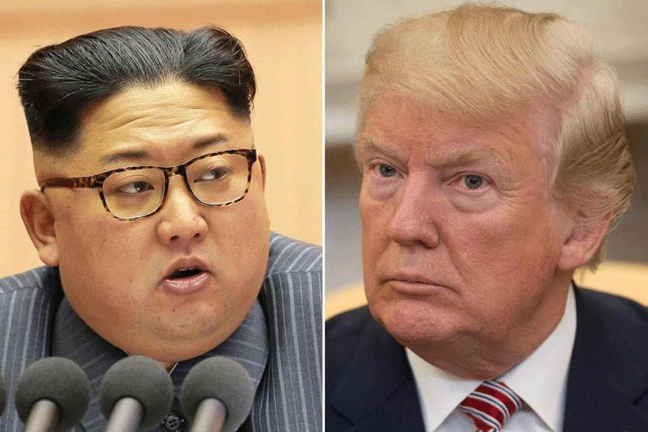 Donald Trump and Kim Jong-un cut short their nuclear summit,
The nuclear summit between President Donald Trump and Kim Jong-un has collapsed after the two sides failed to reach a deal due to a stand-off over US sanctions on the reclusive nation — a stunning end to high-stakes meetings meant to disarm a global threat.
Key points:
- Donald Trump says the talks were “productive” despite the lack of an agreement
- The two nations reached a stalemate over the US removing all sanctions on North Korea
- North Korea refused to eliminate its entire nuclear arsenal, but will stop testing nuclear weapons
In a news conference after the abrupt end to the talks, Mr Trump said the breakdown occurred over North Korea’s insistence that all punishing sanctions the US had imposed be lifted without Pyongyang committing to eliminate its entire nuclear arsenal…….
Both leaders’ motorcades roared away from the downtown Hanoi summit site within minutes of each other after both a lunch and the signing ceremony were scuttled…….– https://www.abc.net.au/news/2019-02-28/donald-trump-and-kim-jong-un-cut-short-their-nuclear-summit/10859310
South Korea offers hope that the Trump-Kim nuclear summit could bring an end to the Korean War
Korean War could be declared over at Trump-Kim summit, says South Korea There’s an upbeat tone that a formal declaration ending the Korean War could be made at the Hanoi summit this week. SBS News 25 Feb 19, Hopes that US President Donald Trump and North Korean leader Kim Jong-un will formally declare an end to the 1950-53 Korean War at the Hanoi summit rose Monday, after South Korea said the two leaders could reach an agreement.The devastating conflict between communist North Korea, backed by China, and the capitalist South, aided by the United States, ended with an armistice rather than a peace treaty, leaving Pyongyang and Washington still technically at war.
“I believe that the possibility is there,” the South’s presidential Blue House spokesman Kim Eui-kyeom told reporters about a formal declaration.
“There is no way of knowing what kind of declaration it might be, but I believe the US and North Korea may reach an agreement.”
President Moon Jae-in said in October “it was only a matter of time” before Washington and Pyongyang declared an end to the war.
The US has also struck an upbeat tone. Stephen Biegun, the US special envoy for North Korea, said earlier this month that Trump was “ready to end this war”, fuelling speculation that the formal end of the conflict may be near.
Kim, the leader of North Korea, is due to meet the US president in the Vietnamese capital on Wednesday and Thursday, where it is hoped the pair will make progress in talks on denuclearisation, and a possible peace treaty……..
President Trump says he would be happy as long as North Korea maintains its pause on weapons testing, and he is in no rush to strike a nuclear deal with Kim Jong-un. …..https://www.sbs.com.au/news/korean-war-could-be-declared-over-at-trump-kim-summit-says-south-korea
Tensions in Kashmir: Pakistan readies for war
 Pakistan readies military, hospitals for war with its nuclear rival India after Pulwama terror attack, Business Insider
U.N. Secretary-General Antonio Guterres urges the United States and Russia to save nuclear arms safeguards
 U.N. chief wants INF nuclear treaty saved, concrete steps in Hanoi https://www.euronews.com/2019/02/25/un-chief-wants-inf-nuclear-treaty-saved-concrete-steps-in-hanoi
Russia flexes nuclear muscles , warns on its ability to strike nuclear targets in USA
 After Putin’s warning, Russian TV lists nuclear targets in U.S. Andrew Osborn, MOSCOW (Reuters) 25 Feb 19, – Russian state television has listed U.S. military facilities that Moscow would target in the event of a nuclear strike, and said that a hypersonic missile Russia is developing would be able to hit them in less than five minutes.
The targets included the Pentagon and the presidential retreat in Camp David, Maryland.
The report, unusual even by the sometimes bellicose standards of Russian state TV, was broadcast on Sunday evening, days after President Vladimir Putin said Moscow was militarily ready for a “Cuban Missile”-style crisis if the United States wanted one.
With tensions rising over Russian fears that the United States might deploy intermediate-range nuclear missiles in Europe as a Cold War-era arms-control treaty unravels, Putin has said Russia would be forced to respond by placing hypersonic nuclear missiles on submarines near U.S. waters.
……..The targets, which Kiselyov described as U.S. presidential or military command centers, also included Fort Ritchie, a military training center in Maryland closed in 1998, McClellan, a U.S. Air Force base in California closed in 2001, and Jim Creek, a naval communications base in Washington state.
Kiselyov, who is close to the Kremlin, said the “Tsirkon” (‘Zircon’) hypersonic missile that Russia is developing could hit the targets in less than five minutes if launched from Russian submarines.
Hypersonic flight is generally taken to mean traveling through the atmosphere at more than five times the speed of sound……. https://www.reuters.com/article/us-usa-nuclear-russia/after-putins-warning-russian-tv-lists-nuclear-targets-in-us-idUSKCN1QE1DM
Indian and Pakistan relations have again reached a dangerous level.
If Pakistan Attacks With One Nuclear Bomb, India Can Finish Us With 20, Says Pervez Musharraf
Addressing a press conference in UAE, Pakistan’s former president said that Indian and Pakistan relations have again reached a dangerous level. News18.com February 25, 2019, New Delhi: India could “finish” Pakistan with 20 bombs if Islamabad decides to launch even a single nuclear attack on the neighbouring country, former Pakistan president Pervez Musharraf has said.
Addressing a press conference in UAE, Pakistan’s former president further said that if India launched any attack in Kashmir, Pakistan could respond in other areas in Sindh and Punjab and “could teach them a lesson”.
North Korea blasts Japan, claiming that Japan in “nuclear weaponizing”
In a commentary published Saturday in the Rodong Sinmun, the official newspaper of the North’s ruling party criticized what it claimed were “voices for the revision of the constitution and increased military spending and nuclear weaponization” from within the administration of Prime Minister Shinzo Abe.
The commentary said that under Abe, Japan “can go nuclear anytime after giving up ‘three non-nuclear principles.’ ” Consequently, it claimed, “peace in the Asia-Pacific region will be exposed to a great danger.”
Japan, the only country to have endured a nuclear attack, has long maintained that it adheres to its three nonnuclear principles of not possessing, not producing and not permitting the introduction of nuclear weapons. However, the government admitted in 2010 that previous administrations had lied to the public for decades about atomic weapons, after a government-appointed panel confirmed the existence of secret Cold War-era agreements allowing the U.S. to bring them into the country.
The Rodong Sinmun commentary said that if Japan ditches its three nonnuclear principles, there would be “unimaginable” and “catastrophic consequences.”
“All the countries that truly want global peace and security should keep close watch over Japan’s nuclear weaponization.”
Japan has ramped up military spending and the acquisition of sophisticated weapons in recent years, spending around 1 percent of its gross domestic product on the Self-Defense Forces — which, given the size of its economy, makes it one of the world’s biggest military spenders……. https://www.japantimes.co.jp/news/2019/02/25/national/politics-diplomacy/north-korea-alleges-nuclear-weaponization-japan-trump-kim-summit-draws-near/#.XHRA0YkzbGg
Danger signs in Trump and co’s continuing push to sell nuclear technology to Saudi Arabia
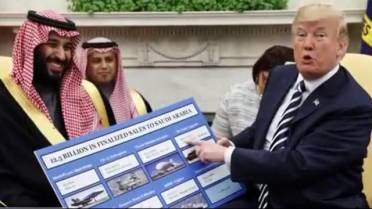 Why proposals to sell nuclear reactors to Saudi Arabia raise
 red flags, The Conversation, Director, Middle East Nonproliferation Program, Middlebury, February 23, 2019 According to a congressional report, a group that includes former senior U.S. government officials is lobbying to sell nuclear power plants to Saudi Arabia. As an expert focusing on the Middle East and the spread of nuclear weapons, I believe these efforts raise important legal, economic and strategic concerns.
It is understandable that the Trump administration might want to support the U.S. nuclear industry, which is shrinking at home. However, the congressional report raised concerns that the group seeking to make the sale may have have sought to carry it out without going through the process required under U.S. law. Doing so could give Saudi Arabia U.S. nuclear technology without appropriate guarantees that it would not be used for nuclear weapons in the future.
A competitive global market
Exporting nuclear technology is lucrative, and many U.S. policymakers have long believed that it promotes U.S. foreign policy interests. However, the international market is shrinking, and competition between suppliers is stiff.
Private U.S. nuclear companies have trouble competing against state-supported international suppliers in Russia and China. These companies offer complete construction and operation packages with attractive financing options. Russia, for example, is willing to accept spent fuel from the reactor it supplies, relieving host countries of the need to manage nuclear waste. And China can offer lower construction costs.
Saudi Arabia declared in 2011 that it planned to spend over US$80 billion to construct 16 reactors, and U.S. companies want to provide them. Many U.S. officials see the decadeslong relationships involved in a nuclear sale as an opportunity to influence Riyadh’s nuclear future and preserve U.S. influence in the Saudi kingdom.
Why does Saudi Arabia want nuclear power?
With the world’s second-largest known petroleum reserves, abundant untapped supplies of natural gas and high potential for solar energy, why is Saudi Arabia shopping for nuclear power? Some of its motives are benign, but others are worrisome. ………..
US nuclear trade regulations
Under the U.S. Atomic Energy Act, before American companies can compete to export nuclear reactors to Saudi Arabia, Washington and Riyadh must conclude a nuclear cooperation agreement, and the U.S. government must submit it to Congress. Unless Congress adopts a joint resolution within 90 days disapproving the agreement, it is approved. The United States currently has 23 nuclear cooperation agreements in force, including Middle Eastern countries such as Egypt (approved in 1981), Turkey (2008) and the United Arab Emirates (2009).
The Atomic Energy Act requires countries seeking to purchase U.S. nuclear technology to make legally binding commitments that they will not use those materials and equipment for nuclear weapons, and to place them under International Atomic Energy Agency safeguards. It also mandates that the United States must approve any uranium enrichment or plutonium separation activities involving U.S. technologies and materials, in order to prevent countries from diverting them to weapons use.
American nuclear suppliers claim that these strict conditions and time-consuming legal requirements put them at a competitive disadvantage. But those conditions exist to prevent countries from misusing U.S. technology for nuclear weapons. I find it alarming that according to the House report, White House officials may have attempted to bypass or sidestep these conditions – potentially enriching themselves in the process.
According to the congressional report, within days of President Trump’s inauguration, senior U.S. officials were promoting an initiative to transfer nuclear technology to Saudi Arabia, without either concluding a nuclear cooperation agreement and submitting it to Congress or involving key government agencies, such as the Department of Energy or the Nuclear  Regulatory Commission. One key advocate for this so-called “Marshall Plan” for nuclear reactors in the Middle East was then-national security adviser Michael Flynn, who reportedly served as an adviser to a subsidiary of IP3, the firm that devised this plan, while he was advising Trump’s presidential campaign.
The promoters of the plan also reportedly proposed to sidestep U.S. sanctions against Russia by partnering with Russian companies – which impose less stringent restrictions on nuclear exports – to sell reactors to Saudi Arabia.
Flynn resigned soon afterward and now is cooperating with the investigation into Russian interference in the 2016 campaign. But IP3 access to the White House persists: According to press reports, President Trump met with representatives of U.S. industry, a meeting organized by IP3 to discuss nuclear exports to Saudi Arabia as recently as mid-February 2019……..https://theconversation.com/why-proposals-to-sell-nuclear-reactors-to-saudi-arabia-raise-red-flags-112276
India ‘Reluctant’ Nuclear Weapon State, Committed to No-first-use Policy
India ‘Reluctant’ Nuclear Weapon State, Committed to No-first-use Policy, Says Manmohan Singh
The former prime minister referred to today’s nuclear age ‘as an age of asymmetry, asymmetry in terms of doctrines, arsenals and technology’.
The former prime minister referred to today’s nuclear age “as an age of asymmetry, asymmetry in terms of doctrines, arsenals and technology”.
Donald Trump’s enthusiasm to sell nuclear technology to the reckless Saudi regime
|
Why was the Trump administration so eager to give nuclear technology to the reckless Saudi regime? https://www.washingtonpost.com/opinions/global-opinions/why-was-the-trump-administration-so-eager-to-give-nuclear-technology-to-the-reckless-saudi-regime/2019/02/21/e40e38e6-353c-11e9-a400-e481bf264fdc_story.html?utm_term=.cdaa56e24b47, By Editorial Board, February 21
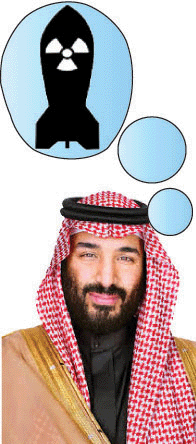 SAUDI ARABIA’s Crown Prince Mohammed bin Salman has built a record of reckless aggression against opponents both at home and abroad. He has also declared on at least one occasion that his regime could seek to acquire nuclear weapons. It would seem common-sensical for the United States to avoid transferring any nuclear technology to his regime without ironclad guarantees that it could not be used to build bombs. Yet the Trump administration appears to have persisted in considering proposals to do just that — in part at the urging of senior officials and lobbyists with troubling conflicts of interest. SAUDI ARABIA’s Crown Prince Mohammed bin Salman has built a record of reckless aggression against opponents both at home and abroad. He has also declared on at least one occasion that his regime could seek to acquire nuclear weapons. It would seem common-sensical for the United States to avoid transferring any nuclear technology to his regime without ironclad guarantees that it could not be used to build bombs. Yet the Trump administration appears to have persisted in considering proposals to do just that — in part at the urging of senior officials and lobbyists with troubling conflicts of interest.
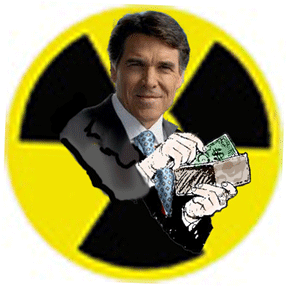
A report by the Democratic staff of the House Oversight and Reform Committee this week provided new details of how former national security adviser Michael Flynn and other National Security Council officials attempted to rush through a plan for U.S. companies to sell nuclear power plants to Saudi Arabia in the early weeks of the Trump administration. Ignoring warnings by career officials that they could violate laws on technology transfers, as well as conflict-of-interest rules, they pushed a scheme drawn up by a firm represented by several well-connected retired generals. According to the committee report, Mr. Flynn had identified himself as an adviser to the Though the NSC initiative appears to have been squelched by H.R. McMaster, who replaced Mr. Flynn, negotiations with the Saudis have quietly continued under Energy Secretary Rick
Unsurprisingly, the arrogant crown prince is refusing to accept those terms — probably because he wishes to preserve a nuclear-arms option. Though federal law requires the United States to negotiate a protocol on the conditions for supplying nuclear technology and submit that to Congress, it does not mandate those conditions. So Congress must insist that any nuclear deal with Saudi Arabia embrace this gold standard. To do otherwise would only compound the danger posed by Mohammed bin Salman. |
|
|
Nuclear weapons seen by North Korea as essential to its survival

North Korean leader Kim Jong Un provides guidance on a nuclear weapons program in this undated photo released by North Korea’s Korean Central News Agency (KCNA) in Pyongyang September 3, 2017. KCNA via REUTERS
alliances-seen-by-north-korea-as-guarantor-of-survival/ BY KATIANA KRAWCHENKO FEBRUARY 22, 2019 CBS NEWSNorth Korean leader Kim Jong Un sees nuclear weapons, not alliances, as the “ultimate guarantor” of survival, according to former top CIA analyst Jung Pak, who joined CBS News chief Washington correspondent Major Garrett for lunch on this week’s episode of “The Takeout.”That, she told Garrett, complicates the question of what “denuclearization” ultimately means, particularly ahead of President Trump’s summit with Kim beginning next Wednesday.
“The first summit produced very little in terms of how we were going to move toward North Korea denuclearization,” Pak said, adding that Kim has been “developing all of the ingredients for this recipe of mating the nuclear weapon on top of the ballistic missile that is shown to be able to fly across the world, to hit virtually any spot, frankly.”
Kim has been intent on showing us his capabilities, and he’s also been pretty clear about his intentions. He’s not going to unilaterally disarm, he said — unless the U.S., and frankly, the world give up its nuclear weapons.”
Trump administration officials say they do not know if North Korea has made the choice yet to denuclearize, but they’re engaged in these talks because they believe in the possibility.
President Trump himself has asserted that if North Korea does achieve verifiable “denuclearization,” which he simultaneously said he is now in “no rush” to achieve, the country could become a “tremendous economic power” due to their “unbelievable location” tucked in next to Russia, China and South Korea.
Pak believes “there is something to be said” for that point. But the North also sees its location as a real vulnerability, she told Garrett.
“They’re surrounded by the second, third and eleventh largest economies, and the only thing that sets them apart, and the only thing that makes them relevant is nuclear weapons.”
International Atomic Energy Agency says that Iran is sticking to the terms of the nuclear deal

 Iran still holding up its end of nuclear deal, IAEA report shows, Francois Murphy, VIENNA (Reuters) 22 Feb 19, – Iran has remained within the key limits on its nuclear activities imposed by its 2015 deal with major powers despite growing pressure from newly reimposed U.S. sanctions, a report by the U.N. nuclear watchdog showed on Friday.
The International Atomic Energy Agency is policing the deal, which lifted sanctions against Tehran in exchange for restrictions on Tehran’s atomic activities aimed at increasing the time Iran would need to make an atom bomb if it chose to.
Iran has stayed within caps on the level to which it can enrich uranium, as well as its stock of enriched uranium, the IAEA said in a confidential quarterly report sent to its member states and obtained by Reuters.
“Not much has changed…, a continuing reporting of the implementation (by Iran),” a senior diplomat said on condition of anonymity, summarising the report.
The IAEA also repeated its usual statement that it carried out so-called complementary access inspections – which are often at short notice – at all locations in Iran that it needed to visit.
President Donald Trump pulled the United States out of the Iran nuclear deal last May, reimposing U.S. sanctions on Iran’s economy and lifeblood oil industry that were lifted under the 2015 agreement.
European powers that signed the deal – France, Britain and Germany – have sought to cushion the blow to Iran of those sanctions. They are setting up a new channel for non-dollar trade with Iran but diplomats say it will not be able to handle the big transactions Iran says it needs to keep the deal afloat………https://www.reuters.com/article/us-iran-nuclear-iaea/iran-still-holding-up-its-end-of-nuclear-deal-iaea-report-shows-idUSKCN1QB1XC
Global nuclear arms race – triggered by Trump’s withdrawal from nuclear weapons treaty
Trump Accidentally Just Triggered Global Nuclear Proliferation

CIS:E.1512-2004
Before the United States killed it, the INF Treaty didn’t just stem the arms race with Russia—it stopped the spread of nuclear weapons around the world.
FOREIGN POLICY.COM BY SARAH BIDGOOD, FEBRUARY 21, 2019 O n Feb. 1, the Trump administration made good on its threats and began the official withdrawal process from the 1987 Intermediate-Range Nuclear Forces (INF) Treaty between the United States and Russia. As others have pointed out, this was a short-sighted decision. By withdrawing from the INF Treaty, the Trump administration has eliminated any consequences of Moscow’s alleged noncompliance, leaving it free to deploy as many intermediate-range missiles as it wants. U.S. President Donald Trump’s decision to throw out the rulebook instead of trying to enforce it greases the wheels for a return to U.S.-Russian nuclear arms racing—with potentially dire consequences for international security.
The importance of U.S.-Russian relations to nonproliferation means that the end of the INF Treaty will affect other areas of the regime, too. As many experts have observed, New START—now the last bastion of bilateral arms control—is probably the most susceptible to contagion. Set to expire in just two years, this 2010 agreement can be extended for up to five years if both parties agree. Emboldened by its withdrawal from the INF Treaty, however, the Trump administration might pass over this silver bullet for the freedom to pursue maximum flexibility in its military options……… https://foreignpolicy.com/2019/02/21/trump-accidentally-just-triggered-global-nuclear-proliferation/
Ending The U.S. Doctrine of Perpetual War
 Mutually Agreed Peace: Ending The U.S. Doctrine of Perpetual War By Ethan Indigo Smith, Contributing Writer for Wake Up World, 22 Feb 19, “Just because you do not take an interest in politics doesn’t mean politics won’t take an interest in you.” ~ Pericles.
Everything is ultimately political these days, but everything is firstly biological. Yet, ignoring our biology and our humanity, the military-industrial complex, with all its toxic modalities, still claims to operate in our best interests.
The fact is, modern politics has become the imposition of institutional formality where individuals and truth once were. Increasingly favoring institutional privilege over individual rights, politicians on all sides of the game act to reinforce and advance the standing of corporations at the expense of our physical world. They embark on resource wars for profit, destroy our environment for energy, construe zealotry as patriotism, and steer a culture of social competition – not cooperation – all the while hiding behind veils of secrecy and meaningless rhetoric. …..
The Nuclear Energy and Armament Experiments
One of the largest tentacles of the military-industrial complex is the nuclear experimentation facet of their operations. These operations include both energy and armament — programs which are inextricably linked, as I will demonstrate – with negative impacts on all life on earth and, and when disaster strikes, capable of negating life altogether.
Maintaining a deafening silence over the ongoing Fukushima disaster, for example, the world’s political heads show zero regard for our biological wellbeing (much less our social wellbeing) in both the formulation and the execution of policy. Instead of shutting down the deadly reactors at Fukushima, the world’s powers simply shut down any information about the situation.
For example, the Japanese government passed a law through Parliament, called the “States Secret Act” following the 2011 Fukushima meltdown. Under this act, both officials and private citizens who leak “special state secrets” (ie. details of the disaster) face prison terms of up to 10 years, while journalists who publish classified information (ie. all relevant information) face up to five years.[1] Meanwhile, in 2011 the U.S. Environmental Protection Agency’s response to increases in detected radiation levels within the United States was to reduce the use of radiation monitoring while at the same time, raising the official allowable levels of radiation in food, water and soil. [2] Of course, this was not reported by mainstream media.
Nor was the 2014 partial shutdown of the Florida Power & Light’s Turkey Point facility in the Miami area, following a steam leak that resulted from the failure of the archaic facility’s cooling system.[3] While mainstream news completely blocked coverage of this potential meltdown situation, the facility remained in operation not because it managed to rectify the cooling problem, but because the corporation lobbied for special permission to violate allowable water temperature safety thresholds from the previous limit of 100’F limit up to 103’F. [4]
The simple reason for the secrecy and suppression of information is that the nuclear experimentation industry is just that — an experiment. Although it is touted as a ‘clean’ technology, the nuclear industry has no mechanism for disposing of the radioactive waste it generates, and no viable plan for such a mechanism in the future. All it has is a plan to contain the mounting radioactive waste it generates each day and store it for the million years it takes for radioactive waste to break down naturally.
o, whether nor not we accept or reject the philosophies of government, it is an inarguable fact that our biology, and that of our grandchildren’s grandchildren’s grandchildren — is at the complete mercy of those individuals who, hiding behind political formality, have their fingers “on the button”. And, for as long as their priorities are clearly shaped by the objectives of the corporate-military-industrial complex, there is very little mercy involved. Instead our collective future and the future of our planet is heavily influenced by corporate profitability and contrived political hemispheres which, with the support of corporate media, teeter between deliberately limited polarities, never really making progress or improvement or exploring possibilities — such as peaceful solutions, or sustainable energy investment — beyond those which may profit those already in power…….
The rise of the military industrial complex changed the whole dynamic of war and peace, and in the process, steered our society from exploring sustainable energy solutions toward the constant danger of nuclear meltdown. Nuclear power generation is inherently risky of itself; both the waste it stores and the pollution it releases pose a largely unseen but no less dangerous threat to our Earth Mother, and to our biology. But it also creates obvious military strike targets for enemy nations which, if detonated, can destroy entire nations in one sweep. Building nuclear power experiments is akin to building a self-destruct button into your nation’s infrastructure; one false move, be it intentional (military) or accidental (like Fukushima), and it destroys the landscape and all who dwell on and around it for an eternity, with no known remedy……..
“I foolishly once believed the myth that nuclear energy is clean and safe. That myth has completely broken down. Restarting nuclear reactors while we still have no place to dispose of nuclear waste is a criminal act toward future generations.” — Morihiro Hosokawa, 79th Prime Minister of Japan
The U.S. Doctrine of Perpetual War
One of the best ways to gain and maintain power is to keep the people in constant fear — in fear of wars, of outsiders, and more recently, of “terrorism”. Maintaining a culture of war-minded fear ensures the public consent to the constant funding of the military-industrial-complex, under the guise of security and protection.
If we look at the history of the Presidents of the United States since the end of the Second World War, we see that each administration invented a presidential Doctrine directly pertaining to war – either inviting involvement in or directly inciting conflict………
the most famously barbarous doctrine was the Bush Doctrine, in which President George W. Bush Jr. essentially declared that the United States was adopting a shoot-first-ask-questions-later policy pertaining to perceived terrorist activities, both in other countries and at home. [19] Advocating the illogical notion of “preventive war”, the Bush Doctrine is based on the faulty reasoning that attacking a potential threat before it attacks the United States is the only way to ensure peace and security, rather than — as history has proven — the most effective way to ensure more wars and security threats…..
The fact is, the United States has been at war for 225 years out of the last 242 years. That’s 93% of the time! Since the Declaration of Independence was written in 1776, the U.S. has actually been at peace (albeit planning for further wars) for a total of only 21 years. [20] Not one U.S. president actually qualifies as a solely peacetime president, and the only time the United States lasted five years without going to war was between 1935 and 1940 — during the period of the Great Depression.
Since U.S. involvement in World War II began in 1940, most of the world’s military operations have been initiated by the U.S., [6] and U.S. military spending today exceeds the rest of the world’s military spending combined. [21] In addition, the U.S. also supplies in excess of $3 billion each year (over $10 million per day!) in military aid to Israel, funding the continued war in Palestine.[22] ………
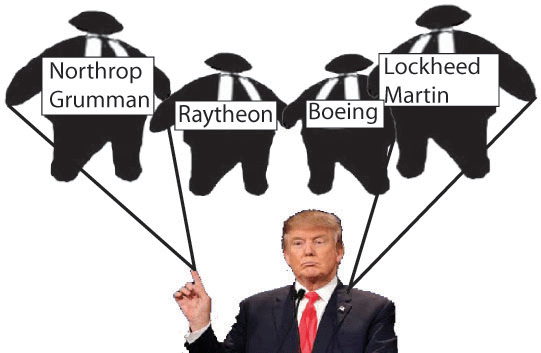
Today, the U.S. economy is now so dependent on war, there is no incentive for the U.S. government to strive for peace — it simply isn’t profitable. The U.S. defense industry employs a staggering 3.5 million Americans, while the private companies supporting the military generate in excess of $300 billion in revenue per year. [24]
With the U.S. economy and military operations so intrinsically linked, the American people have over time come to accept its war culture as normal, believing the increasingly ludicrous propaganda that tells us the U.S. is subject to threats from far weaker military nations and that the U.S. is nobly “fighting for peace” — an oxymoron of the highest order. ……….
clearly, the lessons of history and failed Presidential policy have not been learned by those in power in recent years, who claim to have our interests at heart. Barack Obama, for example, despite his (false) doctrine of negotiation and collaboration (“change”) as a contrast to the confrontation and unilateralism of the Bush Jr. era, invested a trillion dollars of U.S. taxpayers’ money into the military industry to develop and build more nuclear weaponry [25] This, despite the fact that the U.S. is already the most heavily armed nuclear nation in the world — something current President Trump, who also campaigned on a platform of “change”, has done nothing to wind back. ……
The institutions of the United States and Russia may have different perpetrators behind them, they may play different melodies and use different instruments, but in fact they sound very much the same. The collectivism of the oligarchy in the U.S.A. is flavored with corporate tones, whereas in Russia it is dominated by state tones. Different name, same game. In the U.S.A. the divine right of corporations rules and in Russia it’s the godhead of the state the leads the symphony. Either way though, it’s a war song of militant, nationalistic not individual concerns.
In our every deliberation, we must consider the impact of our decisions on the next seven generations.” ~ Iroquois Maxim
The Indigo Doctrine: Mutually Agreed Peace
We, The People of the World, can supersede institutional war-mongering concerns that belittle individual life, liberty and pursuit of happiness. We have no other choice. If we do not act to mandate Mutually Agreed Peace, we are allowing politicians to shrug their shoulders and say, “it’s politics”, as Earth Mother is ravaged and its inhabitants are systematically annihilated by nuclear, war-driven madness.
………History has shown us that preparing for war doesn’t just lead to more war; it makes war an economic necessity. The only way to ensure peace in our world is to adopt a doctrine of Mutually Agreed Peace in theory and practice; to give peace a budget, give peace a mandate, and give peace all our energy, both politically and personally — and to remove from government, through the power of our will and our numbers, any individual who fails to act on it……. https://wakeup-world.com/2015/08/29/mutually-agreed-peace-ending-the-doctrine-of-perpetual-war/
1 This Month
26 September – International Day for the Total Elimination of Nuclear Weapons





PLEASE OPPOSE HR 8255 AND S.3639 – bills would accelerate satellite deployment, with no environmental review or safeguards – https://ncstd5li.quorum.us/campaign/169331/
To see nuclear-related stories in greater depth and intensity – go to https://nuclearinformation.wordpress.com
-
Archives
- September 2026 (305)
- August 2026 (330)
- July 2026 (355)
- June 2026 (287)
- May 2026 (306)
- April 2026 (356)
- March 2026 (251)
- February 2026 (267)
- January 2026 (308)
- December 2025 (358)
- November 2025 (359)
- October 2025 (375)
-
Categories
- 1
- 1 NUCLEAR ISSUES
- business and costs
- climate change
- culture and arts
- ENERGY
- environment
- health
- history
- indigenous issues
- Legal
- marketing of nuclear
- media
- opposition to nuclear
- PERSONAL STORIES
- politics
- politics international
- Religion and ethics
- safety
- secrets,lies and civil liberties
- spinbuster
- technology
- Uranium
- wastes
- weapons and war
- Women
- 2 WORLD
- ACTION
- AFRICA
- Atrocities
- AUSTRALIA
- Christina's notes
- Christina's themes
- culture and arts
- Events
- Fuk 2022
- Fuk 2023
- Fukushima 2017
- Fukushima 2018
- fukushima 2019
- Fukushima 2020
- Fukushima 2021
- general
- global warming
- Humour (God we need it)
- Nuclear
- RARE EARTHS
- Reference
- resources – print
- Resources -audiovicual
- Weekly Newsletter
- World
- World Nuclear
- YouTube
-
RSS
Entries RSS
Comments RSS

